




Social Media Return on
Investment Workshop
Today‟s wireless „MCTC‟ is brought to you
by the password sentry23.
Tweet on #smroi

@HughStephens
20-Oct-13
2

Strategy // Risk // Advisory

About Dialogue Consulting
• Strategy, risk and advisory services
– Risk management products: eLearning, monitoring
– ROI products – in development!
– UPVOTE – company magazine (?next week)

20-Oct-13
3
4

Questions & Tangents welcome!

Agenda
•
•
•
•
•

Introductions
Part 1
Afternoon tea (~2:45)
Part 2
Finish (~4:30)

20-Oct-13
5
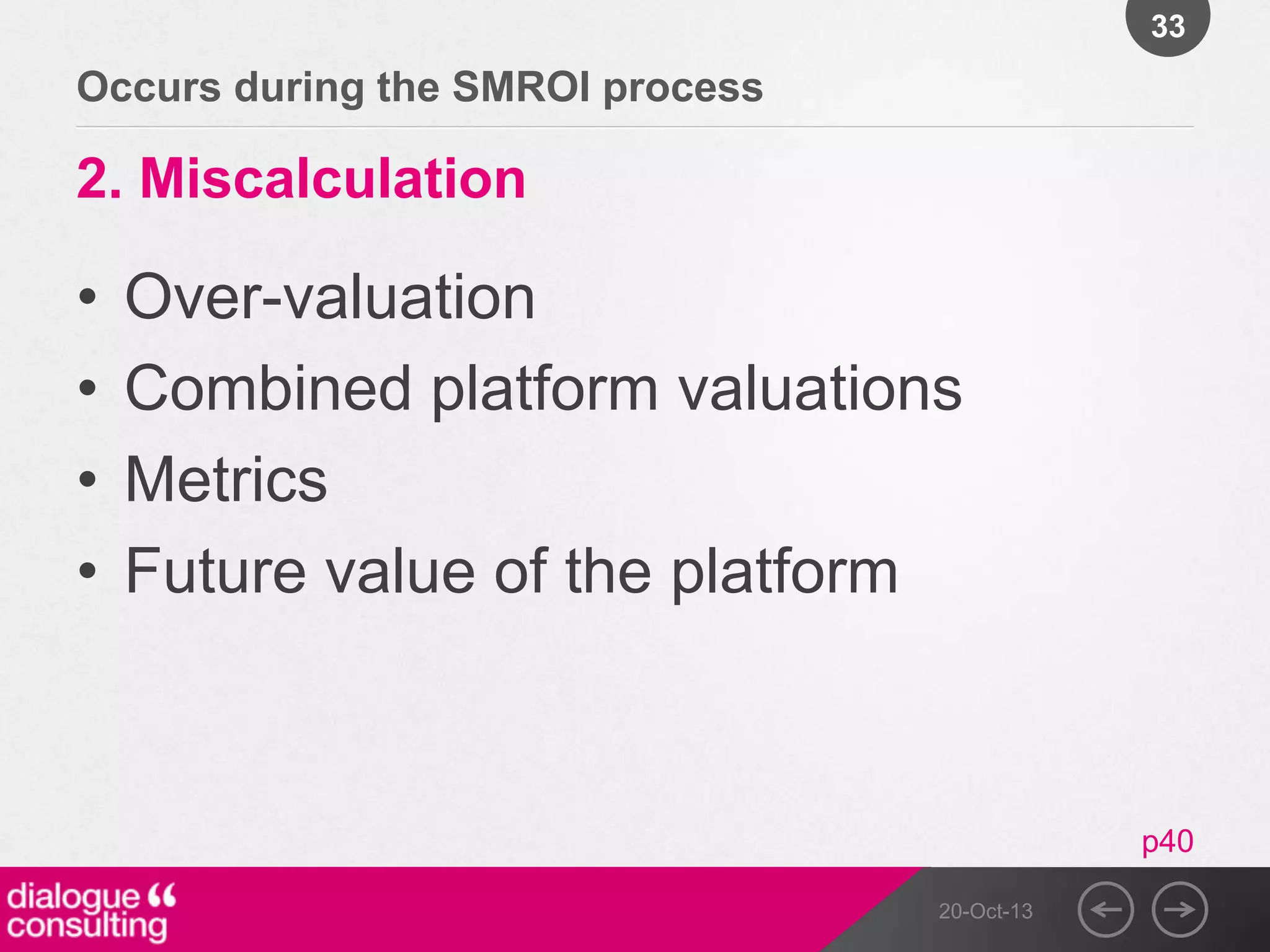
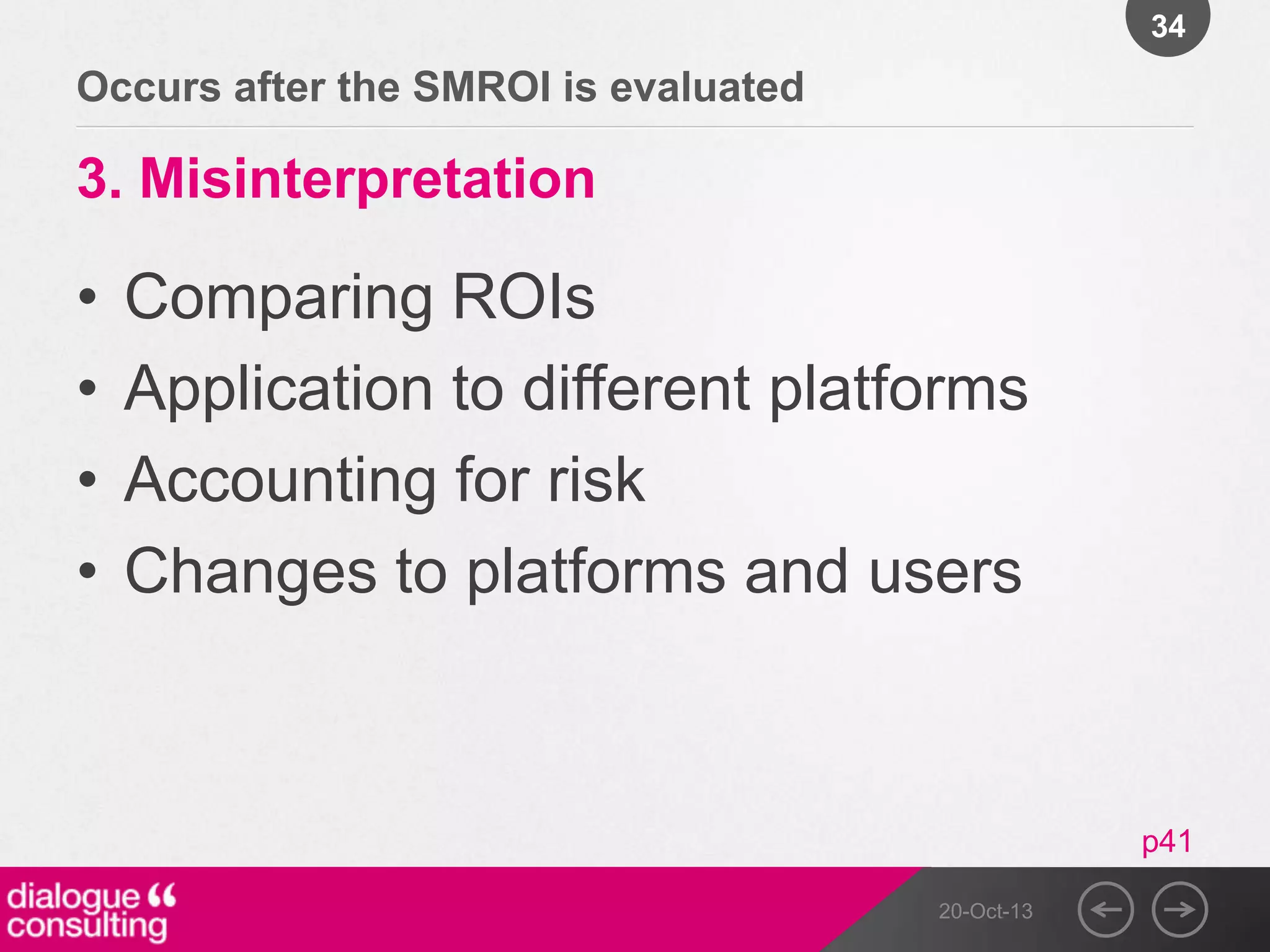
√Σπμ
(!!!11!!1!)
8

Primer: stats and numbers.

20-Oct-13
9

We usually estimate things. Our confidence varies.

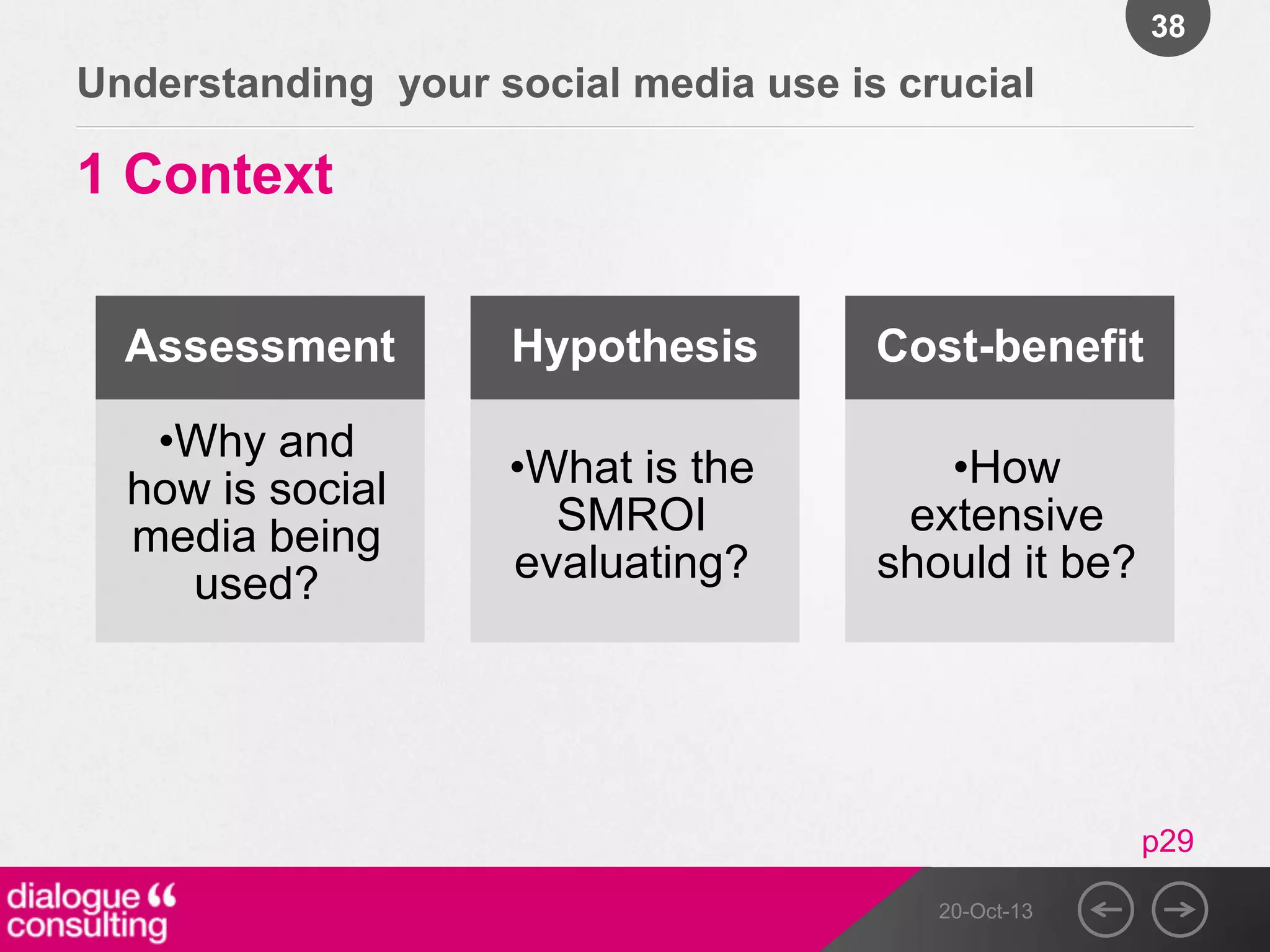
Confidence in estimations
• When we estimate, we are making
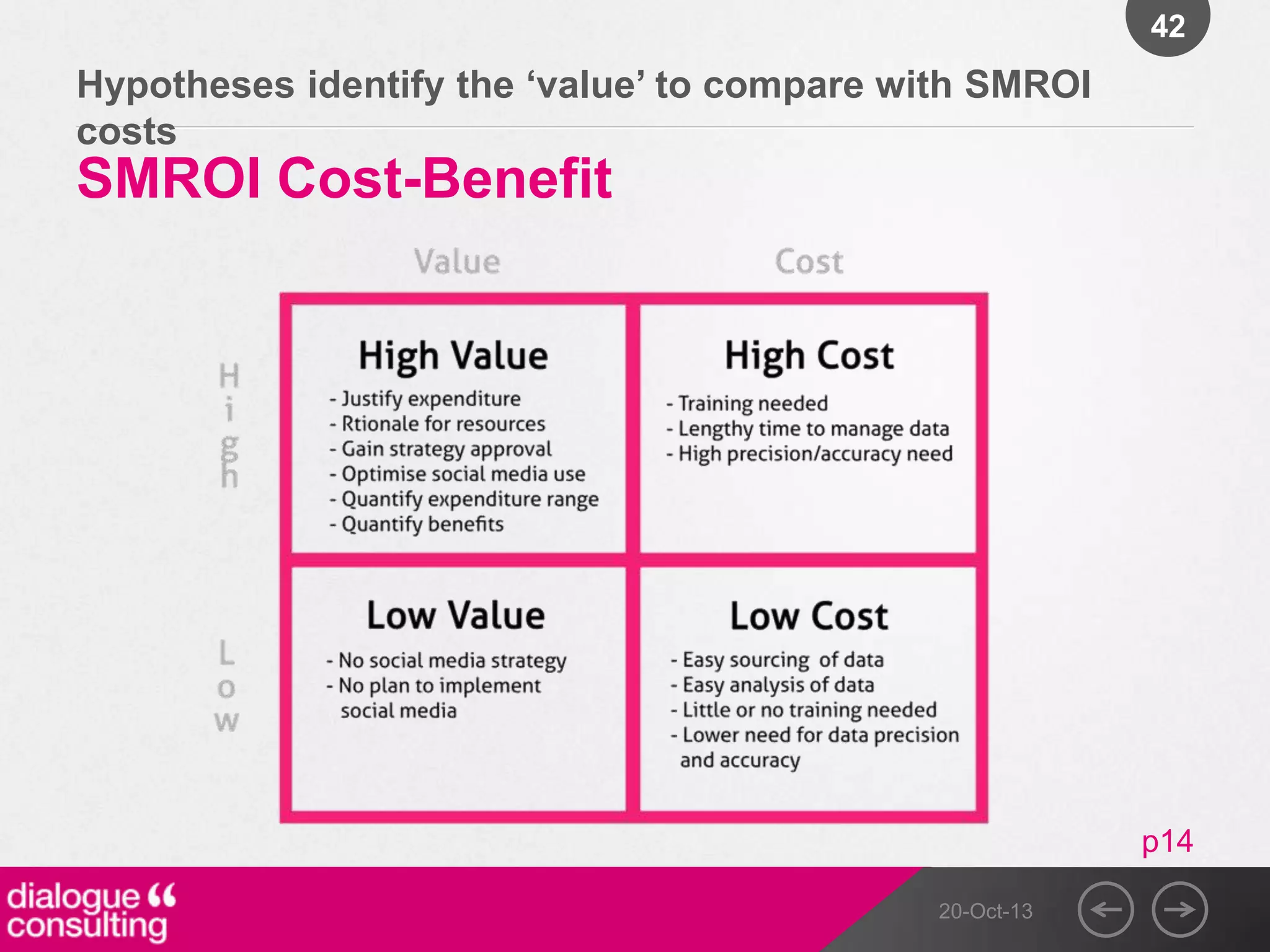
assumptions on the true population
mean.
• If you don‟t have every piece of
information (e.g. from every person), you
are estimating.
• Sometimes you are confident that your
estimate is good, others not.
20-Oct-13
10

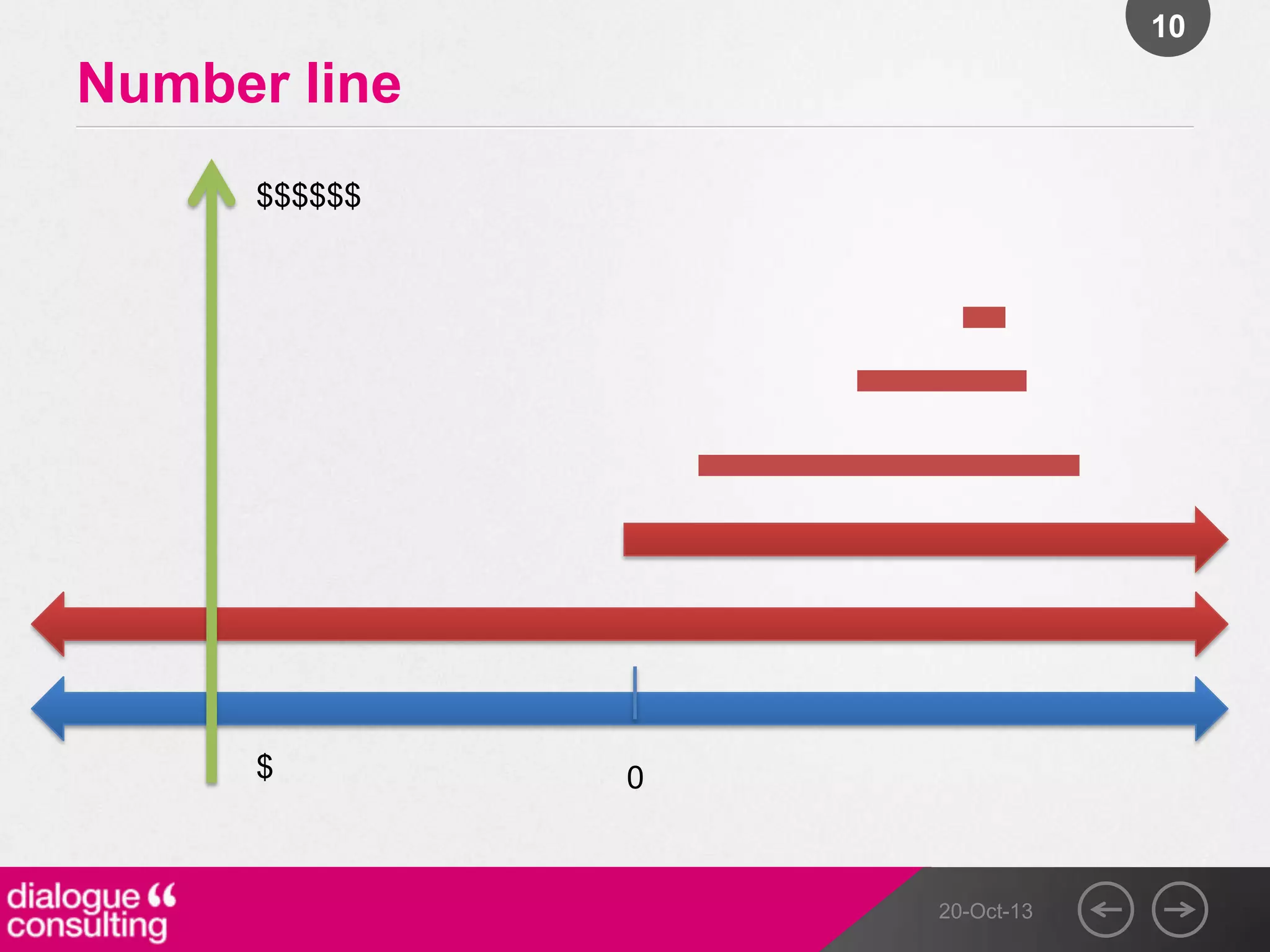
Number line
$$$$$$

$

0

20-Oct-13
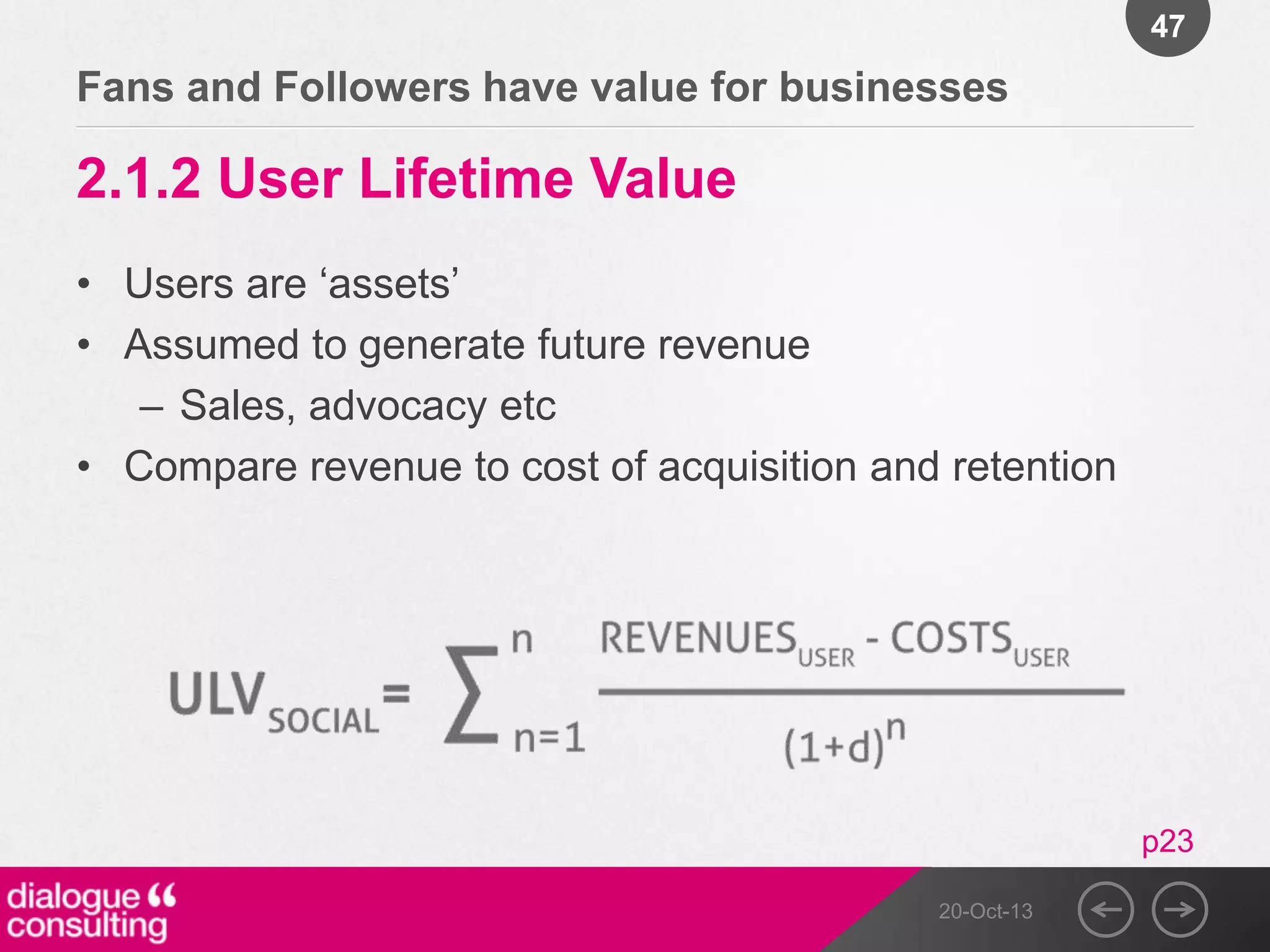
11

Measurements aim to narrow a confidence interval.

Confidence intervals
• “I am xx% confident that the true population
mean falls between yy and zz.”
• Measurements reduce uncertainty.

20-Oct-13
12

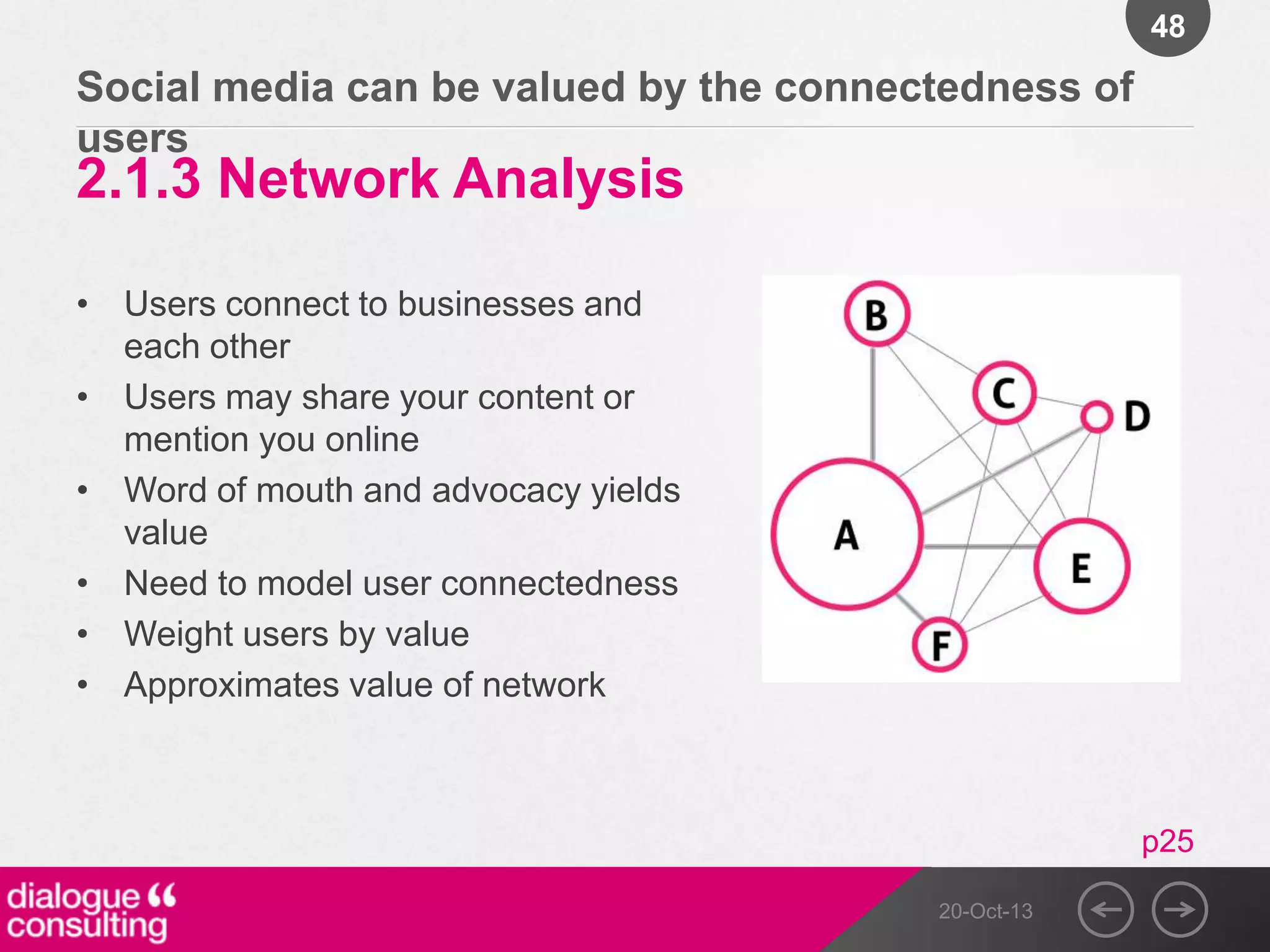
Simulation helps model uncertainty & its impact

Simulation is important
• Monte Carlo
• Basic concept:
RETURNSOCIAL = [n(conversion traffic referred from social)
* av(value sale) *
P(social actually drove them there)] +
[n(customer acq through social) *
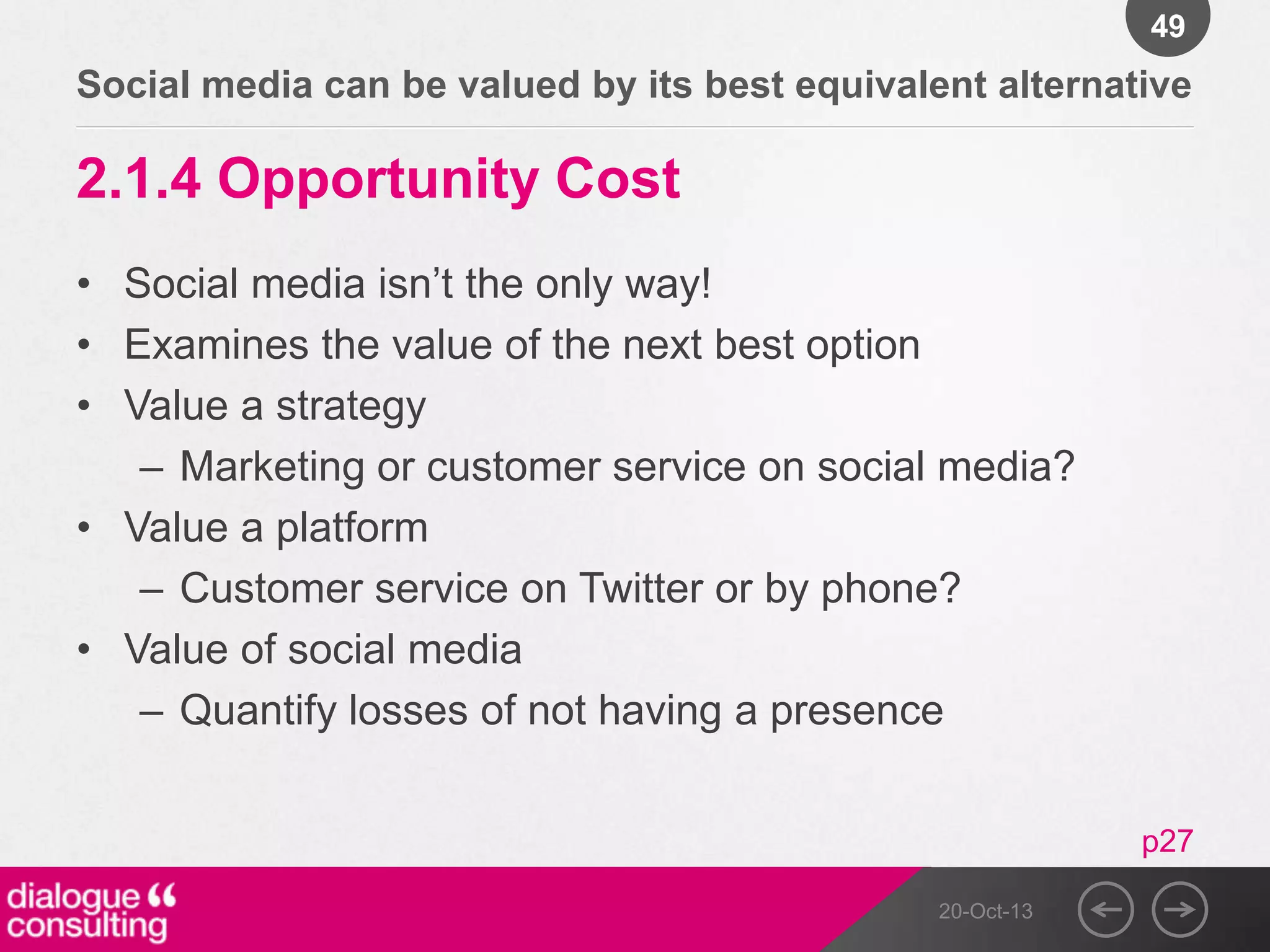
av(value of socially referred cust)]

Estimates
n(sales) == 2,000
av(val sale) = $110 (sd 25)
P(social drive) = 0.1– 0.7
n(cust acq) = 400-1200
Av(value social ref cust) = $340 (sd 90)
20-Oct-13
13

Monte Carlo simulates across many variable values

Monte Carlo Estimates
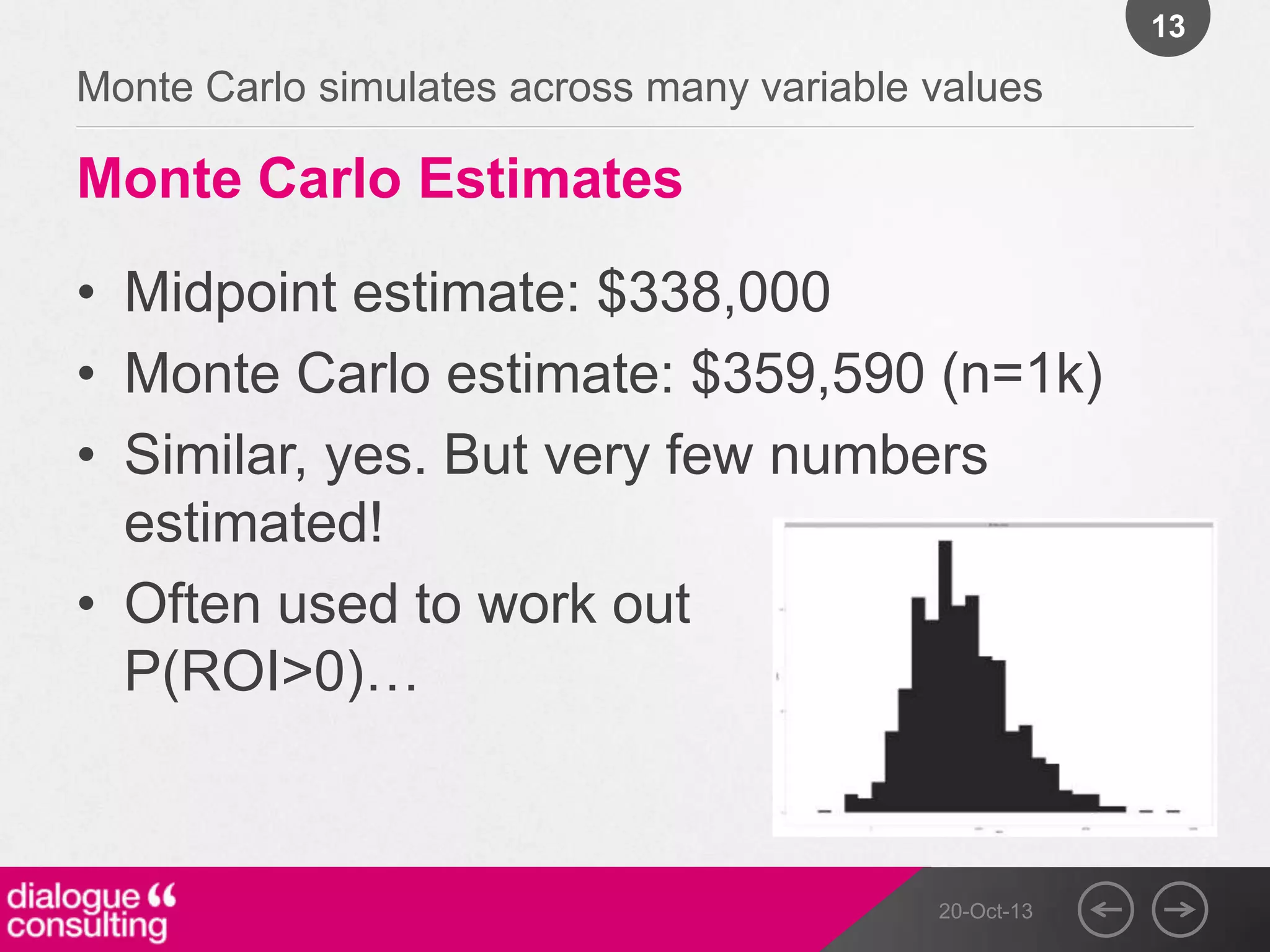
• Midpoint estimate: $338,000
• Monte Carlo estimate: $359,590 (n=1k)
• Similar, yes. But very few numbers
estimated!
• Often used to work out
P(ROI>0)…

20-Oct-13
14

The summary.

20-Oct-13
15

Ask these questions before you begin

Fast Five
1. Why are we conducting an ROI evaluation?
2. What are the costs and benefits of doing so?
3. Do we understand our social media strategy and
uses?
4. Do we have the required analysis and data
collection skills?
5. Are we aware of the SMROI principles and
framework?
p5
20-Oct-13
16

Following these principles will increase the SMROI integrity

10 key SMROI principles
1. Understand the objectives
2. Involve stakeholders
3. Understand the platforms
4. Identify which metrics and KPIs change
5. Be selective in what is valued
6. Understand the valuation process
7. Make reasonable assumptions
8. Do not over-claim or over-fit
9. Be transparent
10.Verify the result
p5
20-Oct-13
17

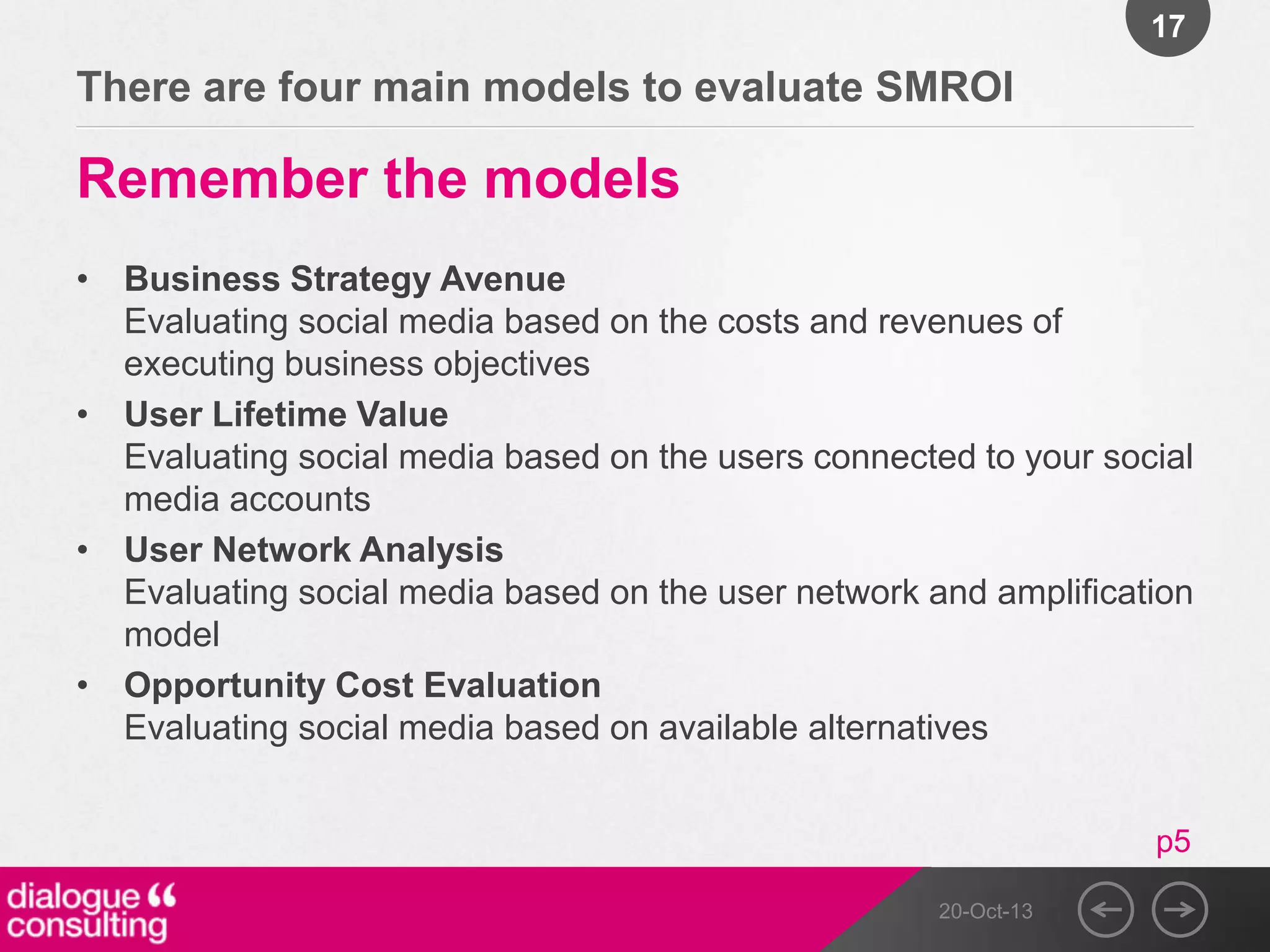
There are four main models to evaluate SMROI

Remember the models
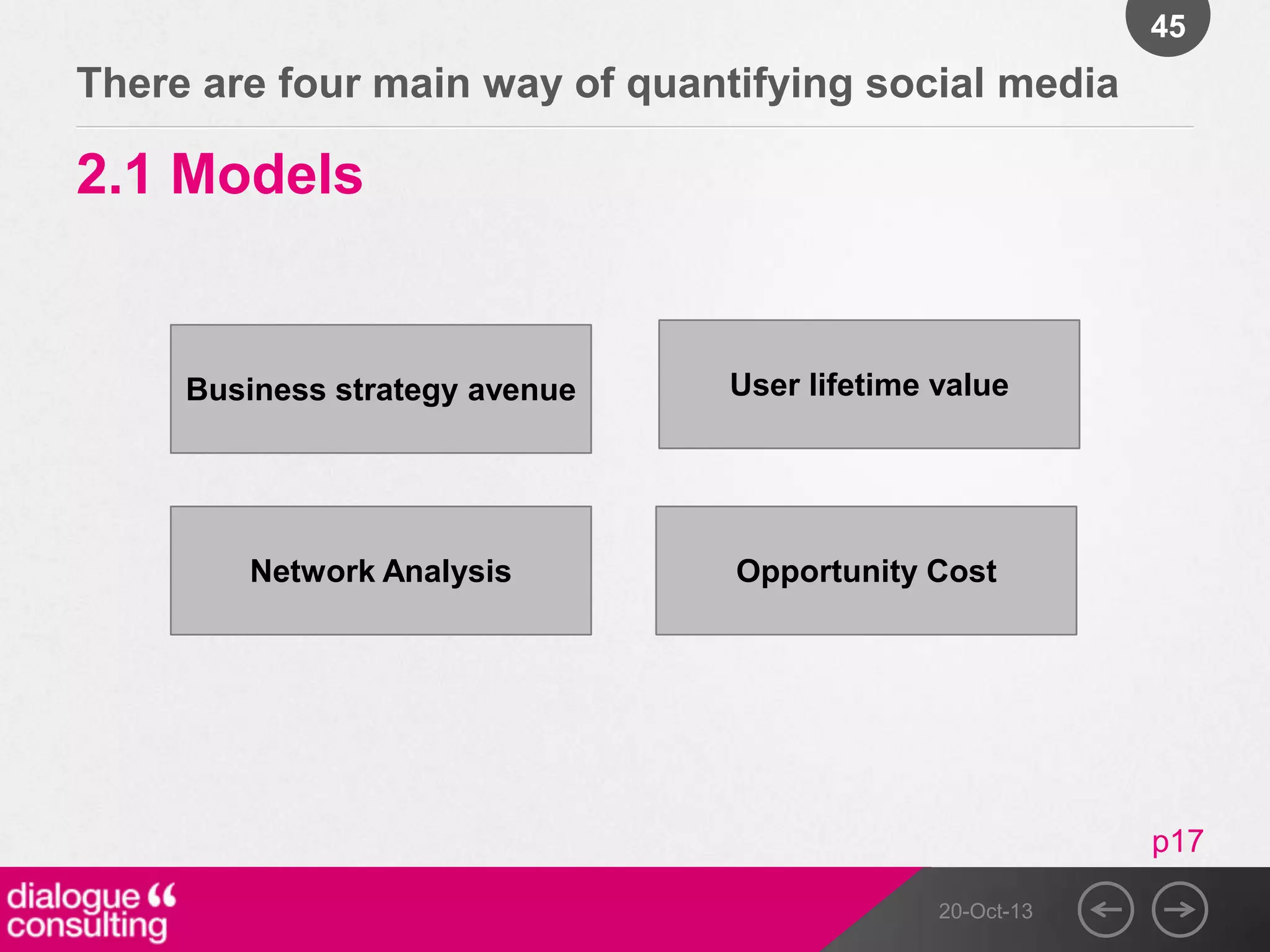
• Business Strategy Avenue
Evaluating social media based on the costs and revenues of
executing business objectives
• User Lifetime Value
Evaluating social media based on the users connected to your social
media accounts
• User Network Analysis
Evaluating social media based on the user network and amplification
model
• Opportunity Cost Evaluation
Evaluating social media based on available alternatives
p5
20-Oct-13
18

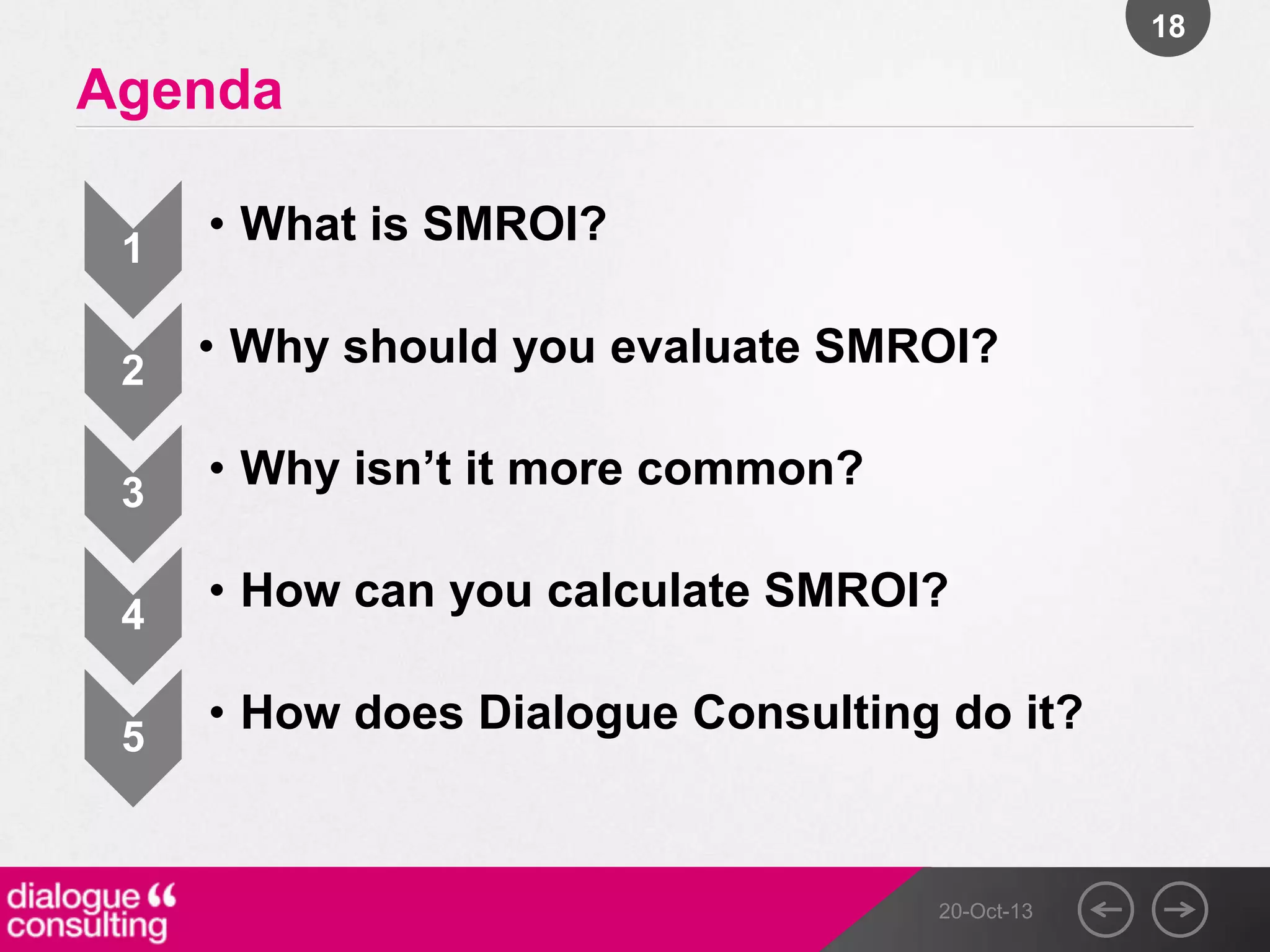
Agenda
1
2
3

4
5

• What is SMROI?
• Why should you evaluate SMROI?
• Why isn‟t it more common?
• How can you calculate SMROI?
• How does Dialogue Consulting do it?

20-Oct-13
19

1

What is SMROI?
Defining what we don‟t know.

20-Oct-13
20

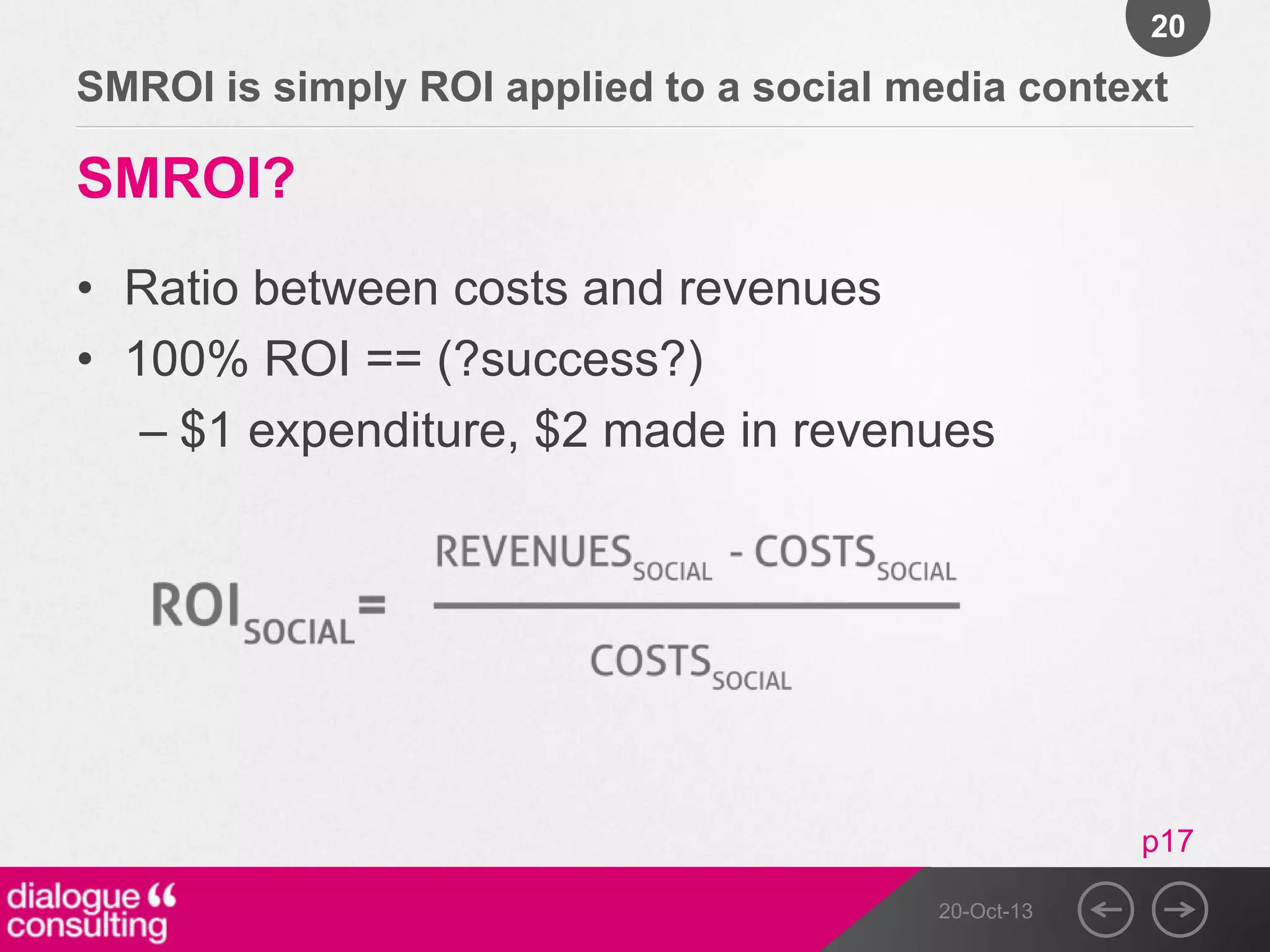
SMROI is simply ROI applied to a social media context

SMROI?
• Ratio between costs and revenues
• 100% ROI == (?success?)
– $1 expenditure, $2 made in revenues

p17
20-Oct-13
21

There are many sources of social media revenues

Revenues
Common examples include:
• Sales
• Advocacy
– Word of mouth
– User generated content
• Leads
• Donations

20-Oct-13
22

Social media costs are more easily identified

Costs
Common examples include:
• Personnel
• Social media budgets e.g. Facebook Ads
• Time
• Hardware
• Software
• Other resources

20-Oct-13
23

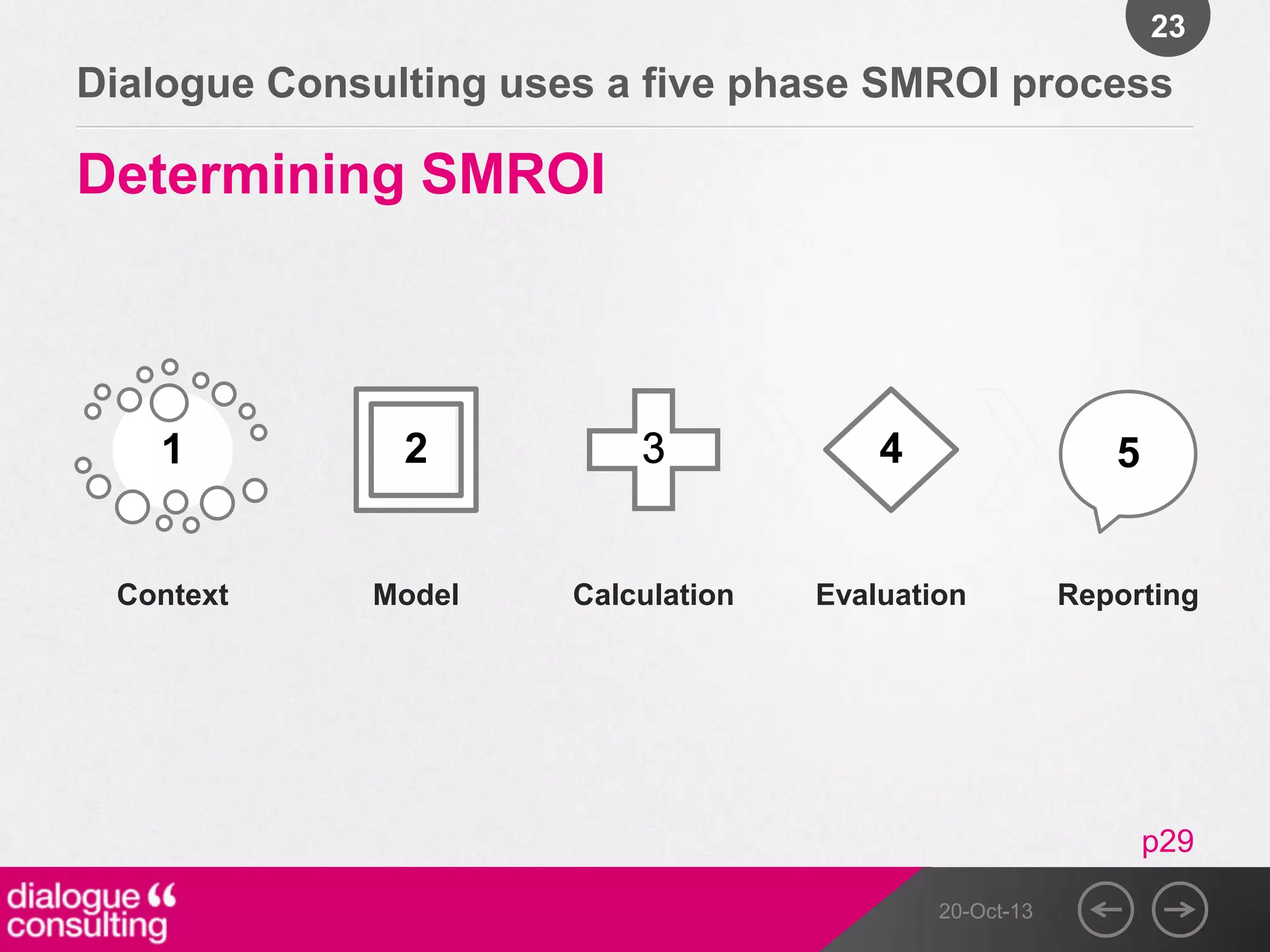
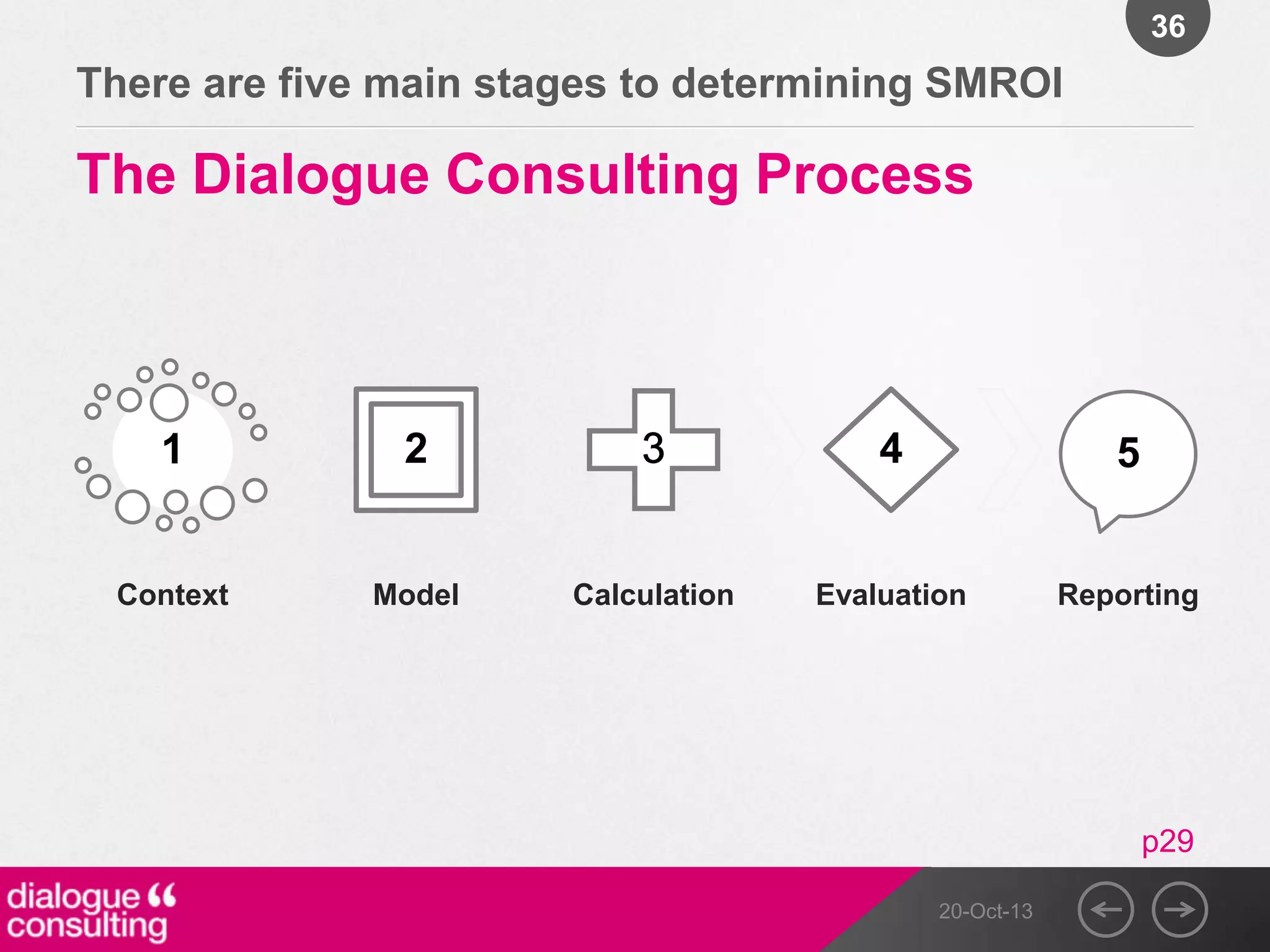
Dialogue Consulting uses a five phase SMROI process

Determining SMROI

1

2

Context

Model

4

Calculation

5

Evaluation

Reporting

p29
20-Oct-13
24

2

Why evaluate
The business case.
SMROI?

20-Oct-13
25

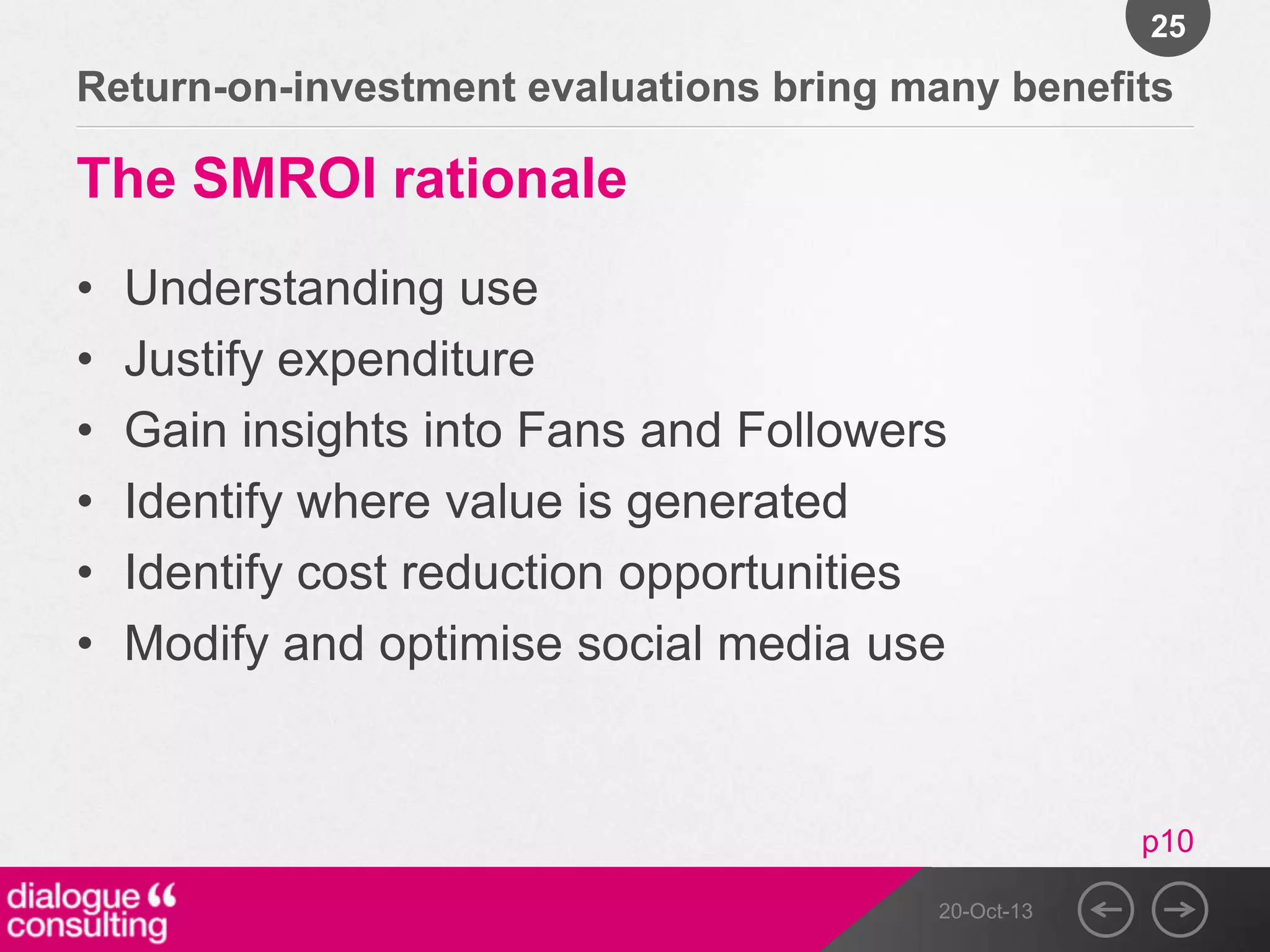
Return-on-investment evaluations bring many benefits

The SMROI rationale
•
•
•
•
•
•

Understanding use
Justify expenditure
Gain insights into Fans and Followers
Identify where value is generated
Identify cost reduction opportunities
Modify and optimise social media use

p10
20-Oct-13
26

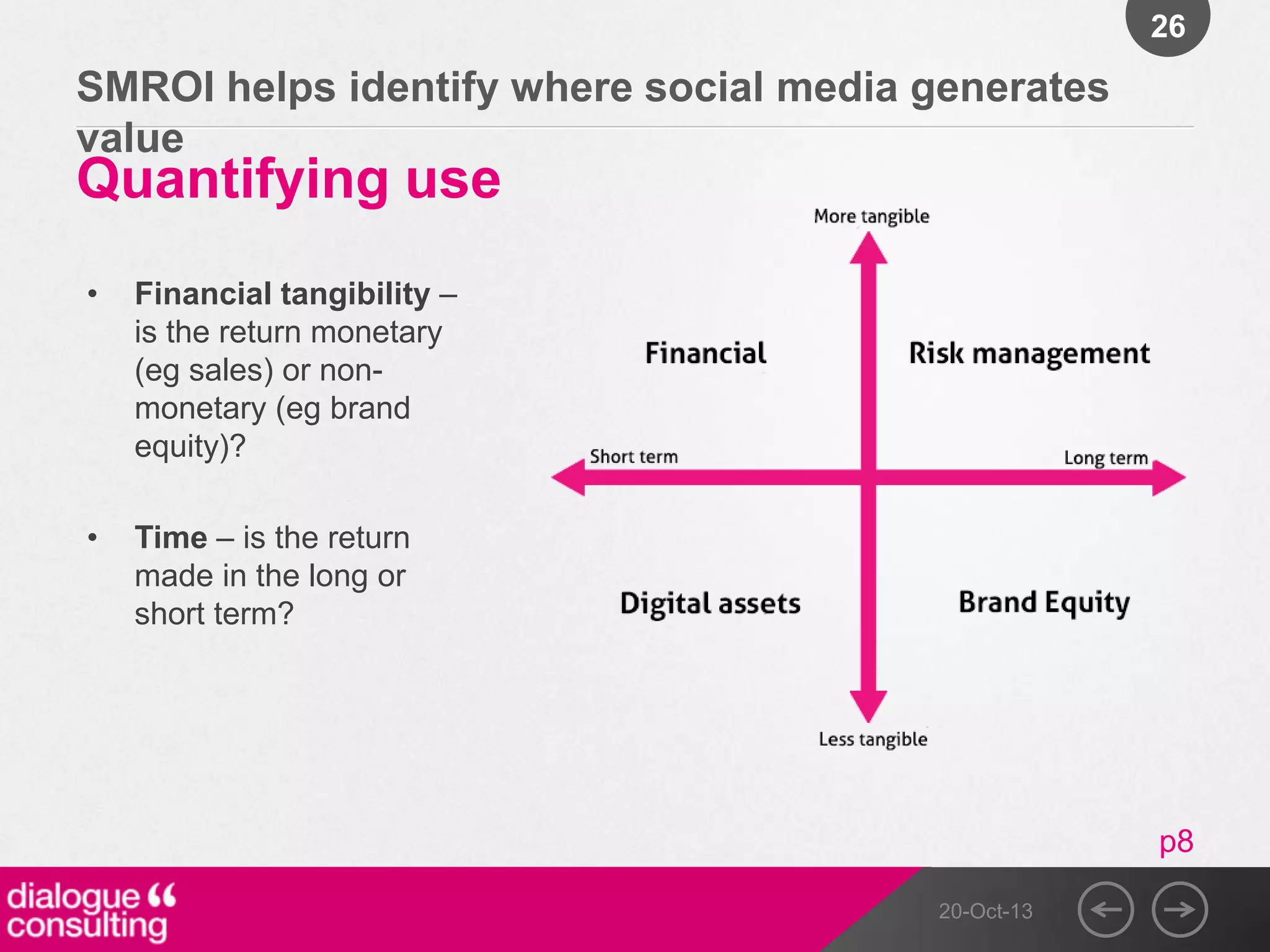
SMROI helps identify where social media generates
value

Quantifying use
•

Financial tangibility –
is the return monetary
(eg sales) or nonmonetary (eg brand
equity)?

•

Time – is the return
made in the long or
short term?

p8
20-Oct-13
27

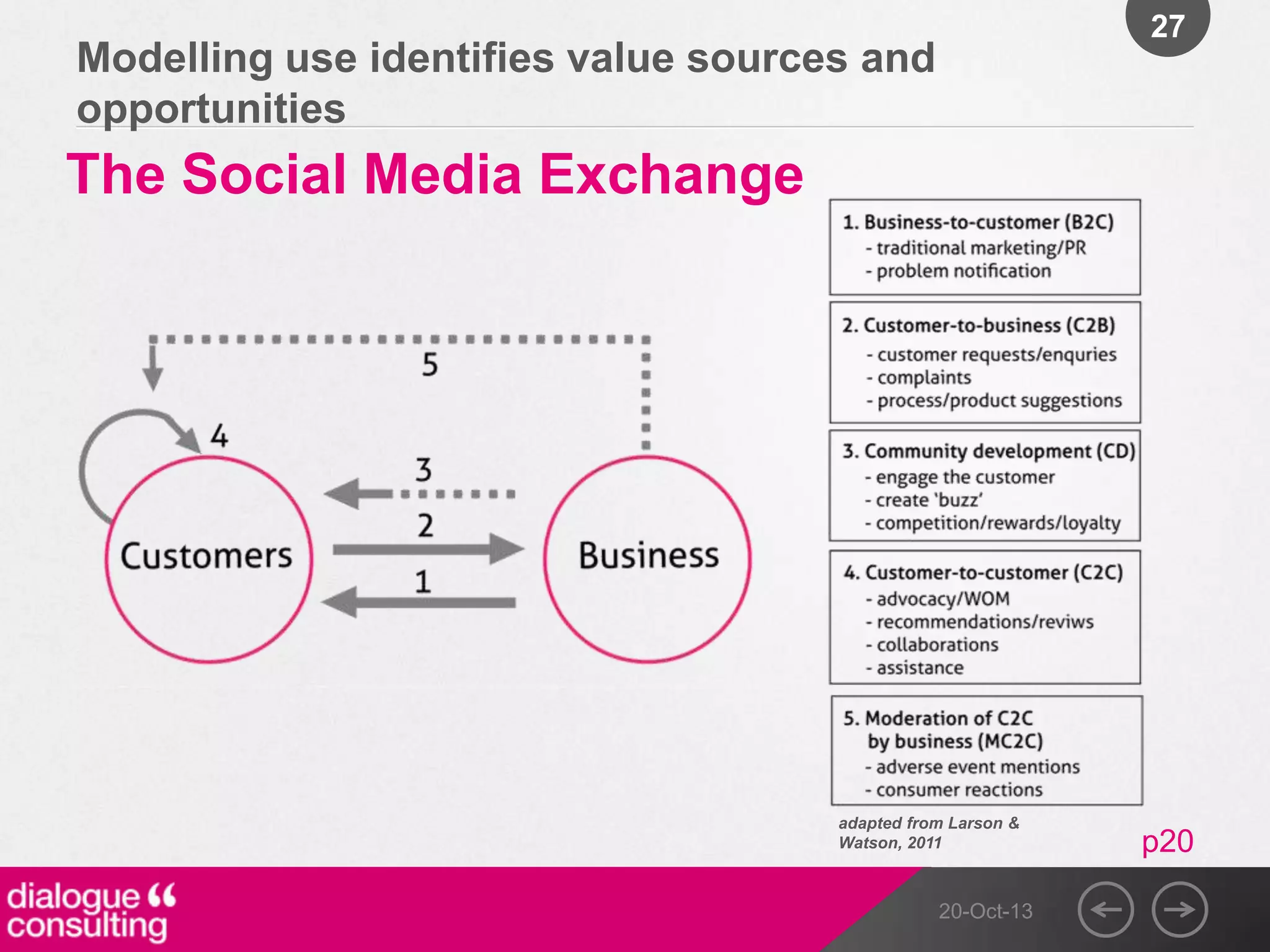
Modelling use identifies value sources and
opportunities

The Social Media Exchange

adapted from Larson &
Watson, 2011

20-Oct-13

p20
28

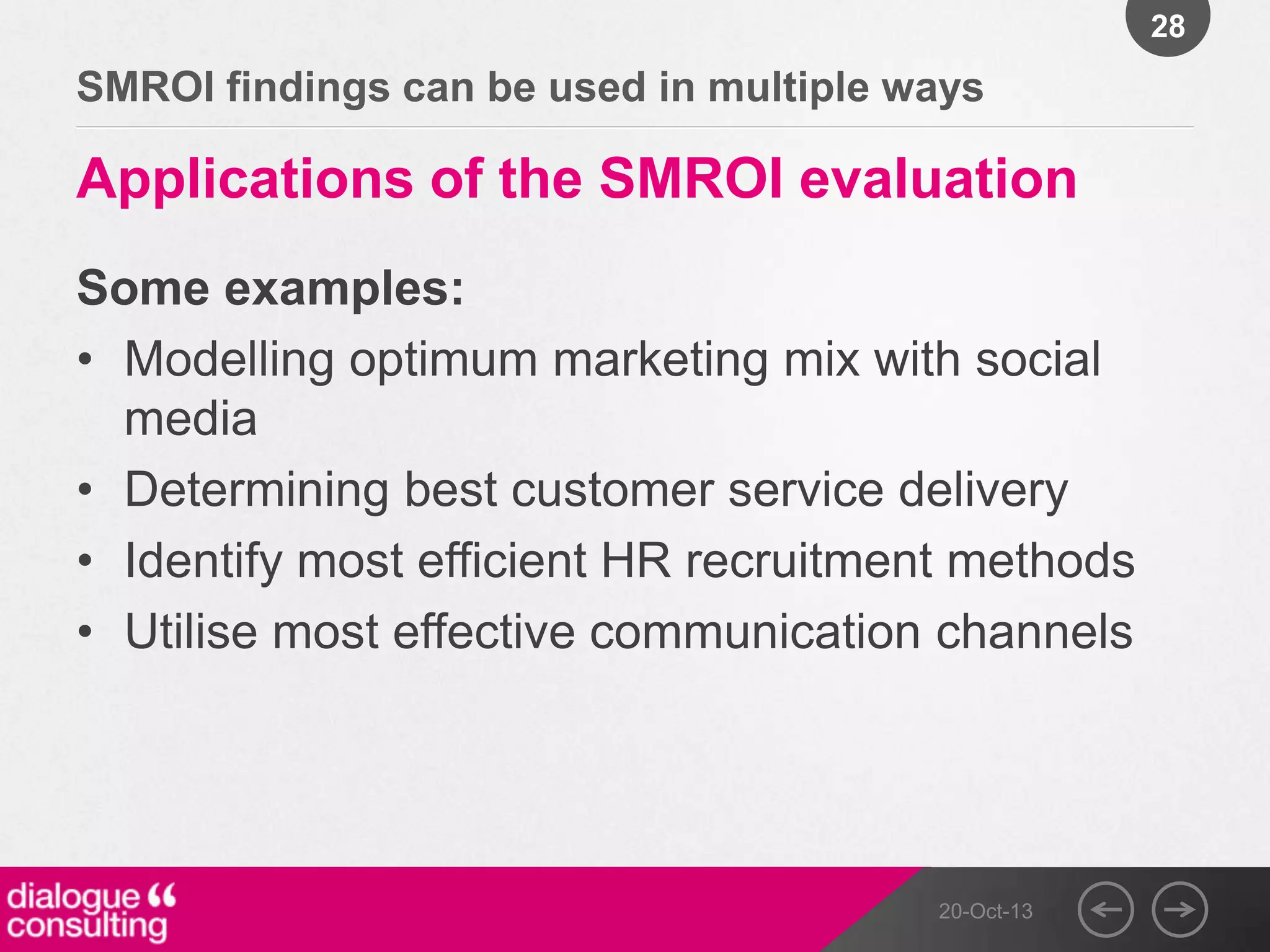
SMROI findings can be used in multiple ways

Applications of the SMROI evaluation
Some examples:
• Modelling optimum marketing mix with social
media
• Determining best customer service delivery
• Identify most efficient HR recruitment methods
• Utilise most effective communication channels

20-Oct-13
29

3

Why isn‟t it more
The usual suspects.
common?

20-Oct-13
30

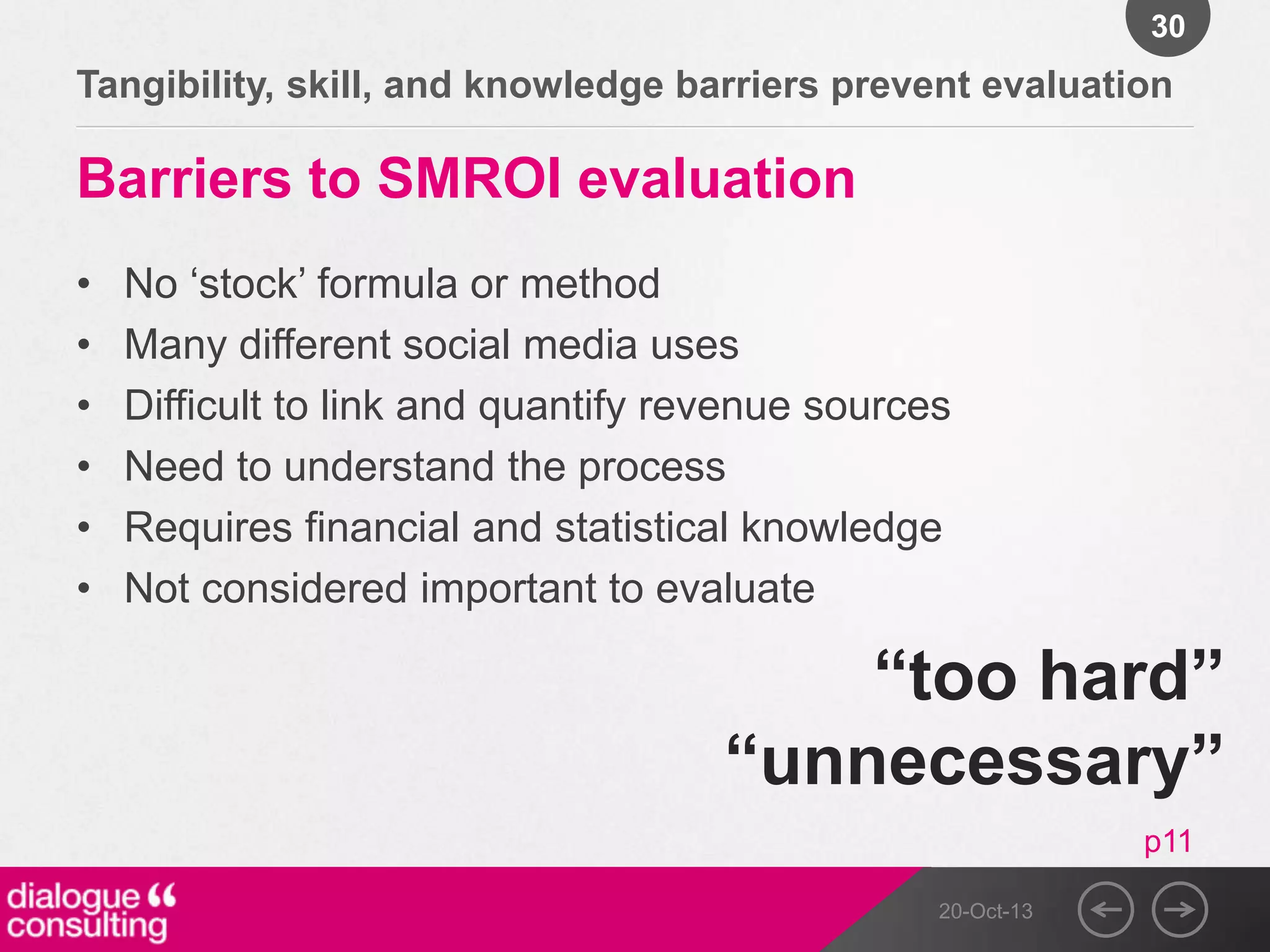
Tangibility, skill, and knowledge barriers prevent evaluation

Barriers to SMROI evaluation
•
•
•
•
•
•

No „stock‟ formula or method
Many different social media uses
Difficult to link and quantify revenue sources
Need to understand the process
Requires financial and statistical knowledge
Not considered important to evaluate

“too hard”
“unnecessary”
p11
20-Oct-13
31

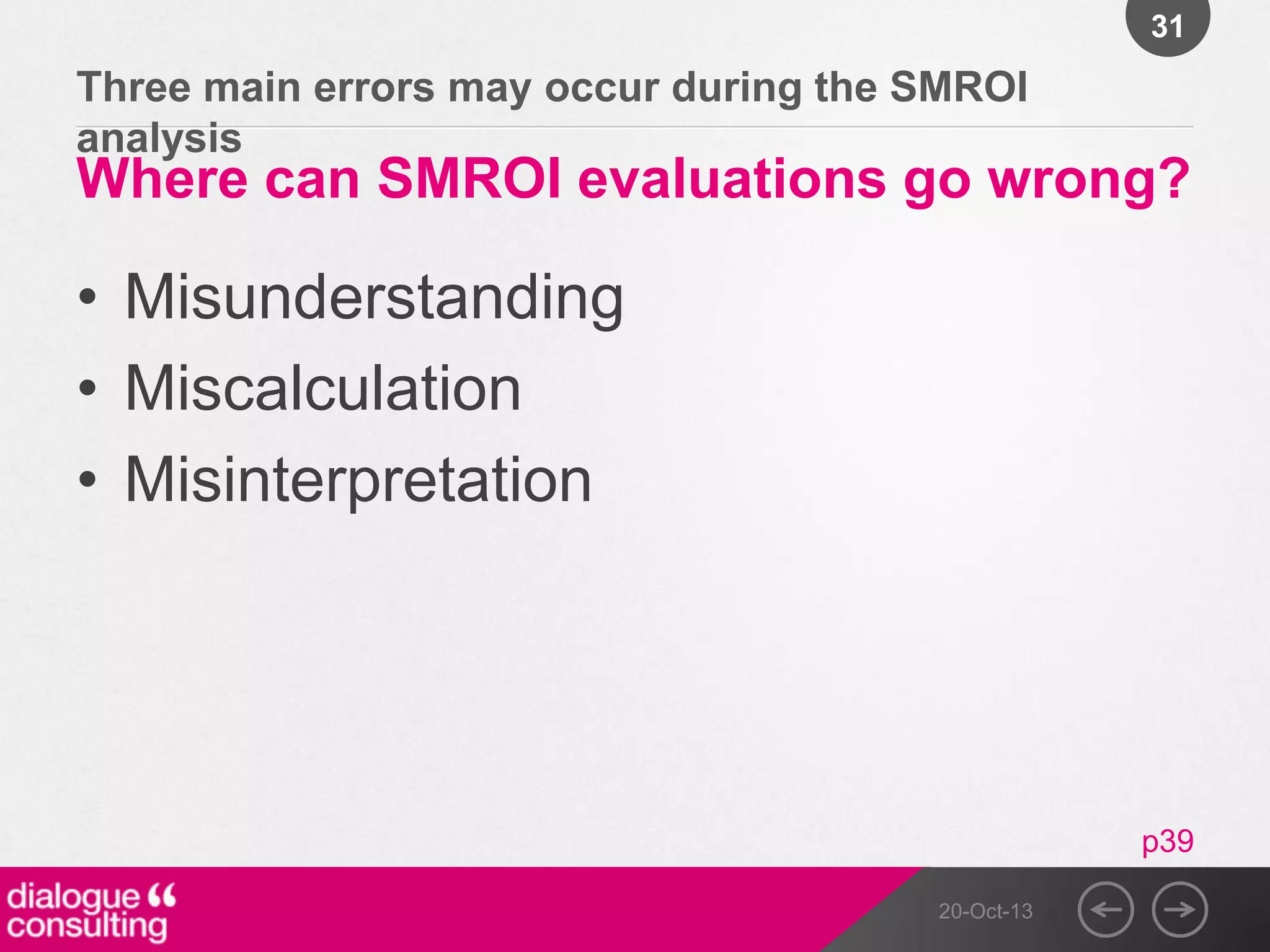
Three main errors may occur during the SMROI
analysis

Where can SMROI evaluations go wrong?

• Misunderstanding
• Miscalculation
• Misinterpretation

p39
20-Oct-13
32

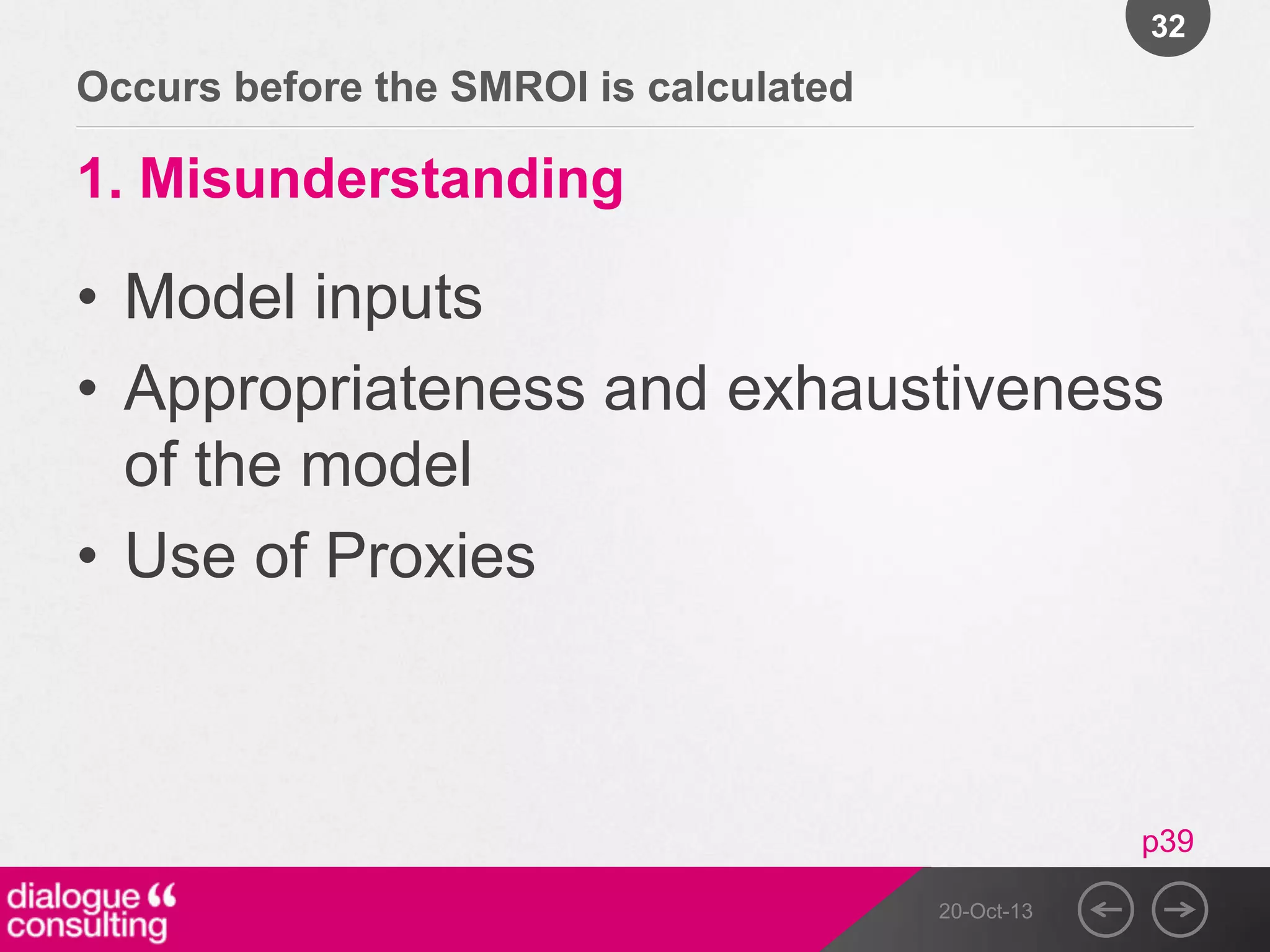
Occurs before the SMROI is calculated

1. Misunderstanding

• Model inputs
• Appropriateness and exhaustiveness
of the model
• Use of Proxies

p39
20-Oct-13
33

Occurs during the SMROI process

2. Miscalculation

•
•
•
•

Over-valuation
Combined platform valuations
Metrics
Future value of the platform

p40
20-Oct-13
34

Occurs after the SMROI is evaluated

3. Misinterpretation

•
•
•
•

Comparing ROIs
Application to different platforms
Accounting for risk
Changes to platforms and users

p41
20-Oct-13
35

4

How do you
Numbers and mathemagic.
calculate it?

20-Oct-13
36

There are five main stages to determining SMROI

The Dialogue Consulting Process

1

2

Context

Model

4

Calculation

5

Evaluation

Reporting

p29
20-Oct-13
37

It‟s impossible to measure something you don‟t understand

1 Context

A problem well stated is a
problem half solved.
- Charles Kettering

20-Oct-13
38

Understanding your social media use is crucial

1 Context
Assessment

Hypothesis

Cost-benefit

•Why and
how is social
media being
used?

•What is the
SMROI
evaluating?

•How
extensive
should it be?

p29
20-Oct-13
39

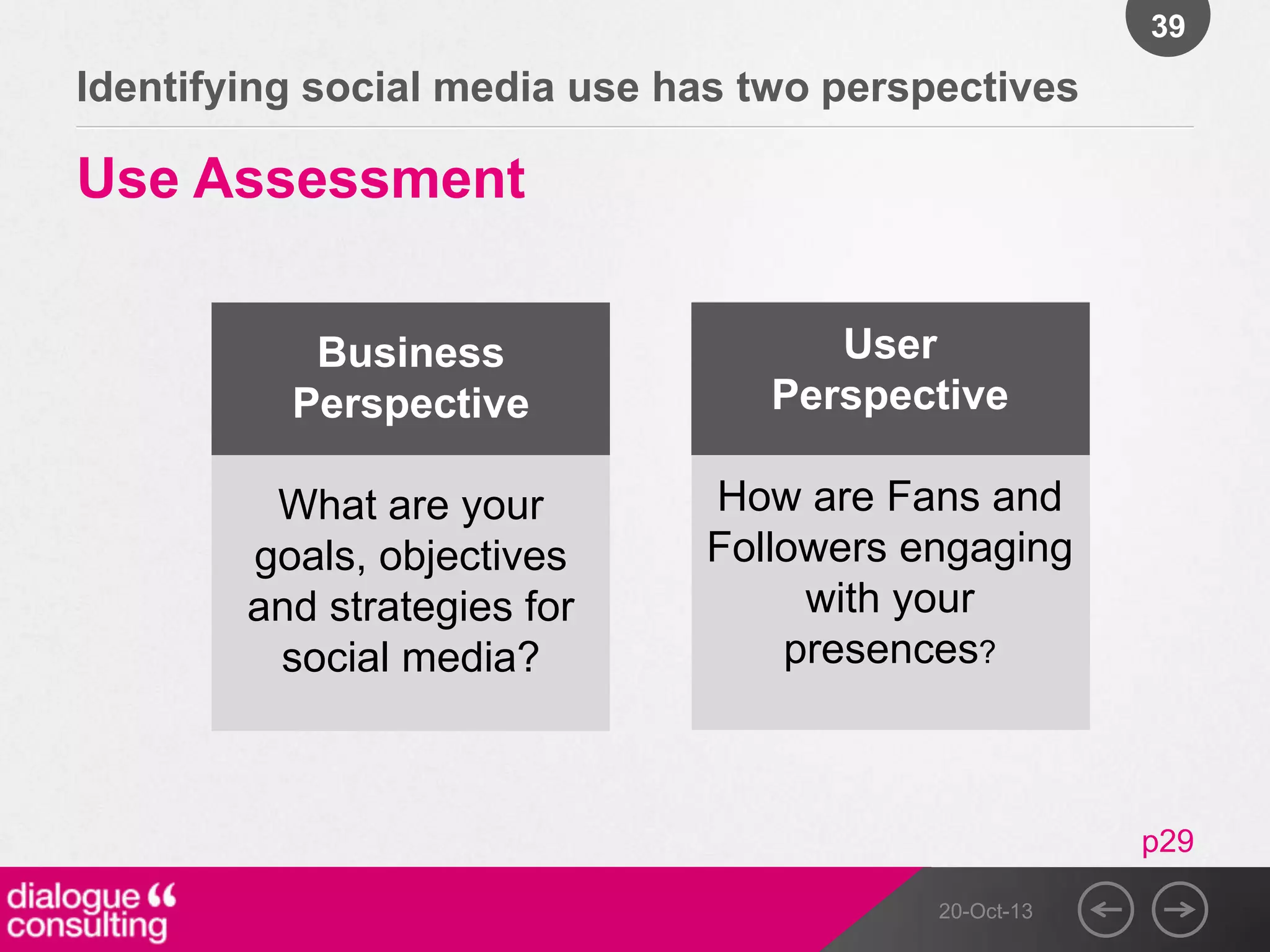
Identifying social media use has two perspectives

Use Assessment
Business
Perspective

User
Perspective

What are your
goals, objectives
and strategies for
social media?

How are Fans and
Followers engaging
with your
presences?

p29
20-Oct-13
40

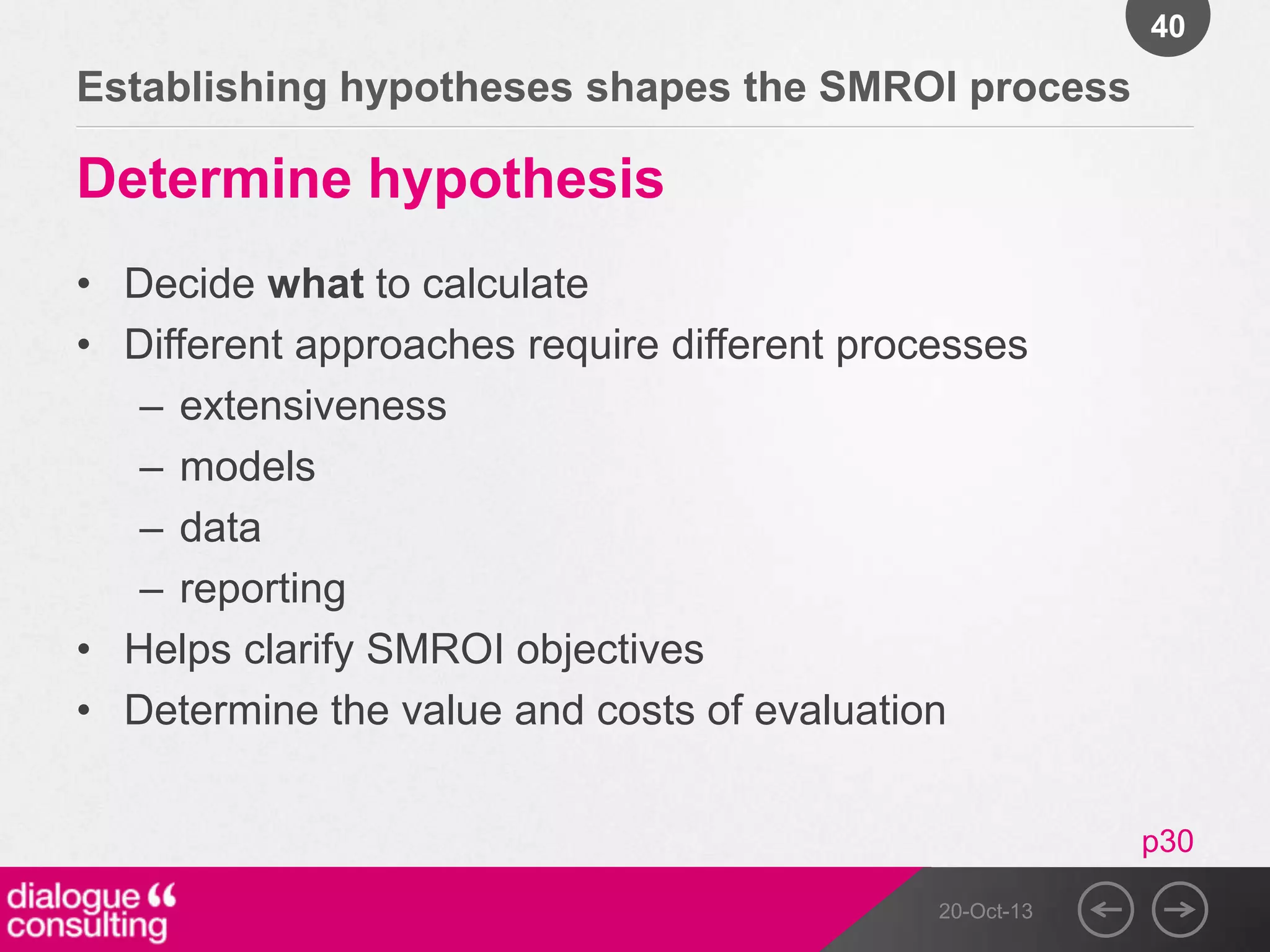
Establishing hypotheses shapes the SMROI process

Determine hypothesis
• Decide what to calculate
• Different approaches require different processes
– extensiveness
– models
– data
– reporting
• Helps clarify SMROI objectives
• Determine the value and costs of evaluation
p30
20-Oct-13
41

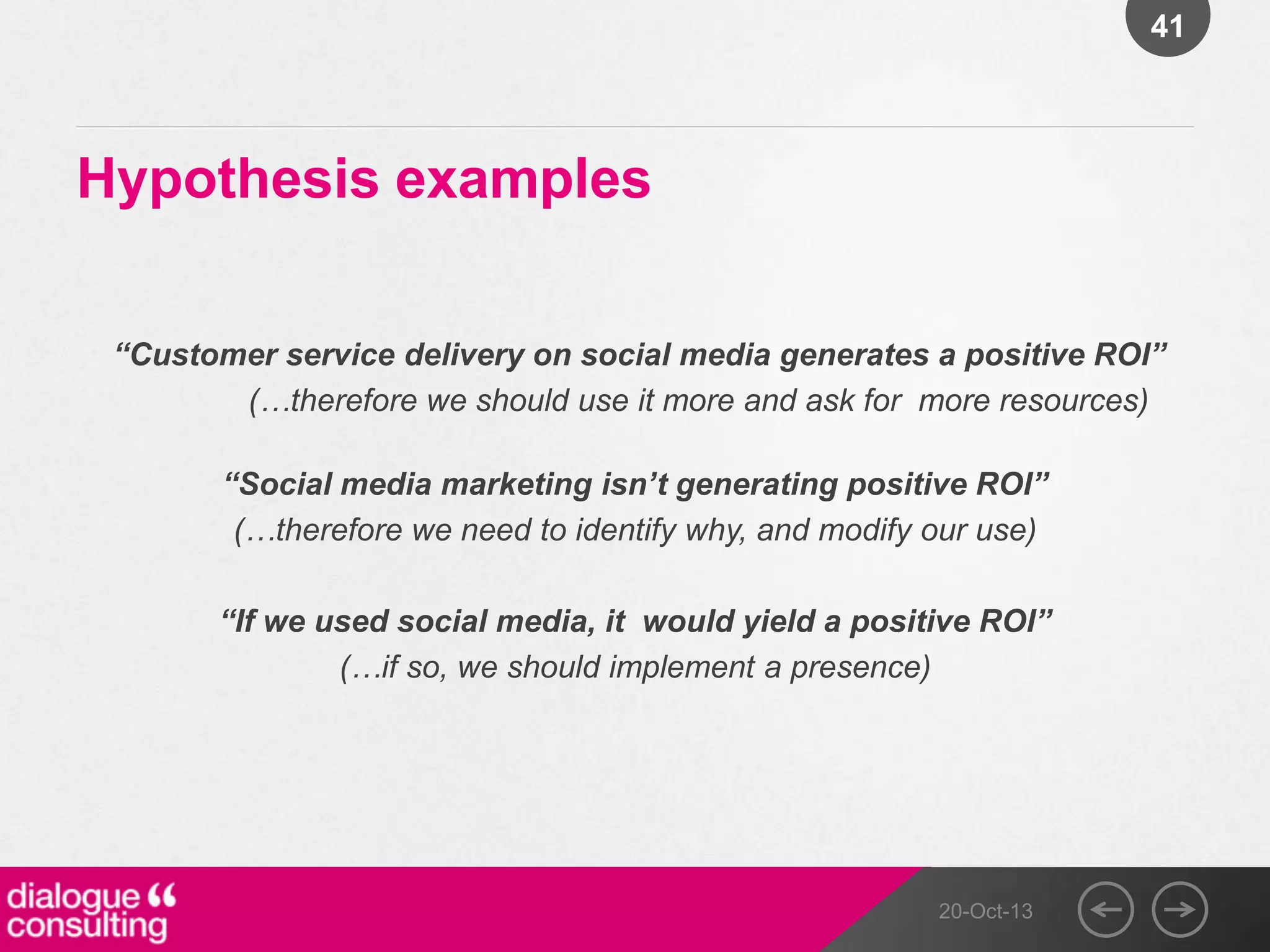
Hypothesis examples
“Customer service delivery on social media generates a positive ROI”
(…therefore we should use it more and ask for more resources)
“Social media marketing isn’t generating positive ROI”
(…therefore we need to identify why, and modify our use)
“If we used social media, it would yield a positive ROI”
(…if so, we should implement a presence)

20-Oct-13
42

Hypotheses identify the „value‟ to compare with SMROI
costs

SMROI Cost-Benefit

p14
20-Oct-13
43

SMROI extensiveness depends on resource availability

Extensiveness of SMROI

p15
20-Oct-13
44

Four main factors determine appropriate model
selection

2 Model Identification

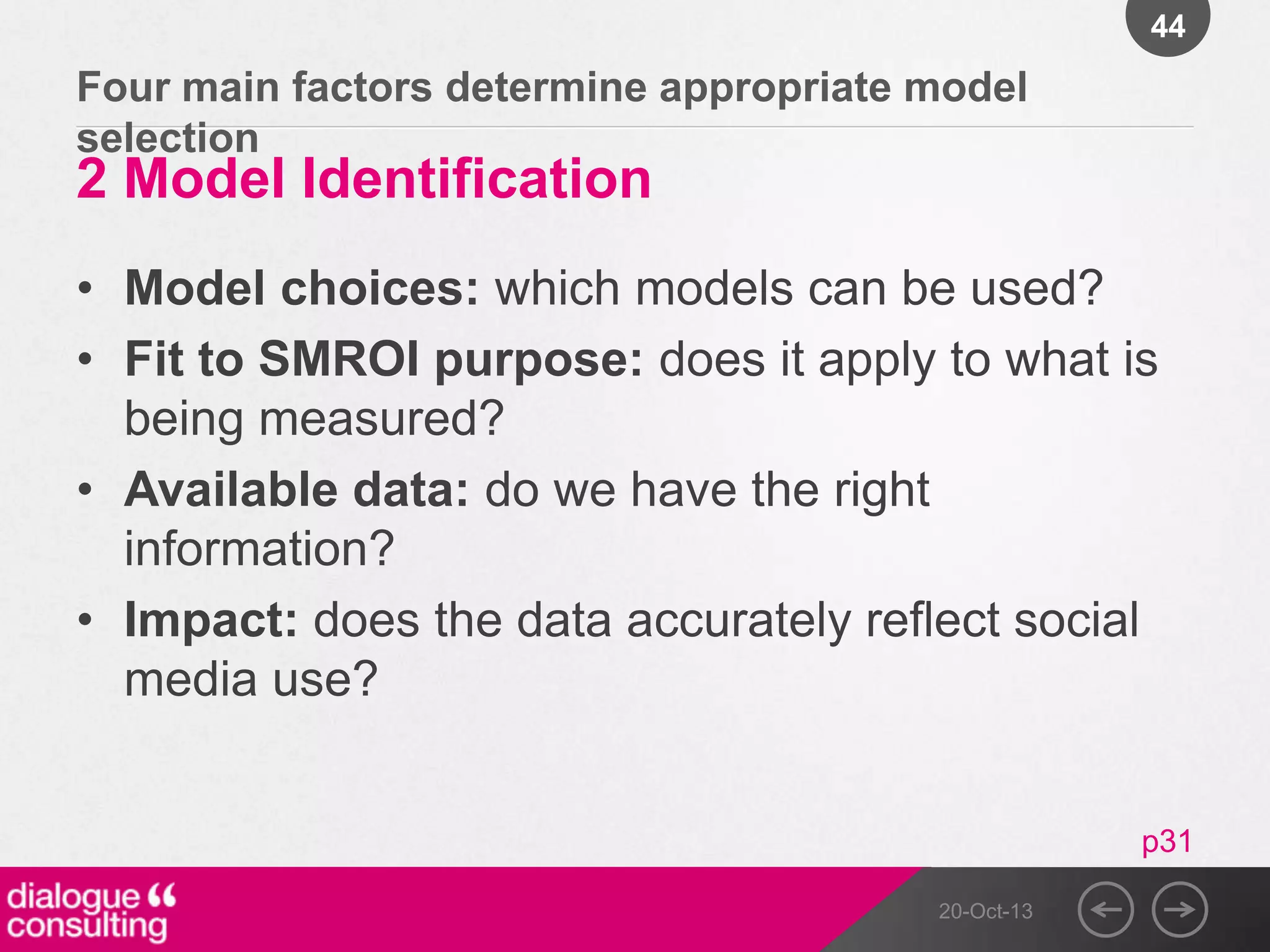
• Model choices: which models can be used?
• Fit to SMROI purpose: does it apply to what is
being measured?
• Available data: do we have the right
information?
• Impact: does the data accurately reflect social
media use?

p31
20-Oct-13
45

There are four main way of quantifying social media

2.1 Models

Business strategy avenue

User lifetime value

Network Analysis

Opportunity Cost

p17
20-Oct-13
46

Social media value comes from executing strategies online

2.1.1 Business Strategy Avenue
•

Common Examples
– Customer Service
– Marketing
– HR

•

Value and cost drivers depend on strategy
– Savings
– Revenues (sales etc)
– Time
– Resources

p20
20-Oct-13
47

Fans and Followers have value for businesses

2.1.2 User Lifetime Value
• Users are „assets‟
• Assumed to generate future revenue
– Sales, advocacy etc
• Compare revenue to cost of acquisition and retention

p23
20-Oct-13
48

Social media can be valued by the connectedness of
users

2.1.3 Network Analysis
• Users connect to businesses and
each other
• Users may share your content or
mention you online
• Word of mouth and advocacy yields
value
• Need to model user connectedness
• Weight users by value
• Approximates value of network

p25
20-Oct-13
49

Social media can be valued by its best equivalent alternative

2.1.4 Opportunity Cost
• Social media isn‟t the only way!
• Examines the value of the next best option
• Value a strategy
– Marketing or customer service on social media?
• Value a platform
– Customer service on Twitter or by phone?
• Value of social media
– Quantify losses of not having a presence
p27
20-Oct-13
50

Ensure the right data is sourced for the model and
evaluation

2.3 Data Collection
• What data is needed?
• How to collect it?
– Surveys and questionnaires
– Observation and tracking
• Reaching users
• Representative samples

p45
20-Oct-13
51

These main considerations impact on data collection

Issues with data collection
•
•
•
•
•
•

Non generalizable findings
Biased samples
Non-responsiveness
Badly phrased questions
Unusable data
Ethics

p47
20-Oct-13
52

Determine how costs and revenue factors relate to social
media

2.4 Impact
• Determines how much of an outcome relates to
social media
• Outcomes indicators are metrics which explain
costs and revenues
• Errors arise from assuming your social media
activity accounts for 100% of outcome indicators

p32
20-Oct-13
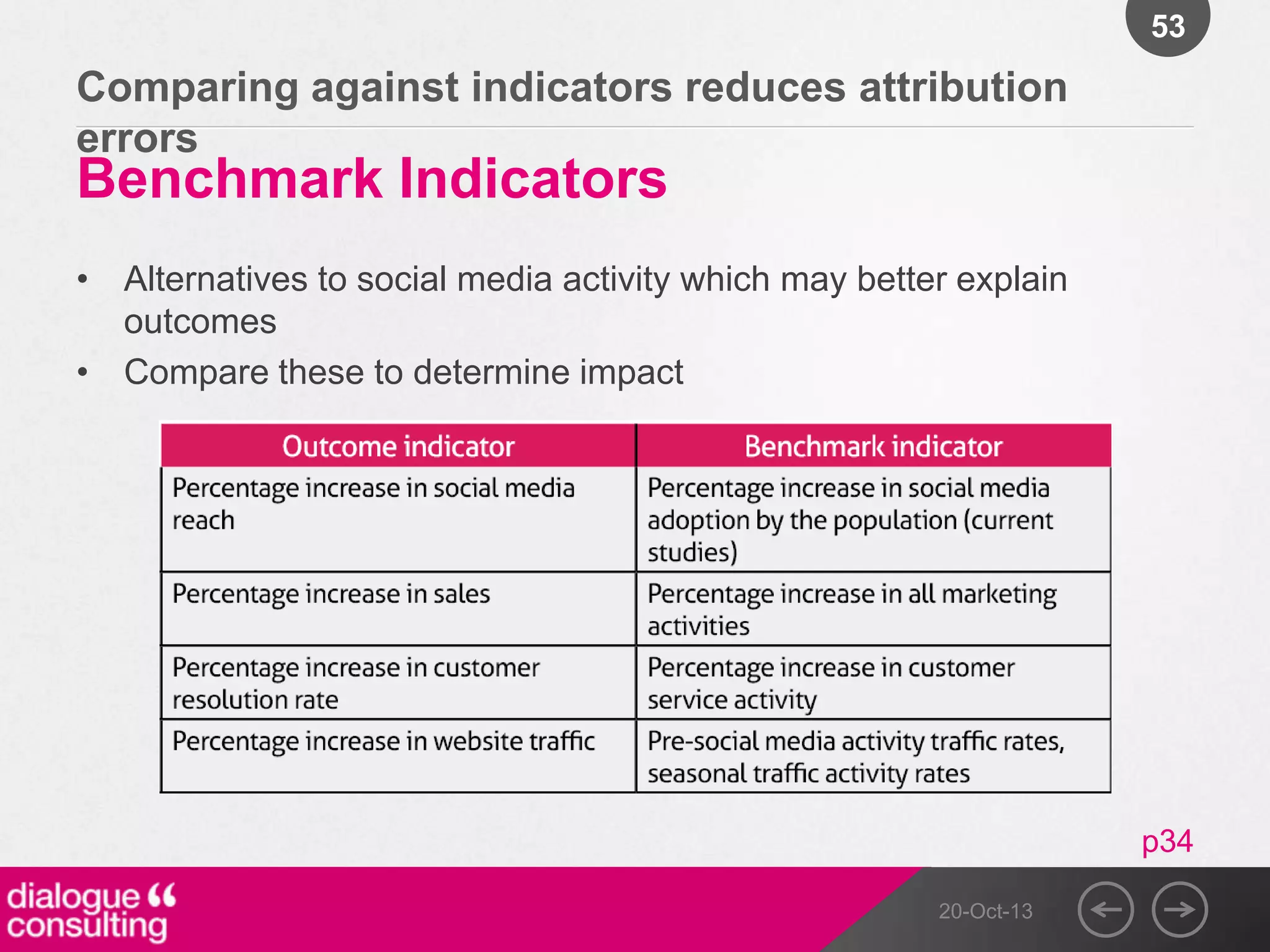
53

Comparing against indicators reduces attribution
errors

Benchmark Indicators

• Alternatives to social media activity which may better explain
outcomes
• Compare these to determine impact

p34
20-Oct-13
54

Four factors explain the difference between indicators

Determining Impact
• Deadweight: the outcome may have occurred
regardless
• Displacement: increase in social media activity may
decrease other activities
• Attribution: other factors may be contributing to the
outcome
• Drop-off: the outcome may reduce over time

p32
20-Oct-13
55

Determining SMROI should include sensitivity and
forecasting

3 Calculation
• Build the model: does it reflect your social
media use?
• Calculate the ROI figure: what is the return?
• Apply a sensitivity analysis: what are the
most influential factors?
• Forecast changes: how might the ROI change
in the future?

p35
20-Oct-13
56

Implementing findings can optimise social media use

4 Evaluation
• Compare ROI values: how did social media
perform?
• Improvements: how can social media be used
better?

p35
20-Oct-13
57

Determine how social media and other investments
compare

Compare the ROI figures
• How does investment in social media
perform against traditional channels?
• Modify social media use accordingly

p36
20-Oct-13
58

Examine current activity to increase ROI

Improve the SMROI figure
•
•
•
•
•

How to gain more positive ROI?
Remember the ratio!
Examine current processes
What could generate higher return?
Where can cost savings be achieved?

p36
20-Oct-13
59

SMROI findings must be communicated appropriately

5 Reporting
• Format: Who is it for?
• Process: How was it calculated?
• Rationale: What outcome is intended?
– Increased budget
– More resources and personnel
– Greater social media scope
• Assurance: is it accurate?
p37
20-Oct-13
60

These key areas should be covered in your report

What to include in an SMROI report
•
•
•
•
•
•
•

Who conducted the SMROI
Why the SMROI was calculated
Stakeholder involvement
SMROI evaluation methodology
Rationale of proxies, assumptions, estimates or benchmarks used
Explanations and demonstrations of calculations
Review of the sensitivity analysis and the impact of changing
variables
• Recommendations based on findings

p37
20-Oct-13
61

5

How do we do it?
A case study…

Move to part 2 of your workbook!
20-Oct-13
62

Dialogue Consulting completed an ROI evaluation

Connectro Case Study
•
•
•
•
•

Train provider for large city
Two presences
12,000 Facebook Fans
33,000 Twitter Followers
Frequent social media
posting
• Dedicated social media
team (two employees)

p4
20-Oct-13
63

Application of the SMROI procedure to Connectro

Process
1. Consultation with Connectro
2. Determine what they wanted to evaluate
– Customer service
– Marketing
3. Examine how they use social media
4. Data collection and analysis
5. Calculation and evaluation
6. Findings and recommendations
7. Reporting
p4
20-Oct-13
64

Connectro and Dialogue identified key objectives

Objectives
•
•
•
•
•
•

Justify expenditure
Identify potential value from social media
Quantify current revenues and costs
Optimise use of social media
Identify opportunities for social media use
Focus on marketing and customer service
strategies
p7
20-Oct-13
65

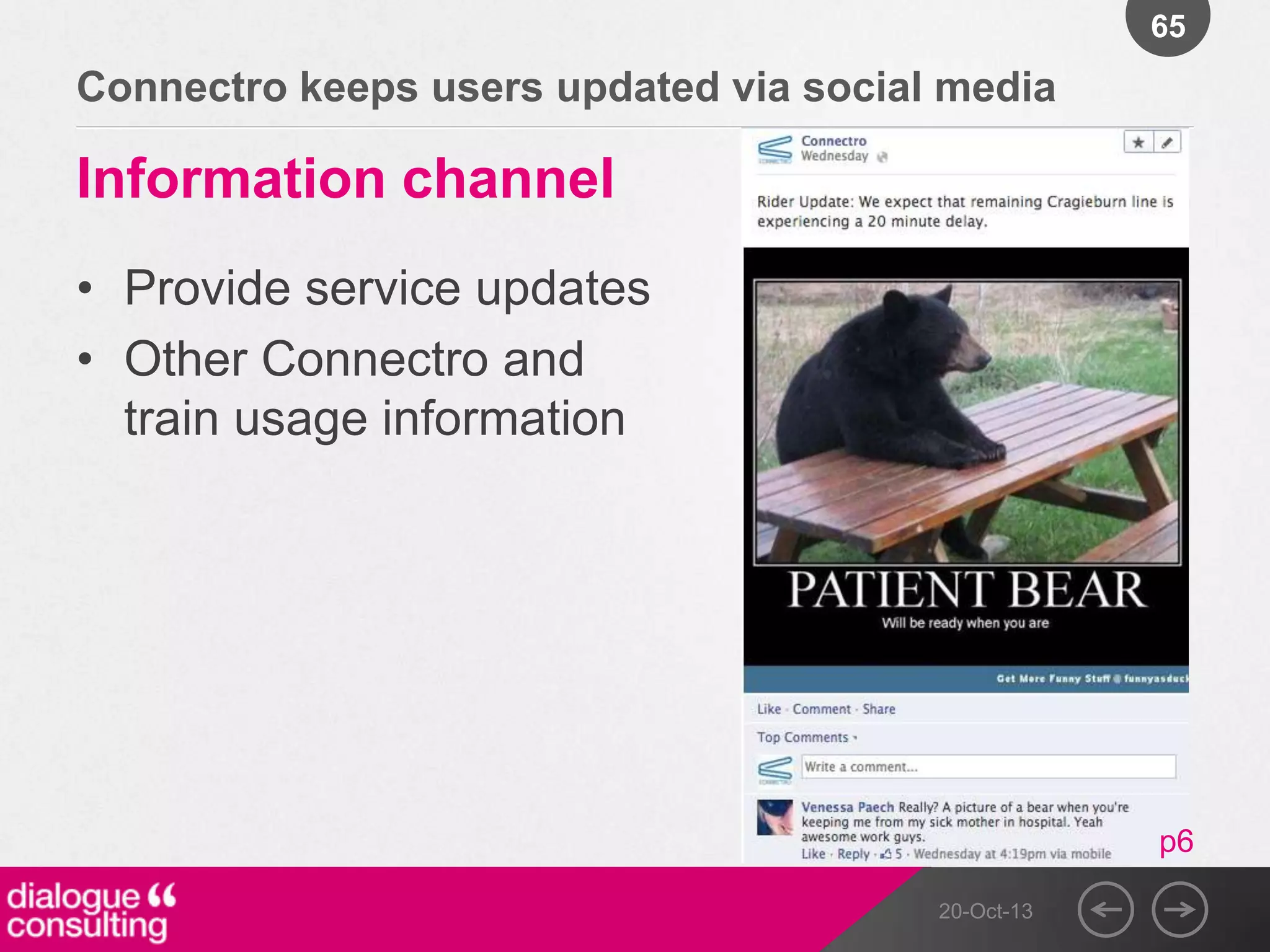
Connectro keeps users updated via social media

Information channel
• Provide service updates
• Other Connectro and
train usage information

p6
20-Oct-13
66

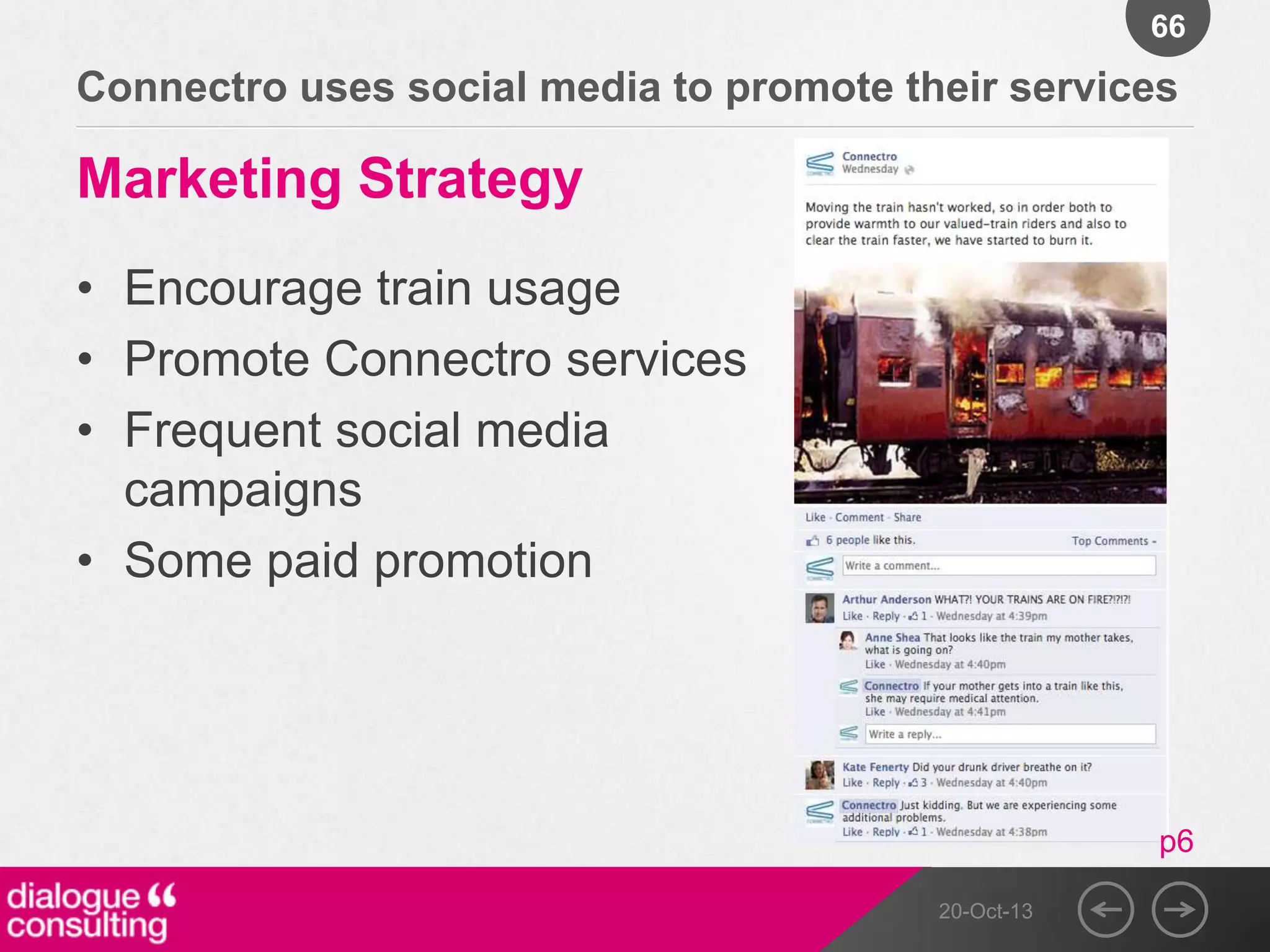
Connectro uses social media to promote their services

Marketing Strategy
• Encourage train usage
• Promote Connectro services
• Frequent social media
campaigns
• Some paid promotion

p6
20-Oct-13
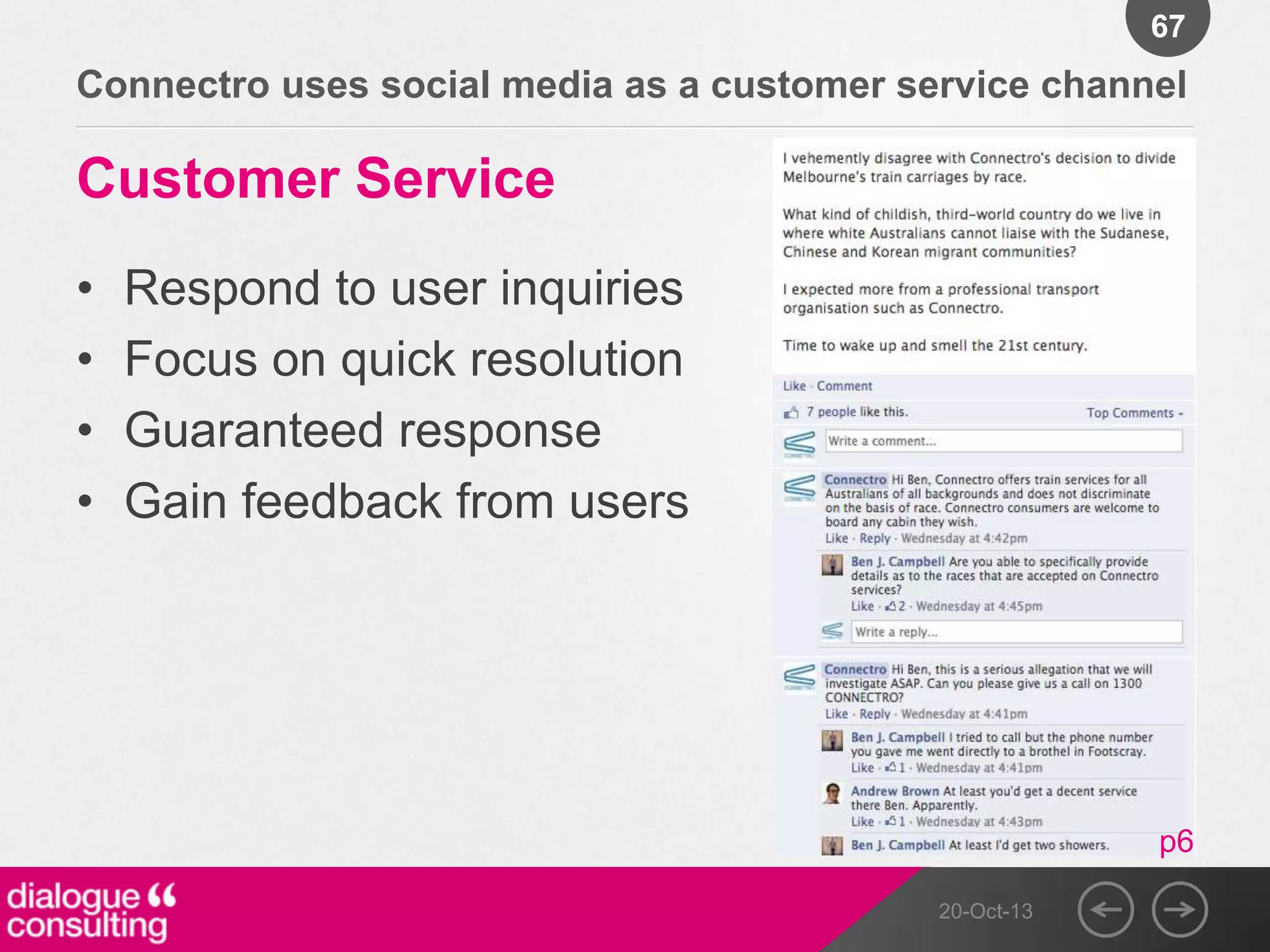
67

Connectro uses social media as a customer service channel

Customer Service
•
•
•
•

Respond to user inquiries
Focus on quick resolution
Guaranteed response
Gain feedback from users

p6
20-Oct-13
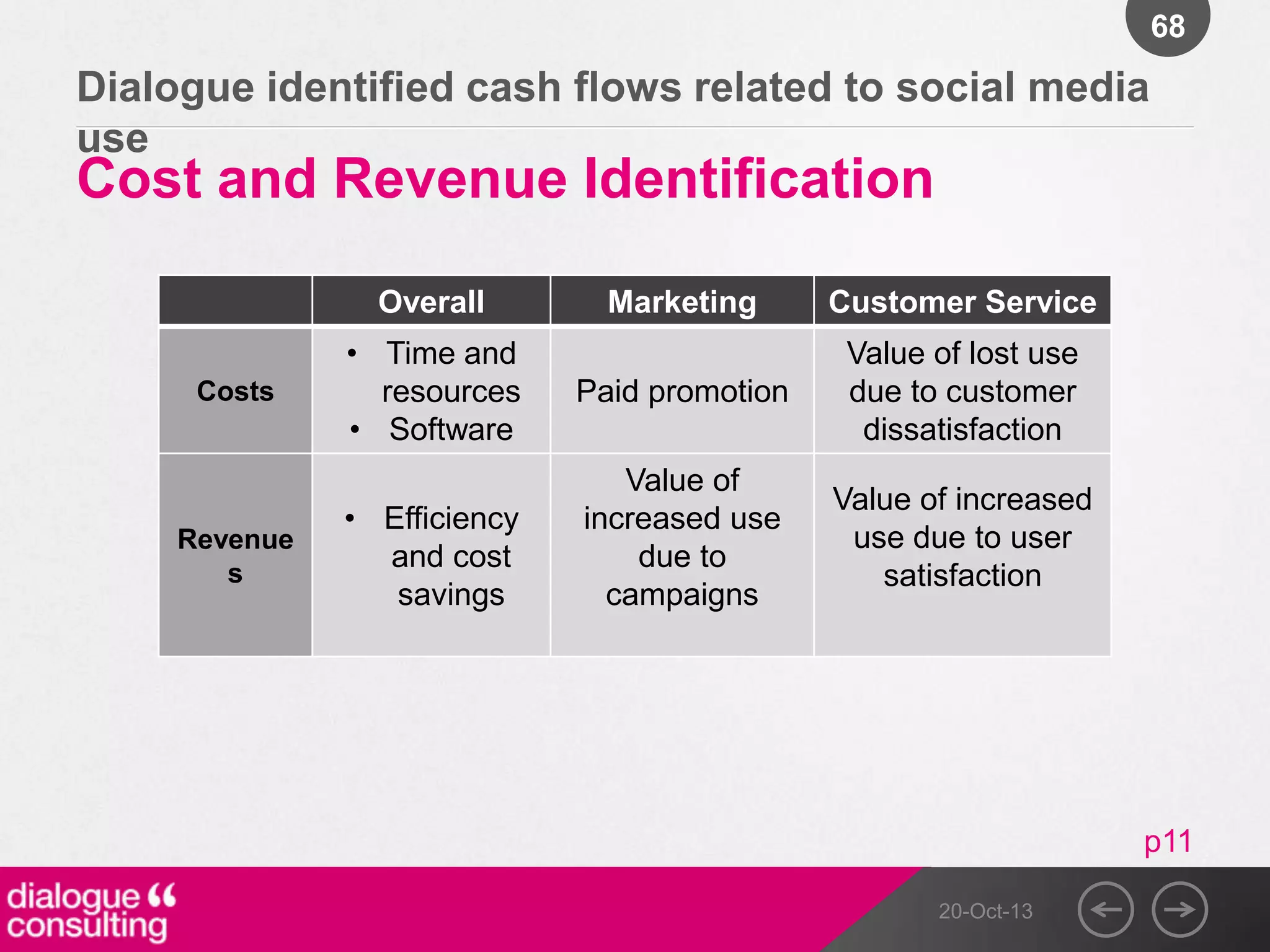
68

Dialogue identified cash flows related to social media
use

Cost and Revenue Identification
Overall
Costs

Revenue
s

• Time and
resources
• Software
• Efficiency
and cost
savings

Marketing

Customer Service

Paid promotion

Value of lost use
due to customer
dissatisfaction

Value of
increased use
due to
campaigns

Value of increased
use due to user
satisfaction

p11
20-Oct-13
69

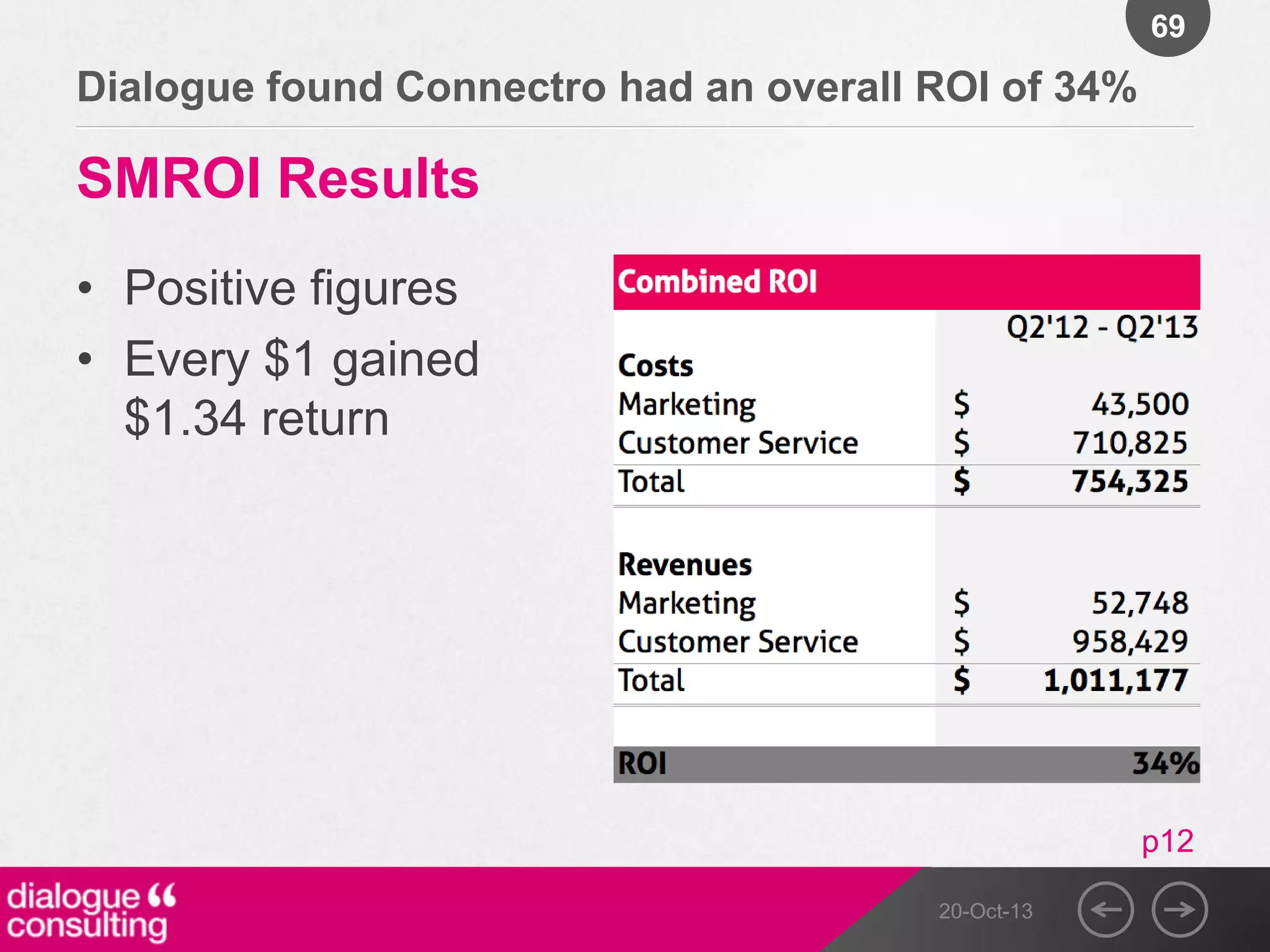
Dialogue found Connectro had an overall ROI of 34%

SMROI Results
• Positive figures
• Every $1 gained
$1.34 return

p12
20-Oct-13
70

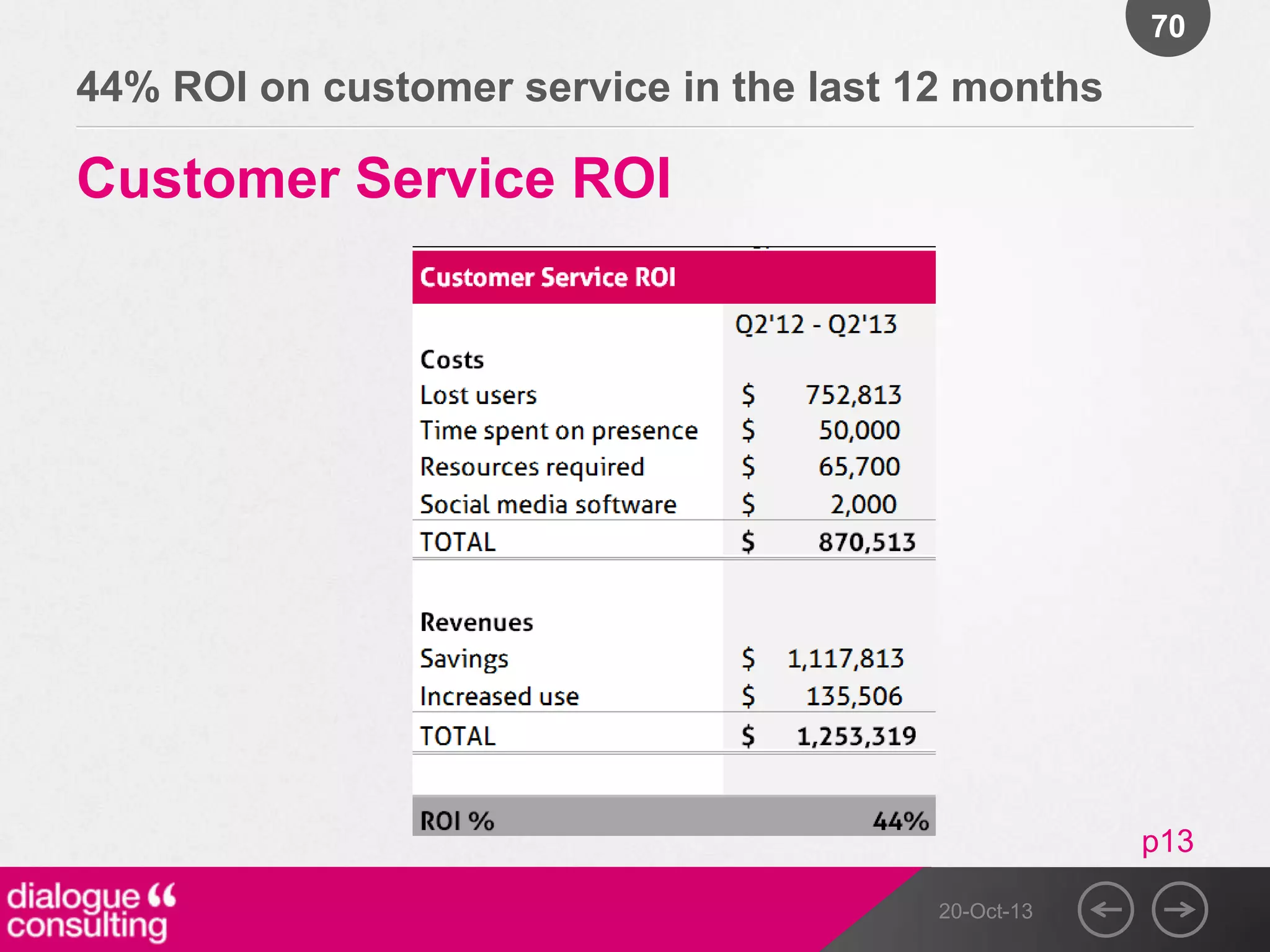
44% ROI on customer service in the last 12 months

Customer Service ROI

p13
20-Oct-13
71

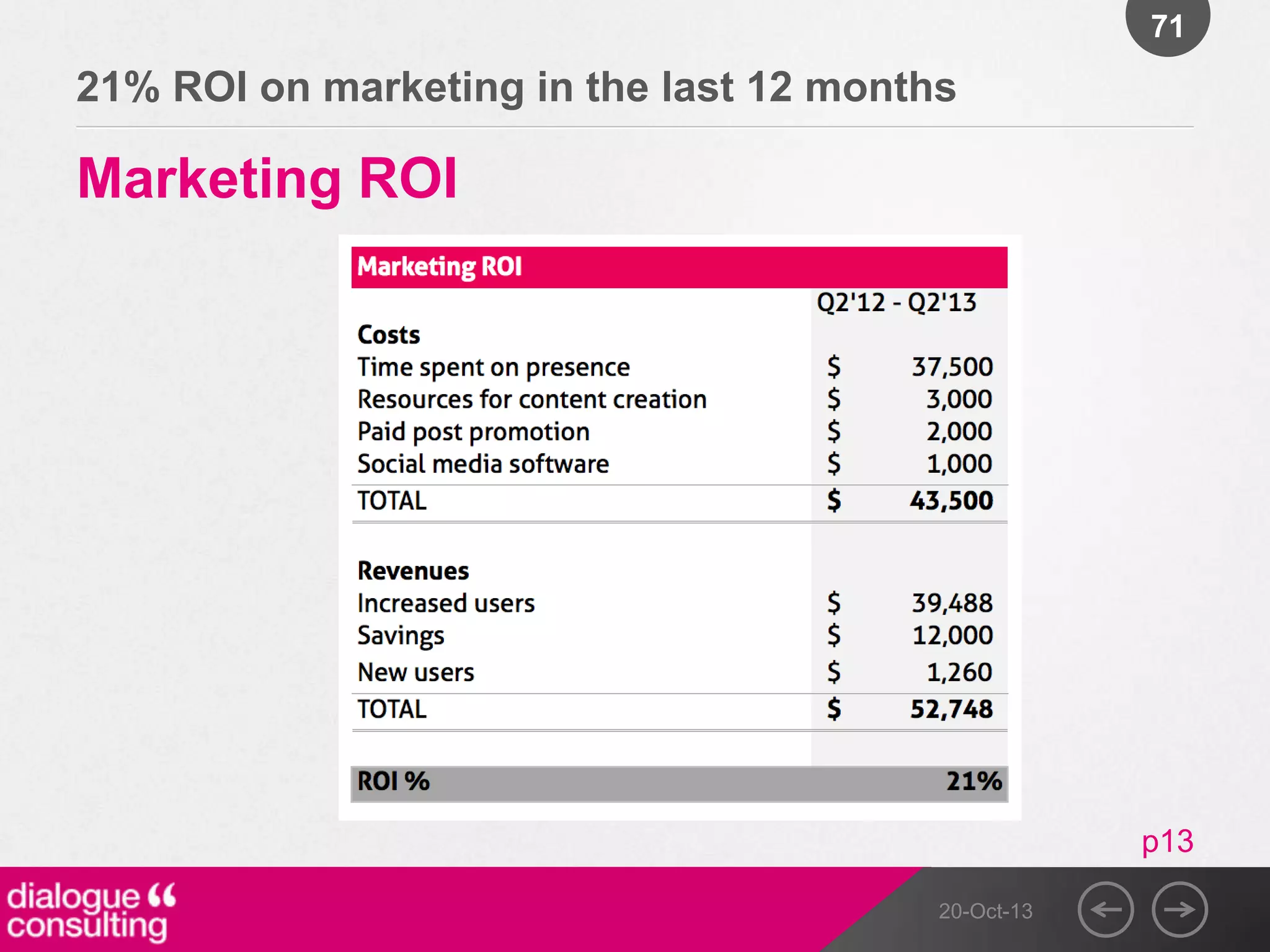
21% ROI on marketing in the last 12 months

Marketing ROI

p13
20-Oct-13
72

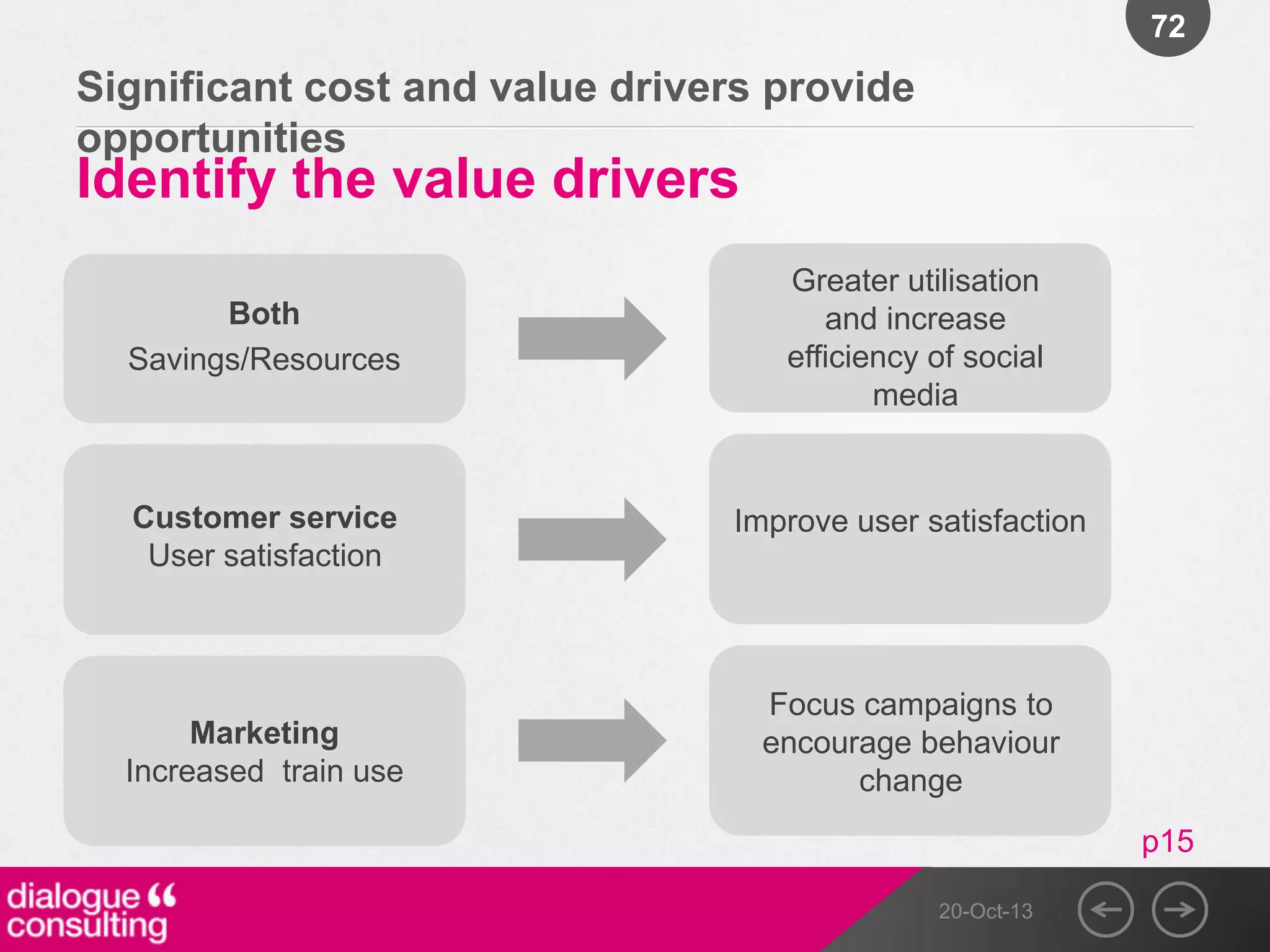
Significant cost and value drivers provide
opportunities

Identify the value drivers
Both
Savings/Resources

Greater utilisation
and increase
efficiency of social
media

Customer service
User satisfaction

Improve user satisfaction

Marketing
Increased train use

Focus campaigns to
encourage behaviour
change
p15
20-Oct-13
73

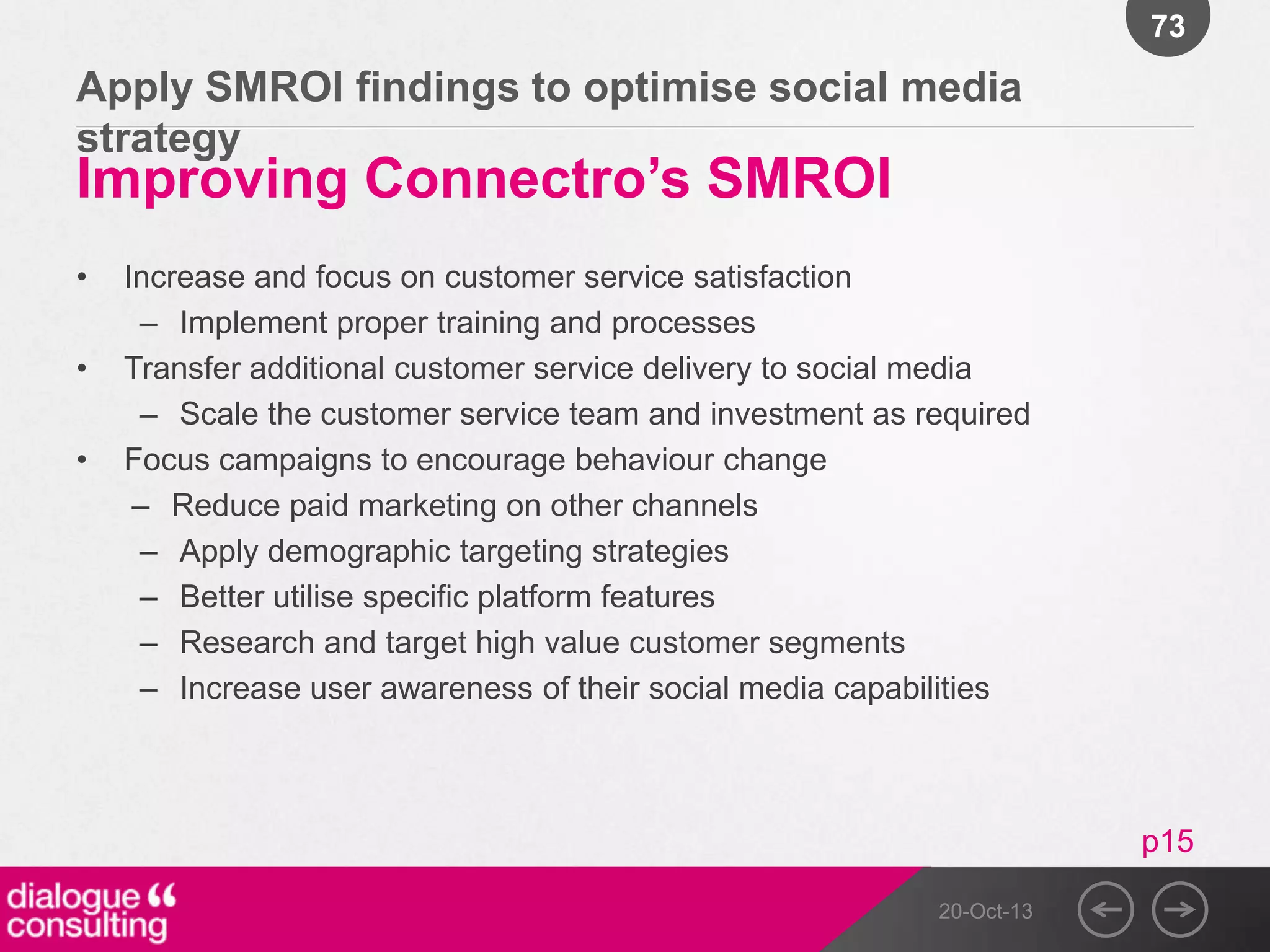
Apply SMROI findings to optimise social media
strategy

Improving Connectro‟s SMROI
•
•

•

Increase and focus on customer service satisfaction
– Implement proper training and processes
Transfer additional customer service delivery to social media
– Scale the customer service team and investment as required
Focus campaigns to encourage behaviour change
– Reduce paid marketing on other channels
– Apply demographic targeting strategies
– Better utilise specific platform features
– Research and target high value customer segments
– Increase user awareness of their social media capabilities

p15
20-Oct-13
74

Dialogue produced tailored SMROI reports for
Connectro

Reporting
•
•
•
•

Focused on key stakeholders
How to best communicate findings
How to implement recommendations
Provided assurance

p16
20-Oct-13
75

Dialogue recommends...

20-Oct-13
76

Recommendation 1

Identify and understand your
strategic purposes of maintaining a
social media presence

20-Oct-13
77

Recommendation 2

Social media presences should
be evaluated regularly.
Its use should be justified, costeffective and add value.

20-Oct-13
78

Recommendation 3

SMROI should be evaluated and
help direct improvements to better
extract value from social media.

20-Oct-13
79

Recommendation 4

SMROI should be undertaken
carefully to ensure models, metrics
and calculations are accurate.

20-Oct-13
80

Recommendation 5
To be valid and accurate, ROI models
should remain fluid to reflect changes
in social media platforms, uses and
users.

20-Oct-13
81

Questions?

20-Oct-13

Measuring Social Media Return on Investment: Advanced social media analytics

  • 1.
    Social Media Returnon Investment Workshop Today‟s wireless „MCTC‟ is brought to you by the password sentry23. Tweet on #smroi @HughStephens 20-Oct-13
  • 2.
    2 Strategy // Risk// Advisory About Dialogue Consulting • Strategy, risk and advisory services – Risk management products: eLearning, monitoring – ROI products – in development! – UPVOTE – company magazine (?next week) 20-Oct-13
  • 3.
  • 4.
    4 Questions & Tangentswelcome! Agenda • • • • • Introductions Part 1 Afternoon tea (~2:45) Part 2 Finish (~4:30) 20-Oct-13
  • 5.
  • 7.
  • 8.
    8 Primer: stats andnumbers. 20-Oct-13
  • 9.
    9 We usually estimatethings. Our confidence varies. Confidence in estimations • When we estimate, we are making assumptions on the true population mean. • If you don‟t have every piece of information (e.g. from every person), you are estimating. • Sometimes you are confident that your estimate is good, others not. 20-Oct-13
  • 10.
  • 11.
    11 Measurements aim tonarrow a confidence interval. Confidence intervals • “I am xx% confident that the true population mean falls between yy and zz.” • Measurements reduce uncertainty. 20-Oct-13
  • 12.
    12 Simulation helps modeluncertainty & its impact Simulation is important • Monte Carlo • Basic concept: RETURNSOCIAL = [n(conversion traffic referred from social) * av(value sale) * P(social actually drove them there)] + [n(customer acq through social) * av(value of socially referred cust)] Estimates n(sales) == 2,000 av(val sale) = $110 (sd 25) P(social drive) = 0.1– 0.7 n(cust acq) = 400-1200 Av(value social ref cust) = $340 (sd 90) 20-Oct-13
  • 13.
    13 Monte Carlo simulatesacross many variable values Monte Carlo Estimates • Midpoint estimate: $338,000 • Monte Carlo estimate: $359,590 (n=1k) • Similar, yes. But very few numbers estimated! • Often used to work out P(ROI>0)… 20-Oct-13
  • 14.
  • 15.
    15 Ask these questionsbefore you begin Fast Five 1. Why are we conducting an ROI evaluation? 2. What are the costs and benefits of doing so? 3. Do we understand our social media strategy and uses? 4. Do we have the required analysis and data collection skills? 5. Are we aware of the SMROI principles and framework? p5 20-Oct-13
  • 16.
    16 Following these principleswill increase the SMROI integrity 10 key SMROI principles 1. Understand the objectives 2. Involve stakeholders 3. Understand the platforms 4. Identify which metrics and KPIs change 5. Be selective in what is valued 6. Understand the valuation process 7. Make reasonable assumptions 8. Do not over-claim or over-fit 9. Be transparent 10.Verify the result p5 20-Oct-13
  • 17.
    17 There are fourmain models to evaluate SMROI Remember the models • Business Strategy Avenue Evaluating social media based on the costs and revenues of executing business objectives • User Lifetime Value Evaluating social media based on the users connected to your social media accounts • User Network Analysis Evaluating social media based on the user network and amplification model • Opportunity Cost Evaluation Evaluating social media based on available alternatives p5 20-Oct-13
  • 18.
    18 Agenda 1 2 3 4 5 • What isSMROI? • Why should you evaluate SMROI? • Why isn‟t it more common? • How can you calculate SMROI? • How does Dialogue Consulting do it? 20-Oct-13
  • 19.
    19 1 What is SMROI? Definingwhat we don‟t know. 20-Oct-13
  • 20.
    20 SMROI is simplyROI applied to a social media context SMROI? • Ratio between costs and revenues • 100% ROI == (?success?) – $1 expenditure, $2 made in revenues p17 20-Oct-13
  • 21.
    21 There are manysources of social media revenues Revenues Common examples include: • Sales • Advocacy – Word of mouth – User generated content • Leads • Donations 20-Oct-13
  • 22.
    22 Social media costsare more easily identified Costs Common examples include: • Personnel • Social media budgets e.g. Facebook Ads • Time • Hardware • Software • Other resources 20-Oct-13
  • 23.
    23 Dialogue Consulting usesa five phase SMROI process Determining SMROI 1 2 Context Model 4 Calculation 5 Evaluation Reporting p29 20-Oct-13
  • 24.
    24 2 Why evaluate The businesscase. SMROI? 20-Oct-13
  • 25.
    25 Return-on-investment evaluations bringmany benefits The SMROI rationale • • • • • • Understanding use Justify expenditure Gain insights into Fans and Followers Identify where value is generated Identify cost reduction opportunities Modify and optimise social media use p10 20-Oct-13
  • 26.
    26 SMROI helps identifywhere social media generates value Quantifying use • Financial tangibility – is the return monetary (eg sales) or nonmonetary (eg brand equity)? • Time – is the return made in the long or short term? p8 20-Oct-13
  • 27.
    27 Modelling use identifiesvalue sources and opportunities The Social Media Exchange adapted from Larson & Watson, 2011 20-Oct-13 p20
  • 28.
    28 SMROI findings canbe used in multiple ways Applications of the SMROI evaluation Some examples: • Modelling optimum marketing mix with social media • Determining best customer service delivery • Identify most efficient HR recruitment methods • Utilise most effective communication channels 20-Oct-13
  • 29.
    29 3 Why isn‟t itmore The usual suspects. common? 20-Oct-13
  • 30.
    30 Tangibility, skill, andknowledge barriers prevent evaluation Barriers to SMROI evaluation • • • • • • No „stock‟ formula or method Many different social media uses Difficult to link and quantify revenue sources Need to understand the process Requires financial and statistical knowledge Not considered important to evaluate “too hard” “unnecessary” p11 20-Oct-13
  • 31.
    31 Three main errorsmay occur during the SMROI analysis Where can SMROI evaluations go wrong? • Misunderstanding • Miscalculation • Misinterpretation p39 20-Oct-13
  • 32.
    32 Occurs before theSMROI is calculated 1. Misunderstanding • Model inputs • Appropriateness and exhaustiveness of the model • Use of Proxies p39 20-Oct-13
  • 33.
    33 Occurs during theSMROI process 2. Miscalculation • • • • Over-valuation Combined platform valuations Metrics Future value of the platform p40 20-Oct-13
  • 34.
    34 Occurs after theSMROI is evaluated 3. Misinterpretation • • • • Comparing ROIs Application to different platforms Accounting for risk Changes to platforms and users p41 20-Oct-13
  • 35.
    35 4 How do you Numbersand mathemagic. calculate it? 20-Oct-13
  • 36.
    36 There are fivemain stages to determining SMROI The Dialogue Consulting Process 1 2 Context Model 4 Calculation 5 Evaluation Reporting p29 20-Oct-13
  • 37.
    37 It‟s impossible tomeasure something you don‟t understand 1 Context A problem well stated is a problem half solved. - Charles Kettering 20-Oct-13
  • 38.
    38 Understanding your socialmedia use is crucial 1 Context Assessment Hypothesis Cost-benefit •Why and how is social media being used? •What is the SMROI evaluating? •How extensive should it be? p29 20-Oct-13
  • 39.
    39 Identifying social mediause has two perspectives Use Assessment Business Perspective User Perspective What are your goals, objectives and strategies for social media? How are Fans and Followers engaging with your presences? p29 20-Oct-13
  • 40.
    40 Establishing hypotheses shapesthe SMROI process Determine hypothesis • Decide what to calculate • Different approaches require different processes – extensiveness – models – data – reporting • Helps clarify SMROI objectives • Determine the value and costs of evaluation p30 20-Oct-13
  • 41.
    41 Hypothesis examples “Customer servicedelivery on social media generates a positive ROI” (…therefore we should use it more and ask for more resources) “Social media marketing isn’t generating positive ROI” (…therefore we need to identify why, and modify our use) “If we used social media, it would yield a positive ROI” (…if so, we should implement a presence) 20-Oct-13
  • 42.
    42 Hypotheses identify the„value‟ to compare with SMROI costs SMROI Cost-Benefit p14 20-Oct-13
  • 43.
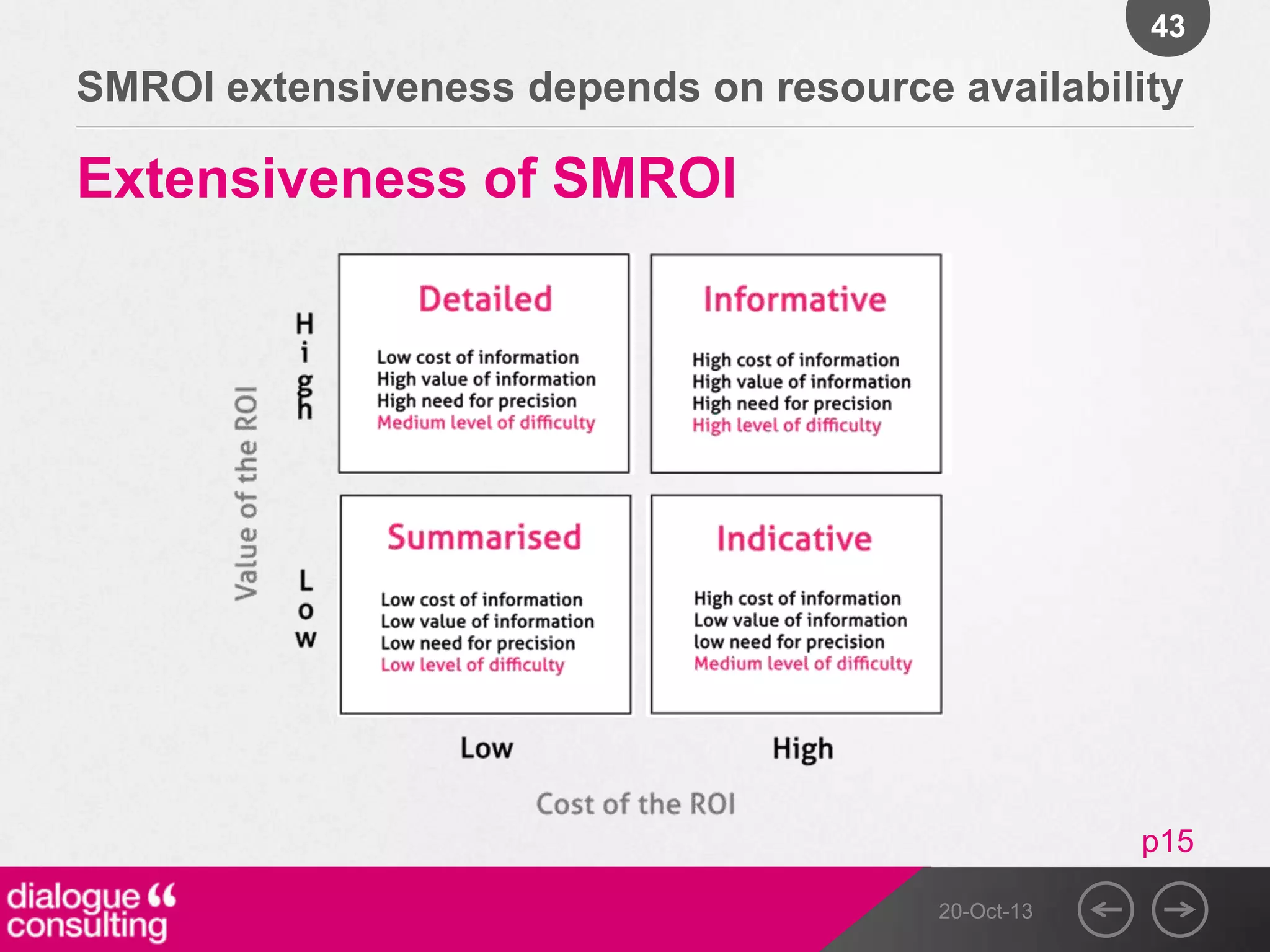
    43 SMROI extensiveness dependson resource availability Extensiveness of SMROI p15 20-Oct-13
  • 44.
    44 Four main factorsdetermine appropriate model selection 2 Model Identification • Model choices: which models can be used? • Fit to SMROI purpose: does it apply to what is being measured? • Available data: do we have the right information? • Impact: does the data accurately reflect social media use? p31 20-Oct-13
  • 45.
    45 There are fourmain way of quantifying social media 2.1 Models Business strategy avenue User lifetime value Network Analysis Opportunity Cost p17 20-Oct-13
  • 46.
    46 Social media valuecomes from executing strategies online 2.1.1 Business Strategy Avenue • Common Examples – Customer Service – Marketing – HR • Value and cost drivers depend on strategy – Savings – Revenues (sales etc) – Time – Resources p20 20-Oct-13
  • 47.
    47 Fans and Followershave value for businesses 2.1.2 User Lifetime Value • Users are „assets‟ • Assumed to generate future revenue – Sales, advocacy etc • Compare revenue to cost of acquisition and retention p23 20-Oct-13
  • 48.
    48 Social media canbe valued by the connectedness of users 2.1.3 Network Analysis • Users connect to businesses and each other • Users may share your content or mention you online • Word of mouth and advocacy yields value • Need to model user connectedness • Weight users by value • Approximates value of network p25 20-Oct-13
  • 49.
    49 Social media canbe valued by its best equivalent alternative 2.1.4 Opportunity Cost • Social media isn‟t the only way! • Examines the value of the next best option • Value a strategy – Marketing or customer service on social media? • Value a platform – Customer service on Twitter or by phone? • Value of social media – Quantify losses of not having a presence p27 20-Oct-13
  • 50.
    50 Ensure the rightdata is sourced for the model and evaluation 2.3 Data Collection • What data is needed? • How to collect it? – Surveys and questionnaires – Observation and tracking • Reaching users • Representative samples p45 20-Oct-13
  • 51.
    51 These main considerationsimpact on data collection Issues with data collection • • • • • • Non generalizable findings Biased samples Non-responsiveness Badly phrased questions Unusable data Ethics p47 20-Oct-13
  • 52.
    52 Determine how costsand revenue factors relate to social media 2.4 Impact • Determines how much of an outcome relates to social media • Outcomes indicators are metrics which explain costs and revenues • Errors arise from assuming your social media activity accounts for 100% of outcome indicators p32 20-Oct-13
  • 53.
    53 Comparing against indicatorsreduces attribution errors Benchmark Indicators • Alternatives to social media activity which may better explain outcomes • Compare these to determine impact p34 20-Oct-13
  • 54.
    54 Four factors explainthe difference between indicators Determining Impact • Deadweight: the outcome may have occurred regardless • Displacement: increase in social media activity may decrease other activities • Attribution: other factors may be contributing to the outcome • Drop-off: the outcome may reduce over time p32 20-Oct-13
  • 55.
    55 Determining SMROI shouldinclude sensitivity and forecasting 3 Calculation • Build the model: does it reflect your social media use? • Calculate the ROI figure: what is the return? • Apply a sensitivity analysis: what are the most influential factors? • Forecast changes: how might the ROI change in the future? p35 20-Oct-13
  • 56.
    56 Implementing findings canoptimise social media use 4 Evaluation • Compare ROI values: how did social media perform? • Improvements: how can social media be used better? p35 20-Oct-13
  • 57.
    57 Determine how socialmedia and other investments compare Compare the ROI figures • How does investment in social media perform against traditional channels? • Modify social media use accordingly p36 20-Oct-13
  • 58.
    58 Examine current activityto increase ROI Improve the SMROI figure • • • • • How to gain more positive ROI? Remember the ratio! Examine current processes What could generate higher return? Where can cost savings be achieved? p36 20-Oct-13
  • 59.
    59 SMROI findings mustbe communicated appropriately 5 Reporting • Format: Who is it for? • Process: How was it calculated? • Rationale: What outcome is intended? – Increased budget – More resources and personnel – Greater social media scope • Assurance: is it accurate? p37 20-Oct-13
  • 60.
    60 These key areasshould be covered in your report What to include in an SMROI report • • • • • • • Who conducted the SMROI Why the SMROI was calculated Stakeholder involvement SMROI evaluation methodology Rationale of proxies, assumptions, estimates or benchmarks used Explanations and demonstrations of calculations Review of the sensitivity analysis and the impact of changing variables • Recommendations based on findings p37 20-Oct-13
  • 61.
    61 5 How do wedo it? A case study… Move to part 2 of your workbook! 20-Oct-13
  • 62.
    62 Dialogue Consulting completedan ROI evaluation Connectro Case Study • • • • • Train provider for large city Two presences 12,000 Facebook Fans 33,000 Twitter Followers Frequent social media posting • Dedicated social media team (two employees) p4 20-Oct-13
  • 63.
    63 Application of theSMROI procedure to Connectro Process 1. Consultation with Connectro 2. Determine what they wanted to evaluate – Customer service – Marketing 3. Examine how they use social media 4. Data collection and analysis 5. Calculation and evaluation 6. Findings and recommendations 7. Reporting p4 20-Oct-13
  • 64.
    64 Connectro and Dialogueidentified key objectives Objectives • • • • • • Justify expenditure Identify potential value from social media Quantify current revenues and costs Optimise use of social media Identify opportunities for social media use Focus on marketing and customer service strategies p7 20-Oct-13
  • 65.
    65 Connectro keeps usersupdated via social media Information channel • Provide service updates • Other Connectro and train usage information p6 20-Oct-13
  • 66.
    66 Connectro uses socialmedia to promote their services Marketing Strategy • Encourage train usage • Promote Connectro services • Frequent social media campaigns • Some paid promotion p6 20-Oct-13
  • 67.
    67 Connectro uses socialmedia as a customer service channel Customer Service • • • • Respond to user inquiries Focus on quick resolution Guaranteed response Gain feedback from users p6 20-Oct-13
  • 68.
    68 Dialogue identified cashflows related to social media use Cost and Revenue Identification Overall Costs Revenue s • Time and resources • Software • Efficiency and cost savings Marketing Customer Service Paid promotion Value of lost use due to customer dissatisfaction Value of increased use due to campaigns Value of increased use due to user satisfaction p11 20-Oct-13
  • 69.
    69 Dialogue found Connectrohad an overall ROI of 34% SMROI Results • Positive figures • Every $1 gained $1.34 return p12 20-Oct-13
  • 70.
    70 44% ROI oncustomer service in the last 12 months Customer Service ROI p13 20-Oct-13
  • 71.
    71 21% ROI onmarketing in the last 12 months Marketing ROI p13 20-Oct-13
  • 72.
    72 Significant cost andvalue drivers provide opportunities Identify the value drivers Both Savings/Resources Greater utilisation and increase efficiency of social media Customer service User satisfaction Improve user satisfaction Marketing Increased train use Focus campaigns to encourage behaviour change p15 20-Oct-13
  • 73.
    73 Apply SMROI findingsto optimise social media strategy Improving Connectro‟s SMROI • • • Increase and focus on customer service satisfaction – Implement proper training and processes Transfer additional customer service delivery to social media – Scale the customer service team and investment as required Focus campaigns to encourage behaviour change – Reduce paid marketing on other channels – Apply demographic targeting strategies – Better utilise specific platform features – Research and target high value customer segments – Increase user awareness of their social media capabilities p15 20-Oct-13
  • 74.
    74 Dialogue produced tailoredSMROI reports for Connectro Reporting • • • • Focused on key stakeholders How to best communicate findings How to implement recommendations Provided assurance p16 20-Oct-13
  • 75.
  • 76.
    76 Recommendation 1 Identify andunderstand your strategic purposes of maintaining a social media presence 20-Oct-13
  • 77.
    77 Recommendation 2 Social mediapresences should be evaluated regularly. Its use should be justified, costeffective and add value. 20-Oct-13
  • 78.
    78 Recommendation 3 SMROI shouldbe evaluated and help direct improvements to better extract value from social media. 20-Oct-13
  • 79.
    79 Recommendation 4 SMROI shouldbe undertaken carefully to ensure models, metrics and calculations are accurate. 20-Oct-13
  • 80.
    80 Recommendation 5 To bevalid and accurate, ROI models should remain fluid to reflect changes in social media platforms, uses and users. 20-Oct-13
  • 81.

Editor's Notes

  • #24 Will be explained in a later section….
  • #39 Want to answer these questions before you beginKnow rationale for SMROI (the ROI of SMROI – costs and benefits)Know how you use SM, to then identify what to measure, and therefore what data you need
  • #40 May discover you are doing more on social than you think
  • #42 High value examples
  • #44 Four overview types detailing how extensive the roi should beLook at hypothesis and ‘value’ of ROI and match with costs
  • #49 Other benefits:Eg NPSIdentify most influential users, determine most valuable customers/online users (ie for better targeting)
  • #69 Savings as compared to “traditional” and non social
  • #74 Dialogue provided actionable recommendations to Connectro