Getting to Social ROI Black & White and Lots of Gray #SMWsocialROI  September 20, 2011
Why is social  ROI needed? Especially what the ROI of the website is  (if there is no way to tie back sales) Instead it’s focused on engagement, awareness, retention. 2002… “ Why do I need a website?” “ The internet isn’t going to be around forever.” “ What’s the ROI of my website if I don’t sell any products?” 2011… nobody asks those questions anymore. That said…we’ll try to give some guidance on how to evaluate Social ROI today. Remember
What this presentation isn’t… We aren’t going to give you a $$ for Social Media ROI . Just like a website, the ROI of each marketing initiative is unique to the business and the initiative itself . We are going to share methodology and process for figuring out social ROI. FREE intellectual property.  Yep. Why?  To advance the industry beyond this question.
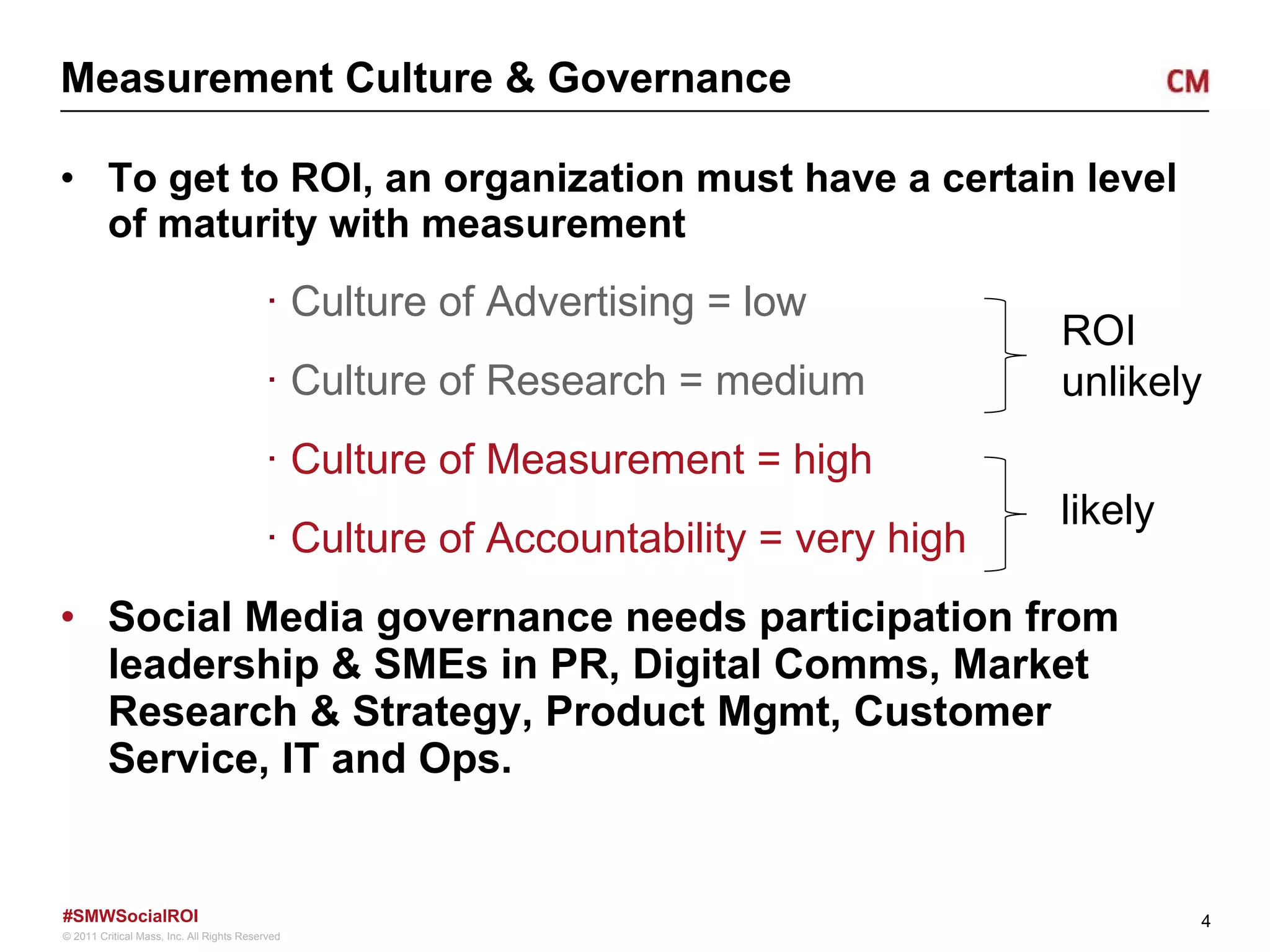
Measurement Culture & Governance To get to ROI, an organization must have a certain level of maturity with measurement Culture of Advertising = low Culture of Research = medium Culture of Measurement = high Culture of Accountability = very high Social Media governance needs participation from leadership & SMEs in PR, Digital Comms, Market Research & Strategy, Product Mgmt, Customer Service, IT and Ops.  ROI unlikely likely
Secrets to ROI Success Clearly defined business, marketing and consumer objectives.  Yes, this is more difficult than you would believe to get marketers and agencies to take the time to do, and to do right.  Marketing: Improve usability of home page and navigation to increase clarity of the path into consideration and ultimately conversion  Consumer: Help me find what ’s new and on sale Business: Increase store locator visits from top navigation on non-ecomm sites Adoption, Belief, Trust:  Deep understanding of objectives, and constant reminder and adherence to the objectives throughout the program by all business and agency stakeholders.  Targets/Goals:  Accountability and incentives to meet defined targets/goals.
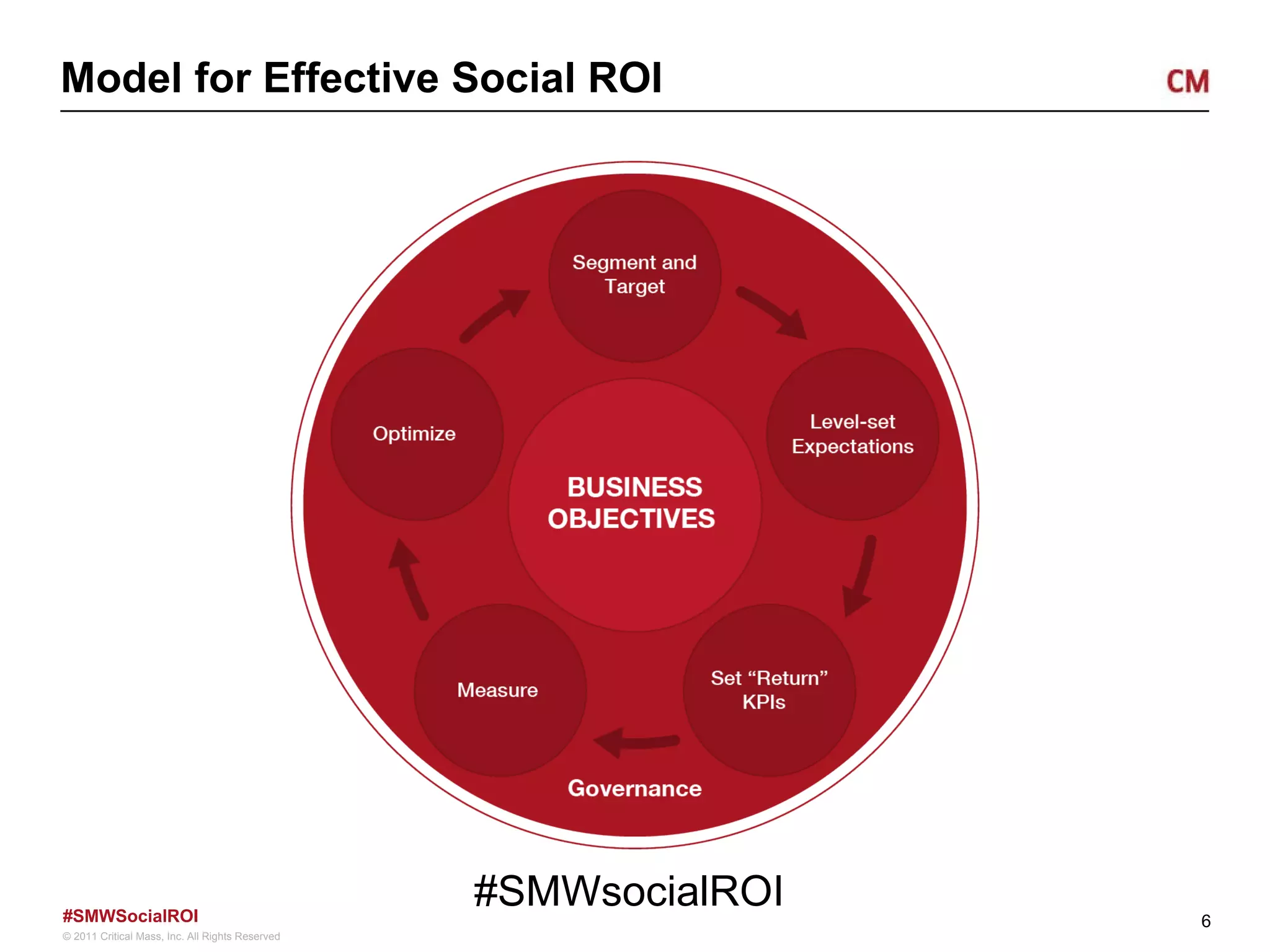
Model for Effective Social ROI #SMWsocialROI
Segment  and Target Segment  and Target
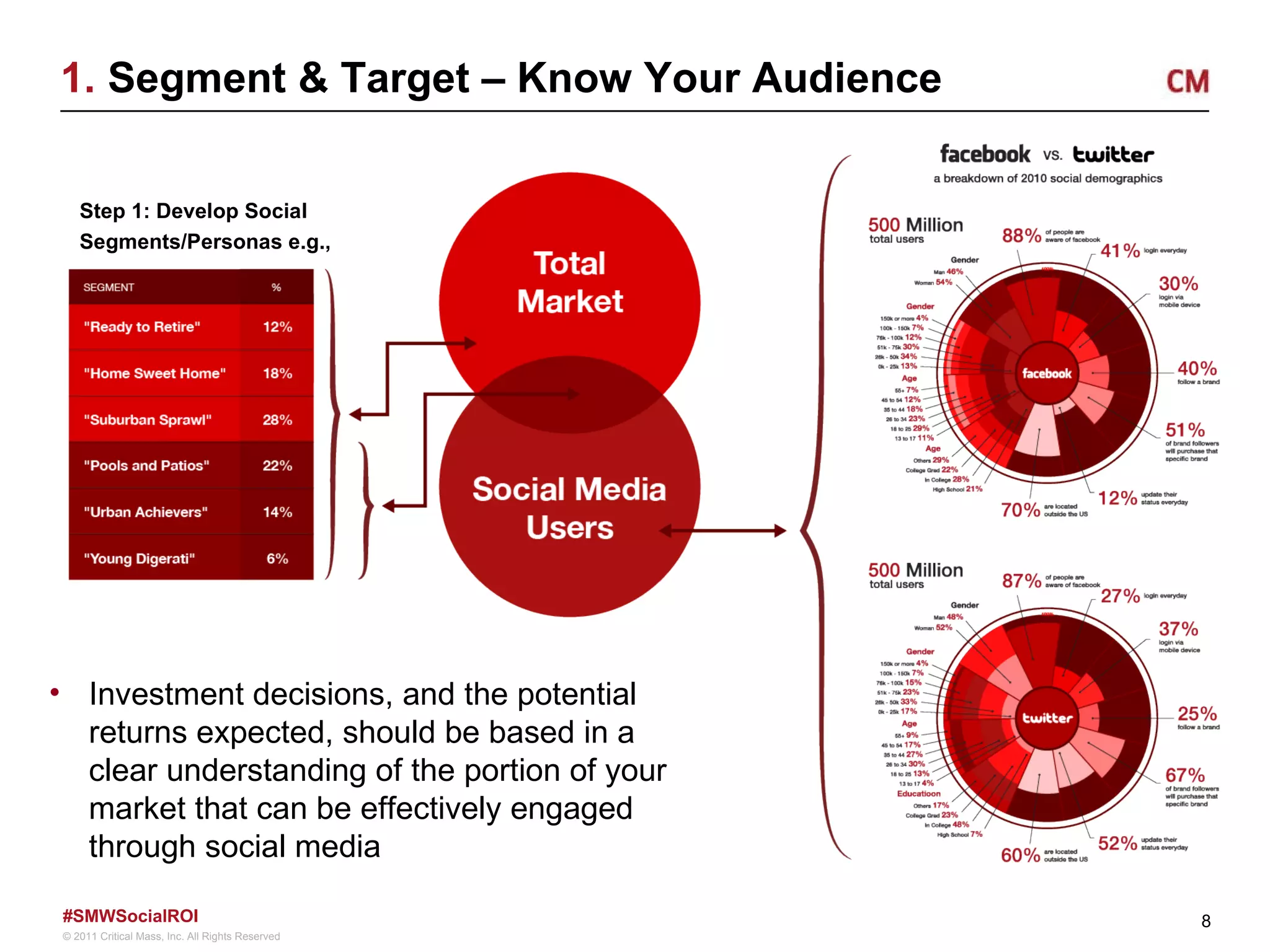
1.  Segment & Target – Know Your Audience Investment decisions, and the potential returns expected, should be based in a clear understanding of the portion of your market that can be effectively engaged through social media Step 1: Develop Social Segments/Personas e.g.,
Level-set Expectations Level-set Expectations
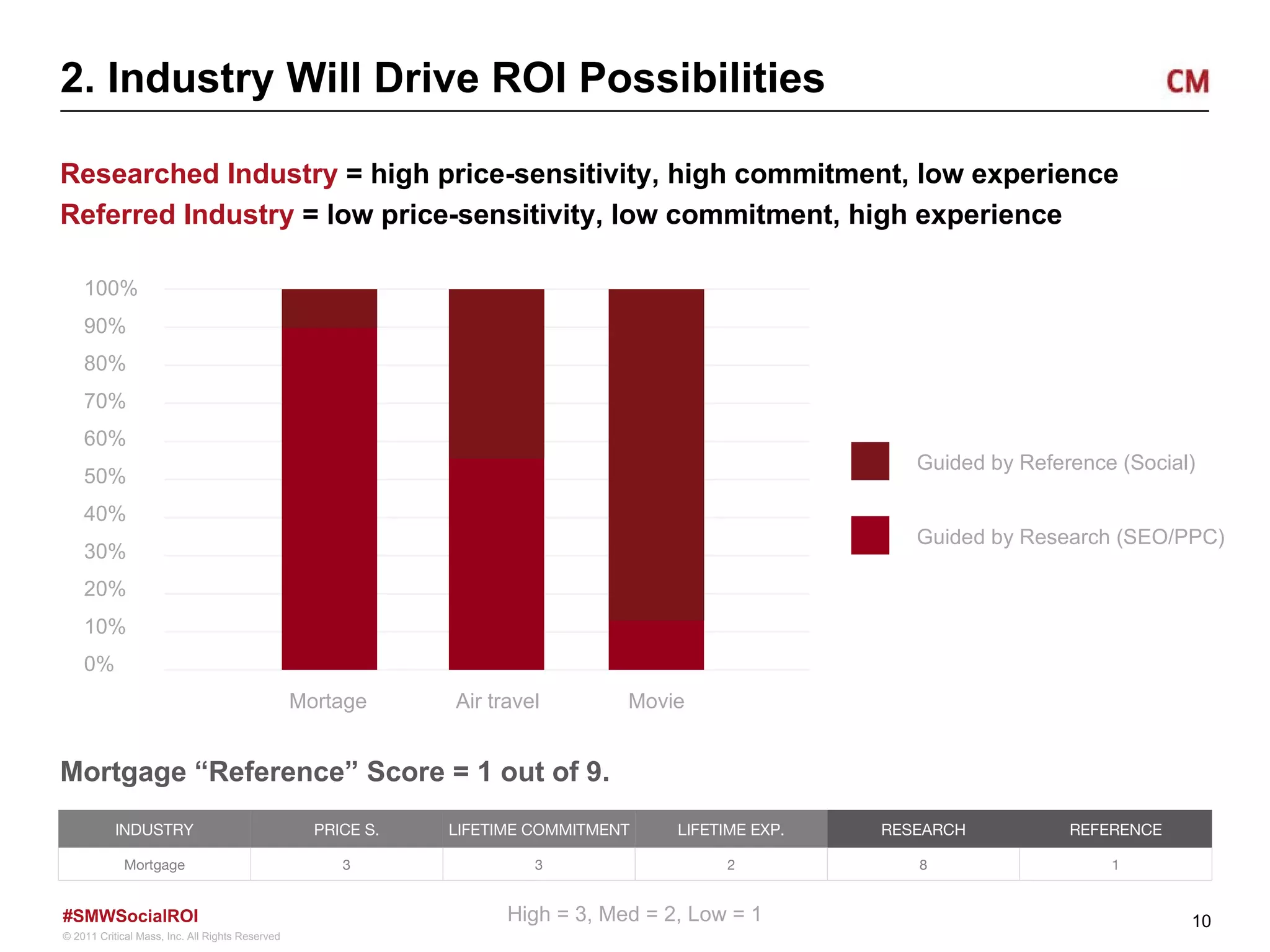
2. Industry Will Drive ROI Possibilities High = 3, Med = 2, Low = 1 Researched Industry  = high price-sensitivity, high commitment, low experience Referred Industry  = low price-sensitivity, low commitment, high experience Mortage  Air travel  Movie Guided by Reference (Social) Guided by Research (SEO/PPC) Mortgage “Reference” Score = 1 out of 9. INDUSTRY PRICE S. LIFETIME COMMITMENT LIFETIME EXP. RESEARCH REFERENCE Mortgage 3 3 2 8 1 100% 90% 80% 70% 60% 50% 40% 30% 20% 10% 0%
Set “Return” KPIs Set “Return” KPIs
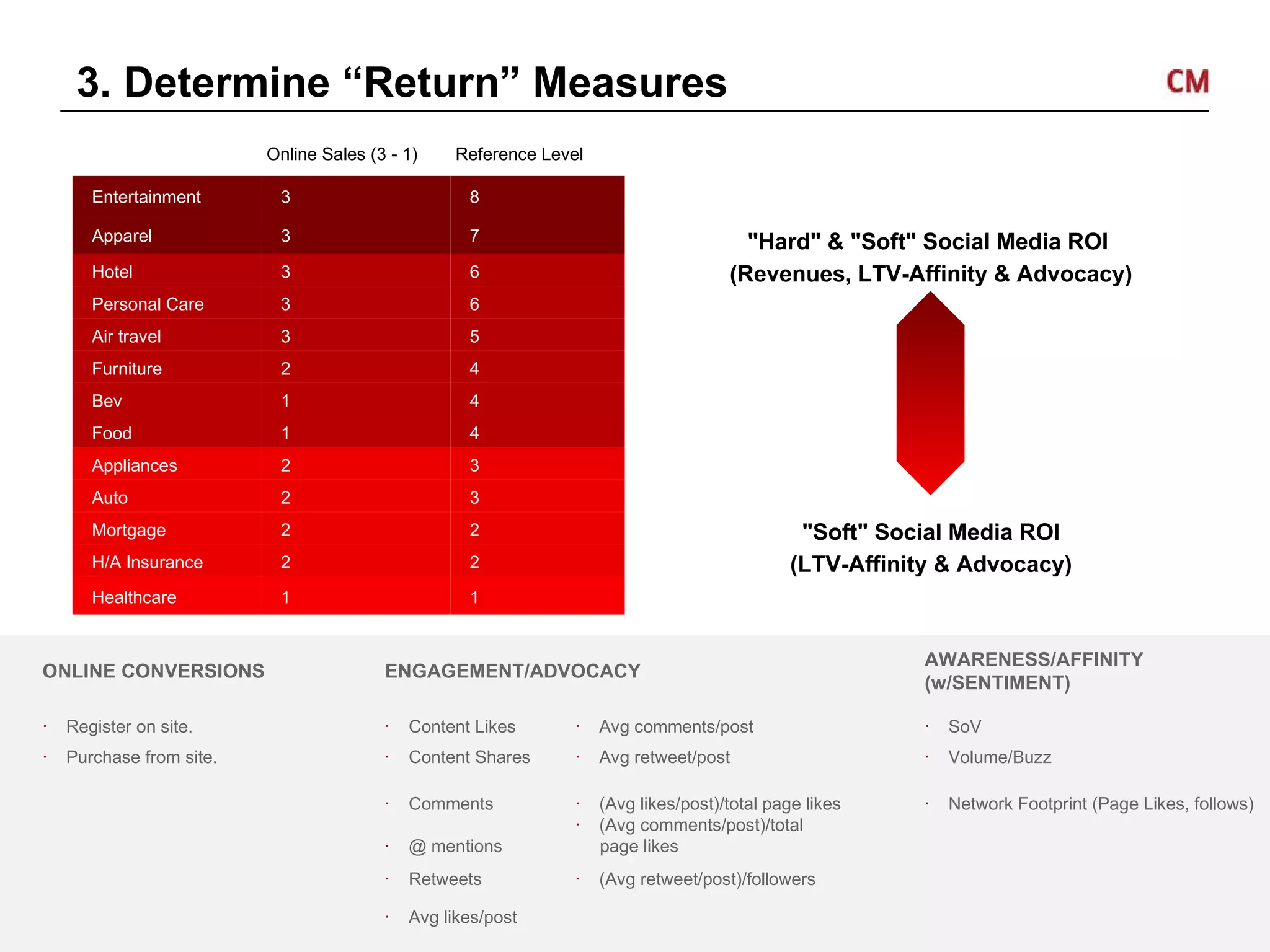
3. Determine “Return” Measures ONLINE CONVERSIONS ENGAGEMENT/ADVOCACY AWARENESS/AFFINITY (w/SENTIMENT) Register on site.  Content Likes Avg comments/post SoV Purchase from site. Content Shares Avg retweet/post Volume/Buzz Comments (Avg likes/post)/total page likes Network Footprint (Page Likes, follows) @ mentions (Avg comments/post)/total  page likes Retweets (Avg retweet/post)/followers Avg likes/post   Online Sales (3 - 1) Reference Level       Entertainment  3 8   Apparel 3 7   "Hard" & "Soft" Social Media ROI  Hotel 3 6   (Revenues, LTV-Affinity & Advocacy) Personal Care 3 6       Air travel 3 5       Furniture 2 4       Bev 1 4       Food 1 4       Appliances 2 3       Auto 2 3       Mortgage 2 2   "Soft" Social Media ROI H/A Insurance 2 2   (LTV-Affinity & Advocacy) Healthcare 1 1  
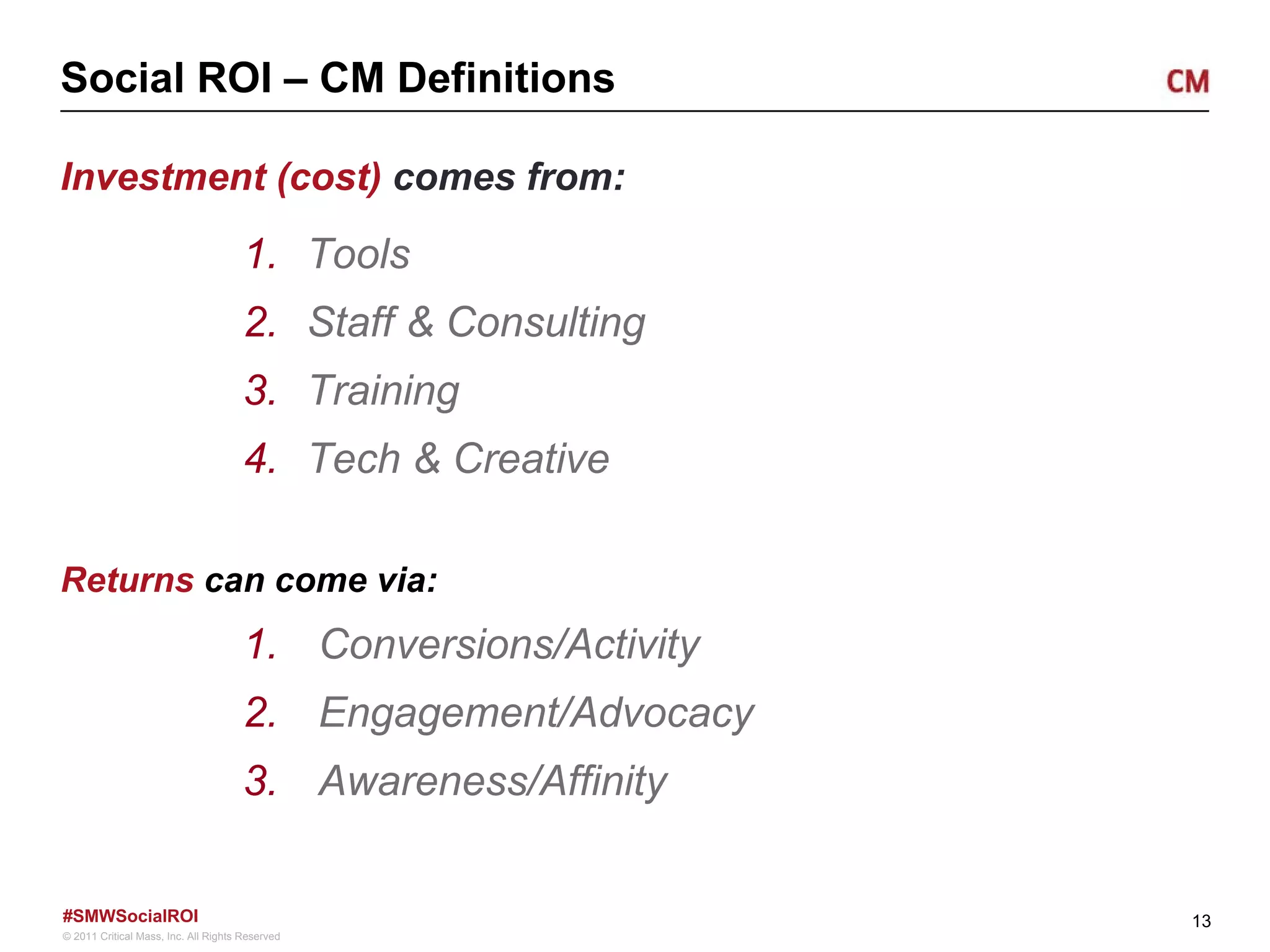
Social ROI – CM Definitions Investment (cost)  comes from: Tools Staff & Consulting Training Tech & Creative Returns  can come via: Conversions/Activity Engagement/Advocacy Awareness/Affinity
Measurement Approaches Measure
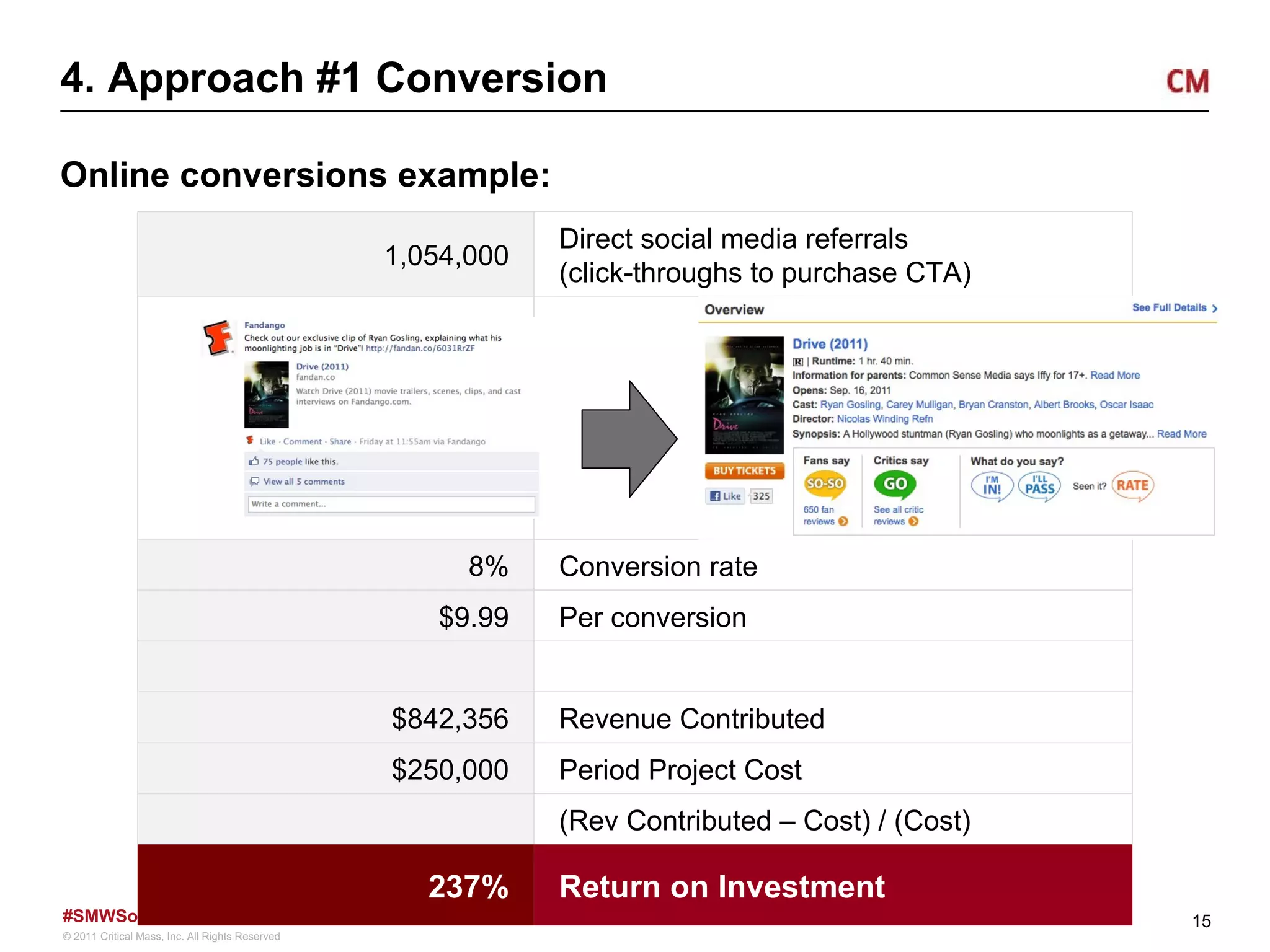
4. Approach #1 Conversion Online conversions example: 1,054,000 Direct social media referrals  (click-throughs to purchase CTA) 8% Conversion rate $9.99 Per conversion $842,356 Revenue Contributed $250,000 Period Project Cost (Rev Contributed – Cost) / (Cost) 237% Return on Investment
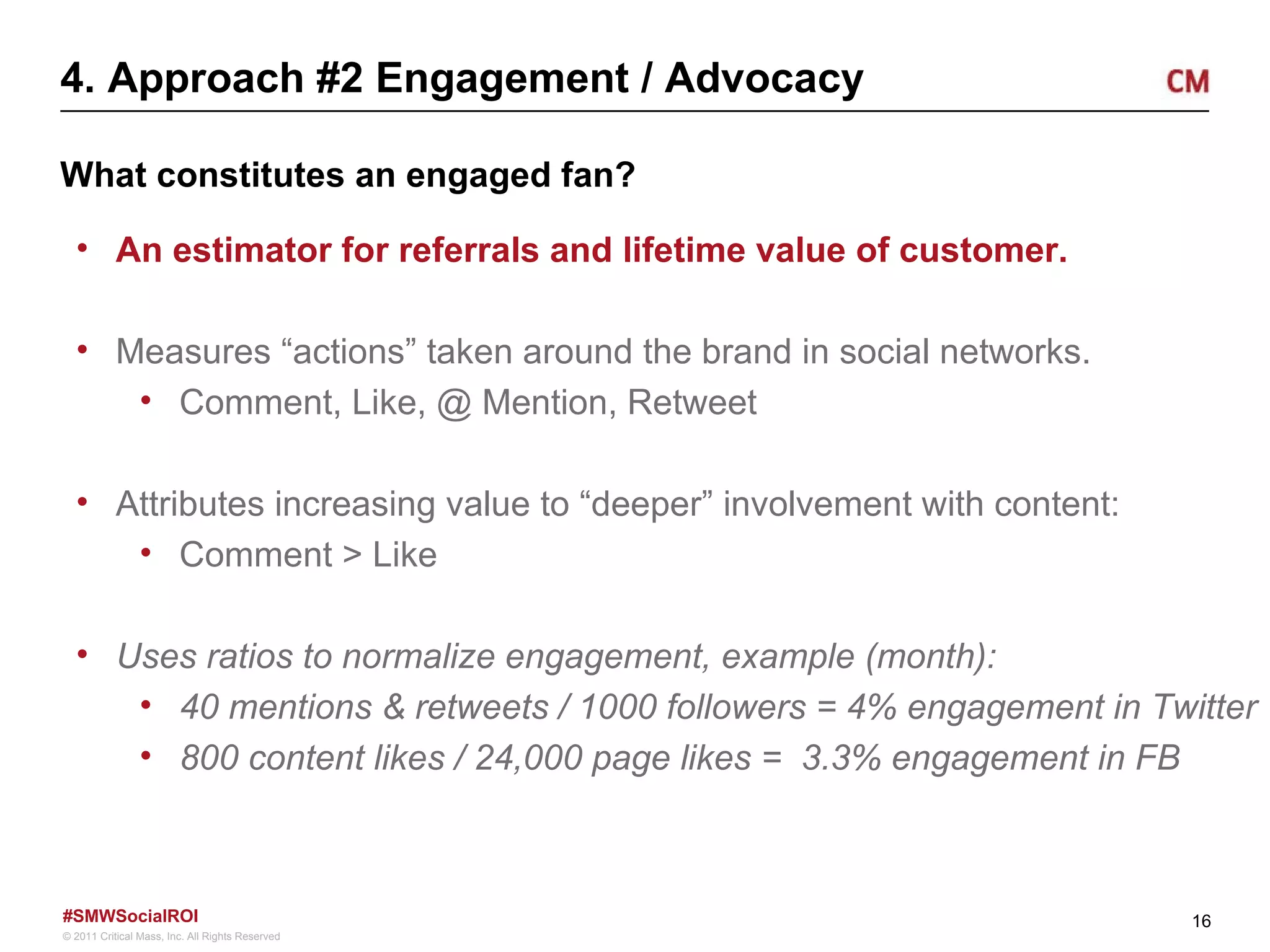
4. Approach #2 Engagement / Advocacy What constitutes an engaged fan? An estimator for referrals and lifetime value of customer.  Measures “actions” taken around the brand in social networks. Comment, Like, @ Mention, Retweet Attributes increasing value to “deeper” involvement with content: Comment > Like  Uses ratios to normalize engagement, example (month): 40 mentions & retweets / 1000 followers = 4% engagement in Twitter 800 content likes / 24,000 page likes =  3.3% engagement in FB
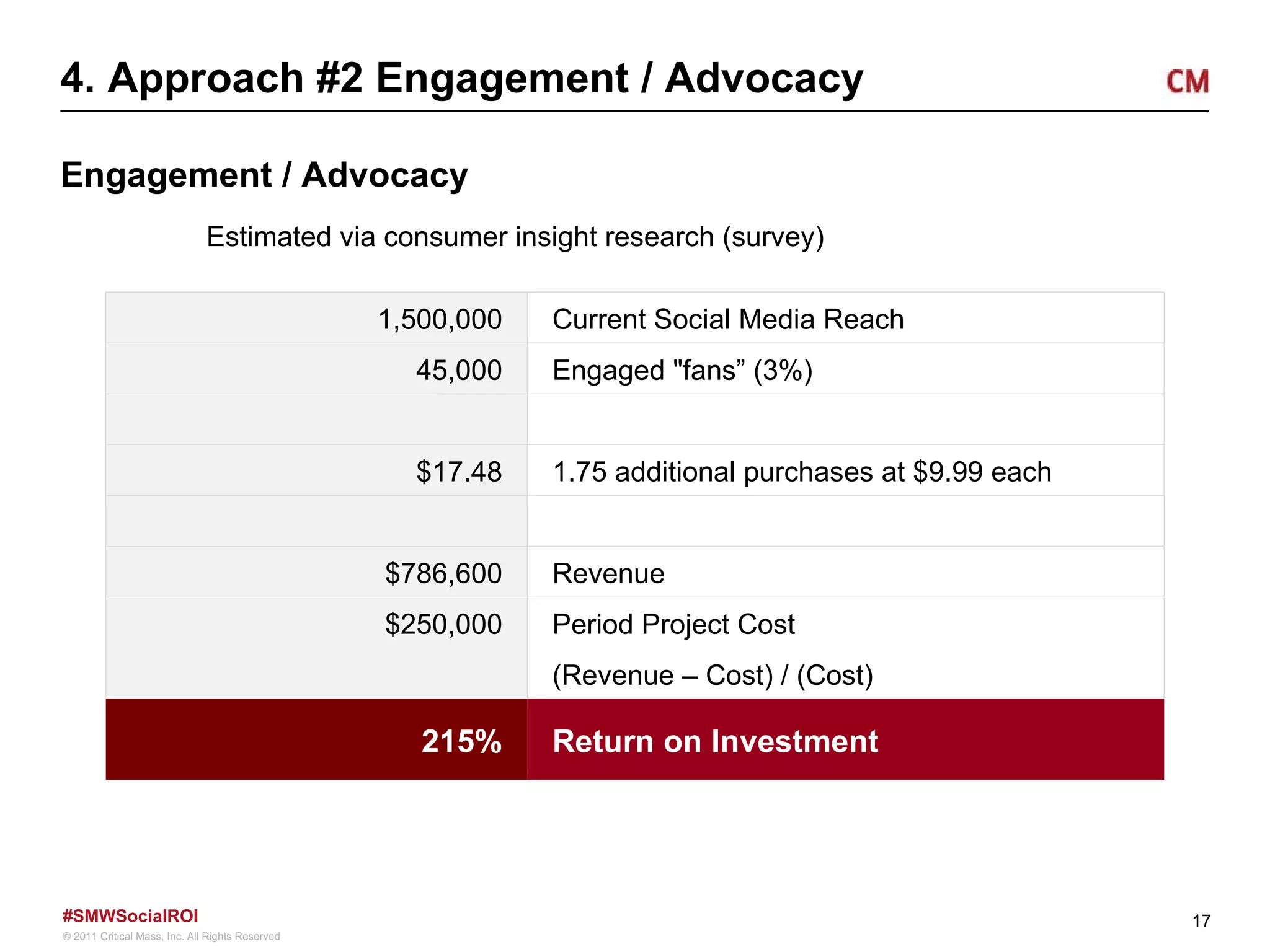
4. Approach #2 Engagement / Advocacy Engagement / Advocacy Estimated via consumer insight research (survey) 1,500,000 Current Social Media Reach 45,000 Engaged "fans” (3%) $17.48 1.75 additional purchases at $9.99 each $786,600 Revenue $250,000 Period Project Cost (Revenue – Cost) / (Cost) 215% Return on Investment
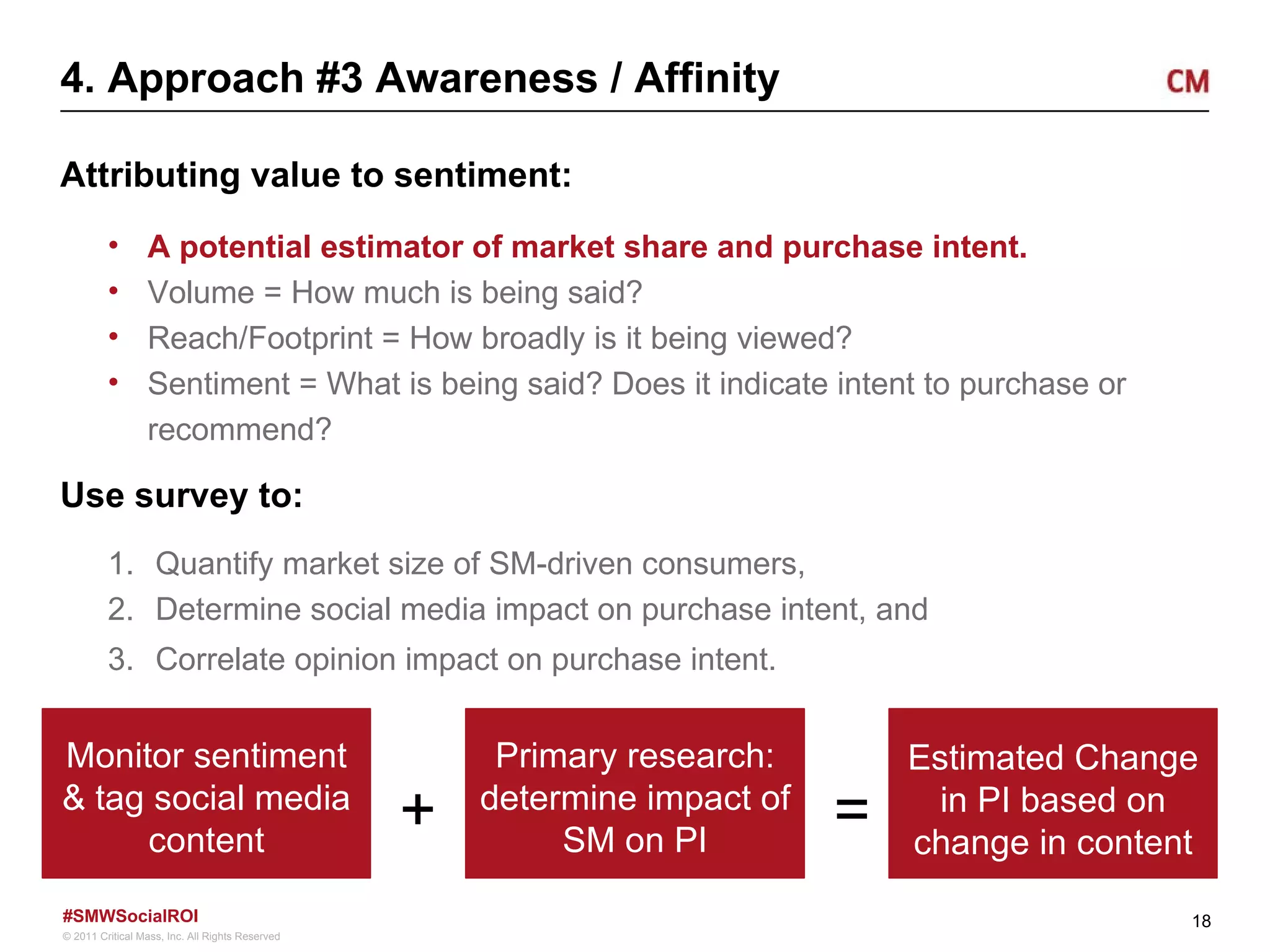
4. Approach #3 Awareness / Affinity Attributing value to sentiment: A potential estimator of market share and purchase intent.  Volume = How much is being said? Reach/Footprint = How broadly is it being viewed? Sentiment = What is being said? Does it indicate intent to purchase or recommend? Use survey to: Quantify market size of SM-driven consumers, Determine social media impact on purchase intent, and Correlate opinion impact on purchase intent. Monitor sentiment & tag social media content Primary research: determine impact of SM on PI Estimated Change in PI based on change in content + =
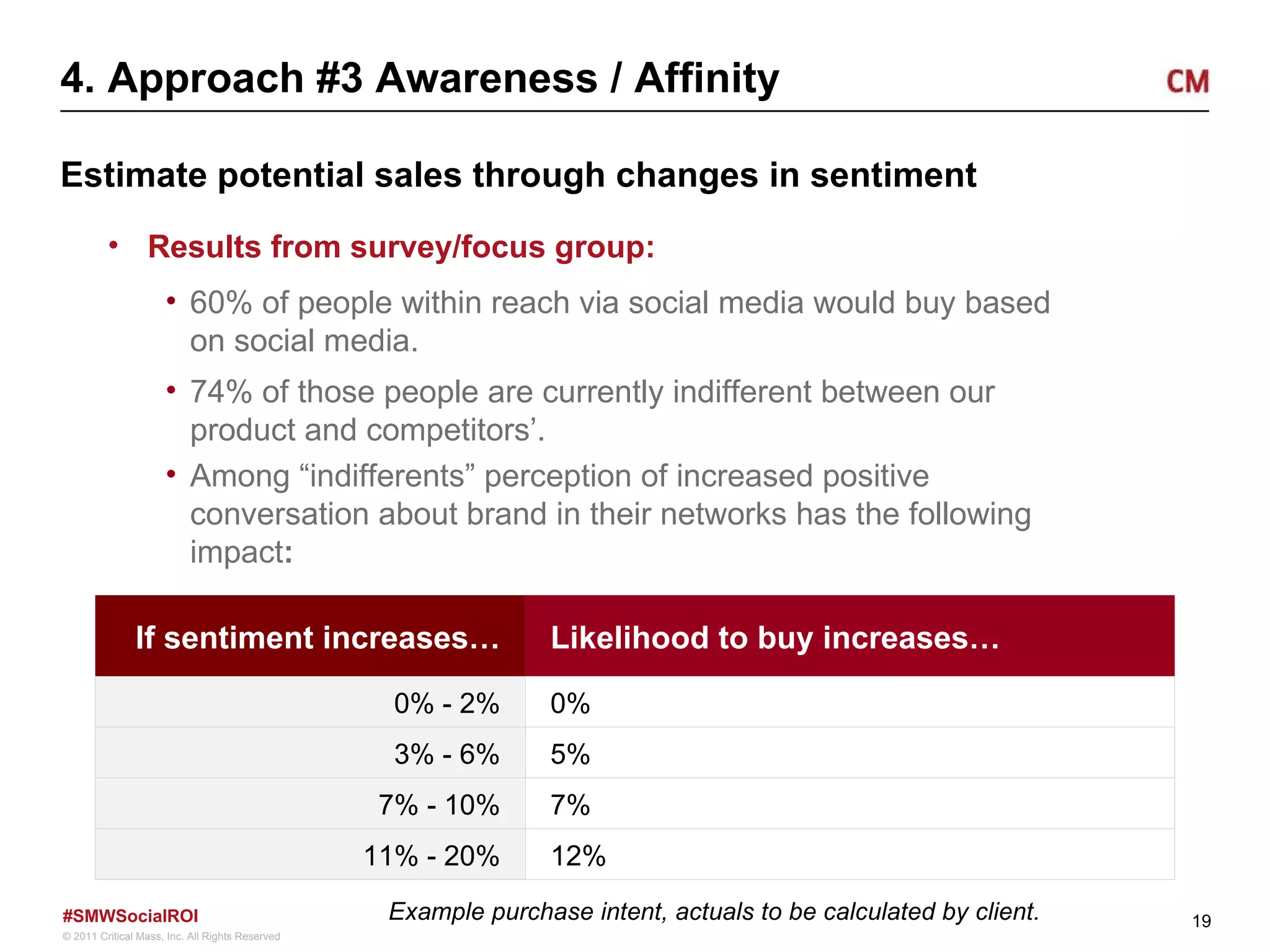
4. Approach #3 Awareness / Affinity Estimate potential sales through changes in sentiment Results from survey/focus group: 60% of people within reach via social media would buy based on social media. 74% of those people are currently indifferent between our product and competitors’. Among “ indifferents ”  perception of increased positive conversation about brand in their networks has the following impact : Example purchase intent, actuals to be calculated by client. If sentiment increases… Likelihood to buy increases… 0% - 2% 0% 3% - 6% 5% 7% - 10% 7% 11% - 20% 12%
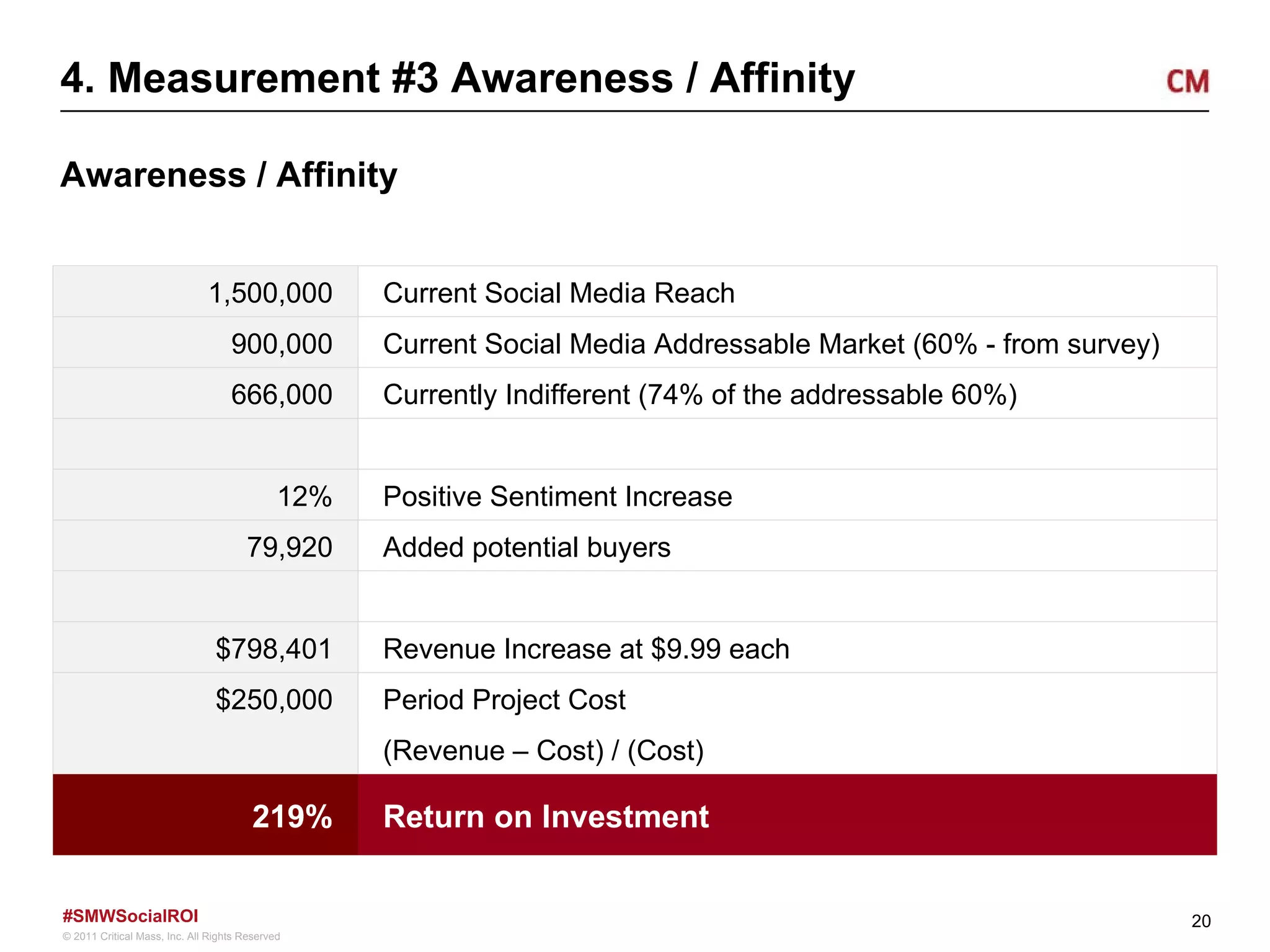
4. Measurement #3 Awareness / Affinity Awareness / Affinity 1,500,000 Current Social Media Reach 900,000 Current Social Media Addressable Market (60% - from survey) 666,000 Currently Indifferent (74% of the addressable 60%) 12% Positive Sentiment Increase 79,920 Added potential buyers $798,401 Revenue Increase at $9.99 each $250,000 Period Project Cost (Revenue – Cost) / (Cost) 219% Return on Investment
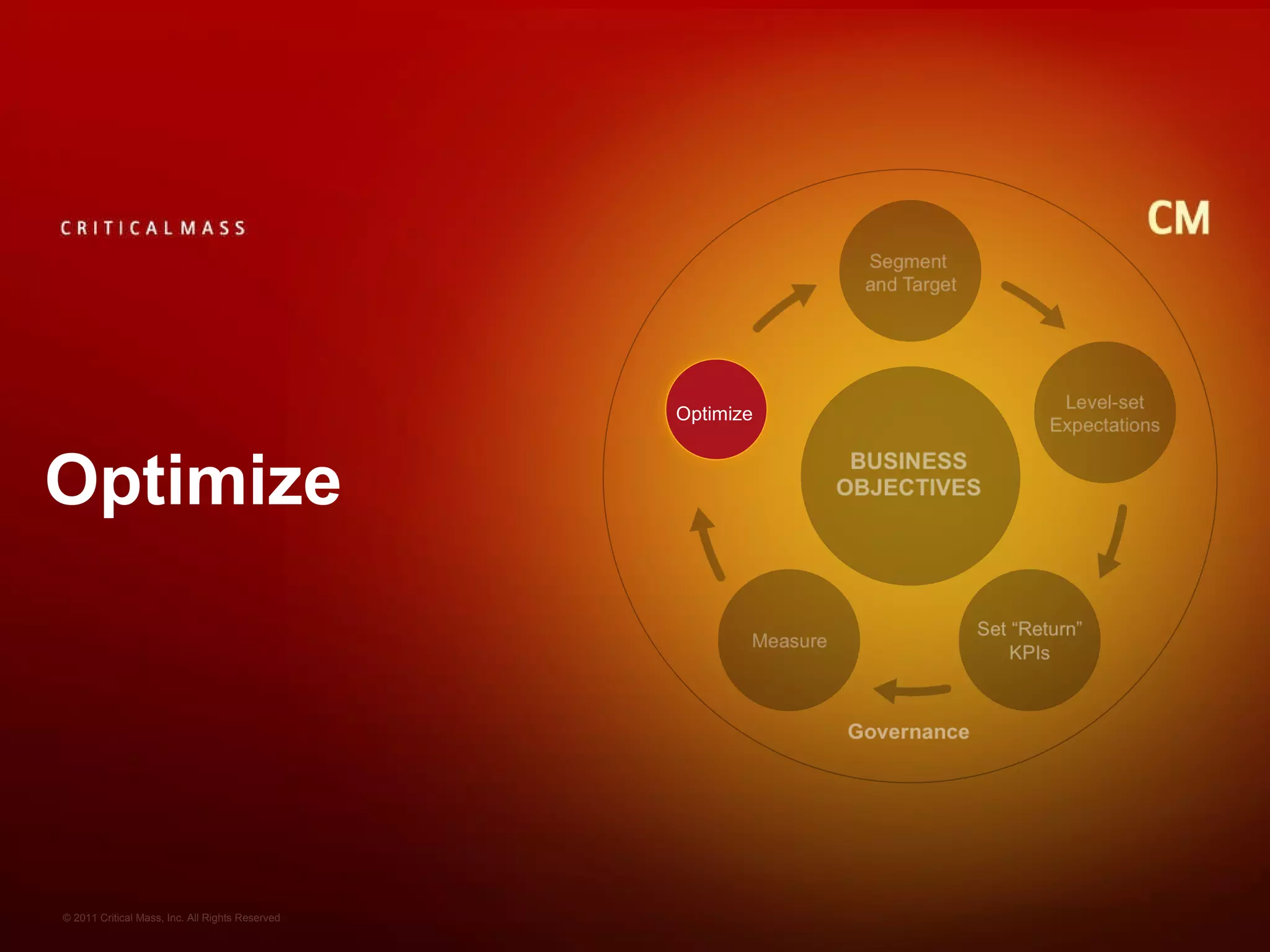
Optimize Optimize
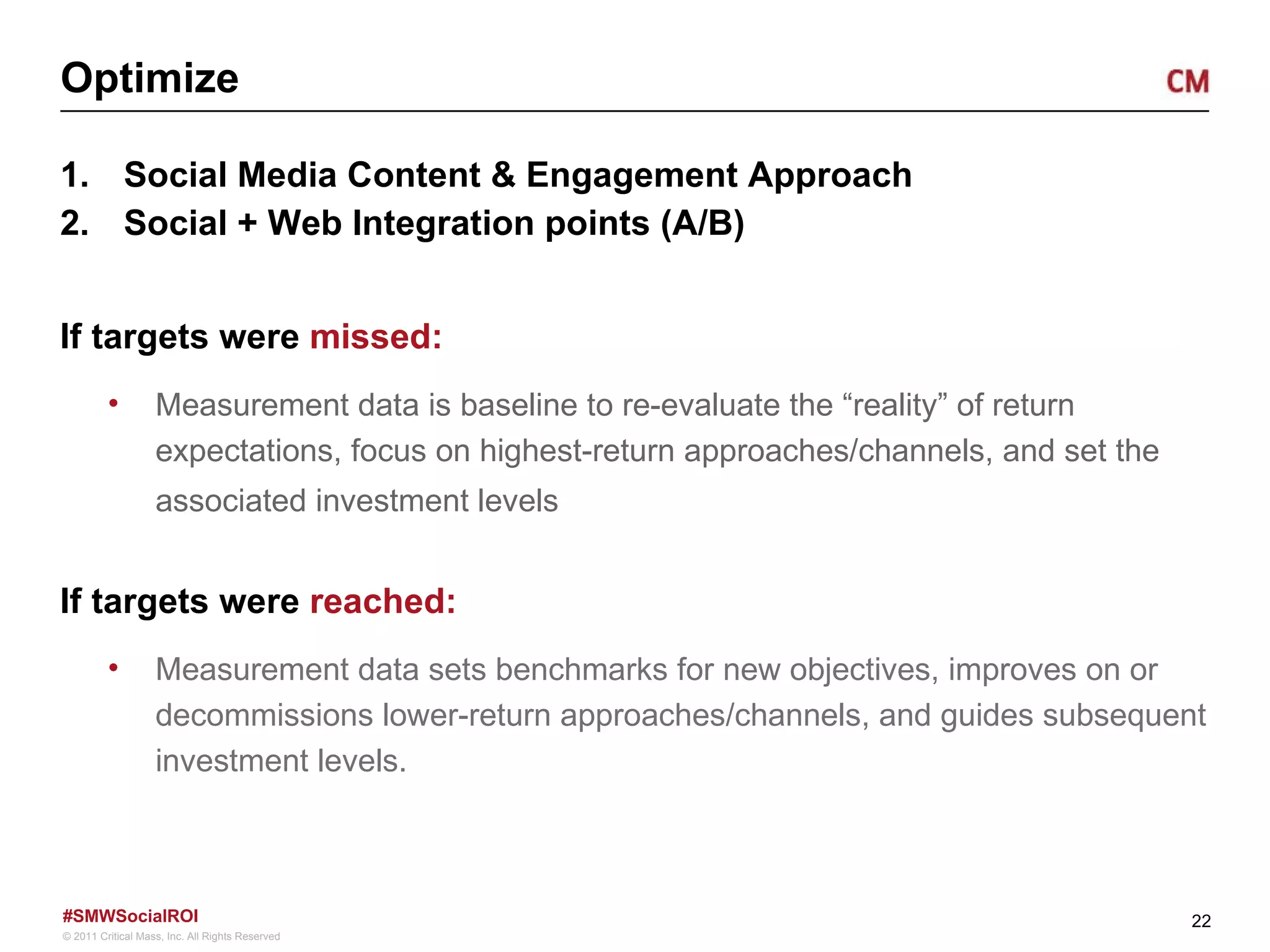
Optimize Social Media Content & Engagement Approach Social + Web Integration points (A/B) If targets were  missed: Measurement data is baseline to re-evaluate the “reality” of return expectations, focus on highest-return approaches/channels, and set the associated investment levels If targets were  reached:   Measurement data sets benchmarks for new objectives, improves on or decommissions lower-return approaches/channels, and guides subsequent investment levels.
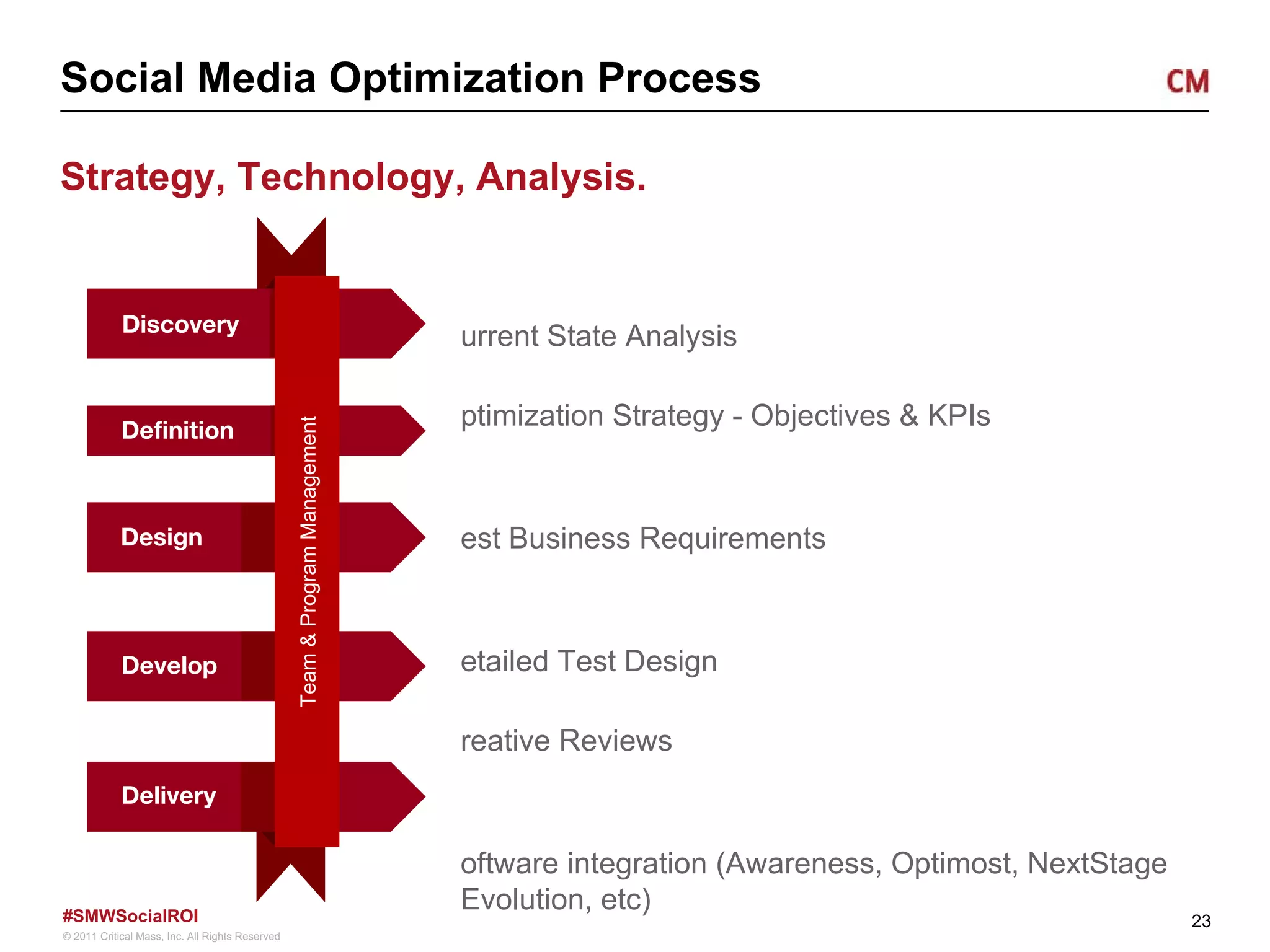
Social Media Optimization Process Strategy, Technology, Analysis. Develop Current State Analysis Optimization Strategy - Objectives & KPIs Test Business Requirements Detailed Test Design Creative Reviews Software integration (Awareness, Optimost, NextStage Evolution, etc) Implementation Run Test Analysis & Recommendations for next test Discovery Design Delivery Definition Team & Program Management
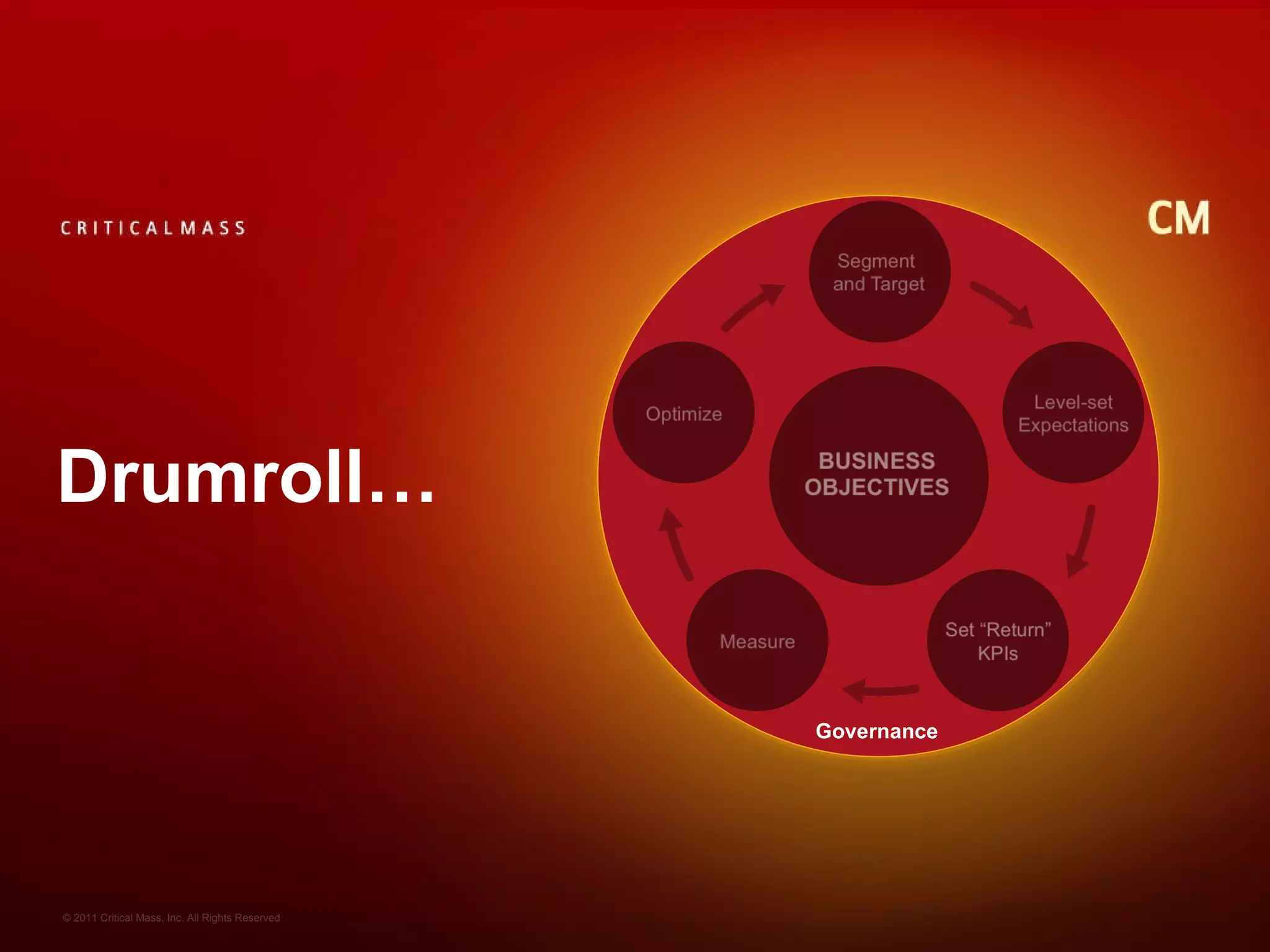
Drumroll… Governance
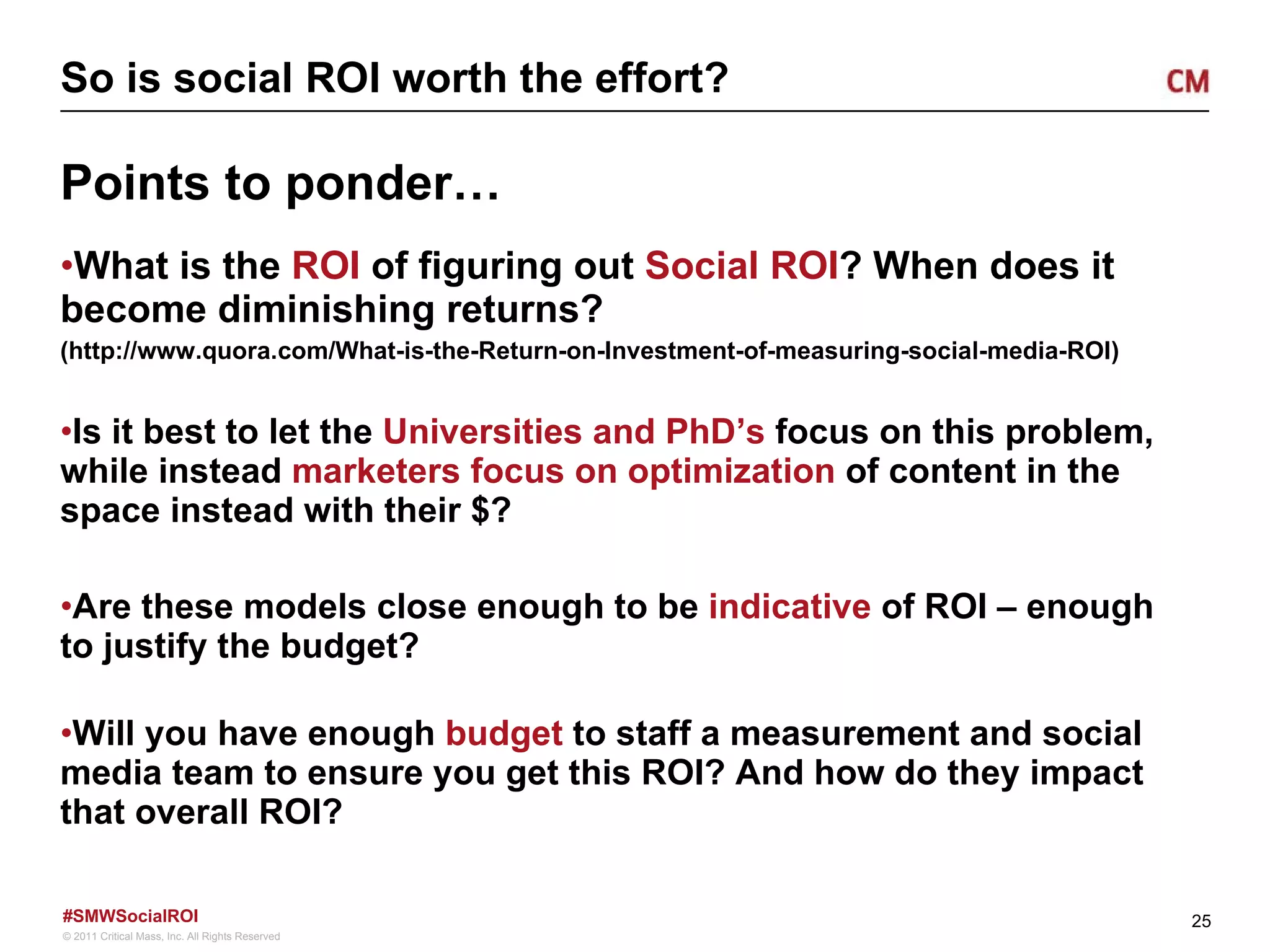
So is social ROI worth the effort? Points to ponder… What is the  ROI  of figuring out  Social ROI ? When does it become diminishing returns? (http://www.quora.com/What-is-the-Return-on-Investment-of-measuring-social-media-ROI) Is it best to let the  Universities and PhD’s  focus on this problem, while instead  marketers focus on optimization  of content in the space instead with their $? Are these models close enough to be  indicative  of ROI – enough to justify the budget? Will you have enough  budget  to staff a measurement and social media team to ensure you get this ROI? And how do they impact that overall ROI?
Questions @shainaboone @scotwheeler
Thank You

Getting to social roi

  • 1.
    Getting to SocialROI Black & White and Lots of Gray #SMWsocialROI September 20, 2011
  • 2.
    Why is social ROI needed? Especially what the ROI of the website is (if there is no way to tie back sales) Instead it’s focused on engagement, awareness, retention. 2002… “ Why do I need a website?” “ The internet isn’t going to be around forever.” “ What’s the ROI of my website if I don’t sell any products?” 2011… nobody asks those questions anymore. That said…we’ll try to give some guidance on how to evaluate Social ROI today. Remember
  • 3.
    What this presentationisn’t… We aren’t going to give you a $$ for Social Media ROI . Just like a website, the ROI of each marketing initiative is unique to the business and the initiative itself . We are going to share methodology and process for figuring out social ROI. FREE intellectual property. Yep. Why? To advance the industry beyond this question.
  • 4.
    Measurement Culture &Governance To get to ROI, an organization must have a certain level of maturity with measurement Culture of Advertising = low Culture of Research = medium Culture of Measurement = high Culture of Accountability = very high Social Media governance needs participation from leadership & SMEs in PR, Digital Comms, Market Research & Strategy, Product Mgmt, Customer Service, IT and Ops. ROI unlikely likely
  • 5.
    Secrets to ROISuccess Clearly defined business, marketing and consumer objectives. Yes, this is more difficult than you would believe to get marketers and agencies to take the time to do, and to do right. Marketing: Improve usability of home page and navigation to increase clarity of the path into consideration and ultimately conversion Consumer: Help me find what ’s new and on sale Business: Increase store locator visits from top navigation on non-ecomm sites Adoption, Belief, Trust: Deep understanding of objectives, and constant reminder and adherence to the objectives throughout the program by all business and agency stakeholders. Targets/Goals: Accountability and incentives to meet defined targets/goals.
  • 6.
    Model for EffectiveSocial ROI #SMWsocialROI
  • 7.
    Segment andTarget Segment and Target
  • 8.
    1. Segment& Target – Know Your Audience Investment decisions, and the potential returns expected, should be based in a clear understanding of the portion of your market that can be effectively engaged through social media Step 1: Develop Social Segments/Personas e.g.,
  • 9.
  • 10.
    2. Industry WillDrive ROI Possibilities High = 3, Med = 2, Low = 1 Researched Industry = high price-sensitivity, high commitment, low experience Referred Industry = low price-sensitivity, low commitment, high experience Mortage Air travel Movie Guided by Reference (Social) Guided by Research (SEO/PPC) Mortgage “Reference” Score = 1 out of 9. INDUSTRY PRICE S. LIFETIME COMMITMENT LIFETIME EXP. RESEARCH REFERENCE Mortgage 3 3 2 8 1 100% 90% 80% 70% 60% 50% 40% 30% 20% 10% 0%
  • 11.
    Set “Return” KPIsSet “Return” KPIs
  • 12.
    3. Determine “Return”Measures ONLINE CONVERSIONS ENGAGEMENT/ADVOCACY AWARENESS/AFFINITY (w/SENTIMENT) Register on site. Content Likes Avg comments/post SoV Purchase from site. Content Shares Avg retweet/post Volume/Buzz Comments (Avg likes/post)/total page likes Network Footprint (Page Likes, follows) @ mentions (Avg comments/post)/total page likes Retweets (Avg retweet/post)/followers Avg likes/post   Online Sales (3 - 1) Reference Level       Entertainment 3 8   Apparel 3 7   "Hard" & "Soft" Social Media ROI Hotel 3 6   (Revenues, LTV-Affinity & Advocacy) Personal Care 3 6       Air travel 3 5       Furniture 2 4       Bev 1 4       Food 1 4       Appliances 2 3       Auto 2 3       Mortgage 2 2   "Soft" Social Media ROI H/A Insurance 2 2   (LTV-Affinity & Advocacy) Healthcare 1 1  
  • 13.
    Social ROI –CM Definitions Investment (cost) comes from: Tools Staff & Consulting Training Tech & Creative Returns can come via: Conversions/Activity Engagement/Advocacy Awareness/Affinity
  • 14.
  • 15.
    4. Approach #1Conversion Online conversions example: 1,054,000 Direct social media referrals (click-throughs to purchase CTA) 8% Conversion rate $9.99 Per conversion $842,356 Revenue Contributed $250,000 Period Project Cost (Rev Contributed – Cost) / (Cost) 237% Return on Investment
  • 16.
    4. Approach #2Engagement / Advocacy What constitutes an engaged fan? An estimator for referrals and lifetime value of customer. Measures “actions” taken around the brand in social networks. Comment, Like, @ Mention, Retweet Attributes increasing value to “deeper” involvement with content: Comment > Like Uses ratios to normalize engagement, example (month): 40 mentions & retweets / 1000 followers = 4% engagement in Twitter 800 content likes / 24,000 page likes = 3.3% engagement in FB
  • 17.
    4. Approach #2Engagement / Advocacy Engagement / Advocacy Estimated via consumer insight research (survey) 1,500,000 Current Social Media Reach 45,000 Engaged "fans” (3%) $17.48 1.75 additional purchases at $9.99 each $786,600 Revenue $250,000 Period Project Cost (Revenue – Cost) / (Cost) 215% Return on Investment
  • 18.
    4. Approach #3Awareness / Affinity Attributing value to sentiment: A potential estimator of market share and purchase intent. Volume = How much is being said? Reach/Footprint = How broadly is it being viewed? Sentiment = What is being said? Does it indicate intent to purchase or recommend? Use survey to: Quantify market size of SM-driven consumers, Determine social media impact on purchase intent, and Correlate opinion impact on purchase intent. Monitor sentiment & tag social media content Primary research: determine impact of SM on PI Estimated Change in PI based on change in content + =
  • 19.
    4. Approach #3Awareness / Affinity Estimate potential sales through changes in sentiment Results from survey/focus group: 60% of people within reach via social media would buy based on social media. 74% of those people are currently indifferent between our product and competitors’. Among “ indifferents ” perception of increased positive conversation about brand in their networks has the following impact : Example purchase intent, actuals to be calculated by client. If sentiment increases… Likelihood to buy increases… 0% - 2% 0% 3% - 6% 5% 7% - 10% 7% 11% - 20% 12%
  • 20.
    4. Measurement #3Awareness / Affinity Awareness / Affinity 1,500,000 Current Social Media Reach 900,000 Current Social Media Addressable Market (60% - from survey) 666,000 Currently Indifferent (74% of the addressable 60%) 12% Positive Sentiment Increase 79,920 Added potential buyers $798,401 Revenue Increase at $9.99 each $250,000 Period Project Cost (Revenue – Cost) / (Cost) 219% Return on Investment
  • 21.
  • 22.
    Optimize Social MediaContent & Engagement Approach Social + Web Integration points (A/B) If targets were missed: Measurement data is baseline to re-evaluate the “reality” of return expectations, focus on highest-return approaches/channels, and set the associated investment levels If targets were reached: Measurement data sets benchmarks for new objectives, improves on or decommissions lower-return approaches/channels, and guides subsequent investment levels.
  • 23.
    Social Media OptimizationProcess Strategy, Technology, Analysis. Develop Current State Analysis Optimization Strategy - Objectives & KPIs Test Business Requirements Detailed Test Design Creative Reviews Software integration (Awareness, Optimost, NextStage Evolution, etc) Implementation Run Test Analysis & Recommendations for next test Discovery Design Delivery Definition Team & Program Management
  • 24.
  • 25.
    So is socialROI worth the effort? Points to ponder… What is the ROI of figuring out Social ROI ? When does it become diminishing returns? (http://www.quora.com/What-is-the-Return-on-Investment-of-measuring-social-media-ROI) Is it best to let the Universities and PhD’s focus on this problem, while instead marketers focus on optimization of content in the space instead with their $? Are these models close enough to be indicative of ROI – enough to justify the budget? Will you have enough budget to staff a measurement and social media team to ensure you get this ROI? And how do they impact that overall ROI?
  • 26.
  • 27.

Editor's Notes

  • #7 So
  • #13 What does “return” mean in this header? This slide needs to find a way to explain the model – Is it only 1-6? Or 1-10? Is this “Referral Score” same as “referral” from previous slide? Which direction do the ratings go? Seems like 2 is best but 6 is negative? Confusing – make the evaluation scale go the same direction unless there is a good reason for it