Workshop On Communication Skills
Workshop on
Communication Skills
Presented By
Md. Al-Imran Monju
14 Sep 2018, Friday
Content
1. What is Communication?
2. Process of communication
3. Effective communication
skills
4. Barriers to effective
communication
5. Effective Youth IP
communication
Workshop On Communication Skills
What is Communication?
“the imparting or exchanging of information by
speaking, writing, or using some other medium” and
“means of sending or receiving information, such as
telephone lines or computers”.
~Google
Communication comes from Latin word “communis” means to share
It involves two parties/people, Sender and Receiver.
1
Workshop On Communication Skills
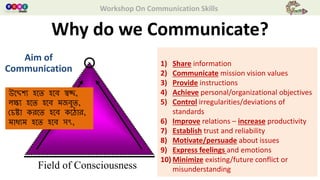
Why do we Communicate?
Field of Consciousness
Aim of
Communication
1) Share information
2) Communicate mission vision values
3) Provide instructions
4) Achieve personal/organizational objectives
5) Control irregularities/deviations of
standards
6) Improve relations – increase productivity
7) Establish trust and reliability
8) Motivate/persuade about issues
9) Express feelings and emotions
10) Minimize existing/future conflict or
misunderstanding
উদ্দেশ্য হদ্দে হদ্দে স্বচ্ছ,
লক্ষ্য হদ্দে হদ্দে মজেুে,
চেষ্টা করদ্দে হদ্দে কদ্দ ার,
মাধ্যম হদ্দে হদ্দে সৎ,
Workshop On Communication Skills
Categories of Communication:
Spoken or Verbal Communication: face-to-face, telephone, radio or television
and other media.
Non-Verbal Communication: body language, gestures, how we dress or act -
even our scent communication between people through sending and receiving wordless cues.
Written Communication: letters, e-mails, books, magazines, the Internet or via
other media.
Visualizations: graphs and charts, maps, logos and other visualizations can
communicate messages.
Workshop On Communication Skills
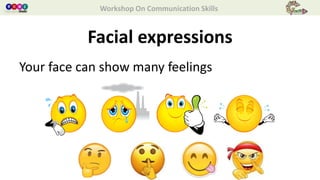
Facial expressions
Your face can show many feelings
Workshop On Communication Skills
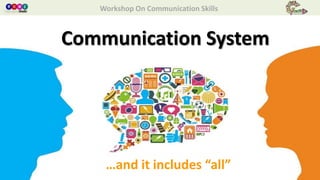
Communication System
…and it includes “all”
Workshop On Communication Skills
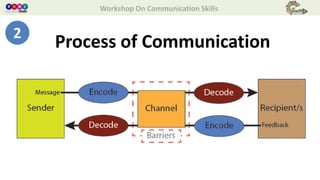
Process of Communication2
Workshop On Communication Skills
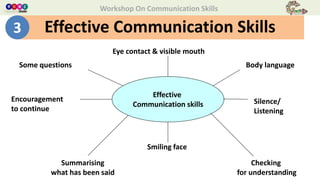
Effective
Communication skills
Eye contact & visible mouth
Body language
Silence/
Listening
Checking
for understanding
Smiling face
Summarising
what has been said
Encouragement
to continue
Some questions
Effective Communication Skills3
Workshop On Communication Skills
The Art of Listening
“If we were supposed to talk more than listen, we
would have been given two mouths and one ear.”
- Mark Twain
American writer
The most basic and powerful way to connect to another person is to listen. Just
listen. Perhaps the most important thing we ever give each other is our attention.
- Rachel Naomi Remen
Author
Professor of California University
Workshop On Communication Skills
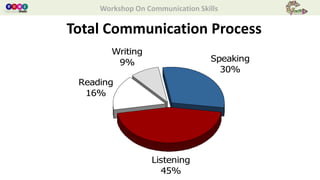
Total Communication Process
Reading
16%
Writing
9% Speaking
30%
Listening
45%
Workshop On Communication Skills
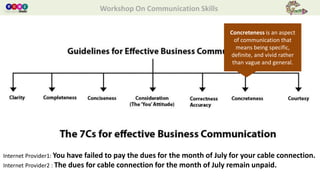
Internet Provider1: You have failed to pay the dues for the month of July for your cable connection.
Internet Provider2 : The dues for cable connection for the month of July remain unpaid.
Concreteness is an aspect
of communication that
means being specific,
definite, and vivid rather
than vague and general.
Workshop On Communication Skills
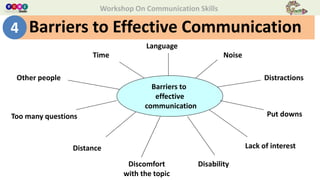
Barriers to
effective
communication
Language
NoiseTime
DistractionsOther people
Put downsToo many questions
Distance
Discomfort
with the topic
Disability
Lack of interest
Barriers to Effective Communication4
Workshop On Communication Skills
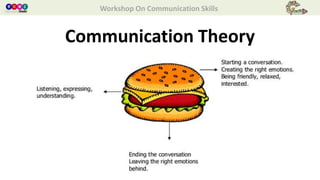
Communication Theory
Workshop On Communication Skills
 Always think ahead about what you are going to say.
 Use simple words and phrases that are understood by every body.
 Increase your knowledge on all subjects you are required to speak.
 Speak clearly and audibly.
 Check twice with the listener whether you have been understood accurately or not
 In case of an interruption, always do a little recap of what has been already said.
 Always pay undivided attention to the speaker while listening.
 While listening, always make notes of important points.
 Always ask for clarification if you have failed to grasp other’s point of view.
 Repeat what the speaker has said to check whether you have understood accurately.
Essentials Of Communication [Dos]
Workshop On Communication Skills
 Do not instantly react and mutter something in anger.
 Do not use technical terms & terminologies not understood by majority of people.
 Do not speak too fast or too slow.
 Do not speak in inaudible surroundings, as you won’t be heard.
 Do not assume that every body understands you.
 While listening do not glance here and there as it might distract the speaker.
 Do not interrupt the speaker.
 Do not jump to the conclusion that you have understood every thing.
Essentials of Communication [Don’ts]
Workshop On Communication Skills
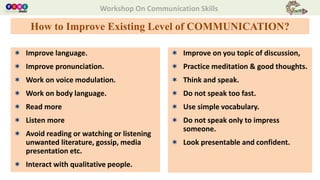
 Improve language.
 Improve pronunciation.
 Work on voice modulation.
 Work on body language.
 Read more
 Listen more
 Avoid reading or watching or listening
unwanted literature, gossip, media
presentation etc.
 Interact with qualitative people.
 Improve on you topic of discussion,
 Practice meditation & good thoughts.
 Think and speak.
 Do not speak too fast.
 Use simple vocabulary.
 Do not speak only to impress
someone.
 Look presentable and confident.
How to Improve Existing Level of COMMUNICATION?
Workshop On Communication Skills
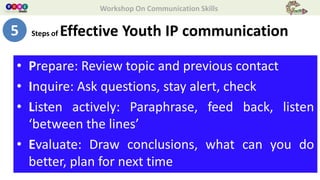
Steps of Effective Youth IP communication
• Prepare: Review topic and previous contact
• Inquire: Ask questions, stay alert, check
• Listen actively: Paraphrase, feed back, listen
‘between the lines’
• Evaluate: Draw conclusions, what can you do
better, plan for next time
5
Workshop On Communication Skills
References:
1. Mr. M Mainuddin Mainul, Managing Director, Good Neighbors Bangladesh
2. https://www.habitsforwellbeing.com/9-effective-communication-skills/
3. https://www.skillsyouneed.com/ips/communication-skills.html
4. https://www.skillsyouneed.com/ips/listening-skills.html
5. https://www.skillsyouneed.com/ips/what-is-communication.html
6. http://open.lib.umn.edu/principlesmanagement/chapter/12-5-different-types-of-communication/
7. Mr. Josef Dias, Capacity Development Consultant, Good Neighbors Global Capacity Development
Center, Thailand
Workshop On Communication Skills
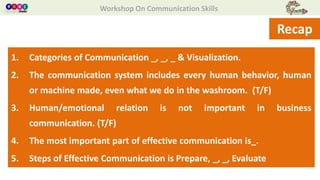
Recap
1. Categories of Communication _, _, _ & Visualization.
2. The communication system includes every human behavior, human
or machine made, even what we do in the washroom. (T/F)
3. Human/emotional relation is not important in business
communication. (T/F)
4. The most important part of effective communication is_.
5. Steps of Effective Communication is Prepare, _, _, Evaluate
Workshop On Communication Skills
THANKS
Youth IP: Home Studio:
E-mail: youthip.org@gmail.com E-mail: hstudiorec@gmail.com
https://www.facebook.com/youthip.org/ https://www.facebook.com/hstudiorec/
https://www.youtube.com/AlimranMonju

Workshop on Communication Skill

  • 1.
    Workshop On CommunicationSkills Workshop on Communication Skills Presented By Md. Al-Imran Monju 14 Sep 2018, Friday Content 1. What is Communication? 2. Process of communication 3. Effective communication skills 4. Barriers to effective communication 5. Effective Youth IP communication
  • 2.
    Workshop On CommunicationSkills What is Communication? “the imparting or exchanging of information by speaking, writing, or using some other medium” and “means of sending or receiving information, such as telephone lines or computers”. ~Google Communication comes from Latin word “communis” means to share It involves two parties/people, Sender and Receiver. 1
  • 3.
    Workshop On CommunicationSkills Why do we Communicate? Field of Consciousness Aim of Communication 1) Share information 2) Communicate mission vision values 3) Provide instructions 4) Achieve personal/organizational objectives 5) Control irregularities/deviations of standards 6) Improve relations – increase productivity 7) Establish trust and reliability 8) Motivate/persuade about issues 9) Express feelings and emotions 10) Minimize existing/future conflict or misunderstanding উদ্দেশ্য হদ্দে হদ্দে স্বচ্ছ, লক্ষ্য হদ্দে হদ্দে মজেুে, চেষ্টা করদ্দে হদ্দে কদ্দ ার, মাধ্যম হদ্দে হদ্দে সৎ,
  • 4.
    Workshop On CommunicationSkills Categories of Communication: Spoken or Verbal Communication: face-to-face, telephone, radio or television and other media. Non-Verbal Communication: body language, gestures, how we dress or act - even our scent communication between people through sending and receiving wordless cues. Written Communication: letters, e-mails, books, magazines, the Internet or via other media. Visualizations: graphs and charts, maps, logos and other visualizations can communicate messages.
  • 5.
    Workshop On CommunicationSkills Facial expressions Your face can show many feelings
  • 6.
    Workshop On CommunicationSkills Communication System …and it includes “all”
  • 7.
    Workshop On CommunicationSkills Process of Communication2
  • 8.
    Workshop On CommunicationSkills Effective Communication skills Eye contact & visible mouth Body language Silence/ Listening Checking for understanding Smiling face Summarising what has been said Encouragement to continue Some questions Effective Communication Skills3
  • 9.
    Workshop On CommunicationSkills The Art of Listening “If we were supposed to talk more than listen, we would have been given two mouths and one ear.” - Mark Twain American writer The most basic and powerful way to connect to another person is to listen. Just listen. Perhaps the most important thing we ever give each other is our attention. - Rachel Naomi Remen Author Professor of California University
  • 10.
    Workshop On CommunicationSkills Total Communication Process Reading 16% Writing 9% Speaking 30% Listening 45%
  • 11.
    Workshop On CommunicationSkills Internet Provider1: You have failed to pay the dues for the month of July for your cable connection. Internet Provider2 : The dues for cable connection for the month of July remain unpaid. Concreteness is an aspect of communication that means being specific, definite, and vivid rather than vague and general.
  • 12.
    Workshop On CommunicationSkills Barriers to effective communication Language NoiseTime DistractionsOther people Put downsToo many questions Distance Discomfort with the topic Disability Lack of interest Barriers to Effective Communication4
  • 13.
    Workshop On CommunicationSkills Communication Theory
  • 14.
    Workshop On CommunicationSkills  Always think ahead about what you are going to say.  Use simple words and phrases that are understood by every body.  Increase your knowledge on all subjects you are required to speak.  Speak clearly and audibly.  Check twice with the listener whether you have been understood accurately or not  In case of an interruption, always do a little recap of what has been already said.  Always pay undivided attention to the speaker while listening.  While listening, always make notes of important points.  Always ask for clarification if you have failed to grasp other’s point of view.  Repeat what the speaker has said to check whether you have understood accurately. Essentials Of Communication [Dos]
  • 15.
    Workshop On CommunicationSkills  Do not instantly react and mutter something in anger.  Do not use technical terms & terminologies not understood by majority of people.  Do not speak too fast or too slow.  Do not speak in inaudible surroundings, as you won’t be heard.  Do not assume that every body understands you.  While listening do not glance here and there as it might distract the speaker.  Do not interrupt the speaker.  Do not jump to the conclusion that you have understood every thing. Essentials of Communication [Don’ts]
  • 16.
    Workshop On CommunicationSkills  Improve language.  Improve pronunciation.  Work on voice modulation.  Work on body language.  Read more  Listen more  Avoid reading or watching or listening unwanted literature, gossip, media presentation etc.  Interact with qualitative people.  Improve on you topic of discussion,  Practice meditation & good thoughts.  Think and speak.  Do not speak too fast.  Use simple vocabulary.  Do not speak only to impress someone.  Look presentable and confident. How to Improve Existing Level of COMMUNICATION?
  • 17.
    Workshop On CommunicationSkills Steps of Effective Youth IP communication • Prepare: Review topic and previous contact • Inquire: Ask questions, stay alert, check • Listen actively: Paraphrase, feed back, listen ‘between the lines’ • Evaluate: Draw conclusions, what can you do better, plan for next time 5
  • 18.
    Workshop On CommunicationSkills References: 1. Mr. M Mainuddin Mainul, Managing Director, Good Neighbors Bangladesh 2. https://www.habitsforwellbeing.com/9-effective-communication-skills/ 3. https://www.skillsyouneed.com/ips/communication-skills.html 4. https://www.skillsyouneed.com/ips/listening-skills.html 5. https://www.skillsyouneed.com/ips/what-is-communication.html 6. http://open.lib.umn.edu/principlesmanagement/chapter/12-5-different-types-of-communication/ 7. Mr. Josef Dias, Capacity Development Consultant, Good Neighbors Global Capacity Development Center, Thailand
  • 19.
    Workshop On CommunicationSkills Recap 1. Categories of Communication _, _, _ & Visualization. 2. The communication system includes every human behavior, human or machine made, even what we do in the washroom. (T/F) 3. Human/emotional relation is not important in business communication. (T/F) 4. The most important part of effective communication is_. 5. Steps of Effective Communication is Prepare, _, _, Evaluate
  • 20.
    Workshop On CommunicationSkills THANKS Youth IP: Home Studio: E-mail: youthip.org@gmail.com E-mail: hstudiorec@gmail.com https://www.facebook.com/youthip.org/ https://www.facebook.com/hstudiorec/ https://www.youtube.com/AlimranMonju