Tim Kingsbury, Conflict Management Plus Ltd  The Fallible Investigation -  Keeping the investigator “out” of interviews, analysis and reports
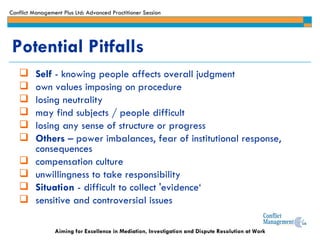
Self  - knowing people affects overall judgment own values imposing on procedure losing neutrality may find subjects / people difficult losing any sense of structure or progress Others  – power imbalances, fear of institutional response, consequences compensation culture unwillingness to take responsibility Situation  - difficult to collect 'evidence‘ sensitive and controversial issues Potential Pitfalls
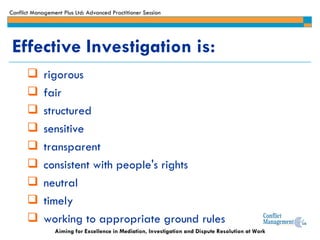
rigorous fair structured sensitive transparent consistent with people's rights neutral timely working to appropriate ground rules Effective Investigation is:
WHAT AFFECTS OUR JUDGEMENT? Emotions Experience Perception and assumptions Received messages Rapport Values
BUILDING RAPPORT SET-UP STAGE Information up front Check for any special requirements/adjustments Create the right physical environment Welcomes Role introductions Ground rules Map process Rapport-build opening THROUGHOUT  Put people at ease Build understanding Communicate effectively Being non-judgemental about others’ beliefs, values, needs Maintaining integrity and impartiality Recognising and understanding difference Managing difficult moments fairly and calmly
NEUTRALITY  AND IMPARTIALITY NEUTRALITY Not making snap judgements Avoiding assumptions Managing your own feelings Putting your own values to one side IMPARTIALITY Not being biased against or for Acting fairly Being consistent Listening equally to all Not blaming or colluding Sticking to ground rules and applying them evenly
checking, clarifying and confirming what you have heard summarising accurately and appropriately – the 4 Fs – Full, Fair, Feelings, Facts building a detailed picture of issues and concerns not interpreting, distorting or responding REFLECTION
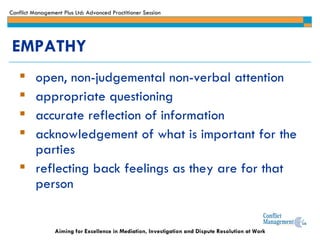
EMPATHY open, non-judgemental non-verbal attention appropriate questioning  accurate reflection of information acknowledgement of what is important for the parties reflecting back feelings as they are for that person
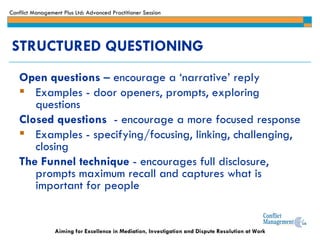
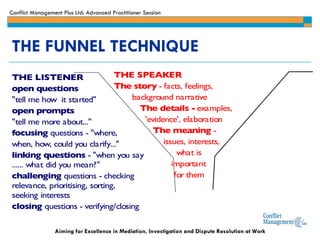
STRUCTURED QUESTIONING Open questions  – encourage a ‘narrative’ reply  Examples - door openers, prompts, exploring questions Closed questions   - encourage a more focused response Examples - specifying/focusing, linking, challenging, closing  The Funnel technique  - encourages full disclosure, prompts maximum recall and captures what is important for people
THE FUNNEL TECHNIQUE
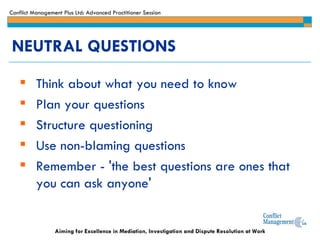
NEUTRAL  QUESTIONS T hink   about what you need to know P lan your questions Structure questioning Us e  non-blaming questions Remember -  'the best questions are ones that you can ask anyone'
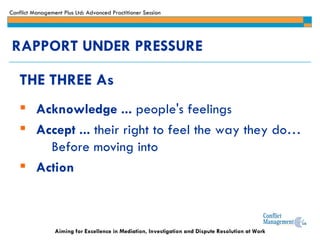
RAPPORT UNDER PRESSURE THE THREE As Acknowledge ...  people's feelings Accept ...  their right to feel the way they do… Before moving into  Action
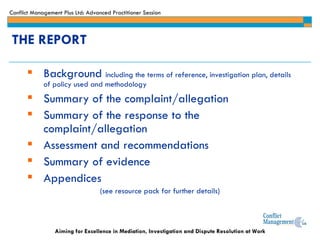
THE REPORT Background  including the terms of reference, investigation plan, details of policy used and methodology Summary of the complaint/allegation Summary of the response to the complaint/allegation Assessment and recommendations Summary of evidence Appendices (see resource pack for further details)
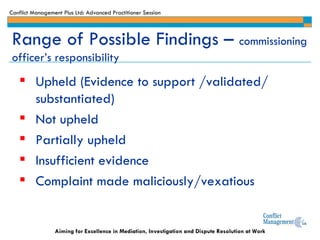
Range of Possible Findings –  commissioning officer’s responsibility Upheld (Evidence to support /validated/ substantiated) Not upheld Partially upheld Insufficient evidence Complaint made maliciously/vexatious
Tim Kingsbury, Conflict Management Plus Ltd  The Fallible Investigation -  Keeping the investigator “out” of interviews, analysis and reports

Workshop G: Tim Kingsbury, Conflict Management Plus

  • 1.
    Tim Kingsbury, ConflictManagement Plus Ltd The Fallible Investigation - Keeping the investigator “out” of interviews, analysis and reports
  • 2.
    Self -knowing people affects overall judgment own values imposing on procedure losing neutrality may find subjects / people difficult losing any sense of structure or progress Others – power imbalances, fear of institutional response, consequences compensation culture unwillingness to take responsibility Situation - difficult to collect 'evidence‘ sensitive and controversial issues Potential Pitfalls
  • 3.
    rigorous fair structuredsensitive transparent consistent with people's rights neutral timely working to appropriate ground rules Effective Investigation is:
  • 4.
    WHAT AFFECTS OURJUDGEMENT? Emotions Experience Perception and assumptions Received messages Rapport Values
  • 5.
    BUILDING RAPPORT SET-UPSTAGE Information up front Check for any special requirements/adjustments Create the right physical environment Welcomes Role introductions Ground rules Map process Rapport-build opening THROUGHOUT Put people at ease Build understanding Communicate effectively Being non-judgemental about others’ beliefs, values, needs Maintaining integrity and impartiality Recognising and understanding difference Managing difficult moments fairly and calmly
  • 6.
    NEUTRALITY ANDIMPARTIALITY NEUTRALITY Not making snap judgements Avoiding assumptions Managing your own feelings Putting your own values to one side IMPARTIALITY Not being biased against or for Acting fairly Being consistent Listening equally to all Not blaming or colluding Sticking to ground rules and applying them evenly
  • 7.
    checking, clarifying andconfirming what you have heard summarising accurately and appropriately – the 4 Fs – Full, Fair, Feelings, Facts building a detailed picture of issues and concerns not interpreting, distorting or responding REFLECTION
  • 8.
    EMPATHY open, non-judgementalnon-verbal attention appropriate questioning accurate reflection of information acknowledgement of what is important for the parties reflecting back feelings as they are for that person
  • 9.
    STRUCTURED QUESTIONING Openquestions – encourage a ‘narrative’ reply Examples - door openers, prompts, exploring questions Closed questions - encourage a more focused response Examples - specifying/focusing, linking, challenging, closing The Funnel technique - encourages full disclosure, prompts maximum recall and captures what is important for people
  • 10.
  • 11.
    NEUTRAL QUESTIONST hink about what you need to know P lan your questions Structure questioning Us e non-blaming questions Remember - 'the best questions are ones that you can ask anyone'
  • 12.
    RAPPORT UNDER PRESSURETHE THREE As Acknowledge ... people's feelings Accept ... their right to feel the way they do… Before moving into Action
  • 13.
    THE REPORT Background including the terms of reference, investigation plan, details of policy used and methodology Summary of the complaint/allegation Summary of the response to the complaint/allegation Assessment and recommendations Summary of evidence Appendices (see resource pack for further details)
  • 14.
    Range of PossibleFindings – commissioning officer’s responsibility Upheld (Evidence to support /validated/ substantiated) Not upheld Partially upheld Insufficient evidence Complaint made maliciously/vexatious
  • 15.
    Tim Kingsbury, ConflictManagement Plus Ltd The Fallible Investigation - Keeping the investigator “out” of interviews, analysis and reports