WELCOME TO HR HOT
TOPICS 2018 - 2019
Agenda
8:55 am Welcome and Introductions
- Jill Zappitelli, H2R Business Solutions
9:00 am Interpersonal Conflict and How to Defuse Them
- Chantal MacIntyre, HR Director, Clarion Medical Supplies
9:40 am Best Practices for Investigations
- Dean Benard, Owner, Benard & Associates
10:20 am Break
10:30 am Cannabis in the Workplace, ESA Changes and Other Hot Topics
- P.A. Neena Gupta, Partner, Gowling WLG
- Dr. Melissa Snider-Adler, DriverCheck Inc.
11:15 am High-Performance Cultures
- Jackie Lauer, Owner, Jackie Lauer Consulting
11:55 am Wrap Up / Draws / HRPA Code
- Chris Perkins, Grand River Personnel
WELCOME REMARKS
Jill Zappitelli, H2R Business Solutions
INTERPERSONAL
CONFLICTS AND HOW
TO DEFUSE THEM
Chantal MacIntyre
HR Director
Clarion Medical Supplies
Conflict… Crisis or Opportunity?
Mount Washington
Mount Everest
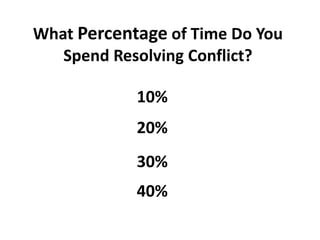
What Percentage of Time Do You
Spend Resolving Conflict?
10%
40%
20%
30%
Naive CHRL Girl Right Here!
Why Can’t They All Just Get Along?
Remember the Leaders?
How many of you feel confident in your
Conflict Resolution strategies?
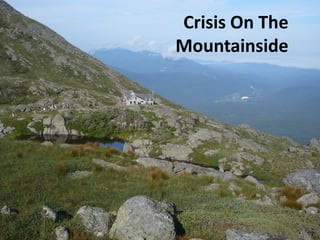
Crisis On The
Mountainside
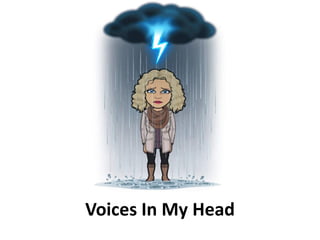
Voices In My Head
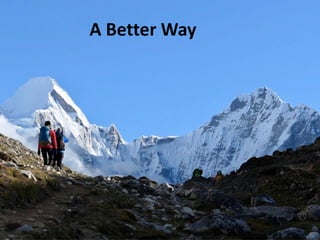
A Better Way
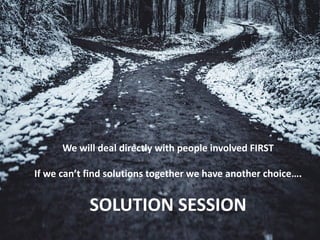
We will deal directly with people involved FIRST
If we can’t find solutions together we have another choice….
SOLUTION SESSION
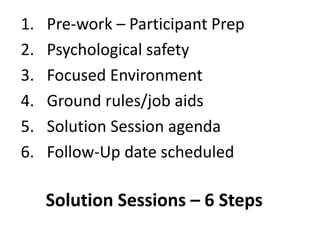
Solution Sessions – 6 Steps
1. Pre-work – Participant Prep
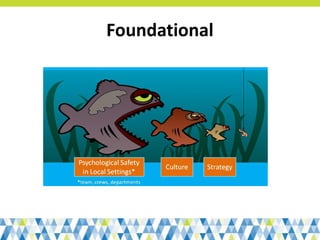
2. Psychological safety
3. Focused Environment
4. Ground rules/job aids
5. Solution Session agenda
6. Follow-Up date scheduled
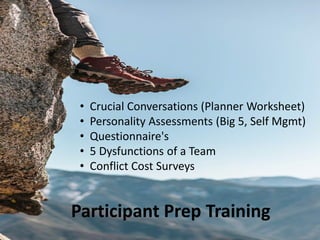
1. Participant Prep
• Crucial Conversations (Planner Worksheet)
• Personality Assessments (Big 5, Self Mgmt)
• Questionnaire's
• 5 Dysfunctions of a Team
• Conflict Cost Surveys
Participant Prep Training
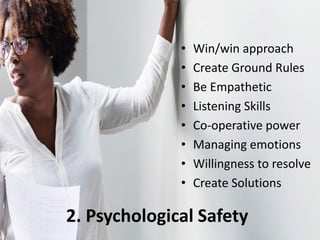
• Win/win approach
• Create Ground Rules
• Be Empathetic
• Listening Skills
• Co-operative power
• Managing emotions
• Willingness to resolve
• Create Solutions
2. Psychological Safety
3. No Distraction Environment
4. Ground Rules
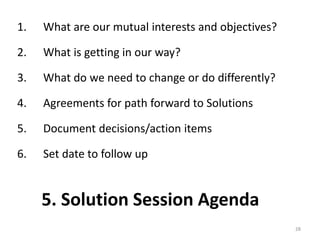
1. What are our mutual interests and objectives?
2. What is getting in our way?
3. What do we need to change or do differently?
4. Agreements for path forward to Solutions
5. Document decisions/action items
6. Set date to follow up
28
5. Solution Session Agenda
Can’t Leave Them Hanging
6. Follow Up Date Scheduled
The Solution Session
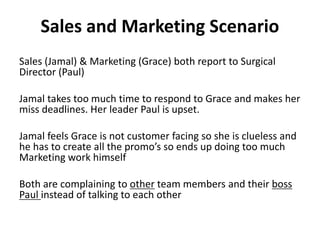
Sales and Marketing Scenario
Sales (Jamal) & Marketing (Grace) both report to Surgical
Director (Paul)
Jamal takes too much time to respond to Grace and makes her
miss deadlines. Her leader Paul is upset.
Jamal feels Grace is not customer facing so she is clueless and
he has to create all the promo’s so ends up doing too much
Marketing work himself
Both are complaining to other team members and their boss
Paul instead of talking to each other
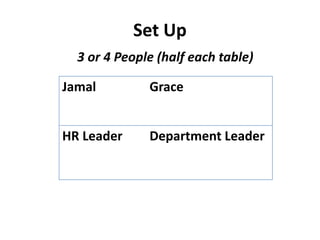
Set Up
3 or 4 People (half each table)
Jamal Grace
HR Leader Department Leader
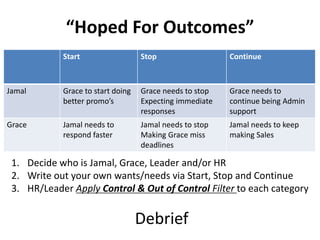
“Hoped For Outcomes”
Start Stop Continue
Jamal Grace to start doing
better promo’s
Grace needs to stop
Expecting immediate
responses
Grace needs to
continue being Admin
support
Grace Jamal needs to
respond faster
Jamal needs to stop
Making Grace miss
deadlines
Jamal needs to keep
making Sales
1. Decide who is Jamal, Grace, Leader and/or HR
2. Write out your own wants/needs via Start, Stop and Continue
3. HR/Leader Apply Control & Out of Control Filter to each category
Debrief
Expectations Realistic?
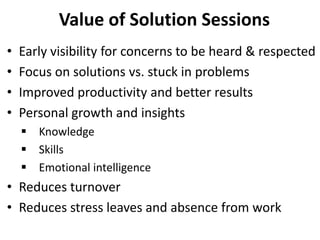
• Early visibility for concerns to be heard & respected
• Focus on solutions vs. stuck in problems
• Improved productivity and better results
• Personal growth and insights
 Knowledge
 Skills
 Emotional intelligence
• Reduces turnover
• Reduces stress leaves and absence from work
Value of Solution Sessions
Conflict… An Opportunity For Growth
Connect with me on
www.chantalmcintyre.com
• Presentation
• Resources
• Solution Session
Legal Process
• Peer Support or
Need A Sherpa?
INVESTIGATION BEST
PRACTICES
Dean Benard
Benard & Associates
Investigation
Best Practices
HR Hot Topics
November 21, 2018
Presented By
Dean Benard
Hitting The Target
“Top Ten List”
The top ten considerations that
can make or break an
investigation
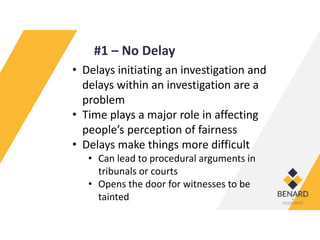
#1 – No Delay
• Delays initiating an investigation and
delays within an investigation are a
problem
• Time plays a major role in affecting
people’s perception of fairness
• Delays make things more difficult
• Can lead to procedural arguments in
tribunals or courts
• Opens the door for witnesses to be
tainted
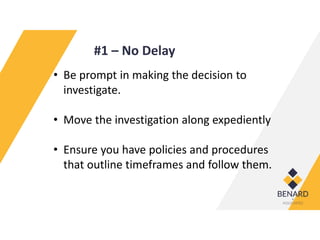
#1 – No Delay
• Be prompt in making the decision to
investigate.
• Move the investigation along expediently
• Ensure you have policies and procedures
that outline timeframes and follow them.
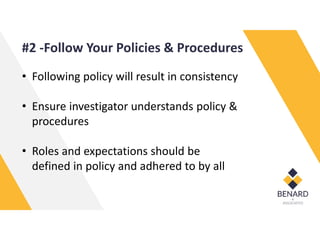
#2 -Follow Your Policies & Procedures
• Following policy will result in consistency
• Ensure investigator understands policy &
procedures
• Roles and expectations should be
defined in policy and adhered to by all
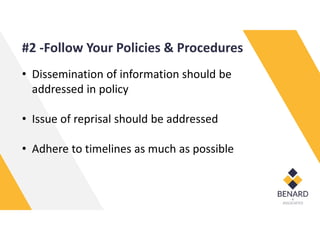
#2 -Follow Your Policies & Procedures
• Dissemination of information should be
addressed in policy
• Issue of reprisal should be addressed
• Adhere to timelines as much as possible
#3 – Proper Selection of Investigator
Internal
• Consider any perceived conflicts
• Will the investigator be able to devote
the required time
• Ensure the investigator is not going to
feel at risk
• Skills and experience vs. complexity – is
it a good fit?
#3 – Proper Selection of Investigator
External – Investigate the Investigator!
• Are they licensed or otherwise exempt?
• Consider a short interview
• Are they adequately experienced in this area
of investigations?
• What are some examples of cases they have
completed?
• Do they have appropriate insurance
coverage?
• Consider checking references
#4 – Stay Within Scope / Mandate
• Confirm the scope of the investigation
in writing with a “TOR” or engagement
letter
• This is the first consideration when
planning the investigation
• Understand the issues, incidents, and
context
#4 – Stay Within Scope / Mandate
• Going outside scope can lead to
unfairness and even missing what was
intended to be investigated
• Be alert to efforts by some to raise
irrelevant information to “strengthen”
their position
• What if new information is discovered?
#5 – Proper and Complete Interviews
• Gather the relevant facts
• Share information on a “need to now”
• Consider recording interviews
• Always give interviewee the
opportunity to review their statement
• Have them sign off on their statement
• Assess credibility & reliability
#5 – Proper and Complete Interviews
Your Approach:
• Build rapport
• Provide context for the interviewee
• General to specific
• Avoid leading questions
• Don’t coerce or threaten
• Stay calm
#5 – Proper and Complete Interviews
Assessing Credibility
• Corroboration is often not available
• Critical skill required of investigators
• Be wary of body language myths
• Key things to focus on
• Plausibility of statements
• Shifting context
• Discrediting the Complainant
• Consider motives
#6 – Appropriate Evidence Gathered
& Preserved
• Consider all options for evidence - internal and
external
• Company owned cell phones, laptops,
computers etc.
• Consider possibility that evidence provided
may have been altered or not provided in full
(messenger, text messages, emails)
#6 – Appropriate Evidence Gathered
& Preserved
• Verify source and compare if possible
• Note how and by whom evidence was
provided
• Copy documentary evidence – do not alter
originals
• Safeguard evidence to prevent unnecessary
access or tampering
#7 – Investigation is carefully
Documented
• Keep a file of the investigation that
includes:
• Investigation plan
• Notes of all interviews and contacts
• Copies of documents obtained
• Documentation of your actions as the
investigator
#8 – Maintain Neutrality &
Procedural Fairness
• Remain objective and neutral – Remember,
investigators are not advocates
• Be transparent with the process
• Ensure fair notice to Respondents of
complaints and provide sufficient detail
• Give Respondents the opportunity to
respond
#8 – Maintain Neutrality &
Procedural Fairness
• Consider all relevant information
• Conduct interviews in a neutral manner
• Stay within the investigation mandate
• Refrain from unnecessary commentary
• Neutral language in notes and reports
#9 – Confidentiality Is Preserved
• Share information only as necessary
• Guard evidence carefully
• Reinforce need for confidentiality -
Consider confidentiality agreements for
witnesses
• Make a statement in interviews that you
do not consent to be recorded
Thorough: The report contains all the
information needed to reach a decision.
Objective: The report presents the facts in a
neutral manner. Conclusions are tied to
evidence, not opinion
Clear: The language is easy to understand
and difficult to misinterpret.
#10 – Reports Are Clear & Comprehensive
#10 – Reports Are Clear &
Comprehensive
Accurate: The report contains the facts
gathered by the investigator.
Professional: The report reflects the
credibility of the investigation and the
investigator.
Summary
Investigators and the investigation process
will be scrutinized for errors
Attention to these aspects of the process is
crucial to avoid negative criticism
A lot rests on these investigations and we
owe it to all involved to get it right
Thank You
Benard + Associates
240 Holiday Inn Drive, Unit O
Cambridge, Ontario
519-880-1917
888-733-2226
dbenard@benardinc.com
www.benardinc.com
NETWORKING BREAK
CANNABIS IN THE WORKPLACE, ESA
CHANGES FOR 2019 AND OTHER HOT
TOPICS
PRESENTED BY:
P.A. NEENA GUPTA
GOWLING WLG
DR. MELISSA SNIDER-ADLER
DRIVERCHECK INC.
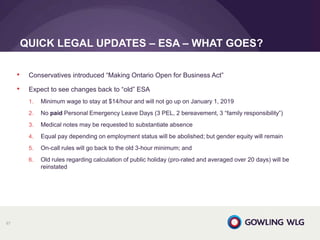
• Conservatives introduced “Making Ontario Open for Business Act”
• Expect to see changes back to “old” ESA
1. Minimum wage to stay at $14/hour and will not go up on January 1, 2019
2. No paid Personal Emergency Leave Days (3 PEL, 2 bereavement, 3 “family responsibility”)
3. Medical notes may be requested to substantiate absence
4. Equal pay depending on employment status will be abolished; but gender equity will remain
5. On-call rules will go back to the old 3-hour minimum; and
6. Old rules regarding calculation of public holiday (pro-rated and averaged over 20 days) will be
reinstated
QUICK LEGAL UPDATES – ESA – WHAT GOES?
67
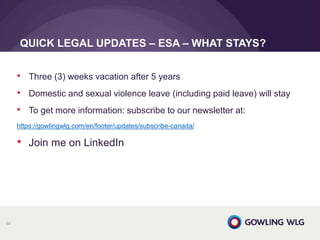
• Three (3) weeks vacation after 5 years
• Domestic and sexual violence leave (including paid leave) will stay
• To get more information: subscribe to our newsletter at:
https://gowlingwlg.com/en/footer/updates/subscribe-canada/
• Join me on LinkedIn
QUICK LEGAL UPDATES – ESA – WHAT STAYS?
68
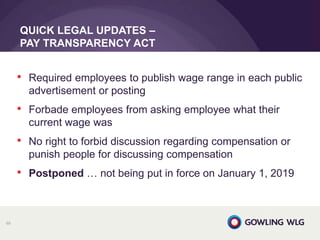
• Required employees to publish wage range in each public
advertisement or posting
• Forbade employees from asking employee what their
current wage was
• No right to forbid discussion regarding compensation or
punish people for discussing compensation
• Postponed … not being put in force on January 1, 2019
QUICK LEGAL UPDATES –
PAY TRANSPARENCY ACT
69
• Courts do not like ESA only employment agreements
• Look for any kind of non-conformity
• Agreements need protective language that if there is any
inadvertent violation of ESA, ESA governs
• If you have language that says “no notice or compensation for
cause”, make sure it has language that says, “unless otherwise
required by ESA” – otherwise, Court of Appeal says it violates
the ESA
• Get agreements every year and any time there is a critical high-
level offer
COURTS KEEP STRIKING DOWN CONTRACTS
70
CANNABIS IN THE
WORKPLACE
What makes cannabis different from alcohol and other recreational drugs?
• Easy and expensive to obtain or grow
• No easy workplace test for current impairment
• Habitual users may be impaired, but may not show “obvious” signs
• No « breathalyzer » for marijuana
Statistics source: “Number of Canadians buying legal medical marijuana triples in just one year”, The
National Post, 13 December 2016, online:
<http://business.financialpost.com/commodities/agriculture/number-of-canadians-buying-legal-
medical-marijuana-triples-in-just-one-year-pn-1188-words-local-news>.
WHY ARE WE AFRAID OF CANNABIS?
NEGATIVELY IMPACTS:
• Judgment
• Motor coordination
• Reaction Time
• Memory
• Ability to Learn
• Mood
IS CANNABIS A PROBLEM?
73
• Not always easy to determine if individual impaired
• Even police not fully trained to ascertain impairment
• The new roadside devices new to market (the Dräger Drug Test 5000 approved on August 27,
2018 by the federal government)
• Regulations in their infancy – Criminal Code amended June 21, 2018
-- 2 to 5 nanograms (summary conviction – precautionary)
-- 5 nanograms or more (more serious)
-- 5 nanograms + alcohol of 50 mg (.05) (more serious)
IS CANNABIS A PROBLEM?
74
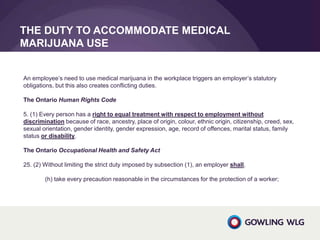
THE DUTY TO ACCOMMODATE MEDICAL
MARIJUANA USE
An employee’s need to use medical marijuana in the workplace triggers an employer’s statutory
obligations, but this also creates conflicting duties.
The Ontario Human Rights Code
5. (1) Every person has a right to equal treatment with respect to employment without
discrimination because of race, ancestry, place of origin, colour, ethnic origin, citizenship, creed, sex,
sexual orientation, gender identity, gender expression, age, record of offences, marital status, family
status or disability.
The Ontario Occupational Health and Safety Act
25. (2) Without limiting the strict duty imposed by subsection (1), an employer shall,
(h) take every precaution reasonable in the circumstances for the protection of a worker;
EMPLOYER’S LEGITIMATE EXPECTATION
76
Expectation is that “all workers are fit
to safely and reliably perform their
work duties … throughout their shift
and free from impairment due to
alcohol and/or drugs.” [Canadian
Model for Providing a Safe Workplace]
ADDICTION IS A DISABILITY
PRESCRIPTION CANNABIS
NEEDS TO BE
ACCOMMODATED
79
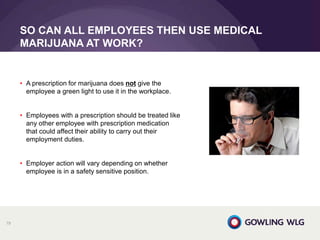
SO CAN ALL EMPLOYEES THEN USE MEDICAL
MARIJUANA AT WORK?
• A prescription for marijuana does not give the
employee a green light to use it in the workplace.
• Employees with a prescription should be treated like
any other employee with prescription medication
that could affect their ability to carry out their
employment duties.
• Employer action will vary depending on whether
employee is in a safety sensitive position.
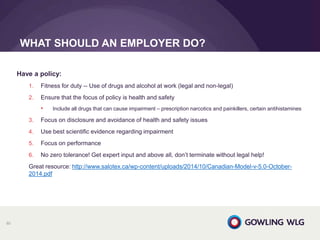
Have a policy:
1. Fitness for duty -- Use of drugs and alcohol at work (legal and non-legal)
2. Ensure that the focus of policy is health and safety
• Include all drugs that can cause impairment – prescription narcotics and painkillers, certain antihistamines
3. Focus on disclosure and avoidance of health and safety issues
4. Use best scientific evidence regarding impairment
5. Focus on performance
6. No zero tolerance! Get expert input and above all, don’t terminate without legal help!
Great resource: http://www.salotex.ca/wp-content/uploads/2014/10/Canadian-Model-v-5.0-October-
2014.pdf
WHAT SHOULD AN EMPLOYER DO?
80
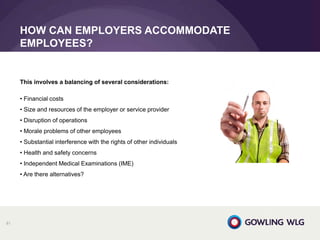
HOW CAN EMPLOYERS ACCOMMODATE
EMPLOYEES?
81
This involves a balancing of several considerations:
• Financial costs
• Size and resources of the employer or service provider
• Disruption of operations
• Morale problems of other employees
• Substantial interference with the rights of other individuals
• Health and safety concerns
• Independent Medical Examinations (IME)
• Are there alternatives?
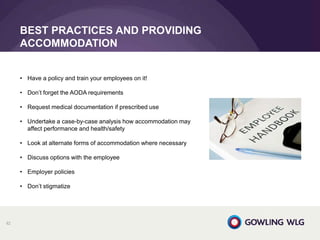
BEST PRACTICES AND PROVIDING
ACCOMMODATION
82
• Have a policy and train your employees on it!
• Don’t forget the AODA requirements
• Request medical documentation if prescribed use
• Undertake a case-by-case analysis how accommodation may
affect performance and health/safety
• Look at alternate forms of accommodation where necessary
• Discuss options with the employee
• Employer policies
• Don’t stigmatize
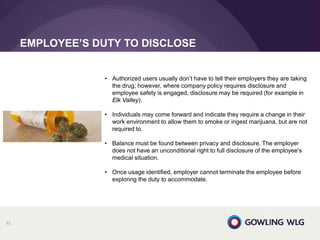
EMPLOYEE’S DUTY TO DISCLOSE
83
• Authorized users usually don’t have to tell their employers they are taking
the drug; however, where company policy requires disclosure and
employee safety is engaged, disclosure may be required (for example in
Elk Valley).
• Individuals may come forward and indicate they require a change in their
work environment to allow them to smoke or ingest marijuana, but are not
required to.
• Balance must be found between privacy and disclosure. The employer
does not have an unconditional right to full disclosure of the employee's
medical situation.
• Once usage identified, employer cannot terminate the employee before
exploring the duty to accommodate.
• If Legal Narcotic and Medical Marijuana – obtain medical information regarding side effects
and their duration (4 to 24 hours depending on metabolism and usage)
• Think of ways to accommodate
• Make sure that a written accommodation plan under the Accommodation for Disabilities Act,
2005 is prepared and reviewed frequently
• If you cannot accommodate, communicate carefully and request further information
• Never terminate before getting expert input and speaking to legal
THINGS TO CONSIDER
84
• Policies can restrict recreational use even when off-duty (enforcement difficult)
• No legal right to use marijuana recreationally (Calgary police has banned recreational use –
September 26, 2018)
• If recreational use is diagnosed as an addiction, then there is a duty to accommodate up to
the point of undue hardship under human rights law.
• Accommodation does not mean allowing employee to smoke up or come to work impaired
• May mean a leave of absence to deal with addiction or allowing a return to work on a
restricted or supervised basis and may involve a regime of drug testing.
WHAT IF IT IS “JUST” RECREATIONAL USE?
85
86
WHAT ROLES ARE CONSIDERED SAFETY-
SENSITIVE POSITIONS?
• In its Policy on Drug and Alcohol Testing, the Ontario Human Rights Commission
states that a safety-sensitive job can be characterized as “one in which incapacity
due to drug or alcohol impairment could result in direct and significant risk of injury
to the employee, others or the environment.”
• Classification depends on the duties performed and the nature of the industry.
• Often involves driving (cars, trucks, forklifts), the use of heavy machinery and work
environments which are inherently dangerous, such as warehouses or lumber
yards.
• Availability of direct supervision is another consideration.
• Responsibility for vulnerable adults or children
CAN AN EMPLOYEE SMOKE ANYWHERE?
87
Gibson v Ridgeview Restaurant Limited (2013 HRTO 1163)
• The complainant had a severe spinal cord injury which limited movement in his neck
• Complaint was filed after the respondent-restauranteur asked complainant not to smoke near the front door of
the restaurant and then asked him not to come back after he did so
• Tribunal found that complainant did not have a disability which required accommodation to smoke near the
entrance
CONSIDER ALSO:
• No smoking laws.
• Lease restrictions
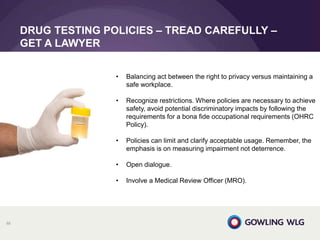
DRUG TESTING POLICIES – TREAD CAREFULLY –
GET A LAWYER
88
• Balancing act between the right to privacy versus maintaining a
safe workplace.
• Recognize restrictions. Where policies are necessary to achieve
safety, avoid potential discriminatory impacts by following the
requirements for a bona fide occupational requirements (OHRC
Policy).
• Policies can limit and clarify acceptable usage. Remember, the
emphasis is on measuring impairment not deterrence.
• Open dialogue.
• Involve a Medical Review Officer (MRO).
89
TAKEAWAYS
• Have a Fitness for Duty policy
• Remember the AODA
• Have a clear policy regarding all substances that may impair
performance
• Review latest version of Canadian Model for Providing a Safe
Workplace
• Have clear training on expectations of all workers regarding
 Disclosure
 Safety
TAKEAWAYS
TAKEAWAYS
90
• Do not impose “zero tolerance”, but rather a policy based on possible
impairment
• Recognize that lengthy periods of use may have cumulative impact
• Health and Safety key
• Do not terminate right away if:
 Medical marijuana
 Addiction
• Consult your lawyer
• Work with an expert
TAKEAWAYS
TAKEAWAYS
gowlingwlg.com
Gowling WLG (Canada) LLP is a member of Gowling WLG, an international law firm which consists of independent and
autonomous entities providing services around the world. Our structure is explained in more detail at
gowlingwlg.com/legal91
NEENA GUPTA
Partner
neena.gupta@gowlingwlg.com
+1 519 575 7501
THANK YOU
• Third-Party Administrator
• Helping companies with:
– Alcohol Drug Testing
– Expert Opinions
– Arbitrations/Tribunals/Court
– Occupational Health
– Sleep Apnea
– Medical Cannabis Review
Program
WHAT IS A TPA?
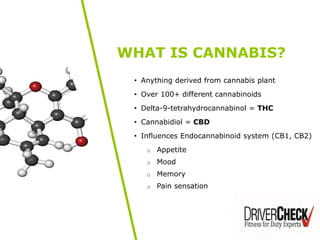
• Anything derived from cannabis plant
• Over 100+ different cannabinoids
• Delta-9-tetrahydrocannabinol = THC
• Cannabidiol = CBD
• Influences Endocannabinoid system (CB1, CB2)
o Appetite
o Mood
o Memory
o Pain sensation
WHAT IS CANNABIS?
shatter
DABS
60-90% THC
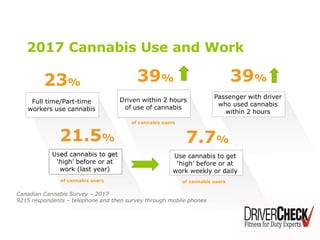
21.5%
Used cannabis to get
‘high’ before or at
work (last year)
39%
Driven within 2 hours
of use of cannabis
39%
Passenger with driver
who used cannabis
within 2 hours
7.7%
Use cannabis to get
‘high’ before or at
work weekly or daily
23%
Full time/Part-time
workers use cannabis
Canadian Cannabis Survey – 2017
9215 respondents – telephone and then survey through mobile phones
2017 Cannabis Use and Work
of cannabis users
of cannabis users of cannabis users
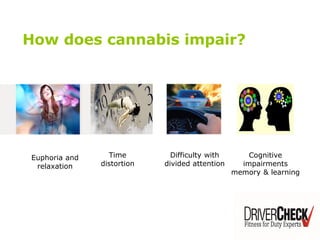
How does cannabis impair?
Euphoria and
relaxation
Time
distortion
Difficulty with
divided attention
Cognitive
impairments
memory & learning
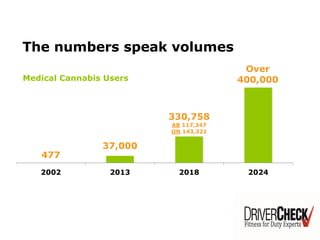
The Growth of
Medical Cannabis in
Canada
477
37,000
330,758
AB 117,347
ON 143,321
Over
400,000
2002 2013 2018 2024
The numbers speak volumes
Medical Cannabis Users
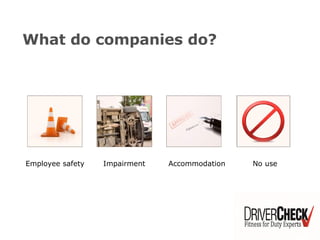
What do companies do?
Employee safety Impairment Accommodation No use
• Employee consent
• Ensure it is ACMPR
• Letter to authorizing physician
• Letter to treating physician
• Review of specific use
• Letter to employer with recommendations
regarding safety sensitive work
Medical Cannabis
Review Program
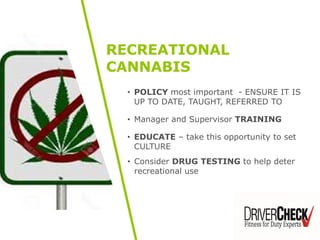
• POLICY most important - ENSURE IT IS
UP TO DATE, TAUGHT, REFERRED TO
• Manager and Supervisor TRAINING
• EDUCATE – take this opportunity to set
CULTURE
• Consider DRUG TESTING to help deter
recreational use
RECREATIONAL
CANNABIS
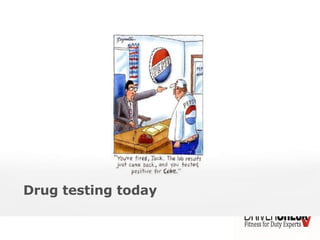
Drug testing today
TRUTH ABOUT DRUG TESTING…
ORAL
FLUID
URINE
• Just because it’s legal, authorized
or prescribed does not
mean it’s safe
BOTTOM LINE
• Don’t let privacy and human rights override employee
and public safety
• An evolving science with new information every day
• Cannabis (specifically THC) causes
impairment that impacts workplaces
and can last for hours, days, weeks
HIGH PERFORMANCE
CULTURES
Jackie Lauer
Your partner in creating a flourishing workplace culture
High-performance cultures:
Trust conversations and
dropping the F-bomb
The F Bomb
Driving High Performance Cultures
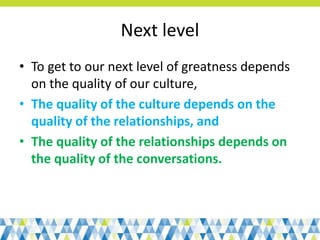
Next level
• To get to our next level of greatness depends
on the quality of our culture,
• The quality of the culture depends on the
quality of the relationships, and
• The quality of the relationships depends on
the quality of the conversations.
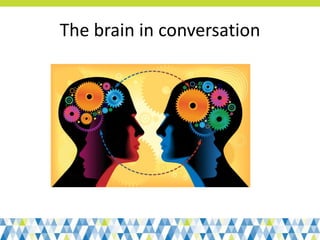
The brain in conversation
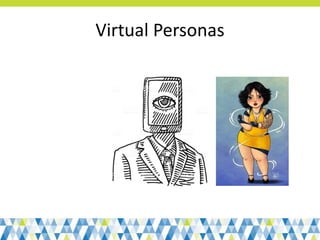
Virtual Personas
The greatest gift to me as a leader,
and as a human
Foundational
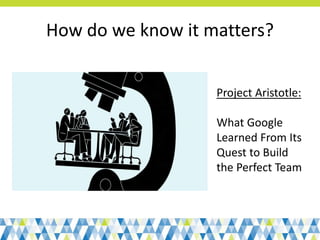
How do we know it matters?
Project Aristotle:
What Google
Learned From Its
Quest to Build
the Perfect Team
• The researchers found that what really
mattered was less about who is on the team,
and more about how the team worked
together.
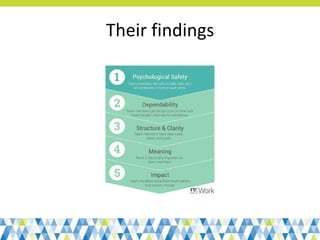
Their findings
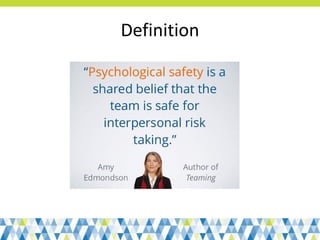
Definition
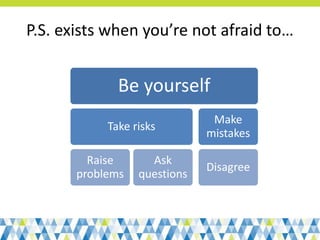
P.S. exists when you’re not afraid to…
Be yourself
Take risks
Raise
problems
Ask
questions
Make
mistakes
Disagree
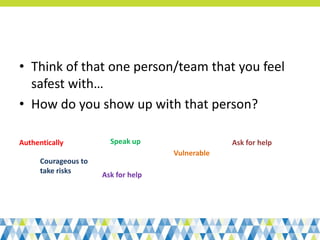
• Think of that one person/team that you feel
safest with…
• How do you show up with that person?
Authentically Speak up
Ask for help
Courageous to
take risks
Ask for help
Vulnerable
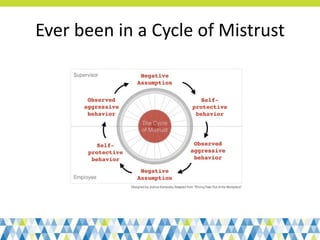
Ever been in a Cycle of Mistrust
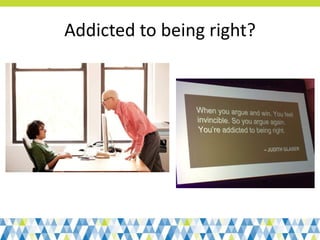
Addicted to being right?
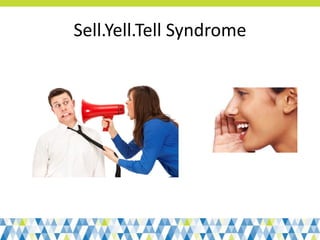
Sell.Yell.Tell Syndrome
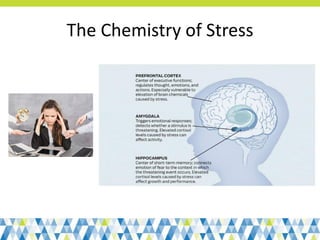
The Chemistry of Stress
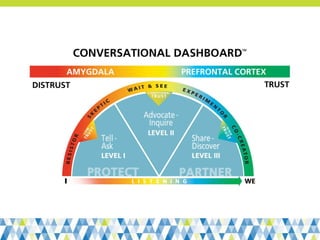
SO HOW DO WE PRIME FOR TRUST TO
CREATE SAFETY OVER TIME?
Move from I to We
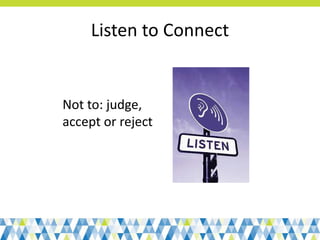
Listen to Connect
Not to: judge,
accept or reject
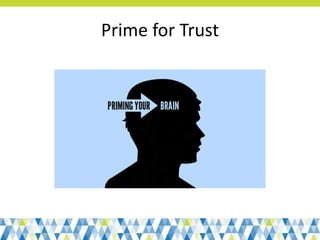
Prime for Trust
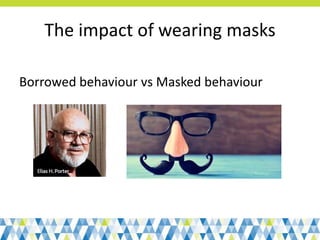
The impact of wearing masks
Borrowed behaviour vs Masked behaviour
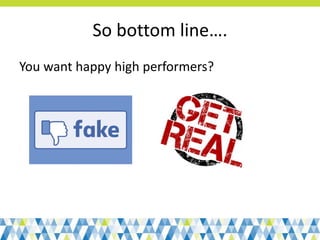
So bottom line….
You want happy high performers?
How to Reach Me
Jackie Lauer
www.jackielauer.com
jackie@jackielauer.com
519-502-7081
@jackielauer
Thank You For Joining Us

Hot HR Topics for 2018

  • 1.
    WELCOME TO HRHOT TOPICS 2018 - 2019
  • 2.
    Agenda 8:55 am Welcomeand Introductions - Jill Zappitelli, H2R Business Solutions 9:00 am Interpersonal Conflict and How to Defuse Them - Chantal MacIntyre, HR Director, Clarion Medical Supplies 9:40 am Best Practices for Investigations - Dean Benard, Owner, Benard & Associates 10:20 am Break 10:30 am Cannabis in the Workplace, ESA Changes and Other Hot Topics - P.A. Neena Gupta, Partner, Gowling WLG - Dr. Melissa Snider-Adler, DriverCheck Inc. 11:15 am High-Performance Cultures - Jackie Lauer, Owner, Jackie Lauer Consulting 11:55 am Wrap Up / Draws / HRPA Code - Chris Perkins, Grand River Personnel
  • 3.
    WELCOME REMARKS Jill Zappitelli,H2R Business Solutions
  • 4.
    INTERPERSONAL CONFLICTS AND HOW TODEFUSE THEM Chantal MacIntyre HR Director Clarion Medical Supplies
  • 5.
  • 6.
  • 7.
  • 8.
    What Percentage ofTime Do You Spend Resolving Conflict? 10% 40% 20% 30%
  • 10.
    Naive CHRL GirlRight Here!
  • 11.
    Why Can’t TheyAll Just Get Along?
  • 14.
  • 15.
    How many ofyou feel confident in your Conflict Resolution strategies?
  • 16.
  • 17.
  • 18.
  • 20.
    We will dealdirectly with people involved FIRST If we can’t find solutions together we have another choice…. SOLUTION SESSION
  • 22.
    Solution Sessions –6 Steps 1. Pre-work – Participant Prep 2. Psychological safety 3. Focused Environment 4. Ground rules/job aids 5. Solution Session agenda 6. Follow-Up date scheduled
  • 23.
  • 24.
    • Crucial Conversations(Planner Worksheet) • Personality Assessments (Big 5, Self Mgmt) • Questionnaire's • 5 Dysfunctions of a Team • Conflict Cost Surveys Participant Prep Training
  • 25.
    • Win/win approach •Create Ground Rules • Be Empathetic • Listening Skills • Co-operative power • Managing emotions • Willingness to resolve • Create Solutions 2. Psychological Safety
  • 26.
    3. No DistractionEnvironment
  • 27.
  • 28.
    1. What areour mutual interests and objectives? 2. What is getting in our way? 3. What do we need to change or do differently? 4. Agreements for path forward to Solutions 5. Document decisions/action items 6. Set date to follow up 28 5. Solution Session Agenda
  • 29.
  • 30.
    6. Follow UpDate Scheduled
  • 31.
  • 32.
    Sales and MarketingScenario Sales (Jamal) & Marketing (Grace) both report to Surgical Director (Paul) Jamal takes too much time to respond to Grace and makes her miss deadlines. Her leader Paul is upset. Jamal feels Grace is not customer facing so she is clueless and he has to create all the promo’s so ends up doing too much Marketing work himself Both are complaining to other team members and their boss Paul instead of talking to each other
  • 33.
    Set Up 3 or4 People (half each table) Jamal Grace HR Leader Department Leader
  • 34.
    “Hoped For Outcomes” StartStop Continue Jamal Grace to start doing better promo’s Grace needs to stop Expecting immediate responses Grace needs to continue being Admin support Grace Jamal needs to respond faster Jamal needs to stop Making Grace miss deadlines Jamal needs to keep making Sales 1. Decide who is Jamal, Grace, Leader and/or HR 2. Write out your own wants/needs via Start, Stop and Continue 3. HR/Leader Apply Control & Out of Control Filter to each category Debrief
  • 35.
  • 37.
    • Early visibilityfor concerns to be heard & respected • Focus on solutions vs. stuck in problems • Improved productivity and better results • Personal growth and insights  Knowledge  Skills  Emotional intelligence • Reduces turnover • Reduces stress leaves and absence from work Value of Solution Sessions
  • 39.
  • 40.
    Connect with meon www.chantalmcintyre.com • Presentation • Resources • Solution Session Legal Process • Peer Support or Need A Sherpa?
  • 41.
  • 42.
    Investigation Best Practices HR HotTopics November 21, 2018 Presented By Dean Benard
  • 43.
    Hitting The Target “TopTen List” The top ten considerations that can make or break an investigation
  • 44.
    #1 – NoDelay • Delays initiating an investigation and delays within an investigation are a problem • Time plays a major role in affecting people’s perception of fairness • Delays make things more difficult • Can lead to procedural arguments in tribunals or courts • Opens the door for witnesses to be tainted
  • 45.
    #1 – NoDelay • Be prompt in making the decision to investigate. • Move the investigation along expediently • Ensure you have policies and procedures that outline timeframes and follow them.
  • 46.
    #2 -Follow YourPolicies & Procedures • Following policy will result in consistency • Ensure investigator understands policy & procedures • Roles and expectations should be defined in policy and adhered to by all
  • 47.
    #2 -Follow YourPolicies & Procedures • Dissemination of information should be addressed in policy • Issue of reprisal should be addressed • Adhere to timelines as much as possible
  • 48.
    #3 – ProperSelection of Investigator Internal • Consider any perceived conflicts • Will the investigator be able to devote the required time • Ensure the investigator is not going to feel at risk • Skills and experience vs. complexity – is it a good fit?
  • 49.
    #3 – ProperSelection of Investigator External – Investigate the Investigator! • Are they licensed or otherwise exempt? • Consider a short interview • Are they adequately experienced in this area of investigations? • What are some examples of cases they have completed? • Do they have appropriate insurance coverage? • Consider checking references
  • 50.
    #4 – StayWithin Scope / Mandate • Confirm the scope of the investigation in writing with a “TOR” or engagement letter • This is the first consideration when planning the investigation • Understand the issues, incidents, and context
  • 51.
    #4 – StayWithin Scope / Mandate • Going outside scope can lead to unfairness and even missing what was intended to be investigated • Be alert to efforts by some to raise irrelevant information to “strengthen” their position • What if new information is discovered?
  • 52.
    #5 – Properand Complete Interviews • Gather the relevant facts • Share information on a “need to now” • Consider recording interviews • Always give interviewee the opportunity to review their statement • Have them sign off on their statement • Assess credibility & reliability
  • 53.
    #5 – Properand Complete Interviews Your Approach: • Build rapport • Provide context for the interviewee • General to specific • Avoid leading questions • Don’t coerce or threaten • Stay calm
  • 54.
    #5 – Properand Complete Interviews Assessing Credibility • Corroboration is often not available • Critical skill required of investigators • Be wary of body language myths • Key things to focus on • Plausibility of statements • Shifting context • Discrediting the Complainant • Consider motives
  • 55.
    #6 – AppropriateEvidence Gathered & Preserved • Consider all options for evidence - internal and external • Company owned cell phones, laptops, computers etc. • Consider possibility that evidence provided may have been altered or not provided in full (messenger, text messages, emails)
  • 56.
    #6 – AppropriateEvidence Gathered & Preserved • Verify source and compare if possible • Note how and by whom evidence was provided • Copy documentary evidence – do not alter originals • Safeguard evidence to prevent unnecessary access or tampering
  • 57.
    #7 – Investigationis carefully Documented • Keep a file of the investigation that includes: • Investigation plan • Notes of all interviews and contacts • Copies of documents obtained • Documentation of your actions as the investigator
  • 58.
    #8 – MaintainNeutrality & Procedural Fairness • Remain objective and neutral – Remember, investigators are not advocates • Be transparent with the process • Ensure fair notice to Respondents of complaints and provide sufficient detail • Give Respondents the opportunity to respond
  • 59.
    #8 – MaintainNeutrality & Procedural Fairness • Consider all relevant information • Conduct interviews in a neutral manner • Stay within the investigation mandate • Refrain from unnecessary commentary • Neutral language in notes and reports
  • 60.
    #9 – ConfidentialityIs Preserved • Share information only as necessary • Guard evidence carefully • Reinforce need for confidentiality - Consider confidentiality agreements for witnesses • Make a statement in interviews that you do not consent to be recorded
  • 61.
    Thorough: The reportcontains all the information needed to reach a decision. Objective: The report presents the facts in a neutral manner. Conclusions are tied to evidence, not opinion Clear: The language is easy to understand and difficult to misinterpret. #10 – Reports Are Clear & Comprehensive
  • 62.
    #10 – ReportsAre Clear & Comprehensive Accurate: The report contains the facts gathered by the investigator. Professional: The report reflects the credibility of the investigation and the investigator.
  • 63.
    Summary Investigators and theinvestigation process will be scrutinized for errors Attention to these aspects of the process is crucial to avoid negative criticism A lot rests on these investigations and we owe it to all involved to get it right
  • 64.
    Thank You Benard +Associates 240 Holiday Inn Drive, Unit O Cambridge, Ontario 519-880-1917 888-733-2226 dbenard@benardinc.com www.benardinc.com
  • 65.
  • 66.
    CANNABIS IN THEWORKPLACE, ESA CHANGES FOR 2019 AND OTHER HOT TOPICS PRESENTED BY: P.A. NEENA GUPTA GOWLING WLG DR. MELISSA SNIDER-ADLER DRIVERCHECK INC.
  • 67.
    • Conservatives introduced“Making Ontario Open for Business Act” • Expect to see changes back to “old” ESA 1. Minimum wage to stay at $14/hour and will not go up on January 1, 2019 2. No paid Personal Emergency Leave Days (3 PEL, 2 bereavement, 3 “family responsibility”) 3. Medical notes may be requested to substantiate absence 4. Equal pay depending on employment status will be abolished; but gender equity will remain 5. On-call rules will go back to the old 3-hour minimum; and 6. Old rules regarding calculation of public holiday (pro-rated and averaged over 20 days) will be reinstated QUICK LEGAL UPDATES – ESA – WHAT GOES? 67
  • 68.
    • Three (3)weeks vacation after 5 years • Domestic and sexual violence leave (including paid leave) will stay • To get more information: subscribe to our newsletter at: https://gowlingwlg.com/en/footer/updates/subscribe-canada/ • Join me on LinkedIn QUICK LEGAL UPDATES – ESA – WHAT STAYS? 68
  • 69.
    • Required employeesto publish wage range in each public advertisement or posting • Forbade employees from asking employee what their current wage was • No right to forbid discussion regarding compensation or punish people for discussing compensation • Postponed … not being put in force on January 1, 2019 QUICK LEGAL UPDATES – PAY TRANSPARENCY ACT 69
  • 70.
    • Courts donot like ESA only employment agreements • Look for any kind of non-conformity • Agreements need protective language that if there is any inadvertent violation of ESA, ESA governs • If you have language that says “no notice or compensation for cause”, make sure it has language that says, “unless otherwise required by ESA” – otherwise, Court of Appeal says it violates the ESA • Get agreements every year and any time there is a critical high- level offer COURTS KEEP STRIKING DOWN CONTRACTS 70
  • 71.
  • 72.
    What makes cannabisdifferent from alcohol and other recreational drugs? • Easy and expensive to obtain or grow • No easy workplace test for current impairment • Habitual users may be impaired, but may not show “obvious” signs • No « breathalyzer » for marijuana Statistics source: “Number of Canadians buying legal medical marijuana triples in just one year”, The National Post, 13 December 2016, online: <http://business.financialpost.com/commodities/agriculture/number-of-canadians-buying-legal- medical-marijuana-triples-in-just-one-year-pn-1188-words-local-news>. WHY ARE WE AFRAID OF CANNABIS?
  • 73.
    NEGATIVELY IMPACTS: • Judgment •Motor coordination • Reaction Time • Memory • Ability to Learn • Mood IS CANNABIS A PROBLEM? 73
  • 74.
    • Not alwayseasy to determine if individual impaired • Even police not fully trained to ascertain impairment • The new roadside devices new to market (the Dräger Drug Test 5000 approved on August 27, 2018 by the federal government) • Regulations in their infancy – Criminal Code amended June 21, 2018 -- 2 to 5 nanograms (summary conviction – precautionary) -- 5 nanograms or more (more serious) -- 5 nanograms + alcohol of 50 mg (.05) (more serious) IS CANNABIS A PROBLEM? 74
  • 75.
    THE DUTY TOACCOMMODATE MEDICAL MARIJUANA USE An employee’s need to use medical marijuana in the workplace triggers an employer’s statutory obligations, but this also creates conflicting duties. The Ontario Human Rights Code 5. (1) Every person has a right to equal treatment with respect to employment without discrimination because of race, ancestry, place of origin, colour, ethnic origin, citizenship, creed, sex, sexual orientation, gender identity, gender expression, age, record of offences, marital status, family status or disability. The Ontario Occupational Health and Safety Act 25. (2) Without limiting the strict duty imposed by subsection (1), an employer shall, (h) take every precaution reasonable in the circumstances for the protection of a worker;
  • 76.
    EMPLOYER’S LEGITIMATE EXPECTATION 76 Expectationis that “all workers are fit to safely and reliably perform their work duties … throughout their shift and free from impairment due to alcohol and/or drugs.” [Canadian Model for Providing a Safe Workplace]
  • 77.
    ADDICTION IS ADISABILITY
  • 78.
  • 79.
    79 SO CAN ALLEMPLOYEES THEN USE MEDICAL MARIJUANA AT WORK? • A prescription for marijuana does not give the employee a green light to use it in the workplace. • Employees with a prescription should be treated like any other employee with prescription medication that could affect their ability to carry out their employment duties. • Employer action will vary depending on whether employee is in a safety sensitive position.
  • 80.
    Have a policy: 1.Fitness for duty -- Use of drugs and alcohol at work (legal and non-legal) 2. Ensure that the focus of policy is health and safety • Include all drugs that can cause impairment – prescription narcotics and painkillers, certain antihistamines 3. Focus on disclosure and avoidance of health and safety issues 4. Use best scientific evidence regarding impairment 5. Focus on performance 6. No zero tolerance! Get expert input and above all, don’t terminate without legal help! Great resource: http://www.salotex.ca/wp-content/uploads/2014/10/Canadian-Model-v-5.0-October- 2014.pdf WHAT SHOULD AN EMPLOYER DO? 80
  • 81.
    HOW CAN EMPLOYERSACCOMMODATE EMPLOYEES? 81 This involves a balancing of several considerations: • Financial costs • Size and resources of the employer or service provider • Disruption of operations • Morale problems of other employees • Substantial interference with the rights of other individuals • Health and safety concerns • Independent Medical Examinations (IME) • Are there alternatives?
  • 82.
    BEST PRACTICES ANDPROVIDING ACCOMMODATION 82 • Have a policy and train your employees on it! • Don’t forget the AODA requirements • Request medical documentation if prescribed use • Undertake a case-by-case analysis how accommodation may affect performance and health/safety • Look at alternate forms of accommodation where necessary • Discuss options with the employee • Employer policies • Don’t stigmatize
  • 83.
    EMPLOYEE’S DUTY TODISCLOSE 83 • Authorized users usually don’t have to tell their employers they are taking the drug; however, where company policy requires disclosure and employee safety is engaged, disclosure may be required (for example in Elk Valley). • Individuals may come forward and indicate they require a change in their work environment to allow them to smoke or ingest marijuana, but are not required to. • Balance must be found between privacy and disclosure. The employer does not have an unconditional right to full disclosure of the employee's medical situation. • Once usage identified, employer cannot terminate the employee before exploring the duty to accommodate.
  • 84.
    • If LegalNarcotic and Medical Marijuana – obtain medical information regarding side effects and their duration (4 to 24 hours depending on metabolism and usage) • Think of ways to accommodate • Make sure that a written accommodation plan under the Accommodation for Disabilities Act, 2005 is prepared and reviewed frequently • If you cannot accommodate, communicate carefully and request further information • Never terminate before getting expert input and speaking to legal THINGS TO CONSIDER 84
  • 85.
    • Policies canrestrict recreational use even when off-duty (enforcement difficult) • No legal right to use marijuana recreationally (Calgary police has banned recreational use – September 26, 2018) • If recreational use is diagnosed as an addiction, then there is a duty to accommodate up to the point of undue hardship under human rights law. • Accommodation does not mean allowing employee to smoke up or come to work impaired • May mean a leave of absence to deal with addiction or allowing a return to work on a restricted or supervised basis and may involve a regime of drug testing. WHAT IF IT IS “JUST” RECREATIONAL USE? 85
  • 86.
    86 WHAT ROLES ARECONSIDERED SAFETY- SENSITIVE POSITIONS? • In its Policy on Drug and Alcohol Testing, the Ontario Human Rights Commission states that a safety-sensitive job can be characterized as “one in which incapacity due to drug or alcohol impairment could result in direct and significant risk of injury to the employee, others or the environment.” • Classification depends on the duties performed and the nature of the industry. • Often involves driving (cars, trucks, forklifts), the use of heavy machinery and work environments which are inherently dangerous, such as warehouses or lumber yards. • Availability of direct supervision is another consideration. • Responsibility for vulnerable adults or children
  • 87.
    CAN AN EMPLOYEESMOKE ANYWHERE? 87 Gibson v Ridgeview Restaurant Limited (2013 HRTO 1163) • The complainant had a severe spinal cord injury which limited movement in his neck • Complaint was filed after the respondent-restauranteur asked complainant not to smoke near the front door of the restaurant and then asked him not to come back after he did so • Tribunal found that complainant did not have a disability which required accommodation to smoke near the entrance CONSIDER ALSO: • No smoking laws. • Lease restrictions
  • 88.
    DRUG TESTING POLICIES– TREAD CAREFULLY – GET A LAWYER 88 • Balancing act between the right to privacy versus maintaining a safe workplace. • Recognize restrictions. Where policies are necessary to achieve safety, avoid potential discriminatory impacts by following the requirements for a bona fide occupational requirements (OHRC Policy). • Policies can limit and clarify acceptable usage. Remember, the emphasis is on measuring impairment not deterrence. • Open dialogue. • Involve a Medical Review Officer (MRO).
  • 89.
    89 TAKEAWAYS • Have aFitness for Duty policy • Remember the AODA • Have a clear policy regarding all substances that may impair performance • Review latest version of Canadian Model for Providing a Safe Workplace • Have clear training on expectations of all workers regarding  Disclosure  Safety TAKEAWAYS TAKEAWAYS
  • 90.
    90 • Do notimpose “zero tolerance”, but rather a policy based on possible impairment • Recognize that lengthy periods of use may have cumulative impact • Health and Safety key • Do not terminate right away if:  Medical marijuana  Addiction • Consult your lawyer • Work with an expert TAKEAWAYS TAKEAWAYS
  • 91.
    gowlingwlg.com Gowling WLG (Canada)LLP is a member of Gowling WLG, an international law firm which consists of independent and autonomous entities providing services around the world. Our structure is explained in more detail at gowlingwlg.com/legal91 NEENA GUPTA Partner neena.gupta@gowlingwlg.com +1 519 575 7501 THANK YOU
  • 92.
    • Third-Party Administrator •Helping companies with: – Alcohol Drug Testing – Expert Opinions – Arbitrations/Tribunals/Court – Occupational Health – Sleep Apnea – Medical Cannabis Review Program WHAT IS A TPA?
  • 93.
    • Anything derivedfrom cannabis plant • Over 100+ different cannabinoids • Delta-9-tetrahydrocannabinol = THC • Cannabidiol = CBD • Influences Endocannabinoid system (CB1, CB2) o Appetite o Mood o Memory o Pain sensation WHAT IS CANNABIS?
  • 94.
  • 95.
    21.5% Used cannabis toget ‘high’ before or at work (last year) 39% Driven within 2 hours of use of cannabis 39% Passenger with driver who used cannabis within 2 hours 7.7% Use cannabis to get ‘high’ before or at work weekly or daily 23% Full time/Part-time workers use cannabis Canadian Cannabis Survey – 2017 9215 respondents – telephone and then survey through mobile phones 2017 Cannabis Use and Work of cannabis users of cannabis users of cannabis users
  • 96.
    How does cannabisimpair? Euphoria and relaxation Time distortion Difficulty with divided attention Cognitive impairments memory & learning
  • 97.
    The Growth of MedicalCannabis in Canada
  • 98.
    477 37,000 330,758 AB 117,347 ON 143,321 Over 400,000 20022013 2018 2024 The numbers speak volumes Medical Cannabis Users
  • 99.
    What do companiesdo? Employee safety Impairment Accommodation No use
  • 100.
    • Employee consent •Ensure it is ACMPR • Letter to authorizing physician • Letter to treating physician • Review of specific use • Letter to employer with recommendations regarding safety sensitive work Medical Cannabis Review Program
  • 101.
    • POLICY mostimportant - ENSURE IT IS UP TO DATE, TAUGHT, REFERRED TO • Manager and Supervisor TRAINING • EDUCATE – take this opportunity to set CULTURE • Consider DRUG TESTING to help deter recreational use RECREATIONAL CANNABIS
  • 102.
  • 103.
    TRUTH ABOUT DRUGTESTING… ORAL FLUID URINE
  • 104.
    • Just becauseit’s legal, authorized or prescribed does not mean it’s safe BOTTOM LINE • Don’t let privacy and human rights override employee and public safety • An evolving science with new information every day • Cannabis (specifically THC) causes impairment that impacts workplaces and can last for hours, days, weeks
  • 105.
  • 106.
    Your partner increating a flourishing workplace culture High-performance cultures: Trust conversations and dropping the F-bomb
  • 107.
  • 108.
  • 109.
    Next level • Toget to our next level of greatness depends on the quality of our culture, • The quality of the culture depends on the quality of the relationships, and • The quality of the relationships depends on the quality of the conversations.
  • 110.
    The brain inconversation
  • 111.
  • 113.
    The greatest giftto me as a leader, and as a human
  • 114.
  • 115.
    How do weknow it matters? Project Aristotle: What Google Learned From Its Quest to Build the Perfect Team
  • 116.
    • The researchersfound that what really mattered was less about who is on the team, and more about how the team worked together.
  • 117.
  • 118.
  • 119.
    P.S. exists whenyou’re not afraid to… Be yourself Take risks Raise problems Ask questions Make mistakes Disagree
  • 120.
    • Think ofthat one person/team that you feel safest with… • How do you show up with that person? Authentically Speak up Ask for help Courageous to take risks Ask for help Vulnerable
  • 121.
    Ever been ina Cycle of Mistrust
  • 122.
  • 123.
  • 124.
  • 125.
    SO HOW DOWE PRIME FOR TRUST TO CREATE SAFETY OVER TIME?
  • 126.
  • 128.
    Listen to Connect Notto: judge, accept or reject
  • 129.
  • 130.
    The impact ofwearing masks Borrowed behaviour vs Masked behaviour
  • 131.
    So bottom line…. Youwant happy high performers?
  • 133.
    How to ReachMe Jackie Lauer www.jackielauer.com jackie@jackielauer.com 519-502-7081 @jackielauer
  • 134.
    Thank You ForJoining Us