


Kom verder. Saxion.
Workshop Sustainable Energy
Building a business model
Jacques Bazen
Lecturer Entrepreneurship / International Economics
Kom verder. Saxion.
Overview of the workshop
• International entrepreneurship: Barriers
• International entrepreneurship: Building a
business together!
• Business plans / Business model canvas
• Defining a useful value proposal, case study
• Your own business idea…
Kom verder. Saxion.
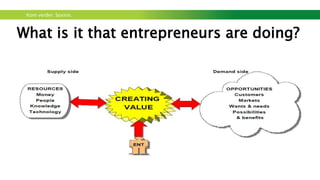
What is it that entrepreneurs are doing?
Kom verder. Saxion.
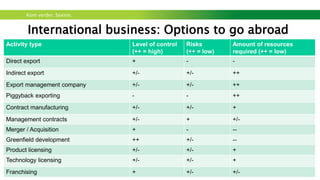
International business
Kom verder. Saxion.
Quote from a Dutch entrepreneur
“Very nice all these theoretical talks about going abroad, but you just
have to do it. Point.
You science guys teach the students to analyze everything so much
until their ability to just act decisively is dead. The only thing they see
is problems. I don’t need that kind of people. Why would someone
need market research? Just drive around for a week in this country
and you exactly know what they buy, how they behave and everything
else you want to know as well”.
Guts vs. Analytics?
Kom verder. Saxion.
International partnerships
• Basically you are building a new organization.
• Suddenly things how you know that are working
in your home country, probably do not work as
you are used to.
• There is a risk that discovered solutions are sub-
optimal.
Kom verder. Saxion.
Kom verder. Saxion.
Kom verder. Saxion.
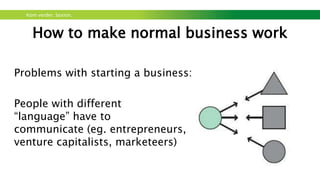
How to make normal business work
Problems with starting a business:
People with different
“language” have to
communicate (eg. entrepreneurs,
venture capitalists, marketeers)
Kom verder. Saxion.
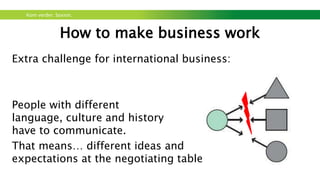
How to make business work
Extra challenge for international business:
People with different
language, culture and history
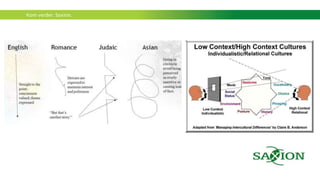
have to communicate.
That means… different ideas and
expectations at the negotiating table
Kom verder. Saxion.
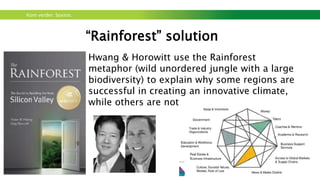
“Rainforest” solution
Hwang & Horowitt use the Rainforest
metaphor (wild unordered jungle with a large
biodiversity) to explain why some regions are
successful in creating an innovative climate,
while others are not.
Kom verder. Saxion.
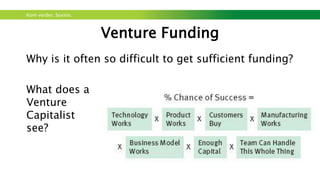
Venture Funding
Why is it often so difficult to get sufficient funding?
What does a
Venture
Capitalist
see?
Kom verder. Saxion.
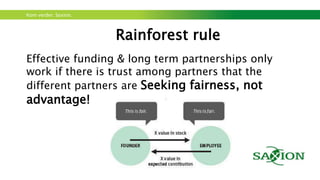
Rainforest rule
Effective funding & long term partnerships only
work if there is trust among partners that the
different partners are Seeking fairness, not
advantage!
Kom verder. Saxion.
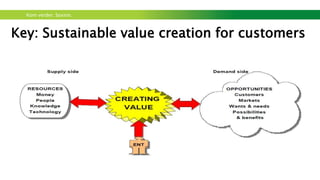
Key: Sustainable value creation for customers
Kom verder. Saxion.
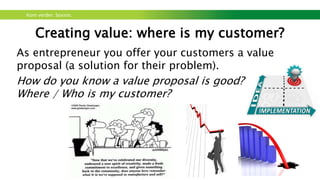
Creating value: where is my customer?
As entrepreneur you offer your customers a value
proposal (a solution for their problem).
How do you know a value proposal is good?
Where / Who is my customer?
Kom verder. Saxion.
Remember when developing a business:
Kom verder. Saxion.
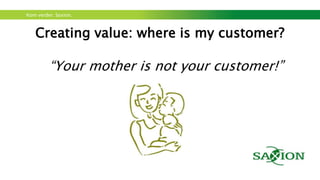
Creating value: where is my customer?
“Your mother is not your customer!”
Kom verder. Saxion.
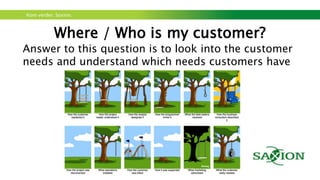
Answer to this question is to look into the customer
needs and understand which needs customers have
Where / Who is my customer?
Kom verder. Saxion.
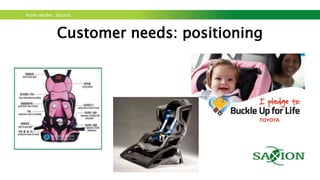
Customer needs
Example: Parents looking for a baby seat in car
• Technical:
It must be helping our baby to be transported safely (the
product does the job)
• Emotional:
Buying a good baby seats makes us feel good, as loving
parents (the product makes you feel good)
• Social:
We want to show others that we have the best product
(how the product is seen by others)
Kom verder. Saxion.
Customer needs: positioning
Kom verder. Saxion.
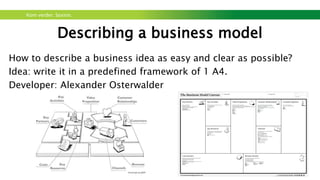
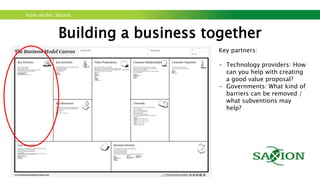
Describing a business model
How to describe a business idea as easy and clear as possible?
Idea: write it in a predefined framework of 1 A4.
Developer: Alexander Osterwalder
Kom verder. Saxion.
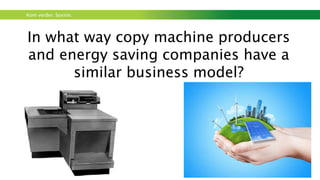
In what way copy machine producers
and energy saving companies have a
similar business model?
Kom verder. Saxion.
Osterwalder about his business model canvas
• Business models as tool to compete in business
http://www.youtube.com/watch?v=RzkdJiax6Tw
• The canvas is a way to show in an easy way what
you do and how you work
• Because it is easy to produce, it is easy to make
several canvasses and select the best.
Kom verder. Saxion.
After finding an idea for a business
model…
Kom verder. Saxion.
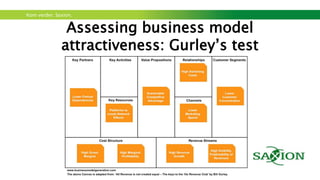
Assessing business model
attractiveness: Gurley’s test
Kom verder. Saxion.
Gurley’s test
• Most important question: “How easy is it for someone
else to provide the same product or service that you
provide?”
• More information on Gurley’s test:
http://bmimatters.com/2012/04/04/assessing-a-business-model-attractiveness/
• Look through the eyes of an
investor to your business
Kom verder. Saxion.
Competition
In the market you will find competitors. You have
to develop your business idea in such a way that
your business has a unique offer for your
customers.
Parable of the printing house.
Kom verder. Saxion.
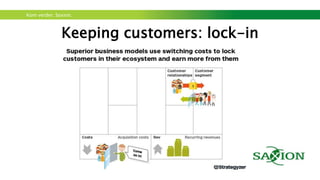
Keeping customers: lock-in
Kom verder. Saxion.
Osterwalder: Lock-in possibilities
• Base Product & Consumable trap: Nespresso,
Gillette, HP, Kodak
• Data trap: Apple, Google Android, Spotify
• Learning Curve trap: Adobe
• Industry standards trap: Microsoft, Adobe
• Service trap: Rolls Royce, Hilti
• Exit trap: Mobile phone companies: subscriptions
Kom verder. Saxion.
Another way of thinking about
“Customer relationships”…
Kom verder. Saxion.
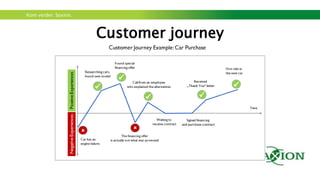
Customer journey
Kom verder. Saxion.
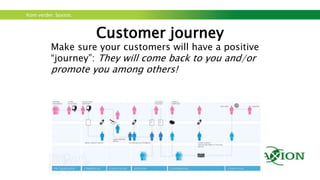
Customer journey
Make sure your customers will have a positive
“journey”: They will come back to you and/or
promote you among others!
Kom verder. Saxion.
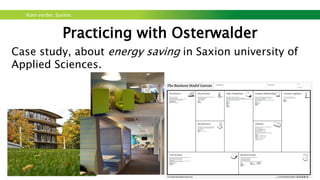
Practicing with Osterwalder
Case study, about energy saving in Saxion university of
Applied Sciences.
Kom verder. Saxion.
Testing the business model
Steve Blank:
1. Get out of the building! There are no facts to be
found in school or in the company itself 
interview prospective customers to test your ideas
2. Make the process iterative. Adopt your product
according to the ideas of your future customers.
Don’t go for a waterfall development… step by step
improvements.
Kom verder. Saxion.
Testing the business model
3. Failure is part of the search! Try to experiment
with different things and when experiments fail,
try something else.
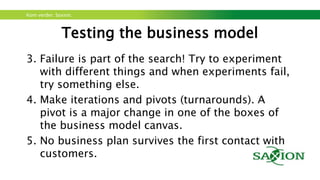
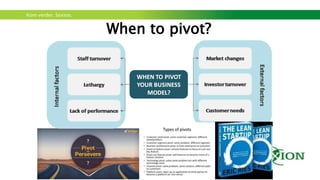
4. Make iterations and pivots (turnarounds). A
pivot is a major change in one of the boxes of
the business model canvas.
5. No business plan survives the first contact with
customers.
Kom verder. Saxion.
When to pivot?
Kom verder. Saxion.
Meet Frank
Kom verder. Saxion.
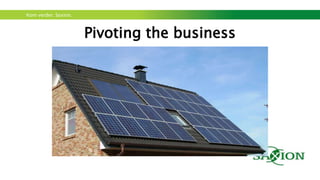
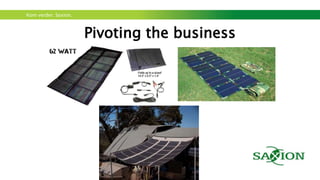
Pivoting the business
Kom verder. Saxion.
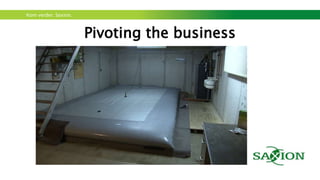
Pivoting the business
Kom verder. Saxion.
Pivoting the business
Kom verder. Saxion.
Testing the business model
6. Design experiments to test your assumptions
(hypotheses, guesses) about customer needs and
behaviour. Experiments could include test websites or
models of a product.
7. Think about market positioning. New market, new
product? New product, existing market? Niche market
entrance? These are important for sales channel
selection.
8. It’s all about passion
Kom verder. Saxion.
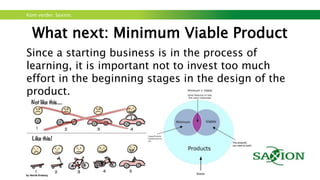
What next: Minimum Viable Product
Since a starting business is in the process of
learning, it is important not to invest too much
effort in the beginning stages in the design of the
product.
Kom verder. Saxion.
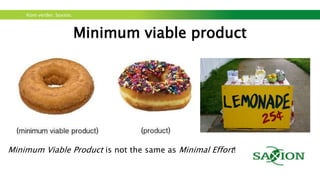
Minimum viable product
Minimum Viable Product is not the same as Minimal Effort!
Kom verder. Saxion.
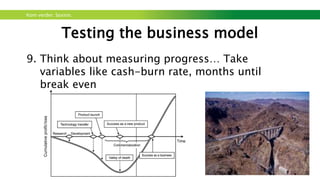
Testing the business model
9. Think about measuring progress… Take
variables like cash-burn rate, months until
break even
Kom verder. Saxion.
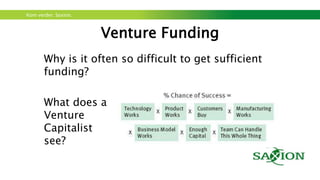
Venture Funding
Why is it often so difficult to get sufficient
funding?
What does a
Venture
Capitalist
see?
Kom verder. Saxion.
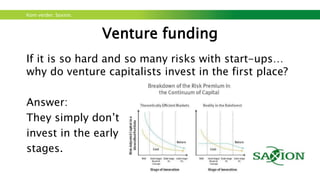
Venture funding
If it is so hard and so many risks with start-ups…
why do venture capitalists invest in the first place?
Answer:
They simply don’t
invest in the early
stages.
Kom verder. Saxion.
Venture Funding
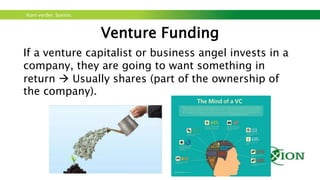
If a venture capitalist or business angel invests in a
company, they are going to want something in
return  Usually shares (part of the ownership of
the company).
Kom verder. Saxion.
Negative aspects of venture funding
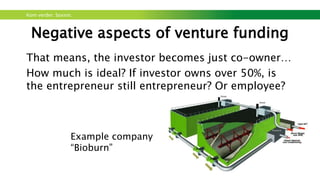
That means, the investor becomes just co-owner…
How much is ideal? If investor owns over 50%, is
the entrepreneur still entrepreneur? Or employee?
Example company
“Bioburn”
Kom verder. Saxion.
Kom verder. Saxion.
Testing the business model
10. Fast decision making: changes are
necessary. Many startups face
problems: psychological it is hard to
get away from an idea that was
developed by months. But
sometimes it is necessary.
Kom verder. Saxion.
Testing the business model
11. Job functions in a startup are very different
than in ordinary companies. Startups require
people who are comfortable with situations
of uncertainty, chaos and change…
Kom verder. Saxion.
Testing the business model
12. Preserve cash until needed: Then spend. In other
words, don’t waste your money until you found a really
promising idea.
13. Communicate and share learning. Make sure
everyone on the team knows as much as possible: It
will help finding new solutions.
Kom verder. Saxion.
Testing the business model
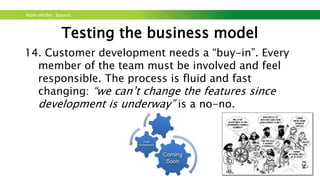
14. Customer development needs a “buy-in”. Every
member of the team must be involved and feel
responsible. The process is fluid and fast
changing: “we can’t change the features since
development is underway” is a no-no.
Kom verder. Saxion.
Measure your business…
AARRR = Acquisition, Activation, Retention, Revenue, Referral
Acquisition: describes the moment when an unconscious visitor is
interested in your product/service.
Activation: when the customers who are interested in the product
are having their first (positive) user experience
Retention: measuring the reuse and the involvement in the
product / service
Revenue: measuring the product / service what you get paid
Referral: the number of customers who are coming back
Kom verder. Saxion.
Talk to your customers
• Find a group of potentially interested people in your
product / service (minimum 50) and ask them about
your business idea.
• This is not a sales pitch!
• Listen if your customers feel they have problems and
how they deal with it.
• In the end, ask them whether the idea you are
thinking about might help them.
Kom verder. Saxion.
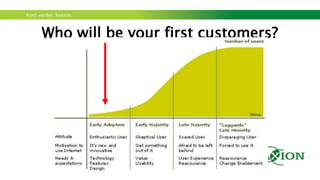
Who will be your first customers?
Kom verder. Saxion.
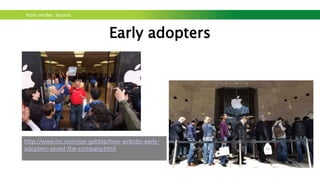
Early adopters
http://www.inc.com/joe-gebbia/how-airbnbs-early-
adopters-saved-the-company.html
Kom verder. Saxion.
Talk to your customers
Don’t ask them “would you like to have candy” type of
questions… Everyone would like to have candy, so don’t
ask questions that nobody will say no to.
For example: Do you also often feel thirsty while
shopping in the city in the summer? Would you be
interested in a good non-expensive offer of healthy
fresh drinks while shopping…? I would like to start a
watermelon store, do you like watermelon?
Kom verder. Saxion.
Talk to your customers
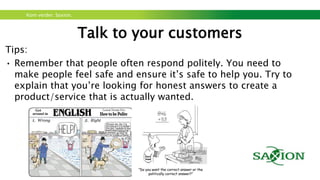
Tips:
• Remember that people often respond politely. You need to
make people feel safe and ensure it’s safe to help you. Try to
explain that you’re looking for honest answers to create a
product/service that is actually wanted.
Kom verder. Saxion.
Talk to your customers
• Start out with behaviour, not with feedback: start with
questions about the behaviour of the person in front of you, in
relation to the ‘problem or opportunity’. As soon as that’s
clear for you, you can ask for feedback.
• Ask open questions: no yes/no questions, just W-questions
(Why, Where, What, how?)
• Listen, don’t talk: Try to talk as little as possible and try to ask
your questions as short and neutral (so don’t enclose your
wanted answer intro the question) as possible.
Kom verder. Saxion.
Remember when developing a business:
Kom verder. Saxion.
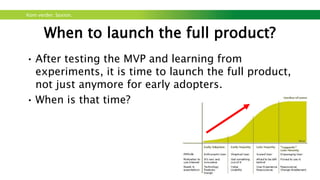
When to launch the full product?
• After testing the MVP and learning from
experiments, it is time to launch the full product,
not just anymore for early adopters.
• When is that time?
Kom verder. Saxion.
“Sean Ellis” test
How would you feel if you could no longer use [product]?
1. Very disappointed
2. Somewhat disappointed
3. Not disappointed (it isn’t really that useful)
4. N/A - I no longer use [product]
If you find that over 40% of your users are saying that they would
be “very disappointed” without your product, there is a great
chance you can build sustainable, scalable customer acquisition
growth on this “must have” product.
Kom verder. Saxion.
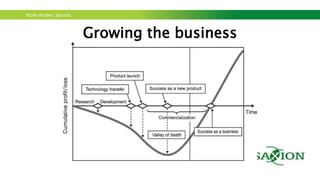
Growing the business
Kom verder. Saxion.
Growing the business
• Growth strategies:
New customers vs. Existing customers,
New products vs. Existing products?
http://www.youtube.com/watch?v=sGNDARIu11A
• Staff growth:
http://www.youtube.com/watch?v=j4oVe9YSfps
Kom verder. Saxion.
Your own business model…
Practicing with Osterwalder Business Model Canvas
Kom verder. Saxion.
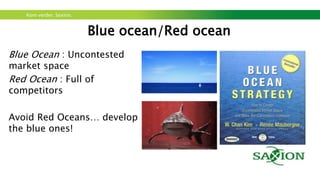
Blue ocean/Red ocean
Blue Ocean : Uncontested
market space
Red Ocean : Full of
competitors
Avoid Red Oceans… develop
the blue ones!
Kom verder. Saxion.
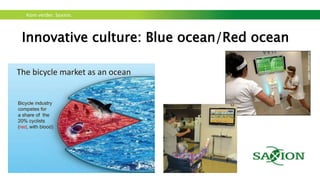
Innovative culture: Blue ocean/Red ocean
Kom verder. Saxion.
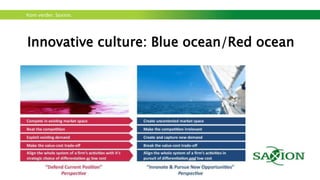
Innovative culture: Blue ocean/Red ocean
Kom verder. Saxion.
Blue Ocean / Red Ocean example
Read the text about Glasses Direct.co.uk
Describe for all the “Blue Ocean” criteria mentioned
before in how far they managed to create a blue
ocean!
Kom verder. Saxion.
The process of innovation
Golden rules of successful innovation:
(According to Microsoft)
1.It is something new.
2.I want to have it!
3.Why didn’t I think about it?
Kom verder. Saxion.
Resources used for this presentation
/ Further reading
• Saxion Startup Handbook (2014), Berrie Coelman
(downloadable at: http://www.startupwerkboek.nl/index.php/124)
• Entrepreneurship (2014), David Rae
• The Startup owners manual (2012), Steve Blank & Bob Dorf
• Business Model Generation (2010), Alexander Osterwalder & Yves
Peigneur
• The Lean Startup (2011), Eric Ries
• Start with Why (2011), Simon Sinek
• Blue Ocean Strategy (2005/2015), Kim & Mauborgne

Workshop Business Development

  • 1.
    Kom verder. Saxion. WorkshopSustainable Energy Building a business model Jacques Bazen Lecturer Entrepreneurship / International Economics
  • 2.
    Kom verder. Saxion. Overviewof the workshop • International entrepreneurship: Barriers • International entrepreneurship: Building a business together! • Business plans / Business model canvas • Defining a useful value proposal, case study • Your own business idea…
  • 3.
    Kom verder. Saxion. Whatis it that entrepreneurs are doing?
  • 4.
  • 5.
    Kom verder. Saxion. Quotefrom a Dutch entrepreneur “Very nice all these theoretical talks about going abroad, but you just have to do it. Point. You science guys teach the students to analyze everything so much until their ability to just act decisively is dead. The only thing they see is problems. I don’t need that kind of people. Why would someone need market research? Just drive around for a week in this country and you exactly know what they buy, how they behave and everything else you want to know as well”. Guts vs. Analytics?
  • 6.
    Kom verder. Saxion. Internationalpartnerships • Basically you are building a new organization. • Suddenly things how you know that are working in your home country, probably do not work as you are used to. • There is a risk that discovered solutions are sub- optimal.
  • 7.
  • 8.
  • 9.
    Kom verder. Saxion. Howto make normal business work Problems with starting a business: People with different “language” have to communicate (eg. entrepreneurs, venture capitalists, marketeers)
  • 10.
    Kom verder. Saxion. Howto make business work Extra challenge for international business: People with different language, culture and history have to communicate. That means… different ideas and expectations at the negotiating table
  • 11.
    Kom verder. Saxion. “Rainforest”solution Hwang & Horowitt use the Rainforest metaphor (wild unordered jungle with a large biodiversity) to explain why some regions are successful in creating an innovative climate, while others are not.
  • 12.
    Kom verder. Saxion. VentureFunding Why is it often so difficult to get sufficient funding? What does a Venture Capitalist see?
  • 13.
    Kom verder. Saxion. Rainforestrule Effective funding & long term partnerships only work if there is trust among partners that the different partners are Seeking fairness, not advantage!
  • 14.
    Kom verder. Saxion. Key:Sustainable value creation for customers
  • 15.
    Kom verder. Saxion. Creatingvalue: where is my customer? As entrepreneur you offer your customers a value proposal (a solution for their problem). How do you know a value proposal is good? Where / Who is my customer?
  • 16.
    Kom verder. Saxion. Rememberwhen developing a business:
  • 17.
    Kom verder. Saxion. Creatingvalue: where is my customer? “Your mother is not your customer!”
  • 18.
    Kom verder. Saxion. Answerto this question is to look into the customer needs and understand which needs customers have Where / Who is my customer?
  • 19.
    Kom verder. Saxion. Customerneeds Example: Parents looking for a baby seat in car • Technical: It must be helping our baby to be transported safely (the product does the job) • Emotional: Buying a good baby seats makes us feel good, as loving parents (the product makes you feel good) • Social: We want to show others that we have the best product (how the product is seen by others)
  • 20.
    Kom verder. Saxion. Customerneeds: positioning
  • 21.
    Kom verder. Saxion. Describinga business model How to describe a business idea as easy and clear as possible? Idea: write it in a predefined framework of 1 A4. Developer: Alexander Osterwalder
  • 22.
    Kom verder. Saxion. Inwhat way copy machine producers and energy saving companies have a similar business model?
  • 23.
    Kom verder. Saxion. Osterwalderabout his business model canvas • Business models as tool to compete in business http://www.youtube.com/watch?v=RzkdJiax6Tw • The canvas is a way to show in an easy way what you do and how you work • Because it is easy to produce, it is easy to make several canvasses and select the best.
  • 24.
    Kom verder. Saxion. Afterfinding an idea for a business model…
  • 25.
    Kom verder. Saxion. Assessingbusiness model attractiveness: Gurley’s test
  • 26.
    Kom verder. Saxion. Gurley’stest • Most important question: “How easy is it for someone else to provide the same product or service that you provide?” • More information on Gurley’s test: http://bmimatters.com/2012/04/04/assessing-a-business-model-attractiveness/ • Look through the eyes of an investor to your business
  • 27.
    Kom verder. Saxion. Competition Inthe market you will find competitors. You have to develop your business idea in such a way that your business has a unique offer for your customers. Parable of the printing house.
  • 28.
    Kom verder. Saxion. Keepingcustomers: lock-in
  • 29.
    Kom verder. Saxion. Osterwalder:Lock-in possibilities • Base Product & Consumable trap: Nespresso, Gillette, HP, Kodak • Data trap: Apple, Google Android, Spotify • Learning Curve trap: Adobe • Industry standards trap: Microsoft, Adobe • Service trap: Rolls Royce, Hilti • Exit trap: Mobile phone companies: subscriptions
  • 30.
    Kom verder. Saxion. Anotherway of thinking about “Customer relationships”…
  • 31.
  • 32.
    Kom verder. Saxion. Customerjourney Make sure your customers will have a positive “journey”: They will come back to you and/or promote you among others!
  • 33.
    Kom verder. Saxion. Practicingwith Osterwalder Case study, about energy saving in Saxion university of Applied Sciences.
  • 34.
    Kom verder. Saxion. Testingthe business model Steve Blank: 1. Get out of the building! There are no facts to be found in school or in the company itself  interview prospective customers to test your ideas 2. Make the process iterative. Adopt your product according to the ideas of your future customers. Don’t go for a waterfall development… step by step improvements.
  • 35.
    Kom verder. Saxion. Testingthe business model 3. Failure is part of the search! Try to experiment with different things and when experiments fail, try something else. 4. Make iterations and pivots (turnarounds). A pivot is a major change in one of the boxes of the business model canvas. 5. No business plan survives the first contact with customers.
  • 36.
  • 37.
  • 38.
  • 39.
  • 40.
  • 41.
    Kom verder. Saxion. Testingthe business model 6. Design experiments to test your assumptions (hypotheses, guesses) about customer needs and behaviour. Experiments could include test websites or models of a product. 7. Think about market positioning. New market, new product? New product, existing market? Niche market entrance? These are important for sales channel selection. 8. It’s all about passion
  • 42.
    Kom verder. Saxion. Whatnext: Minimum Viable Product Since a starting business is in the process of learning, it is important not to invest too much effort in the beginning stages in the design of the product.
  • 43.
    Kom verder. Saxion. Minimumviable product Minimum Viable Product is not the same as Minimal Effort!
  • 44.
    Kom verder. Saxion. Testingthe business model 9. Think about measuring progress… Take variables like cash-burn rate, months until break even
  • 45.
    Kom verder. Saxion. VentureFunding Why is it often so difficult to get sufficient funding? What does a Venture Capitalist see?
  • 46.
    Kom verder. Saxion. Venturefunding If it is so hard and so many risks with start-ups… why do venture capitalists invest in the first place? Answer: They simply don’t invest in the early stages.
  • 47.
    Kom verder. Saxion. VentureFunding If a venture capitalist or business angel invests in a company, they are going to want something in return  Usually shares (part of the ownership of the company).
  • 48.
    Kom verder. Saxion. Negativeaspects of venture funding That means, the investor becomes just co-owner… How much is ideal? If investor owns over 50%, is the entrepreneur still entrepreneur? Or employee? Example company “Bioburn”
  • 49.
  • 50.
    Kom verder. Saxion. Testingthe business model 10. Fast decision making: changes are necessary. Many startups face problems: psychological it is hard to get away from an idea that was developed by months. But sometimes it is necessary.
  • 51.
    Kom verder. Saxion. Testingthe business model 11. Job functions in a startup are very different than in ordinary companies. Startups require people who are comfortable with situations of uncertainty, chaos and change…
  • 52.
    Kom verder. Saxion. Testingthe business model 12. Preserve cash until needed: Then spend. In other words, don’t waste your money until you found a really promising idea. 13. Communicate and share learning. Make sure everyone on the team knows as much as possible: It will help finding new solutions.
  • 53.
    Kom verder. Saxion. Testingthe business model 14. Customer development needs a “buy-in”. Every member of the team must be involved and feel responsible. The process is fluid and fast changing: “we can’t change the features since development is underway” is a no-no.
  • 54.
    Kom verder. Saxion. Measureyour business… AARRR = Acquisition, Activation, Retention, Revenue, Referral Acquisition: describes the moment when an unconscious visitor is interested in your product/service. Activation: when the customers who are interested in the product are having their first (positive) user experience Retention: measuring the reuse and the involvement in the product / service Revenue: measuring the product / service what you get paid Referral: the number of customers who are coming back
  • 55.
    Kom verder. Saxion. Talkto your customers • Find a group of potentially interested people in your product / service (minimum 50) and ask them about your business idea. • This is not a sales pitch! • Listen if your customers feel they have problems and how they deal with it. • In the end, ask them whether the idea you are thinking about might help them.
  • 56.
    Kom verder. Saxion. Whowill be your first customers?
  • 57.
    Kom verder. Saxion. Earlyadopters http://www.inc.com/joe-gebbia/how-airbnbs-early- adopters-saved-the-company.html
  • 58.
    Kom verder. Saxion. Talkto your customers Don’t ask them “would you like to have candy” type of questions… Everyone would like to have candy, so don’t ask questions that nobody will say no to. For example: Do you also often feel thirsty while shopping in the city in the summer? Would you be interested in a good non-expensive offer of healthy fresh drinks while shopping…? I would like to start a watermelon store, do you like watermelon?
  • 59.
    Kom verder. Saxion. Talkto your customers Tips: • Remember that people often respond politely. You need to make people feel safe and ensure it’s safe to help you. Try to explain that you’re looking for honest answers to create a product/service that is actually wanted.
  • 60.
    Kom verder. Saxion. Talkto your customers • Start out with behaviour, not with feedback: start with questions about the behaviour of the person in front of you, in relation to the ‘problem or opportunity’. As soon as that’s clear for you, you can ask for feedback. • Ask open questions: no yes/no questions, just W-questions (Why, Where, What, how?) • Listen, don’t talk: Try to talk as little as possible and try to ask your questions as short and neutral (so don’t enclose your wanted answer intro the question) as possible.
  • 61.
    Kom verder. Saxion. Rememberwhen developing a business:
  • 62.
    Kom verder. Saxion. Whento launch the full product? • After testing the MVP and learning from experiments, it is time to launch the full product, not just anymore for early adopters. • When is that time?
  • 63.
    Kom verder. Saxion. “SeanEllis” test How would you feel if you could no longer use [product]? 1. Very disappointed 2. Somewhat disappointed 3. Not disappointed (it isn’t really that useful) 4. N/A - I no longer use [product] If you find that over 40% of your users are saying that they would be “very disappointed” without your product, there is a great chance you can build sustainable, scalable customer acquisition growth on this “must have” product.
  • 64.
  • 65.
    Kom verder. Saxion. Growingthe business • Growth strategies: New customers vs. Existing customers, New products vs. Existing products? http://www.youtube.com/watch?v=sGNDARIu11A • Staff growth: http://www.youtube.com/watch?v=j4oVe9YSfps
  • 66.
    Kom verder. Saxion. Yourown business model… Practicing with Osterwalder Business Model Canvas
  • 67.
    Kom verder. Saxion. Blueocean/Red ocean Blue Ocean : Uncontested market space Red Ocean : Full of competitors Avoid Red Oceans… develop the blue ones!
  • 68.
    Kom verder. Saxion. Innovativeculture: Blue ocean/Red ocean
  • 69.
    Kom verder. Saxion. Innovativeculture: Blue ocean/Red ocean
  • 70.
    Kom verder. Saxion. BlueOcean / Red Ocean example Read the text about Glasses Direct.co.uk Describe for all the “Blue Ocean” criteria mentioned before in how far they managed to create a blue ocean!
  • 71.
    Kom verder. Saxion. Theprocess of innovation Golden rules of successful innovation: (According to Microsoft) 1.It is something new. 2.I want to have it! 3.Why didn’t I think about it?
  • 72.
    Kom verder. Saxion. Resourcesused for this presentation / Further reading • Saxion Startup Handbook (2014), Berrie Coelman (downloadable at: http://www.startupwerkboek.nl/index.php/124) • Entrepreneurship (2014), David Rae • The Startup owners manual (2012), Steve Blank & Bob Dorf • Business Model Generation (2010), Alexander Osterwalder & Yves Peigneur • The Lean Startup (2011), Eric Ries • Start with Why (2011), Simon Sinek • Blue Ocean Strategy (2005/2015), Kim & Mauborgne

Editor's Notes

  • #29 1. ‘Base Product & Consumable trap’: Nespresso, Gillette, HP, Kodak For this trap, companies lure customers into their ecosystem with a base product and then milk profits from 'consumables' that customers are forced to buy. Nespresso coffee machines (base product) are sold at cost and available at major retailers so anyone can buy them. But the highly-profitable coffee pods are only sold through Nespresso’s owned sales channels, allowing them to absorb juicy margins. There was no way to buy pods from another manufacturer until 2011 because Nespresso owned exclusive rights to produce them. That's how consumers got locked in. Companies that have used the ‘base product & consumable trap’ include Gillette (razors & blades), Kodak (cameras and film), Hewlett-Packard (printers and cartridges). 2. ‘Data trap’: Apple, Google Android, Spotify The ‘Data trap’ consists encourages customers to create or purchase content and apps that are exclusively hosted on a platform. These platforms can be websites, software or devices. But, leaving one platform for another forces customers to let go of data or activity that can't be migrated to another app. For example, smartphone marketplaces like the AppStore or the Google PlayStore host content & apps that can’t be transferred elsewhere. Android or Apple users will have to give up their purchased music tracks, apps or movies if they want to switch to a competitor. Spotify, a music software company, threatened Apple and Google’s music revenues and switching costs by offering a vast catalogue of songs on an app that can be downloaded from major smartphone marketplaces. But if you switch from Spotify to another music app, you’ll lose your playlists. Another example of 'data trap'! 3. ‘Learning Curve Trap’: Adobe, Salesforce, Box Customers can be discouraged when they have to start over and learn how to use a new product. The ‘learning curve’ trap is centered around offering a great value proposition that’s only accessible to those willing to train to know how to use it. Salesforce and Adobe use the ‘learning curve trap’ to get customers hooked to their products--some users get so good at using their software that they become certified experts. They don’t feel like switching to something else unless they experience a very strong pain with their existing product. A similar example would be the file synchronisation app ‘Box’ for companies. It becomes so hard to rebuild an infrastructure for file sharing and synchronisation from scratch that companies prefer to stay with Box. It gets hard to switch to a different solution because it would mean losing a skill that you acquired in order to use the tool.   4. ‘Industry standards trap’: Microsoft, Adobe Sometimes, you are forced to do things because everyone else does it a certain way. That's another way companies lock customers in. They position themselves as leaders by public acceptance. Their product, or one of their product features, has become the standard in an industry, which makes it very difficult to use something else. Microsoft Office’s Word software is one of them. The .doc format, distinctive to Word documents, has been the industry standard since Microsoft’s early entrance on the word processing software market. Switching costs are high because it is nearly impossible to work with a word processing software that doesn’t create or accept .doc files today. The .pdf format is another widely accepted file format around the world and has enabled Adobe to create switching costs the same way. 5. ‘Servitization Trap’: Rolls Royce, Hilti If your competitor uses the ‘servitization trap’, you’re not just competing against their product, but against an entire experience they offer. In this approach, a company can bundle their products with complementary services provided only to their customers. Rolls Royce creates such switching costs in their ‘power by the hour’ offer. In essence, ‘power by the hour’ consists of leasing jet engines, maintenance and repair services for a flat fee. The real game-changer is that Rolls Royce only charges airlines for the time they use the engine. This experience is outstanding for airlines because it relieves them from the huge pain of losing money when defective engines block planes from flying. By bundling its highly profitable services with its first-class engines into one integrated offer, Rolls Royce make it harder for airlines to switch to a competitor. Another great example is Hilti who uses the 'servitization trap' to provide the best and latest constructions tools to its clients, which in turn can fend off competition from low-cost manufacturers. 6. ‘Exit trap’: Verizon, AT&T The ‘exit trap’ forces customers to use a product for a certain period of time specified in a contract. If the customer wants to exit the contract, he/she has to pay early termination fees. This strategy is commonly used to dissuade customers from switching to a competitor before their contract ends. Telecom operators such as AT&T or Verizon can charge up to $350 in early termination fees. Companies like T-Mobile are trying to threaten this business model by offering to cover early termination fees if customers switch to their offers.