Deciding on a
          ?
• Characteristics of a Successful Entrepreneur
• Step-by-Step Approach
  – Decide if you really want to be in business
  – Decide what business and where
  – Decide whether to start full-time or moonlight
• Selection Strategy
• Things to Watch Out For
• Required Activities
  – Comparative Evaluation
  – How to Evaluate a Specific Business you have in
    Mind
  – "For" and "Against" List
  – Get Completely Qualified
• Decision Time
The Business Plan
• What is a Business Plan?
• Why Prepare a Business Plan?
   – What to avoid in your business plan
• Business Plan Format
   –   Vision statement
   –   The people
   –   Business profile
   –   Economic assessment
• Six Steps to a Great Business Plan
• Business Plan's Necessary Factors
   –   Understanding your market
   –   Healthy, growing and stable industry
   –   Capable management
   –   Able financial control
   –   Consistent business focus
   –   Mindset to anticipate change
Characteristics of a Successful
Entrepreneur.
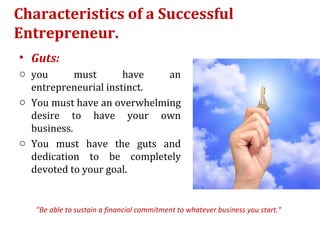
• Guts:
o you       must      have   an
  entrepreneurial instinct.
o You must have an overwhelming
  desire to have your own
  business.
o You must have the guts and
  dedication to be completely
  devoted to your goal.


   "Be able to sustain a financial commitment to whatever business you start."
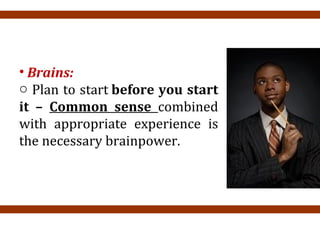
• Brains:
o Plan to start before you start
it – Common sense combined
with appropriate experience is
the necessary brainpower.
• Capital:
o You will need seed money of your own plus
  sufficient cash to maintain a positive cash
  flow for at least One year.
(In some cases you don't need starting capital
  to hire other people because you might start
  by doing everything yourself)
Step-by-Step Approach
Decide if you really want to be in business:
You will be putting some (not all, hopefully) of your net worth at risk. You will
run the risk of becoming eccentric, meaning creating a life that is out of balance,
with working hours taking away from other pleasurable activities. There may
be levels of stress you have not experienced as an employee/employer.


Decide what business and where:
Once you have decided you have the characteristics of a successful
entrepreneur and that you definitely want to be in business, then you must
decide which business is best for you and where to locate that business.
Selection strategy is covered later on in this Session.
Decide whether to start full-time or moonlight:
  There are some interesting advantages and some pitfalls in starting as a
     moonlight business. (That is, a business you start in your off hours while
     still working at your current job.) More often than not, the advantages of
     starting as a moonlighter outweigh the risks:

  •   Your full-time job won't suffer if you maintain certain conflict of
      interest disciplines, including compartmentalizing your job and
      business into completely separate worlds.

  •   You can avoid conflict of interest with your job by choosing a business
      that is appropriate for moonlighting, such as: single products, real
      estate, specialized food, e-commerce, direct marketing or family-run
      operations.

  •  There are great advantages for operating a family business. The family
     can run the business while you are at work. You have a built-in
     organizational structure. You can teach your family the benefits of
     being in business.
But there are also some pitfalls to consider in starting a moonlight business:
• There is a temptation to spend time at your job working on
  your moonlight business. That is unfair to your employer
  and should not be done under any circumstances. (You
  may need a family member or some trusted person to
  cover emergencies when you are at your job.)

• Another problem may be competing with your employer,
  which, again, is not right. Think of how you would feel or
  handle this employee if you were the boss.

• Any kind of conflict with your regular work can jeopardize
  your job and your moonlight business.

• Overwork and mental and physical exhaustion can also
  become a very real problem for moonlight entrepreneurs.
Selection Strategy
Selecting the wrong
business is the most
frequent mistake
that start-up
entrepreneurs
make. Here is a
checklist to help you
select a successful
one:
• Take your time and wait for the
  business that is just right for you.
• Don't tackle businesses that may be
  too challenging. It is better to identify
  a one-foot hurdle than try to jump a
  seven-footer.
• Try to identify a business that has
  long-term economic potential, then
  FOLLOW.
• Look for a business that will grow in
  today's and tomorrow's markets.
• Businesses to avoid are "commodity"
  businesses where you must compete
  entirely on price and in which you
  must have the lowest cost to survive.


       "As the saying goes, fail to plan and you are planning to fail."
Things to Watch Out For:
•   Impatience
•   Do not let overconfidence short-
    circuit you from analyzing your
    selection of businesses carefully.
    You must not fear of hearing the
    negative aspects; it is much better
    to be aware of them and face them
    early on.
•   Be realistic. Do not become lured
    by high rewards. They will come if
    you choose the right business and if
    you understand every aspect of the
    business before you open its doors.


       "To get ahead in this business you do everything to get the job done."
Required Activities
The most common mistake and the most costly one is not picking the
right business to begin with. This is the time for soul searching.
IF YOU HAVE NOT DECIDED ON A BUSINESS, DO THIS:

•On the top of a blank sheet of paper, write an activity you like to do
(make this the heading). Do a separate page for each activity or interest
you have.

•On those same sheets list as many businesses you can think of that are
related to that activity.

•On the same sheets list all the products or services you can think of that
are related to that activity. Use your imagination and think of every
possible product or service you could do.

•Make a list of businesses that do better in bad times (one may be
appropriate for you). Some examples might be pawnshops, auto repairs
and fabric stores.
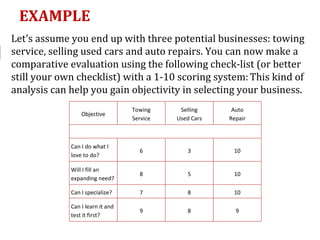
EXAMPLE
Let's assume you end up with three potential businesses: towing
service, selling used cars and auto repairs. You can now make a
comparative evaluation using the following check-list (or better
still your own checklist) with a 1-10 scoring system: This kind of
analysis can help you gain objectivity in selecting your business.
                                  Towing     Selling     Auto
                 Objective
                                  Service   Used Cars   Repair


             Can I do what I
                                    6          3         10
             love to do?

             Will I fill an
                                    8          5         10
             expanding need?

             Can I specialize?      7          8         10

             Can I learn it and
                                    9          8          9
             test it first?
How to Evaluate a Specific Business you
have in mind.
• Here are some questions to help clarify your thoughts:
• Is it something I will enjoy doing?
  My favorite activities are: __________________________
  I like to serve people by: ________________________________
• Can I be so good at a specialized, targeted need that
  customers will think there is no close substitute?
• Can I handle the capital requirements?
• Can I learn the business by working for someone else
  first?
• Is this a product or service that I can test first?
• Should I consider a partner who has complementary
  skills to mine or who could help finance the business?
Once you have decided what business you want
                to start, do this:

• Write down the names of at least five successful businesses
  in your chosen field.
• Analyze what these five businesses have in common and
  make a list of reasons that make them successful.
• Talk to several people in your intended business. Don't be
  afraid of the negative aspects of your intended business.
  Instead, seek out the pitfalls:
• Analyze the competition that are not doing well and write
  down the reasons.
Get Completely Qualified
Before you start, get completely qualified:


• The best way to become qualified is to go to work
  for someone in the same business.
• Attend all classes you can on the subjects you
  need, for example: accounting, computer and
  selling.
• Read all the appropriate "how-to" books you can.
• Don't be afraid to ask questions or seek help from
  the most successful people in your intended
  business.
Decision Time:

• What could you sell or what services could you
  perform that would make money and you would
  enjoy?
• To complete this session you should have decided on a
  business or at least selected a business you think
  would be best for you.
• To get the most benefit out of the next sessions you
  should have a definite plan in mind.

Session Two will show you how to prepare your business plan.

Deciding On A Business

  • 1.
  • 2.
    • Characteristics ofa Successful Entrepreneur • Step-by-Step Approach – Decide if you really want to be in business – Decide what business and where – Decide whether to start full-time or moonlight • Selection Strategy • Things to Watch Out For • Required Activities – Comparative Evaluation – How to Evaluate a Specific Business you have in Mind – "For" and "Against" List – Get Completely Qualified • Decision Time
  • 3.
  • 4.
    • What isa Business Plan? • Why Prepare a Business Plan? – What to avoid in your business plan • Business Plan Format – Vision statement – The people – Business profile – Economic assessment • Six Steps to a Great Business Plan • Business Plan's Necessary Factors – Understanding your market – Healthy, growing and stable industry – Capable management – Able financial control – Consistent business focus – Mindset to anticipate change
  • 5.
    Characteristics of aSuccessful Entrepreneur. • Guts: o you must have an entrepreneurial instinct. o You must have an overwhelming desire to have your own business. o You must have the guts and dedication to be completely devoted to your goal. "Be able to sustain a financial commitment to whatever business you start."
  • 6.
    • Brains: o Planto start before you start it – Common sense combined with appropriate experience is the necessary brainpower.
  • 7.
    • Capital: o Youwill need seed money of your own plus sufficient cash to maintain a positive cash flow for at least One year. (In some cases you don't need starting capital to hire other people because you might start by doing everything yourself)
  • 8.
    Step-by-Step Approach Decide ifyou really want to be in business: You will be putting some (not all, hopefully) of your net worth at risk. You will run the risk of becoming eccentric, meaning creating a life that is out of balance, with working hours taking away from other pleasurable activities. There may be levels of stress you have not experienced as an employee/employer. Decide what business and where: Once you have decided you have the characteristics of a successful entrepreneur and that you definitely want to be in business, then you must decide which business is best for you and where to locate that business. Selection strategy is covered later on in this Session.
  • 9.
    Decide whether tostart full-time or moonlight: There are some interesting advantages and some pitfalls in starting as a moonlight business. (That is, a business you start in your off hours while still working at your current job.) More often than not, the advantages of starting as a moonlighter outweigh the risks: • Your full-time job won't suffer if you maintain certain conflict of interest disciplines, including compartmentalizing your job and business into completely separate worlds. • You can avoid conflict of interest with your job by choosing a business that is appropriate for moonlighting, such as: single products, real estate, specialized food, e-commerce, direct marketing or family-run operations. • There are great advantages for operating a family business. The family can run the business while you are at work. You have a built-in organizational structure. You can teach your family the benefits of being in business. But there are also some pitfalls to consider in starting a moonlight business:
  • 10.
    • There isa temptation to spend time at your job working on your moonlight business. That is unfair to your employer and should not be done under any circumstances. (You may need a family member or some trusted person to cover emergencies when you are at your job.) • Another problem may be competing with your employer, which, again, is not right. Think of how you would feel or handle this employee if you were the boss. • Any kind of conflict with your regular work can jeopardize your job and your moonlight business. • Overwork and mental and physical exhaustion can also become a very real problem for moonlight entrepreneurs.
  • 11.
    Selection Strategy Selecting thewrong business is the most frequent mistake that start-up entrepreneurs make. Here is a checklist to help you select a successful one:
  • 12.
    • Take yourtime and wait for the business that is just right for you. • Don't tackle businesses that may be too challenging. It is better to identify a one-foot hurdle than try to jump a seven-footer. • Try to identify a business that has long-term economic potential, then FOLLOW. • Look for a business that will grow in today's and tomorrow's markets. • Businesses to avoid are "commodity" businesses where you must compete entirely on price and in which you must have the lowest cost to survive. "As the saying goes, fail to plan and you are planning to fail."
  • 13.
    Things to WatchOut For: • Impatience • Do not let overconfidence short- circuit you from analyzing your selection of businesses carefully. You must not fear of hearing the negative aspects; it is much better to be aware of them and face them early on. • Be realistic. Do not become lured by high rewards. They will come if you choose the right business and if you understand every aspect of the business before you open its doors. "To get ahead in this business you do everything to get the job done."
  • 14.
    Required Activities The mostcommon mistake and the most costly one is not picking the right business to begin with. This is the time for soul searching. IF YOU HAVE NOT DECIDED ON A BUSINESS, DO THIS: •On the top of a blank sheet of paper, write an activity you like to do (make this the heading). Do a separate page for each activity or interest you have. •On those same sheets list as many businesses you can think of that are related to that activity. •On the same sheets list all the products or services you can think of that are related to that activity. Use your imagination and think of every possible product or service you could do. •Make a list of businesses that do better in bad times (one may be appropriate for you). Some examples might be pawnshops, auto repairs and fabric stores.
  • 15.
    EXAMPLE Let's assume youend up with three potential businesses: towing service, selling used cars and auto repairs. You can now make a comparative evaluation using the following check-list (or better still your own checklist) with a 1-10 scoring system: This kind of analysis can help you gain objectivity in selecting your business. Towing Selling Auto Objective Service Used Cars Repair Can I do what I 6 3 10 love to do? Will I fill an 8 5 10 expanding need? Can I specialize? 7 8 10 Can I learn it and 9 8 9 test it first?
  • 16.
    How to Evaluatea Specific Business you have in mind. • Here are some questions to help clarify your thoughts: • Is it something I will enjoy doing? My favorite activities are: __________________________ I like to serve people by: ________________________________ • Can I be so good at a specialized, targeted need that customers will think there is no close substitute? • Can I handle the capital requirements? • Can I learn the business by working for someone else first? • Is this a product or service that I can test first? • Should I consider a partner who has complementary skills to mine or who could help finance the business?
  • 17.
    Once you havedecided what business you want to start, do this: • Write down the names of at least five successful businesses in your chosen field. • Analyze what these five businesses have in common and make a list of reasons that make them successful. • Talk to several people in your intended business. Don't be afraid of the negative aspects of your intended business. Instead, seek out the pitfalls: • Analyze the competition that are not doing well and write down the reasons.
  • 18.
    Get Completely Qualified Beforeyou start, get completely qualified: • The best way to become qualified is to go to work for someone in the same business. • Attend all classes you can on the subjects you need, for example: accounting, computer and selling. • Read all the appropriate "how-to" books you can. • Don't be afraid to ask questions or seek help from the most successful people in your intended business.
  • 19.
    Decision Time: • Whatcould you sell or what services could you perform that would make money and you would enjoy? • To complete this session you should have decided on a business or at least selected a business you think would be best for you. • To get the most benefit out of the next sessions you should have a definite plan in mind. Session Two will show you how to prepare your business plan.