Customer Service NVQ
Benchmarking and solving customer
problems
Workshop
22nd
March 2016
University of Westminster
Trainers Bev Gilder and Diane Eaton
Session objectivesSession objectives
• Understand what customers want
• Understand the importance of bench marking and feedback
• Acknowledge customers perceptions and manage customers
expectations
• Recognise behavioural attitudes and how they can influence others
• Explore effective ways in which to deal with challenging customers
• Develop confidence when dealing with challenging customers
• How to offer solutions
• Devising ideas to deal with problems.
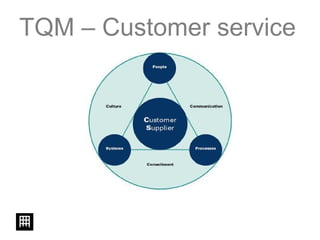
TQM – Customer service
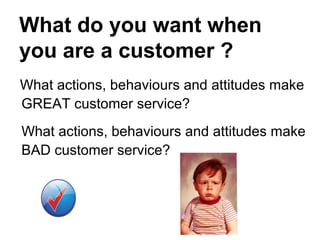
What do you want when
you are a customer ?
What actions, behaviours and attitudes make
GREAT customer service?
What actions, behaviours and attitudes make
BAD customer service?
What do you love when you
are a customer ?
When you are a customer what do
you really love……
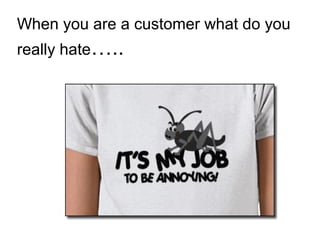
When you are a customer what do you
really hate…..are a customer ?
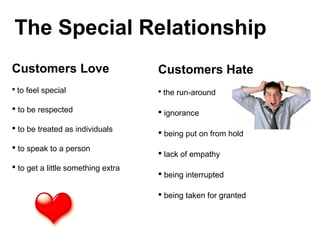
The Special Relationship
Customers Love
 to feel special
 to be respected
 to be treated as individuals
 to speak to a person
 to get a little something extra
Customers Hate
 the run-around
 ignorance
 being put on from hold
 lack of empathy
 being interrupted
 being taken for granted
Five keys to Customer ServiceFive keys to Customer Service
Keep promises and exceed expectations… be responsive
Be honest with customers, colleagues and yourself
Listen to feedback, it’s the tip of the iceberg
Find out what your customers think of you
Live the message you convey
Group exercise with others from yourGroup exercise with others from your
area of work…….area of work…….
Think about actions, behaviours and systems/processes
•What do your internal and external customers expect overall from
the University of Westminster ?
•What do your internal and external customers expect from your
specific area ?
How do you know how you’re doing ?How do you know how you’re doing ?
• University league tables National Student Survey
• Internal staff survey
• Feedback from external customers – good and bad
• Feedback from internal customers – good and bad
• Your own performance review and your Key Performance
Objectives
• Anything else ??
Some measures of performanceSome measures of performance
University league tables
•Entry standards
•Student satisfaction
•Research assessment
•Graduation prospects
National student survey
•Teaching
•Assessment and feedback
•Academic support
•Organisation and
management
•Learning resources
•Personal development
What can you measure in your area toWhat can you measure in your area to
bench mark performance ?bench mark performance ?
• How can you collect this information
• What will it tell you ?
• How will you share it ?
• What can it help you do ?
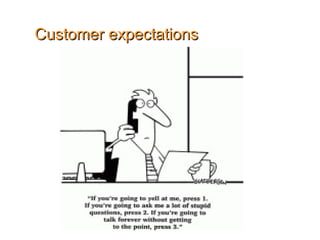
Customer expectationsCustomer expectations
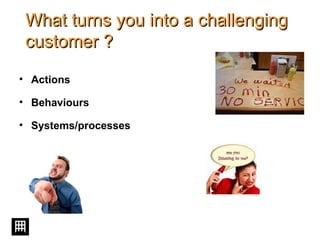
What turns you into a challengingWhat turns you into a challenging
customer ?customer ?
• Actions
• Behaviours
• Systems/processes
What type of challenging situation doWhat type of challenging situation do
you find most difficult to handle ?you find most difficult to handle ?
• Describe the situation to your group
• Work with people from a different area ?
• Support each other with ideas about what you can do ?
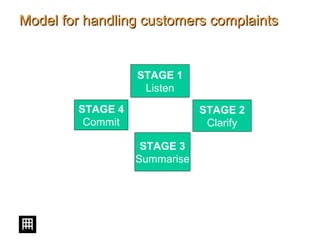
Model for handling customers complaintsModel for handling customers complaints
A FOUR-STAGE PROCESS
STAGE 1
Listen
STAGE 2
Clarify
STAGE 3
Summarise
STAGE 4
Commit
Stage 1: Use active listeningStage 1: Use active listening
• Look at the person if you are face to face
• If on the telephone – acknowledge that you are attentive
• Ignore distractions
• Track the conversation
• Empathise – use works like ‘acknowledge’ and ‘understand’
• Make appropriate verbal responses to show you are listening
Stage 2: Ask questions and clarifyStage 2: Ask questions and clarify
• Ask or advise that you may need to take a note so that you can
accurately record the issues they have and do it !
• Use open and closed questions to extract information and focus on
the problem
• Avoid multiply questions – they confuse everyone
Stage 3: SummariseStage 3: Summarise
• Replay your understanding of what the person is concerned
about – precise key points
• Outline your suggestions/options for addressing the person’s
needs
• Aim to give a choice if you can
• Seek confirmation of agreement and then advise of next stage
FOUR TYPES OF CHALLENGINGFOUR TYPES OF CHALLENGING
CUSTOMER…..WHAT CAN YOU DO ?CUSTOMER…..WHAT CAN YOU DO ?
• Aggressive and angry people
• Vague and indecisive people
• Unfriendly people
• Avoiders
Aggressive and angry….Aggressive and angry….
• Stay in neutral - don’t respond with confrontation or retraction
• Check your body language and tone of voice on phone or face to face
• Keep asking for the facts
• Acknowledge their feelings about the issue
• Focus on reaching a positive outcome
• Be clear about what you can and can’t do before you start
• Use broken record technique
• Avoid over justifying with loads of reasons
VaguenessVagueness
• Stay patient – someone is trying to communicate
• Write down facts when they are given
• Aim to get control of the conversation so you get the facts you need
• Use clear open questions and closed ones to pin down to specifics
• Consider if there's a piece of info they don’t want to give – why ?
• Be business like and focussed
• Stay on topic
• Summarise regularly
UnfriendlinessUnfriendliness
•Smile as you speak
•Deal quickly
•Leave chit chat out
•Stick to the facts
•Avoid sarcastic comments
•Personalise using their name a
little
AvoidersAvoiders
• Give short term time frame for
action- yours and theirs
• Give one reason only
• Ask closed questions
• Stay assertive
• Use key phrases back
• Monitor outcome
Customer challenges … pleaseCustomer challenges … please
• Demonstrate professionalism
• Watch your body language and your tone of voice
• Keep your voice friendly and open
• Listen
• Get information and record it
• Empathise
• Apologise if wrong
• Get back when you say so
• Be prepared to be assertive
and … ensure that you are aware of the
organisation’s standards and codes of practice.
Avoid …Avoid …
• ‘Creating’ policies to avoid responsibility
• Saying they are talking to the wrong person
• Interrupting
• Saying that you didn’t deal with this
• Jumping to conclusions
• Saying you are having a lot of problems like this
• Talking down to them
• Losing your temper
• Appealing for sympathy
What customers wantWhat customers want
HelpHelp … genuine effort reduces hostility
ChoiceChoice….don’t push them into a corner
AcknowledgementAcknowledgement …..treating them as an individual and
recognising they are upset
NVQ units
Level 2
F1 – Communicate using
customer service language
1.1, 1.2, 3.3, 3.9,3.10. 3.14, 3.15
F2- Follow the rules
1.2,1.3, 2.2
Level 3
F3 Demonstrate understanding
Customer Service
1.2,1.3,(ex3.3,3.4,3.6,3.8,3.9,3.1
3.17,3.19
F4 Demonstrate understanding
of rules
1.2
Next WorkshopNext Workshop
• 26th
April 2016 9.30 – 1.00
• Motivation and continuous improvement

Workshop 2 for itslearning

  • 1.
    Customer Service NVQ Benchmarkingand solving customer problems Workshop 22nd March 2016 University of Westminster Trainers Bev Gilder and Diane Eaton
  • 2.
    Session objectivesSession objectives •Understand what customers want • Understand the importance of bench marking and feedback • Acknowledge customers perceptions and manage customers expectations • Recognise behavioural attitudes and how they can influence others • Explore effective ways in which to deal with challenging customers • Develop confidence when dealing with challenging customers • How to offer solutions • Devising ideas to deal with problems.
  • 3.
  • 4.
    What do youwant when you are a customer ? What actions, behaviours and attitudes make GREAT customer service? What actions, behaviours and attitudes make BAD customer service?
  • 5.
    What do youlove when you are a customer ? When you are a customer what do you really love……
  • 6.
    When you area customer what do you really hate…..are a customer ?
  • 7.
    The Special Relationship CustomersLove  to feel special  to be respected  to be treated as individuals  to speak to a person  to get a little something extra Customers Hate  the run-around  ignorance  being put on from hold  lack of empathy  being interrupted  being taken for granted
  • 8.
    Five keys toCustomer ServiceFive keys to Customer Service Keep promises and exceed expectations… be responsive Be honest with customers, colleagues and yourself Listen to feedback, it’s the tip of the iceberg Find out what your customers think of you Live the message you convey
  • 9.
    Group exercise withothers from yourGroup exercise with others from your area of work…….area of work……. Think about actions, behaviours and systems/processes •What do your internal and external customers expect overall from the University of Westminster ? •What do your internal and external customers expect from your specific area ?
  • 10.
    How do youknow how you’re doing ?How do you know how you’re doing ? • University league tables National Student Survey • Internal staff survey • Feedback from external customers – good and bad • Feedback from internal customers – good and bad • Your own performance review and your Key Performance Objectives • Anything else ??
  • 11.
    Some measures ofperformanceSome measures of performance University league tables •Entry standards •Student satisfaction •Research assessment •Graduation prospects National student survey •Teaching •Assessment and feedback •Academic support •Organisation and management •Learning resources •Personal development
  • 12.
    What can youmeasure in your area toWhat can you measure in your area to bench mark performance ?bench mark performance ? • How can you collect this information • What will it tell you ? • How will you share it ? • What can it help you do ?
  • 13.
  • 14.
    What turns youinto a challengingWhat turns you into a challenging customer ?customer ? • Actions • Behaviours • Systems/processes
  • 15.
    What type ofchallenging situation doWhat type of challenging situation do you find most difficult to handle ?you find most difficult to handle ? • Describe the situation to your group • Work with people from a different area ? • Support each other with ideas about what you can do ?
  • 16.
    Model for handlingcustomers complaintsModel for handling customers complaints A FOUR-STAGE PROCESS STAGE 1 Listen STAGE 2 Clarify STAGE 3 Summarise STAGE 4 Commit
  • 17.
    Stage 1: Useactive listeningStage 1: Use active listening • Look at the person if you are face to face • If on the telephone – acknowledge that you are attentive • Ignore distractions • Track the conversation • Empathise – use works like ‘acknowledge’ and ‘understand’ • Make appropriate verbal responses to show you are listening
  • 18.
    Stage 2: Askquestions and clarifyStage 2: Ask questions and clarify • Ask or advise that you may need to take a note so that you can accurately record the issues they have and do it ! • Use open and closed questions to extract information and focus on the problem • Avoid multiply questions – they confuse everyone
  • 19.
    Stage 3: SummariseStage3: Summarise • Replay your understanding of what the person is concerned about – precise key points • Outline your suggestions/options for addressing the person’s needs • Aim to give a choice if you can • Seek confirmation of agreement and then advise of next stage
  • 20.
    FOUR TYPES OFCHALLENGINGFOUR TYPES OF CHALLENGING CUSTOMER…..WHAT CAN YOU DO ?CUSTOMER…..WHAT CAN YOU DO ? • Aggressive and angry people • Vague and indecisive people • Unfriendly people • Avoiders
  • 21.
    Aggressive and angry….Aggressiveand angry…. • Stay in neutral - don’t respond with confrontation or retraction • Check your body language and tone of voice on phone or face to face • Keep asking for the facts • Acknowledge their feelings about the issue • Focus on reaching a positive outcome • Be clear about what you can and can’t do before you start • Use broken record technique • Avoid over justifying with loads of reasons
  • 22.
    VaguenessVagueness • Stay patient– someone is trying to communicate • Write down facts when they are given • Aim to get control of the conversation so you get the facts you need • Use clear open questions and closed ones to pin down to specifics • Consider if there's a piece of info they don’t want to give – why ? • Be business like and focussed • Stay on topic • Summarise regularly
  • 23.
    UnfriendlinessUnfriendliness •Smile as youspeak •Deal quickly •Leave chit chat out •Stick to the facts •Avoid sarcastic comments •Personalise using their name a little AvoidersAvoiders • Give short term time frame for action- yours and theirs • Give one reason only • Ask closed questions • Stay assertive • Use key phrases back • Monitor outcome
  • 24.
    Customer challenges …pleaseCustomer challenges … please • Demonstrate professionalism • Watch your body language and your tone of voice • Keep your voice friendly and open • Listen • Get information and record it • Empathise • Apologise if wrong • Get back when you say so • Be prepared to be assertive and … ensure that you are aware of the organisation’s standards and codes of practice.
  • 25.
    Avoid …Avoid … •‘Creating’ policies to avoid responsibility • Saying they are talking to the wrong person • Interrupting • Saying that you didn’t deal with this • Jumping to conclusions • Saying you are having a lot of problems like this • Talking down to them • Losing your temper • Appealing for sympathy
  • 26.
    What customers wantWhatcustomers want HelpHelp … genuine effort reduces hostility ChoiceChoice….don’t push them into a corner AcknowledgementAcknowledgement …..treating them as an individual and recognising they are upset
  • 27.
    NVQ units Level 2 F1– Communicate using customer service language 1.1, 1.2, 3.3, 3.9,3.10. 3.14, 3.15 F2- Follow the rules 1.2,1.3, 2.2 Level 3 F3 Demonstrate understanding Customer Service 1.2,1.3,(ex3.3,3.4,3.6,3.8,3.9,3.1 3.17,3.19 F4 Demonstrate understanding of rules 1.2
  • 28.
    Next WorkshopNext Workshop •26th April 2016 9.30 – 1.00 • Motivation and continuous improvement