Nick Dodds Managing Director
DAY THREE – AGENDA Session One Marketing: Basic Introduction, Audience Development, Media and PR Session Two Marketing Online Marketing: Edinburgh International Festival Session Three and Four Fundraising: Governments, Sponsorship, Trusts and Foundations, Individuals British Council Vietnam Festival Workshop 17-20 March 2010
Marketing and Communications This section aims to give those who are new to festival marketing and communications a basic guide to help them through the planning process. It may also act as a  stimulus for more experienced festival & event marketers to review or rethink existing activity. British Council Vietnam Festival Workshop 17-20 March 2010
GENERAL MARKETING PRINCIPALS The development of an effective marketing and communications plan is essential for the delivery of a successful festival.  The key is to match your festival concept (the theme, programme, etc) with the appropriate audience (those who will attend or participate in your event). In order to do that, you must have a strong idea of what the event actually offers and to whom. You also need to have an effective plan of action and the necessary resources to implement it. British Council Vietnam Festival Workshop 17-20 March 2010
SPECIAL FESTIVAL MARKETING CONSIDERATIONS Festival are, in general, special annual or one-off manifestations that take place in a specific, relatively short time-frame.  You have a finite period to plan and action your marketing activity and a one-time-only chance to mount your festival. Remember, attendees that you attract to your festival as a result of your marketing activity are themselves key to the event’s success. If you attract the right type and level of attendees, this will help create the special atmosphere and experience that the Festival aspires to offer, not to mention any financial or other targets that you have set. British Council Vietnam Festival Workshop 17-20 March 2010
FESTIVAL MARKETING  Where to start: the situational analysis The first stage of devising your marketing plan involves what is sometimes called the  ‘situational analysis’ .  It basically means taking a step back and having a good look at all the available information that relates to the festival before devising a plan to move forward British Council Vietnam Festival Workshop 17-20 March 2010
SIYUATIONAL ANALYSIS The existing audience for the event  ( i.e.  who comes, where from, how many, level of repeat attendees, level of first time attendees, has the audience profile changed over the years, etc?) If there is any existing research  ( i.e.  do you hold any hard information on your audiences, have you closely examined it, what does it tell you, is it recent, what else do you need to find out, etc?) Previous marketing activity and resources  ( i.e.  what has worked in the past, what could be developed further, etc?) Available resources  ( i.e.  budget, staff, stakeholder support and amount of time available to deliver the plan, etc) Competitor analysis  ( i.e.  does the event have any competitors, can you learn from them?) Income targets  ( i.e.  what level of return does the marketing activity aim to deliver by way of ticket sales, what are the other sources of potential income and can marketing activity influence these?) British Council Vietnam Festival Workshop 17-20 March 2010
MARKETING RESOURCES When preparing your Marketing and Communications Plan you must keep the available resources at the forefront of your mind.  There are three key resource factors to consider: >  Budget  – you need to establish the basic marketing budget at the outset. 5-10-15-20% >  Time  – you need to be aware of what’s actually possible in the time available – GETTING EASIER >  Staff  – you need to agree who’s responsible for what and identify if there are any sources of additional assistance British Council Vietnam Festival Workshop 17-20 March 2010
Identifying Target Markets Identify in detail the types of groups that you will actually spend time and money trying to attract: specific and realistic. Who are the Target Markets?: Residents and Visitors:  these may include previous attendees; new audiences; special interest and community groups; schools; specific age, socio-economic and ethnic groups; families, couples, tourists, future sponsors, the media, stakeholders, key influencers Where are the Target Markets?:  for each entry in the WHO category you should identify WHERE they are likely to be drawn from,  i.e.  the local community, the wider region, Vietnam, Asia, the world.  Be Realistic . British Council Vietnam Festival Workshop 17-20 March 2010
Building and Developing your audience Your existing audiences are one of your most important assets.  At the very least you need to ensure that you are constantly building and utilising your audience database. You need to understand your current audience profile in order to maintain and develop it further.  Audience data should be captured at every event and trends analysed and compared to previous years. Your existing audiences can be useful ambassadors for your event. They are important in spreading positive word-of-mouth and should be nurtured in order that they will return.  In accordance with budget limitations, remember to concentrate on your existing and ‘potential new audiences’ and don’t spend valuable time trying to convert groups that your research and experience tell you may be indifferent or unlikely to attend.  The more you understand about your current and potential audiences, the more sophisticated you can become in using different techniques to target specific groups  Remember to talk to them regularly – mailings, offers etc. Build relationships British Council Vietnam Festival Workshop 17-20 March 2010
Building the Marketing and Coms Plan Marketing Objectives: Where do you want to go? Make sure your marketing objectives are  SMART  : S pecific – do they describe precisely what are you aiming to achieve? M easurable – can you define and measure them? A chievable – do you have the resources to put them into action? R ealistic – never over-estimate anything, especially financial targets T imely – can you achieve them in the timeframe available British Council Vietnam Festival Workshop 17-20 March 2010
Developing the Marketing Strategy: How are you going to get there? Marketing Mix: What makes people attend events? Product – what the event offers Can you develop the product any further? Packaging Price – the cost of attending How does the cost of attending the event add up? Discounting? Convenience – making it easy to attend  Access to tickets. Getting there? Promotion – saying the right things to the right people  What’s the message? Why you have to be there? British Council Vietnam Festival Workshop 17-20 March 2010
Marketing Tools:  Some of the most commonly used event marketing tools include: Print: posters, leaflets, postcards, programmes, etc Direct mail and print distribution Media advertising: print, radio and TV Website/internet/e-bulletins Outdoor advertising: billboards, bus sides, poster sites, street dressing, etc Friends/ambassadors’ programmes/clubs Media releases, promotions and activity Media sponsorship British Council Vietnam Festival Workshop 17-20 March 2010
Top Tips…. Build your customer database…. Choose the most practical method of delivery... Direct Mail? British Council Vietnam Festival Workshop 17-20 March 2010
Media Relations and Planning Build a media database. Be aware of deadline days and preferred format (email or post)  Keep a track of media response and interest. Create a good relationship with the local paper and appropriate journalists. Think about angles and sell the story Always be accurate and honest when dealing with the media. Provide appropriate accreditation and facilities for the media to report from the event.  Remember to invite journalists to review the event. Always say “thank you” if the event is covered. British Council Vietnam Festival Workshop 17-20 March 2010
Lots of Resources On-Line Event Scotland http://www.eventscotland.org/funding-and-resources/event-management-a-practical-guide/ British Council Vietnam Festival Workshop 17-20 March 2010
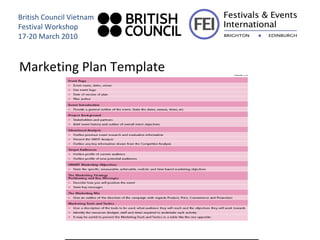
Marketing Plan Template British Council Vietnam Festival Workshop 17-20 March 2010
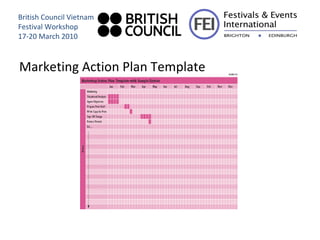
Marketing Action Plan Template British Council Vietnam Festival Workshop 17-20 March 2010
Thank You Questions ? British Council Vietnam Festival Workshop 17-20 March 2010

Workshop 1 10 fei vienam workshop marketing

  • 1.
  • 2.
    DAY THREE –AGENDA Session One Marketing: Basic Introduction, Audience Development, Media and PR Session Two Marketing Online Marketing: Edinburgh International Festival Session Three and Four Fundraising: Governments, Sponsorship, Trusts and Foundations, Individuals British Council Vietnam Festival Workshop 17-20 March 2010
  • 3.
    Marketing and CommunicationsThis section aims to give those who are new to festival marketing and communications a basic guide to help them through the planning process. It may also act as a stimulus for more experienced festival & event marketers to review or rethink existing activity. British Council Vietnam Festival Workshop 17-20 March 2010
  • 4.
    GENERAL MARKETING PRINCIPALSThe development of an effective marketing and communications plan is essential for the delivery of a successful festival. The key is to match your festival concept (the theme, programme, etc) with the appropriate audience (those who will attend or participate in your event). In order to do that, you must have a strong idea of what the event actually offers and to whom. You also need to have an effective plan of action and the necessary resources to implement it. British Council Vietnam Festival Workshop 17-20 March 2010
  • 5.
    SPECIAL FESTIVAL MARKETINGCONSIDERATIONS Festival are, in general, special annual or one-off manifestations that take place in a specific, relatively short time-frame. You have a finite period to plan and action your marketing activity and a one-time-only chance to mount your festival. Remember, attendees that you attract to your festival as a result of your marketing activity are themselves key to the event’s success. If you attract the right type and level of attendees, this will help create the special atmosphere and experience that the Festival aspires to offer, not to mention any financial or other targets that you have set. British Council Vietnam Festival Workshop 17-20 March 2010
  • 6.
    FESTIVAL MARKETING Where to start: the situational analysis The first stage of devising your marketing plan involves what is sometimes called the ‘situational analysis’ . It basically means taking a step back and having a good look at all the available information that relates to the festival before devising a plan to move forward British Council Vietnam Festival Workshop 17-20 March 2010
  • 7.
    SIYUATIONAL ANALYSIS Theexisting audience for the event ( i.e. who comes, where from, how many, level of repeat attendees, level of first time attendees, has the audience profile changed over the years, etc?) If there is any existing research ( i.e. do you hold any hard information on your audiences, have you closely examined it, what does it tell you, is it recent, what else do you need to find out, etc?) Previous marketing activity and resources ( i.e. what has worked in the past, what could be developed further, etc?) Available resources ( i.e. budget, staff, stakeholder support and amount of time available to deliver the plan, etc) Competitor analysis ( i.e. does the event have any competitors, can you learn from them?) Income targets ( i.e. what level of return does the marketing activity aim to deliver by way of ticket sales, what are the other sources of potential income and can marketing activity influence these?) British Council Vietnam Festival Workshop 17-20 March 2010
  • 8.
    MARKETING RESOURCES Whenpreparing your Marketing and Communications Plan you must keep the available resources at the forefront of your mind. There are three key resource factors to consider: > Budget – you need to establish the basic marketing budget at the outset. 5-10-15-20% > Time – you need to be aware of what’s actually possible in the time available – GETTING EASIER > Staff – you need to agree who’s responsible for what and identify if there are any sources of additional assistance British Council Vietnam Festival Workshop 17-20 March 2010
  • 9.
    Identifying Target MarketsIdentify in detail the types of groups that you will actually spend time and money trying to attract: specific and realistic. Who are the Target Markets?: Residents and Visitors: these may include previous attendees; new audiences; special interest and community groups; schools; specific age, socio-economic and ethnic groups; families, couples, tourists, future sponsors, the media, stakeholders, key influencers Where are the Target Markets?: for each entry in the WHO category you should identify WHERE they are likely to be drawn from, i.e. the local community, the wider region, Vietnam, Asia, the world. Be Realistic . British Council Vietnam Festival Workshop 17-20 March 2010
  • 10.
    Building and Developingyour audience Your existing audiences are one of your most important assets. At the very least you need to ensure that you are constantly building and utilising your audience database. You need to understand your current audience profile in order to maintain and develop it further. Audience data should be captured at every event and trends analysed and compared to previous years. Your existing audiences can be useful ambassadors for your event. They are important in spreading positive word-of-mouth and should be nurtured in order that they will return. In accordance with budget limitations, remember to concentrate on your existing and ‘potential new audiences’ and don’t spend valuable time trying to convert groups that your research and experience tell you may be indifferent or unlikely to attend. The more you understand about your current and potential audiences, the more sophisticated you can become in using different techniques to target specific groups Remember to talk to them regularly – mailings, offers etc. Build relationships British Council Vietnam Festival Workshop 17-20 March 2010
  • 11.
    Building the Marketingand Coms Plan Marketing Objectives: Where do you want to go? Make sure your marketing objectives are SMART : S pecific – do they describe precisely what are you aiming to achieve? M easurable – can you define and measure them? A chievable – do you have the resources to put them into action? R ealistic – never over-estimate anything, especially financial targets T imely – can you achieve them in the timeframe available British Council Vietnam Festival Workshop 17-20 March 2010
  • 12.
    Developing the MarketingStrategy: How are you going to get there? Marketing Mix: What makes people attend events? Product – what the event offers Can you develop the product any further? Packaging Price – the cost of attending How does the cost of attending the event add up? Discounting? Convenience – making it easy to attend Access to tickets. Getting there? Promotion – saying the right things to the right people What’s the message? Why you have to be there? British Council Vietnam Festival Workshop 17-20 March 2010
  • 13.
    Marketing Tools: Some of the most commonly used event marketing tools include: Print: posters, leaflets, postcards, programmes, etc Direct mail and print distribution Media advertising: print, radio and TV Website/internet/e-bulletins Outdoor advertising: billboards, bus sides, poster sites, street dressing, etc Friends/ambassadors’ programmes/clubs Media releases, promotions and activity Media sponsorship British Council Vietnam Festival Workshop 17-20 March 2010
  • 14.
    Top Tips…. Buildyour customer database…. Choose the most practical method of delivery... Direct Mail? British Council Vietnam Festival Workshop 17-20 March 2010
  • 15.
    Media Relations andPlanning Build a media database. Be aware of deadline days and preferred format (email or post) Keep a track of media response and interest. Create a good relationship with the local paper and appropriate journalists. Think about angles and sell the story Always be accurate and honest when dealing with the media. Provide appropriate accreditation and facilities for the media to report from the event. Remember to invite journalists to review the event. Always say “thank you” if the event is covered. British Council Vietnam Festival Workshop 17-20 March 2010
  • 16.
    Lots of ResourcesOn-Line Event Scotland http://www.eventscotland.org/funding-and-resources/event-management-a-practical-guide/ British Council Vietnam Festival Workshop 17-20 March 2010
  • 17.
    Marketing Plan TemplateBritish Council Vietnam Festival Workshop 17-20 March 2010
  • 18.
    Marketing Action PlanTemplate British Council Vietnam Festival Workshop 17-20 March 2010
  • 19.
    Thank You Questions? British Council Vietnam Festival Workshop 17-20 March 2010

Editor's Notes

  • #2 DELIGHTED TO BE HERE TO LAUNCH A BRAND NEW SERVICE FROM FEI