DATA AND DATABASE
Syed Measum Haider Naqvi
Network Specialist
WHAT IS DATA
Data is any set of characters that has been gathered and translated for
some purpose, usually analysis. It can be any character, including text and
numbers, pictures, sound, or video. If data is not put into context, it
doesn't do anything to a human or computer.
DATA TYPES
A data type is a classification of the type of data that a variable or object can hold in
computer programming. Data types are an important factor in virtually all computer
programming languages, including C#, C++, JavaScript, and Visual Basic.
Common examples of data types
Boolean (e.g. True or False)
Character (e.g. a)
Date (e.g. 03/01/2016)
Double (e.g. 1.79769313486232E308)
Floating-point number (e.g. 1.234)
Integer (e.g. 1234)
Long (e.g. 123456789)
Short (e.g. 0)
String (e.g. abcd)
Void (e.g. no data)
WHAT IS DATABASE
A database is a collection of information that is organized so that it can be
easily accessed, managed and updated.
Data is organized into rows, columns and tables, and it is indexed to make
it easier to find relevant information. Data gets updated, expanded and
deleted as new information is added. Databases process workloads to
create and update themselves, querying the data they contain and
running applications against it.
DATABASE TYPES
There are following common type of database
▪ Relational Databases
▪ Operational Databases
▪ Database Warehouses
▪ Distributed Databases
▪ End-User Databases
▪ External Database
▪ Hypermedia Database
▪ Navigational Database
▪ In-Memory Database.
▪ Document-Oriented Database
▪ Real-Time Database
▪ Analytical Database
RELATIONAL DATABASES
Relational Databases
This is the most common of all the different types of databases. In this, the data in a relational
database is stored in various data tables. Each table has a key field which is used to connect it to
other tables. Hence all the tables are related to each other through several key fields. These
databases are extensively used in various industries and will be the one you are most likely to
come across when working in IT.
Examples of relational databases are Oracle, Sybase and Microsoft SQL Server and they are often
key parts of the process of software development.
OPERATIONAL DATABASES
Operational Databases
In its day to day operation, an organization generates a huge amount of data. Think of things such
as inventory management, purchases, transactions and financials. All this data is collected in a
database which is often known by several names such as operational/ production database,
subject-area database (SADB) or transaction databases.
An operational database is usually hugely important to Organizations as they include the customer
database, personal database and inventory database i.e. the details of how much of a product the
company has as well as information on the customers who buy them. The data stored in
operational databases can be changed and manipulated depending on what the company requires.
DATABASE WAREHOUSES
Database Warehouses
Organizations are required to keep all relevant data for several years. In the UK it can be as
long as 6 years. This data is also an important source of information for analyzing and
comparing the current year data with that of the past years which also makes it easier to
determine key trends taking place. All this data from previous years are stored in a database
warehouse. Since the data stored has gone through all kinds of screening, editing and
integration it does not need any further editing or alteration.
With this database ensure that the software requirements specification (SRS) is formally
approved as part of the project quality plan.
DISTRIBUTED DATABASES
Distributed Databases
Many organizations have several office locations, manufacturing plants, regional offices, branch
offices and a head office at different geographic locations. Each of these work groups may have
their own database which together will form the main database of the company. This is known as a
distributed database.
END-USER DATABASES
End-User Databases
There is a variety of data available at the workstation of all the end users of any organization. Each
workstation is like a small database in itself which includes data in spreadsheets, presentations,
word files, note pads and downloaded files. All such small databases form a different type of
database called the end-user database. .
EXTERNAL DATABASE
External Database
There is a sea of information available outside world which is required by an organization. They are
privately-owned data for which one can have conditional and limited access for a fortune. This
data is meant for commercial usage. All such databases outside the organization which are of use
and limited access are together called external database.
HYPERMEDIA DATABASE
Hypermedia Database
Most websites have various interconnected multimedia pages which might include text, video
clips, audio clips, photographs and graphics. These all need to be stored and “called” from
somewhere when the webpage if created. All of them together form the hypermedia database.
NAVIGATIONAL DATABASE
Navigational Database
Navigational database has all the items which are references from other objects. In this, one has to
navigate from one reference to other or one object to other. It might be using modern systems like
XPath. One of its applications is the air flight management systems.
IN-MEMORY DATABASE
In-Memory Database
An in-memory databases stores data in a computer’s main memory instead of using a disk-based
storage system. It is faster and more reliable than that in a disk. They find their application in
telecommunications network equipment.
DOCUMENT-ORIENTED DATABASE
Document-Oriented Database
A document oriented database is a different type of database which is used in applications which
are document oriented. The data is stored in the form of text records instead of being stored in a
data table as usually happens.
REAL-TIME DATABASE
Real-Time Database
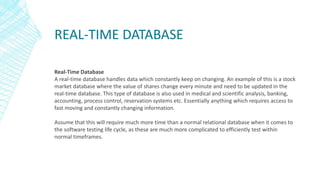
A real-time database handles data which constantly keep on changing. An example of this is a stock
market database where the value of shares change every minute and need to be updated in the
real-time database. This type of database is also used in medical and scientific analysis, banking,
accounting, process control, reservation systems etc. Essentially anything which requires access to
fast moving and constantly changing information.
Assume that this will require much more time than a normal relational database when it comes to
the software testing life cycle, as these are much more complicated to efficiently test within
normal timeframes.
ANALYTICAL DATABASE
Analytical Database
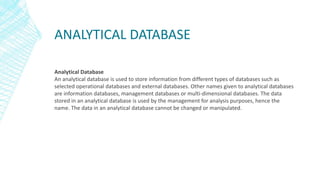
An analytical database is used to store information from different types of databases such as
selected operational databases and external databases. Other names given to analytical databases
are information databases, management databases or multi-dimensional databases. The data
stored in an analytical database is used by the management for analysis purposes, hence the
name. The data in an analytical database cannot be changed or manipulated.

Data and Database

  • 1.
    DATA AND DATABASE SyedMeasum Haider Naqvi Network Specialist
  • 2.
    WHAT IS DATA Datais any set of characters that has been gathered and translated for some purpose, usually analysis. It can be any character, including text and numbers, pictures, sound, or video. If data is not put into context, it doesn't do anything to a human or computer.
  • 3.
    DATA TYPES A datatype is a classification of the type of data that a variable or object can hold in computer programming. Data types are an important factor in virtually all computer programming languages, including C#, C++, JavaScript, and Visual Basic. Common examples of data types Boolean (e.g. True or False) Character (e.g. a) Date (e.g. 03/01/2016) Double (e.g. 1.79769313486232E308) Floating-point number (e.g. 1.234) Integer (e.g. 1234) Long (e.g. 123456789) Short (e.g. 0) String (e.g. abcd) Void (e.g. no data)
  • 4.
    WHAT IS DATABASE Adatabase is a collection of information that is organized so that it can be easily accessed, managed and updated. Data is organized into rows, columns and tables, and it is indexed to make it easier to find relevant information. Data gets updated, expanded and deleted as new information is added. Databases process workloads to create and update themselves, querying the data they contain and running applications against it.
  • 5.
    DATABASE TYPES There arefollowing common type of database ▪ Relational Databases ▪ Operational Databases ▪ Database Warehouses ▪ Distributed Databases ▪ End-User Databases ▪ External Database ▪ Hypermedia Database ▪ Navigational Database ▪ In-Memory Database. ▪ Document-Oriented Database ▪ Real-Time Database ▪ Analytical Database
  • 6.
    RELATIONAL DATABASES Relational Databases Thisis the most common of all the different types of databases. In this, the data in a relational database is stored in various data tables. Each table has a key field which is used to connect it to other tables. Hence all the tables are related to each other through several key fields. These databases are extensively used in various industries and will be the one you are most likely to come across when working in IT. Examples of relational databases are Oracle, Sybase and Microsoft SQL Server and they are often key parts of the process of software development.
  • 7.
    OPERATIONAL DATABASES Operational Databases Inits day to day operation, an organization generates a huge amount of data. Think of things such as inventory management, purchases, transactions and financials. All this data is collected in a database which is often known by several names such as operational/ production database, subject-area database (SADB) or transaction databases. An operational database is usually hugely important to Organizations as they include the customer database, personal database and inventory database i.e. the details of how much of a product the company has as well as information on the customers who buy them. The data stored in operational databases can be changed and manipulated depending on what the company requires.
  • 8.
    DATABASE WAREHOUSES Database Warehouses Organizationsare required to keep all relevant data for several years. In the UK it can be as long as 6 years. This data is also an important source of information for analyzing and comparing the current year data with that of the past years which also makes it easier to determine key trends taking place. All this data from previous years are stored in a database warehouse. Since the data stored has gone through all kinds of screening, editing and integration it does not need any further editing or alteration. With this database ensure that the software requirements specification (SRS) is formally approved as part of the project quality plan.
  • 9.
    DISTRIBUTED DATABASES Distributed Databases Manyorganizations have several office locations, manufacturing plants, regional offices, branch offices and a head office at different geographic locations. Each of these work groups may have their own database which together will form the main database of the company. This is known as a distributed database.
  • 10.
    END-USER DATABASES End-User Databases Thereis a variety of data available at the workstation of all the end users of any organization. Each workstation is like a small database in itself which includes data in spreadsheets, presentations, word files, note pads and downloaded files. All such small databases form a different type of database called the end-user database. .
  • 11.
    EXTERNAL DATABASE External Database Thereis a sea of information available outside world which is required by an organization. They are privately-owned data for which one can have conditional and limited access for a fortune. This data is meant for commercial usage. All such databases outside the organization which are of use and limited access are together called external database.
  • 12.
    HYPERMEDIA DATABASE Hypermedia Database Mostwebsites have various interconnected multimedia pages which might include text, video clips, audio clips, photographs and graphics. These all need to be stored and “called” from somewhere when the webpage if created. All of them together form the hypermedia database.
  • 13.
    NAVIGATIONAL DATABASE Navigational Database Navigationaldatabase has all the items which are references from other objects. In this, one has to navigate from one reference to other or one object to other. It might be using modern systems like XPath. One of its applications is the air flight management systems.
  • 14.
    IN-MEMORY DATABASE In-Memory Database Anin-memory databases stores data in a computer’s main memory instead of using a disk-based storage system. It is faster and more reliable than that in a disk. They find their application in telecommunications network equipment.
  • 15.
    DOCUMENT-ORIENTED DATABASE Document-Oriented Database Adocument oriented database is a different type of database which is used in applications which are document oriented. The data is stored in the form of text records instead of being stored in a data table as usually happens.
  • 16.
    REAL-TIME DATABASE Real-Time Database Areal-time database handles data which constantly keep on changing. An example of this is a stock market database where the value of shares change every minute and need to be updated in the real-time database. This type of database is also used in medical and scientific analysis, banking, accounting, process control, reservation systems etc. Essentially anything which requires access to fast moving and constantly changing information. Assume that this will require much more time than a normal relational database when it comes to the software testing life cycle, as these are much more complicated to efficiently test within normal timeframes.
  • 17.
    ANALYTICAL DATABASE Analytical Database Ananalytical database is used to store information from different types of databases such as selected operational databases and external databases. Other names given to analytical databases are information databases, management databases or multi-dimensional databases. The data stored in an analytical database is used by the management for analysis purposes, hence the name. The data in an analytical database cannot be changed or manipulated.