WORKING CONDITIONS
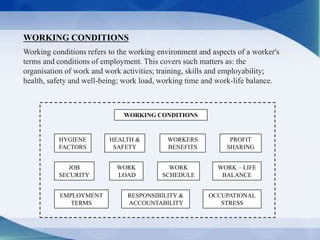
HYGIENE
FACTORS
HEALTH &
SAFETY
WORKERS
BENEFITS
RESPONSIBILITY &
ACCOUNTABILITY
WORK
LOAD
WORK
SCHEDULE
WORK – LIFE
BALANCE
OCCUPATIONAL
STRESS
EMPLOYMENT
TERMS
JOB
SECURITY
PROFIT
SHARING
WORKING CONDITIONS
Working conditions refers to the working environment and aspects of a worker's
terms and conditions of employment. This covers such matters as: the
organisation of work and work activities; training, skills and employability;
health, safety and well-being; work load, working time and work-life balance.
Effective work Organisation
Improving organization of work processes is the best way
to increase productivity, especially since it can be achieved
with little or no capital investment.
Some of the working conditions for work-related welfare facilities which
contribute to productivity and good labor-management relations are as follows:
Eliminate extra tasks and Operations
Defeat monotony to keep workers alert and productive.
Provide adequate training and retraining
Specify individual tasks and responsibilities
Combine production operations and tasks
Low-cost work-related welfare facilities and
benefits
We need to make sure essential facilities serve their purpose.
Fatigue and disease are enemies of efficient work. Essential
facilities are more than just a legal requirement. They cando
much to reduce fatigue and maintain health. It isimportant that
the quality of such basic facilities is high:otherwise they can
spread disease instead of preventing it.
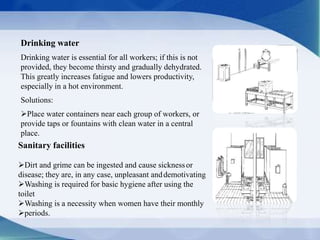
Drinking water
Drinking water is essential for all workers; if this is not
provided, they become thirsty and gradually dehydrated.
This greatly increases fatigue and lowers productivity,
especially in a hot environment.
Solutions:
Place water containers near each group of workers, or
provide taps or fountains with clean water in a central
place.
Sanitary facilities
Dirt and grime can be ingested and cause sicknessor
disease; they are, in any case, unpleasant anddemotivating
Washing is required for basic hygiene after using the
toilet
Washing is a necessity when women have their monthly
periods.
Be ready for emergencies
Problems
Accidents can happen even if proper preventive measures
are installed, so always be prepared for emergencies, like
cuts and bruises, eye injuries, burns etc.
Solution
Every industry, therefore, has to maintain a well-stocked
first-aid box and assign at least one person from every shift
to handle emergencies.
Allowing Rest breaks
If the worker rests before he or she shows signs ofbeing
really tired, recovery is much faster. Short breakstaken
frequently are much better than infrequent longer breaks.
Rest areas
A good rest area also helps to reduce fatigue. This will
hasten the recovery of workers from fatigue and enable
continued productive work
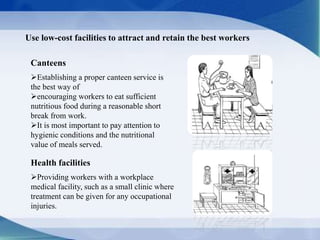
Canteens
Establishing a proper canteen service is
the best way of
encouraging workers to eat sufficient
nutritious food during a reasonable short
break from work.
It is most important to pay attention to
hygienic conditions and the nutritional
value of meals served.
Use low-cost facilities to attract and retain the best workers
Health facilities
Providing workers with a workplace
medical facility, such as a small clinic where
treatment can be given for any occupational
injuries.
Transport facilities
Problem
Getting to and from the workplace can sometimes be
difficult, lengthy and tiring. This can cause fatigue, anxiety
and financial hardship for the workers.
Solution
Informing the workers about public transport services,
schedules, costs and monthly or seasonal ticket offers can
help.
Child-care facilities
Many employers find that working mothers are especially
committed and efficient workers, but they often need help
with the problem of caring for their children.
A clean room, preferably with access to an enclosed space
outside can be used as children should not be allowed inside
the factory.

working conditions.pptx

  • 1.
    WORKING CONDITIONS HYGIENE FACTORS HEALTH & SAFETY WORKERS BENEFITS RESPONSIBILITY& ACCOUNTABILITY WORK LOAD WORK SCHEDULE WORK – LIFE BALANCE OCCUPATIONAL STRESS EMPLOYMENT TERMS JOB SECURITY PROFIT SHARING WORKING CONDITIONS Working conditions refers to the working environment and aspects of a worker's terms and conditions of employment. This covers such matters as: the organisation of work and work activities; training, skills and employability; health, safety and well-being; work load, working time and work-life balance.
  • 2.
    Effective work Organisation Improvingorganization of work processes is the best way to increase productivity, especially since it can be achieved with little or no capital investment. Some of the working conditions for work-related welfare facilities which contribute to productivity and good labor-management relations are as follows: Eliminate extra tasks and Operations Defeat monotony to keep workers alert and productive. Provide adequate training and retraining Specify individual tasks and responsibilities Combine production operations and tasks
  • 3.
    Low-cost work-related welfarefacilities and benefits We need to make sure essential facilities serve their purpose. Fatigue and disease are enemies of efficient work. Essential facilities are more than just a legal requirement. They cando much to reduce fatigue and maintain health. It isimportant that the quality of such basic facilities is high:otherwise they can spread disease instead of preventing it.
  • 4.
    Drinking water Drinking wateris essential for all workers; if this is not provided, they become thirsty and gradually dehydrated. This greatly increases fatigue and lowers productivity, especially in a hot environment. Solutions: Place water containers near each group of workers, or provide taps or fountains with clean water in a central place. Sanitary facilities Dirt and grime can be ingested and cause sicknessor disease; they are, in any case, unpleasant anddemotivating Washing is required for basic hygiene after using the toilet Washing is a necessity when women have their monthly periods.
  • 5.
    Be ready foremergencies Problems Accidents can happen even if proper preventive measures are installed, so always be prepared for emergencies, like cuts and bruises, eye injuries, burns etc. Solution Every industry, therefore, has to maintain a well-stocked first-aid box and assign at least one person from every shift to handle emergencies. Allowing Rest breaks If the worker rests before he or she shows signs ofbeing really tired, recovery is much faster. Short breakstaken frequently are much better than infrequent longer breaks. Rest areas A good rest area also helps to reduce fatigue. This will hasten the recovery of workers from fatigue and enable continued productive work
  • 6.
    Canteens Establishing a propercanteen service is the best way of encouraging workers to eat sufficient nutritious food during a reasonable short break from work. It is most important to pay attention to hygienic conditions and the nutritional value of meals served. Use low-cost facilities to attract and retain the best workers Health facilities Providing workers with a workplace medical facility, such as a small clinic where treatment can be given for any occupational injuries.
  • 7.
    Transport facilities Problem Getting toand from the workplace can sometimes be difficult, lengthy and tiring. This can cause fatigue, anxiety and financial hardship for the workers. Solution Informing the workers about public transport services, schedules, costs and monthly or seasonal ticket offers can help. Child-care facilities Many employers find that working mothers are especially committed and efficient workers, but they often need help with the problem of caring for their children. A clean room, preferably with access to an enclosed space outside can be used as children should not be allowed inside the factory.