
Labour Welfare
Who are Labour?
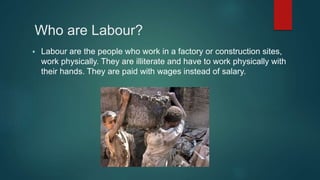
 Labour are the people who work in a factory or construction sites,
work physically. They are illiterate and have to work physically with
their hands. They are paid with wages instead of salary.
Some Categories of Labour
 Child Labour
 Female Labour
 Contract Labour
 Construction Labour
 Agricultural Labour
Labour Welfare
 Labour Welfare refers to anything that is done for the comfort and
improvement of employees and is provided over and above the
wages.
 It can also be provided by government, non government agencies
and trade unions.
 International Labour Organization (ILO) has played a very
significant role for Labour Welfare.
 According to Arthur James “Labour Welfare means anything done
for the comfort and improvement, intellectual and social, of the
employees over and above the wages paid which is not a necessity
of the industry.”
 Industrial/ Labour welfare also refers to the Statutory and voluntary
efforts made for betterment of the labour.
 According to International Labour Organization (ILO)
“Labour Welfare may be understood including such services,
facilities and amenities which may be established in vicinity of
undertaking to perform their work in healthy and congenial
environment and to avail of facilities which improve their health and
bring high morale.”
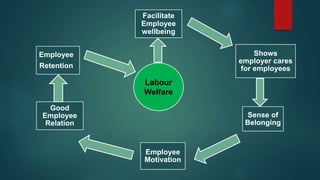
Labour
Welfare
Good
Employee
Relation
Facilitate
Employee
wellbeing
Shows
employer cares
for employees
Sense of
Belonging
Employee
Motivation
Employee
Retention
Objectives of Labour Welfare
 Monetary needs: wages at least sufficient for his subsistent
level
 Fatigue compensation
 Security and safeguard needs
 Health maintenance
 Promotion and development needs
 Recognition of work expectation
Features of Labour Welfare
 Labor welfare includes various facilities, services and amenities
provided to workers for improving their health, efficiency,
economic betterment and social status.
 Labor welfare schemes are flexible and ever-changing. New
welfare measures are added to the existing ones from time to
time.
 Welfare measures may be introduced by the employers,
government, employees or by any social or charitable agency.
 The purpose of labor welfare is to bring about the development
of the whole personality of the workers to make a better
workforce.
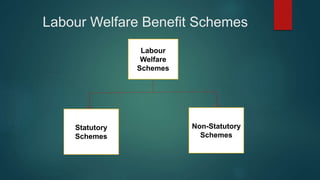
Labour Welfare Benefit Schemes
Labour
Welfare
Schemes
Statutory
Schemes
Non-Statutory
Schemes
Statutory Schemes
 The statutory schemes are those schemes that are compulsory to
provide by an organization as compliance to the laws governing
employee health and safety.
 The statutory welfare benefit schemes include the following
provisions.
Drinking Water
Facilities for sitting
First Aid Appliances
Latrines and Urinals
Canteen Facilities
Statutory Schemes(cont.)
Spittoons
Lighting
Washing Places
Changing rooms
Rest rooms
Non-statutory Schemes
 Non-statutory welfare benefit include the following schemes.
 Personal Health Care (Regular medical check-ups)
 Flexi-time
 Employee Assistance programs
 Employee Referral Scheme
Labour welfare

Labour welfare

  • 1.
  • 2.
    Who are Labour? Labour are the people who work in a factory or construction sites, work physically. They are illiterate and have to work physically with their hands. They are paid with wages instead of salary.
  • 3.
    Some Categories ofLabour  Child Labour  Female Labour  Contract Labour  Construction Labour  Agricultural Labour
  • 4.
    Labour Welfare  LabourWelfare refers to anything that is done for the comfort and improvement of employees and is provided over and above the wages.  It can also be provided by government, non government agencies and trade unions.  International Labour Organization (ILO) has played a very significant role for Labour Welfare.
  • 5.
     According toArthur James “Labour Welfare means anything done for the comfort and improvement, intellectual and social, of the employees over and above the wages paid which is not a necessity of the industry.”  Industrial/ Labour welfare also refers to the Statutory and voluntary efforts made for betterment of the labour.
  • 6.
     According toInternational Labour Organization (ILO) “Labour Welfare may be understood including such services, facilities and amenities which may be established in vicinity of undertaking to perform their work in healthy and congenial environment and to avail of facilities which improve their health and bring high morale.”
  • 7.
  • 8.
    Objectives of LabourWelfare  Monetary needs: wages at least sufficient for his subsistent level  Fatigue compensation  Security and safeguard needs  Health maintenance  Promotion and development needs  Recognition of work expectation
  • 9.
    Features of LabourWelfare  Labor welfare includes various facilities, services and amenities provided to workers for improving their health, efficiency, economic betterment and social status.  Labor welfare schemes are flexible and ever-changing. New welfare measures are added to the existing ones from time to time.  Welfare measures may be introduced by the employers, government, employees or by any social or charitable agency.  The purpose of labor welfare is to bring about the development of the whole personality of the workers to make a better workforce.
  • 10.
    Labour Welfare BenefitSchemes Labour Welfare Schemes Statutory Schemes Non-Statutory Schemes
  • 11.
    Statutory Schemes  Thestatutory schemes are those schemes that are compulsory to provide by an organization as compliance to the laws governing employee health and safety.  The statutory welfare benefit schemes include the following provisions. Drinking Water Facilities for sitting First Aid Appliances Latrines and Urinals Canteen Facilities
  • 12.
  • 13.
    Non-statutory Schemes  Non-statutorywelfare benefit include the following schemes.  Personal Health Care (Regular medical check-ups)  Flexi-time  Employee Assistance programs  Employee Referral Scheme