Work Improvements In
Small Enterprises
( WISE)
Neha Gahlot (Ph.D Scholar)
CCSHAU , Hisar
CONTENTS
 Introduction of WISE
 Small scale enterprises
 Occupational hazards
 Workplace problems and wise solutions
 Experiment part
Work Improvement in Small Enterprise
(WISE) also known as ‘Higher productivity
& a better place to work’, is a program
developed by the International Labour
Organization (ILO) (1996) to assist small and
medium scale enterprises (SMEs) in
improving working conditions and
productivity using simple, effective &
affordable techniques.
What are the Small Scale Enterprises ???
DEFINITION :- All industrial units with a capital
investment of not more than Rs. one crore are, treated as small-
scale units. For ancillary units i.e., those supplying components
to large-scale industries and the export-oriented units, the limit
of capital investment is also Rs. one crore.
Industrial units with an investment of up to Rs. 25 lakhs belong
to the tiny sector.
4
Source : Ministry of Small Scale Industries (2009-2010
Major enterprises groups in the
small-scale sector >>>
• Food Processing enterprises
• Chemical & Chemical Products
• Basic Metal Industries
• Metal Products
• Electrical Machinery & Parts
• Rubber & Plastic Products
• Machinery & Parts Except Electrical goods
• Hosiery & Garments
• Wood Products
5
Cont…
6
Non-metallic Mineral Products
Paper Products & Printing
Transport Equipments & Parts
Leather & Leather Products
Miscellaneous Manufacturing Industries
Other Services & Products
Beverages, Tobacco & Tobacco Products
Repair Services
Cotton Textiles
Wool, Silk, Synthetic Fiber Textiles
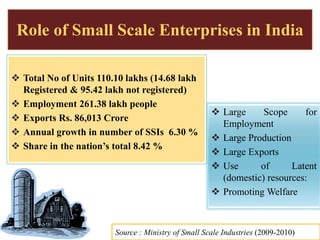
 Total No of Units 110.10 lakhs (14.68 lakh
Registered & 95.42 lakh not registered)
 Employment 261.38 lakh people
 Exports Rs. 86,013 Crore
 Annual growth in number of SSIs 6.30 %
 Share in the nation’s total 8.42 %
Role of Small Scale Enterprises in India
7
 Large Scope for
Employment
 Large Production
 Large Exports
 Use of Latent
(domestic) resources:
 Promoting Welfare
Source : Ministry of Small Scale Industries (2009-2010)
8
• Small and Medium enterprises play an extraordinarily
important role as muscles for regional economic development.
• Indian economy is an under developed economy. Its vast
resources are either unutilized or under utilized.
• A major section of man power is lying idle. The per capita
income is low. Capital is shy and scarce and investment is
lean.
• Production is traditional and the technique is outdated. The out
put is insufficient and the basic needs of the people remain
unfulfilled.
Contd……
Work kills people more than war, ( ILO), “ some
6000 workers a day, or one every 15 seconds , die
from the occupational accidents and diseases.
(T.K. Joshi 2010)
9
Joshi, T.K., Bhuva, B. Uttpal, R. and Ansari,M.A (2010) “occupational and environmental health “ standards of India (18) :9 December 2010
A health hazard may produce serious and immediate (acute) affects ,
or may cause long term (chronic ) problems.
Occupational Health Hazards
10
An occupational health hazard is any agent that can cause illness to
an individual exposed to that agent as a result of his/ her
occupation.
Workplace Problems and Losses
 Increased discomfort, pain, injury, or illness
 Workers’ compensation costs
 Lost or restricted work time
 Short- or long-term disability
 Increased absenteeism
 Low morale
 Decreased productivity and/or quality
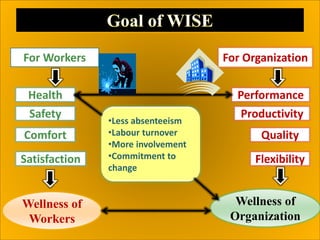
For Workers For Organization
Wellness of
Workers
Wellness of
Organization
•Less absenteeism
•Labour turnover
•More involvement
•Commitment to
change
Health
Safety
Comfort
Satisfaction
Performance
Productivity
Quality
Flexibility
Occupational Health
 World Health Organization - is the promotion
and maintenance of the highest degree of
physical, mental and social well-being of workers
in all occupations by preventing departures from
health, controlling risks and the adaptation of
work to people, and people to their jobs.
 National Institutes of Health - refers to the
identification and control of the risks arising from
physical, chemical, and other workplace hazards
in order to establish and maintain a safe and
healthy working environment.
13www.wikkepiedia .COM
www.cdc.gov/niosh/nasd/docs/as04200.html
ILO, (1991) Encyclopedia of Occupational Health & Safety, Thermal (revised) Edition, International Labour Organisation (ILO)
Geneva.
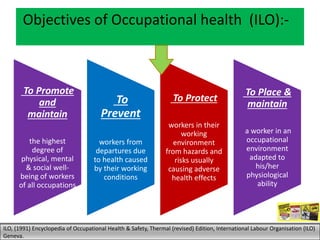
Objectives of Occupational health (ILO):-
To Promote
and
maintain
the highest
degree of
physical, mental
& social well-
being of workers
of all occupations
To
Prevent
workers from
departures due
to health caused
by their working
conditions
To Protect
workers in their
working
environment
from hazards and
risks usually
causing adverse
health effects
To Place &
maintain
a worker in an
occupational
environment
adapted to
his/her
physiological
ability
14
Wise can be introduced in terms ofWISE (Work Improvement in Small Enterprise) for
improving working conditions
 Every worker spends at least 8 hours a day in the workplace.
Therefore, work environment should be safe and healthy.
Occupational safety and health (OSHA) is concerned with safety
and health of workers in relation to work and the working
environment.
 OSHA at work in SMEs present a particular challenge as the
majority of workforce is employed in SMEs and resources to
protect and promote health of this workforce are much lesser.
Cont…
• As a result of the hazards and lack of attention given to safety
and health, work related accidents and MSDs are very
common. The Occupational Safety and Health Administration
(OSHA) objective of assuring as far as possible every man and
woman a safe and healthy work environment could be
achieved only when efforts are directed towards identifying
occupational health hazards of workers.
• Accordingly, suitable and effective mitigating measures are to
be developed and suggested to either minimize or eliminate the
extent of such hazards.
• The implementation of WISE (Work Improvement in Small
Enterprise) is thought to lead to concrete workplace
improvements in these SMEs. WISE looks at the multiple
aspects of workstation and productivity enhancement under
local conditions (Kogi, 1985).
16
WORKPLACE PROBLEMS AND
WISE SOLUTIONS IN SMALL SCALE
ENTERPRISES
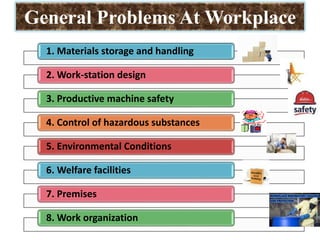
1. Materials storage and handling
2. Work-station design
3. Productive machine safety
4. Control of hazardous substances
5. Environmental Conditions
6. Welfare facilities
7. Premises
8. Work organization
General Problems At Workplace
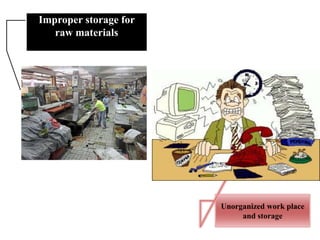
Material and Storage Problems
Unorganized work place
and storage
Improper storage for
raw materials
Very Unhygienic &
Slippery Surface
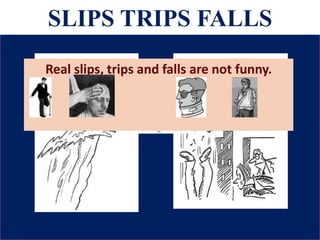
SLIPS TRIPS FALLS
Real slips, trips and falls are not funny.
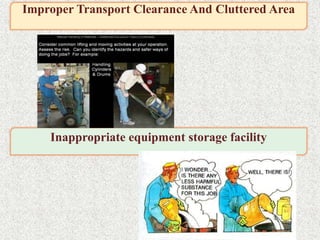
Inappropriate equipment storage facility
Improper Transport Clearance And Cluttered Area
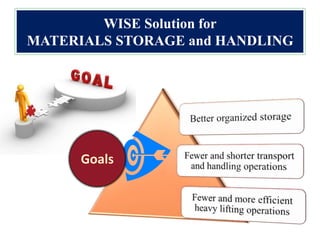
WISE Solution for
MATERIALS STORAGE and HANDLING
Goals
RULES ON FEWER AND SHORTER TRANSPORT AND HANDLING
OPERATIONS
• The more you use it, the closer it should be
• Use mobile storage
• Make your equipment easy to move to where it is needed
• Don't lift loads higher than necessary
• Move materials at working height
• Make lifting more efficient and safer
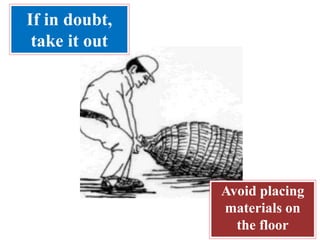
Avoid placing
materials on
the floor
If in doubt,
take it out
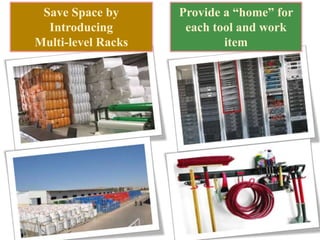
Save Space by
Introducing
Multi-level Racks
Provide a “home” for
each tool and work
item
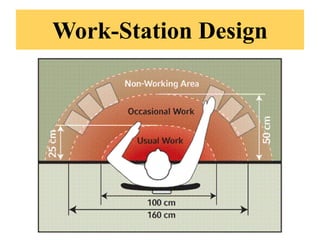
Work-Station Design
Roelofs and Straker (2002) conducted a study on discomfort and
preferences of 30 full-time bank tellers who worked at a standing
height work surface while sitting on a high chair, then standing, and
then alternating between sitting and standing. The mode in which the
least reported discomfort arose and which was regarded as the
preferred posture by 70 percent of subjects was alternation between
sitting and standing.
Huang (2004) suggested that the job redesign and interventions that
address a worker's work style when faced with increased work
demands may help reduce the likelihood of musculoskeletal symptoms
and /or their intensity.
Roelofs, A. & Straker, L. (2002). The experience of musculoskeletal discomfort amongst bank tellers who just sit, just stand, or sit and stand at work.
Ergonomics SA, 14(2), 11-29
Hedge, A. (2004). Effects of an electric height-adjustable work surface on self-assessed musculoskeletal discomfort and productivity in computer workers. Cornell
University, Human Factors and Ergonomics Research Laboratory, Technical Report 0904.
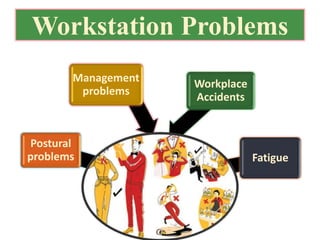
Workstation Problems
Postural
problems
Management
problems
Workplace
Accidents
Fatigue
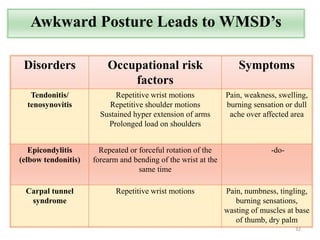
Disorders Occupational risk
factors
Symptoms
Tendonitis/
tenosynovitis
Repetitive wrist motions
Repetitive shoulder motions
Sustained hyper extension of arms
Prolonged load on shoulders
Pain, weakness, swelling,
burning sensation or dull
ache over affected area
Epicondylitis
(elbow tendonitis)
Repeated or forceful rotation of the
forearm and bending of the wrist at the
same time
-do-
Carpal tunnel
syndrome
Repetitive wrist motions Pain, numbness, tingling,
burning sensations,
wasting of muscles at base
of thumb, dry palm
32
Awkward Posture Leads to WMSD’s
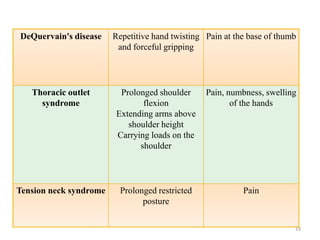
DeQuervain's disease Repetitive hand twisting
and forceful gripping
Pain at the base of thumb
Thoracic outlet
syndrome
Prolonged shoulder
flexion
Extending arms above
shoulder height
Carrying loads on the
shoulder
Pain, numbness, swelling
of the hands
Tension neck syndrome Prolonged restricted
posture
Pain
33
IDEAS FOR BETTER WORK-STATION
DESIGN
Increase productivity by changing the
position of tools and materials
locate dials and controls to minimize
mistakes
Avoid wasted effort using simple fixing
device
Place materials, tools, and controls where
they can be reached easily by the worker
without bending or twisting the body
Redesign a work height and chair to
increase product quality
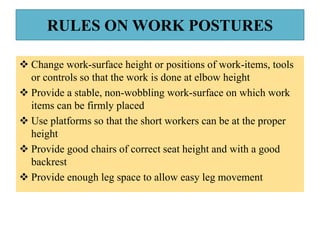
RULES ON WORK POSTURES
 Change work-surface height or positions of work-items, tools
or controls so that the work is done at elbow height
 Provide a stable, non-wobbling work-surface on which work
items can be firmly placed
 Use platforms so that the short workers can be at the proper
height
 Provide good chairs of correct seat height and with a good
backrest
 Provide enough leg space to allow easy leg movement
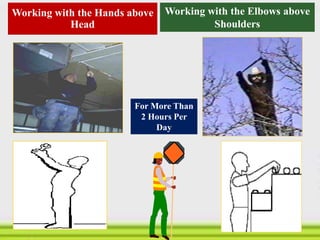
Avoid
Working with the Hands above
Head
For More Than
2 Hours Per
Day
Working with the Elbows above
Shoulders
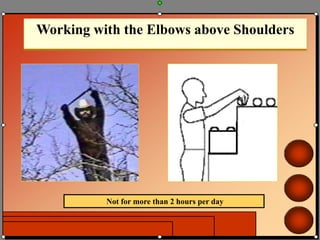
Working with the Elbows above Shoulders
Not for more than 2 hours per day
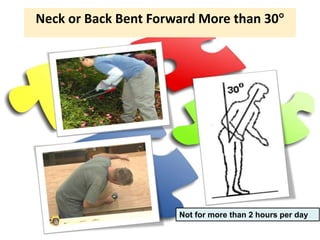
Neck or Back Bent Forward More than 30º
Not For more than 2 hours per day
Neck or Back Bent Forward More than 30
Not for more than 2 hours per day
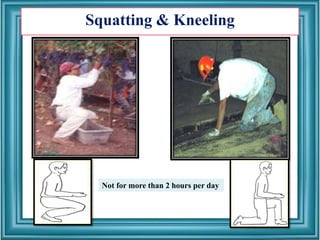
Squatting & Kneeling
Not for more than 2 hours per day
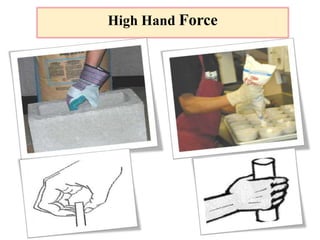
High Hand Force
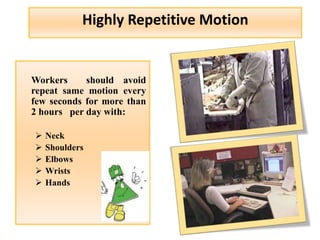
Highly Repetitive Motion
Workers should avoid
repeat same motion every
few seconds for more than
2 hours per day with:
 Neck
 Shoulders
 Elbows
 Wrists
 Hands
Repeated Impact
Using hands or knees as a hammer
– more than 10 times per hour
– more than 2 hours per day
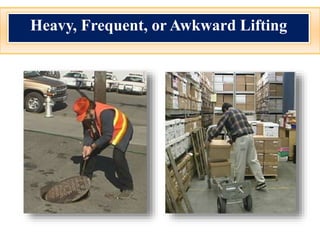
Heavy, Frequent, or Awkward Lifting
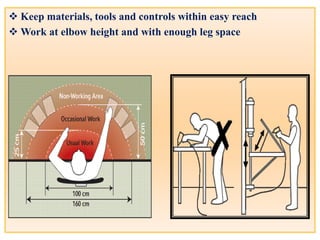
 Keep materials, tools and controls within easy reach
 Work at elbow height and with enough leg space
Make Displays & controls Easy to See & Understand
Productive Machine Safety
Kogi, K. (1985). Improving workstation conditions in small enterprises in developing Asia.
International Labour Office, Geneva.
Dahalan et al. (2002) stated that improper man machine match may
create risks to the worker’s body system due to: localized fatigue
that can cause pain and discomfort to the muscles of the back, neck
and shoulders; and the joints of the knees, ankles, hips, shoulders,
and elbows.
General fatigue that results in reduced physical ability to perform a
task. It also can reduce the concentration level of employees
overexertion to the musculoskeletal system; injuries to the employee
such as slipped disc, tendonitis, sprained back, and others.
Improper Machinery Can Cause
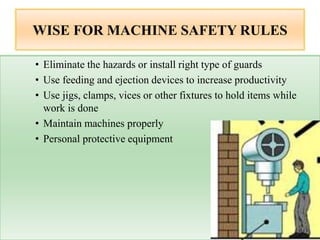
WISE FOR MACHINE SAFETY RULES
• Eliminate the hazards or install right type of guards
• Use feeding and ejection devices to increase productivity
• Use jigs, clamps, vices or other fixtures to hold items while
work is done
• Maintain machines properly
• Personal protective equipment
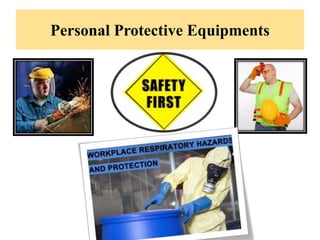
Personal Protective Equipments
CONTROL OF HAZARDOUS
SUBSTANCES
Replace a dangerous substance with less dangerous one
Use lids, covers, maintenance and isolation of process to control
hazards and reduce losses
Save energy used to overheat chemicals
Use natural air flow to reduce air contamination
Clean properly-don't spread dust
Make local ventilation cost-effective
RULES ON PREVENTING ELECTRICAL
HAZARDS
• Any repair or maintenance work on machines should only be
done
• when the power is off and the switch is locked in the OFF
position
• Be sure that all electrical wiring is identified and protected
• All circuits should be protected with circuit breakers or fuses
• All equipment should be earthed
• Portable tools and equipment should be double insulated and
Earthed
• Be certain that electrical power can be shut off immediately in
case of emergency
Environmental Conditions
Jain (2002) found that people who are long exposed to 80 dB of noise suffer
from 10% permanent hearing loss which at 100 dB rise to 53% and at 115 dB to 94%
hearing loss.
Mehta et al.(2009) conducted a study on bead making activity and found that
making beads requires high concentration because of poor illumination (127lux) which
leads stress on eyes and bending of neck leading to severe eye strain in with highest
mean score (3.5)
Shaffaq (2009) found that hot seasons with an average maximum temperature
above 30 degrees C and relative humidity above 74%, lasting for four to six months from
May to October, pose health threats to steel factory, fertilizer factory and food processing
workers. In particular, populations of ageing farmers and physically overloaded
construction workers are the two most vulnerable worker categories in which high
temperature impacts on health and productivity.
Jain B.(2002), Pollution Dilution. The Times of India June pp-11.
Mehta M. Gandhi S., and Dilbaghi M.(2009) Activity profile of Bead makers: Ergonomic study . International ergomnomics conference .pp101 (abstract)
Shaffaq M. 2009 Effects of heat on workers' health and productivity in Taiwan. Global Health Action. 2009 Nov 11;2.
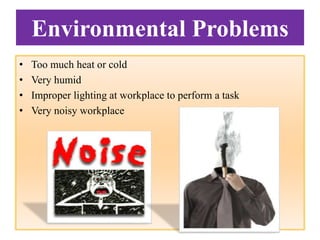
Environmental Problems
• Too much heat or cold
• Very humid
• Improper lighting at workplace to perform a task
• Very noisy workplace
WISE Solutions For Environment
RULES ON COST-
EFFECTIVE VENTILATION
• Use natural air flow to reduce air
contamination
• Clean properly-don't spread dust
• Use fans properly
• Use push and pull ventilation
• Make better use of horizontal air-flow
• Utilize the tendency of hot-air to rise
• Find the right place for light sources
• Distinguish an object from its background
• Reveal its surface texture
• Reveal its shape
• Enable any marking on its surface to be seen easily
• Group of lights for group of machines
• Use reflected light to avoid glare
• Avoiding isolated pools of bright light
• Better light direction
RULE ON PROTECTION FROM HEAT
• Protect your factory from outside heat
and cold
• Let nature help you
• Improve the heat reflection of the
walls and roof
• Improve heat insulation
• Use shades to protect against heat
from the sun
• Eliminate or isolate sources of
pollution
Welfare Facilities
WELFARE FACILITIES
• to reduce fatigue and maintain health of your workers by
providing facilities meeting their needs
• to be ready for emergencies
• to make sure that rest means recovery
• to attract and retain the best workers
Rule On Upgrading The Most Basic Facilities
Drinking water
 Water bags or bottles
 Drinking water containers
 Drinking fountains
Sanitary facilities
 Toilets
 Wash-basins
RULES ON FIRST-AIDS
• Be ready for emergencies
• Sterile bandages, pressure
bandages, dressings and slings
• Cotton wool for cleaning wounds
• Scissors, tweezers and safety pins
• An eye bath and eye wash bottle
• Ready-to-use antiseptic solution
and cream
• Simple over-the- counter
medicines such as aspirin and
antacids
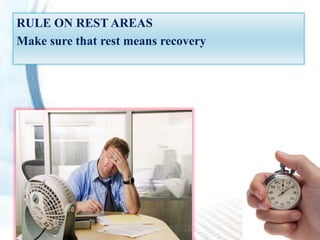
RULE ON REST AREAS
Make sure that rest means recovery
Provision For Attractive Low-cost Facilities
• Use low -cost facilities to attract
and retain workers
• Work clothes
• Locker and changing rooms
• Eating areas
• Canteens
• Health services
• Transport facilities
• Recreational facilities
• Child-care facilities
• Factory day
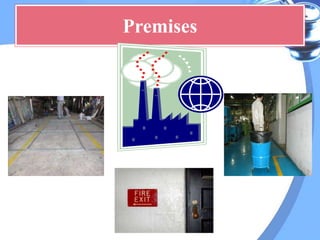
Premises
RULES ON FLEXIBILITY AND ADAPTABILITY
INTO PLANT LAYOUT
• Reserve free space in the work area
• Allocate sufficient passageways and make sure that they are
kept clean
• Avoid the use of rail-type floor transportation systems
• Use production equipment and storage facilities
• Provide evenly distributed general lighting and supply lines
throughout the production area
RULES ON PREVENTING FIRES
• Ensure that electrical circuits are enclosed, insulated , earthed
and properly fused
• Lubricate properly the moving parts of machines
• Keep combustible and flammable materials well away from
hot surfaces and open flames
• Store flammable liquids in appropriate containers away from
heat sources
• Dispose of oily used rags in airtight containers
SUMMARY FOR RULES ON PREMISES
• Protect your factory from outside heat and cold
• Let natural air-flow improve ventilation
• Eliminate or isolate sources of pollution
• Improve your floor
• Build flexibility and adaptability into plant layout
• Prevent fires and electrical accidents
Work Organization
Kogi (1985) reported that participatory ergonomics plays very
crucial role in improving workstations in small enterprises. Basic
rules of workstation improvements widely applicable in small
enterprises include: efficient material flow, easy reach, elbow height
work, use of fixing and lifting devices, action information and
autonomous group work. Selection and application of priority
solutions cab be best done by organizing group work through each
action program which proceeds through: study of potential actions,
planning of practicable actions, agreeing on priorities, immediate
changes by using local materials and skills and evaluation and
follow ups.
Dahalan, J. & Musri, M. (2002). Guidelines on occupational safety and health for standing at work department of
occupational safety and health. Ministry of Human Resources, Malaysia.
GET RID OF EXTRA TASKS AND OPERATIONS
• Introduce changes into the design of the products
• Switch to new production methods
• Perform a number of tasks in one operation by using special
multitasks tools or machines
DEFEAT MONOTONY TO KEEP WORKERS ALERT
& PRODUCTIVE
• Frequent changes in tasks
• Opportunities to walk around or change from sitting to standing
or standing to sitting
• Frequent, short breaks
• Opportunities to communicate with other workers or listen to
music without leaving their work-station
INSTALL BUFFER STOCKS TO MAKE THE
WORK FLOW SMOOTHLY
• Minimize the floor space taken up by the buffer
• Ensure easy maintenance, transport and replacement
• Choose the appropriate height for the buffer and design it to
• minimize the effort needed to put stock in or take it out
• Store work-pieces in a systematic manner so you can get an exact
idea at a glance of what is available
DESIGN RESPONSIBLE, FLEXIBLE JOBS
• Jobs should make clear who is responsible for output and
quality
• Jobs should help workers to develop skills and become
interchangeable
• Jobs should occupy each worker fully but should remain
within each workers capacity
SET UPAUTONOMOUS GROUPS TO IMPROVE
EFFICIENCY AND TO CUT SUPERVISORY COSTS
• Group work arrangements have several advantages
• It is much easier, and less time-consuming
• The work flows more smoothly, and less supervision is needed
• It takes less time for new workers to learn a skill
• Continuous co-operation between the workers help them to spot
mistakes more promptly
MAKE THE ORGANIZATION OF PRODUCTION FIT
YOUR BUSINESS OBJECTIVES
• Set up one simple, preferably straight line flow of materials for each
product or family of products
• Let everyone concerned not only with the quality of his or her own
operation but with the total quality of the products
• Keep constant and rapid feedback between the customer or dealer
and everyone engaged in production
• Provide individual reward not only on performance of a given task
but on attaining a common final goal
SUMMARY FOR RULES FOR EFFECTIVE
ORGANIZATION OF WORK
• Get rid of extra tasks and operations
• Defeat monotony to keep workers alert and productive
• Install buffers to make the work flow smoothly
• Design responsible, flexible jobs
• Set up autonomous groups to improve
• Make the organization of production fit your business objectives
REMEMBER
A healthy and safe group provides multiple
returns for any organization. Put a health and
safety environment to work at the
organization!
79

Wise credit seminat upload

  • 1.
    Work Improvements In SmallEnterprises ( WISE) Neha Gahlot (Ph.D Scholar) CCSHAU , Hisar
  • 2.
    CONTENTS  Introduction ofWISE  Small scale enterprises  Occupational hazards  Workplace problems and wise solutions  Experiment part
  • 3.
    Work Improvement inSmall Enterprise (WISE) also known as ‘Higher productivity & a better place to work’, is a program developed by the International Labour Organization (ILO) (1996) to assist small and medium scale enterprises (SMEs) in improving working conditions and productivity using simple, effective & affordable techniques.
  • 4.
    What are theSmall Scale Enterprises ??? DEFINITION :- All industrial units with a capital investment of not more than Rs. one crore are, treated as small- scale units. For ancillary units i.e., those supplying components to large-scale industries and the export-oriented units, the limit of capital investment is also Rs. one crore. Industrial units with an investment of up to Rs. 25 lakhs belong to the tiny sector. 4 Source : Ministry of Small Scale Industries (2009-2010
  • 5.
    Major enterprises groupsin the small-scale sector >>> • Food Processing enterprises • Chemical & Chemical Products • Basic Metal Industries • Metal Products • Electrical Machinery & Parts • Rubber & Plastic Products • Machinery & Parts Except Electrical goods • Hosiery & Garments • Wood Products 5
  • 6.
    Cont… 6 Non-metallic Mineral Products PaperProducts & Printing Transport Equipments & Parts Leather & Leather Products Miscellaneous Manufacturing Industries Other Services & Products Beverages, Tobacco & Tobacco Products Repair Services Cotton Textiles Wool, Silk, Synthetic Fiber Textiles
  • 7.
     Total Noof Units 110.10 lakhs (14.68 lakh Registered & 95.42 lakh not registered)  Employment 261.38 lakh people  Exports Rs. 86,013 Crore  Annual growth in number of SSIs 6.30 %  Share in the nation’s total 8.42 % Role of Small Scale Enterprises in India 7  Large Scope for Employment  Large Production  Large Exports  Use of Latent (domestic) resources:  Promoting Welfare Source : Ministry of Small Scale Industries (2009-2010)
  • 8.
    8 • Small andMedium enterprises play an extraordinarily important role as muscles for regional economic development. • Indian economy is an under developed economy. Its vast resources are either unutilized or under utilized. • A major section of man power is lying idle. The per capita income is low. Capital is shy and scarce and investment is lean. • Production is traditional and the technique is outdated. The out put is insufficient and the basic needs of the people remain unfulfilled. Contd……
  • 9.
    Work kills peoplemore than war, ( ILO), “ some 6000 workers a day, or one every 15 seconds , die from the occupational accidents and diseases. (T.K. Joshi 2010) 9 Joshi, T.K., Bhuva, B. Uttpal, R. and Ansari,M.A (2010) “occupational and environmental health “ standards of India (18) :9 December 2010
  • 10.
    A health hazardmay produce serious and immediate (acute) affects , or may cause long term (chronic ) problems. Occupational Health Hazards 10 An occupational health hazard is any agent that can cause illness to an individual exposed to that agent as a result of his/ her occupation.
  • 11.
    Workplace Problems andLosses  Increased discomfort, pain, injury, or illness  Workers’ compensation costs  Lost or restricted work time  Short- or long-term disability  Increased absenteeism  Low morale  Decreased productivity and/or quality
  • 12.
    For Workers ForOrganization Wellness of Workers Wellness of Organization •Less absenteeism •Labour turnover •More involvement •Commitment to change Health Safety Comfort Satisfaction Performance Productivity Quality Flexibility
  • 13.
    Occupational Health  WorldHealth Organization - is the promotion and maintenance of the highest degree of physical, mental and social well-being of workers in all occupations by preventing departures from health, controlling risks and the adaptation of work to people, and people to their jobs.  National Institutes of Health - refers to the identification and control of the risks arising from physical, chemical, and other workplace hazards in order to establish and maintain a safe and healthy working environment. 13www.wikkepiedia .COM www.cdc.gov/niosh/nasd/docs/as04200.html
  • 14.
    ILO, (1991) Encyclopediaof Occupational Health & Safety, Thermal (revised) Edition, International Labour Organisation (ILO) Geneva. Objectives of Occupational health (ILO):- To Promote and maintain the highest degree of physical, mental & social well- being of workers of all occupations To Prevent workers from departures due to health caused by their working conditions To Protect workers in their working environment from hazards and risks usually causing adverse health effects To Place & maintain a worker in an occupational environment adapted to his/her physiological ability 14
  • 15.
    Wise can beintroduced in terms ofWISE (Work Improvement in Small Enterprise) for improving working conditions  Every worker spends at least 8 hours a day in the workplace. Therefore, work environment should be safe and healthy. Occupational safety and health (OSHA) is concerned with safety and health of workers in relation to work and the working environment.  OSHA at work in SMEs present a particular challenge as the majority of workforce is employed in SMEs and resources to protect and promote health of this workforce are much lesser. Cont…
  • 16.
    • As aresult of the hazards and lack of attention given to safety and health, work related accidents and MSDs are very common. The Occupational Safety and Health Administration (OSHA) objective of assuring as far as possible every man and woman a safe and healthy work environment could be achieved only when efforts are directed towards identifying occupational health hazards of workers. • Accordingly, suitable and effective mitigating measures are to be developed and suggested to either minimize or eliminate the extent of such hazards. • The implementation of WISE (Work Improvement in Small Enterprise) is thought to lead to concrete workplace improvements in these SMEs. WISE looks at the multiple aspects of workstation and productivity enhancement under local conditions (Kogi, 1985). 16
  • 17.
    WORKPLACE PROBLEMS AND WISESOLUTIONS IN SMALL SCALE ENTERPRISES
  • 18.
    1. Materials storageand handling 2. Work-station design 3. Productive machine safety 4. Control of hazardous substances 5. Environmental Conditions 6. Welfare facilities 7. Premises 8. Work organization General Problems At Workplace
  • 20.
  • 21.
    Unorganized work place andstorage Improper storage for raw materials
  • 22.
  • 23.
    SLIPS TRIPS FALLS Realslips, trips and falls are not funny.
  • 24.
    Inappropriate equipment storagefacility Improper Transport Clearance And Cluttered Area
  • 25.
    WISE Solution for MATERIALSSTORAGE and HANDLING Goals
  • 26.
    RULES ON FEWERAND SHORTER TRANSPORT AND HANDLING OPERATIONS • The more you use it, the closer it should be • Use mobile storage • Make your equipment easy to move to where it is needed • Don't lift loads higher than necessary • Move materials at working height • Make lifting more efficient and safer
  • 27.
    Avoid placing materials on thefloor If in doubt, take it out
  • 28.
    Save Space by Introducing Multi-levelRacks Provide a “home” for each tool and work item
  • 29.
  • 30.
    Roelofs and Straker(2002) conducted a study on discomfort and preferences of 30 full-time bank tellers who worked at a standing height work surface while sitting on a high chair, then standing, and then alternating between sitting and standing. The mode in which the least reported discomfort arose and which was regarded as the preferred posture by 70 percent of subjects was alternation between sitting and standing. Huang (2004) suggested that the job redesign and interventions that address a worker's work style when faced with increased work demands may help reduce the likelihood of musculoskeletal symptoms and /or their intensity. Roelofs, A. & Straker, L. (2002). The experience of musculoskeletal discomfort amongst bank tellers who just sit, just stand, or sit and stand at work. Ergonomics SA, 14(2), 11-29 Hedge, A. (2004). Effects of an electric height-adjustable work surface on self-assessed musculoskeletal discomfort and productivity in computer workers. Cornell University, Human Factors and Ergonomics Research Laboratory, Technical Report 0904.
  • 31.
  • 32.
    Disorders Occupational risk factors Symptoms Tendonitis/ tenosynovitis Repetitivewrist motions Repetitive shoulder motions Sustained hyper extension of arms Prolonged load on shoulders Pain, weakness, swelling, burning sensation or dull ache over affected area Epicondylitis (elbow tendonitis) Repeated or forceful rotation of the forearm and bending of the wrist at the same time -do- Carpal tunnel syndrome Repetitive wrist motions Pain, numbness, tingling, burning sensations, wasting of muscles at base of thumb, dry palm 32 Awkward Posture Leads to WMSD’s
  • 33.
    DeQuervain's disease Repetitivehand twisting and forceful gripping Pain at the base of thumb Thoracic outlet syndrome Prolonged shoulder flexion Extending arms above shoulder height Carrying loads on the shoulder Pain, numbness, swelling of the hands Tension neck syndrome Prolonged restricted posture Pain 33
  • 34.
    IDEAS FOR BETTERWORK-STATION DESIGN Increase productivity by changing the position of tools and materials locate dials and controls to minimize mistakes Avoid wasted effort using simple fixing device Place materials, tools, and controls where they can be reached easily by the worker without bending or twisting the body Redesign a work height and chair to increase product quality
  • 35.
    RULES ON WORKPOSTURES  Change work-surface height or positions of work-items, tools or controls so that the work is done at elbow height  Provide a stable, non-wobbling work-surface on which work items can be firmly placed  Use platforms so that the short workers can be at the proper height  Provide good chairs of correct seat height and with a good backrest  Provide enough leg space to allow easy leg movement
  • 36.
  • 37.
    Working with theHands above Head For More Than 2 Hours Per Day Working with the Elbows above Shoulders
  • 38.
    Working with theElbows above Shoulders Not for more than 2 hours per day
  • 39.
    Neck or BackBent Forward More than 30º Not For more than 2 hours per day
  • 40.
    Neck or BackBent Forward More than 30 Not for more than 2 hours per day
  • 41.
    Squatting & Kneeling Notfor more than 2 hours per day
  • 42.
  • 43.
    Highly Repetitive Motion Workersshould avoid repeat same motion every few seconds for more than 2 hours per day with:  Neck  Shoulders  Elbows  Wrists  Hands
  • 44.
    Repeated Impact Using handsor knees as a hammer – more than 10 times per hour – more than 2 hours per day
  • 45.
    Heavy, Frequent, orAwkward Lifting
  • 46.
     Keep materials,tools and controls within easy reach  Work at elbow height and with enough leg space
  • 47.
    Make Displays &controls Easy to See & Understand
  • 48.
    Productive Machine Safety Kogi,K. (1985). Improving workstation conditions in small enterprises in developing Asia. International Labour Office, Geneva. Dahalan et al. (2002) stated that improper man machine match may create risks to the worker’s body system due to: localized fatigue that can cause pain and discomfort to the muscles of the back, neck and shoulders; and the joints of the knees, ankles, hips, shoulders, and elbows. General fatigue that results in reduced physical ability to perform a task. It also can reduce the concentration level of employees overexertion to the musculoskeletal system; injuries to the employee such as slipped disc, tendonitis, sprained back, and others.
  • 49.
  • 50.
    WISE FOR MACHINESAFETY RULES • Eliminate the hazards or install right type of guards • Use feeding and ejection devices to increase productivity • Use jigs, clamps, vices or other fixtures to hold items while work is done • Maintain machines properly • Personal protective equipment
  • 51.
  • 52.
    CONTROL OF HAZARDOUS SUBSTANCES Replacea dangerous substance with less dangerous one Use lids, covers, maintenance and isolation of process to control hazards and reduce losses Save energy used to overheat chemicals Use natural air flow to reduce air contamination Clean properly-don't spread dust Make local ventilation cost-effective
  • 53.
    RULES ON PREVENTINGELECTRICAL HAZARDS • Any repair or maintenance work on machines should only be done • when the power is off and the switch is locked in the OFF position • Be sure that all electrical wiring is identified and protected • All circuits should be protected with circuit breakers or fuses • All equipment should be earthed • Portable tools and equipment should be double insulated and Earthed • Be certain that electrical power can be shut off immediately in case of emergency
  • 54.
    Environmental Conditions Jain (2002)found that people who are long exposed to 80 dB of noise suffer from 10% permanent hearing loss which at 100 dB rise to 53% and at 115 dB to 94% hearing loss. Mehta et al.(2009) conducted a study on bead making activity and found that making beads requires high concentration because of poor illumination (127lux) which leads stress on eyes and bending of neck leading to severe eye strain in with highest mean score (3.5) Shaffaq (2009) found that hot seasons with an average maximum temperature above 30 degrees C and relative humidity above 74%, lasting for four to six months from May to October, pose health threats to steel factory, fertilizer factory and food processing workers. In particular, populations of ageing farmers and physically overloaded construction workers are the two most vulnerable worker categories in which high temperature impacts on health and productivity. Jain B.(2002), Pollution Dilution. The Times of India June pp-11. Mehta M. Gandhi S., and Dilbaghi M.(2009) Activity profile of Bead makers: Ergonomic study . International ergomnomics conference .pp101 (abstract) Shaffaq M. 2009 Effects of heat on workers' health and productivity in Taiwan. Global Health Action. 2009 Nov 11;2.
  • 55.
    Environmental Problems • Toomuch heat or cold • Very humid • Improper lighting at workplace to perform a task • Very noisy workplace
  • 56.
    WISE Solutions ForEnvironment RULES ON COST- EFFECTIVE VENTILATION • Use natural air flow to reduce air contamination • Clean properly-don't spread dust • Use fans properly • Use push and pull ventilation • Make better use of horizontal air-flow • Utilize the tendency of hot-air to rise
  • 57.
    • Find theright place for light sources • Distinguish an object from its background • Reveal its surface texture • Reveal its shape • Enable any marking on its surface to be seen easily • Group of lights for group of machines • Use reflected light to avoid glare • Avoiding isolated pools of bright light • Better light direction
  • 58.
    RULE ON PROTECTIONFROM HEAT • Protect your factory from outside heat and cold • Let nature help you • Improve the heat reflection of the walls and roof • Improve heat insulation • Use shades to protect against heat from the sun • Eliminate or isolate sources of pollution
  • 59.
  • 60.
    WELFARE FACILITIES • toreduce fatigue and maintain health of your workers by providing facilities meeting their needs • to be ready for emergencies • to make sure that rest means recovery • to attract and retain the best workers
  • 61.
    Rule On UpgradingThe Most Basic Facilities Drinking water  Water bags or bottles  Drinking water containers  Drinking fountains Sanitary facilities  Toilets  Wash-basins
  • 62.
    RULES ON FIRST-AIDS •Be ready for emergencies • Sterile bandages, pressure bandages, dressings and slings • Cotton wool for cleaning wounds • Scissors, tweezers and safety pins • An eye bath and eye wash bottle • Ready-to-use antiseptic solution and cream • Simple over-the- counter medicines such as aspirin and antacids
  • 63.
    RULE ON RESTAREAS Make sure that rest means recovery
  • 64.
    Provision For AttractiveLow-cost Facilities • Use low -cost facilities to attract and retain workers • Work clothes • Locker and changing rooms • Eating areas • Canteens • Health services • Transport facilities • Recreational facilities • Child-care facilities • Factory day
  • 65.
  • 66.
    RULES ON FLEXIBILITYAND ADAPTABILITY INTO PLANT LAYOUT • Reserve free space in the work area • Allocate sufficient passageways and make sure that they are kept clean • Avoid the use of rail-type floor transportation systems • Use production equipment and storage facilities • Provide evenly distributed general lighting and supply lines throughout the production area
  • 67.
    RULES ON PREVENTINGFIRES • Ensure that electrical circuits are enclosed, insulated , earthed and properly fused • Lubricate properly the moving parts of machines • Keep combustible and flammable materials well away from hot surfaces and open flames • Store flammable liquids in appropriate containers away from heat sources • Dispose of oily used rags in airtight containers
  • 68.
    SUMMARY FOR RULESON PREMISES • Protect your factory from outside heat and cold • Let natural air-flow improve ventilation • Eliminate or isolate sources of pollution • Improve your floor • Build flexibility and adaptability into plant layout • Prevent fires and electrical accidents
  • 69.
  • 70.
    Kogi (1985) reportedthat participatory ergonomics plays very crucial role in improving workstations in small enterprises. Basic rules of workstation improvements widely applicable in small enterprises include: efficient material flow, easy reach, elbow height work, use of fixing and lifting devices, action information and autonomous group work. Selection and application of priority solutions cab be best done by organizing group work through each action program which proceeds through: study of potential actions, planning of practicable actions, agreeing on priorities, immediate changes by using local materials and skills and evaluation and follow ups. Dahalan, J. & Musri, M. (2002). Guidelines on occupational safety and health for standing at work department of occupational safety and health. Ministry of Human Resources, Malaysia.
  • 71.
    GET RID OFEXTRA TASKS AND OPERATIONS • Introduce changes into the design of the products • Switch to new production methods • Perform a number of tasks in one operation by using special multitasks tools or machines
  • 72.
    DEFEAT MONOTONY TOKEEP WORKERS ALERT & PRODUCTIVE • Frequent changes in tasks • Opportunities to walk around or change from sitting to standing or standing to sitting • Frequent, short breaks • Opportunities to communicate with other workers or listen to music without leaving their work-station
  • 73.
    INSTALL BUFFER STOCKSTO MAKE THE WORK FLOW SMOOTHLY • Minimize the floor space taken up by the buffer • Ensure easy maintenance, transport and replacement • Choose the appropriate height for the buffer and design it to • minimize the effort needed to put stock in or take it out • Store work-pieces in a systematic manner so you can get an exact idea at a glance of what is available
  • 74.
    DESIGN RESPONSIBLE, FLEXIBLEJOBS • Jobs should make clear who is responsible for output and quality • Jobs should help workers to develop skills and become interchangeable • Jobs should occupy each worker fully but should remain within each workers capacity
  • 75.
    SET UPAUTONOMOUS GROUPSTO IMPROVE EFFICIENCY AND TO CUT SUPERVISORY COSTS • Group work arrangements have several advantages • It is much easier, and less time-consuming • The work flows more smoothly, and less supervision is needed • It takes less time for new workers to learn a skill • Continuous co-operation between the workers help them to spot mistakes more promptly
  • 76.
    MAKE THE ORGANIZATIONOF PRODUCTION FIT YOUR BUSINESS OBJECTIVES • Set up one simple, preferably straight line flow of materials for each product or family of products • Let everyone concerned not only with the quality of his or her own operation but with the total quality of the products • Keep constant and rapid feedback between the customer or dealer and everyone engaged in production • Provide individual reward not only on performance of a given task but on attaining a common final goal
  • 77.
    SUMMARY FOR RULESFOR EFFECTIVE ORGANIZATION OF WORK • Get rid of extra tasks and operations • Defeat monotony to keep workers alert and productive • Install buffers to make the work flow smoothly • Design responsible, flexible jobs • Set up autonomous groups to improve • Make the organization of production fit your business objectives
  • 78.
    REMEMBER A healthy andsafe group provides multiple returns for any organization. Put a health and safety environment to work at the organization!
  • 79.