Sri Ramakrishna College of Arts &
Science
Coimbatore – 06.
Topic: Working Capital Management
M.VADIVEL
Assistant Professor
Department of B.Com PA
Sri Ramakrishna College of Arts & Science
Coimbatore.
Meaning
Working capital management refers to the set of
activities performed by a company to make sure it
got enough resources for day-to-day operating
expenses while keeping resources invested in a
productive way.
Understanding Working Capital
• Working capital is the difference between a company’s
current assets and its current liabilities.
• Current assets include cash, accounts receivable, and
inventories.
• Current liabilities include accounts payable, short-term
borrowings, and accrued liabilities.
• Some approaches may subtract cash from current assets and
financial debt from current liabilities.
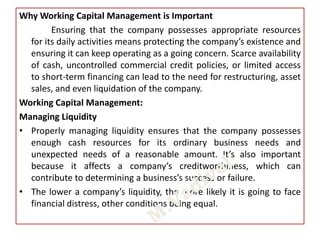
Why Working Capital Management is Important
Ensuring that the company possesses appropriate resources
for its daily activities means protecting the company’s existence and
ensuring it can keep operating as a going concern. Scarce availability
of cash, uncontrolled commercial credit policies, or limited access
to short-term financing can lead to the need for restructuring, asset
sales, and even liquidation of the company.
Working Capital Management:
Managing Liquidity
• Properly managing liquidity ensures that the company possesses
enough cash resources for its ordinary business needs and
unexpected needs of a reasonable amount. It’s also important
because it affects a company’s creditworthiness, which can
contribute to determining a business’s success or failure.
• The lower a company’s liquidity, the more likely it is going to face
financial distress, other conditions being equal.
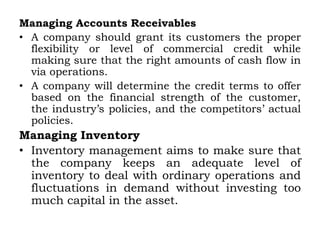
Managing Accounts Receivables
• A company should grant its customers the proper
flexibility or level of commercial credit while
making sure that the right amounts of cash flow in
via operations.
• A company will determine the credit terms to offer
based on the financial strength of the customer,
the industry’s policies, and the competitors’ actual
policies.
Managing Inventory
• Inventory management aims to make sure that
the company keeps an adequate level of
inventory to deal with ordinary operations and
fluctuations in demand without investing too
much capital in the asset.
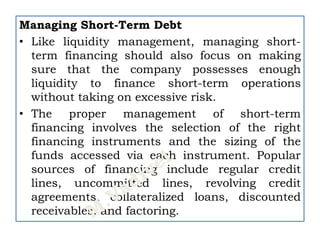
Managing Short-Term Debt
• Like liquidity management, managing short-
term financing should also focus on making
sure that the company possesses enough
liquidity to finance short-term operations
without taking on excessive risk.
• The proper management of short-term
financing involves the selection of the right
financing instruments and the sizing of the
funds accessed via each instrument. Popular
sources of financing include regular credit
lines, uncommitted lines, revolving credit
agreements, collateralized loans, discounted
receivables, and factoring.
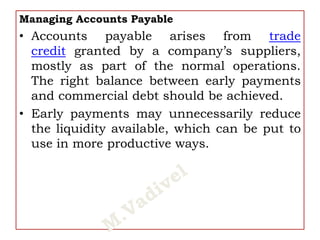
Managing Accounts Payable
• Accounts payable arises from trade
credit granted by a company’s suppliers,
mostly as part of the normal operations.
The right balance between early payments
and commercial debt should be achieved.
• Early payments may unnecessarily reduce
the liquidity available, which can be put to
use in more productive ways.
Working Capital Ratios
Current Ratio = Current Assets – Current Liabilities
Current Assets include: Stock, Debtors, Cash in Hand,
Cash at Bank, Bills Receivable, Prepaid Expenses and
Accrued Income.
Current Liabilities include: Creditors, Bills Payable,
Bank Overdraft, Outstanding Expense and Income
received in advance….
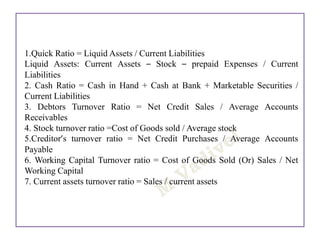
1.Quick Ratio = Liquid Assets / Current Liabilities
Liquid Assets: Current Assets – Stock – prepaid Expenses / Current
Liabilities
2. Cash Ratio = Cash in Hand + Cash at Bank + Marketable Securities /
Current Liabilities
3. Debtors Turnover Ratio = Net Credit Sales / Average Accounts
Receivables
4. Stock turnover ratio =Cost of Goods sold / Average stock
5.Creditor’s turnover ratio = Net Credit Purchases / Average Accounts
Payable
6. Working Capital Turnover ratio = Cost of Goods Sold (Or) Sales / Net
Working Capital
7. Current assets turnover ratio = Sales / current assets
Thank You…………

Working Capital Management and its Elements

  • 1.
    Sri Ramakrishna Collegeof Arts & Science Coimbatore – 06. Topic: Working Capital Management M.VADIVEL Assistant Professor Department of B.Com PA Sri Ramakrishna College of Arts & Science Coimbatore.
  • 2.
    Meaning Working capital managementrefers to the set of activities performed by a company to make sure it got enough resources for day-to-day operating expenses while keeping resources invested in a productive way.
  • 3.
    Understanding Working Capital •Working capital is the difference between a company’s current assets and its current liabilities. • Current assets include cash, accounts receivable, and inventories. • Current liabilities include accounts payable, short-term borrowings, and accrued liabilities. • Some approaches may subtract cash from current assets and financial debt from current liabilities.
  • 4.
    Why Working CapitalManagement is Important Ensuring that the company possesses appropriate resources for its daily activities means protecting the company’s existence and ensuring it can keep operating as a going concern. Scarce availability of cash, uncontrolled commercial credit policies, or limited access to short-term financing can lead to the need for restructuring, asset sales, and even liquidation of the company. Working Capital Management: Managing Liquidity • Properly managing liquidity ensures that the company possesses enough cash resources for its ordinary business needs and unexpected needs of a reasonable amount. It’s also important because it affects a company’s creditworthiness, which can contribute to determining a business’s success or failure. • The lower a company’s liquidity, the more likely it is going to face financial distress, other conditions being equal.
  • 5.
    Managing Accounts Receivables •A company should grant its customers the proper flexibility or level of commercial credit while making sure that the right amounts of cash flow in via operations. • A company will determine the credit terms to offer based on the financial strength of the customer, the industry’s policies, and the competitors’ actual policies. Managing Inventory • Inventory management aims to make sure that the company keeps an adequate level of inventory to deal with ordinary operations and fluctuations in demand without investing too much capital in the asset.
  • 6.
    Managing Short-Term Debt •Like liquidity management, managing short- term financing should also focus on making sure that the company possesses enough liquidity to finance short-term operations without taking on excessive risk. • The proper management of short-term financing involves the selection of the right financing instruments and the sizing of the funds accessed via each instrument. Popular sources of financing include regular credit lines, uncommitted lines, revolving credit agreements, collateralized loans, discounted receivables, and factoring.
  • 7.
    Managing Accounts Payable •Accounts payable arises from trade credit granted by a company’s suppliers, mostly as part of the normal operations. The right balance between early payments and commercial debt should be achieved. • Early payments may unnecessarily reduce the liquidity available, which can be put to use in more productive ways.
  • 8.
    Working Capital Ratios CurrentRatio = Current Assets – Current Liabilities Current Assets include: Stock, Debtors, Cash in Hand, Cash at Bank, Bills Receivable, Prepaid Expenses and Accrued Income. Current Liabilities include: Creditors, Bills Payable, Bank Overdraft, Outstanding Expense and Income received in advance….
  • 9.
    1.Quick Ratio =Liquid Assets / Current Liabilities Liquid Assets: Current Assets – Stock – prepaid Expenses / Current Liabilities 2. Cash Ratio = Cash in Hand + Cash at Bank + Marketable Securities / Current Liabilities 3. Debtors Turnover Ratio = Net Credit Sales / Average Accounts Receivables 4. Stock turnover ratio =Cost of Goods sold / Average stock 5.Creditor’s turnover ratio = Net Credit Purchases / Average Accounts Payable 6. Working Capital Turnover ratio = Cost of Goods Sold (Or) Sales / Net Working Capital 7. Current assets turnover ratio = Sales / current assets
  • 10.