RVU-Woliso
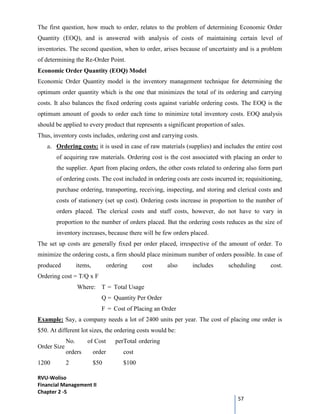
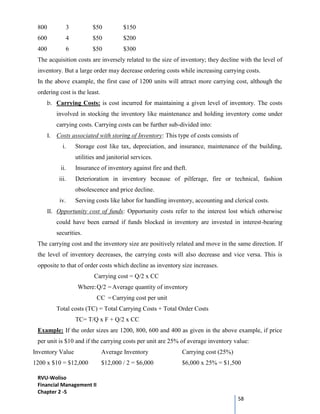
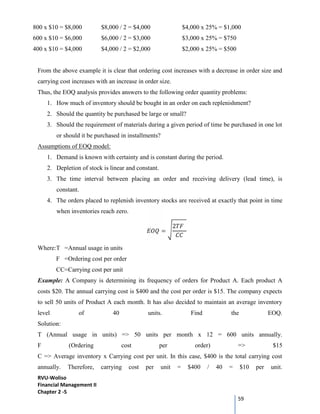
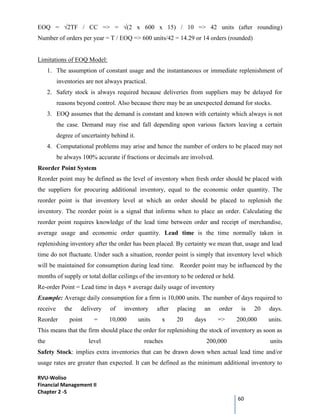
Financial Management II
Chapter 2 -5
1
FINANCIAL MANAGEMENT II
CHAPTER -2
PRINCIPLES OF WORKING CAPITAL MANAGEMENT
INTRODUCTION
Working capital management is also one of the important parts of the financial management. It is
concerned with short-term finance of the business concern which is a closely related trade
between profitability and liquidity. Efficient working capital management leads to improve the
operating performance of the business concern and it helps to meet the short term liquidity.
Short-term, or current assets and liabilities are collectively known as working capital. It
measures how much in liquid assets a company has available to build its business. Positive
working capital is needed to ensure that a firm is able to continue its operations and that it has
sufficient funds to satisfy both maturing short term debt and upcoming operational expenses. The
management of working capital involves managing inventories, account receivable and payable
and cash.
An increase in working capital indicates that the business has either increased current assets (that
is received cash, or other current assets) or has decreased current liabilities, for example, if it has
paid some short term debts from creditors.
Decision relating to working capital and short term financing are referred to as working capital
management. Active working capital management is an extremely effective way to increase
enterprise value. Optimizing working capital results in a rapid release of liquid resources and
contributes to an improvement in free cash flow and to a permanent reduction in inventory and
capital costs, thereby increasing liquidity for strategic investment and debt deduction.
The fundamental principles of working capital management are reducing the capital employed
and improving efficiency in the areas of receivables, inventories, and payables. Working capital
is essential for long-term success of a business. No business can survive, if it cannot meet its
day-to-day obligations. A business must therefore have clear policies for the management of
each component of working capital.
Working capital concepts
 Working capital, sometimes called gross working capital, simply refers to current assets
used in operations.
 Net working capital is defined as current assets minus current liabilities.
RVU-Woliso
Financial Management II
Chapter 2 -5
2
 Net operating working capital is defined as current assets minus none interest- bearing
current liabilities. More specifically, net operating working capital is often expressed as cash
and marketable securities, accounts receivable, and inventories, less accounts payable and
accruals.
 The current ratio, which is calculated by dividing current assets by current liabilities and it is
intended to measure liquidity. However, a high current ratio does not ensure that a firm will
have the cash required to meet its needs. If inventories cannot be sold, or if receivables
cannot be collected in a timely manner, then the apparent safety reflected in a high current
ratio could be illusory.
 The quick ratio, or acid test, also attempts to measure liquidity, and it is found by
subtracting inventories from current assets and then dividing by current liabilities. The quick
ratio removes inventories from current assets because they are the least liquid of current
assets. Therefore, the quick ratio is an “acid test” of a company’s ability to meet its current
obligations.
 The best and most comprehensive picture of a firm’s liquidity position is shown by its cash
budget. This statement, which forecasts cash inflows and outflows, focuses on what really
counts, namely, the firm’s ability to generate sufficient cash inflows to meet its required cash
outflows. We will discuss cash budgeting in detail later in the chapter.
 Working capital policy refers to the firm’s policies regarding (1) target levels for each
category of current assets and (2) how current assets will be financed.
 Working capital management involves both setting working capital policy and carrying out
that policy in day-to-day operations.
Characteristics of working capital management confines with the characteristics of the
components of working capital.
 It has short life span: cash balances may hold idle for a week or two, thus accounts may have
a life of 30-60 days.
 Swift transformation in to other asset forms: i.e each current asset is swiftly transformed in to
other assets from like cash is used for acquiring raw materials, raw materials are transformed
in to finished goods and these sold on credit are convertible in to account receivables and
finally in to cash.
The Components of Working Capital
RVU-Woliso
Financial Management II
Chapter 2 -5
3
Current Assets: One important current asset is accounts receivable. Accounts receivable arise
because companies do not usually expect customers to pay for their purchases immediately.
These unpaid bills are a valuable asset that companies expect to be able to turn into cash in the
near future. The bulk of accounts receivable consists of unpaid bills from sales to other
companies and are known as trade credit. The remainder arises from the sale of goods to the
final consumer. These are known as consumer credit.
Another important current asset is inventory. Inventories may consist of raw materials, work in
process, or finished goods awaiting sale and shipment.
The remaining current assets are cash and marketable securities. The cash consists partly of
dollar bills, but most of the cash is in the form of bank deposits. These may be demand deposits
(money in checking accounts that the firm can pay out immediately) and time deposits (money in
savings accounts that can be paid out only with a delay).
The principal marketable security is commercial paper (short-term unsecured debt sold by other
firms). Other securities include Treasury bills, which are short-term debts sold by federal
government, and state and local government securities.
Current Liabilities: We have seen that a company’s principal current asset consists of unpaid
bills. One firm’s credit must be another’s debit. Therefore, it is not surprising that a company’s
principal current liability consists of accounts payable—that is, outstanding payments due to
other companies.
The other major current liability consists of short-term borrowing.
NEEDS OF WORKING CAPITAL
Working Capital is an essential part of the business concern. Every business concern must
maintain certain amount of Working Capital for their day-to-day requirements and meet the
short-term obligations.
Working Capital is needed for the following purposes.
I. Purchase of raw materials and spares: The basic part of manufacturing process is, raw
materials. It should purchase frequently according to the needs of the business concern.
Hence, every business concern maintains certain amount as Working Capital to purchase raw
materials, components, spares, etc.
II. Payment of wages and salary: The next part of Working Capital is payment of wages and
salaries to labour and employees. Periodical payment facilities make employees perfect in
RVU-Woliso
Financial Management II
Chapter 2 -5
4
their work. So a business concern maintains adequate the amount of working capital to make
the payment of wages and salaries.
III. Day-to-day expenses: A business concern has to meet various expenditures regarding the
operations at daily basis like fuel, power, office expenses, etc.
IV. Provide credit obligations: A business concern responsible to provide credit facilities to the
customer and meet the short-term obligation. So the concern must provide adequate Working
Capital.
Determinants of working capital requirements or management
Working Capital requirements depends upon various factors. There are no set of rules or formula
to determine the Working Capital needs of the business concern. The following are the major
factors which are determining the Working Capital requirements.
a) Nature of business: Working Capital of the business concerns largely depend upon the
nature of the business. If the business concerns follow rigid credit policy and sell goods only
for cash, they can maintain lesser amount of Working Capital. A transport company
maintains lesser amount of Working Capital while a construction company maintains larger
amount of Working Capital.
b) Production cycle: Amount of Working Capital depends upon the length of the production
cycle. If the production cycle length is small, they need to maintain lesser amount of
Working Capital. If it is not, they have to maintain large amount of Working Capital.
c) Business cycle: Business fluctuations lead to cyclical and seasonal changes in the business
condition and it will affect the requirements of the Working Capital. In the booming
conditions, the Working Capital requirement is larger and in the depression condition,
requirement of Working Capital will reduce. Better business results lead to increase the
Working Capital requirements.
d) Production policy: It is also one of the factors which affects the Working Capital
requirement of the business concern. If the company maintains the continuous production
policy, there is a need of regular Working Capital. If the production policy of the company
depends upon the situation or conditions, Working Capital requirement will depend upon the
conditions laid down by the company.
e) Credit policy: Credit policy of sales and purchase also affect the Working Capital
requirements of the business concern. If the company maintains liberal credit policy to
RVU-Woliso
Financial Management II
Chapter 2 -5
5
collect the payments from its customers, they have to maintain more Working Capital. If the
company pays the dues on the last date it will create the cash maintenance in hand and bank.
f) Growth and expansion: During the growth and expansion of the business concern, Working
Capital requirements are higher, because it needs some additional Working Capital and
incurs some extra expenses at the initial stages.
g) Availability of raw materials: Major part of the Working Capital requirements are largely
depend on the availability of raw materials. Raw materials are the basic components of the
production process. If the raw material is not readily available, it leads to production
stoppage. So, the concern must maintain adequate raw material; for that purpose, they have
to spend some amount of Working Capital.
h) Earning capacity: If the business concern consists of high level of earning capacity, they
can generate more Working Capital, with the help of cash from operation. Earning capacity is
also one of the factors which determines the Working Capital requirements of the business
concern.
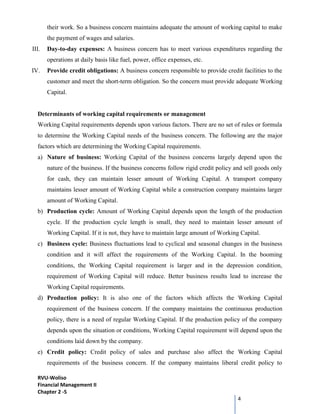
OPERATING AND CASH CYCLE
Operating cycle is the time duration required to convert sales, after the conversion of resources in
to inventories, in to cash. The operating cycle of a manufacturing company involves three
phases.
 Acquisition of resources such as raw materials, labour, power, fuel, etc
 Manufacturing of the product which includes conversion of raw materials in to work-in-
progress in to finished goods.
 Sale of the product either for cash or on credit. Credit sale create account receivable for
collection.
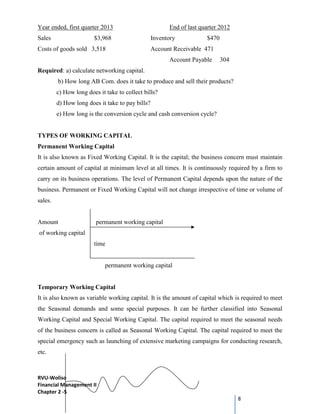
The components of working capital constantly change with the cycle of operations, but the
amount of working capital is fixed. This is one reason why net working capital is useful
summary measure of current.
Cash
Receivables Raw materials inventory
RVU-Woliso
Financial Management II
Chapter 2 -5
6
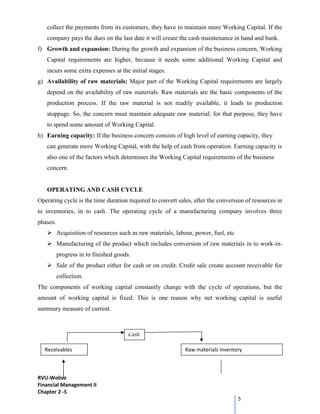
Figure:1 Simple cycle of operation
If you prepare the firm’s balance sheet at the beginning of the process, you will see cash (a
current asset). If you delay a little you will find the cash replaced first by inventories of raw
materials and then by inventories of finished goods (also a current asset). When the goods are
sold, the inventories give way to receivable ( another current asset) and finally, when the
customers pay their bills, the firms takes out its profit and replenishes the cash balance.
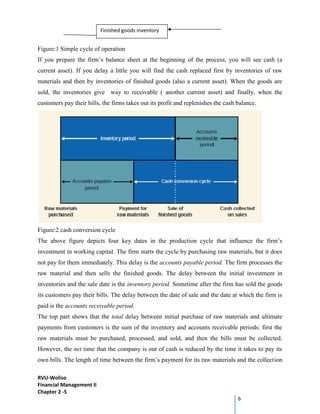
Figure:2 cash conversion cycle
The above figure depicts four key dates in the production cycle that influence the firm’s
investment in working capital. The firm starts the cycle by purchasing raw materials, but it does
not pay for them immediately. This delay is the accounts payable period. The firm processes the
raw material and then sells the finished goods. The delay between the initial investment in
inventories and the sale date is the inventory period. Sometime after the firm has sold the goods
its customers pay their bills. The delay between the date of sale and the date at which the firm is
paid is the accounts receivable period.
The top part shows that the total delay between initial purchase of raw materials and ultimate
payments from customers is the sum of the inventory and accounts receivable periods: first the
raw materials must be purchased, processed, and sold, and then the bills must be collected.
However, the net time that the company is out of cash is reduced by the time it takes to pay its
own bills. The length of time between the firm’s payment for its raw materials and the collection
Finished goods inventory
RVU-Woliso
Financial Management II
Chapter 2 -5
7
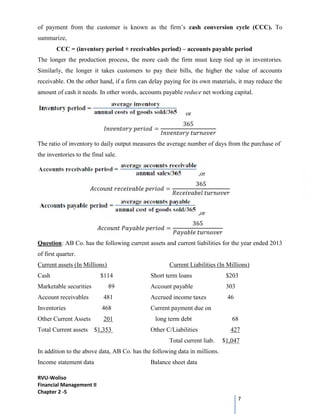
of payment from the customer is known as the firm’s cash conversion cycle (CCC). To
summarize,
CCC = (inventory period + receivables period) – accounts payable period
The longer the production process, the more cash the firm must keep tied up in inventories.
Similarly, the longer it takes customers to pay their bills, the higher the value of accounts
receivable. On the other hand, if a firm can delay paying for its own materials, it may reduce the
amount of cash it needs. In other words, accounts payable reduce net working capital.
or
=
365
The ratio of inventory to daily output measures the average number of days from the purchase of
the inventories to the final sale.
,or
=
365
,or
=
365
Question: AB Co. has the following current assets and current liabilities for the year ended 2013
of first quarter.
Current assets (In Millions) Current Liabilities (In Millions)
Cash $114 Short term loans $203
Marketable securities 89 Account payable 303
Account receivables 481 Accrued income taxes 46
Inventories 468 Current payment due on
Other Current Assets 201 long term debt 68
Total Current assets $1,353 Other C/Liabilities 427
Total current liab. $1,047
In addition to the above data, AB Co. has the following data in millions.
Income statement data Balance sheet data
RVU-Woliso
Financial Management II
Chapter 2 -5
8
Year ended, first quarter 2013 End of last quarter 2012
Sales $3,968 Inventory $470
Costs of goods sold 3,518 Account Receivable 471
Account Payable 304
Required: a) calculate networking capital.
b) How long AB Com. does it take to produce and sell their products?
c) How long does it take to collect bills?
d) How long does it take to pay bills?
e) How long is the conversion cycle and cash conversion cycle?
TYPES OF WORKING CAPITAL
Permanent Working Capital
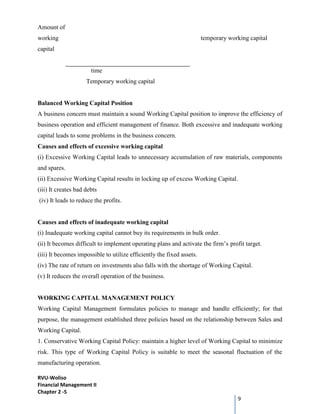
It is also known as Fixed Working Capital. It is the capital; the business concern must maintain
certain amount of capital at minimum level at all times. It is continuously required by a firm to
carry on its business operations. The level of Permanent Capital depends upon the nature of the
business. Permanent or Fixed Working Capital will not change irrespective of time or volume of
sales.
Amount permanent working capital
of working capital
time
permanent working capital
Temporary Working Capital
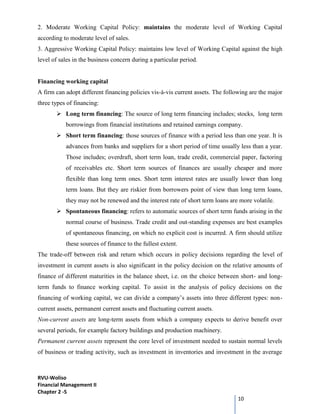
It is also known as variable working capital. It is the amount of capital which is required to meet
the Seasonal demands and some special purposes. It can be further classified into Seasonal
Working Capital and Special Working Capital. The capital required to meet the seasonal needs
of the business concern is called as Seasonal Working Capital. The capital required to meet the
special emergency such as launching of extensive marketing campaigns for conducting research,
etc.
RVU-Woliso
Financial Management II
Chapter 2 -5
9
Amount of
working temporary working capital
capital
time
Temporary working capital
Balanced Working Capital Position
A business concern must maintain a sound Working Capital position to improve the efficiency of
business operation and efficient management of finance. Both excessive and inadequate working
capital leads to some problems in the business concern.
Causes and effects of excessive working capital
(i) Excessive Working Capital leads to unnecessary accumulation of raw materials, components
and spares.
(ii) Excessive Working Capital results in locking up of excess Working Capital.
(iii) It creates bad debts
(iv) It leads to reduce the profits.
Causes and effects of inadequate working capital
(i) Inadequate working capital cannot buy its requirements in bulk order.
(ii) It becomes difficult to implement operating plans and activate the firm’s profit target.
(iii) It becomes impossible to utilize efficiently the fixed assets.
(iv) The rate of return on investments also falls with the shortage of Working Capital.
(v) It reduces the overall operation of the business.
WORKING CAPITAL MANAGEMENT POLICY
Working Capital Management formulates policies to manage and handle efficiently; for that
purpose, the management established three policies based on the relationship between Sales and
Working Capital.
1. Conservative Working Capital Policy: maintain a higher level of Working Capital to minimize
risk. This type of Working Capital Policy is suitable to meet the seasonal fluctuation of the
manufacturing operation.
RVU-Woliso
Financial Management II
Chapter 2 -5
10
2. Moderate Working Capital Policy: maintains the moderate level of Working Capital
according to moderate level of sales.
3. Aggressive Working Capital Policy: maintains low level of Working Capital against the high
level of sales in the business concern during a particular period.
Financing working capital
A firm can adopt different financing policies vis-à-vis current assets. The following are the major
three types of financing:
 Long term financing: The source of long term financing includes; stocks, long term
borrowings from financial institutions and retained earnings company.
 Short term financing: those sources of finance with a period less than one year. It is
advances from banks and suppliers for a short period of time usually less than a year.
Those includes; overdraft, short term loan, trade credit, commercial paper, factoring
of receivables etc. Short term sources of finances are usually cheaper and more
flexible than long term ones. Short term interest rates are usually lower than long
term loans. But they are riskier from borrowers point of view than long term loans,
they may not be renewed and the interest rate of short term loans are more volatile.
 Spontaneous financing: refers to automatic sources of short term funds arising in the
normal course of business. Trade credit and out-standing expenses are best examples
of spontaneous financing, on which no explicit cost is incurred. A firm should utilize
these sources of finance to the fullest extent.
The trade-off between risk and return which occurs in policy decisions regarding the level of
investment in current assets is also significant in the policy decision on the relative amounts of
finance of different maturities in the balance sheet, i.e. on the choice between short- and long-
term funds to finance working capital. To assist in the analysis of policy decisions on the
financing of working capital, we can divide a company’s assets into three different types: non-
current assets, permanent current assets and fluctuating current assets.
Non-current assets are long-term assets from which a company expects to derive benefit over
several periods, for example factory buildings and production machinery.
Permanent current assets represent the core level of investment needed to sustain normal levels
of business or trading activity, such as investment in inventories and investment in the average
RVU-Woliso
Financial Management II
Chapter 2 -5
11
level of a company’s trade receivables. Fluctuating current assets correspond to the variations in
the level of current assets arising from normal business activity.
And hence, the relationship among risk, return and liquidity are measured and also which type of
financing is suitable to meet the Working Capital requirements of the business concern. The
following are the commonly used approaches in determining the financing mix;
A MATCHING FUNDING POLICY is one which finances fluctuating current assets with
short term funds and permanent current assets and non-current assets with long-term funds. The
maturity of the funds roughly matches the maturity of the different types of assets. It is an
approach when a firm adopts a financial plan which matches the expected life of assets with
expected life of sources of funds raised to finance assets. For example: a ten year loan may be
raised to finance a plant asset with an expected life of ten years.
A CONSERVATIVE FUNDING POLICY uses long-term funds to finance not only non-
current assets and permanent current assets, but some fluctuating current assets as well. As there
is less reliance on short-term funding, the risk of such a policy is lower, but the higher cost of
long-term finance means that profitability is reduced as well.
An AGGRESSIVE FUNDING POLICY uses short-term funds to finance not only fluctuating
current assets, but some permanent current assets as well. This policy carries the greatest risk to
solvency, but also offers the highest profitability and increases shareholder value. Some
extremely aggressive firms may even finance a part of their fixed assets with short term
financing.
End of chapter 2
RVU-Woliso
Financial Management II
Chapter 2 -5
12
CHAPTER - 3
CASH AND LIQUIDITY MANAGEMENT
3. Definition and Nature of cash
Cashrefers to coins, currency, checks held by a firm, and demand deposits. Cash is the money
which a firm can disburse immediately without any restriction. Sometimes near money such as
marketable securities or bank time deposits are also included to define cash.
Cash is the most important current asset for the operation of the business. Cash is the basic input
needed to keep the business running on a continuous basis; it is also the ultimate output expected
to be realized by selling the service output or product manufactured by the firm. The firm should
keep sufficient cash, neither more nor less. Cash shortage will disrupt the firm’s manufacturing
operations while excess will simply remain idle, without contributing anything towards the
firm’s profitability. Thus, the financial manager should maintain a sound cash position within the
firm.
Cash is often called a “nonearning asset.” It is needed to pay for labor and raw materials, to buy
fixed assets, to pay taxes, to service debt, to pay dividends, and so on. However, cash itself (and
also most commercial checking accounts) earns no interest. Thus, the goal of the cash manager is
to minimize the amount of cash the firm must hold for use in conducting its normal business
RVU-Woliso
Financial Management II
Chapter 2 -5
13
activities, yet, at the same time, to have sufficient cash (a) to take trade discounts, (b) to maintain
its credit rating, and (c) to meet unexpected cash needs.
Cash management is concerned with optimizing the amount of cash available, maximizing the
interest earned by spare funds not required immediately and reducing losses caused by delays in
the transmission of funds. Holding cash to meet short-term needs incurs an opportunity cost
equal to the return which could have been earned if the cash had been invested or put to
productive use. However, reducing this opportunity cost by operating with small cash balances
will increase the risk of being unable to meet debts as they fall due, so an optimum cash balance
should be found.
In addition to this, Cash management is concerned with managing of: (i) cash flows in to and out
of the firm, (ii) cash flows within the firm, (iii) cash balances held by the firm at a point of time
by financing deficit or investing surplus cash. Sales generate cash which has to be disbursed out.
The surplus cash has to be invested while deficit has to be borrowed. Cash management assumes
more important than other current assets because cash is the most significant and the least
productive asset that a firm holds. It is significant because it is used to pay the firm’s obligations.
However, cash is unproductive, unlike fixed assets or inventories; it does not produce goods for
sale. Therefore, the aim of Cash management is to maintain adequate control over cash position
to keep the firm sufficiently liquid and to use excess cash in some profitable way.
Cash management is also important because it is difficult to predict cash flows accurately,
particularly the inflows, and there is no perfect coincidence between the inflows and outflows of
cash. During some periods, cash out flows will exceed cash inflows, because payments for taxes,
dividends, or seasonal inventory buildup. At other times, cash inflow will be more than cash
payments because there may be large cash sales and debtors may be realized in large sums
promptly. Further Cash management is significant because cash constitutes the smallest portion
of the total current assets, yet management’s considerable time is devoted in managing it.
In order to resolve the uncertainty about cash flow prediction and lack of synchronization
between cash receipts and payments, the firm should develop appropriate strategies for Cash
management. The firm should evolve strategies regarding the following four facets of Cash
management.
o Cash Planning: cash inflows and out flows should be planned to project cash
surplus or deficit for each period of the planning period. Cash budget should be
prepared for this purpose.
RVU-Woliso
Financial Management II
Chapter 2 -5
14
o Managing the cash flows: the flow of cash should be properly managed. The cash
inflows should be accelerated while, as far as possible, the cash outflows should be
decelerated.
o Optimum cash level: the firm should decide about the appropriate level of cash
balances. The cost of excess cash and danger of cash deficiency should be matched
to determine the optimum level of cash balances.
o Investing surplus cash: the surplus cash balances should be properly invested to
earn profits. The firm should decide about the division of such cash balances
between alternative short-term investment opportunities such as bank deposits,
marketable securities, or inter-corporate lending.
The ideal Cash management system will depend on the firm’s products, organizational structure,
competition, culture and options available.
3.1 Reasons for Holding Cash
The company should not hold an excessive cash balance since no return is being earned upon it.
The least amount of cash a firm should hold is the greater of (1)compensating balances (a deposit
held by a bank to compensate it for providing services) or (2) precautionary balances (money
held for emergency purposes) plus transaction balances (money needed to cover checks
outstanding); the reasons for holding cash.
a. Transactions motive
Companies need cash reserve in order to balance short-term cash inflows and outflows since
these are not perfectly matched. Transaction motive is a motive for holding cash or near cash to
meet routine cash requirements to finance transaction in the normal course of
business.Transaction-related needs come from the normal disbursement and collection
activitiesof the firm. The disbursement of cash includes the payment of wages andsalaries, trade
debts, taxes, and dividends. The approximate size of the cash reserve can be estimated by
forecasting cash inflows and outflows and by preparing cash budgets. In addition to the cash
reserve held for day-to-day operational needs, cash may be built up to meet significant
RVU-Woliso
Financial Management II
Chapter 2 -5
15
anticipated cash outflows, for example those arising from investment in a new project or the
redemption of debt.
b. Precautionary motive
Forecasts of future cash flows are subject to uncertainty and it is possible that a company will
experience unexpected demands for cash. This gives rise to the precautionary motive for holding
cash. It is the motive for holding cash or near cash as a cushion to meet unexpected
contingencies such as floodsstrikes etc.Reserves held for precautionary reasons could be in the
form of easily-realized short-term investments.
c. Speculative motive
Companies may build up cash reserves in order to take advantage of any attractive investment
opportunities that may arise. The speculative motiveis the motive for holding cash to quickly
take advantage of opportunitiestypically outside the normal course of business. For example the
firm may need to hold cash to take advantage of bargain purchases that might arise, attractive
interest rates, and (in the caseof international firms) favorable exchange rate fluctuations.
If a company has significant speculative cash reserves for which it cannot see an advantageous
use, it may choose to enhance shareholder value by returning them to shareholders, for example
by means of a share repurchase scheme or a special cash dividend.
4. Compensating motive
It is a motive for holding cash to compensate banks for providing certain servicesor loans. Banks
provide variety of services to the business concern, such asclearance of cheque, transfer of funds
etc.
The amount of cash to be held depends upon the following factors:
 Cash management policies
 Current liquidity position
 Management’s liquidity risk preferences
 Schedule of debt maturity
 The firm’s ability to borrow
 Forecasted short- and long-term cash flow
 The probabilities of different cash flows under varying circumstances
3.2 Costs of Holding Cash
RVU-Woliso
Financial Management II
Chapter 2 -5
16
When a firm holds cash in excess of some necessary minimum, it incurs an opportunitycost. The
opportunity cost of excess cash (held in currency or bank deposits) is the interestincome that
could be earned in the next best use, such as investment in marketablesecurities.
Given the opportunity cost of holding cash, why would a firm hold cash in excess ofits
compensating balance requirements? The answer is that a cash balance must bemaintained to
provide the liquidity necessary for transaction needs - paying bills. If thefirm maintains too small
a cash balance, it may run out of cash. If this happens, the firmmay have to raise cash on a short-
term basis. This could involve, for example, sellingmarketable securities or borrowing.Activities
such as selling marketable securities and borrowing involve various costs.
3.2.1 Understanding Float
The cash balance that a firm shows onits books is called the firm’s book, or ledger, balance. The
balance shown in its bank accountas available to spend is called its available, or collected,
balance. The differencebetween the available balance and the ledger balance is called the float,
and it representsthe net effect of checks in the process of clearing (moving through the banking
system).
Disbursement Float
Checks written by a firm generate disbursement float, causing a decrease in the firm’sbook
balance but no change in its available balance. For example, suppose KK plc. currently has
$100,000 on deposit with its bank. On April 11, it buyssome raw materials and pays with a check
for $100,000. The company’s book balanceis immediately reduced by $100,000 as a result.
KK’s bank, however, will not find out about this check until it is presented to the bank for
payment on, say, April 15. Until the check is presented, the firm’s available balanceis greater
than its book balance by $100,000. In other words, before April 11, KK has a zero float:
Float = Firm’s available balance - Firm’s book balance
= $100,000 - 100,000 = 0
KK’s position from April 11 to 15 is:
Disbursement float = Firm’s available balance -Firm’s book balance
Float is the difference b/n book cash & bank cash
RVU-Woliso
Financial Management II
Chapter 2 -5
17
=$100,000-0= $100,000
During this period of time that the check is clearing, KK has a balance with the bankof $100,000.
It can obtain the benefit of this cash while the check is clearing. For example,the available
balance could be temporarily invested in marketable securities andthus earn some interest.
Collection Float and Net Float
Checks received by the firm create collection float. Collection float increases book balancesbut
does not immediately change available balances. For example, suppose KK receives a check
from a customer for $100,000 on April 16. Assume, as before, that thecompany has $100,000
deposited at its bank and a zero float. It deposits the check andincreases its book balance by
$100,000 to $200,000. However, the additional cash is not available to KK until its bank has
presented the check to the customer’s bank and received$100,000. This will occur on, say, April
22. In the meantime, the cash position at KK will reflect a collection float of $100,000.
BeforeApril 16, KK’s position is:
Float = Firm’s available balance - Firm’s book balance
= $100,000 - 100,000 =$0
KK’s position from April 16 to 22 is:
Collection float = Firm’s available balance - Firm’s book balance
= $100,000 - 200,000 = $100,000
In general, a firm’s payment (disbursement) activities generate disbursement float,and its
collection activities generate collection float. The net effect, that is, the sum ofthe total collection
and disbursement floats, is the net float. The net float at a point intime is simply the overall
difference between the firm’s available balance and its bookbalance. If the net float is positive,
then the firm’s disbursement float exceeds its collectionfloat, and its available balance exceeds
its book balance. If the available balanceis less than the book balance, then the firm has a net
collection float.
A firm should be concerned with its net float and available balance more than withits book
balance. If a financial manager knows that a check written by the company willnot clear for
several days, that manager will be able to keep lower cash balance at thebank than might be
possible otherwise. This can generate a great deal of money.
RVU-Woliso
Financial Management II
Chapter 2 -5
18
Activity
Suppose you have $5,000 on deposit. One day, you write a check for $1,000 to pay for books,and
you deposit $2,000. What are your disbursement, collection, and net floats?
After you write the $1,000 check, you show a balance of $4,000 on your books, but thebank
shows $5,000 while the check is clearing. The difference is a disbursement float of$1,000.
After you deposit the $2,000 check, you show a balance of $6,000. Your available
balancedoesn’t rise until the check clears. This results in a collection float of $2,000. Your net
floatis the sum of the collection and disbursement floats, or $1,000.
Overall, you show $6,000 on your books. The bank shows a $7,000 balance, but only$5,000 is
available because your deposit has not been cleared. The discrepancy between youravailable
balance and your book balance is the net float (-$1,000), and it is bad for you. If youwrite
another check for $5,500, there may not be sufficient available funds to cover it, and itmight
bounce. This is the reason that financial managers have to be more concerned withavailable
balances than book balances.
Float Management
Float management involves controlling the collection and disbursement of cash. The objectivein
cash collection is to speed up collections and reduce the lag between the timecustomers pay their
bills and the time the cash becomes available. The objective in cashdisbursement is to control
payments and minimize the firm’s costs associated with makingpayments.
Total collection or disbursement times can be broken down into three parts: mailingtime,
processing delay, and availability delay:
1. Mailing timeis the part of the collection and disbursement process during whichchecks are
trapped in the postal system.
2. Processing delayis the time it takes the receiver of a check to process the payment and
deposits it in a bank for collection.
3. Availability delayrefers to the time required to clear a check through the bankingsystem.
Speeding up collections involves reducing one or more of these components. Slowingup
disbursements involves increasing one of them.
RVU-Woliso
Financial Management II
Chapter 2 -5
19
Measuring Float
The size of the float depends on both the dollars and the time delayinvolved. For example,
suppose KK Co. mail a check for $500 to another state each month.
It takes five days in the mail for the check to reach its destination (the mailing time) andone day
for the recipient to get over to the bank (the processing delay). The recipient’sbank holds out-of-
state checks for three days (availability delay). The total delay is 5 +1 +3 =9 days.
In this case, what is the company’s average daily disbursement float?
There are two equivalentways of calculating average daily disbursement float:
First, you have a $500 float for nine days, so we say thatthe total float is 9 x $500 =$4,500.
Assuming 30 days in the month, the average dailyfloat is $4,500/30 = $150.
Alternatively, the company’s disbursement float is $500 for 9 days out of the month and zerothe
other 21 days (again assuming 30 days in a month). The average daily float is thus:
Average daily float = (9 x $500 + 21 x 0)/30
= 9/30 x $500 + 21/30 x 0
=$4,500/30 = $150
This means that, on an average day, the company’s book balance is $150 less than its
availablebalance, representing a $150 average disbursement float.
Things are only a little more complicated when there are multiple disbursements or receipts.
To illustrate, suppose MM co. receives two items each month as follows:
Processing and
Amountavailability delay Total float
Item 1: $5,000,000 x9 =$45,000,000
Item 2: $3,000,000 x 5 =$15,000,000
Total $8,000,000 $60,000,000
The average daily float is equal to:
Average daily float =Total float
Total days
=60 million/30 = $2 million
So, on an average day, there is $2 million that is uncollected and not available.
RVU-Woliso
Financial Management II
Chapter 2 -5
20
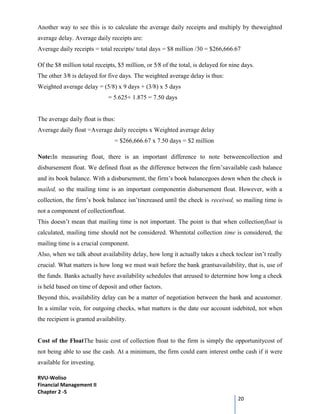
Another way to see this is to calculate the average daily receipts and multiply by theweighted
average delay. Average daily receipts are:
Average daily receipts = total receipts/ total days = $8 million /30 = $266,666.67
Of the $8 million total receipts, $5 million, or 5⁄8 of the total, is delayed for nine days.
The other 3⁄8 is delayed for five days. The weighted average delay is thus:
Weighted average delay = (5/8) x 9 days + (3/8) x 5 days
= 5.625+ 1.875 = 7.50 days
The average daily float is thus:
Average daily float =Average daily receipts x Weighted average delay
= $266,666.67 x 7.50 days = $2 million
Note:In measuring float, there is an important difference to note betweencollection and
disbursement float. We defined float as the difference between the firm’savailable cash balance
and its book balance. With a disbursement, the firm’s book balancegoes down when the check is
mailed, so the mailing time is an important componentin disbursement float. However, with a
collection, the firm’s book balance isn’tincreased until the check is received, so mailing time is
not a component of collectionfloat.
This doesn’t mean that mailing time is not important. The point is that when collectionfloat is
calculated, mailing time should not be considered. Whentotal collection time is considered, the
mailing time is a crucial component.
Also, when we talk about availability delay, how long it actually takes a check toclear isn’t really
crucial. What matters is how long we must wait before the bank grantsavailability, that is, use of
the funds. Banks actually have availability schedules that areused to determine how long a check
is held based on time of deposit and other factors.
Beyond this, availability delay can be a matter of negotiation between the bank and acustomer.
In a similar vein, for outgoing checks, what matters is the date our account isdebited, not when
the recipient is granted availability.
Cost of the FloatThe basic cost of collection float to the firm is simply the opportunitycost of
not being able to use the cash. At a minimum, the firm could earn interest onthe cash if it were
available for investing.
RVU-Woliso
Financial Management II
Chapter 2 -5
21
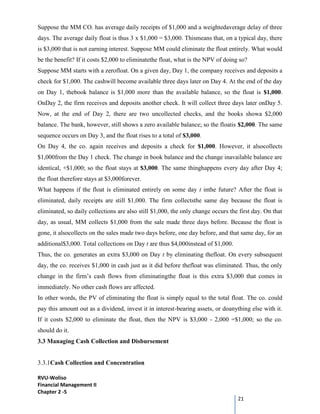
Suppose the MM CO. has average daily receipts of $1,000 and a weightedaverage delay of three
days. The average daily float is thus 3 x $1,000 = $3,000. Thismeans that, on a typical day, there
is $3,000 that is not earning interest. Suppose MM could eliminate the float entirely. What would
be the benefit? If it costs $2,000 to eliminatethe float, what is the NPV of doing so?
Suppose MM starts with a zerofloat. On a given day, Day 1, the company receives and deposits a
check for $1,000. The cashwill become available three days later on Day 4. At the end of the day
on Day 1, thebook balance is $1,000 more than the available balance, so the float is $1,000.
OnDay 2, the firm receives and deposits another check. It will collect three days later onDay 5.
Now, at the end of Day 2, there are two uncollected checks, and the books showa $2,000
balance. The bank, however, still shows a zero available balance; so the floatis $2,000. The same
sequence occurs on Day 3, and the float rises to a total of $3,000.
On Day 4, the co. again receives and deposits a check for $1,000. However, it alsocollects
$1,000from the Day 1 check. The change in book balance and the change inavailable balance are
identical, +$1,000; so the float stays at $3,000. The same thinghappens every day after Day 4;
the float therefore stays at $3,000forever.
What happens if the float is eliminated entirely on some day t inthe future? After the float is
eliminated, daily receipts are still $1,000. The firm collectsthe same day because the float is
eliminated, so daily collections are also still $1,000, the only change occurs the first day. On that
day, as usual, MM collects $1,000 from the sale made three days before. Because the float is
gone, it alsocollects on the sales made two days before, one day before, and that same day, for an
additional$3,000. Total collections on Day t are thus $4,000instead of $1,000.
Thus, the co. generates an extra $3,000 on Day t by eliminating thefloat. On every subsequent
day, the co. receives $1,000 in cash just as it did before thefloat was eliminated. Thus, the only
change in the firm’s cash flows from eliminatingthe float is this extra $3,000 that comes in
immediately. No other cash flows are affected.
In other words, the PV of eliminating the float is simply equal to the total float. The co. could
pay this amount out as a dividend, invest it in interest-bearing assets, or doanything else with it.
If it costs $2,000 to eliminate the float, then the NPV is $3,000 - 2,000 =$1,000; so the co.
should do it.
3.3 Managing Cash Collection and Disbursement
3.3.1Cash Collection and Concentration
RVU-Woliso
Financial Management II
Chapter 2 -5
22
A firm must adopt procedures to speed up collectionsand thereby decrease collection times. In
addition, even after cash is collected, firmsneed procedures to channel, or concentrate that cash
where it can be best used.
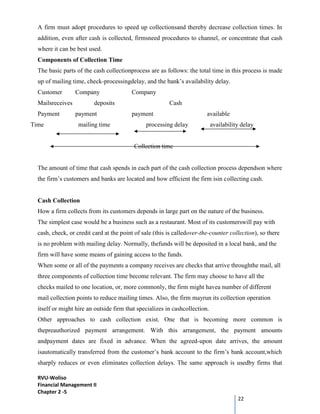
Components of Collection Time
The basic parts of the cash collectionprocess are as follows: the total time in this process is made
up of mailing time, check-processingdelay, and the bank’s availability delay.
Customer Company Company
Mailsreceives deposits Cash
Payment payment payment available
Time mailing time processing delay availability delay
Collection time
The amount of time that cash spends in each part of the cash collection process dependson where
the firm’s customers and banks are located and how efficient the firm isin collecting cash.
Cash Collection
How a firm collects from its customers depends in large part on the nature of the business.
The simplest case would be a business such as a restaurant. Most of its customerswill pay with
cash, check, or credit card at the point of sale (this is calledover-the-counter collection), so there
is no problem with mailing delay. Normally, thefunds will be deposited in a local bank, and the
firm will have some means of gaining access to the funds.
When some or all of the payments a company receives are checks that arrive throughthe mail, all
three components of collection time become relevant. The firm may choose to have all the
checks mailed to one location, or, more commonly, the firm might havea number of different
mail collection points to reduce mailing times. Also, the firm mayrun its collection operation
itself or might hire an outside firm that specializes in cashcollection.
Other approaches to cash collection exist. One that is becoming more common is
thepreauthorized payment arrangement. With this arrangement, the payment amounts
andpayment dates are fixed in advance. When the agreed-upon date arrives, the amount
isautomatically transferred from the customer’s bank account to the firm’s bank account,which
sharply reduces or even eliminates collection delays. The same approach is usedby firms that
RVU-Woliso
Financial Management II
Chapter 2 -5
23
have on-line terminals, meaning that when a sale is rung up, the money isimmediately transferred
to the firm’s accounts.
Cash Concentration
The firm needs procedures to move the cash into its main accounts. This iscalled cash
concentration. By routinely pooling its cash, the firm greatly simplifies itscash management by
reducing the number of accounts that must be tracked. Also, byhaving a larger pool of funds
available, a firm may be able to negotiate or otherwise obtaina better rate on any short-term
investments.
In setting up a concentration system, firms will typically use one or more concentrationbanks. A
concentration bank pools the funds obtained from local banks containedwithin some geographic
region. Concentration systems are often used in conjunctionwith lockbox systems. A key part of
the cash collectionand concentration process is the transfer of funds to the concentration bank.
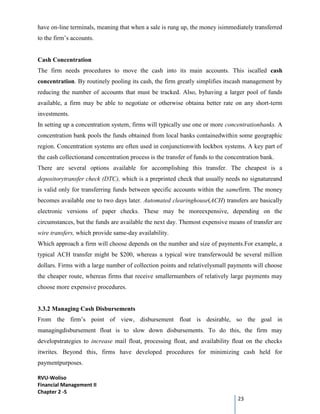
There are several options available for accomplishing this transfer. The cheapest is a
depositorytransfer check (DTC), which is a preprinted check that usually needs no signatureand
is valid only for transferring funds between specific accounts within the samefirm. The money
becomes available one to two days later. Automated clearinghouse(ACH) transfers are basically
electronic versions of paper checks. These may be moreexpensive, depending on the
circumstances, but the funds are available the next day. Themost expensive means of transfer are
wire transfers, which provide same-day availability.
Which approach a firm will choose depends on the number and size of payments.For example, a
typical ACH transfer might be $200, whereas a typical wire transferwould be several million
dollars. Firms with a large number of collection points and relativelysmall payments will choose
the cheaper route, whereas firms that receive smallernumbers of relatively large payments may
choose more expensive procedures.
3.3.2 Managing Cash Disbursements
From the firm’s point of view, disbursement float is desirable, so the goal in
managingdisbursement float is to slow down disbursements. To do this, the firm may
developstrategies to increase mail float, processing float, and availability float on the checks
itwrites. Beyond this, firms have developed procedures for minimizing cash held for
paymentpurposes.
RVU-Woliso
Financial Management II
Chapter 2 -5
24
Increasing Disbursement Float
Slowing down payments comes from the time involved in mail delivery,check processing, and
collection of funds. Disbursement float can be increased bywriting a check on a geographically
distant bank. This will increase the time requiredfor the checks to clear through the banking
system. Mailing checks from remotepost offices is another way firms slow down disbursement.
Strategies for maximizing disbursement float are debatable on both ethical and
economicgrounds. First,payment termsvery frequently offer a substantial discount for early
payment. The discount is usuallymuch larger than any possible savings from “playing the float
game.” In such cases, increasingmailing time will be of no benefit if the recipient dates payments
based on thedate received (as is common) as opposed to the postmark date.
Beyond this, suppliers are not likely to be fooled by attempts to slow down disbursements.
The negative consequences of poor relations with suppliers can be costly. Inbroader terms,
intentionally delaying payments by taking advantage of mailing times orunsophisticated
suppliers may amount to avoiding paying bills when they are due, anunethical business
procedure.
Controlling Disbursements
We have seen that maximizing disbursement float is probably poor business practice.
However, a firm will still wish to tie up as little cash as possible in disbursements. Firms have
therefore developed systems for efficiently managing the disbursement process.
The general idea in such systems is to have no more than the minimum amount necessaryto pay
bills on deposit in the bank. Approaches to accomplishingthis goal
Zero-Balance Accounts With a zero-balance accountsystem, the firm, in cooperationwith its
bank, maintains a master account and a set of subaccounts. When a checkwritten on one of the
subaccounts must be paid, the necessary funds are transferred infrom the master account. In
thiscase, the firm maintains two disbursement accounts, one for suppliers and one for payroll.
If the firm does not use zero-balance accounts, then each of these accountsmust have a safety
stock of cash to meet unanticipated demands. If the firm doesuse zero-balance accounts, then it
can keep one safety stock in a master account andtransfer the funds to the two subsidiary
accounts as needed. The key is that the totalamount of cash held as a safeguard is smaller under
the zero-balance arrangement, whichfrees up cash to be used elsewhere.
Controlled Disbursement Accounts With a controlled disbursement accountsystem, almost
all payments that must be made in a given day are known in the morning.
RVU-Woliso
Financial Management II
Chapter 2 -5
25
The bank informs the firm of the total, and the firm transfers (usually by wire) theamount
needed.
3.4 Determination of the Optimal Cash Balance
Given the variety of needs a company may have for cash and the different reasons it may have
for holding cash, the optimum cash level will vary both over time and between companies. The
optimum amount of cash held by a company will depend on the following factors:
 Forecasts of the future cash inflows and outflows of the company;
 The efficiency with which the cash flows of the company are managed;
 The availability of liquid assets to the company;
 The borrowing capability of the company;
 The company’s tolerance of risk, or risk appetite.
There are two techniques for deciding how much cash to maintain at any given point,
considering that both holding cash and investing it have both advantages and disadvantages. The
purpose of cash models is to satisfy cash requirements at the least cost.
Baumol’s Model
The Baumol Model is based on the Economic Order Quantity (EOQ)model developed for
inventory management. Applied to the management of cash, the EOQmodel determines the
amount of cash that minimizes the sum of theholding cost and transactions cost. This model
attempts to determine the optimum cash balance under conditions of certainty. The main
objective is to minimize the sum of the fixed costs of transactions and the opportunity cost of
holding cash balances.
The holding cost includes the costs of administration (keeping track of the cash) and the
opportunity costof not investing the cash elsewhere. The transaction cost is the cost ofgetting
more cash—either through selling marketable securities orthrough borrowing. The economic
order quantity is the level of cashinfusion (from selling marketable securities or borrowing) that
minimizesthe total cost associated with cash.
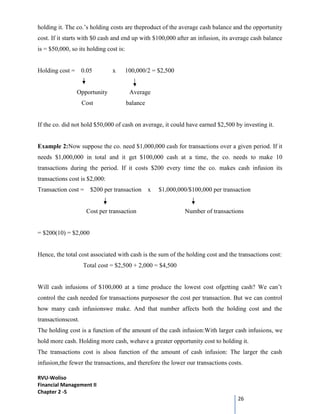
Example 1:Suppose each time the company’s cash balance is zero it generate
$100,000(borrowing or selling securities). Further suppose that the co.’s opportunitycost for
holding cash is 5%—it could have invested the cash in somethingthat earns 5% instead of
RVU-Woliso
Financial Management II
Chapter 2 -5
26
holding it. The co.’s holding costs are theproduct of the average cash balance and the opportunity
cost. If it starts with $0 cash and end up with $100,000 after an infusion, its average cash balance
is = $50,000, so its holding cost is:
Holding cost = 0.05 x 100,000/2 = $2,500
Opportunity Average
Cost balance
If the co. did not hold $50,000 of cash on average, it could have earned $2,500 by investing it.
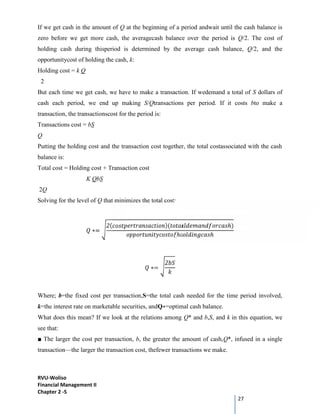
Example 2:Now suppose the co. need $1,000,000 cash for transactions over a given period. If it
needs $1,000,000 in total and it get $100,000 cash at a time, the co. needs to make 10
transactions during the period. If it costs $200 every time the co. makes cash infusion its
transactions cost is $2,000:
Transaction cost = $200 per transaction x $1,000,000/$100,000 per transaction
Cost per transaction Number of transactions
= $200(10) = $2,000
Hence, the total cost associated with cash is the sum of the holding cost and the transactions cost:
Total cost = $2,500 + 2,000 = $4,500
Will cash infusions of $100,000 at a time produce the lowest cost ofgetting cash? We can’t
control the cash needed for transactions purposesor the cost per transaction. But we can control
how many cash infusionswe make. And that number affects both the holding cost and the
transactionscost.
The holding cost is a function of the amount of the cash infusion:With larger cash infusions, we
hold more cash. Holding more cash, wehave a greater opportunity cost to holding it.
The transactions cost is alsoa function of the amount of cash infusion: The larger the cash
infusion,the fewer the transactions, and therefore the lower our transactions costs.
RVU-Woliso
Financial Management II
Chapter 2 -5
27
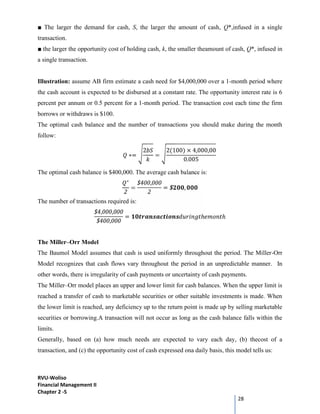
If we get cash in the amount of Q at the beginning of a period andwait until the cash balance is
zero before we get more cash, the averagecash balance over the period is Q/2. The cost of
holding cash during thisperiod is determined by the average cash balance, Q/2, and the
opportunitycost of holding the cash, k:
Holding cost = k Q
2
But each time we get cash, we have to make a transaction. If wedemand a total of S dollars of
cash each period, we end up making S/Qtransactions per period. If it costs bto make a
transaction, the transactionscost for the period is:
Transactions cost = bS
Q
Putting the holding cost and the transaction cost together, the total costassociated with the cash
balance is:
Total cost = Holding cost + Transaction cost
K QbS
2Q
Solving for the level of Q that minimizes the total cost:
∗=
2( )( ℎ)
ℎ ℎ
∗=
2
Where; b=the fixed cost per transaction,S=the total cash needed for the time period involved,
k=the interest rate on marketable securities, andQ∗=optimal cash balance.
What does this mean? If we look at the relations among Q* and b,S, and k in this equation, we
see that:
■ The larger the cost per transaction, b, the greater the amount of cash,Q*, infused in a single
transaction—the larger the transaction cost, thefewer transactions we make.
RVU-Woliso
Financial Management II
Chapter 2 -5
28
■ The larger the demand for cash, S, the larger the amount of cash, Q*,infused in a single
transaction.
■ the larger the opportunity cost of holding cash, k, the smaller theamount of cash, Q*, infused in
a single transaction.
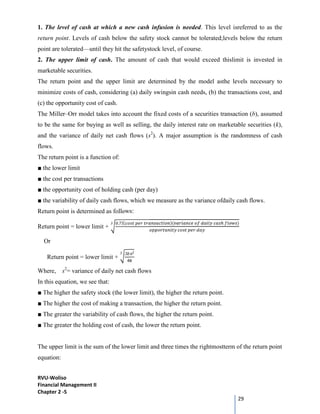
Illustration: assume AB firm estimate a cash need for $4,000,000 over a 1-month period where
the cash account is expected to be disbursed at a constant rate. The opportunity interest rate is 6
percent per annum or 0.5 percent for a 1-month period. The transaction cost each time the firm
borrows or withdraws is $100.
The optimal cash balance and the number of transactions you should make during the month
follow:
∗=
2
=
2(100) × 4,000,00
0.005
The optimal cash balance is $400,000. The average cash balance is:
∗
2
=
$400,000
2
= $ ,
The number of transactions required is:
$4,000,000
$400,000
= ℎ ℎ
The Miller–Orr Model
The Baumol Model assumes that cash is used uniformly throughout the period. The Miller-Orr
Model recognizes that cash flows vary throughout the period in an unpredictable manner. In
other words, there is irregularity of cash payments or uncertainty of cash payments.
The Miller–Orr model places an upper and lower limit for cash balances. When the upper limit is
reached a transfer of cash to marketable securities or other suitable investments is made. When
the lower limit is reached, any deficiency up to the return point is made up by selling marketable
securities or borrowing.A transaction will not occur as long as the cash balance falls within the
limits.
Generally, based on (a) how much needs are expected to vary each day, (b) thecost of a
transaction, and (c) the opportunity cost of cash expressed ona daily basis, this model tells us:
RVU-Woliso
Financial Management II
Chapter 2 -5
29
1. The level of cash at which a new cash infusion is needed. This level isreferred to as the
return point. Levels of cash below the safety stock cannot be tolerated;levels below the return
point are tolerated—until they hit the safetystock level, of course.
2. The upper limit of cash. The amount of cash that would exceed thislimit is invested in
marketable securities.
The return point and the upper limit are determined by the model asthe levels necessary to
minimize costs of cash, considering (a) daily swingsin cash needs, (b) the transactions cost, and
(c) the opportunity cost of cash.
The Miller–Orr model takes into account the fixed costs of a securities transaction (b), assumed
to be the same for buying as well as selling, the daily interest rate on marketable securities (k),
and the variance of daily net cash flows (s2
). A major assumption is the randomness of cash
flows.
The return point is a function of:
■ the lower limit
■ the cost per transactions
■ the opportunity cost of holding cash (per day)
■ the variability of daily cash flows, which we measure as the variance ofdaily cash flows.
Return point is determined as follows:
Return point = lower limit +
0.75( )( )
3
Or
Return point = lower limit +
3 2
4
3
Where, s2
= variance of daily net cash flows
In this equation, we see that:
■ The higher the safety stock (the lower limit), the higher the return point.
■ The higher the cost of making a transaction, the higher the return point.
■ The greater the variability of cash flows, the higher the return point.
■ The greater the holding cost of cash, the lower the return point.
The upper limit is the sum of the lower limit and three times the rightmostterm of the return point
equation:
RVU-Woliso
Financial Management II
Chapter 2 -5
30
Upper limit = lower limit + 3[
0.75( )( )
3
]
EXAMPLE. KK co. has experienced a stochastic demand for its product, which results in
fluctuating cash balances randomly. The following information supplied:
Fixed cost of a securities transaction $200
Variance of daily net cash flows $20,000
Daily interest rate on securities(opportunity cost ) 0.01%
Lower limit $10,000
The optimal cash balance (return point), and the upper limit of cash neededis determined as
follows:
= $10,000 +
0.75(200)(20,000)
0.0001
3
= 13,107
Upper limit = $10,000 + 3($3,107) = $19,321
What we have just determined using the Miller-Orr model is thatthe cash balance is allowed to
fluctuate between $13,107 and $19,321.If the cash balance exceeds $19,321, we invest the
difference betweenthe cash balance and the return point, restoring the cash balance to thereturn
point. If the cash balance is below the lower limit, marketablesecurities are sold to bring the cash
balance to the return point. Eachtime the cash balance is outside either the lower or the upper
limit, webounce back to the return point.
3.5 Investing Idle Cash
If a firm has a temporary cash surplus, it can invest in short-term securities. The market for
short-term financial assets is called themoney market. The maturity of short-term financial assets
that trade in the money marketis one year or less.
RVU-Woliso
Financial Management II
Chapter 2 -5
31
Most large firms manage their own short-term financial assets, carrying out transactionsthrough
banks and dealers. Some large firms and many small firms use moneymarket mutual funds.
These are funds that invest in short-term financial assets for amanagement fee. The management
fee is compensation for the professional expertiseand diversification provided by the fund
manager.
Among the many money market mutual funds, some specialize in corporate customers.
In addition, banks offer arrangements in which the bank takes all excess availablefunds at the
close of each business day and invests them for the firm.
Temporary Cash Surpluses
Firms have temporary cash surpluses for various reasons. Two of the most important arethe
financing of seasonal or cyclical activities of the firm and the financing of plannedor possible
expenditures.
Seasonal or Cyclical ActivitiesSome firms have a predictable cash flow pattern.They have
surplus cash flows during part of the year and deficit cash flows the rest ofthe year. Thus firms
may buy marketable securities when surplus cash flows occurand sell marketable securities when
deficits occur. Of course, bank loans are anothershort-term financing device.
Planned or Possible ExpendituresFirms frequently accumulate temporary investmentsin
marketable securities to provide the cash for a plant construction program, dividendpayment, or
other large expenditure. Thus, firms may issue bonds and stocks beforethe cash is needed,
investing the proceeds in short-term marketable securities and thenselling the securities to
finance the expenditures. Also, firms may face the possibility ofhaving to make a large cash
outlay. An obvious example would involve the possibility oflosing a large claim. Firms may
build up cash surpluses against such a contingency.
Characteristics of Short-Term Securities
Given that a firm has some temporarily idle cash, there are a variety of short-term
securitiesavailable for investing. The most important characteristics of these short-
termmarketable securities are their maturity, default risk, marketability, and taxability.
Maturityfor a given change in the level of interestrates, the prices of longer-maturity securities
will change more than those of shortermaturitysecurities. As a consequence, firms that invest in
long-term securities are acceptinggreater risk than firms that invest in securities with short-term
maturities.
RVU-Woliso
Financial Management II
Chapter 2 -5
32
This type of risk called interest rate risk. Firms often limit their investments inmarketable
securities to those maturing in less than 90 days to avoid the risk of losses invalue from changing
interest rates. Of course, the expected return on securities withshort-term maturities is usually
less than the expected return on securities with longermaturities.
Default Risk Default risk refers to the probability that interest and principal will notbe paid in
the promised amounts on the due dates (or will not be paid at all).
Given the purposesof investing idle corporate cash, firms typically avoid investing in marketable
securitieswith significant default risk.
Marketability refers to how easy it is to convert an asset to cash; somarketability and liquidity
mean much the same thing. Some money market instrumentsare much more marketable than
others.
TaxesInterest earned on money market securities that are not some kind of governmentobligation
(either federal or state) is taxable at the local, state, and federal levels.
Management of Marketable securities
Realistically, the management of cash and marketable securities cannot be separated
management of one implies management of the other.
Marketable securities typically provide much lower yields than operating assets. In many cases,
companies hold marketable securities for the same reasons they hold cash. Although these
securities are not the same as cash, in most cases they can be converted to cash on very short
notice (often just a few minutes) with a single telephone call. Moreover, while cash and most
commercial checking accounts yield nothing, marketable securities provide at least a modest
return. For this reason, many firms hold at least some marketable securities in lieu of larger cash
balances, liquidating part of the portfolio to increase the cash account when cash outflows
exceed inflows. In such situations, the marketable securities could be used as a substitute for
transactions balances, for precautionary balances, for speculative balances, or for all three. In
most cases, the securities are held primarily for precautionary purposes; most firms prefer to rely
on bank credit to make temporary transactions or to meet speculative needs, but they may still
hold some liquid assets to guard against a possible shortage of bank credit.
To summarize, there are both benefits and costs associated with holding cash and marketable
securities. The benefits are twofold: (1) the firm reduces transactions costs because it won’t have
to issue securities or borrow as frequently to raise cash; and (2) it will have ready cash to take
advantage of bargain purchases or growth opportunities. The primary disadvantage is that the
RVU-Woliso
Financial Management II
Chapter 2 -5
33
after-tax return on cash and short-term securities is very low. Thus, firms face a trade-off
between benefits and costs.
Types of marketable securities
Certificates of deposit Debt issued by banks sold in large denominations. This
debt has maturities ranging generally up to one year.
Because this debt is issued by banks, but exceeds the
amount for deposit guarantees by bank insurance, there is
some default risk.
Commercial paper Debt issued by large corporations that is sold in large
denominations and generally matures in 30 days. While the
debt is unsecured credit and is issued by corporations, there
is some default risk, though this is minimized by the back-
up lines of credit at commercial banks.
Banker's acceptances time drafts or notes issued by firm that is guaranteed
payment by a bank. Often used in foreign trade.
Repurchase agreements buy securities from a bond dealer with agreement for
dealer to repurchase at higher prices.
Treasury Bills mature in 90, 180, 270 or 360 days. Usually issued by
government companies, and have low risk associated with
investing on it.
Criteria in selecting marketable securities
Marketable securities are short-term, high-quality debt instruments that can be easily converted
into cash.
In order of priority, three primary criteria for selecting appropriate marketable securities to meet
firm’s anticipated short-term cash needs (particularly those arising from precautionary and
speculative motives):
(1) Safety (2) Liquidity (3) Yield
Safety: it implies that there is negligible risk of default of securities purchases and marketable
securities will not be subject to excessive market fluctuations due to fluctuations in interest rates
Liquidity: it requires that marketable securities can be sold quickly and easily with no loss in
principal value due to inability to readily locate purchaser for securities
RVU-Woliso
Financial Management II
Chapter 2 -5
34
Yield: it requires that the highest possible yield be earned and is consistent with safety and
liquidity criteria. It is the least important of three in structuring marketable securities portfolio
Safety, liquidity, and yield criteria severely restrict range of securities acceptable as marketable
securities.
RVU-Woliso
Financial Management II
Chapter 2 -5
35
CHAPTER 4
RECEIVABLES MANAGEMENT
4. Definition and Nature of Receivables
When a firm allows customers to pay for goods and services at a later date, it creates accounts
receivable. Firms sell goods on credit to increase the volume of sales. In the present era of
intense competition, business firms, to improve their sales, offer to their customers relaxed
conditions of payment. When goods are sold on credit, finished goods get converted into
receivables, which is Trade credit. Trade credit is an informal credit arrangement.Unlike other
forms of credit, trade credit is not usually evidenced by notes, but rather is generated
spontaneously. Trade credit is a marketing tool that functions as a bridge for the movement of
goods from the firm’s wear house to its customers.
The receivables arising out of trade credit have three features.
1. It involves an element of risk. Therefore, before sanctioning credit, careful analysis of the
risk involved needs to be done;
2. It is based on economic value. Buyer gets economic value in goods immediately on sale,
while the seller will receive an equivalent value later on and
3. It has an element of futurity. The buyer makes payment in a future period.
Amounts due from customers, when goods are sold on credit, are called trade debits or
receivables. Receivables form part of current assets. They constitute a significant portion of the
total current assets of the buyers next to inventories. Receivables are asset – accounts
representing amounts owing to the firm as a result of sale of goods/services in the ordinary
course of business.
RVU-Woliso
Financial Management II
Chapter 2 -5
36
The main objective of selling goods on credit is to promote sales for increasing the profits of the
firm. Customers will always prefer to buy on credit to buying on cash basis. They always go to a
supplier who gives credit. All firms therefore grant credit to their customers to increase sales,
profits and to meet competition.
Additional funds are, therefore, required for the operating needs of the business which involve
extra costs in terms of interest. Moreover, increase in receivables also increases the chances of
bad debts. Thus, creation of accounts receivables is beneficial as well as dangerous to the firm.
The financial manager needs to follow a policy of using cash funds economically to the extent
possible in extending receivables without adversely affecting the chances of increasing sales and
making more profits.
Management of accounts receivables may, therefore, be defined as, the process of making
decision relating to the investment of funds in receivables which will result in maximizing the
overall return on the investment of the firm.
Thus, the objective of receivables management is to promote sales and profits until the level
where the return on investment in further finding of receivables is less than the cost of funds
raised to finance that additional credit.
4.1 Objectives of Receivable Management
From creation of receivables the firm gets a few advantages & it has to bear bad debts,
administrative expenses, financing costs etc. In the management of receivables financial manager
should follow such policy through which cash resources of the firm can be fully utilized.
Management of receivables is a process under which decisions to maximize returns on the
investment blocked in them are taken. Thus, the main objectives of management receivable are
to maximize the returns on investment in receivables & to minimize risk of bad debts etc.
Because investment in receivables affects liquidity and profitability, it is, therefore, significant to
maintain proper level of receivables.
Thus, following are the main objectives of receivables management:
(1) To optimize the amount of sales.
(2) To minimize cost of credit.
(3) To optimize investment in receivables.
4.2 Procedures in management of receivable
Credit management involves the following steps:
First, a firm must establish the terms of sale on which it propose to sell its goods.
RVU-Woliso
Financial Management II
Chapter 2 -5
37
How long does the firm going to give customers to pay their bills? Does the firm prepared to
offera cash discount for prompt payment?
Second, a firm must decide what evidence it needs that the customer owes it money.
Does the firm ask the buyer to sign a receipt, or do you insist on a more formal credit
instrument?
Third, a firm must consider which customers are likely to pay their bills. This is calledcredit
analysis. Does the firm judge this from the customer’s past payment record or past financial
statements? Does the firm also rely on bank references?
Fourth, the firm must decide on credit policy. How much credit are prepared to extend to each
customer? Does the firm play safe by turning down any doubtful prospects? Ordoes it accept the
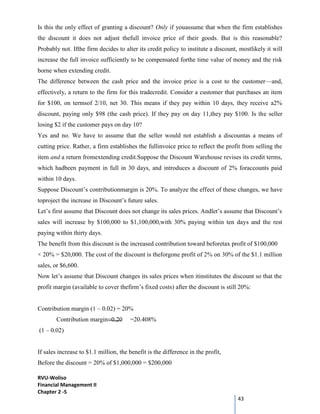
risk of a few bad debts as part of the cost of building up a large regularclientele?
Fifth, a firm must establish collection policy.
4.3 Components of Credit Policy
If a firm decides to grant credit to its customers, then it must establish procedures for
extendingcredit and collecting. This is credit policy, which are standards set to determine the
amount and nature of credit to extend to customers. In particular, the firm will have to deal with
the following components of credit policy:
1. Terms of sale. The terms of sale establish how the firm proposes to sell its goodsand services.
A basic decision is whether the firm will require cash or will extendcredit. If the firm does grant
credit to a customer, the terms of sale will specifythe credit period, the cash discount and
discount period, andthe type of credit instrument.
2. Credit analysis. In granting credit, a firm determines how much effort to expendtrying to
distinguish between customers who will pay and customers who will notpay. Firms use a number
of devices and procedures to determine the probability thatcustomers will not pay, and, put
together, these are called credit analysis.
3. Collection policy. After credit has been granted, the firm has the potential problemof
collecting the cash, for which it must establish a collection policy.
The Investment in Receivables
The investment in accounts receivable for any firm depends on the amount of creditsales and the
average collection period. For example, if a firm’s average collectionperiod, ACP, is 30 days,
then at any given time, there will be 30 days’ worth of sales outstanding. If credit sales run
RVU-Woliso
Financial Management II
Chapter 2 -5
38
$1,000 per day, the firm’s accounts receivable will thenbe equal to 30 days x $1,000 per day
=$30,000, on average.
As our example illustrates, a firm’s receivables generally will be equal to its averagedaily sales
multiplied by its average collection period, or ACP:
Accounts receivable =Average daily sales x ACP
Thus, a firm’s investment in accounts receivable depends on factors that influence creditsales
and collections.
4.3.1 Terms of Sale
The terms of a sale are made up of three distinct elements:
1. The period for which credit is granted (the credit period)
2. The cash discount and the discount period
3. The type of credit instrument
Within a given industry, the terms of sale are usually fairly standard, but these termsvary quite a
bit across industries.
The Basic Form of term of sale
Terms of sale may be stated as 2/10, net 60. This means that customers have 60 days fromthe
invoice date to pay the full amount; however, if payment ismade within 10 days, a 2 percent cash
discount can be taken.
Credit Period
The credit periodis the length of time for which credit is granted. The credit periodvaries widely
from industry to industry, but it is almost always between 30 and 120days. If a cash discount is
offered, then the credit period has two components: the netcredit period and the cash discount
period.
The net credit period is the length of time the customer has to pay. The cash discountperiod is the
time during which the discount is available. With 2/10, net 30, for example,the net credit period
is 30 days and the cash discount period is 10 days.
The Invoice DateThe invoice date is the beginning of the credit period. An invoiceis a written
account of merchandise shipped to the buyer. For individual items, by convention,the invoice
date is usually the shipping date or the billing date, not the date thatthe buyer receives the goods
or the bill.
RVU-Woliso
Financial Management II
Chapter 2 -5
39
Length of the Credit Period
Several factors influence the length of the credit period.The important ones are the buyer’s
inventory period and operating cycle. All elseequal, the shorter these are, the shorter the credit
period will be.
The operating cycle has two components: the inventory period andthe receivables period. The
buyer’s inventory period is the time it takes the buyer to acquire inventory, process it, and sell it.
The buyer’s receivables period is thetime it then takes the buyer to collect on the sale. Note that
the credit period the buyer offer iseffectively the buyer’s payables period.
By extending credit, the seller finance a portion of its buyer’s operating cycle and therebyshorten
that buyer’s cash cycle. If the sellers’ credit period exceeds thebuyer’s inventory period, then the
seller is not only financing the buyer’s inventory purchases,but part of the buyer’s receivables as
well.
Furthermore, if the seller’s credit period exceeds the buyer’s operating cycle, then the seller is
effectively providing financing for aspects of its customer’s business beyond theimmediate
purchase and sale of its merchandise. The reason is that the buyer effectivelyhas a loan from the
seller even after the merchandise is resold, and the buyer can use thatcredit for other purposes.
For this reason, the length of the buyer’s operating cycle isoften cited as an appropriate upper
limit to the credit period.
Other factors that influence the credit period:
1. Perishability and collateral value. Perishable items have relatively rapid turnoverand
relatively low collateral value. Credit periods are thus shorter for such goods.
For example, a food wholesaler selling fresh fruit and produce might use net sevendays.
Alternatively, jewelry might be sold for 5/30, net four months.
2. Consumer demand. Products that are well established generally have more rapidturnover.
Newer or slow-moving products will often have longer credit periodsassociated with them to
entice buyers.
3. Cost, profitability, and standardization. Relatively inexpensive goods tend to haveshorter
credit periods. The same is true for relatively standardized goods and rawmaterials. These all
tend to have lower markups and higher turnover rates, both ofwhich lead to shorter credit
periods.
4. Credit risk. The greater the credit risk of the buyer, the shorter the credit period islikely to be
(assuming that credit is granted at all).
RVU-Woliso
Financial Management II
Chapter 2 -5
40
5. Size of the account. If an account is small, the credit period may be shorter becausesmall
accounts cost more to manage, and the customers are less important.
6. Competition.When the seller is in a highly competitive market, longer creditperiods may be
offered as a way of attracting customers.
7. Customer type. A single seller might offer different credit terms to different buyers.A food
wholesaler, for example, might supply groceries, bakeries, and restaurants.Each group would
probably have different credit terms. More generally, sellersoften have both wholesale and retail
customers, and they frequently quote differentterms to the two types.
The Cash Discount and the ACP
To the extent that a cash discount encourages customersto pay early, it will shorten the
receivables period and, all other things beingequal, reduce the firm’s investment in receivables.
For example, suppose a firm currently has terms of net 30 and an average collectionperiod, ACP,
of 30 days. If it offers terms of 2/10, net 30, then perhaps 50 percent of itscustomers (in terms of
volume of purchases) will pay in 10 days. The remaining customerswill still take an average of
30 days to pay. What will the new ACP be? If thefirm’s annual sales are $15 million (before
discounts), what will happen to the investmentin receivables?
If half of the customers take 10 days to pay and half take 30, then the new averagecollection
period will be:
New ACP =.50 x10 days +.50 x 30 days =20 days
The ACP thus falls from 30 days to 20 days. Average daily sales are $15 million/365 =$41,096
per day. Receivables will thus fall by $41,096 x10 =$410,960.
Credit Instruments
The credit instrumentis the basic evidence of indebtedness. Most trade credit is offeredon open
account. This means that the only formal instrument of credit is the invoice,which is sent with
the shipment of goods and which the customer signs as evidence that the goods have been
received. Afterwards, the firm and its customersrecord the exchange on their books of account.
At times, the firm may require that the customer sign a promissory note. Promissory notes are
notcommon, but they can eliminate possible controversies later about the existence of debt.
One problem with promissory notes is that they are signed after delivery of thegoods.
RVU-Woliso
Financial Management II
Chapter 2 -5
41
One way to obtain a credit commitment from a customer before the goods are deliveredis to
arrange a commercial draft. Typically, the firm draws up a commercial draftcalling for the
customer to pay a specific amount by a specified date. The draft is thensent to the customer’s
bank with the shipping invoices.
When the draft is presented andthe buyer “accepts” it, meaning that the buyer promises to pay it
in the future, then it iscalled a trade acceptance and is sent back to the selling firm. The seller
can then keepthe acceptance or sell it to someone else. If a bank accepts the draft, meaning that
thebank is guaranteeing payment, then the draft becomes a banker’s acceptance.
Thisarrangement is common in international trade.
A firm can also use a conditional sales contract as a credit instrument. With such anarrangement,
the firm retains legal ownership of the goods until the customer has completedpayment.
Conditional sales contracts usually are paid in installments and have aninterest cost built into
them.
Benefits of extending credit
Extending credit is both a financial and a marketing decision. Whena firm extends credit to its
customers, it does so to encourage sales of itsgoods and services. The most direct benefit is the
profit on the increasedsales. If the firm has a variable cost margin (that is, variable cost/sales)of
80%, then increasing sales by $100,000 increases the firm’s profitbefore taxes by $20,000.
Another way of stating this is that the contributionmargin (funds available to cover fixed costs)
is 20%: For every$1 of sales, 20 cents is available after variable costs.
The benefit from extending credit is:
Benefit from extending credit = Contribution margin x Change in sales
If a firm liberalizes its credit it grants to customers, increasing salesby $5 million and if its
contribution margin is 25%, the benefit fromliberalizing credit is 25% of $5 million, or $1.25
million.
Costs of Credit
But like any credit, it has a cost. The firm granting the credit is forgoingthe use of the funds for a
period—so there is an opportunity cost associatedwith giving credit. In addition, there are costs
of administering theaccounts receivable—keeping track of what is owed, carrying cost of tying-
RVU-Woliso
Financial Management II
Chapter 2 -5
42
up funds in accounts receivable and, there is achance that the customer may not pay what is due
when it is due.
The carrying cost is the product of the opportunity cost of investing inaccounts receivable and
the investment in the accounts. The opportunity cost is the return the firm could have earned on
its next best opportunity.
Suppose a firm liberalizes its credit policy, resulting in an increase inaccounts receivable of $1
million. And suppose that this firm’s contributionmargin is 40% (which means its variable cost
ratio is 60%). Thefirm’s increased investment in accounts receivable is 60% of $1 million,or
$600,000. If the firm’s opportunity cost is 5%, the carrying cost ofaccounts receivable is:
Carrying cost of accounts receivable = 5% of $600,000 = $30,000
We can state the carrying cost more formally as:
Carrying cost of accounts receivable
= (Opportunity cost)(Variable cost ratio)
(Change in accounts receivable)
The Cost of Discounts
Do firms grant credit at no cost to the customer? No, because as we justexplained, a firm has
costs in granting credit. So they generally givecredit with an implicit or hidden cost:
 The customer that pays cash on delivery or within a specified time thereafter—called a
discount period—gets a discount from the invoice price.
 The customer that pays after this discount period pays the full invoice price.
Paying after the discount period is really borrowing. The customer paysthe difference between
the discounted price and the full invoice price.How much has been borrowed? A customer
paying in cash within thediscount period pays the discounted price. So what is effectively
borrowedis the cash price.
Cost of discount
= Discount percentage × Credit sales using discount
If a discount is 5% and there are $20 million credit sales using the discount,the cost of the
discount is 5% of $20 million, or $1 million.
RVU-Woliso
Financial Management II
Chapter 2 -5
43
Is this the only effect of granting a discount? Only if youassume that when the firm establishes
the discount it does not adjust thefull invoice price of their goods. But is this reasonable?
Probably not. Ifthe firm decides to alter its credit policy to institute a discount, mostlikely it will
increase the full invoice sufficiently to be compensated forthe time value of money and the risk
borne when extending credit.
The difference between the cash price and the invoice price is a cost to the customer—and,
effectively, a return to the firm for this tradecredit. Consider a customer that purchases an item
for $100, on termsof 2/10, net 30. This means if they pay within 10 days, they receive a2%
discount, paying only $98 (the cash price). If they pay on day 11,they pay $100. Is the seller
losing $2 if the customer pays on day 10?
Yes and no. We have to assume that the seller would not establish a discountas a means of
cutting price. Rather, a firm establishes the fullinvoice price to reflect the profit from selling the
item and a return fromextending credit.Suppose the Discount Warehouse revises its credit terms,
which hadbeen payment in full in 30 days, and introduces a discount of 2% foraccounts paid
within 10 days.
Suppose Discount’s contributionmargin is 20%. To analyze the effect of these changes, we have
toproject the increase in Discount’s future sales.
Let’s first assume that Discount does not change its sales prices. Andlet’s assume that Discount’s
sales will increase by $100,000 to $1,100,000,with 30% paying within ten days and the rest
paying within thirty days.
The benefit from this discount is the increased contribution toward beforetax profit of $100,000
× 20% = $20,000. The cost of the discount is theforgone profit of 2% on 30% of the $1.1 million
sales, or $6,600.
Now let’s assume that Discount changes its sales prices when itinstitutes the discount so that the
profit margin (available to cover thefirm’s fixed costs) after the discount is still 20%:
Contribution margin (1 – 0.02) = 20%
Contribution margin=0.20 =20.408%
(1 – 0.02)
If sales increase to $1.1 million, the benefit is the difference in the profit,
Before the discount = 20% of $1,000,000 = $200,000
RVU-Woliso
Financial Management II
Chapter 2 -5
44
After the discount = 20.408% of $1,100,000 = $224,488
So the incremental benefit is $24,488. And the cost, in terms of the discountstaken is 2% of 30%
of $1,100,000, or $6,600.
The Implicit Cost of Trade Credit to the Customer
Trade credit is often stated in terms of a rate of discount, a discount period, and a net period
when payment in full is due. The effective cost of trade credit to the customer can be calculated
by determining first the effective interest cost for the period of credit and then placing this
effective cost on an annual basis so that we can compare it with the cost of other forms of credit.
If you purchase an item that costs $100, with credit terms “2/10, net 30,” you would either pay
$98 within the first ten days after purchase or the full $100 price if you pay after ten days.
The effective cost of credit is the discount forgone. For a $100 purchase, this is $2. Putting this
in percentage terms, you pay 2% of the invoice price to borrow 98% of the invoice price:
Cost of credit= r= 0.02/.98= 0.020408 or 2.0408% per credit period
The effective annual cost is calculated by determining the compounded annual cost if this form
of financing is done through the year. Assuming that payment is made on the net day (thirty days
after the sale), the credit period (the difference between the net period and the discount period) is
twenty days and there are t = 365/20 = 18.25 such credit periods in a year. The effective annual
cost is:
Effective annual cost = (1 + r)t
– 1 (1+ discount/discounted price)365/extra days credit
-1
(1 + 0.020408)18.25
– 1= 44.58% per year
The flip-side of this trade credit is that the firm granting credit has an effective return on credit of
44.58% per year. On the other hand, the customer who does not take the discount is effectively
borrowing money at an annual interest rate of 44.58%.
ANALYZING CREDIT POLICY
Credit Policy effect
In evaluating credit policy, there are five basic factors to consider:
RVU-Woliso
Financial Management II
Chapter 2 -5
45
1. Revenue effects.If the firm grants credit, then there will be a delay in revenuecollections as
some customers take advantage of the credit offered and pay later.
However, the firm may be able to charge a higher price if it grants credit and it maybe able to
increase the quantity sold, so as to increase total revenues.
2. Cost effects. Although the firm may experience delayed revenues if it grants credit,it will still
incur the costs of sales immediately. Whether the firm sells for cash orcredit, it will still have to
acquire or produce the goods and pay for it.
3. The cost of debt. When the firm grants credit, it must arrange to finance theresulting
receivables. As a result, the firm’s cost of short-term borrowing is a factorin the decision to grant
credit.
4. The probability of nonpayment. If the firm grants credit, some percentage of thecredit buyers
will not pay.
5. The cash discount. When the firm offers a cash discount as part of its credit terms,some
customers will choose to pay early to take advantage of the discount.
Evaluating a Proposed Credit Policy
The following case illustrates how credit policy can be analyzed.
XX Company has been in existence for two years, and it is one of several successfulfirms that
develop computer programs. Currently, xx sells for cash only. The company is evaluating a
request from some major customers to change its current policyto net one month (30 days).
To analyze this proposal, let:
P =Price per unit
v =Variable cost per unit
Q =Current quantity sold per month
Q’=Quantity sold under new policy
R =Monthly required return
NPV of Switching Policies To illustrate the NPV of switching credit policies, suppose we have
the following for XX:
P =$49
v =$20
Q =100
Q’= 110
RVU-Woliso
Financial Management II
Chapter 2 -5
46
If the required return, R, is 2 percent per month, should Company make the switch?
Currently, XX has monthly sales of P xQ = $4,900. Variable costs each monthare v xQ =$2,000,
so the monthly cash flow from this activity is:
Cash flow with old policy = (P -v)Q
= ($49 - 20) x100=$2,900
If XX does switch to net 30 days on sales, then the quantity sold will rise to Q’=110. Monthly
revenues will increase to P xQ’, and costs will be v xQ’.
The monthlycash flow under the new policy will thus be:
Cash flow with new policy = (P -v) Q’
=($49 -20) x110 =$3,190
The relevant incremental cash flow is the differencebetween the new and old cash flows:
Incremental cash inflow = (P - v)(Q’- Q)
= ($49 - 20) (110 - 100)= $290
This means the benefit each month of changing policies is equal to the gross profit perunit sold,
P -v = $29, multiplied by the increase in sales, Q’-Q = 10.
The presentvalue of the future incremental cash flows is thus:
PV = [(P -v)(Q’ -Q)]/R
For XX, the present value of future incremental cash flow:
PV = ($29 X 10)/.02 = $14,500
Now we know the benefit of switching, what’s the cost? There are two componentsto consider.
First, because the quantity sold will rise from Q to Q’, the firm will have to produceQ’-Q more
units at a cost of v(Q’-Q) = $20 x (110 - 100) = $200.
Second,the sales that would have been collected this month under the current policy (P xQ =
$4,900) will not be collected. Under the new policy, the sales made this month won’t becollected
until 30 days later. The cost of the switch is the sum of these two components:
Cost of switching = PQ + v(Q’ - Q)
For XX, this cost would be $4,900 +200 = $5,100.
Thus, the NPV of the switch is:
NPV of switching = -[PQ + v(Q’ -Q)] + [(P -v)(Q’ -Q)]/R
For XX, the cost of switching is $5,100. As we saw earlier, the benefit is $290 permonth,
forever. At 2 percent per month, the NPV is:
NPV=-$5,100 + 290/.02
RVU-Woliso
Financial Management II
Chapter 2 -5
47
= - $5,100 +14,500 =$9,400
Therefore, the switch is very profitable.
A Break-Even ApplicationBased on our discussion thus far, the key variable for XX is
Q’ -Q, the increase in unit sales. The projected increase of 10 units is only anestimate, so there is
some forecasting risk. Under the circumstances, it’s natural to wonderwhat increase in unit sales
is necessary to break even.
Earlier, the NPV of the switch was defined as:
NPV= -[PQ +v(Q’ -Q)] + [(P -v)(Q’ -Q)]/R
We can calculate the break-even point explicitly by setting the NPV equal to zero andsolving for
(Q’ -Q):
NPV = 0 =-[PQ + v(Q’ -Q)] + [(P -v)(Q’ -Q)]/R
Q’-Q = PQ/[(P -v)/R -v]
For XX, the break-even sales increase is thus:
Q’ -Q =$4,900/(29/.02 -20)= 3.43 units
This tells us that the switch is a good idea as long as the Company is confident that it can sellat
least 3.43 more units per month.
OPTIMAL CREDIT POLICY
Optimal credit policy:is a policy that maximizes the firm’s value. In principle, the optimal
amount of credit is determined by the point at which the incremental cash flows from increased
sales are exactly equal to the incremental costs of carrying the increase in investment in accounts
receivable. Hence the value of the firm is maximized when; the incremental or marginal rate of
return of an investment is equal to the incremental or marginal cost of funds used to finance the
investment.
The incremental rate of return can be calculated as incremental operating profit divided by the
incremental investment in receivable. The incremental cost of funds is the rate of return required
by suppliers of funds given the risk of investment in accounts receivables.
RVU-Woliso
Financial Management II
Chapter 2 -5
48
Total Credit Cost
The trade-off between granting credit and not granting credit isn’t hard to identify, but it
isdifficult to quantify precisely.
To begin, the carrying costs associated with granting credit come in three forms:
1. The required return on receivables
2. The losses from bad debts
3. The costs of managing credit and credit collections
The cost of managingcredit consists of the expenses associated with running the credit
department.Firms that don’t grant credit have no such department and no such expense. These
threecosts will all increase as credit policy is relaxed.
If a firm has a very restrictive credit policy, then all of the associated costs will below. In this
case, the firm will have a “shortage” of credit, so there will be an opportunitycost. This
opportunity cost is the extra potential profit from credit sales that is lost because credit is refused.
This forgone benefit comes from two sources, the increase inquantity sold, Q’ minus Q, and,
potentially, a higher price. The opportunity costs godown as credit policy is relaxed.
The sum of the carrying costs and the opportunity costs of a particular credit policyis called the
total credit cost.
In general, the costs and benefits from extending credit will depend on characteristicsof
particular firms and industries. All other things being equal, for example, it islikely that firms
with (1) excess capacity, (2) low variable operating costs, and (3) repeatcustomers will extend
credit more liberally than other firms.
CREDIT ANALYSIS
Once a firm decides to grantcredit to its customers, it must then establish guidelines for
determining who will andwho will not be allowed to buy on credit. Credit analysis refers to the
process of decidingwhether or not to extend credit to a particular customer. It usually involves
two steps: gathering relevant information and determining creditworthiness.
Credit Information
If a firm does want credit information on customers, there are a number of sources.
Informationsources commonly used to assess creditworthiness include the following:
RVU-Woliso
Financial Management II
Chapter 2 -5
49
1. Financial statements. A firm can ask a customer to supply financial statements suchas
balance sheets and income statements.
2. Credit reports on the customer’s payment history with other firms. a few organizations may
sell information on the credit strength and credit history of businessfirms.
3. Banks.Banks will generally provide some assistance to their business customers inacquiring
information on the creditworthiness of other firms.
4. The customer’s payment history with the firm. The most obvious way to obtaininformation
about the likelihood of a customer’s not paying is to examine whetherthey have settled past
obligations (and how quickly).
Credit Evaluation and Scoring
There are no magical formulas for assessing the probability that a customer will not pay.
In very general terms, the classic five Cs of creditare the basic factors to be evaluated:
1. Character:The customer’s willingness to meet credit obligations.
2. Capacity:The customer’s ability to meet credit obligations out of operating cashflows.
3. Capital: The customer’s financial reserves.
4. Collateral:An asset pledged in the case of default.
Ability of creditors to collect on bad debts if the customer liquidates its assets.
5. Conditions:General economic conditions in the customer’s line of business. The sensitivity of
the customer’s ability to pay to underlying economic and market factors.
Credit scoringis the process of calculating a numerical rating for a customer basedon
information collected; credit is then granted or refused based on the result. For example,a firm
might rate a customer on a scale of 1 (very poor) to 10 (very good) oneach of the five Cs of
credit using all the information available about the customer. Acredit score could then be
calculated by totaling these ratings. Based on experience, afirm might choose to grant credit only
to customers with a score above, say, 30.
COLLECTION POLICY
Collection policy involves monitoring receivables to spot trouble and obtaining payment on past-
due accounts.
RVU-Woliso
Financial Management II
Chapter 2 -5
50
Collection policiesspecify the procedures for collecting delinquent accounts. Collection could
start with polite reminders, continuing in progressively severe steps, and ending by placing the
account in the hands of a collection agency, a firm that specializes in collecting accounts. The
following sequence is typical:
1. When an account is a few days overdue, a letter is sent reminding thecustomer of the amount
due and the credit terms.
2. When an account is a month overdue, a telephone call is made remindingthe customer of the
amount due, the credit terms, and efforts to collectthe account by letter.
3. When an account is two months overdue it is handed over to a collectionagency.
Monitoring Receivables
Firm’s can monitor how well accounts receivable are managed using financialratios and aging
schedules. Financial ratios can be used to get an overall picture of how fast it collect on accounts
receivable. Agingschedules, which are breakdowns of the accounts receivable by howlong they
have been around, helps to get a more detailed picture of the firm’s collection efforts.
A firm can get an idea of how quickly it collect its accounts receivableby calculating the Number
of Days of Credit, which is the ratio ofthe balance in accounts receivable at a point in time (say,
at the end of ayear) to the credit sales per day (on average, the dollar amount of creditsales
during a day).
The number of days credit ratio, also referred to as the average collectionperiod and days sales
outstanding (DSO), measures how long, onaverage, it takes firms to collect on their accounts
receivable.
Suppose that wise co. has $1 million ofcredit sales per year and currently has a balance in
accounts receivableof $80,000. Then:
Credit sales per day= $1,000,000/365 days = $2,740 per day
Number of days of credit= $80,000/2740 = 29 days
This means the firm has, on average, 29 days worth of sales that havenot been paid for as yet.
RVU-Woliso
Financial Management II
Chapter 2 -5
51
The firm can use this measure to evaluate the effectiveness of its collectionpolicies, comparing
the number of days of credit with the netperiod allowed in the credit terms. It can also use this
information to help in cash forecasting since it tells how long beforeeach credit sale turns into
cash, on average.
Aging Schedule
The aging scheduleis a second basic tool for monitoring receivables. Receivable is managed by
classifying accounts by age.
Ex:Suppose a firm has $100,000 inreceivables. Some of these accounts are only a few days old,
but others have been outstandingfor quite some time. The table below shows how account
receivable is managed by aging schedule.
If this firm has a credit period of 60 days, then 25 percent of its accounts are late.Whether or not
this is serious depends on the nature of the firm’s collections and customers.It is often the case
that accounts beyond a certain age is almost never collected.Monitoring the age of accounts is
very important in such cases.Firms with seasonal sales will find the percentages on the aging
schedule changingduring the year. For example, if sales in the current month are very high, then
total receivableswill also increase sharply. This means that the older accounts, as a percentageof
total receivables, become smaller and might appear less important.
Collection Effort
RVU-Woliso
Financial Management II
Chapter 2 -5
52
Afirm usually goes through the following sequence of procedures for customers whosepayments
are overdue:
1. It sends out a delinquency letter informing the customer of the past-due status ofthe account.
2. It makes a telephone call to the customer.
3. It employs a collection agency.
4. It takes legal action against the customer.
At times, a firm may refuse to grant additional credit to customers until arrearages arecleared up.
This may antagonize a normally good customer, which points to a potentialconflict between the
collections department and the sales department.
In probably the worst case, the customer files for bankruptcy. When this happens, thecredit-
granting firm is just another unsecured creditor. The firm can simply wait, or it cansell its
receivable.
RVU-Woliso
Financial Management II
Chapter 2 -5
53
CHAPTER - 5
INVENTORY MANAGEMENT
Roles and Types of Inventory
Role of Inventory in Working Capital
The term inventory refers to the stock of the products a firm is offering for sale and the
components that make up the product.
It is a part of current asset in working capital calculations. Current assets are those assets which
can be converted into cash easily within a period of one year. It is assumed that inventory can
also be sold and converted into cash within a year's time and hence categorized as current assets.
Inventories accounts large size (more than half) for a given firms current assets.
Though it is categorized as a current asset, practically, they cannot be equivalent to cash and cash
equivalents. In fact, they are not quick assets and hence not included as cash equivalent in
calculating quick ratio or acid-test ratio. The reasons are:
i. Although inventory can be sold and converted into cash or accounts receivables, it is a
blocked up fund till the accounts receivables are collected.
ii. The time it takes for the inventory to convert into sales may be longer, sometimes even
more than a year. The time depends upon the nature of the product, demand for the
product, price and market conditions.
Inventory and Operating cycle: Operating cycle has the following events:
i. Cash converted into inventory
RVU-Woliso
Financial Management II
Chapter 2 -5
54
ii. Inventory converted into accounts receivables
iii. Accounts receivables converted into cash
iv. Cash again re-converted into inventory
The above is the case of a normal wholesale or retail business. In case of manufacturing
businesses, the inventory passes through three stages and operating cycle will be as given below:
i. Cash converted into Raw materials
ii. Raw materials converted into work-in-progress
iii. Work-in-progress converted into finished goods inventory
iv. Finished goods inventory converted into accounts receivables
v. Accounts receivables converted into cash and
vi. Cash re-converted into raw materials.
In all the above cases, accounts receivables come into picture in case of credit sales. In
case of cash sales, inventory will be straight-away reconverted into cash.
Types of Inventory
In a typical manufacturing company, inventory will be in the following forms:
1. Raw Materials Inventory: Raw materials, as the name implies are in the raw stage
without any processing. They are in the stage as such purchased from the supplier. They
can also be extracted materials if not purchased from the supplier. They contain the
material or the parts required for production.
2. Work-in-Progress Inventory: Work-in-Progress inventory is in a stage between the raw
materials stage and the finished goods stage. They are partly processed (semi-
manufactured products) materials and as such direct material, labor and overheads would
have been incurred to bring the raw materials into the work-in-progress state. They
cannot be called finished goods until they are fully processed or produced.
3. Finished goods Inventory: Finished goods inventory is the final stage of inventory. All
the processes are over and the product fully manufactured and ready for sale. Sometimes,
companies also procure short-term finance pledging the finished goods inventory as
security. Finished goods inventory will be then distributed to wholesalers, distributors or
retailers as the case may be.
Levels of inventories in firms differ depending upon the type of firms and their sizes.
Manufacturing firm hold all types of inventories at high level while, retail and wholesalers holds
only finished goods inventory.
RVU-Woliso
Financial Management II
Chapter 2 -5
55
Motive for holding inventories
Like, motives of holding cash, there are three general motives for holding inventories.
Transaction motive: emphasizes the need to maintain inventories to facilitate smooth
production and sales operation.
Precautionary motive necessitates holding of inventories to guard against the risk of
unpredictable changes in demand and supply forces and other factors.
Speculative motives: influences the decision to increase or reduce inventory levels to take
advantage of price fluctuations.
Other factors, which may lead firms to hold inventory includes; quantity discounts and
anticipated price increase.
Having either of these motives, a firm should maintain adequate stock of materials for a
continuous supply; otherwise mismatch will exist between demand and supply of inventories.
Functions and purpose of inventory
The purpose of storing inventory is to make the finished products available for sale. Selling
activity in no scenario should be stopped for want or shortage of inventory. Hence, businesses
store inventory despite the costs of holding inventory.
The basic function of inventories is to act as a buffer to decouple or uncouple the various
activities of a firm so that all do not have to be pursued at exactly the same rate. The key
activities are: Purchasing, Production and Selling. Inventory storage functions in such a way that
these activities can be carried on independently.
Advantages of holding inventory
Advantages in Purchasing: If the purchasing of raw materials and other goods is not tied to
production and sales, then the company can reap a lot of advantages in purchasing inventory. In
this case the company is acting independently to avail the best purchase deal. Most of the time,
bulk discounts are offered by suppliers for large purchases. If the costs of holding inventory i.e.,
the ordering and carrying costs are lower than the benefits of storing huge inventories, the
company can go ahead and avail discounts. By ordering in bulk, the company is also saving time
and ordering costs. Also, at times, firms may expect a hike in price of raw materials in future. To
avoid paying higher prices in future and to lower the cost of production, firms may decide to
purchase and store inventory in bulk.
Advantages in Production function: Inventory helps a firm to coordinate its production
scheduling so as to avoid disruptions and the accompanying expenses. Because inventory
RVU-Woliso
Financial Management II
Chapter 2 -5
56
permits least cost production scheduling, production can be carried on more efficiently. Finished
goods inventory serves to uncouple production and sale. This enables production at a rate
different from that of sales. So, production can be carried on a rate higher or lower than the sales
rate. This would be of special advantage to firms with seasonal sales pattern.
Advantages in Work-in-Progress: Work-in-progress inventory is necessary because production
processes are not instantaneous. The inventory goes through a lot of stages before reaching the
finished goods state. Partly processed inventory is called as the work-in-progress inventory. The
amount of this inventory depends upon the technology used and the efficiency of production.
It also uncouples the various stages of production so that all of them need not be performed at the
same rate.
Meeting demand and avoiding lost sales: Inventories help to meet the demand in time. There is
a time lag involved in the production of a product till it reaches the final stage good for selling.
During these times, stocks of inventories enable the company to carry on its sales activities
without disruption for want of stock or shortage of product. If these would have been the case,
customers are likely to shift to companies where the products are readily available. So
inventories helps to meet the demand in time and rapidly, avoiding losing customers. Also, in
case of seasonal products, inventories have to be kept to meet the demand during off-season.
Serves as security for short-term finance: In some cases, companies often pledge the finished
goods inventory for short-term loans. So, essentially inventories serve as good assets to provide
security for such loans.
Objective of inventory management
An effective inventory management should:
 Ensure a continuous supply of raw materials to facilitate uninterrupted production,
 Maintain sufficient stocks of raw materials in periods of short supply and anticipate price
changes,
 Maintain sufficient finished goods inventory for smooth sales operation, and efficient
customer service,
 Minimize the carrying cost and time and
 Control investment in inventories and keep it at an optimum.
Inventory management techniques and Cost of Holding Inventory
To manage inventories efficiency, answers should be sought to the following two questions. (a)
How much should be ordered? (b) When should be ordered?
RVU-Woliso
Financial Management II
Chapter 2 -5
57
The first question, how much to order, relates to the problem of determining Economic Order
Quantity (EOQ), and is answered with analysis of costs of maintaining certain level of
inventories. The second question, when to order, arises because of uncertainty and is a problem
of determining the Re-Order Point.
Economic Order Quantity (EOQ) Model
Economic Order Quantity model is the inventory management technique for determining the
optimum order quantity which is the one that minimizes the total of its ordering and carrying
costs. It also balances the fixed ordering costs against variable ordering costs. The EOQ is the
optimum amount of goods to order each time to minimize total inventory costs. EOQ analysis
should be applied to every product that represents a significant proportion of sales.
Thus, inventory costs includes, ordering cost and carrying costs.
a. Ordering costs: it is used in case of raw materials (supplies) and includes the entire cost
of acquiring raw materials. Ordering cost is the cost associated with placing an order to
the supplier. Apart from placing orders, the other costs related to ordering also form part
of ordering costs. The cost included in ordering costs are costs incurred in; requisitioning,
purchase ordering, transporting, receiving, inspecting, and storing and clerical costs and
costs of stationery (set up cost). Ordering costs increase in proportion to the number of
orders placed. The clerical costs and staff costs, however, do not have to vary in
proportion to the number of orders placed. But the ordering costs reduces as the size of
inventory increases, because there will be few orders placed.
The set up costs are generally fixed per order placed, irrespective of the amount of order. To
minimize the ordering costs, a firm should place minimum number of orders possible. In case of
produced items, ordering cost also includes scheduling cost.
Ordering cost = T/Q x F
Where: T = Total Usage
Q = Quantity Per Order
F = Cost of Placing an Order
Example: Say, a company needs a lot of 2400 units per year. The cost of placing one order is
$50. At different lot sizes, the ordering costs would be:
Order Size
No. of
orders
Cost per
order
Total ordering
cost
1200 2 $50 $100
RVU-Woliso
Financial Management II
Chapter 2 -5
58
800 3 $50 $150
600 4 $50 $200
400 6 $50 $300
The acquisition costs are inversely related to the size of inventory; they decline with the level of
inventory. But a large order may decrease ordering costs while increasing carrying costs.
In the above example, the first case of 1200 units will attract more carrying cost, although the
ordering cost is the least.
b. Carrying Costs: is cost incurred for maintaining a given level of inventory. The costs
involved in stocking the inventory like maintenance and holding inventory come under
carrying costs. Carrying costs can be further sub-divided into:
I. Costs associated with storing of Inventory: This type of costs consists of
i. Storage cost like tax, depreciation, and insurance, maintenance of the building,
utilities and janitorial services.
ii. Insurance of inventory against fire and theft.
iii. Deterioration in inventory because of pilferage, fire or technical, fashion
obsolescence and price decline.
iv. Serving costs like labor for handling inventory, accounting and clerical costs.
II. Opportunity cost of funds: Opportunity costs refer to the interest lost which otherwise
could have been earned if funds blocked in inventory are invested in interest-bearing
securities.
The carrying cost and the inventory size are positively related and move in the same direction. If
the level of inventory decreases, the carrying costs will also decrease and vice versa. This is
opposite to that of order costs which decline as inventory size increases.
Carrying cost = Q/2 x CC
Where:Q/2 =Average quantity of inventory
CC =Carrying cost per unit
Total costs (TC) = Total Carrying Costs + Total Order Costs
TC= T/Q x F + Q/2 x CC
Example: If the order sizes are 1200, 800, 600 and 400 as given in the above example, if price
per unit is $10 and if the carrying costs per unit are 25% of average inventory value:
Inventory Value Average Inventory Carrying cost (25%)
1200 x $10 = $12,000 $12,000 / 2 = $6,000 $6,000 x 25% = $1,500
RVU-Woliso
Financial Management II
Chapter 2 -5
59
800 x $10 = $8,000 $8,000 / 2 = $4,000 $4,000 x 25% = $1,000
600 x $10 = $6,000 $6,000 / 2 = $3,000 $3,000 x 25% = $750
400 x $10 = $4,000 $4,000 / 2 = $2,000 $2,000 x 25% = $500
From the above example it is clear that ordering cost increases with a decrease in order size and
carrying cost increases with an increase in order size.
Thus, the EOQ analysis provides answers to the following order quantity problems:
1. How much of inventory should be bought in an order on each replenishment?
2. Should the quantity be purchased be large or small?
3. Should the requirement of materials during a given period of time be purchased in one lot
or should it be purchased in installments?
Assumptions of EOQ model:
1. Demand is known with certainty and is constant during the period.
2. Depletion of stock is linear and constant.
3. The time interval between placing an order and receiving delivery (lead time), is
constant.
4. The orders placed to replenish inventory stocks are received at exactly that point in time
when inventories reach zero.
=
2
Where:T =Annual usage in units
F =Ordering cost per order
CC=Carrying cost per unit
Example: A Company is determining its frequency of orders for Product A. Each product A
costs $20. The annual carrying cost is $400 and the cost per order is $15. The company expects
to sell 50 units of Product A each month. It has also decided to maintain an average inventory
level of 40 units. Find the EOQ.
Solution:
T (Annual usage in units) => 50 units per month x 12 = 600 units annually.
F (Ordering cost per order) => $15
C => Average inventory x Carrying cost per unit. In this case, $400 is the total carrying cost
annually. Therefore, carrying cost per unit = $400 / 40 = $10 per unit.
RVU-Woliso
Financial Management II
Chapter 2 -5
60
EOQ = √2TF / CC => = √(2 x 600 x 15) / 10 => 42 units (after rounding)
Number of orders per year = T / EOQ => 600 units/42 = 14.29 or 14 orders (rounded)
Limitations of EOQ Model:
1. The assumption of constant usage and the instantaneous or immediate replenishment of
inventories are not always practical.
2. Safety stock is always required because deliveries from suppliers may be delayed for
reasons beyond control. Also because there may be an unexpected demand for stocks.
3. EOQ assumes that the demand is constant and known with certainty which always is not
the case. Demand may rise and fall depending upon various factors leaving a certain
degree of uncertainty behind it.
4. Computational problems may arise and hence the number of orders to be placed may not
be always 100% accurate if fractions or decimals are involved.
Reorder Point System
Reorder point may be defined as the level of inventory when fresh order should be placed with
the suppliers for procuring additional inventory, equal to the economic order quantity. The
reorder point is that inventory level at which an order should be placed to replenish the
inventory. The reorder point is a signal that informs when to place an order. Calculating the
reorder point requires knowledge of the lead time between order and receipt of merchandise,
average usage and economic order quantity. Lead time is the time normally taken in
replenishing inventory after the order has been placed. By certainty we mean that, usage and lead
time do not fluctuate. Under such a situation, reorder point is simply that inventory level which
will be maintained for consumption during lead time. Reorder point may be influenced by the
months of supply or total dollar ceilings of the inventory to be ordered or held.
Re-order Point = Lead time in days × average daily usage of inventory
Example: Average daily consumption for a firm is 10,000 units. The number of days required to
receive the delivery of inventory after placing an order is 20 days.
Reorder point = 10,000 units x 20 days => 200,000 units.
This means that the firm should place the order for replenishing the stock of inventory as soon as
the level reaches 200,000 units
Safety Stock: implies extra inventories that can be drawn down when actual lead time and/or
usage rates are greater than expected. It can be defined as the minimum additional inventory to
RVU-Woliso
Financial Management II
Chapter 2 -5
61
serve as a safety margin or buffer to meet an unanticipated increase in usage resulting from an
unusually high demand and or uncontrollable late receipt of incoming inventory.
To determine the reorder point when safety stock is maintained s as follow:
Re-order Point = Lead time in days × average daily usage of inventory × safety stock
Determination of Safety Stock : The financial manager should determine the appropriate level of
safety stock on the basis of a trade-off between the following two costs associated with it:
1. Stock-out costs: Stock-out costs refer to the cost associated with the shortage of
inventory. It is an opportunity cost of losing the benefits that would have been gained if
stocks were there.
2. Carrying costs: Carrying costs are the costs associated with the maintenance of inventory.
The larger the safety stock, the larger would be the carrying costs and vice versa. The
larger the safety stock, the smaller would be the stock-out costs. So, based on the stock-out costs
and carrying costs, safety stock will be determined attaining a trade-off between the two.
Inventory control systems
There are various inventory control systems, ranging from simple systems (two-bin system)
to vague and complex systems (computerized inventory control systems). The nature of
business and the size of the business dictate the choice of the inventory control systems.
Two-bin system: is used by small firms. Under this system, companies maintained two bins.
Once inventory in one bin is used, an order is placed, and mean while the firm uses inventory
in the second bin.
ABC Inventory Control System: in large firms, which maintain several types of inventories,
classify their inventories to identify which items should receive the most effort in controlling.
The firm should be selective in its approach to control investment in various types of
inventories. This analytical approach is called the ABC analysis and tends to measure the
significance of each item of inventories in terms of its value. Under this system, inventories
will be classified as ‘A-items’, when they have high value and needs tightest control. Those
inventories which have least value are categorized as ‘C-items’ would be under simple
control. And ‘B-items’ are those which are in between and requires reasonable attention of
management. The ABC analysis is also known as Control by Importance and Exception (as
it concentrates on important items) and Proportional Value Analysis (as the items are
classified in importance of their relative value).
The following steps are involved in implementing the ABC analysis.
RVU-Woliso
Financial Management II
Chapter 2 -5
62
- Classify the items of inventories, determining the expected use in units and the
price per unit of for each item.
- Determine the total value of each item by multiplying the expected units by its
unit’s price.
- Rank the items in accordance with the total value, giving first rank to the item
with highest total value and so on.
- Compute the ratios (percentages) of number of units of each item to total units of
all items and the ratio of the total value of each item to total value of all items.
- Combine items on the basis of their relative value t form three categories (i.e A,
B, and C)
Just-In-Time systems (JIT): in JIT system material or the manufactured components and parts
arrive to the manufacturing sites or stores just few hours before they are put to use. The delivery
of material is synchronized with the manufacturing cycle and speed. JIT system eliminates the
necessity of carrying large inventories, and thus, saves carrying and other related costs to the
manufacturer. The system requires perfect understanding and coordination between the
manufacturers and suppliers in terms of timing of delivery and quality of the material. The JIT
inventory system complements the Total Quality Management (TQM). The success of the
system depends on how well a company manages its suppliers.
Out-sourcing: is the system of buying parts and components from outsider rather than
manufacturing them internally. Many companies develop a single source of supply, and many
others help developing small and middle size suppliers of components that they require.
Computerized Inventory Control System: enables a company to easily track large items of
inventories. It is an automatic system of counting inventories, recording withdrawals and
revising the balance. The computerized information of a given firm and its suppliers and buyers
are linked to each other. This helps to understand each other how much order they receive and
when the order will be made.

Financial Management II - (Chapter 2-5).pdf

  • 1.
    RVU-Woliso Financial Management II Chapter2 -5 1 FINANCIAL MANAGEMENT II CHAPTER -2 PRINCIPLES OF WORKING CAPITAL MANAGEMENT INTRODUCTION Working capital management is also one of the important parts of the financial management. It is concerned with short-term finance of the business concern which is a closely related trade between profitability and liquidity. Efficient working capital management leads to improve the operating performance of the business concern and it helps to meet the short term liquidity. Short-term, or current assets and liabilities are collectively known as working capital. It measures how much in liquid assets a company has available to build its business. Positive working capital is needed to ensure that a firm is able to continue its operations and that it has sufficient funds to satisfy both maturing short term debt and upcoming operational expenses. The management of working capital involves managing inventories, account receivable and payable and cash. An increase in working capital indicates that the business has either increased current assets (that is received cash, or other current assets) or has decreased current liabilities, for example, if it has paid some short term debts from creditors. Decision relating to working capital and short term financing are referred to as working capital management. Active working capital management is an extremely effective way to increase enterprise value. Optimizing working capital results in a rapid release of liquid resources and contributes to an improvement in free cash flow and to a permanent reduction in inventory and capital costs, thereby increasing liquidity for strategic investment and debt deduction. The fundamental principles of working capital management are reducing the capital employed and improving efficiency in the areas of receivables, inventories, and payables. Working capital is essential for long-term success of a business. No business can survive, if it cannot meet its day-to-day obligations. A business must therefore have clear policies for the management of each component of working capital. Working capital concepts  Working capital, sometimes called gross working capital, simply refers to current assets used in operations.  Net working capital is defined as current assets minus current liabilities.
  • 2.
    RVU-Woliso Financial Management II Chapter2 -5 2  Net operating working capital is defined as current assets minus none interest- bearing current liabilities. More specifically, net operating working capital is often expressed as cash and marketable securities, accounts receivable, and inventories, less accounts payable and accruals.  The current ratio, which is calculated by dividing current assets by current liabilities and it is intended to measure liquidity. However, a high current ratio does not ensure that a firm will have the cash required to meet its needs. If inventories cannot be sold, or if receivables cannot be collected in a timely manner, then the apparent safety reflected in a high current ratio could be illusory.  The quick ratio, or acid test, also attempts to measure liquidity, and it is found by subtracting inventories from current assets and then dividing by current liabilities. The quick ratio removes inventories from current assets because they are the least liquid of current assets. Therefore, the quick ratio is an “acid test” of a company’s ability to meet its current obligations.  The best and most comprehensive picture of a firm’s liquidity position is shown by its cash budget. This statement, which forecasts cash inflows and outflows, focuses on what really counts, namely, the firm’s ability to generate sufficient cash inflows to meet its required cash outflows. We will discuss cash budgeting in detail later in the chapter.  Working capital policy refers to the firm’s policies regarding (1) target levels for each category of current assets and (2) how current assets will be financed.  Working capital management involves both setting working capital policy and carrying out that policy in day-to-day operations. Characteristics of working capital management confines with the characteristics of the components of working capital.  It has short life span: cash balances may hold idle for a week or two, thus accounts may have a life of 30-60 days.  Swift transformation in to other asset forms: i.e each current asset is swiftly transformed in to other assets from like cash is used for acquiring raw materials, raw materials are transformed in to finished goods and these sold on credit are convertible in to account receivables and finally in to cash. The Components of Working Capital
  • 3.
    RVU-Woliso Financial Management II Chapter2 -5 3 Current Assets: One important current asset is accounts receivable. Accounts receivable arise because companies do not usually expect customers to pay for their purchases immediately. These unpaid bills are a valuable asset that companies expect to be able to turn into cash in the near future. The bulk of accounts receivable consists of unpaid bills from sales to other companies and are known as trade credit. The remainder arises from the sale of goods to the final consumer. These are known as consumer credit. Another important current asset is inventory. Inventories may consist of raw materials, work in process, or finished goods awaiting sale and shipment. The remaining current assets are cash and marketable securities. The cash consists partly of dollar bills, but most of the cash is in the form of bank deposits. These may be demand deposits (money in checking accounts that the firm can pay out immediately) and time deposits (money in savings accounts that can be paid out only with a delay). The principal marketable security is commercial paper (short-term unsecured debt sold by other firms). Other securities include Treasury bills, which are short-term debts sold by federal government, and state and local government securities. Current Liabilities: We have seen that a company’s principal current asset consists of unpaid bills. One firm’s credit must be another’s debit. Therefore, it is not surprising that a company’s principal current liability consists of accounts payable—that is, outstanding payments due to other companies. The other major current liability consists of short-term borrowing. NEEDS OF WORKING CAPITAL Working Capital is an essential part of the business concern. Every business concern must maintain certain amount of Working Capital for their day-to-day requirements and meet the short-term obligations. Working Capital is needed for the following purposes. I. Purchase of raw materials and spares: The basic part of manufacturing process is, raw materials. It should purchase frequently according to the needs of the business concern. Hence, every business concern maintains certain amount as Working Capital to purchase raw materials, components, spares, etc. II. Payment of wages and salary: The next part of Working Capital is payment of wages and salaries to labour and employees. Periodical payment facilities make employees perfect in
  • 4.
    RVU-Woliso Financial Management II Chapter2 -5 4 their work. So a business concern maintains adequate the amount of working capital to make the payment of wages and salaries. III. Day-to-day expenses: A business concern has to meet various expenditures regarding the operations at daily basis like fuel, power, office expenses, etc. IV. Provide credit obligations: A business concern responsible to provide credit facilities to the customer and meet the short-term obligation. So the concern must provide adequate Working Capital. Determinants of working capital requirements or management Working Capital requirements depends upon various factors. There are no set of rules or formula to determine the Working Capital needs of the business concern. The following are the major factors which are determining the Working Capital requirements. a) Nature of business: Working Capital of the business concerns largely depend upon the nature of the business. If the business concerns follow rigid credit policy and sell goods only for cash, they can maintain lesser amount of Working Capital. A transport company maintains lesser amount of Working Capital while a construction company maintains larger amount of Working Capital. b) Production cycle: Amount of Working Capital depends upon the length of the production cycle. If the production cycle length is small, they need to maintain lesser amount of Working Capital. If it is not, they have to maintain large amount of Working Capital. c) Business cycle: Business fluctuations lead to cyclical and seasonal changes in the business condition and it will affect the requirements of the Working Capital. In the booming conditions, the Working Capital requirement is larger and in the depression condition, requirement of Working Capital will reduce. Better business results lead to increase the Working Capital requirements. d) Production policy: It is also one of the factors which affects the Working Capital requirement of the business concern. If the company maintains the continuous production policy, there is a need of regular Working Capital. If the production policy of the company depends upon the situation or conditions, Working Capital requirement will depend upon the conditions laid down by the company. e) Credit policy: Credit policy of sales and purchase also affect the Working Capital requirements of the business concern. If the company maintains liberal credit policy to
  • 5.
    RVU-Woliso Financial Management II Chapter2 -5 5 collect the payments from its customers, they have to maintain more Working Capital. If the company pays the dues on the last date it will create the cash maintenance in hand and bank. f) Growth and expansion: During the growth and expansion of the business concern, Working Capital requirements are higher, because it needs some additional Working Capital and incurs some extra expenses at the initial stages. g) Availability of raw materials: Major part of the Working Capital requirements are largely depend on the availability of raw materials. Raw materials are the basic components of the production process. If the raw material is not readily available, it leads to production stoppage. So, the concern must maintain adequate raw material; for that purpose, they have to spend some amount of Working Capital. h) Earning capacity: If the business concern consists of high level of earning capacity, they can generate more Working Capital, with the help of cash from operation. Earning capacity is also one of the factors which determines the Working Capital requirements of the business concern. OPERATING AND CASH CYCLE Operating cycle is the time duration required to convert sales, after the conversion of resources in to inventories, in to cash. The operating cycle of a manufacturing company involves three phases.  Acquisition of resources such as raw materials, labour, power, fuel, etc  Manufacturing of the product which includes conversion of raw materials in to work-in- progress in to finished goods.  Sale of the product either for cash or on credit. Credit sale create account receivable for collection. The components of working capital constantly change with the cycle of operations, but the amount of working capital is fixed. This is one reason why net working capital is useful summary measure of current. Cash Receivables Raw materials inventory
  • 6.
    RVU-Woliso Financial Management II Chapter2 -5 6 Figure:1 Simple cycle of operation If you prepare the firm’s balance sheet at the beginning of the process, you will see cash (a current asset). If you delay a little you will find the cash replaced first by inventories of raw materials and then by inventories of finished goods (also a current asset). When the goods are sold, the inventories give way to receivable ( another current asset) and finally, when the customers pay their bills, the firms takes out its profit and replenishes the cash balance. Figure:2 cash conversion cycle The above figure depicts four key dates in the production cycle that influence the firm’s investment in working capital. The firm starts the cycle by purchasing raw materials, but it does not pay for them immediately. This delay is the accounts payable period. The firm processes the raw material and then sells the finished goods. The delay between the initial investment in inventories and the sale date is the inventory period. Sometime after the firm has sold the goods its customers pay their bills. The delay between the date of sale and the date at which the firm is paid is the accounts receivable period. The top part shows that the total delay between initial purchase of raw materials and ultimate payments from customers is the sum of the inventory and accounts receivable periods: first the raw materials must be purchased, processed, and sold, and then the bills must be collected. However, the net time that the company is out of cash is reduced by the time it takes to pay its own bills. The length of time between the firm’s payment for its raw materials and the collection Finished goods inventory
  • 7.
    RVU-Woliso Financial Management II Chapter2 -5 7 of payment from the customer is known as the firm’s cash conversion cycle (CCC). To summarize, CCC = (inventory period + receivables period) – accounts payable period The longer the production process, the more cash the firm must keep tied up in inventories. Similarly, the longer it takes customers to pay their bills, the higher the value of accounts receivable. On the other hand, if a firm can delay paying for its own materials, it may reduce the amount of cash it needs. In other words, accounts payable reduce net working capital. or = 365 The ratio of inventory to daily output measures the average number of days from the purchase of the inventories to the final sale. ,or = 365 ,or = 365 Question: AB Co. has the following current assets and current liabilities for the year ended 2013 of first quarter. Current assets (In Millions) Current Liabilities (In Millions) Cash $114 Short term loans $203 Marketable securities 89 Account payable 303 Account receivables 481 Accrued income taxes 46 Inventories 468 Current payment due on Other Current Assets 201 long term debt 68 Total Current assets $1,353 Other C/Liabilities 427 Total current liab. $1,047 In addition to the above data, AB Co. has the following data in millions. Income statement data Balance sheet data
  • 8.
    RVU-Woliso Financial Management II Chapter2 -5 8 Year ended, first quarter 2013 End of last quarter 2012 Sales $3,968 Inventory $470 Costs of goods sold 3,518 Account Receivable 471 Account Payable 304 Required: a) calculate networking capital. b) How long AB Com. does it take to produce and sell their products? c) How long does it take to collect bills? d) How long does it take to pay bills? e) How long is the conversion cycle and cash conversion cycle? TYPES OF WORKING CAPITAL Permanent Working Capital It is also known as Fixed Working Capital. It is the capital; the business concern must maintain certain amount of capital at minimum level at all times. It is continuously required by a firm to carry on its business operations. The level of Permanent Capital depends upon the nature of the business. Permanent or Fixed Working Capital will not change irrespective of time or volume of sales. Amount permanent working capital of working capital time permanent working capital Temporary Working Capital It is also known as variable working capital. It is the amount of capital which is required to meet the Seasonal demands and some special purposes. It can be further classified into Seasonal Working Capital and Special Working Capital. The capital required to meet the seasonal needs of the business concern is called as Seasonal Working Capital. The capital required to meet the special emergency such as launching of extensive marketing campaigns for conducting research, etc.
  • 9.
    RVU-Woliso Financial Management II Chapter2 -5 9 Amount of working temporary working capital capital time Temporary working capital Balanced Working Capital Position A business concern must maintain a sound Working Capital position to improve the efficiency of business operation and efficient management of finance. Both excessive and inadequate working capital leads to some problems in the business concern. Causes and effects of excessive working capital (i) Excessive Working Capital leads to unnecessary accumulation of raw materials, components and spares. (ii) Excessive Working Capital results in locking up of excess Working Capital. (iii) It creates bad debts (iv) It leads to reduce the profits. Causes and effects of inadequate working capital (i) Inadequate working capital cannot buy its requirements in bulk order. (ii) It becomes difficult to implement operating plans and activate the firm’s profit target. (iii) It becomes impossible to utilize efficiently the fixed assets. (iv) The rate of return on investments also falls with the shortage of Working Capital. (v) It reduces the overall operation of the business. WORKING CAPITAL MANAGEMENT POLICY Working Capital Management formulates policies to manage and handle efficiently; for that purpose, the management established three policies based on the relationship between Sales and Working Capital. 1. Conservative Working Capital Policy: maintain a higher level of Working Capital to minimize risk. This type of Working Capital Policy is suitable to meet the seasonal fluctuation of the manufacturing operation.
  • 10.
    RVU-Woliso Financial Management II Chapter2 -5 10 2. Moderate Working Capital Policy: maintains the moderate level of Working Capital according to moderate level of sales. 3. Aggressive Working Capital Policy: maintains low level of Working Capital against the high level of sales in the business concern during a particular period. Financing working capital A firm can adopt different financing policies vis-à-vis current assets. The following are the major three types of financing:  Long term financing: The source of long term financing includes; stocks, long term borrowings from financial institutions and retained earnings company.  Short term financing: those sources of finance with a period less than one year. It is advances from banks and suppliers for a short period of time usually less than a year. Those includes; overdraft, short term loan, trade credit, commercial paper, factoring of receivables etc. Short term sources of finances are usually cheaper and more flexible than long term ones. Short term interest rates are usually lower than long term loans. But they are riskier from borrowers point of view than long term loans, they may not be renewed and the interest rate of short term loans are more volatile.  Spontaneous financing: refers to automatic sources of short term funds arising in the normal course of business. Trade credit and out-standing expenses are best examples of spontaneous financing, on which no explicit cost is incurred. A firm should utilize these sources of finance to the fullest extent. The trade-off between risk and return which occurs in policy decisions regarding the level of investment in current assets is also significant in the policy decision on the relative amounts of finance of different maturities in the balance sheet, i.e. on the choice between short- and long- term funds to finance working capital. To assist in the analysis of policy decisions on the financing of working capital, we can divide a company’s assets into three different types: non- current assets, permanent current assets and fluctuating current assets. Non-current assets are long-term assets from which a company expects to derive benefit over several periods, for example factory buildings and production machinery. Permanent current assets represent the core level of investment needed to sustain normal levels of business or trading activity, such as investment in inventories and investment in the average
  • 11.
    RVU-Woliso Financial Management II Chapter2 -5 11 level of a company’s trade receivables. Fluctuating current assets correspond to the variations in the level of current assets arising from normal business activity. And hence, the relationship among risk, return and liquidity are measured and also which type of financing is suitable to meet the Working Capital requirements of the business concern. The following are the commonly used approaches in determining the financing mix; A MATCHING FUNDING POLICY is one which finances fluctuating current assets with short term funds and permanent current assets and non-current assets with long-term funds. The maturity of the funds roughly matches the maturity of the different types of assets. It is an approach when a firm adopts a financial plan which matches the expected life of assets with expected life of sources of funds raised to finance assets. For example: a ten year loan may be raised to finance a plant asset with an expected life of ten years. A CONSERVATIVE FUNDING POLICY uses long-term funds to finance not only non- current assets and permanent current assets, but some fluctuating current assets as well. As there is less reliance on short-term funding, the risk of such a policy is lower, but the higher cost of long-term finance means that profitability is reduced as well. An AGGRESSIVE FUNDING POLICY uses short-term funds to finance not only fluctuating current assets, but some permanent current assets as well. This policy carries the greatest risk to solvency, but also offers the highest profitability and increases shareholder value. Some extremely aggressive firms may even finance a part of their fixed assets with short term financing. End of chapter 2
  • 12.
    RVU-Woliso Financial Management II Chapter2 -5 12 CHAPTER - 3 CASH AND LIQUIDITY MANAGEMENT 3. Definition and Nature of cash Cashrefers to coins, currency, checks held by a firm, and demand deposits. Cash is the money which a firm can disburse immediately without any restriction. Sometimes near money such as marketable securities or bank time deposits are also included to define cash. Cash is the most important current asset for the operation of the business. Cash is the basic input needed to keep the business running on a continuous basis; it is also the ultimate output expected to be realized by selling the service output or product manufactured by the firm. The firm should keep sufficient cash, neither more nor less. Cash shortage will disrupt the firm’s manufacturing operations while excess will simply remain idle, without contributing anything towards the firm’s profitability. Thus, the financial manager should maintain a sound cash position within the firm. Cash is often called a “nonearning asset.” It is needed to pay for labor and raw materials, to buy fixed assets, to pay taxes, to service debt, to pay dividends, and so on. However, cash itself (and also most commercial checking accounts) earns no interest. Thus, the goal of the cash manager is to minimize the amount of cash the firm must hold for use in conducting its normal business
  • 13.
    RVU-Woliso Financial Management II Chapter2 -5 13 activities, yet, at the same time, to have sufficient cash (a) to take trade discounts, (b) to maintain its credit rating, and (c) to meet unexpected cash needs. Cash management is concerned with optimizing the amount of cash available, maximizing the interest earned by spare funds not required immediately and reducing losses caused by delays in the transmission of funds. Holding cash to meet short-term needs incurs an opportunity cost equal to the return which could have been earned if the cash had been invested or put to productive use. However, reducing this opportunity cost by operating with small cash balances will increase the risk of being unable to meet debts as they fall due, so an optimum cash balance should be found. In addition to this, Cash management is concerned with managing of: (i) cash flows in to and out of the firm, (ii) cash flows within the firm, (iii) cash balances held by the firm at a point of time by financing deficit or investing surplus cash. Sales generate cash which has to be disbursed out. The surplus cash has to be invested while deficit has to be borrowed. Cash management assumes more important than other current assets because cash is the most significant and the least productive asset that a firm holds. It is significant because it is used to pay the firm’s obligations. However, cash is unproductive, unlike fixed assets or inventories; it does not produce goods for sale. Therefore, the aim of Cash management is to maintain adequate control over cash position to keep the firm sufficiently liquid and to use excess cash in some profitable way. Cash management is also important because it is difficult to predict cash flows accurately, particularly the inflows, and there is no perfect coincidence between the inflows and outflows of cash. During some periods, cash out flows will exceed cash inflows, because payments for taxes, dividends, or seasonal inventory buildup. At other times, cash inflow will be more than cash payments because there may be large cash sales and debtors may be realized in large sums promptly. Further Cash management is significant because cash constitutes the smallest portion of the total current assets, yet management’s considerable time is devoted in managing it. In order to resolve the uncertainty about cash flow prediction and lack of synchronization between cash receipts and payments, the firm should develop appropriate strategies for Cash management. The firm should evolve strategies regarding the following four facets of Cash management. o Cash Planning: cash inflows and out flows should be planned to project cash surplus or deficit for each period of the planning period. Cash budget should be prepared for this purpose.
  • 14.
    RVU-Woliso Financial Management II Chapter2 -5 14 o Managing the cash flows: the flow of cash should be properly managed. The cash inflows should be accelerated while, as far as possible, the cash outflows should be decelerated. o Optimum cash level: the firm should decide about the appropriate level of cash balances. The cost of excess cash and danger of cash deficiency should be matched to determine the optimum level of cash balances. o Investing surplus cash: the surplus cash balances should be properly invested to earn profits. The firm should decide about the division of such cash balances between alternative short-term investment opportunities such as bank deposits, marketable securities, or inter-corporate lending. The ideal Cash management system will depend on the firm’s products, organizational structure, competition, culture and options available. 3.1 Reasons for Holding Cash The company should not hold an excessive cash balance since no return is being earned upon it. The least amount of cash a firm should hold is the greater of (1)compensating balances (a deposit held by a bank to compensate it for providing services) or (2) precautionary balances (money held for emergency purposes) plus transaction balances (money needed to cover checks outstanding); the reasons for holding cash. a. Transactions motive Companies need cash reserve in order to balance short-term cash inflows and outflows since these are not perfectly matched. Transaction motive is a motive for holding cash or near cash to meet routine cash requirements to finance transaction in the normal course of business.Transaction-related needs come from the normal disbursement and collection activitiesof the firm. The disbursement of cash includes the payment of wages andsalaries, trade debts, taxes, and dividends. The approximate size of the cash reserve can be estimated by forecasting cash inflows and outflows and by preparing cash budgets. In addition to the cash reserve held for day-to-day operational needs, cash may be built up to meet significant
  • 15.
    RVU-Woliso Financial Management II Chapter2 -5 15 anticipated cash outflows, for example those arising from investment in a new project or the redemption of debt. b. Precautionary motive Forecasts of future cash flows are subject to uncertainty and it is possible that a company will experience unexpected demands for cash. This gives rise to the precautionary motive for holding cash. It is the motive for holding cash or near cash as a cushion to meet unexpected contingencies such as floodsstrikes etc.Reserves held for precautionary reasons could be in the form of easily-realized short-term investments. c. Speculative motive Companies may build up cash reserves in order to take advantage of any attractive investment opportunities that may arise. The speculative motiveis the motive for holding cash to quickly take advantage of opportunitiestypically outside the normal course of business. For example the firm may need to hold cash to take advantage of bargain purchases that might arise, attractive interest rates, and (in the caseof international firms) favorable exchange rate fluctuations. If a company has significant speculative cash reserves for which it cannot see an advantageous use, it may choose to enhance shareholder value by returning them to shareholders, for example by means of a share repurchase scheme or a special cash dividend. 4. Compensating motive It is a motive for holding cash to compensate banks for providing certain servicesor loans. Banks provide variety of services to the business concern, such asclearance of cheque, transfer of funds etc. The amount of cash to be held depends upon the following factors:  Cash management policies  Current liquidity position  Management’s liquidity risk preferences  Schedule of debt maturity  The firm’s ability to borrow  Forecasted short- and long-term cash flow  The probabilities of different cash flows under varying circumstances 3.2 Costs of Holding Cash
  • 16.
    RVU-Woliso Financial Management II Chapter2 -5 16 When a firm holds cash in excess of some necessary minimum, it incurs an opportunitycost. The opportunity cost of excess cash (held in currency or bank deposits) is the interestincome that could be earned in the next best use, such as investment in marketablesecurities. Given the opportunity cost of holding cash, why would a firm hold cash in excess ofits compensating balance requirements? The answer is that a cash balance must bemaintained to provide the liquidity necessary for transaction needs - paying bills. If thefirm maintains too small a cash balance, it may run out of cash. If this happens, the firmmay have to raise cash on a short- term basis. This could involve, for example, sellingmarketable securities or borrowing.Activities such as selling marketable securities and borrowing involve various costs. 3.2.1 Understanding Float The cash balance that a firm shows onits books is called the firm’s book, or ledger, balance. The balance shown in its bank accountas available to spend is called its available, or collected, balance. The differencebetween the available balance and the ledger balance is called the float, and it representsthe net effect of checks in the process of clearing (moving through the banking system). Disbursement Float Checks written by a firm generate disbursement float, causing a decrease in the firm’sbook balance but no change in its available balance. For example, suppose KK plc. currently has $100,000 on deposit with its bank. On April 11, it buyssome raw materials and pays with a check for $100,000. The company’s book balanceis immediately reduced by $100,000 as a result. KK’s bank, however, will not find out about this check until it is presented to the bank for payment on, say, April 15. Until the check is presented, the firm’s available balanceis greater than its book balance by $100,000. In other words, before April 11, KK has a zero float: Float = Firm’s available balance - Firm’s book balance = $100,000 - 100,000 = 0 KK’s position from April 11 to 15 is: Disbursement float = Firm’s available balance -Firm’s book balance Float is the difference b/n book cash & bank cash
  • 17.
    RVU-Woliso Financial Management II Chapter2 -5 17 =$100,000-0= $100,000 During this period of time that the check is clearing, KK has a balance with the bankof $100,000. It can obtain the benefit of this cash while the check is clearing. For example,the available balance could be temporarily invested in marketable securities andthus earn some interest. Collection Float and Net Float Checks received by the firm create collection float. Collection float increases book balancesbut does not immediately change available balances. For example, suppose KK receives a check from a customer for $100,000 on April 16. Assume, as before, that thecompany has $100,000 deposited at its bank and a zero float. It deposits the check andincreases its book balance by $100,000 to $200,000. However, the additional cash is not available to KK until its bank has presented the check to the customer’s bank and received$100,000. This will occur on, say, April 22. In the meantime, the cash position at KK will reflect a collection float of $100,000. BeforeApril 16, KK’s position is: Float = Firm’s available balance - Firm’s book balance = $100,000 - 100,000 =$0 KK’s position from April 16 to 22 is: Collection float = Firm’s available balance - Firm’s book balance = $100,000 - 200,000 = $100,000 In general, a firm’s payment (disbursement) activities generate disbursement float,and its collection activities generate collection float. The net effect, that is, the sum ofthe total collection and disbursement floats, is the net float. The net float at a point intime is simply the overall difference between the firm’s available balance and its bookbalance. If the net float is positive, then the firm’s disbursement float exceeds its collectionfloat, and its available balance exceeds its book balance. If the available balanceis less than the book balance, then the firm has a net collection float. A firm should be concerned with its net float and available balance more than withits book balance. If a financial manager knows that a check written by the company willnot clear for several days, that manager will be able to keep lower cash balance at thebank than might be possible otherwise. This can generate a great deal of money.
  • 18.
    RVU-Woliso Financial Management II Chapter2 -5 18 Activity Suppose you have $5,000 on deposit. One day, you write a check for $1,000 to pay for books,and you deposit $2,000. What are your disbursement, collection, and net floats? After you write the $1,000 check, you show a balance of $4,000 on your books, but thebank shows $5,000 while the check is clearing. The difference is a disbursement float of$1,000. After you deposit the $2,000 check, you show a balance of $6,000. Your available balancedoesn’t rise until the check clears. This results in a collection float of $2,000. Your net floatis the sum of the collection and disbursement floats, or $1,000. Overall, you show $6,000 on your books. The bank shows a $7,000 balance, but only$5,000 is available because your deposit has not been cleared. The discrepancy between youravailable balance and your book balance is the net float (-$1,000), and it is bad for you. If youwrite another check for $5,500, there may not be sufficient available funds to cover it, and itmight bounce. This is the reason that financial managers have to be more concerned withavailable balances than book balances. Float Management Float management involves controlling the collection and disbursement of cash. The objectivein cash collection is to speed up collections and reduce the lag between the timecustomers pay their bills and the time the cash becomes available. The objective in cashdisbursement is to control payments and minimize the firm’s costs associated with makingpayments. Total collection or disbursement times can be broken down into three parts: mailingtime, processing delay, and availability delay: 1. Mailing timeis the part of the collection and disbursement process during whichchecks are trapped in the postal system. 2. Processing delayis the time it takes the receiver of a check to process the payment and deposits it in a bank for collection. 3. Availability delayrefers to the time required to clear a check through the bankingsystem. Speeding up collections involves reducing one or more of these components. Slowingup disbursements involves increasing one of them.
  • 19.
    RVU-Woliso Financial Management II Chapter2 -5 19 Measuring Float The size of the float depends on both the dollars and the time delayinvolved. For example, suppose KK Co. mail a check for $500 to another state each month. It takes five days in the mail for the check to reach its destination (the mailing time) andone day for the recipient to get over to the bank (the processing delay). The recipient’sbank holds out-of- state checks for three days (availability delay). The total delay is 5 +1 +3 =9 days. In this case, what is the company’s average daily disbursement float? There are two equivalentways of calculating average daily disbursement float: First, you have a $500 float for nine days, so we say thatthe total float is 9 x $500 =$4,500. Assuming 30 days in the month, the average dailyfloat is $4,500/30 = $150. Alternatively, the company’s disbursement float is $500 for 9 days out of the month and zerothe other 21 days (again assuming 30 days in a month). The average daily float is thus: Average daily float = (9 x $500 + 21 x 0)/30 = 9/30 x $500 + 21/30 x 0 =$4,500/30 = $150 This means that, on an average day, the company’s book balance is $150 less than its availablebalance, representing a $150 average disbursement float. Things are only a little more complicated when there are multiple disbursements or receipts. To illustrate, suppose MM co. receives two items each month as follows: Processing and Amountavailability delay Total float Item 1: $5,000,000 x9 =$45,000,000 Item 2: $3,000,000 x 5 =$15,000,000 Total $8,000,000 $60,000,000 The average daily float is equal to: Average daily float =Total float Total days =60 million/30 = $2 million So, on an average day, there is $2 million that is uncollected and not available.
  • 20.
    RVU-Woliso Financial Management II Chapter2 -5 20 Another way to see this is to calculate the average daily receipts and multiply by theweighted average delay. Average daily receipts are: Average daily receipts = total receipts/ total days = $8 million /30 = $266,666.67 Of the $8 million total receipts, $5 million, or 5⁄8 of the total, is delayed for nine days. The other 3⁄8 is delayed for five days. The weighted average delay is thus: Weighted average delay = (5/8) x 9 days + (3/8) x 5 days = 5.625+ 1.875 = 7.50 days The average daily float is thus: Average daily float =Average daily receipts x Weighted average delay = $266,666.67 x 7.50 days = $2 million Note:In measuring float, there is an important difference to note betweencollection and disbursement float. We defined float as the difference between the firm’savailable cash balance and its book balance. With a disbursement, the firm’s book balancegoes down when the check is mailed, so the mailing time is an important componentin disbursement float. However, with a collection, the firm’s book balance isn’tincreased until the check is received, so mailing time is not a component of collectionfloat. This doesn’t mean that mailing time is not important. The point is that when collectionfloat is calculated, mailing time should not be considered. Whentotal collection time is considered, the mailing time is a crucial component. Also, when we talk about availability delay, how long it actually takes a check toclear isn’t really crucial. What matters is how long we must wait before the bank grantsavailability, that is, use of the funds. Banks actually have availability schedules that areused to determine how long a check is held based on time of deposit and other factors. Beyond this, availability delay can be a matter of negotiation between the bank and acustomer. In a similar vein, for outgoing checks, what matters is the date our account isdebited, not when the recipient is granted availability. Cost of the FloatThe basic cost of collection float to the firm is simply the opportunitycost of not being able to use the cash. At a minimum, the firm could earn interest onthe cash if it were available for investing.
  • 21.
    RVU-Woliso Financial Management II Chapter2 -5 21 Suppose the MM CO. has average daily receipts of $1,000 and a weightedaverage delay of three days. The average daily float is thus 3 x $1,000 = $3,000. Thismeans that, on a typical day, there is $3,000 that is not earning interest. Suppose MM could eliminate the float entirely. What would be the benefit? If it costs $2,000 to eliminatethe float, what is the NPV of doing so? Suppose MM starts with a zerofloat. On a given day, Day 1, the company receives and deposits a check for $1,000. The cashwill become available three days later on Day 4. At the end of the day on Day 1, thebook balance is $1,000 more than the available balance, so the float is $1,000. OnDay 2, the firm receives and deposits another check. It will collect three days later onDay 5. Now, at the end of Day 2, there are two uncollected checks, and the books showa $2,000 balance. The bank, however, still shows a zero available balance; so the floatis $2,000. The same sequence occurs on Day 3, and the float rises to a total of $3,000. On Day 4, the co. again receives and deposits a check for $1,000. However, it alsocollects $1,000from the Day 1 check. The change in book balance and the change inavailable balance are identical, +$1,000; so the float stays at $3,000. The same thinghappens every day after Day 4; the float therefore stays at $3,000forever. What happens if the float is eliminated entirely on some day t inthe future? After the float is eliminated, daily receipts are still $1,000. The firm collectsthe same day because the float is eliminated, so daily collections are also still $1,000, the only change occurs the first day. On that day, as usual, MM collects $1,000 from the sale made three days before. Because the float is gone, it alsocollects on the sales made two days before, one day before, and that same day, for an additional$3,000. Total collections on Day t are thus $4,000instead of $1,000. Thus, the co. generates an extra $3,000 on Day t by eliminating thefloat. On every subsequent day, the co. receives $1,000 in cash just as it did before thefloat was eliminated. Thus, the only change in the firm’s cash flows from eliminatingthe float is this extra $3,000 that comes in immediately. No other cash flows are affected. In other words, the PV of eliminating the float is simply equal to the total float. The co. could pay this amount out as a dividend, invest it in interest-bearing assets, or doanything else with it. If it costs $2,000 to eliminate the float, then the NPV is $3,000 - 2,000 =$1,000; so the co. should do it. 3.3 Managing Cash Collection and Disbursement 3.3.1Cash Collection and Concentration
  • 22.
    RVU-Woliso Financial Management II Chapter2 -5 22 A firm must adopt procedures to speed up collectionsand thereby decrease collection times. In addition, even after cash is collected, firmsneed procedures to channel, or concentrate that cash where it can be best used. Components of Collection Time The basic parts of the cash collectionprocess are as follows: the total time in this process is made up of mailing time, check-processingdelay, and the bank’s availability delay. Customer Company Company Mailsreceives deposits Cash Payment payment payment available Time mailing time processing delay availability delay Collection time The amount of time that cash spends in each part of the cash collection process dependson where the firm’s customers and banks are located and how efficient the firm isin collecting cash. Cash Collection How a firm collects from its customers depends in large part on the nature of the business. The simplest case would be a business such as a restaurant. Most of its customerswill pay with cash, check, or credit card at the point of sale (this is calledover-the-counter collection), so there is no problem with mailing delay. Normally, thefunds will be deposited in a local bank, and the firm will have some means of gaining access to the funds. When some or all of the payments a company receives are checks that arrive throughthe mail, all three components of collection time become relevant. The firm may choose to have all the checks mailed to one location, or, more commonly, the firm might havea number of different mail collection points to reduce mailing times. Also, the firm mayrun its collection operation itself or might hire an outside firm that specializes in cashcollection. Other approaches to cash collection exist. One that is becoming more common is thepreauthorized payment arrangement. With this arrangement, the payment amounts andpayment dates are fixed in advance. When the agreed-upon date arrives, the amount isautomatically transferred from the customer’s bank account to the firm’s bank account,which sharply reduces or even eliminates collection delays. The same approach is usedby firms that
  • 23.
    RVU-Woliso Financial Management II Chapter2 -5 23 have on-line terminals, meaning that when a sale is rung up, the money isimmediately transferred to the firm’s accounts. Cash Concentration The firm needs procedures to move the cash into its main accounts. This iscalled cash concentration. By routinely pooling its cash, the firm greatly simplifies itscash management by reducing the number of accounts that must be tracked. Also, byhaving a larger pool of funds available, a firm may be able to negotiate or otherwise obtaina better rate on any short-term investments. In setting up a concentration system, firms will typically use one or more concentrationbanks. A concentration bank pools the funds obtained from local banks containedwithin some geographic region. Concentration systems are often used in conjunctionwith lockbox systems. A key part of the cash collectionand concentration process is the transfer of funds to the concentration bank. There are several options available for accomplishing this transfer. The cheapest is a depositorytransfer check (DTC), which is a preprinted check that usually needs no signatureand is valid only for transferring funds between specific accounts within the samefirm. The money becomes available one to two days later. Automated clearinghouse(ACH) transfers are basically electronic versions of paper checks. These may be moreexpensive, depending on the circumstances, but the funds are available the next day. Themost expensive means of transfer are wire transfers, which provide same-day availability. Which approach a firm will choose depends on the number and size of payments.For example, a typical ACH transfer might be $200, whereas a typical wire transferwould be several million dollars. Firms with a large number of collection points and relativelysmall payments will choose the cheaper route, whereas firms that receive smallernumbers of relatively large payments may choose more expensive procedures. 3.3.2 Managing Cash Disbursements From the firm’s point of view, disbursement float is desirable, so the goal in managingdisbursement float is to slow down disbursements. To do this, the firm may developstrategies to increase mail float, processing float, and availability float on the checks itwrites. Beyond this, firms have developed procedures for minimizing cash held for paymentpurposes.
  • 24.
    RVU-Woliso Financial Management II Chapter2 -5 24 Increasing Disbursement Float Slowing down payments comes from the time involved in mail delivery,check processing, and collection of funds. Disbursement float can be increased bywriting a check on a geographically distant bank. This will increase the time requiredfor the checks to clear through the banking system. Mailing checks from remotepost offices is another way firms slow down disbursement. Strategies for maximizing disbursement float are debatable on both ethical and economicgrounds. First,payment termsvery frequently offer a substantial discount for early payment. The discount is usuallymuch larger than any possible savings from “playing the float game.” In such cases, increasingmailing time will be of no benefit if the recipient dates payments based on thedate received (as is common) as opposed to the postmark date. Beyond this, suppliers are not likely to be fooled by attempts to slow down disbursements. The negative consequences of poor relations with suppliers can be costly. Inbroader terms, intentionally delaying payments by taking advantage of mailing times orunsophisticated suppliers may amount to avoiding paying bills when they are due, anunethical business procedure. Controlling Disbursements We have seen that maximizing disbursement float is probably poor business practice. However, a firm will still wish to tie up as little cash as possible in disbursements. Firms have therefore developed systems for efficiently managing the disbursement process. The general idea in such systems is to have no more than the minimum amount necessaryto pay bills on deposit in the bank. Approaches to accomplishingthis goal Zero-Balance Accounts With a zero-balance accountsystem, the firm, in cooperationwith its bank, maintains a master account and a set of subaccounts. When a checkwritten on one of the subaccounts must be paid, the necessary funds are transferred infrom the master account. In thiscase, the firm maintains two disbursement accounts, one for suppliers and one for payroll. If the firm does not use zero-balance accounts, then each of these accountsmust have a safety stock of cash to meet unanticipated demands. If the firm doesuse zero-balance accounts, then it can keep one safety stock in a master account andtransfer the funds to the two subsidiary accounts as needed. The key is that the totalamount of cash held as a safeguard is smaller under the zero-balance arrangement, whichfrees up cash to be used elsewhere. Controlled Disbursement Accounts With a controlled disbursement accountsystem, almost all payments that must be made in a given day are known in the morning.
  • 25.
    RVU-Woliso Financial Management II Chapter2 -5 25 The bank informs the firm of the total, and the firm transfers (usually by wire) theamount needed. 3.4 Determination of the Optimal Cash Balance Given the variety of needs a company may have for cash and the different reasons it may have for holding cash, the optimum cash level will vary both over time and between companies. The optimum amount of cash held by a company will depend on the following factors:  Forecasts of the future cash inflows and outflows of the company;  The efficiency with which the cash flows of the company are managed;  The availability of liquid assets to the company;  The borrowing capability of the company;  The company’s tolerance of risk, or risk appetite. There are two techniques for deciding how much cash to maintain at any given point, considering that both holding cash and investing it have both advantages and disadvantages. The purpose of cash models is to satisfy cash requirements at the least cost. Baumol’s Model The Baumol Model is based on the Economic Order Quantity (EOQ)model developed for inventory management. Applied to the management of cash, the EOQmodel determines the amount of cash that minimizes the sum of theholding cost and transactions cost. This model attempts to determine the optimum cash balance under conditions of certainty. The main objective is to minimize the sum of the fixed costs of transactions and the opportunity cost of holding cash balances. The holding cost includes the costs of administration (keeping track of the cash) and the opportunity costof not investing the cash elsewhere. The transaction cost is the cost ofgetting more cash—either through selling marketable securities orthrough borrowing. The economic order quantity is the level of cashinfusion (from selling marketable securities or borrowing) that minimizesthe total cost associated with cash. Example 1:Suppose each time the company’s cash balance is zero it generate $100,000(borrowing or selling securities). Further suppose that the co.’s opportunitycost for holding cash is 5%—it could have invested the cash in somethingthat earns 5% instead of
  • 26.
    RVU-Woliso Financial Management II Chapter2 -5 26 holding it. The co.’s holding costs are theproduct of the average cash balance and the opportunity cost. If it starts with $0 cash and end up with $100,000 after an infusion, its average cash balance is = $50,000, so its holding cost is: Holding cost = 0.05 x 100,000/2 = $2,500 Opportunity Average Cost balance If the co. did not hold $50,000 of cash on average, it could have earned $2,500 by investing it. Example 2:Now suppose the co. need $1,000,000 cash for transactions over a given period. If it needs $1,000,000 in total and it get $100,000 cash at a time, the co. needs to make 10 transactions during the period. If it costs $200 every time the co. makes cash infusion its transactions cost is $2,000: Transaction cost = $200 per transaction x $1,000,000/$100,000 per transaction Cost per transaction Number of transactions = $200(10) = $2,000 Hence, the total cost associated with cash is the sum of the holding cost and the transactions cost: Total cost = $2,500 + 2,000 = $4,500 Will cash infusions of $100,000 at a time produce the lowest cost ofgetting cash? We can’t control the cash needed for transactions purposesor the cost per transaction. But we can control how many cash infusionswe make. And that number affects both the holding cost and the transactionscost. The holding cost is a function of the amount of the cash infusion:With larger cash infusions, we hold more cash. Holding more cash, wehave a greater opportunity cost to holding it. The transactions cost is alsoa function of the amount of cash infusion: The larger the cash infusion,the fewer the transactions, and therefore the lower our transactions costs.
  • 27.
    RVU-Woliso Financial Management II Chapter2 -5 27 If we get cash in the amount of Q at the beginning of a period andwait until the cash balance is zero before we get more cash, the averagecash balance over the period is Q/2. The cost of holding cash during thisperiod is determined by the average cash balance, Q/2, and the opportunitycost of holding the cash, k: Holding cost = k Q 2 But each time we get cash, we have to make a transaction. If wedemand a total of S dollars of cash each period, we end up making S/Qtransactions per period. If it costs bto make a transaction, the transactionscost for the period is: Transactions cost = bS Q Putting the holding cost and the transaction cost together, the total costassociated with the cash balance is: Total cost = Holding cost + Transaction cost K QbS 2Q Solving for the level of Q that minimizes the total cost: ∗= 2( )( ℎ) ℎ ℎ ∗= 2 Where; b=the fixed cost per transaction,S=the total cash needed for the time period involved, k=the interest rate on marketable securities, andQ∗=optimal cash balance. What does this mean? If we look at the relations among Q* and b,S, and k in this equation, we see that: ■ The larger the cost per transaction, b, the greater the amount of cash,Q*, infused in a single transaction—the larger the transaction cost, thefewer transactions we make.
  • 28.
    RVU-Woliso Financial Management II Chapter2 -5 28 ■ The larger the demand for cash, S, the larger the amount of cash, Q*,infused in a single transaction. ■ the larger the opportunity cost of holding cash, k, the smaller theamount of cash, Q*, infused in a single transaction. Illustration: assume AB firm estimate a cash need for $4,000,000 over a 1-month period where the cash account is expected to be disbursed at a constant rate. The opportunity interest rate is 6 percent per annum or 0.5 percent for a 1-month period. The transaction cost each time the firm borrows or withdraws is $100. The optimal cash balance and the number of transactions you should make during the month follow: ∗= 2 = 2(100) × 4,000,00 0.005 The optimal cash balance is $400,000. The average cash balance is: ∗ 2 = $400,000 2 = $ , The number of transactions required is: $4,000,000 $400,000 = ℎ ℎ The Miller–Orr Model The Baumol Model assumes that cash is used uniformly throughout the period. The Miller-Orr Model recognizes that cash flows vary throughout the period in an unpredictable manner. In other words, there is irregularity of cash payments or uncertainty of cash payments. The Miller–Orr model places an upper and lower limit for cash balances. When the upper limit is reached a transfer of cash to marketable securities or other suitable investments is made. When the lower limit is reached, any deficiency up to the return point is made up by selling marketable securities or borrowing.A transaction will not occur as long as the cash balance falls within the limits. Generally, based on (a) how much needs are expected to vary each day, (b) thecost of a transaction, and (c) the opportunity cost of cash expressed ona daily basis, this model tells us:
  • 29.
    RVU-Woliso Financial Management II Chapter2 -5 29 1. The level of cash at which a new cash infusion is needed. This level isreferred to as the return point. Levels of cash below the safety stock cannot be tolerated;levels below the return point are tolerated—until they hit the safetystock level, of course. 2. The upper limit of cash. The amount of cash that would exceed thislimit is invested in marketable securities. The return point and the upper limit are determined by the model asthe levels necessary to minimize costs of cash, considering (a) daily swingsin cash needs, (b) the transactions cost, and (c) the opportunity cost of cash. The Miller–Orr model takes into account the fixed costs of a securities transaction (b), assumed to be the same for buying as well as selling, the daily interest rate on marketable securities (k), and the variance of daily net cash flows (s2 ). A major assumption is the randomness of cash flows. The return point is a function of: ■ the lower limit ■ the cost per transactions ■ the opportunity cost of holding cash (per day) ■ the variability of daily cash flows, which we measure as the variance ofdaily cash flows. Return point is determined as follows: Return point = lower limit + 0.75( )( ) 3 Or Return point = lower limit + 3 2 4 3 Where, s2 = variance of daily net cash flows In this equation, we see that: ■ The higher the safety stock (the lower limit), the higher the return point. ■ The higher the cost of making a transaction, the higher the return point. ■ The greater the variability of cash flows, the higher the return point. ■ The greater the holding cost of cash, the lower the return point. The upper limit is the sum of the lower limit and three times the rightmostterm of the return point equation:
  • 30.
    RVU-Woliso Financial Management II Chapter2 -5 30 Upper limit = lower limit + 3[ 0.75( )( ) 3 ] EXAMPLE. KK co. has experienced a stochastic demand for its product, which results in fluctuating cash balances randomly. The following information supplied: Fixed cost of a securities transaction $200 Variance of daily net cash flows $20,000 Daily interest rate on securities(opportunity cost ) 0.01% Lower limit $10,000 The optimal cash balance (return point), and the upper limit of cash neededis determined as follows: = $10,000 + 0.75(200)(20,000) 0.0001 3 = 13,107 Upper limit = $10,000 + 3($3,107) = $19,321 What we have just determined using the Miller-Orr model is thatthe cash balance is allowed to fluctuate between $13,107 and $19,321.If the cash balance exceeds $19,321, we invest the difference betweenthe cash balance and the return point, restoring the cash balance to thereturn point. If the cash balance is below the lower limit, marketablesecurities are sold to bring the cash balance to the return point. Eachtime the cash balance is outside either the lower or the upper limit, webounce back to the return point. 3.5 Investing Idle Cash If a firm has a temporary cash surplus, it can invest in short-term securities. The market for short-term financial assets is called themoney market. The maturity of short-term financial assets that trade in the money marketis one year or less.
  • 31.
    RVU-Woliso Financial Management II Chapter2 -5 31 Most large firms manage their own short-term financial assets, carrying out transactionsthrough banks and dealers. Some large firms and many small firms use moneymarket mutual funds. These are funds that invest in short-term financial assets for amanagement fee. The management fee is compensation for the professional expertiseand diversification provided by the fund manager. Among the many money market mutual funds, some specialize in corporate customers. In addition, banks offer arrangements in which the bank takes all excess availablefunds at the close of each business day and invests them for the firm. Temporary Cash Surpluses Firms have temporary cash surpluses for various reasons. Two of the most important arethe financing of seasonal or cyclical activities of the firm and the financing of plannedor possible expenditures. Seasonal or Cyclical ActivitiesSome firms have a predictable cash flow pattern.They have surplus cash flows during part of the year and deficit cash flows the rest ofthe year. Thus firms may buy marketable securities when surplus cash flows occurand sell marketable securities when deficits occur. Of course, bank loans are anothershort-term financing device. Planned or Possible ExpendituresFirms frequently accumulate temporary investmentsin marketable securities to provide the cash for a plant construction program, dividendpayment, or other large expenditure. Thus, firms may issue bonds and stocks beforethe cash is needed, investing the proceeds in short-term marketable securities and thenselling the securities to finance the expenditures. Also, firms may face the possibility ofhaving to make a large cash outlay. An obvious example would involve the possibility oflosing a large claim. Firms may build up cash surpluses against such a contingency. Characteristics of Short-Term Securities Given that a firm has some temporarily idle cash, there are a variety of short-term securitiesavailable for investing. The most important characteristics of these short- termmarketable securities are their maturity, default risk, marketability, and taxability. Maturityfor a given change in the level of interestrates, the prices of longer-maturity securities will change more than those of shortermaturitysecurities. As a consequence, firms that invest in long-term securities are acceptinggreater risk than firms that invest in securities with short-term maturities.
  • 32.
    RVU-Woliso Financial Management II Chapter2 -5 32 This type of risk called interest rate risk. Firms often limit their investments inmarketable securities to those maturing in less than 90 days to avoid the risk of losses invalue from changing interest rates. Of course, the expected return on securities withshort-term maturities is usually less than the expected return on securities with longermaturities. Default Risk Default risk refers to the probability that interest and principal will notbe paid in the promised amounts on the due dates (or will not be paid at all). Given the purposesof investing idle corporate cash, firms typically avoid investing in marketable securitieswith significant default risk. Marketability refers to how easy it is to convert an asset to cash; somarketability and liquidity mean much the same thing. Some money market instrumentsare much more marketable than others. TaxesInterest earned on money market securities that are not some kind of governmentobligation (either federal or state) is taxable at the local, state, and federal levels. Management of Marketable securities Realistically, the management of cash and marketable securities cannot be separated management of one implies management of the other. Marketable securities typically provide much lower yields than operating assets. In many cases, companies hold marketable securities for the same reasons they hold cash. Although these securities are not the same as cash, in most cases they can be converted to cash on very short notice (often just a few minutes) with a single telephone call. Moreover, while cash and most commercial checking accounts yield nothing, marketable securities provide at least a modest return. For this reason, many firms hold at least some marketable securities in lieu of larger cash balances, liquidating part of the portfolio to increase the cash account when cash outflows exceed inflows. In such situations, the marketable securities could be used as a substitute for transactions balances, for precautionary balances, for speculative balances, or for all three. In most cases, the securities are held primarily for precautionary purposes; most firms prefer to rely on bank credit to make temporary transactions or to meet speculative needs, but they may still hold some liquid assets to guard against a possible shortage of bank credit. To summarize, there are both benefits and costs associated with holding cash and marketable securities. The benefits are twofold: (1) the firm reduces transactions costs because it won’t have to issue securities or borrow as frequently to raise cash; and (2) it will have ready cash to take advantage of bargain purchases or growth opportunities. The primary disadvantage is that the
  • 33.
    RVU-Woliso Financial Management II Chapter2 -5 33 after-tax return on cash and short-term securities is very low. Thus, firms face a trade-off between benefits and costs. Types of marketable securities Certificates of deposit Debt issued by banks sold in large denominations. This debt has maturities ranging generally up to one year. Because this debt is issued by banks, but exceeds the amount for deposit guarantees by bank insurance, there is some default risk. Commercial paper Debt issued by large corporations that is sold in large denominations and generally matures in 30 days. While the debt is unsecured credit and is issued by corporations, there is some default risk, though this is minimized by the back- up lines of credit at commercial banks. Banker's acceptances time drafts or notes issued by firm that is guaranteed payment by a bank. Often used in foreign trade. Repurchase agreements buy securities from a bond dealer with agreement for dealer to repurchase at higher prices. Treasury Bills mature in 90, 180, 270 or 360 days. Usually issued by government companies, and have low risk associated with investing on it. Criteria in selecting marketable securities Marketable securities are short-term, high-quality debt instruments that can be easily converted into cash. In order of priority, three primary criteria for selecting appropriate marketable securities to meet firm’s anticipated short-term cash needs (particularly those arising from precautionary and speculative motives): (1) Safety (2) Liquidity (3) Yield Safety: it implies that there is negligible risk of default of securities purchases and marketable securities will not be subject to excessive market fluctuations due to fluctuations in interest rates Liquidity: it requires that marketable securities can be sold quickly and easily with no loss in principal value due to inability to readily locate purchaser for securities
  • 34.
    RVU-Woliso Financial Management II Chapter2 -5 34 Yield: it requires that the highest possible yield be earned and is consistent with safety and liquidity criteria. It is the least important of three in structuring marketable securities portfolio Safety, liquidity, and yield criteria severely restrict range of securities acceptable as marketable securities.
  • 35.
    RVU-Woliso Financial Management II Chapter2 -5 35 CHAPTER 4 RECEIVABLES MANAGEMENT 4. Definition and Nature of Receivables When a firm allows customers to pay for goods and services at a later date, it creates accounts receivable. Firms sell goods on credit to increase the volume of sales. In the present era of intense competition, business firms, to improve their sales, offer to their customers relaxed conditions of payment. When goods are sold on credit, finished goods get converted into receivables, which is Trade credit. Trade credit is an informal credit arrangement.Unlike other forms of credit, trade credit is not usually evidenced by notes, but rather is generated spontaneously. Trade credit is a marketing tool that functions as a bridge for the movement of goods from the firm’s wear house to its customers. The receivables arising out of trade credit have three features. 1. It involves an element of risk. Therefore, before sanctioning credit, careful analysis of the risk involved needs to be done; 2. It is based on economic value. Buyer gets economic value in goods immediately on sale, while the seller will receive an equivalent value later on and 3. It has an element of futurity. The buyer makes payment in a future period. Amounts due from customers, when goods are sold on credit, are called trade debits or receivables. Receivables form part of current assets. They constitute a significant portion of the total current assets of the buyers next to inventories. Receivables are asset – accounts representing amounts owing to the firm as a result of sale of goods/services in the ordinary course of business.
  • 36.
    RVU-Woliso Financial Management II Chapter2 -5 36 The main objective of selling goods on credit is to promote sales for increasing the profits of the firm. Customers will always prefer to buy on credit to buying on cash basis. They always go to a supplier who gives credit. All firms therefore grant credit to their customers to increase sales, profits and to meet competition. Additional funds are, therefore, required for the operating needs of the business which involve extra costs in terms of interest. Moreover, increase in receivables also increases the chances of bad debts. Thus, creation of accounts receivables is beneficial as well as dangerous to the firm. The financial manager needs to follow a policy of using cash funds economically to the extent possible in extending receivables without adversely affecting the chances of increasing sales and making more profits. Management of accounts receivables may, therefore, be defined as, the process of making decision relating to the investment of funds in receivables which will result in maximizing the overall return on the investment of the firm. Thus, the objective of receivables management is to promote sales and profits until the level where the return on investment in further finding of receivables is less than the cost of funds raised to finance that additional credit. 4.1 Objectives of Receivable Management From creation of receivables the firm gets a few advantages & it has to bear bad debts, administrative expenses, financing costs etc. In the management of receivables financial manager should follow such policy through which cash resources of the firm can be fully utilized. Management of receivables is a process under which decisions to maximize returns on the investment blocked in them are taken. Thus, the main objectives of management receivable are to maximize the returns on investment in receivables & to minimize risk of bad debts etc. Because investment in receivables affects liquidity and profitability, it is, therefore, significant to maintain proper level of receivables. Thus, following are the main objectives of receivables management: (1) To optimize the amount of sales. (2) To minimize cost of credit. (3) To optimize investment in receivables. 4.2 Procedures in management of receivable Credit management involves the following steps: First, a firm must establish the terms of sale on which it propose to sell its goods.
  • 37.
    RVU-Woliso Financial Management II Chapter2 -5 37 How long does the firm going to give customers to pay their bills? Does the firm prepared to offera cash discount for prompt payment? Second, a firm must decide what evidence it needs that the customer owes it money. Does the firm ask the buyer to sign a receipt, or do you insist on a more formal credit instrument? Third, a firm must consider which customers are likely to pay their bills. This is calledcredit analysis. Does the firm judge this from the customer’s past payment record or past financial statements? Does the firm also rely on bank references? Fourth, the firm must decide on credit policy. How much credit are prepared to extend to each customer? Does the firm play safe by turning down any doubtful prospects? Ordoes it accept the risk of a few bad debts as part of the cost of building up a large regularclientele? Fifth, a firm must establish collection policy. 4.3 Components of Credit Policy If a firm decides to grant credit to its customers, then it must establish procedures for extendingcredit and collecting. This is credit policy, which are standards set to determine the amount and nature of credit to extend to customers. In particular, the firm will have to deal with the following components of credit policy: 1. Terms of sale. The terms of sale establish how the firm proposes to sell its goodsand services. A basic decision is whether the firm will require cash or will extendcredit. If the firm does grant credit to a customer, the terms of sale will specifythe credit period, the cash discount and discount period, andthe type of credit instrument. 2. Credit analysis. In granting credit, a firm determines how much effort to expendtrying to distinguish between customers who will pay and customers who will notpay. Firms use a number of devices and procedures to determine the probability thatcustomers will not pay, and, put together, these are called credit analysis. 3. Collection policy. After credit has been granted, the firm has the potential problemof collecting the cash, for which it must establish a collection policy. The Investment in Receivables The investment in accounts receivable for any firm depends on the amount of creditsales and the average collection period. For example, if a firm’s average collectionperiod, ACP, is 30 days, then at any given time, there will be 30 days’ worth of sales outstanding. If credit sales run
  • 38.
    RVU-Woliso Financial Management II Chapter2 -5 38 $1,000 per day, the firm’s accounts receivable will thenbe equal to 30 days x $1,000 per day =$30,000, on average. As our example illustrates, a firm’s receivables generally will be equal to its averagedaily sales multiplied by its average collection period, or ACP: Accounts receivable =Average daily sales x ACP Thus, a firm’s investment in accounts receivable depends on factors that influence creditsales and collections. 4.3.1 Terms of Sale The terms of a sale are made up of three distinct elements: 1. The period for which credit is granted (the credit period) 2. The cash discount and the discount period 3. The type of credit instrument Within a given industry, the terms of sale are usually fairly standard, but these termsvary quite a bit across industries. The Basic Form of term of sale Terms of sale may be stated as 2/10, net 60. This means that customers have 60 days fromthe invoice date to pay the full amount; however, if payment ismade within 10 days, a 2 percent cash discount can be taken. Credit Period The credit periodis the length of time for which credit is granted. The credit periodvaries widely from industry to industry, but it is almost always between 30 and 120days. If a cash discount is offered, then the credit period has two components: the netcredit period and the cash discount period. The net credit period is the length of time the customer has to pay. The cash discountperiod is the time during which the discount is available. With 2/10, net 30, for example,the net credit period is 30 days and the cash discount period is 10 days. The Invoice DateThe invoice date is the beginning of the credit period. An invoiceis a written account of merchandise shipped to the buyer. For individual items, by convention,the invoice date is usually the shipping date or the billing date, not the date thatthe buyer receives the goods or the bill.
  • 39.
    RVU-Woliso Financial Management II Chapter2 -5 39 Length of the Credit Period Several factors influence the length of the credit period.The important ones are the buyer’s inventory period and operating cycle. All elseequal, the shorter these are, the shorter the credit period will be. The operating cycle has two components: the inventory period andthe receivables period. The buyer’s inventory period is the time it takes the buyer to acquire inventory, process it, and sell it. The buyer’s receivables period is thetime it then takes the buyer to collect on the sale. Note that the credit period the buyer offer iseffectively the buyer’s payables period. By extending credit, the seller finance a portion of its buyer’s operating cycle and therebyshorten that buyer’s cash cycle. If the sellers’ credit period exceeds thebuyer’s inventory period, then the seller is not only financing the buyer’s inventory purchases,but part of the buyer’s receivables as well. Furthermore, if the seller’s credit period exceeds the buyer’s operating cycle, then the seller is effectively providing financing for aspects of its customer’s business beyond theimmediate purchase and sale of its merchandise. The reason is that the buyer effectivelyhas a loan from the seller even after the merchandise is resold, and the buyer can use thatcredit for other purposes. For this reason, the length of the buyer’s operating cycle isoften cited as an appropriate upper limit to the credit period. Other factors that influence the credit period: 1. Perishability and collateral value. Perishable items have relatively rapid turnoverand relatively low collateral value. Credit periods are thus shorter for such goods. For example, a food wholesaler selling fresh fruit and produce might use net sevendays. Alternatively, jewelry might be sold for 5/30, net four months. 2. Consumer demand. Products that are well established generally have more rapidturnover. Newer or slow-moving products will often have longer credit periodsassociated with them to entice buyers. 3. Cost, profitability, and standardization. Relatively inexpensive goods tend to haveshorter credit periods. The same is true for relatively standardized goods and rawmaterials. These all tend to have lower markups and higher turnover rates, both ofwhich lead to shorter credit periods. 4. Credit risk. The greater the credit risk of the buyer, the shorter the credit period islikely to be (assuming that credit is granted at all).
  • 40.
    RVU-Woliso Financial Management II Chapter2 -5 40 5. Size of the account. If an account is small, the credit period may be shorter becausesmall accounts cost more to manage, and the customers are less important. 6. Competition.When the seller is in a highly competitive market, longer creditperiods may be offered as a way of attracting customers. 7. Customer type. A single seller might offer different credit terms to different buyers.A food wholesaler, for example, might supply groceries, bakeries, and restaurants.Each group would probably have different credit terms. More generally, sellersoften have both wholesale and retail customers, and they frequently quote differentterms to the two types. The Cash Discount and the ACP To the extent that a cash discount encourages customersto pay early, it will shorten the receivables period and, all other things beingequal, reduce the firm’s investment in receivables. For example, suppose a firm currently has terms of net 30 and an average collectionperiod, ACP, of 30 days. If it offers terms of 2/10, net 30, then perhaps 50 percent of itscustomers (in terms of volume of purchases) will pay in 10 days. The remaining customerswill still take an average of 30 days to pay. What will the new ACP be? If thefirm’s annual sales are $15 million (before discounts), what will happen to the investmentin receivables? If half of the customers take 10 days to pay and half take 30, then the new averagecollection period will be: New ACP =.50 x10 days +.50 x 30 days =20 days The ACP thus falls from 30 days to 20 days. Average daily sales are $15 million/365 =$41,096 per day. Receivables will thus fall by $41,096 x10 =$410,960. Credit Instruments The credit instrumentis the basic evidence of indebtedness. Most trade credit is offeredon open account. This means that the only formal instrument of credit is the invoice,which is sent with the shipment of goods and which the customer signs as evidence that the goods have been received. Afterwards, the firm and its customersrecord the exchange on their books of account. At times, the firm may require that the customer sign a promissory note. Promissory notes are notcommon, but they can eliminate possible controversies later about the existence of debt. One problem with promissory notes is that they are signed after delivery of thegoods.
  • 41.
    RVU-Woliso Financial Management II Chapter2 -5 41 One way to obtain a credit commitment from a customer before the goods are deliveredis to arrange a commercial draft. Typically, the firm draws up a commercial draftcalling for the customer to pay a specific amount by a specified date. The draft is thensent to the customer’s bank with the shipping invoices. When the draft is presented andthe buyer “accepts” it, meaning that the buyer promises to pay it in the future, then it iscalled a trade acceptance and is sent back to the selling firm. The seller can then keepthe acceptance or sell it to someone else. If a bank accepts the draft, meaning that thebank is guaranteeing payment, then the draft becomes a banker’s acceptance. Thisarrangement is common in international trade. A firm can also use a conditional sales contract as a credit instrument. With such anarrangement, the firm retains legal ownership of the goods until the customer has completedpayment. Conditional sales contracts usually are paid in installments and have aninterest cost built into them. Benefits of extending credit Extending credit is both a financial and a marketing decision. Whena firm extends credit to its customers, it does so to encourage sales of itsgoods and services. The most direct benefit is the profit on the increasedsales. If the firm has a variable cost margin (that is, variable cost/sales)of 80%, then increasing sales by $100,000 increases the firm’s profitbefore taxes by $20,000. Another way of stating this is that the contributionmargin (funds available to cover fixed costs) is 20%: For every$1 of sales, 20 cents is available after variable costs. The benefit from extending credit is: Benefit from extending credit = Contribution margin x Change in sales If a firm liberalizes its credit it grants to customers, increasing salesby $5 million and if its contribution margin is 25%, the benefit fromliberalizing credit is 25% of $5 million, or $1.25 million. Costs of Credit But like any credit, it has a cost. The firm granting the credit is forgoingthe use of the funds for a period—so there is an opportunity cost associatedwith giving credit. In addition, there are costs of administering theaccounts receivable—keeping track of what is owed, carrying cost of tying-
  • 42.
    RVU-Woliso Financial Management II Chapter2 -5 42 up funds in accounts receivable and, there is achance that the customer may not pay what is due when it is due. The carrying cost is the product of the opportunity cost of investing inaccounts receivable and the investment in the accounts. The opportunity cost is the return the firm could have earned on its next best opportunity. Suppose a firm liberalizes its credit policy, resulting in an increase inaccounts receivable of $1 million. And suppose that this firm’s contributionmargin is 40% (which means its variable cost ratio is 60%). Thefirm’s increased investment in accounts receivable is 60% of $1 million,or $600,000. If the firm’s opportunity cost is 5%, the carrying cost ofaccounts receivable is: Carrying cost of accounts receivable = 5% of $600,000 = $30,000 We can state the carrying cost more formally as: Carrying cost of accounts receivable = (Opportunity cost)(Variable cost ratio) (Change in accounts receivable) The Cost of Discounts Do firms grant credit at no cost to the customer? No, because as we justexplained, a firm has costs in granting credit. So they generally givecredit with an implicit or hidden cost:  The customer that pays cash on delivery or within a specified time thereafter—called a discount period—gets a discount from the invoice price.  The customer that pays after this discount period pays the full invoice price. Paying after the discount period is really borrowing. The customer paysthe difference between the discounted price and the full invoice price.How much has been borrowed? A customer paying in cash within thediscount period pays the discounted price. So what is effectively borrowedis the cash price. Cost of discount = Discount percentage × Credit sales using discount If a discount is 5% and there are $20 million credit sales using the discount,the cost of the discount is 5% of $20 million, or $1 million.
  • 43.
    RVU-Woliso Financial Management II Chapter2 -5 43 Is this the only effect of granting a discount? Only if youassume that when the firm establishes the discount it does not adjust thefull invoice price of their goods. But is this reasonable? Probably not. Ifthe firm decides to alter its credit policy to institute a discount, mostlikely it will increase the full invoice sufficiently to be compensated forthe time value of money and the risk borne when extending credit. The difference between the cash price and the invoice price is a cost to the customer—and, effectively, a return to the firm for this tradecredit. Consider a customer that purchases an item for $100, on termsof 2/10, net 30. This means if they pay within 10 days, they receive a2% discount, paying only $98 (the cash price). If they pay on day 11,they pay $100. Is the seller losing $2 if the customer pays on day 10? Yes and no. We have to assume that the seller would not establish a discountas a means of cutting price. Rather, a firm establishes the fullinvoice price to reflect the profit from selling the item and a return fromextending credit.Suppose the Discount Warehouse revises its credit terms, which hadbeen payment in full in 30 days, and introduces a discount of 2% foraccounts paid within 10 days. Suppose Discount’s contributionmargin is 20%. To analyze the effect of these changes, we have toproject the increase in Discount’s future sales. Let’s first assume that Discount does not change its sales prices. Andlet’s assume that Discount’s sales will increase by $100,000 to $1,100,000,with 30% paying within ten days and the rest paying within thirty days. The benefit from this discount is the increased contribution toward beforetax profit of $100,000 × 20% = $20,000. The cost of the discount is theforgone profit of 2% on 30% of the $1.1 million sales, or $6,600. Now let’s assume that Discount changes its sales prices when itinstitutes the discount so that the profit margin (available to cover thefirm’s fixed costs) after the discount is still 20%: Contribution margin (1 – 0.02) = 20% Contribution margin=0.20 =20.408% (1 – 0.02) If sales increase to $1.1 million, the benefit is the difference in the profit, Before the discount = 20% of $1,000,000 = $200,000
  • 44.
    RVU-Woliso Financial Management II Chapter2 -5 44 After the discount = 20.408% of $1,100,000 = $224,488 So the incremental benefit is $24,488. And the cost, in terms of the discountstaken is 2% of 30% of $1,100,000, or $6,600. The Implicit Cost of Trade Credit to the Customer Trade credit is often stated in terms of a rate of discount, a discount period, and a net period when payment in full is due. The effective cost of trade credit to the customer can be calculated by determining first the effective interest cost for the period of credit and then placing this effective cost on an annual basis so that we can compare it with the cost of other forms of credit. If you purchase an item that costs $100, with credit terms “2/10, net 30,” you would either pay $98 within the first ten days after purchase or the full $100 price if you pay after ten days. The effective cost of credit is the discount forgone. For a $100 purchase, this is $2. Putting this in percentage terms, you pay 2% of the invoice price to borrow 98% of the invoice price: Cost of credit= r= 0.02/.98= 0.020408 or 2.0408% per credit period The effective annual cost is calculated by determining the compounded annual cost if this form of financing is done through the year. Assuming that payment is made on the net day (thirty days after the sale), the credit period (the difference between the net period and the discount period) is twenty days and there are t = 365/20 = 18.25 such credit periods in a year. The effective annual cost is: Effective annual cost = (1 + r)t – 1 (1+ discount/discounted price)365/extra days credit -1 (1 + 0.020408)18.25 – 1= 44.58% per year The flip-side of this trade credit is that the firm granting credit has an effective return on credit of 44.58% per year. On the other hand, the customer who does not take the discount is effectively borrowing money at an annual interest rate of 44.58%. ANALYZING CREDIT POLICY Credit Policy effect In evaluating credit policy, there are five basic factors to consider:
  • 45.
    RVU-Woliso Financial Management II Chapter2 -5 45 1. Revenue effects.If the firm grants credit, then there will be a delay in revenuecollections as some customers take advantage of the credit offered and pay later. However, the firm may be able to charge a higher price if it grants credit and it maybe able to increase the quantity sold, so as to increase total revenues. 2. Cost effects. Although the firm may experience delayed revenues if it grants credit,it will still incur the costs of sales immediately. Whether the firm sells for cash orcredit, it will still have to acquire or produce the goods and pay for it. 3. The cost of debt. When the firm grants credit, it must arrange to finance theresulting receivables. As a result, the firm’s cost of short-term borrowing is a factorin the decision to grant credit. 4. The probability of nonpayment. If the firm grants credit, some percentage of thecredit buyers will not pay. 5. The cash discount. When the firm offers a cash discount as part of its credit terms,some customers will choose to pay early to take advantage of the discount. Evaluating a Proposed Credit Policy The following case illustrates how credit policy can be analyzed. XX Company has been in existence for two years, and it is one of several successfulfirms that develop computer programs. Currently, xx sells for cash only. The company is evaluating a request from some major customers to change its current policyto net one month (30 days). To analyze this proposal, let: P =Price per unit v =Variable cost per unit Q =Current quantity sold per month Q’=Quantity sold under new policy R =Monthly required return NPV of Switching Policies To illustrate the NPV of switching credit policies, suppose we have the following for XX: P =$49 v =$20 Q =100 Q’= 110
  • 46.
    RVU-Woliso Financial Management II Chapter2 -5 46 If the required return, R, is 2 percent per month, should Company make the switch? Currently, XX has monthly sales of P xQ = $4,900. Variable costs each monthare v xQ =$2,000, so the monthly cash flow from this activity is: Cash flow with old policy = (P -v)Q = ($49 - 20) x100=$2,900 If XX does switch to net 30 days on sales, then the quantity sold will rise to Q’=110. Monthly revenues will increase to P xQ’, and costs will be v xQ’. The monthlycash flow under the new policy will thus be: Cash flow with new policy = (P -v) Q’ =($49 -20) x110 =$3,190 The relevant incremental cash flow is the differencebetween the new and old cash flows: Incremental cash inflow = (P - v)(Q’- Q) = ($49 - 20) (110 - 100)= $290 This means the benefit each month of changing policies is equal to the gross profit perunit sold, P -v = $29, multiplied by the increase in sales, Q’-Q = 10. The presentvalue of the future incremental cash flows is thus: PV = [(P -v)(Q’ -Q)]/R For XX, the present value of future incremental cash flow: PV = ($29 X 10)/.02 = $14,500 Now we know the benefit of switching, what’s the cost? There are two componentsto consider. First, because the quantity sold will rise from Q to Q’, the firm will have to produceQ’-Q more units at a cost of v(Q’-Q) = $20 x (110 - 100) = $200. Second,the sales that would have been collected this month under the current policy (P xQ = $4,900) will not be collected. Under the new policy, the sales made this month won’t becollected until 30 days later. The cost of the switch is the sum of these two components: Cost of switching = PQ + v(Q’ - Q) For XX, this cost would be $4,900 +200 = $5,100. Thus, the NPV of the switch is: NPV of switching = -[PQ + v(Q’ -Q)] + [(P -v)(Q’ -Q)]/R For XX, the cost of switching is $5,100. As we saw earlier, the benefit is $290 permonth, forever. At 2 percent per month, the NPV is: NPV=-$5,100 + 290/.02
  • 47.
    RVU-Woliso Financial Management II Chapter2 -5 47 = - $5,100 +14,500 =$9,400 Therefore, the switch is very profitable. A Break-Even ApplicationBased on our discussion thus far, the key variable for XX is Q’ -Q, the increase in unit sales. The projected increase of 10 units is only anestimate, so there is some forecasting risk. Under the circumstances, it’s natural to wonderwhat increase in unit sales is necessary to break even. Earlier, the NPV of the switch was defined as: NPV= -[PQ +v(Q’ -Q)] + [(P -v)(Q’ -Q)]/R We can calculate the break-even point explicitly by setting the NPV equal to zero andsolving for (Q’ -Q): NPV = 0 =-[PQ + v(Q’ -Q)] + [(P -v)(Q’ -Q)]/R Q’-Q = PQ/[(P -v)/R -v] For XX, the break-even sales increase is thus: Q’ -Q =$4,900/(29/.02 -20)= 3.43 units This tells us that the switch is a good idea as long as the Company is confident that it can sellat least 3.43 more units per month. OPTIMAL CREDIT POLICY Optimal credit policy:is a policy that maximizes the firm’s value. In principle, the optimal amount of credit is determined by the point at which the incremental cash flows from increased sales are exactly equal to the incremental costs of carrying the increase in investment in accounts receivable. Hence the value of the firm is maximized when; the incremental or marginal rate of return of an investment is equal to the incremental or marginal cost of funds used to finance the investment. The incremental rate of return can be calculated as incremental operating profit divided by the incremental investment in receivable. The incremental cost of funds is the rate of return required by suppliers of funds given the risk of investment in accounts receivables.
  • 48.
    RVU-Woliso Financial Management II Chapter2 -5 48 Total Credit Cost The trade-off between granting credit and not granting credit isn’t hard to identify, but it isdifficult to quantify precisely. To begin, the carrying costs associated with granting credit come in three forms: 1. The required return on receivables 2. The losses from bad debts 3. The costs of managing credit and credit collections The cost of managingcredit consists of the expenses associated with running the credit department.Firms that don’t grant credit have no such department and no such expense. These threecosts will all increase as credit policy is relaxed. If a firm has a very restrictive credit policy, then all of the associated costs will below. In this case, the firm will have a “shortage” of credit, so there will be an opportunitycost. This opportunity cost is the extra potential profit from credit sales that is lost because credit is refused. This forgone benefit comes from two sources, the increase inquantity sold, Q’ minus Q, and, potentially, a higher price. The opportunity costs godown as credit policy is relaxed. The sum of the carrying costs and the opportunity costs of a particular credit policyis called the total credit cost. In general, the costs and benefits from extending credit will depend on characteristicsof particular firms and industries. All other things being equal, for example, it islikely that firms with (1) excess capacity, (2) low variable operating costs, and (3) repeatcustomers will extend credit more liberally than other firms. CREDIT ANALYSIS Once a firm decides to grantcredit to its customers, it must then establish guidelines for determining who will andwho will not be allowed to buy on credit. Credit analysis refers to the process of decidingwhether or not to extend credit to a particular customer. It usually involves two steps: gathering relevant information and determining creditworthiness. Credit Information If a firm does want credit information on customers, there are a number of sources. Informationsources commonly used to assess creditworthiness include the following:
  • 49.
    RVU-Woliso Financial Management II Chapter2 -5 49 1. Financial statements. A firm can ask a customer to supply financial statements suchas balance sheets and income statements. 2. Credit reports on the customer’s payment history with other firms. a few organizations may sell information on the credit strength and credit history of businessfirms. 3. Banks.Banks will generally provide some assistance to their business customers inacquiring information on the creditworthiness of other firms. 4. The customer’s payment history with the firm. The most obvious way to obtaininformation about the likelihood of a customer’s not paying is to examine whetherthey have settled past obligations (and how quickly). Credit Evaluation and Scoring There are no magical formulas for assessing the probability that a customer will not pay. In very general terms, the classic five Cs of creditare the basic factors to be evaluated: 1. Character:The customer’s willingness to meet credit obligations. 2. Capacity:The customer’s ability to meet credit obligations out of operating cashflows. 3. Capital: The customer’s financial reserves. 4. Collateral:An asset pledged in the case of default. Ability of creditors to collect on bad debts if the customer liquidates its assets. 5. Conditions:General economic conditions in the customer’s line of business. The sensitivity of the customer’s ability to pay to underlying economic and market factors. Credit scoringis the process of calculating a numerical rating for a customer basedon information collected; credit is then granted or refused based on the result. For example,a firm might rate a customer on a scale of 1 (very poor) to 10 (very good) oneach of the five Cs of credit using all the information available about the customer. Acredit score could then be calculated by totaling these ratings. Based on experience, afirm might choose to grant credit only to customers with a score above, say, 30. COLLECTION POLICY Collection policy involves monitoring receivables to spot trouble and obtaining payment on past- due accounts.
  • 50.
    RVU-Woliso Financial Management II Chapter2 -5 50 Collection policiesspecify the procedures for collecting delinquent accounts. Collection could start with polite reminders, continuing in progressively severe steps, and ending by placing the account in the hands of a collection agency, a firm that specializes in collecting accounts. The following sequence is typical: 1. When an account is a few days overdue, a letter is sent reminding thecustomer of the amount due and the credit terms. 2. When an account is a month overdue, a telephone call is made remindingthe customer of the amount due, the credit terms, and efforts to collectthe account by letter. 3. When an account is two months overdue it is handed over to a collectionagency. Monitoring Receivables Firm’s can monitor how well accounts receivable are managed using financialratios and aging schedules. Financial ratios can be used to get an overall picture of how fast it collect on accounts receivable. Agingschedules, which are breakdowns of the accounts receivable by howlong they have been around, helps to get a more detailed picture of the firm’s collection efforts. A firm can get an idea of how quickly it collect its accounts receivableby calculating the Number of Days of Credit, which is the ratio ofthe balance in accounts receivable at a point in time (say, at the end of ayear) to the credit sales per day (on average, the dollar amount of creditsales during a day). The number of days credit ratio, also referred to as the average collectionperiod and days sales outstanding (DSO), measures how long, onaverage, it takes firms to collect on their accounts receivable. Suppose that wise co. has $1 million ofcredit sales per year and currently has a balance in accounts receivableof $80,000. Then: Credit sales per day= $1,000,000/365 days = $2,740 per day Number of days of credit= $80,000/2740 = 29 days This means the firm has, on average, 29 days worth of sales that havenot been paid for as yet.
  • 51.
    RVU-Woliso Financial Management II Chapter2 -5 51 The firm can use this measure to evaluate the effectiveness of its collectionpolicies, comparing the number of days of credit with the netperiod allowed in the credit terms. It can also use this information to help in cash forecasting since it tells how long beforeeach credit sale turns into cash, on average. Aging Schedule The aging scheduleis a second basic tool for monitoring receivables. Receivable is managed by classifying accounts by age. Ex:Suppose a firm has $100,000 inreceivables. Some of these accounts are only a few days old, but others have been outstandingfor quite some time. The table below shows how account receivable is managed by aging schedule. If this firm has a credit period of 60 days, then 25 percent of its accounts are late.Whether or not this is serious depends on the nature of the firm’s collections and customers.It is often the case that accounts beyond a certain age is almost never collected.Monitoring the age of accounts is very important in such cases.Firms with seasonal sales will find the percentages on the aging schedule changingduring the year. For example, if sales in the current month are very high, then total receivableswill also increase sharply. This means that the older accounts, as a percentageof total receivables, become smaller and might appear less important. Collection Effort
  • 52.
    RVU-Woliso Financial Management II Chapter2 -5 52 Afirm usually goes through the following sequence of procedures for customers whosepayments are overdue: 1. It sends out a delinquency letter informing the customer of the past-due status ofthe account. 2. It makes a telephone call to the customer. 3. It employs a collection agency. 4. It takes legal action against the customer. At times, a firm may refuse to grant additional credit to customers until arrearages arecleared up. This may antagonize a normally good customer, which points to a potentialconflict between the collections department and the sales department. In probably the worst case, the customer files for bankruptcy. When this happens, thecredit- granting firm is just another unsecured creditor. The firm can simply wait, or it cansell its receivable.
  • 53.
    RVU-Woliso Financial Management II Chapter2 -5 53 CHAPTER - 5 INVENTORY MANAGEMENT Roles and Types of Inventory Role of Inventory in Working Capital The term inventory refers to the stock of the products a firm is offering for sale and the components that make up the product. It is a part of current asset in working capital calculations. Current assets are those assets which can be converted into cash easily within a period of one year. It is assumed that inventory can also be sold and converted into cash within a year's time and hence categorized as current assets. Inventories accounts large size (more than half) for a given firms current assets. Though it is categorized as a current asset, practically, they cannot be equivalent to cash and cash equivalents. In fact, they are not quick assets and hence not included as cash equivalent in calculating quick ratio or acid-test ratio. The reasons are: i. Although inventory can be sold and converted into cash or accounts receivables, it is a blocked up fund till the accounts receivables are collected. ii. The time it takes for the inventory to convert into sales may be longer, sometimes even more than a year. The time depends upon the nature of the product, demand for the product, price and market conditions. Inventory and Operating cycle: Operating cycle has the following events: i. Cash converted into inventory
  • 54.
    RVU-Woliso Financial Management II Chapter2 -5 54 ii. Inventory converted into accounts receivables iii. Accounts receivables converted into cash iv. Cash again re-converted into inventory The above is the case of a normal wholesale or retail business. In case of manufacturing businesses, the inventory passes through three stages and operating cycle will be as given below: i. Cash converted into Raw materials ii. Raw materials converted into work-in-progress iii. Work-in-progress converted into finished goods inventory iv. Finished goods inventory converted into accounts receivables v. Accounts receivables converted into cash and vi. Cash re-converted into raw materials. In all the above cases, accounts receivables come into picture in case of credit sales. In case of cash sales, inventory will be straight-away reconverted into cash. Types of Inventory In a typical manufacturing company, inventory will be in the following forms: 1. Raw Materials Inventory: Raw materials, as the name implies are in the raw stage without any processing. They are in the stage as such purchased from the supplier. They can also be extracted materials if not purchased from the supplier. They contain the material or the parts required for production. 2. Work-in-Progress Inventory: Work-in-Progress inventory is in a stage between the raw materials stage and the finished goods stage. They are partly processed (semi- manufactured products) materials and as such direct material, labor and overheads would have been incurred to bring the raw materials into the work-in-progress state. They cannot be called finished goods until they are fully processed or produced. 3. Finished goods Inventory: Finished goods inventory is the final stage of inventory. All the processes are over and the product fully manufactured and ready for sale. Sometimes, companies also procure short-term finance pledging the finished goods inventory as security. Finished goods inventory will be then distributed to wholesalers, distributors or retailers as the case may be. Levels of inventories in firms differ depending upon the type of firms and their sizes. Manufacturing firm hold all types of inventories at high level while, retail and wholesalers holds only finished goods inventory.
  • 55.
    RVU-Woliso Financial Management II Chapter2 -5 55 Motive for holding inventories Like, motives of holding cash, there are three general motives for holding inventories. Transaction motive: emphasizes the need to maintain inventories to facilitate smooth production and sales operation. Precautionary motive necessitates holding of inventories to guard against the risk of unpredictable changes in demand and supply forces and other factors. Speculative motives: influences the decision to increase or reduce inventory levels to take advantage of price fluctuations. Other factors, which may lead firms to hold inventory includes; quantity discounts and anticipated price increase. Having either of these motives, a firm should maintain adequate stock of materials for a continuous supply; otherwise mismatch will exist between demand and supply of inventories. Functions and purpose of inventory The purpose of storing inventory is to make the finished products available for sale. Selling activity in no scenario should be stopped for want or shortage of inventory. Hence, businesses store inventory despite the costs of holding inventory. The basic function of inventories is to act as a buffer to decouple or uncouple the various activities of a firm so that all do not have to be pursued at exactly the same rate. The key activities are: Purchasing, Production and Selling. Inventory storage functions in such a way that these activities can be carried on independently. Advantages of holding inventory Advantages in Purchasing: If the purchasing of raw materials and other goods is not tied to production and sales, then the company can reap a lot of advantages in purchasing inventory. In this case the company is acting independently to avail the best purchase deal. Most of the time, bulk discounts are offered by suppliers for large purchases. If the costs of holding inventory i.e., the ordering and carrying costs are lower than the benefits of storing huge inventories, the company can go ahead and avail discounts. By ordering in bulk, the company is also saving time and ordering costs. Also, at times, firms may expect a hike in price of raw materials in future. To avoid paying higher prices in future and to lower the cost of production, firms may decide to purchase and store inventory in bulk. Advantages in Production function: Inventory helps a firm to coordinate its production scheduling so as to avoid disruptions and the accompanying expenses. Because inventory
  • 56.
    RVU-Woliso Financial Management II Chapter2 -5 56 permits least cost production scheduling, production can be carried on more efficiently. Finished goods inventory serves to uncouple production and sale. This enables production at a rate different from that of sales. So, production can be carried on a rate higher or lower than the sales rate. This would be of special advantage to firms with seasonal sales pattern. Advantages in Work-in-Progress: Work-in-progress inventory is necessary because production processes are not instantaneous. The inventory goes through a lot of stages before reaching the finished goods state. Partly processed inventory is called as the work-in-progress inventory. The amount of this inventory depends upon the technology used and the efficiency of production. It also uncouples the various stages of production so that all of them need not be performed at the same rate. Meeting demand and avoiding lost sales: Inventories help to meet the demand in time. There is a time lag involved in the production of a product till it reaches the final stage good for selling. During these times, stocks of inventories enable the company to carry on its sales activities without disruption for want of stock or shortage of product. If these would have been the case, customers are likely to shift to companies where the products are readily available. So inventories helps to meet the demand in time and rapidly, avoiding losing customers. Also, in case of seasonal products, inventories have to be kept to meet the demand during off-season. Serves as security for short-term finance: In some cases, companies often pledge the finished goods inventory for short-term loans. So, essentially inventories serve as good assets to provide security for such loans. Objective of inventory management An effective inventory management should:  Ensure a continuous supply of raw materials to facilitate uninterrupted production,  Maintain sufficient stocks of raw materials in periods of short supply and anticipate price changes,  Maintain sufficient finished goods inventory for smooth sales operation, and efficient customer service,  Minimize the carrying cost and time and  Control investment in inventories and keep it at an optimum. Inventory management techniques and Cost of Holding Inventory To manage inventories efficiency, answers should be sought to the following two questions. (a) How much should be ordered? (b) When should be ordered?
  • 57.
    RVU-Woliso Financial Management II Chapter2 -5 57 The first question, how much to order, relates to the problem of determining Economic Order Quantity (EOQ), and is answered with analysis of costs of maintaining certain level of inventories. The second question, when to order, arises because of uncertainty and is a problem of determining the Re-Order Point. Economic Order Quantity (EOQ) Model Economic Order Quantity model is the inventory management technique for determining the optimum order quantity which is the one that minimizes the total of its ordering and carrying costs. It also balances the fixed ordering costs against variable ordering costs. The EOQ is the optimum amount of goods to order each time to minimize total inventory costs. EOQ analysis should be applied to every product that represents a significant proportion of sales. Thus, inventory costs includes, ordering cost and carrying costs. a. Ordering costs: it is used in case of raw materials (supplies) and includes the entire cost of acquiring raw materials. Ordering cost is the cost associated with placing an order to the supplier. Apart from placing orders, the other costs related to ordering also form part of ordering costs. The cost included in ordering costs are costs incurred in; requisitioning, purchase ordering, transporting, receiving, inspecting, and storing and clerical costs and costs of stationery (set up cost). Ordering costs increase in proportion to the number of orders placed. The clerical costs and staff costs, however, do not have to vary in proportion to the number of orders placed. But the ordering costs reduces as the size of inventory increases, because there will be few orders placed. The set up costs are generally fixed per order placed, irrespective of the amount of order. To minimize the ordering costs, a firm should place minimum number of orders possible. In case of produced items, ordering cost also includes scheduling cost. Ordering cost = T/Q x F Where: T = Total Usage Q = Quantity Per Order F = Cost of Placing an Order Example: Say, a company needs a lot of 2400 units per year. The cost of placing one order is $50. At different lot sizes, the ordering costs would be: Order Size No. of orders Cost per order Total ordering cost 1200 2 $50 $100
  • 58.
    RVU-Woliso Financial Management II Chapter2 -5 58 800 3 $50 $150 600 4 $50 $200 400 6 $50 $300 The acquisition costs are inversely related to the size of inventory; they decline with the level of inventory. But a large order may decrease ordering costs while increasing carrying costs. In the above example, the first case of 1200 units will attract more carrying cost, although the ordering cost is the least. b. Carrying Costs: is cost incurred for maintaining a given level of inventory. The costs involved in stocking the inventory like maintenance and holding inventory come under carrying costs. Carrying costs can be further sub-divided into: I. Costs associated with storing of Inventory: This type of costs consists of i. Storage cost like tax, depreciation, and insurance, maintenance of the building, utilities and janitorial services. ii. Insurance of inventory against fire and theft. iii. Deterioration in inventory because of pilferage, fire or technical, fashion obsolescence and price decline. iv. Serving costs like labor for handling inventory, accounting and clerical costs. II. Opportunity cost of funds: Opportunity costs refer to the interest lost which otherwise could have been earned if funds blocked in inventory are invested in interest-bearing securities. The carrying cost and the inventory size are positively related and move in the same direction. If the level of inventory decreases, the carrying costs will also decrease and vice versa. This is opposite to that of order costs which decline as inventory size increases. Carrying cost = Q/2 x CC Where:Q/2 =Average quantity of inventory CC =Carrying cost per unit Total costs (TC) = Total Carrying Costs + Total Order Costs TC= T/Q x F + Q/2 x CC Example: If the order sizes are 1200, 800, 600 and 400 as given in the above example, if price per unit is $10 and if the carrying costs per unit are 25% of average inventory value: Inventory Value Average Inventory Carrying cost (25%) 1200 x $10 = $12,000 $12,000 / 2 = $6,000 $6,000 x 25% = $1,500
  • 59.
    RVU-Woliso Financial Management II Chapter2 -5 59 800 x $10 = $8,000 $8,000 / 2 = $4,000 $4,000 x 25% = $1,000 600 x $10 = $6,000 $6,000 / 2 = $3,000 $3,000 x 25% = $750 400 x $10 = $4,000 $4,000 / 2 = $2,000 $2,000 x 25% = $500 From the above example it is clear that ordering cost increases with a decrease in order size and carrying cost increases with an increase in order size. Thus, the EOQ analysis provides answers to the following order quantity problems: 1. How much of inventory should be bought in an order on each replenishment? 2. Should the quantity be purchased be large or small? 3. Should the requirement of materials during a given period of time be purchased in one lot or should it be purchased in installments? Assumptions of EOQ model: 1. Demand is known with certainty and is constant during the period. 2. Depletion of stock is linear and constant. 3. The time interval between placing an order and receiving delivery (lead time), is constant. 4. The orders placed to replenish inventory stocks are received at exactly that point in time when inventories reach zero. = 2 Where:T =Annual usage in units F =Ordering cost per order CC=Carrying cost per unit Example: A Company is determining its frequency of orders for Product A. Each product A costs $20. The annual carrying cost is $400 and the cost per order is $15. The company expects to sell 50 units of Product A each month. It has also decided to maintain an average inventory level of 40 units. Find the EOQ. Solution: T (Annual usage in units) => 50 units per month x 12 = 600 units annually. F (Ordering cost per order) => $15 C => Average inventory x Carrying cost per unit. In this case, $400 is the total carrying cost annually. Therefore, carrying cost per unit = $400 / 40 = $10 per unit.
  • 60.
    RVU-Woliso Financial Management II Chapter2 -5 60 EOQ = √2TF / CC => = √(2 x 600 x 15) / 10 => 42 units (after rounding) Number of orders per year = T / EOQ => 600 units/42 = 14.29 or 14 orders (rounded) Limitations of EOQ Model: 1. The assumption of constant usage and the instantaneous or immediate replenishment of inventories are not always practical. 2. Safety stock is always required because deliveries from suppliers may be delayed for reasons beyond control. Also because there may be an unexpected demand for stocks. 3. EOQ assumes that the demand is constant and known with certainty which always is not the case. Demand may rise and fall depending upon various factors leaving a certain degree of uncertainty behind it. 4. Computational problems may arise and hence the number of orders to be placed may not be always 100% accurate if fractions or decimals are involved. Reorder Point System Reorder point may be defined as the level of inventory when fresh order should be placed with the suppliers for procuring additional inventory, equal to the economic order quantity. The reorder point is that inventory level at which an order should be placed to replenish the inventory. The reorder point is a signal that informs when to place an order. Calculating the reorder point requires knowledge of the lead time between order and receipt of merchandise, average usage and economic order quantity. Lead time is the time normally taken in replenishing inventory after the order has been placed. By certainty we mean that, usage and lead time do not fluctuate. Under such a situation, reorder point is simply that inventory level which will be maintained for consumption during lead time. Reorder point may be influenced by the months of supply or total dollar ceilings of the inventory to be ordered or held. Re-order Point = Lead time in days × average daily usage of inventory Example: Average daily consumption for a firm is 10,000 units. The number of days required to receive the delivery of inventory after placing an order is 20 days. Reorder point = 10,000 units x 20 days => 200,000 units. This means that the firm should place the order for replenishing the stock of inventory as soon as the level reaches 200,000 units Safety Stock: implies extra inventories that can be drawn down when actual lead time and/or usage rates are greater than expected. It can be defined as the minimum additional inventory to
  • 61.
    RVU-Woliso Financial Management II Chapter2 -5 61 serve as a safety margin or buffer to meet an unanticipated increase in usage resulting from an unusually high demand and or uncontrollable late receipt of incoming inventory. To determine the reorder point when safety stock is maintained s as follow: Re-order Point = Lead time in days × average daily usage of inventory × safety stock Determination of Safety Stock : The financial manager should determine the appropriate level of safety stock on the basis of a trade-off between the following two costs associated with it: 1. Stock-out costs: Stock-out costs refer to the cost associated with the shortage of inventory. It is an opportunity cost of losing the benefits that would have been gained if stocks were there. 2. Carrying costs: Carrying costs are the costs associated with the maintenance of inventory. The larger the safety stock, the larger would be the carrying costs and vice versa. The larger the safety stock, the smaller would be the stock-out costs. So, based on the stock-out costs and carrying costs, safety stock will be determined attaining a trade-off between the two. Inventory control systems There are various inventory control systems, ranging from simple systems (two-bin system) to vague and complex systems (computerized inventory control systems). The nature of business and the size of the business dictate the choice of the inventory control systems. Two-bin system: is used by small firms. Under this system, companies maintained two bins. Once inventory in one bin is used, an order is placed, and mean while the firm uses inventory in the second bin. ABC Inventory Control System: in large firms, which maintain several types of inventories, classify their inventories to identify which items should receive the most effort in controlling. The firm should be selective in its approach to control investment in various types of inventories. This analytical approach is called the ABC analysis and tends to measure the significance of each item of inventories in terms of its value. Under this system, inventories will be classified as ‘A-items’, when they have high value and needs tightest control. Those inventories which have least value are categorized as ‘C-items’ would be under simple control. And ‘B-items’ are those which are in between and requires reasonable attention of management. The ABC analysis is also known as Control by Importance and Exception (as it concentrates on important items) and Proportional Value Analysis (as the items are classified in importance of their relative value). The following steps are involved in implementing the ABC analysis.
  • 62.
    RVU-Woliso Financial Management II Chapter2 -5 62 - Classify the items of inventories, determining the expected use in units and the price per unit of for each item. - Determine the total value of each item by multiplying the expected units by its unit’s price. - Rank the items in accordance with the total value, giving first rank to the item with highest total value and so on. - Compute the ratios (percentages) of number of units of each item to total units of all items and the ratio of the total value of each item to total value of all items. - Combine items on the basis of their relative value t form three categories (i.e A, B, and C) Just-In-Time systems (JIT): in JIT system material or the manufactured components and parts arrive to the manufacturing sites or stores just few hours before they are put to use. The delivery of material is synchronized with the manufacturing cycle and speed. JIT system eliminates the necessity of carrying large inventories, and thus, saves carrying and other related costs to the manufacturer. The system requires perfect understanding and coordination between the manufacturers and suppliers in terms of timing of delivery and quality of the material. The JIT inventory system complements the Total Quality Management (TQM). The success of the system depends on how well a company manages its suppliers. Out-sourcing: is the system of buying parts and components from outsider rather than manufacturing them internally. Many companies develop a single source of supply, and many others help developing small and middle size suppliers of components that they require. Computerized Inventory Control System: enables a company to easily track large items of inventories. It is an automatic system of counting inventories, recording withdrawals and revising the balance. The computerized information of a given firm and its suppliers and buyers are linked to each other. This helps to understand each other how much order they receive and when the order will be made.