Work-related stress risk assessment:
best practices
www.cesvor.com
Carlo Bisio
Organisational Psychologist, Ergonomist
Associazione Ambiente e Lavoro - Italy
Milano, 23/10/15
Work Related Stress: How to prevent,
assess and tackle the risk at European scale
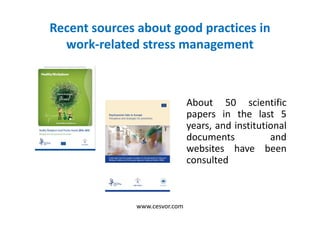
Recent sources about good practices in
work-related stress management
About 50 scientific
papers in the last 5
years, and institutional
documents and
websites have been
consulted
www.cesvor.com
Levels of psychosocial risk management
interventions
• Primary-level interventions attempt to tackle the source of
the work-related problem or stressor
• i.e.: an improvement in ergonomics or a change in organisation
• Secondary-level interventions attempt to strengthen
employees’ ability to cope with exposure to these stressors,
or to reverse, reduce or slow the progression of the
situation
• i.e.: training about stress management
• Tertiary level interventions offer remedial support for the
problems that have already been caused by psychosocial
risks
• i.e.: Employee assistance program
www.cesvor.com
Some positive points in nowadays practices
• Practices in work-related stress management are
nowadays enough advanced and various
• There’s a good balance among primary,
secondary and tertiary levels of intervention
• A lot of experiences and researches are available
• Main limit today is in the organisational cultures
(awarness, values) and it’s not «technical» (tools,
methods)
www.cesvor.com
Some possible improvements in
nowadays practices (1 or 3)
• Most interventions have been conducted in
large organisations
• What about SME?
• A large part of the companies are SME
Some possible improvements in
nowadays practices (2 of 3)
• Most interventions are concerned in risk
reduction, there are few cases in which risk
assessment have been presented or studied in-
depth
• Risk assessment is very often based only on
subjective perceptions of risk
• An objective assessment is often considered
weak but in fact a true consideration of it is
missing in the good practices and in the scientific
debate, there are only superficial and
questionable practices
Some possible improvements in
nowadays practices (3 of 3)
• Ergonomics is almost totally absent by all
interventions in risk assessment and risk
reduction
• Ergonomics is only used as a tool for some
improvements in the workplaces
• In fact that science is almost absent in the
debate about risk assessment
Some issues deserving improvements
• Expliciting and clarifying the relationships among
hazard, risk and harm when talking of stress
• Keeping into account the contribution of
ergonomics in the process of stress risk
evaluation and risk reduction
www.cesvor.com
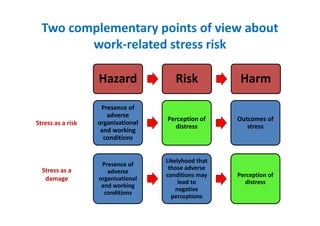
Two complementary points of view about
work-related stress risk
Hazard Risk Harm
Presence of
adverse
organisational
and working
conditions
Perception of
distress
Outcomes of
stress
Presence of
adverse
organisational
and working
conditions
Likelyhood that
those adverse
conditions may
lead to
negative
perceptions
Perception of
distress
Stress as a risk
Stress as a
damage
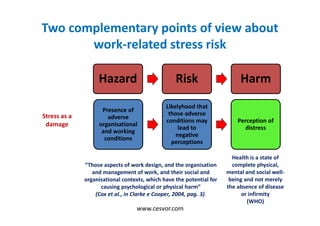
Two complementary points of view about
work-related stress risk
Hazard Risk Harm
Presence of
adverse
organisational
and working
conditions
Likelyhood that
those adverse
conditions may
lead to
negative
perceptions
Perception of
distress
Stress as a
damage
Health is a state of
complete physical,
mental and social well-
being and not merely
the absence of disease
or infirmity
(WHO)
“Those aspects of work design, and the organisation
and management of work, and their social and
organisational contexts, which have the potential for
causing psychological or physical harm”
(Cox et al., in Clarke e Cooper, 2004, pag. 3).
www.cesvor.com
The contribution of Ergonomics
What is Ergonomics?
It is the scientific discipline concerned with the
understanding of the interactions among human
and other elements of a system, and the
profession that applies theory, principles, data
and methods to design in order to optimize
human well-being and overall system
performance
(International Ergonomics Association)
www.cesvor.com
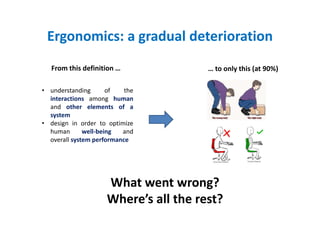
Ergonomics: a gradual deterioration
• understanding of the
interactions among human
and other elements of a
system
• design in order to optimize
human well-being and
overall system performance
From this definition … … to only this (at 90%)
What went wrong?
Where’s all the rest?
Case history: a multinational company
• German multinational company, present in Italy in
the field of hydraulics, electronic control
technology, solenoid technology and other
• About 90 employees (salepersons, warehousemen,
administration; there’s not production in Italy)
• In 2011 a first work-related stress risk assessment
was performed (using objective and subjective
methods)
• In 2014 it was updated with a new analysis
www.cesvor.com
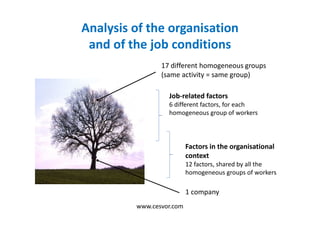
Analysis of the organisation
and of the job conditions
Factors in the organisational
context
12 factors, shared by all the
homogeneous groups of workers
Job-related factors
6 different factors, for each
homogeneous group of workers
1 company
17 different homogeneous groups
(same activity = same group)
www.cesvor.com
A benchmarking-based method
• The assessment of the working conditions is easier and
more effective comparing each group with a sample of
other companies used as a benchmark
• The sample as a benchmark:
– 37 companies, 740 homogeneous groups (activities)
– the number of employees in the 37 companies is about 16.000
– Italian companies (mainly in the North of Italy)
– different business sectors (chemical, engineering and telecoms,
glass, food, tourism, retail, energy, garbage collection,
goldsmith, mechanical, commerce, printing, …)
– sized from a few employees up to 6000 employees; mainly
medium and large companies
• Interventions were realised in the period 2009-2014
www.cesvor.com
Objective or subjective data
• The difference between objective or subjective data has to be discussed
• In every organisational or ergonomic analysis data can be collected:
in the more possible descriptive and objective way
with the participation of several players (from management to
workers)
with the support and the method brought by an expert
• The analysis is based on the description made by well informed persons
as witnesses (involved in the analysis through structured interviews)
• Data and indexes obtained are compared against the benchmarking
sample previously analised
www.cesvor.com
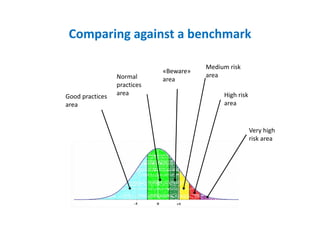
Comparing against a benchmark
Good practices
area
Normal
practices
area
«Beware»
area
Medium risk
area
High risk
area
Very high
risk area
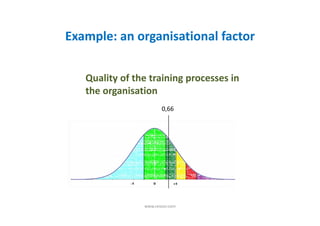
Example: an organisational factor
Quality of the training processes in
the organisation
0,66
www.cesvor.com
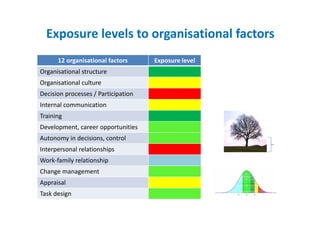
Exposure levels to organisational factors
12 organisational factors Exposure level
Organisational structure
Organisational culture
Decision processes / Participation
Internal communication
Training
Development, career opportunities
Autonomy in decisions, control
Interpersonal relationships
Work-family relationship
Change management
Appraisal
Task design
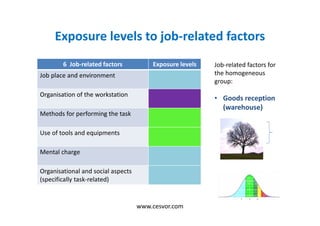
Exposure levels to job-related factors
6 Job-related factors Exposure levels
Job place and environment
Organisation of the workstation
Methods for performing the task
Use of tools and equipments
Mental charge
Organisational and social aspects
(specifically task-related)
Job-related factors for
the homogeneous
group:
• Goods reception
(warehouse)
www.cesvor.com
Actions undertaken after the risk
assessment
• Some actions have been taken for improving
organisational factors
• A specific project for improving the
ergonomics in the warehouse (from the
physical, cognitive and organisational points of
view) has been realised. The project saw a
strong partecipation of the workforce. About
20 improvement actions have been defined
www.cesvor.com
Conclusions
• It is possible to talk of good practices when a
good risk assessment is performed
• The risk assessment needs to include an
objective analysis of the job and of the
organisation, and not only the perceptions of
stress
• The analysis has to be done with a
partecipative process, and possibly having a
benchmark against which to compare the
results
www.cesvor.com
www.cesvor.com
Thank you !

Work related stress 23 oct15

  • 1.
    Work-related stress riskassessment: best practices www.cesvor.com Carlo Bisio Organisational Psychologist, Ergonomist Associazione Ambiente e Lavoro - Italy Milano, 23/10/15 Work Related Stress: How to prevent, assess and tackle the risk at European scale
  • 2.
    Recent sources aboutgood practices in work-related stress management About 50 scientific papers in the last 5 years, and institutional documents and websites have been consulted www.cesvor.com
  • 3.
    Levels of psychosocialrisk management interventions • Primary-level interventions attempt to tackle the source of the work-related problem or stressor • i.e.: an improvement in ergonomics or a change in organisation • Secondary-level interventions attempt to strengthen employees’ ability to cope with exposure to these stressors, or to reverse, reduce or slow the progression of the situation • i.e.: training about stress management • Tertiary level interventions offer remedial support for the problems that have already been caused by psychosocial risks • i.e.: Employee assistance program www.cesvor.com
  • 4.
    Some positive pointsin nowadays practices • Practices in work-related stress management are nowadays enough advanced and various • There’s a good balance among primary, secondary and tertiary levels of intervention • A lot of experiences and researches are available • Main limit today is in the organisational cultures (awarness, values) and it’s not «technical» (tools, methods) www.cesvor.com
  • 5.
    Some possible improvementsin nowadays practices (1 or 3) • Most interventions have been conducted in large organisations • What about SME? • A large part of the companies are SME
  • 6.
    Some possible improvementsin nowadays practices (2 of 3) • Most interventions are concerned in risk reduction, there are few cases in which risk assessment have been presented or studied in- depth • Risk assessment is very often based only on subjective perceptions of risk • An objective assessment is often considered weak but in fact a true consideration of it is missing in the good practices and in the scientific debate, there are only superficial and questionable practices
  • 7.
    Some possible improvementsin nowadays practices (3 of 3) • Ergonomics is almost totally absent by all interventions in risk assessment and risk reduction • Ergonomics is only used as a tool for some improvements in the workplaces • In fact that science is almost absent in the debate about risk assessment
  • 8.
    Some issues deservingimprovements • Expliciting and clarifying the relationships among hazard, risk and harm when talking of stress • Keeping into account the contribution of ergonomics in the process of stress risk evaluation and risk reduction www.cesvor.com
  • 9.
    Two complementary pointsof view about work-related stress risk Hazard Risk Harm Presence of adverse organisational and working conditions Perception of distress Outcomes of stress Presence of adverse organisational and working conditions Likelyhood that those adverse conditions may lead to negative perceptions Perception of distress Stress as a risk Stress as a damage
  • 10.
    Two complementary pointsof view about work-related stress risk Hazard Risk Harm Presence of adverse organisational and working conditions Likelyhood that those adverse conditions may lead to negative perceptions Perception of distress Stress as a damage Health is a state of complete physical, mental and social well- being and not merely the absence of disease or infirmity (WHO) “Those aspects of work design, and the organisation and management of work, and their social and organisational contexts, which have the potential for causing psychological or physical harm” (Cox et al., in Clarke e Cooper, 2004, pag. 3). www.cesvor.com
  • 11.
    The contribution ofErgonomics What is Ergonomics? It is the scientific discipline concerned with the understanding of the interactions among human and other elements of a system, and the profession that applies theory, principles, data and methods to design in order to optimize human well-being and overall system performance (International Ergonomics Association) www.cesvor.com
  • 12.
    Ergonomics: a gradualdeterioration • understanding of the interactions among human and other elements of a system • design in order to optimize human well-being and overall system performance From this definition … … to only this (at 90%) What went wrong? Where’s all the rest?
  • 13.
    Case history: amultinational company • German multinational company, present in Italy in the field of hydraulics, electronic control technology, solenoid technology and other • About 90 employees (salepersons, warehousemen, administration; there’s not production in Italy) • In 2011 a first work-related stress risk assessment was performed (using objective and subjective methods) • In 2014 it was updated with a new analysis www.cesvor.com
  • 14.
    Analysis of theorganisation and of the job conditions Factors in the organisational context 12 factors, shared by all the homogeneous groups of workers Job-related factors 6 different factors, for each homogeneous group of workers 1 company 17 different homogeneous groups (same activity = same group) www.cesvor.com
  • 15.
    A benchmarking-based method •The assessment of the working conditions is easier and more effective comparing each group with a sample of other companies used as a benchmark • The sample as a benchmark: – 37 companies, 740 homogeneous groups (activities) – the number of employees in the 37 companies is about 16.000 – Italian companies (mainly in the North of Italy) – different business sectors (chemical, engineering and telecoms, glass, food, tourism, retail, energy, garbage collection, goldsmith, mechanical, commerce, printing, …) – sized from a few employees up to 6000 employees; mainly medium and large companies • Interventions were realised in the period 2009-2014 www.cesvor.com
  • 16.
    Objective or subjectivedata • The difference between objective or subjective data has to be discussed • In every organisational or ergonomic analysis data can be collected: in the more possible descriptive and objective way with the participation of several players (from management to workers) with the support and the method brought by an expert • The analysis is based on the description made by well informed persons as witnesses (involved in the analysis through structured interviews) • Data and indexes obtained are compared against the benchmarking sample previously analised www.cesvor.com
  • 17.
    Comparing against abenchmark Good practices area Normal practices area «Beware» area Medium risk area High risk area Very high risk area
  • 18.
    Example: an organisationalfactor Quality of the training processes in the organisation 0,66 www.cesvor.com
  • 19.
    Exposure levels toorganisational factors 12 organisational factors Exposure level Organisational structure Organisational culture Decision processes / Participation Internal communication Training Development, career opportunities Autonomy in decisions, control Interpersonal relationships Work-family relationship Change management Appraisal Task design
  • 20.
    Exposure levels tojob-related factors 6 Job-related factors Exposure levels Job place and environment Organisation of the workstation Methods for performing the task Use of tools and equipments Mental charge Organisational and social aspects (specifically task-related) Job-related factors for the homogeneous group: • Goods reception (warehouse) www.cesvor.com
  • 21.
    Actions undertaken afterthe risk assessment • Some actions have been taken for improving organisational factors • A specific project for improving the ergonomics in the warehouse (from the physical, cognitive and organisational points of view) has been realised. The project saw a strong partecipation of the workforce. About 20 improvement actions have been defined www.cesvor.com
  • 22.
    Conclusions • It ispossible to talk of good practices when a good risk assessment is performed • The risk assessment needs to include an objective analysis of the job and of the organisation, and not only the perceptions of stress • The analysis has to be done with a partecipative process, and possibly having a benchmark against which to compare the results www.cesvor.com
  • 23.