PA R T 1
U N D E R S TA N D I N G
E X P E C TAT I O N S
( T H E W H O , W H AT, A N D
W H Y O F Y O U R P R O J E C T )
PA M E L A B E R M E O
I N T E R A C T I V E A C T I V I T Y 1
1. PROJECT MANAGEMENT: THE KEY
TO ACHIEVING RESULTS
What is a project
A project is a temporary
undertaking performed to
produce a product, service or
result
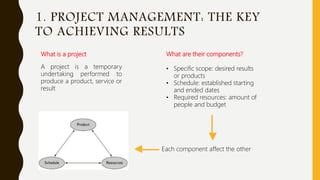
What are their components?
• Specific scope: desired results
or products
• Schedule: established starting
and ended dates
• Required resources: amount of
people and budget
Each component affect the other
What are the basis of a project?
• A project exist to produce a
result
• Project’s end date constitutes
a successful performance
• Availability of resources
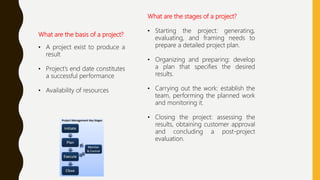
What are the stages of a project?
• Starting the project: generating,
evaluating, and framing needs to
prepare a detailed project plan.
• Organizing and preparing: develop
a plan that specifies the desired
results.
• Carrying out the work: establish the
team, performing the planned work
and monitoring it.
• Closing the project: assessing the
results, obtaining customer approval
and concluding a post-project
evaluation.
What is project management?
It is the process of guiding a project
from its beginning through its
performance to its closure.
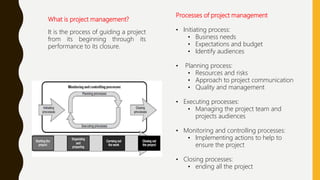
Processes of project management
• Initiating process:
• Business needs
• Expectations and budget
• Identify audiences
• Planning process:
• Resources and risks
• Approach to project communication
• Quality and management
• Executing processes:
• Managing the project team and
projects audiences
• Monitoring and controlling processes:
• Implementing actions to help to
ensure the project
• Closing processes:
• ending all the project
Project manager role:
He must be involved in
the project plans, clarify
expectations, propose
and the most important, be
proactive
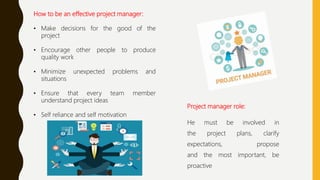
How to be an effective project manager:
• Make decisions for the good of the
project
• Encourage other people to produce
quality work
• Minimize unexpected problems and
situations
• Ensure that every team member
understand project ideas
• Self reliance and self motivation
2. CLARIFYING WHAT YOU’RE TRYING TO
ACCOMPLISH — AND WHY
Define the project with a scope
statement
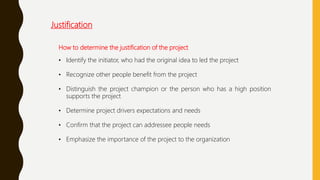
A Scope Statement is a written
confirmation of the results the
project will produce.
Scope Statement includes the following
information:
• Justification: how and why the project came to
be, and why it will be affect others activities.
• Objectives: products, services or results the
project will produce
• Product scope description: features and
functions of the products or services of the
project
• Product acceptance criteria: process for
accepting completed products or results
• Constraints: restriction that limits the projects,
and how to achieve them
• Assumptions: how address with uncertain
information
How to determine the justification of the project
• Identify the initiator, who had the original idea to led the project
• Recognize other people benefit from the project
• Distinguish the project champion or the person who has a high position
supports the project
• Determine project drivers expectations and needs
• Confirm that the project can addressee people needs
• Emphasize the importance of the project to the organization
Justification
Objectives
Elements of the objectives
• Statement: narrative description of
the project achievement
• Measures: indicators to assess the
achievement
• Performance specifications: values of
each measure that define success
How to create clear and specific objectives
• Be brief when describing each objective
• Do not use technical jargon or acronyms
• Make the objectives specific. Measurable,
aggressive, realistic and time sensitive
• Make the objectives controllable
Constraints
Types of constraints:
• Results: the product and effect of
the project
• Time frames
• Resources: type, amount and
availability to perform the project
• Activity performance: strategies for
performing different tasks
How to avoid constraints:
• Consult the audience and check with
supporters about limitations
• Review relevant written material as plans
and annual budgets
• Resolve conflicting opinions
3. KNOWING YOUR PROJECT’S AUDIENCE:
INVOLVING THE RIGHT PEOPLE
Project audience
A project audience is any person or
group that supports, is affected by, or
is interested in your project.
Starting an audience list
• Use specific categories
• Internal: manager, team
members
• External: clients, collaborations,
vendors, society
Audience list template
An audience list template is a predesigned
audience list that contains typical categories
and audiences for a particular type of project.
• Develop templates for frequently
performed tasks and for entire
projects
• Focus on position descriptions rather
than the names of prior audiences.
• Encourage your team to brainstorm
possible audiences before you show
them an existing audience list
template.
Drivers, supporters and observes in the
audience
• Drivers: People who have some say in
defining the results of the project
• Supporters: people who help to
perform the project
• Observers: people who are interested
the activities and results of the project
Methods to keep the audience
involved
• One-on-one meetings
• Group meetings
• Informal written correspondence
• Information sharing vehicles
Maximize audience involvement and
contributions
• Involve audiences early in the
project planning
• Check legality of involving a
specific audience
• Develop a plan to them in order to
meet their needs and interests
• Understand each audience
interests
4. DEVELOPING YOUR GAME PLAN:
GETTING FROM HERE TO THERE
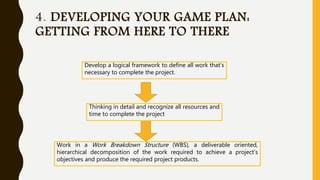
Develop a logical framework to define all work that’s
necessary to complete the project.
Thinking in detail and recognize all resources and
time to complete the project
Work in a Work Breakdown Structure (WBS), a deliverable oriented,
hierarchical decomposition of the work required to achieve a project’s
objectives and produce the required project products.
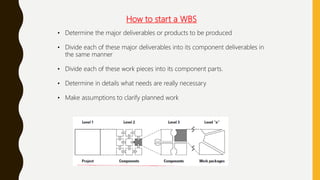
How to start a WBS
• Determine the major deliverables or products to be produced
• Divide each of these major deliverables into its component deliverables in
the same manner
• Divide each of these work pieces into its component parts.
• Determine in details what needs are really necessary
• Make assumptions to clarify planned work
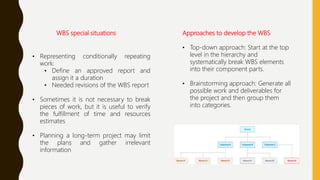
WBS special situations
• Representing conditionally repeating
work:
• Define an approved report and
assign it a duration
• Needed revisions of the WBS report
• Sometimes it is not necessary to break
pieces of work, but it is useful to verify
the fulfillment of time and resources
estimates
• Planning a long-term project may limit
the plans and gather irrelevant
information
Approaches to develop the WBS
• Top-down approach: Start at the top
level in the hierarchy and
systematically break WBS elements
into their component parts.
• Brainstorming approach: Generate all
possible work and deliverables for
the project and then group them
into categories.
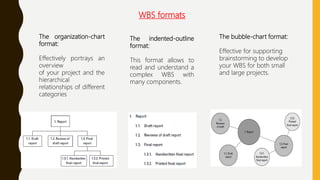
WBS formats
The organization-chart
format:
Effectively portrays an
overview
of your project and the
hierarchical
relationships of different
categories
The indented-outline
format:
This format allows to
read and understand a
complex WBS with
many components.
The bubble-chart format:
Effective for supporting
brainstorming to develop
your WBS for both small
and large projects.
Improve the quality of the WBS:
• Involve the people who will be doing the work
• Review and include information from WBSs from similar projects
• Keep your WBS current
• Make assumptions regarding uncertain activities
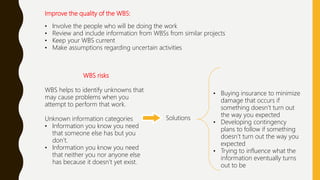
WBS risks
WBS helps to identify unknowns that
may cause problems when you
attempt to perform that work.
Unknown information categories
• Information you know you need
that someone else has but you
don’t.
• Information you know you need
that neither you nor anyone else
has because it doesn’t yet exist.
Solutions
• Buying insurance to minimize
damage that occurs if
something doesn’t turn out
the way you expected
• Developing contingency
plans to follow if something
doesn’t turn out the way you
expected
• Trying to influence what the
information eventually turns
out to be

Interactive activity I

  • 1.
    PA R T1 U N D E R S TA N D I N G E X P E C TAT I O N S ( T H E W H O , W H AT, A N D W H Y O F Y O U R P R O J E C T ) PA M E L A B E R M E O I N T E R A C T I V E A C T I V I T Y 1
  • 2.
    1. PROJECT MANAGEMENT:THE KEY TO ACHIEVING RESULTS What is a project A project is a temporary undertaking performed to produce a product, service or result What are their components? • Specific scope: desired results or products • Schedule: established starting and ended dates • Required resources: amount of people and budget Each component affect the other
  • 3.
    What are thebasis of a project? • A project exist to produce a result • Project’s end date constitutes a successful performance • Availability of resources What are the stages of a project? • Starting the project: generating, evaluating, and framing needs to prepare a detailed project plan. • Organizing and preparing: develop a plan that specifies the desired results. • Carrying out the work: establish the team, performing the planned work and monitoring it. • Closing the project: assessing the results, obtaining customer approval and concluding a post-project evaluation.
  • 4.
    What is projectmanagement? It is the process of guiding a project from its beginning through its performance to its closure. Processes of project management • Initiating process: • Business needs • Expectations and budget • Identify audiences • Planning process: • Resources and risks • Approach to project communication • Quality and management • Executing processes: • Managing the project team and projects audiences • Monitoring and controlling processes: • Implementing actions to help to ensure the project • Closing processes: • ending all the project
  • 5.
    Project manager role: Hemust be involved in the project plans, clarify expectations, propose and the most important, be proactive How to be an effective project manager: • Make decisions for the good of the project • Encourage other people to produce quality work • Minimize unexpected problems and situations • Ensure that every team member understand project ideas • Self reliance and self motivation
  • 6.
    2. CLARIFYING WHATYOU’RE TRYING TO ACCOMPLISH — AND WHY Define the project with a scope statement A Scope Statement is a written confirmation of the results the project will produce. Scope Statement includes the following information: • Justification: how and why the project came to be, and why it will be affect others activities. • Objectives: products, services or results the project will produce • Product scope description: features and functions of the products or services of the project • Product acceptance criteria: process for accepting completed products or results • Constraints: restriction that limits the projects, and how to achieve them • Assumptions: how address with uncertain information
  • 7.
    How to determinethe justification of the project • Identify the initiator, who had the original idea to led the project • Recognize other people benefit from the project • Distinguish the project champion or the person who has a high position supports the project • Determine project drivers expectations and needs • Confirm that the project can addressee people needs • Emphasize the importance of the project to the organization Justification
  • 8.
    Objectives Elements of theobjectives • Statement: narrative description of the project achievement • Measures: indicators to assess the achievement • Performance specifications: values of each measure that define success How to create clear and specific objectives • Be brief when describing each objective • Do not use technical jargon or acronyms • Make the objectives specific. Measurable, aggressive, realistic and time sensitive • Make the objectives controllable Constraints Types of constraints: • Results: the product and effect of the project • Time frames • Resources: type, amount and availability to perform the project • Activity performance: strategies for performing different tasks How to avoid constraints: • Consult the audience and check with supporters about limitations • Review relevant written material as plans and annual budgets • Resolve conflicting opinions
  • 9.
    3. KNOWING YOURPROJECT’S AUDIENCE: INVOLVING THE RIGHT PEOPLE Project audience A project audience is any person or group that supports, is affected by, or is interested in your project. Starting an audience list • Use specific categories • Internal: manager, team members • External: clients, collaborations, vendors, society Audience list template An audience list template is a predesigned audience list that contains typical categories and audiences for a particular type of project. • Develop templates for frequently performed tasks and for entire projects • Focus on position descriptions rather than the names of prior audiences. • Encourage your team to brainstorm possible audiences before you show them an existing audience list template.
  • 10.
    Drivers, supporters andobserves in the audience • Drivers: People who have some say in defining the results of the project • Supporters: people who help to perform the project • Observers: people who are interested the activities and results of the project Methods to keep the audience involved • One-on-one meetings • Group meetings • Informal written correspondence • Information sharing vehicles Maximize audience involvement and contributions • Involve audiences early in the project planning • Check legality of involving a specific audience • Develop a plan to them in order to meet their needs and interests • Understand each audience interests
  • 11.
    4. DEVELOPING YOURGAME PLAN: GETTING FROM HERE TO THERE Develop a logical framework to define all work that’s necessary to complete the project. Thinking in detail and recognize all resources and time to complete the project Work in a Work Breakdown Structure (WBS), a deliverable oriented, hierarchical decomposition of the work required to achieve a project’s objectives and produce the required project products.
  • 12.
    How to starta WBS • Determine the major deliverables or products to be produced • Divide each of these major deliverables into its component deliverables in the same manner • Divide each of these work pieces into its component parts. • Determine in details what needs are really necessary • Make assumptions to clarify planned work
  • 13.
    WBS special situations •Representing conditionally repeating work: • Define an approved report and assign it a duration • Needed revisions of the WBS report • Sometimes it is not necessary to break pieces of work, but it is useful to verify the fulfillment of time and resources estimates • Planning a long-term project may limit the plans and gather irrelevant information Approaches to develop the WBS • Top-down approach: Start at the top level in the hierarchy and systematically break WBS elements into their component parts. • Brainstorming approach: Generate all possible work and deliverables for the project and then group them into categories.
  • 14.
    WBS formats The organization-chart format: Effectivelyportrays an overview of your project and the hierarchical relationships of different categories The indented-outline format: This format allows to read and understand a complex WBS with many components. The bubble-chart format: Effective for supporting brainstorming to develop your WBS for both small and large projects.
  • 15.
    Improve the qualityof the WBS: • Involve the people who will be doing the work • Review and include information from WBSs from similar projects • Keep your WBS current • Make assumptions regarding uncertain activities WBS risks WBS helps to identify unknowns that may cause problems when you attempt to perform that work. Unknown information categories • Information you know you need that someone else has but you don’t. • Information you know you need that neither you nor anyone else has because it doesn’t yet exist. Solutions • Buying insurance to minimize damage that occurs if something doesn’t turn out the way you expected • Developing contingency plans to follow if something doesn’t turn out the way you expected • Trying to influence what the information eventually turns out to be