Web Development with
Presented by:
Overview
• What is WordPress
• How it Works
• Updating WordPress
• Modifying Your Website
— Admin Overview
— Adding Users
— Posts-vs-Pages
— Editing Posts and Pages
— Formatting Text
— Adding Posts
— Writing Titles
— Adding Photos and PDFs
Overview of WordPress
What Is WordPress?
A free publishing platform that allows 

you to easily create content for the web.
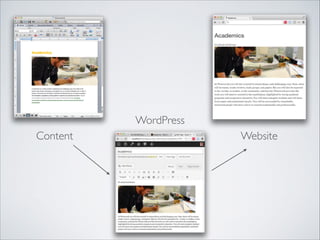
WordPress
WebsiteContent
WordPress powers over 20% of the Web
Why?
• Free (but….. you need a server to host your website)	

• Easy to use	

• Open Source	

• Don’t need to know code	

• Control your own content	

• SEO friendly	

• Easy to get help
Difference Between 	

WordPress.Com and WordPress.Org
WordPress.ComVs WordPress.Com
Picture Credit: https://blog.rooof.com
Questions?
Web DesignTrends
• Clean, Minimal and Simple	

• Flat Design	

• Responsive Design	

• User Experience	

• Content is King
Live Demo
Watch Me Build a Website
Live Demo List
• The Dashboard	

• Settings	

• Post & Pages	

• Posting Content	

• Text, Links, Images,
gallery and video
• Embedding Codes	

• Widgets (Sidebar)	

• Themes	

• Plugins	

!
• WordPress is an open source, free blogging
tool and content management system (CMS)
powered by PHP and MySQL
• Installed in your hosting space
• You can update your site from any computer
that has internet access
The number of Websites
(as of Feb 2014) using WordPress.
That is almost 20% of ALL websites!
How Your Website Works
The Internet
• The Internet is made up of inter-connected servers, fancy computers,
that act like file cabinets.
• Domain names are labels used to tell Internet browsers which hosting
space on the servers, or the location of your website, to look at.
• Each hosting space contains files, folders and documents.
These files make up a website.
=
How Your
Website Works
Viewing Your Site
• A URL (domain name) is
typed into an address
bar of an internet
browser.
• Code is retrieved from a
hosting space,
translated by the
server, paired with
information from a
database.
• Displayed on an internet
browser
code
server+
database
Ways to Modify Your Site
Create
users
Edit
Menus
Add
Posts
Edit
text
Add
Pages
Place
Images
Upload
Files
Embed
Videos
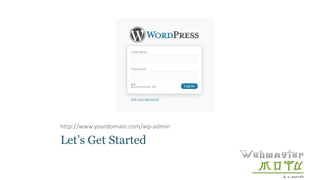
Let’s Get Started
http://www.yourdomain.com/wp-admin
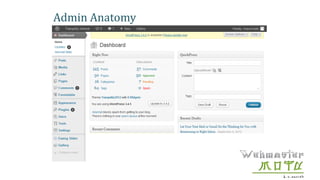
Admin Anatomy
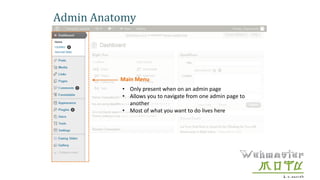
Admin Anatomy
Main Menu
• Only present when on an admin page
• Allows you to navigate from one admin page to
another
• Most of what you want to do lives here
Admin Anatomy
Shortcut Menu
• Present when you’re logged in
• Displays on every page
• Allows you to navigate quickly to do common tasks
• Allows you to navigate from public to admin sides of site
Clicking on your site
name will take you
to the home page
of your website
Admin Anatomy
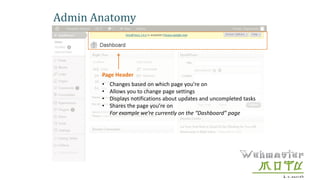
Page Header
• Changes based on which page you’re on
• Allows you to change page settings
• Displays notifications about updates and uncompleted tasks
• Shares the page you’re on
For example we’re currently on the “Dashboard” page
Admin Anatomy
Page Body
• Displays editing options on each page or section
• Contains additional navigational elements
• Each page has different editing options
Blue buttons are
action buttons
allowing you to
permanently save
or publish
Action Panel
Efficiently Yours
Each screen is modifiable
• Check the fields you would like to see in your editing screen
• Uncheck the fields you would like to ignore
Adding Users
Types of WordPress users
• Administrator - Somebody who has access to all the
administration features
• Editor - Somebody who can publish posts, manage posts as
well as manage other people's posts, etc
• Author - Somebody who can publish and manage their own
posts
• Contributor - Somebody who can write and manage their
posts but not publish posts
• Subscriber - Somebody who can read
comments/comment/receive newsletters, etc
Add a User
Add a user
Choose a user level
Investigate Screen Options
PAGE
Posts -vs- Pages
is displayed on pages
or posts for the public
to view
POST
Text
Image
File
Link
Video
Information on your site
Posts -vs- Pages
Posts
• Timely information
• Modular format can be
displayed on multiple pages
• Divided into categories
• Can not display a page
within a post
• Longer URL
• Think blog entry or
Facebook status update
Pages
• Static information
• Confined format can only
be displayed on a page
• Divided by parent pages
• Can display one or multiple
posts
• Short URL
• Think Word Document or
PowerPoint slide
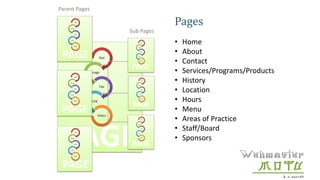
Pages
• Most places on
navigation link to a
page
• To edit posts on a
page you edit the
posts
• Organized by parent
pages
PAGE
• Home
• About
• Contact
• Services/Programs/Products
• History
• Location
• Hours
• Menu
• Areas of Practice
• Staff/Board
• Sponsors
PAGE
PAGE
PAGE
Parent Pages
PAGE
PAGE
PAGE
Sub Pages
Page Example Links to other main pages
Navigation
• One large entry
• No “read more” links
• Listed on and highlighted in main navigation
• Straight forward URL:
http://www.mayecreate.com/contact/
Page Specific Content
PAGE
Posts
• Grouped into
categories and
displayed on a page
POSTPOST
• Can be displayed
on more than one
page or in more
than one category
POST
• Staff or board members
• Products
• News and press releases
• Blog entries
• FAQ
• Resources
• Terminology
• Job listings
• Testimonials
• Announcements
• Events
• Portfolio
Post Example
• Multiple short entries
• Read more links
Post
• Not list in main navigation
• Longer URL, usually with dates:
http://www.mayecreate.com/2010/02/trackbacks
-and-pingbacks/
Page Specific Content
Still not sure about posts and pages?
That’s OK we can talk about it one-on-one.
Editing Pages/Posts
Quick Edit and Sorting Features
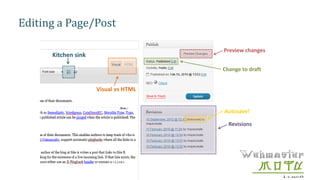
Editing a Page/Post
Visual vs HTML
Kitchen sink
Preview changes
Change to draft
Revisions
Autosave!
Editing a Page/Post: Text Styles
• H1 is used for the title of the page and already applied for you
• Use the other styles in order of hierarchy to add organization
and structure to your page
• H2, H3, H4, H5
• Search engines read the styles this way when reading your
page, surprisingly people do too!
• Maintains consistency and professionalism
• Saves time!
Formatting Text
Applying Styles
Removing Styles
Pasting From Microsoft Word
Shift + Enter
Editing a Page/Post
• It won’t look
the same from
front to back
• Check early and
check often
• If everything
is bold, nothing
is bold
• Don’t underline
it looks like a
link
• Shift+Enter
• Pasting from
Microsoft Word
• Unformatting
Routine Checks Rules of Thumb Tricks
Adding a Post
How to get there (or anywhere really )
Look, Think, Click
Efficient Workspace Layouts, the art of drag and drop
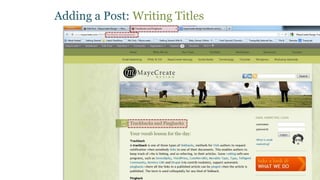
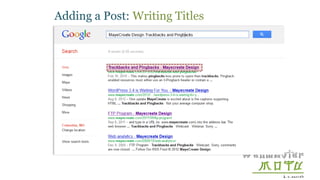
Write a title that applies to your page or post so browsers and
viewers can learn what’s on your page
Adding a Post: Writing Titles
Adding a Post
• Choose a category
– If you don’t it will choose the default
• Scheduling
– By scheduling posts to release in the future you can make your site
appear regularly updated
– Lets Google know you’re actively adding to the site on a regular basis
• Read more link
Adding Links
• How to add a link
• Opening a link in a new window
– PDF
– Other websites
• Photos can be used as links also
• What words to link
– Stay away from “click here”
– Link words that represent the page you’re linking to
Adding a Post in Action
Write a title
Choosing a category
Publishing
Viewing on website
Add a link
Adding a Photo
• Can always make it smaller but making it bigger will make it blurry
• Add titles but don’t start with a number
• Add alt tags to describe the image
• Add captions to assist skimming, give meaning
• Use real photos when possible
• Can upload photos:
– In Media Library
– In the page or post (gallery)
Adding Photos and PDFs
Upload a photo
Name and add alt tags and captions
Linking
Alignment
Sizing
Cropping
Uploading PDFs
Modifying link target on PDFs
Questions?
Suggestions and Resources
WhereTo GetThemes
http://WordPress.org/themes
WhereTo GetThemes
http://themeforest.net/category/WordPress/nonprofit
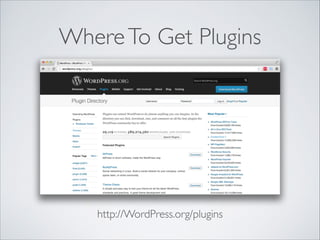
WhereTo Get Plugins
http://WordPress.org/plugins
WhereTo Get Help	

• Google
• Youtube	

• WordPress Support Forum

http://WordPress.org/support 	

• WordPress Answers

http://WordPress.stackexchange.com	

• Boston WordPress

http://www.meetup.com/boston-WordPress-meetup	

• WordCamps

http://central.wordcamp.org	

• Me
Suggestions
• WordPress is easy. 	

• Creating content for your website is hard.	

• Don’t spend too much time on WordPress until you have determined
your website structure (sitemap) and have all your content ready
(including graphics, photos and videos).	

• Utilize WordPress (themes and plugins) to best communicate your
website content to your target audience.	

• Don’t let design (theme) dictate the content of your website.
Questions?
ThankYou
Email: anvith3@gmail.com
Facebook: www.facebook.com/anvith3
Website: www.webmastermotu.me

WordPress_Workshop_Feb_2014_consolidated

  • 1.
  • 2.
    Overview • What isWordPress • How it Works • Updating WordPress • Modifying Your Website — Admin Overview — Adding Users — Posts-vs-Pages — Editing Posts and Pages — Formatting Text — Adding Posts — Writing Titles — Adding Photos and PDFs
  • 3.
  • 4.
  • 5.
    A free publishingplatform that allows 
 you to easily create content for the web.
  • 6.
  • 7.
    WordPress powers over20% of the Web
  • 8.
    Why? • Free (but…..you need a server to host your website) • Easy to use • Open Source • Don’t need to know code • Control your own content • SEO friendly • Easy to get help
  • 9.
  • 10.
  • 11.
  • 12.
    Web DesignTrends • Clean,Minimal and Simple • Flat Design • Responsive Design • User Experience • Content is King
  • 13.
    Live Demo Watch MeBuild a Website
  • 14.
    Live Demo List •The Dashboard • Settings • Post & Pages • Posting Content • Text, Links, Images, gallery and video • Embedding Codes • Widgets (Sidebar) • Themes • Plugins !
  • 15.
    • WordPress isan open source, free blogging tool and content management system (CMS) powered by PHP and MySQL • Installed in your hosting space • You can update your site from any computer that has internet access The number of Websites (as of Feb 2014) using WordPress. That is almost 20% of ALL websites!
  • 16.
    How Your WebsiteWorks The Internet • The Internet is made up of inter-connected servers, fancy computers, that act like file cabinets. • Domain names are labels used to tell Internet browsers which hosting space on the servers, or the location of your website, to look at. • Each hosting space contains files, folders and documents. These files make up a website. =
  • 17.
    How Your Website Works ViewingYour Site • A URL (domain name) is typed into an address bar of an internet browser. • Code is retrieved from a hosting space, translated by the server, paired with information from a database. • Displayed on an internet browser code server+ database
  • 18.
    Ways to ModifyYour Site Create users Edit Menus Add Posts Edit text Add Pages Place Images Upload Files Embed Videos
  • 19.
  • 20.
  • 21.
    Admin Anatomy Main Menu •Only present when on an admin page • Allows you to navigate from one admin page to another • Most of what you want to do lives here
  • 22.
    Admin Anatomy Shortcut Menu •Present when you’re logged in • Displays on every page • Allows you to navigate quickly to do common tasks • Allows you to navigate from public to admin sides of site Clicking on your site name will take you to the home page of your website
  • 23.
    Admin Anatomy Page Header •Changes based on which page you’re on • Allows you to change page settings • Displays notifications about updates and uncompleted tasks • Shares the page you’re on For example we’re currently on the “Dashboard” page
  • 24.
    Admin Anatomy Page Body •Displays editing options on each page or section • Contains additional navigational elements • Each page has different editing options Blue buttons are action buttons allowing you to permanently save or publish Action Panel
  • 25.
    Efficiently Yours Each screenis modifiable • Check the fields you would like to see in your editing screen • Uncheck the fields you would like to ignore
  • 26.
    Adding Users Types ofWordPress users • Administrator - Somebody who has access to all the administration features • Editor - Somebody who can publish posts, manage posts as well as manage other people's posts, etc • Author - Somebody who can publish and manage their own posts • Contributor - Somebody who can write and manage their posts but not publish posts • Subscriber - Somebody who can read comments/comment/receive newsletters, etc
  • 27.
    Add a User Adda user Choose a user level Investigate Screen Options
  • 28.
    PAGE Posts -vs- Pages isdisplayed on pages or posts for the public to view POST Text Image File Link Video Information on your site
  • 29.
    Posts -vs- Pages Posts •Timely information • Modular format can be displayed on multiple pages • Divided into categories • Can not display a page within a post • Longer URL • Think blog entry or Facebook status update Pages • Static information • Confined format can only be displayed on a page • Divided by parent pages • Can display one or multiple posts • Short URL • Think Word Document or PowerPoint slide
  • 30.
    Pages • Most placeson navigation link to a page • To edit posts on a page you edit the posts • Organized by parent pages PAGE • Home • About • Contact • Services/Programs/Products • History • Location • Hours • Menu • Areas of Practice • Staff/Board • Sponsors PAGE PAGE PAGE Parent Pages PAGE PAGE PAGE Sub Pages
  • 31.
    Page Example Linksto other main pages Navigation • One large entry • No “read more” links • Listed on and highlighted in main navigation • Straight forward URL: http://www.mayecreate.com/contact/ Page Specific Content
  • 32.
    PAGE Posts • Grouped into categoriesand displayed on a page POSTPOST • Can be displayed on more than one page or in more than one category POST • Staff or board members • Products • News and press releases • Blog entries • FAQ • Resources • Terminology • Job listings • Testimonials • Announcements • Events • Portfolio
  • 33.
    Post Example • Multipleshort entries • Read more links Post
  • 34.
    • Not listin main navigation • Longer URL, usually with dates: http://www.mayecreate.com/2010/02/trackbacks -and-pingbacks/ Page Specific Content
  • 35.
    Still not sureabout posts and pages? That’s OK we can talk about it one-on-one.
  • 36.
    Editing Pages/Posts Quick Editand Sorting Features
  • 37.
    Editing a Page/Post Visualvs HTML Kitchen sink Preview changes Change to draft Revisions Autosave!
  • 38.
    Editing a Page/Post:Text Styles • H1 is used for the title of the page and already applied for you • Use the other styles in order of hierarchy to add organization and structure to your page • H2, H3, H4, H5 • Search engines read the styles this way when reading your page, surprisingly people do too! • Maintains consistency and professionalism • Saves time!
  • 39.
    Formatting Text Applying Styles RemovingStyles Pasting From Microsoft Word Shift + Enter
  • 40.
    Editing a Page/Post •It won’t look the same from front to back • Check early and check often • If everything is bold, nothing is bold • Don’t underline it looks like a link • Shift+Enter • Pasting from Microsoft Word • Unformatting Routine Checks Rules of Thumb Tricks
  • 41.
    Adding a Post Howto get there (or anywhere really ) Look, Think, Click Efficient Workspace Layouts, the art of drag and drop
  • 42.
    Write a titlethat applies to your page or post so browsers and viewers can learn what’s on your page Adding a Post: Writing Titles
  • 43.
    Adding a Post:Writing Titles
  • 44.
    Adding a Post:Writing Titles
  • 45.
    Adding a Post •Choose a category – If you don’t it will choose the default • Scheduling – By scheduling posts to release in the future you can make your site appear regularly updated – Lets Google know you’re actively adding to the site on a regular basis • Read more link
  • 46.
    Adding Links • Howto add a link • Opening a link in a new window – PDF – Other websites • Photos can be used as links also • What words to link – Stay away from “click here” – Link words that represent the page you’re linking to
  • 47.
    Adding a Postin Action Write a title Choosing a category Publishing Viewing on website Add a link
  • 48.
    Adding a Photo •Can always make it smaller but making it bigger will make it blurry • Add titles but don’t start with a number • Add alt tags to describe the image • Add captions to assist skimming, give meaning • Use real photos when possible • Can upload photos: – In Media Library – In the page or post (gallery)
  • 49.
    Adding Photos andPDFs Upload a photo Name and add alt tags and captions Linking Alignment Sizing Cropping Uploading PDFs Modifying link target on PDFs
  • 50.
  • 51.
  • 52.
  • 53.
  • 54.
  • 55.
    WhereTo Get Help •Google • Youtube • WordPress Support Forum
 http://WordPress.org/support • WordPress Answers
 http://WordPress.stackexchange.com • Boston WordPress
 http://www.meetup.com/boston-WordPress-meetup • WordCamps
 http://central.wordcamp.org • Me
  • 56.
    Suggestions • WordPress iseasy. • Creating content for your website is hard. • Don’t spend too much time on WordPress until you have determined your website structure (sitemap) and have all your content ready (including graphics, photos and videos). • Utilize WordPress (themes and plugins) to best communicate your website content to your target audience. • Don’t let design (theme) dictate the content of your website.
  • 57.
  • 58.