
‘Found’ and ‘After’
A short history of data re-use in the Arts
Martin Donnelly
Digital Curation Centre
University of Edinburgh
Research Data Management Forum #10
University of Oxford, 4th September 2013
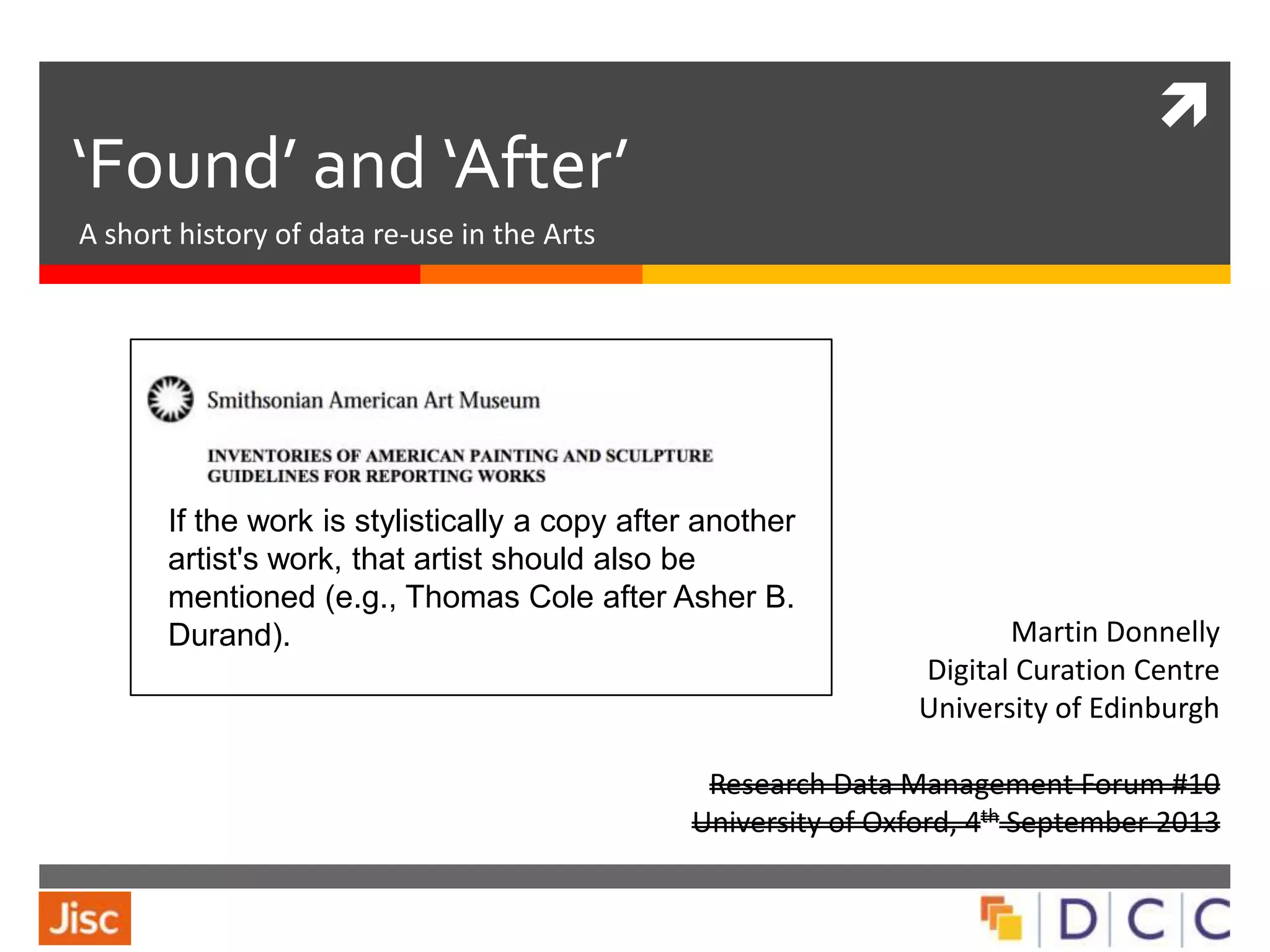
If the work is stylistically a copy after another
artist's work, that artist should also be
mentioned (e.g., Thomas Cole after Asher B.
Durand).
Contents
 Argument / overview
 Intertextuality
 Exemplars
 Text
 Visual
 Music
Argument / overview
 There’s nothing new about data re-use in the Arts; in fact it’s an
integral part of the culture, and always has been
 However, it’s often more complicated than data re-use in other
areas (such as the Sciences)
 For starters, people tend not to think of their sources or
influences as ‘data’
 Also, the value and referencing systems are quite different
 And research / production methods are not always rigorously
methodical
 This presentation offers a number of examples of data re-use in
the Arts, with commentary tying each to common data
concepts
Intertextuality
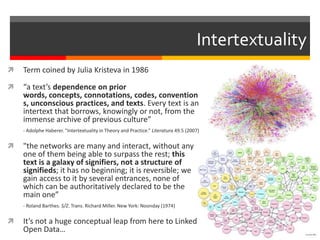
 Term coined by Julia Kristeva in 1986
 “a text’s dependence on prior
words, concepts, connotations, codes, convention
s, unconscious practices, and texts. Every text is an
intertext that borrows, knowingly or not, from the
immense archive of previous culture”
- Adolphe Haberer. “Intertextuality in Theory and Practice.” Literatura 49.5 (2007)
 "the networks are many and interact, without any
one of them being able to surpass the rest; this
text is a galaxy of signifiers, not a structure of
signifieds; it has no beginning; it is reversible; we
gain access to it by several entrances, none of
which can be authoritatively declared to be the
main one”
- Roland Barthes. S/Z. Trans. Richard Miller. New York: Noonday (1974)
 It’s not a huge conceptual leap from here to Linked
Open Data…
Exemplars I: text
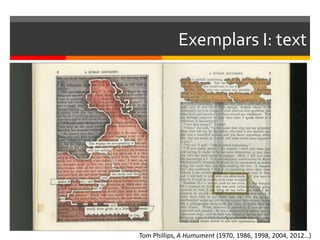
Tom Phillips, A Humument (1970, 1986, 1998, 2004, 2012…)
William Shakespeare
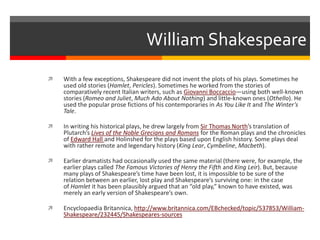
 With a few exceptions, Shakespeare did not invent the plots of his plays. Sometimes he
used old stories (Hamlet, Pericles). Sometimes he worked from the stories of
comparatively recent Italian writers, such as Giovanni Boccaccio—using both well-known
stories (Romeo and Juliet, Much Ado About Nothing) and little-known ones (Othello). He
used the popular prose fictions of his contemporaries in As You Like It and The Winter’s
Tale.
 In writing his historical plays, he drew largely from Sir Thomas North’s translation of
Plutarch’s Lives of the Noble Grecians and Romans for the Roman plays and the chronicles
of Edward Hall and Holinshed for the plays based upon English history. Some plays deal
with rather remote and legendary history (King Lear, Cymbeline, Macbeth).
 Earlier dramatists had occasionally used the same material (there were, for example, the
earlier plays called The Famous Victories of Henry the Fifth and King Leir). But, because
many plays of Shakespeare’s time have been lost, it is impossible to be sure of the
relation between an earlier, lost play and Shakespeare’s surviving one: in the case
of Hamlet it has been plausibly argued that an “old play,” known to have existed, was
merely an early version of Shakespeare’s own.
 Encyclopaedia Britannica, http://www.britannica.com/EBchecked/topic/537853/William-
Shakespeare/232445/Shakespeares-sources
T.S. Eliot
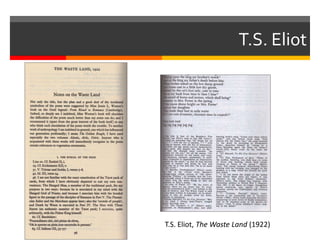
T.S. Eliot, The Waste Land (1922)
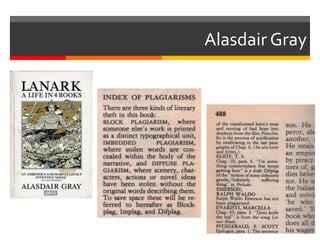
Alasdair Gray
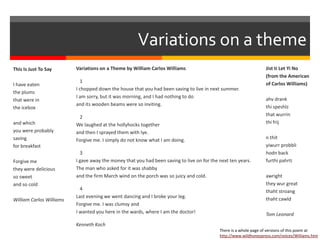
Variations on a theme
This Is Just To Say
I have eaten
the plums
that were in
the icebox
and which
you were probably
saving
for breakfast
Forgive me
they were delicious
so sweet
and so cold
William Carlos Williams
Variations on a Theme by William Carlos Williams
1
I chopped down the house that you had been saving to live in next summer.
I am sorry, but it was morning, and I had nothing to do
and its wooden beams were so inviting.
2
We laughed at the hollyhocks together
and then I sprayed them with lye.
Forgive me. I simply do not know what I am doing.
3
I gave away the money that you had been saving to live on for the next ten years.
The man who asked for it was shabby
and the firm March wind on the porch was so juicy and cold.
4
Last evening we went dancing and I broke your leg.
Forgive me. I was clumsy and
I wanted you here in the wards, where I am the doctor!
Kenneth Koch
Jist ti Let Yi No
(from the American
of Carlos Williams)
ahv drank
thi speshlz
that wurrin
thi frij
n thit
yiwurr probbli
hodn back
furthi pahrti
awright
they wur great
thaht stroang
thaht cawld
Tom Leonard
There is a whole page of versions of this poem at
http://www.wildhoneypress.com/voices/Williams.htm
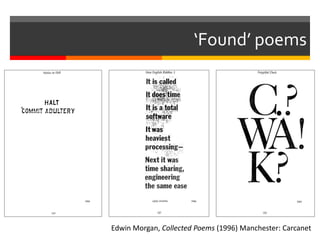
‘Found’ poems
Edwin Morgan, Collected Poems (1996) Manchester: Carcanet
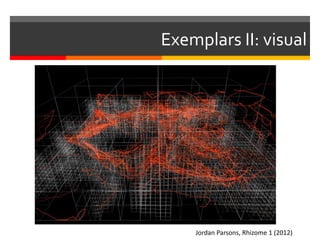
Exemplars II: visual
Jordan Parsons, Rhizome 1 (2012)
A Humument / Tree of Codes
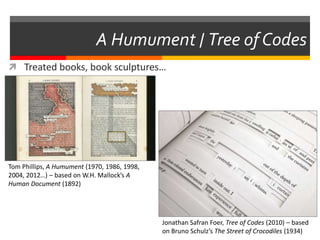
 Treated books, book sculptures…
Tom Phillips, A Humument (1970, 1986, 1998,
2004, 2012…) – based on W.H. Mallock’s A
Human Document (1892)
Jonathan Safran Foer, Tree of Codes (2010) – based
on Bruno Schulz’s The Street of Crocodiles (1934)
Found / readymade
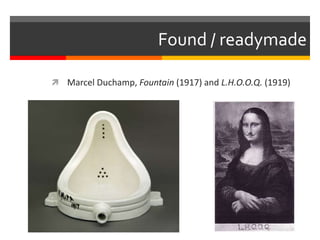
 Marcel Duchamp, Fountain (1917) and L.H.O.O.Q. (1919)
Intermedia / sculpture
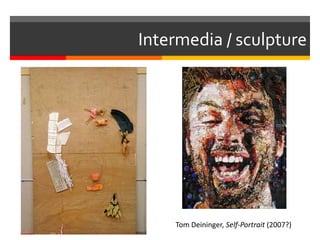
Tom Deininger, Self-Portrait (2007?)
Collage
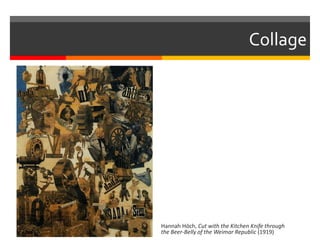
Hannah Höch, Cut with the Kitchen Knife through
the Beer-Belly of the Weimar Republic (1919)
Cartoons
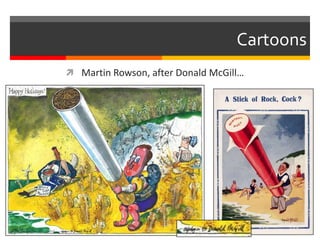
 Martin Rowson, after Donald McGill…
Exemplars III: music
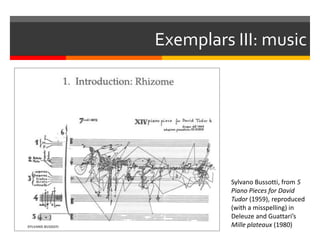
Sylvano Bussotti, from 5
Piano Pieces for David
Tudor (1959), reproduced
(with a misspelling) in
Deleuze and Guattari’s
Mille plateaux (1980)
‘Found’ sounds
 e.g. John Cage’s Imaginary Landscapes
 Imaginary Landscape No. 4 for 24 performers
at 12 radios (1951)
 Imaginary Landscape No. 5 for magnetic tape
recording of any 42 phonograph records (1952)
 “It is thus possible to make a musical
composition the continuity of which is free of
individual taste and memory (psychology) and
also of the literature and ‘traditions’ of the
art. The sounds enter the time-space centered
within themselves, unimpeded by service to
any abstraction, their 360 degrees of
circumference free for an infinite play of
interpenetration....” (John Cage, Silence:
Lectures and Writings, 1961)
Hip hop
 DJ Kool Herc developed the style that was the blueprint for hip hop music. Herc
used the record to focus on a short, heavily percussive, part in it: the "break".
Since this part of the record was the one the dancers liked best, Herc isolated,
changed to the other, and later, prolonged it. As one record reached the end of
the break, he cued the other record back to the beginning of the break, thereby
extending a relatively small part of a record into a "five-minute loop of fury".[9]
 This innovation had its roots in what he called "The Merry-Go-Round"—a
switching from break to break done at the height of the party. Herc told The New
York Times that he first introduced the Merry-Go-Round into his sets in
1972.[10] The earliest known Merry-Go-Round involved playing James Brown's
"Give It Up or Turnit A Loose" (with its refrain, "Now clap your hands! Stomp
your feet!"), then switching from its break into the break from "Bongo Rock"
by The Incredible Bongo Band, and from "Bongo Rock"'s break into that of "The
Mexican" by the English rock band Babe Ruth.[11]
 Source: http://en.wikipedia.org/wiki/DJ_Kool_Herc
Sampling
 The Verve, “Bitter Sweet Symphony” (1997)
(Ashcroft…)
 The Andrew Oldham Orchestra, “The Last Time”
(1966) (Jagger/Richards)
 The Rolling Stones, “The Last Time” (1965)
(Jagger/Richards)
 The Staple Singers, “This May Be The Last Time”
(1955) (trad.)
Open Source music?
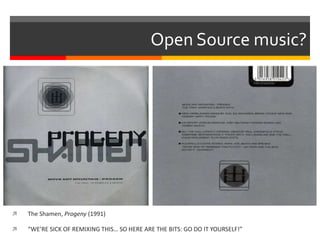
 The Shamen, Progeny (1991)
 “WE’RE SICK OF REMIXING THIS… SO HERE ARE THE BITS: GO DO IT YOURSELF!”
Questions for discussion
 How helpful are the preceding examples in thinking about
Arts research data in the HE sector?
 Where does creative research begin and end?
 What problems does practice-driven research introduce?
 How can we differentiate between funded research and
unfunded personal expression?
 What are the financial/ ownership issues accompanying
creative research?
 To what extent is non-digital material a problem?
 Which other disciplines share these issues?
 Is there merit in trying to pin these questions down?
Contact
 Martin Donnelly
 Digital Curation Centre
 University of Edinburgh
 Email: martin.donnelly@ed.ac.uk
 Twitter: @mkdDCC

'Found' and 'after' - a short history of data reuse in the arts

  • 1.
     ‘Found’ and ‘After’ Ashort history of data re-use in the Arts Martin Donnelly Digital Curation Centre University of Edinburgh Research Data Management Forum #10 University of Oxford, 4th September 2013 If the work is stylistically a copy after another artist's work, that artist should also be mentioned (e.g., Thomas Cole after Asher B. Durand).
  • 2.
    Contents  Argument /overview  Intertextuality  Exemplars  Text  Visual  Music
  • 3.
    Argument / overview There’s nothing new about data re-use in the Arts; in fact it’s an integral part of the culture, and always has been  However, it’s often more complicated than data re-use in other areas (such as the Sciences)  For starters, people tend not to think of their sources or influences as ‘data’  Also, the value and referencing systems are quite different  And research / production methods are not always rigorously methodical  This presentation offers a number of examples of data re-use in the Arts, with commentary tying each to common data concepts
  • 4.
    Intertextuality  Term coinedby Julia Kristeva in 1986  “a text’s dependence on prior words, concepts, connotations, codes, convention s, unconscious practices, and texts. Every text is an intertext that borrows, knowingly or not, from the immense archive of previous culture” - Adolphe Haberer. “Intertextuality in Theory and Practice.” Literatura 49.5 (2007)  "the networks are many and interact, without any one of them being able to surpass the rest; this text is a galaxy of signifiers, not a structure of signifieds; it has no beginning; it is reversible; we gain access to it by several entrances, none of which can be authoritatively declared to be the main one” - Roland Barthes. S/Z. Trans. Richard Miller. New York: Noonday (1974)  It’s not a huge conceptual leap from here to Linked Open Data…
  • 5.
    Exemplars I: text TomPhillips, A Humument (1970, 1986, 1998, 2004, 2012…)
  • 6.
    William Shakespeare  Witha few exceptions, Shakespeare did not invent the plots of his plays. Sometimes he used old stories (Hamlet, Pericles). Sometimes he worked from the stories of comparatively recent Italian writers, such as Giovanni Boccaccio—using both well-known stories (Romeo and Juliet, Much Ado About Nothing) and little-known ones (Othello). He used the popular prose fictions of his contemporaries in As You Like It and The Winter’s Tale.  In writing his historical plays, he drew largely from Sir Thomas North’s translation of Plutarch’s Lives of the Noble Grecians and Romans for the Roman plays and the chronicles of Edward Hall and Holinshed for the plays based upon English history. Some plays deal with rather remote and legendary history (King Lear, Cymbeline, Macbeth).  Earlier dramatists had occasionally used the same material (there were, for example, the earlier plays called The Famous Victories of Henry the Fifth and King Leir). But, because many plays of Shakespeare’s time have been lost, it is impossible to be sure of the relation between an earlier, lost play and Shakespeare’s surviving one: in the case of Hamlet it has been plausibly argued that an “old play,” known to have existed, was merely an early version of Shakespeare’s own.  Encyclopaedia Britannica, http://www.britannica.com/EBchecked/topic/537853/William- Shakespeare/232445/Shakespeares-sources
  • 7.
    T.S. Eliot T.S. Eliot,The Waste Land (1922)
  • 8.
  • 9.
    Variations on atheme This Is Just To Say I have eaten the plums that were in the icebox and which you were probably saving for breakfast Forgive me they were delicious so sweet and so cold William Carlos Williams Variations on a Theme by William Carlos Williams 1 I chopped down the house that you had been saving to live in next summer. I am sorry, but it was morning, and I had nothing to do and its wooden beams were so inviting. 2 We laughed at the hollyhocks together and then I sprayed them with lye. Forgive me. I simply do not know what I am doing. 3 I gave away the money that you had been saving to live on for the next ten years. The man who asked for it was shabby and the firm March wind on the porch was so juicy and cold. 4 Last evening we went dancing and I broke your leg. Forgive me. I was clumsy and I wanted you here in the wards, where I am the doctor! Kenneth Koch Jist ti Let Yi No (from the American of Carlos Williams) ahv drank thi speshlz that wurrin thi frij n thit yiwurr probbli hodn back furthi pahrti awright they wur great thaht stroang thaht cawld Tom Leonard There is a whole page of versions of this poem at http://www.wildhoneypress.com/voices/Williams.htm
  • 10.
    ‘Found’ poems Edwin Morgan,Collected Poems (1996) Manchester: Carcanet
  • 11.
    Exemplars II: visual JordanParsons, Rhizome 1 (2012)
  • 12.
    A Humument /Tree of Codes  Treated books, book sculptures… Tom Phillips, A Humument (1970, 1986, 1998, 2004, 2012…) – based on W.H. Mallock’s A Human Document (1892) Jonathan Safran Foer, Tree of Codes (2010) – based on Bruno Schulz’s The Street of Crocodiles (1934)
  • 13.
    Found / readymade Marcel Duchamp, Fountain (1917) and L.H.O.O.Q. (1919)
  • 14.
    Intermedia / sculpture TomDeininger, Self-Portrait (2007?)
  • 15.
    Collage Hannah Höch, Cutwith the Kitchen Knife through the Beer-Belly of the Weimar Republic (1919)
  • 16.
    Cartoons  Martin Rowson,after Donald McGill…
  • 17.
    Exemplars III: music SylvanoBussotti, from 5 Piano Pieces for David Tudor (1959), reproduced (with a misspelling) in Deleuze and Guattari’s Mille plateaux (1980)
  • 18.
    ‘Found’ sounds  e.g.John Cage’s Imaginary Landscapes  Imaginary Landscape No. 4 for 24 performers at 12 radios (1951)  Imaginary Landscape No. 5 for magnetic tape recording of any 42 phonograph records (1952)  “It is thus possible to make a musical composition the continuity of which is free of individual taste and memory (psychology) and also of the literature and ‘traditions’ of the art. The sounds enter the time-space centered within themselves, unimpeded by service to any abstraction, their 360 degrees of circumference free for an infinite play of interpenetration....” (John Cage, Silence: Lectures and Writings, 1961)
  • 19.
    Hip hop  DJKool Herc developed the style that was the blueprint for hip hop music. Herc used the record to focus on a short, heavily percussive, part in it: the "break". Since this part of the record was the one the dancers liked best, Herc isolated, changed to the other, and later, prolonged it. As one record reached the end of the break, he cued the other record back to the beginning of the break, thereby extending a relatively small part of a record into a "five-minute loop of fury".[9]  This innovation had its roots in what he called "The Merry-Go-Round"—a switching from break to break done at the height of the party. Herc told The New York Times that he first introduced the Merry-Go-Round into his sets in 1972.[10] The earliest known Merry-Go-Round involved playing James Brown's "Give It Up or Turnit A Loose" (with its refrain, "Now clap your hands! Stomp your feet!"), then switching from its break into the break from "Bongo Rock" by The Incredible Bongo Band, and from "Bongo Rock"'s break into that of "The Mexican" by the English rock band Babe Ruth.[11]  Source: http://en.wikipedia.org/wiki/DJ_Kool_Herc
  • 20.
    Sampling  The Verve,“Bitter Sweet Symphony” (1997) (Ashcroft…)  The Andrew Oldham Orchestra, “The Last Time” (1966) (Jagger/Richards)  The Rolling Stones, “The Last Time” (1965) (Jagger/Richards)  The Staple Singers, “This May Be The Last Time” (1955) (trad.)
  • 21.
    Open Source music? The Shamen, Progeny (1991)  “WE’RE SICK OF REMIXING THIS… SO HERE ARE THE BITS: GO DO IT YOURSELF!”
  • 22.
    Questions for discussion How helpful are the preceding examples in thinking about Arts research data in the HE sector?  Where does creative research begin and end?  What problems does practice-driven research introduce?  How can we differentiate between funded research and unfunded personal expression?  What are the financial/ ownership issues accompanying creative research?  To what extent is non-digital material a problem?  Which other disciplines share these issues?  Is there merit in trying to pin these questions down?
  • 23.
    Contact  Martin Donnelly Digital Curation Centre  University of Edinburgh  Email: martin.donnelly@ed.ac.uk  Twitter: @mkdDCC

Editor's Notes

  • #14 Marcel Duchamp coined the term ready-made in 1915 to describe a common object that had been selected and not materially altered in any way. Duchamp assembled Bicycle Wheel in 1913 by attaching a common front wheel and fork to the seat of a common stool. This was not long after his Nude Descending a Staircase was attracting the attention of critics at the International Exhibition of Modern Art. In 1917, Fountain, a urinal signed with the pseudonym "R. Mutt", and generally attributed to Duchamp, confounded the art world. In the same year, Duchamp indicated in a letter to his sister, Suzanne Duchamp, that a female friend was centrally involved in the conception of this work. As he writes: "One of my female friends who had adopted the pseudonym Richard Mutt sent me a porcelain urinal as a sculpture."[5] Irene Gammel argues that the piece is more in line with the scatological aesthetics of Duchamp's friend, the Baroness Elsa von Freytag-Loringhoven, than Duchamp's.[6]Research by Rhonda Roland Shearer indicates that Duchamp may have fabricated his found objects. Exhaustive research of mundane items like snow shovels and bottle racks in use at the time failed to reveal identical matches. The urinal, upon close inspection, is non-functional. However, there are accounts of Walter Arensberg and Joseph Stella being with Duchamp when he purchased the original Fountain at J. L. Mott Iron Works.[7]
  • #21 Verve song based on an orchestral version of a song, bearing very little resemblance to it, and which was in turn based on a traditional gospel song. The band even cleared the sample with the copyright holder, but after a legal challenge they were forced to change the songwriting credit to Jagger/Richards/Ashcroft and 100% of the royalties went to the Rolling Stones. A licensing/legal/creative nightmare.