COMP 4—Power Tools for the Mind 1
Power Tools
Word Processing
What we’ll cover for this lecture topic:
– Types and Examples of Application software
– Creating Documents with Word
– What is logical and physical document structure?
– Demos (as much as time permits)
• Including some useful hints and strategies
COMP 4—Power Tools for the Mind 2
Power Tools
Application Software (1)
• Some types:
– Document production:
•
– Graphics
•
– Presentation
– Numerical Analysis:
•
– Databases
• Word-processing, desktop publishing, web page
authoring
• Photo editing, Painting & drawing, CAD, animation,
video
• Spreadsheets, graphing, statistical
COMP 4—Power Tools for the Mind 3
Power Tools
Application Software (2)
• More types:
– Reference:
•
– Connectivity or communications:
•
– Education and training
– Business: accounting and finance
– Games!
– Office suites:
•
• Word-processing, spreadsheet, presentation, and
database software all carefully integrated
• Web browser, email, remote control, home networking
• Dictionary, encyclopedia, maps
COMP 4—Power Tools for the Mind 4
Power Tools
Application Software (3)
• Some Examples:
– Document production:
•
– Graphics
•
– Presentation
•
– Numerical Analysis:
•
– Databases
•
• MS Word, WordPerfect, FrameMaker, FrontPage, …
• PhotoShop, CorelDraw, AutoCAD, 3D Max, Maya,
Adobe Premiere
• MS PowerPoint
• MS Excel, Lotus 1-2-3, SPSS, …
• MS Access, Lotus Approach, Oracle
COMP 4—Power Tools for the Mind 5
Power Tools
Application Software (4)
• More Examples:
– Reference:
•
– Connectivity or communications:
•
– Education and training
– Business: accounting and finance
– Games!
– Office suites:
•
• MS Encarta, MS Streets, StreetFinder, Webster
Online,…
• MS Internet Explorer, MS Outlook, Netscape
Communicator, Opera, Mulberry, AOL, …
• MS Office, MS Works, OpenOffice, StarOffice, …
COMP 4—Power Tools for the Mind 6
Power Tools
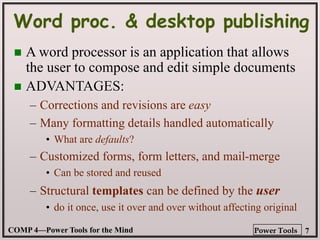
BASIC SUITE
• Word processor (Word)
• Spreadsheet (Excel)
• Email utility (Outlook)
• Web browser (Internet
Explorer)
PROFESSIONAL SUITE
Also includes:
• Presentation maker
(PowerPoint)
• Desktop Web publisher
(Front Page)
• Database (Access)
The Microsoft Office Suite
COMP 4—Power Tools for the Mind 7
Power Tools
Word proc. & desktop publishing
 A word processor is an application that allows
the user to compose and edit simple documents
 ADVANTAGES:
– Corrections and revisions are easy
– Many formatting details handled automatically
• What are defaults?
– Customized forms, form letters, and mail-merge
• Can be stored and reused
– Structural templates can be defined by the user
• do it once, use it over and over without affecting original
COMP 4—Power Tools for the Mind 8
Power Tools
• Like computers, text documents have both:
– a logical structure, which stays the same no
matter how the document is represented, and
– a physical structure, that may be
• different on paper than on a screen;
• different with one page layout than another
• different from printer to printer
– When document gets put out: the “best fit” to
that device is calculated from the logical
structure that the computer knows.
COMP 4—Power Tools for the Mind 9
Power Tools
• SO WHAT? What’s that mean?
• BEWARE: what you see is not
always what you get.
– The physical structure of a document is
system-dependent; i.e., fonts and tab
spacing vary among systems.
– In addition, systems must often
approximate the physical format due to
limitations of the printer. As a result,
formatting on the printout may not
match the formatting shown on the
screen.
COMP 4—Power Tools for the Mind 10
Power Tools
Table of contents
Title
Author
Date
Abstract
Major heading 1
Subhead 1
Text
Major heading 2
Subhead 2
Text
References
Footnotes
Bibliography
LOGICAL STRUCTURE
The information in a document and the order in which it is
presented is referred to as the document’s logical structure.
Here is one simple logical ordering of information:
COMP 4—Power Tools for the Mind 11
Power Tools
• Previous page shows parts of document’s
logical structure: how my ideas are organized.
• Different from layout--how my ideas are
represented or shown.
– Example: Use of major headings
• An important idea becomes a major heading: that’s
part of the logical structure.
• How I will show that the idea is a major heading is
part of the physical structure.
– Such as how?
Writing and editing
• Creating the logical structure:
TEXT ENTRY
• Modifying the logical structure:
EDITING
• MS Word has many tools to help.
– Many under Edit and Tools menus. A few:
• Cut & Paste
• Copy & Paste
• Find & Replace
• Spell/grammar check
• Thesaurus
– Hint: use key combinations to save time.
Buttons are ok but often slower to use. Why?
COMP 4—Power Tools for the Mind 13
Power Tools
– where ink will be on paper…or dots on
the screen. “Page layout”
– Logical structure is converted into pixels:
one set of pixels on screen; different set for
each printer.
PHYSICAL STRUCTURE
Formatting
Formatting—e.g., indentation, text color, style, size, etc.—
changes the physical structure of a document.
COMP 4—Power Tools for the Mind 14
Power Tools
Nowis the time for all
goodmen….
COMP 4—Power Tools for the Mind 15
Power Tools
• Many formatting tools-- File & Format menus
(again, keyboard shortcuts are handy). A few:
– Page Setup (margins; page orientation; ...)
– Font Type, Size, Style, Color
– Text Alignment
– Header & Footer formatting
– Number & bullet lists
– Insert (Break; Page no; Art...)
– Borders
– Tabs
– Lists: numbered, bulleted, etc.
– Tables ... DEMO

Word Processing.ppt

  • 1.
    COMP 4—Power Toolsfor the Mind 1 Power Tools Word Processing What we’ll cover for this lecture topic: – Types and Examples of Application software – Creating Documents with Word – What is logical and physical document structure? – Demos (as much as time permits) • Including some useful hints and strategies
  • 2.
    COMP 4—Power Toolsfor the Mind 2 Power Tools Application Software (1) • Some types: – Document production: • – Graphics • – Presentation – Numerical Analysis: • – Databases • Word-processing, desktop publishing, web page authoring • Photo editing, Painting & drawing, CAD, animation, video • Spreadsheets, graphing, statistical
  • 3.
    COMP 4—Power Toolsfor the Mind 3 Power Tools Application Software (2) • More types: – Reference: • – Connectivity or communications: • – Education and training – Business: accounting and finance – Games! – Office suites: • • Word-processing, spreadsheet, presentation, and database software all carefully integrated • Web browser, email, remote control, home networking • Dictionary, encyclopedia, maps
  • 4.
    COMP 4—Power Toolsfor the Mind 4 Power Tools Application Software (3) • Some Examples: – Document production: • – Graphics • – Presentation • – Numerical Analysis: • – Databases • • MS Word, WordPerfect, FrameMaker, FrontPage, … • PhotoShop, CorelDraw, AutoCAD, 3D Max, Maya, Adobe Premiere • MS PowerPoint • MS Excel, Lotus 1-2-3, SPSS, … • MS Access, Lotus Approach, Oracle
  • 5.
    COMP 4—Power Toolsfor the Mind 5 Power Tools Application Software (4) • More Examples: – Reference: • – Connectivity or communications: • – Education and training – Business: accounting and finance – Games! – Office suites: • • MS Encarta, MS Streets, StreetFinder, Webster Online,… • MS Internet Explorer, MS Outlook, Netscape Communicator, Opera, Mulberry, AOL, … • MS Office, MS Works, OpenOffice, StarOffice, …
  • 6.
    COMP 4—Power Toolsfor the Mind 6 Power Tools BASIC SUITE • Word processor (Word) • Spreadsheet (Excel) • Email utility (Outlook) • Web browser (Internet Explorer) PROFESSIONAL SUITE Also includes: • Presentation maker (PowerPoint) • Desktop Web publisher (Front Page) • Database (Access) The Microsoft Office Suite
  • 7.
    COMP 4—Power Toolsfor the Mind 7 Power Tools Word proc. & desktop publishing  A word processor is an application that allows the user to compose and edit simple documents  ADVANTAGES: – Corrections and revisions are easy – Many formatting details handled automatically • What are defaults? – Customized forms, form letters, and mail-merge • Can be stored and reused – Structural templates can be defined by the user • do it once, use it over and over without affecting original
  • 8.
    COMP 4—Power Toolsfor the Mind 8 Power Tools • Like computers, text documents have both: – a logical structure, which stays the same no matter how the document is represented, and – a physical structure, that may be • different on paper than on a screen; • different with one page layout than another • different from printer to printer – When document gets put out: the “best fit” to that device is calculated from the logical structure that the computer knows.
  • 9.
    COMP 4—Power Toolsfor the Mind 9 Power Tools • SO WHAT? What’s that mean? • BEWARE: what you see is not always what you get. – The physical structure of a document is system-dependent; i.e., fonts and tab spacing vary among systems. – In addition, systems must often approximate the physical format due to limitations of the printer. As a result, formatting on the printout may not match the formatting shown on the screen.
  • 10.
    COMP 4—Power Toolsfor the Mind 10 Power Tools Table of contents Title Author Date Abstract Major heading 1 Subhead 1 Text Major heading 2 Subhead 2 Text References Footnotes Bibliography LOGICAL STRUCTURE The information in a document and the order in which it is presented is referred to as the document’s logical structure. Here is one simple logical ordering of information:
  • 11.
    COMP 4—Power Toolsfor the Mind 11 Power Tools • Previous page shows parts of document’s logical structure: how my ideas are organized. • Different from layout--how my ideas are represented or shown. – Example: Use of major headings • An important idea becomes a major heading: that’s part of the logical structure. • How I will show that the idea is a major heading is part of the physical structure. – Such as how?
  • 12.
    Writing and editing •Creating the logical structure: TEXT ENTRY • Modifying the logical structure: EDITING • MS Word has many tools to help. – Many under Edit and Tools menus. A few: • Cut & Paste • Copy & Paste • Find & Replace • Spell/grammar check • Thesaurus – Hint: use key combinations to save time. Buttons are ok but often slower to use. Why?
  • 13.
    COMP 4—Power Toolsfor the Mind 13 Power Tools – where ink will be on paper…or dots on the screen. “Page layout” – Logical structure is converted into pixels: one set of pixels on screen; different set for each printer. PHYSICAL STRUCTURE Formatting Formatting—e.g., indentation, text color, style, size, etc.— changes the physical structure of a document.
  • 14.
    COMP 4—Power Toolsfor the Mind 14 Power Tools Nowis the time for all goodmen….
  • 15.
    COMP 4—Power Toolsfor the Mind 15 Power Tools • Many formatting tools-- File & Format menus (again, keyboard shortcuts are handy). A few: – Page Setup (margins; page orientation; ...) – Font Type, Size, Style, Color – Text Alignment – Header & Footer formatting – Number & bullet lists – Insert (Break; Page no; Art...) – Borders – Tabs – Lists: numbered, bulleted, etc. – Tables ... DEMO