Wolves   By: Arilyn M
Info
A wolves skeleton
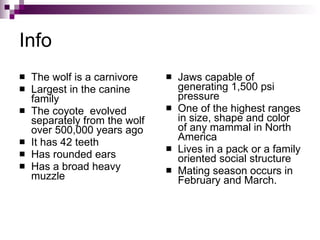
Info The wolf is a carnivore Largest in the canine  family The coyote  evolved separately from the wolf over 500,000 years ago It has 42 teeth Has rounded ears Has a broad heavy muzzle Jaws capable of generating 1,500 psi pressure One of the highest ranges in size, shape and color of any mammal in North America Lives in a pack or a family oriented social structure Mating season occurs in February and March.
Info (cont.) Gestation period lasts for 63 days Pups are born in April and May Average litter size is 4-7 pups Litter size for the wolf depends on nutrition as well as fittness Mortality rates for pups is 50% A wolfs communication consists of vocalizations, visual displays, facial and body postures and rituals
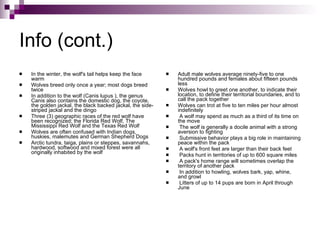
Info (cont.) In the winter, the wolf's tail helps keep the face warm  Wolves breed only once a year; most dogs breed twice  In addition to the wolf (Canis lupus ), the genus Canis also contains the domestic dog, the coyote, the golden jackal, the black backed jackal, the side-striped jackal and the dingo  Three (3) geographic races of the red wolf have been recognized; the Florida Red Wolf, The Mississippi Red Wolf and the Texas Red Wolf  Wolves are often confused with Indian dogs, huskies, malemutes and German Shepherd Dogs  Arctic tundra, taiga, plains or steppes, savannahs, hardwood, softwood and mixed forest were all originally inhabited by the wolf Adult male wolves average ninety-five to one hundred pounds and females about fifteen pounds less Wolves howl to greet one another, to indicate their location, to define their territorial boundaries, and to call the pack together  Wolves can trot at five to ten miles per hour almost indefinitely A wolf may spend as much as a third of its time on the move   The wolf is generally a docile animal with a strong aversion to fighting Submissive behavior plays a big role in maintaining peace within the pack A wolf's front feet are larger than their back feet  Packs hunt in territories of up to 600 square miles  A pack's home range will sometimes overlap the territory of another pack  In addition to howling, wolves bark, yap, whine, and growl  Litters of up to 14 pups are born in April through June 
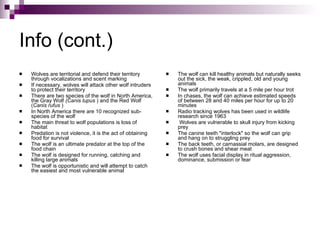
Info (cont.) Wolves are territorial and defend their territory through vocalizations and scent marking  If necessary, wolves will attack other wolf intruders to protect their territory There are two species of the wolf in North America, the Gray Wolf  (Canis lupus  ) and the Red Wolf ( Canis rufus  ) In North America there are 10 recognized sub-species of the wolf The main threat to wolf populations is loss of habitat Predation is not violence, it is the act of obtaining food for survival The wolf is an ultimate predator at the top of the food chain The wolf is designed for running, catching and killing large animals The wolf is opportunistic and will attempt to catch the easiest and most vulnerable animal The wolf can kill healthy animals but naturally seeks out the sick, the weak, crippled, old and young animals The wolf primarily travels at a 5 mile per hour trot In chases, the wolf can achieve estimated speeds of between 28 and 40 miles per hour for up to 20 minutes Radio tracking wolves has been used in wildlife research since 1963 Wolves are vulnerable to skull injury from kicking prey The canine teeth "interlock" so the wolf can grip and hang on to struggling prey The back teeth, or carnassial molars, are designed to crush bones and shear meat The wolf uses facial display in ritual aggression, dominance, submission or fear
Pictures In this photo gallery please tell me what you think the wolf is doing!


Wolves

  • 1.
    Wolves By: Arilyn M
  • 2.
  • 3.
  • 4.
    Info The wolfis a carnivore Largest in the canine family The coyote evolved separately from the wolf over 500,000 years ago It has 42 teeth Has rounded ears Has a broad heavy muzzle Jaws capable of generating 1,500 psi pressure One of the highest ranges in size, shape and color of any mammal in North America Lives in a pack or a family oriented social structure Mating season occurs in February and March.
  • 5.
    Info (cont.) Gestationperiod lasts for 63 days Pups are born in April and May Average litter size is 4-7 pups Litter size for the wolf depends on nutrition as well as fittness Mortality rates for pups is 50% A wolfs communication consists of vocalizations, visual displays, facial and body postures and rituals
  • 6.
    Info (cont.) Inthe winter, the wolf's tail helps keep the face warm  Wolves breed only once a year; most dogs breed twice  In addition to the wolf (Canis lupus ), the genus Canis also contains the domestic dog, the coyote, the golden jackal, the black backed jackal, the side-striped jackal and the dingo  Three (3) geographic races of the red wolf have been recognized; the Florida Red Wolf, The Mississippi Red Wolf and the Texas Red Wolf  Wolves are often confused with Indian dogs, huskies, malemutes and German Shepherd Dogs  Arctic tundra, taiga, plains or steppes, savannahs, hardwood, softwood and mixed forest were all originally inhabited by the wolf Adult male wolves average ninety-five to one hundred pounds and females about fifteen pounds less Wolves howl to greet one another, to indicate their location, to define their territorial boundaries, and to call the pack together  Wolves can trot at five to ten miles per hour almost indefinitely A wolf may spend as much as a third of its time on the move   The wolf is generally a docile animal with a strong aversion to fighting Submissive behavior plays a big role in maintaining peace within the pack A wolf's front feet are larger than their back feet  Packs hunt in territories of up to 600 square miles  A pack's home range will sometimes overlap the territory of another pack  In addition to howling, wolves bark, yap, whine, and growl  Litters of up to 14 pups are born in April through June 
  • 7.
    Info (cont.) Wolvesare territorial and defend their territory through vocalizations and scent marking  If necessary, wolves will attack other wolf intruders to protect their territory There are two species of the wolf in North America, the Gray Wolf (Canis lupus ) and the Red Wolf ( Canis rufus ) In North America there are 10 recognized sub-species of the wolf The main threat to wolf populations is loss of habitat Predation is not violence, it is the act of obtaining food for survival The wolf is an ultimate predator at the top of the food chain The wolf is designed for running, catching and killing large animals The wolf is opportunistic and will attempt to catch the easiest and most vulnerable animal The wolf can kill healthy animals but naturally seeks out the sick, the weak, crippled, old and young animals The wolf primarily travels at a 5 mile per hour trot In chases, the wolf can achieve estimated speeds of between 28 and 40 miles per hour for up to 20 minutes Radio tracking wolves has been used in wildlife research since 1963 Wolves are vulnerable to skull injury from kicking prey The canine teeth "interlock" so the wolf can grip and hang on to struggling prey The back teeth, or carnassial molars, are designed to crush bones and shear meat The wolf uses facial display in ritual aggression, dominance, submission or fear
  • 8.
    Pictures In thisphoto gallery please tell me what you think the wolf is doing!
  • 9.
  • 10.
  • 11.
  • 12.
  • 13.
  • 14.
  • 15.
  • 16.
  • 17.
  • 18.