By: Daisja
1 How do wolves communication?
2 Wolves have an undeserved reputation?
3 How much do they eat?
4 Where do wolves live?
5 How many are in the world?
6 How long do they live?
7 How do wolves travel?
8 Why animals are related?
9 How their body made?
Wolves from different places may howl in
different ways. The howls of European wolves are
much louder than North American wolves.
They have a long history of been hunted by
humans because they kill their farm animals.
Wolves eat both large size prey such as moose
and bison, and medium sized prey like deer and
sheep.
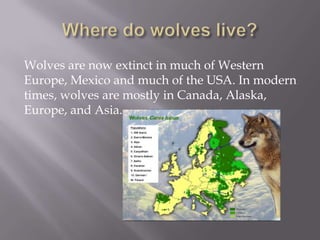
Wolves are now extinct in much of Western
Europe, Mexico and much of the USA. In modern
times, wolves are mostly in Canada, Alaska,
Europe, and Asia.
Wolf population declined in the 1970s and
numbered only 100 by 1973 in the United States.
The lifespan of wolves differ based on the breed.
Wild wolves can live for up to twelve years, while
wolves in captivity have live for over sixteen
years. The record lifespan of a wolf is twenty
years.
The average wolf pack consists of a family of five
to eleven animals. This includes one to two
adults, three to six juveniles, and one to three
yearlings.
The wolves biological family are mammals that
includes domestic wolves, dogs, foxes, jackals,
and coyotes.
Wolves are the largest member of its family, with
males averaging forty three to forty five kg ninety
five to ninety nine lbs, and females 36 to 38. 5 kg
79 to 85 lbs. Compared to equally sized dogs,
wolves tend to have 20% larger skulls and 10%
bigger brains.
Captivity- Held under control.
Extinct- No longer existing.
Howling- Sounds wolves make to communicate
with each other.
Juveniles- Pup or young wolf.
Prey- An animal taken as food.
Population- The total of individuals occupying an
area.
Yearlings- An animal one year old or in the
second year of its age.
Biological family page 9
Captivity page 6
Juveniles page 7
Howling page 1
Prey page 3
Population page 5
Yearlings page 7
My name is Daisja. I am in 3th grade. I go to
Shades Mountain Elementary School. I am in
Mrs. Marchant’s class. My favorite hobby is play
on the basketball team.
I wrote this book because I wanted to learn more
about wolves.

Wolves

  • 1.
  • 2.
    1 How dowolves communication? 2 Wolves have an undeserved reputation? 3 How much do they eat? 4 Where do wolves live? 5 How many are in the world? 6 How long do they live? 7 How do wolves travel? 8 Why animals are related? 9 How their body made?
  • 3.
    Wolves from differentplaces may howl in different ways. The howls of European wolves are much louder than North American wolves.
  • 4.
    They have along history of been hunted by humans because they kill their farm animals.
  • 5.
    Wolves eat bothlarge size prey such as moose and bison, and medium sized prey like deer and sheep.
  • 6.
    Wolves are nowextinct in much of Western Europe, Mexico and much of the USA. In modern times, wolves are mostly in Canada, Alaska, Europe, and Asia.
  • 7.
    Wolf population declinedin the 1970s and numbered only 100 by 1973 in the United States.
  • 8.
    The lifespan ofwolves differ based on the breed. Wild wolves can live for up to twelve years, while wolves in captivity have live for over sixteen years. The record lifespan of a wolf is twenty years.
  • 9.
    The average wolfpack consists of a family of five to eleven animals. This includes one to two adults, three to six juveniles, and one to three yearlings.
  • 10.
    The wolves biologicalfamily are mammals that includes domestic wolves, dogs, foxes, jackals, and coyotes.
  • 11.
    Wolves are thelargest member of its family, with males averaging forty three to forty five kg ninety five to ninety nine lbs, and females 36 to 38. 5 kg 79 to 85 lbs. Compared to equally sized dogs, wolves tend to have 20% larger skulls and 10% bigger brains.
  • 12.
    Captivity- Held undercontrol. Extinct- No longer existing. Howling- Sounds wolves make to communicate with each other. Juveniles- Pup or young wolf. Prey- An animal taken as food. Population- The total of individuals occupying an area. Yearlings- An animal one year old or in the second year of its age.
  • 13.
    Biological family page9 Captivity page 6 Juveniles page 7 Howling page 1 Prey page 3 Population page 5 Yearlings page 7
  • 14.
    My name isDaisja. I am in 3th grade. I go to Shades Mountain Elementary School. I am in Mrs. Marchant’s class. My favorite hobby is play on the basketball team.
  • 15.
    I wrote thisbook because I wanted to learn more about wolves.