ABC Book By: Lizeet Mendoza
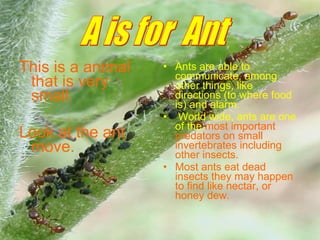
This is a animal that is very small. Look at the ant move. Ants are able to communicate, among other things, like directions (to where food is) and alarm. World wide, ants are one of the   most important predators on small invertebrates including other insects. Most ants eat dead insects they may happen to find like nectar, or honey dew. A is for  Ant
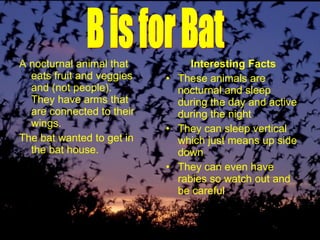
A nocturnal animal that eats fruit and veggies and (not people). They have arms that are connected to their wings. The bat wanted to get in the bat house. Interesting Facts These animals are nocturnal and sleep during the day and active during the night They can sleep vertical which just means up side down They can even have rabies so watch out and be careful B is for Bat
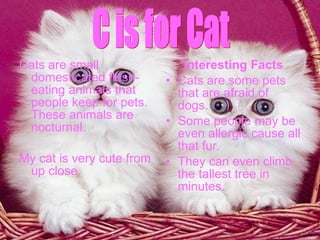
Cats are small domesticated flesh-eating animals that people keep for pets. These animals are nocturnal. My cat is very cute from up close. Interesting Facts Cats are some pets that are afraid of dogs. Some people may be even allergic cause all that fur. They can even climb the tallest tree in minutes. C is for Cat
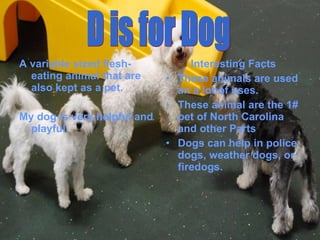
A variable sized flesh-eating animal that are also kept as a pet. My dog is very helpful and playful.   Interesting Facts These animals are used an a lot of uses. These animal are the 1# pet of North Carolina and other Parts  Dogs can help in police dogs, weather dogs, or firedogs. D is for Dog
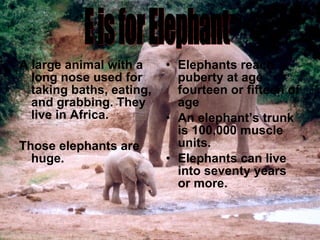
A large animal with a long nose used for taking baths, eating, and grabbing. They live in Africa. Those elephants are huge. Elephants reach   puberty at age fourteen or fifteen of age An elephant’s trunk is 100,000 muscle units. Elephants can live into seventy years or more. E is for Elephant
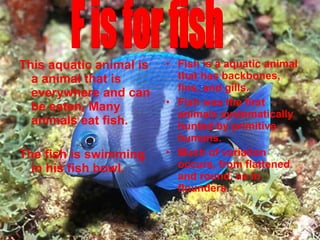
This aquatic animal is a animal that is everywhere and can be eaten. Many animals eat fish. The fish is swimming in his fish bowl. Fish is a aquatic animal that has backbones, fins, and gills. Fish was the first animals systematically hunted by primitive humans. Much of variation occurs, from flattened and round, as in flounders . F is for fish
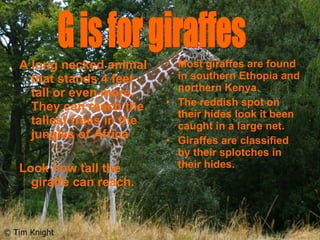
A long necked animal that stands 4 feet tall or even more. They can reach the tallest trees in the jungles of Africa Look how tall the giraffe can reach. Most giraffes are found in southern Ethopia and northern Kenya. The reddish spot on their hides look it been caught in a large net. Giraffes are classified by their splotches in their hides. G is for giraffes
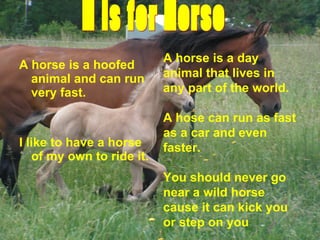
A horse is a hoofed animal and can run very fast. I like to have a horse of my own to ride it. H is for Horse A horse is a day animal that lives in any part of the world. A hose can run as fast as a car and even faster. You should never go near a wild horse cause it can kick you or step on you
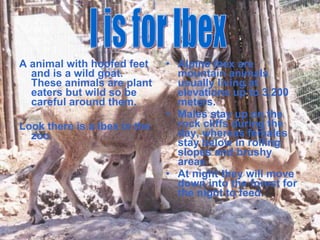
A animal with hoofed feet and is a wild goat. These animals are plant eaters but wild so be careful around them. Look there is a ibex in the zoo. Alpine ibex are mountain animals usually living at elevations up to 3,200 meters. Males stay up on the rock cliffs during the day, whereas females stay below in rolling slopes and brushy areas At night they will move down into the forest for the night to feed. I is for Ibex
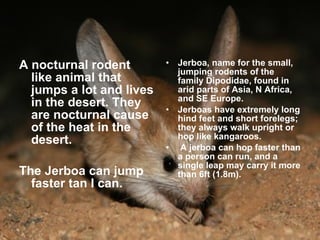
A nocturnal rodent like animal that jumps a lot and lives in the desert. They are nocturnal cause of the heat in the desert. The Jerboa can jump faster tan I can. Jerboa, name for the small, jumping rodents of the family Dipodidae, found in arid parts of Asia, N Africa, and SE Europe. Jerboas have extremely long hind feet and short forelegs; they always walk upright or hop like kangaroos. A jerboa can hop faster than a person can run, and a single leap may carry it more than 6ft (1.8m).
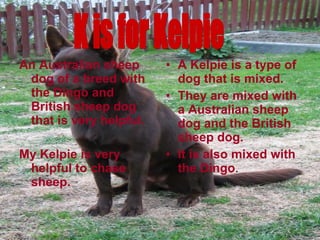
An Australian sheep dog of a breed with the Dingo and British sheep dog that is very helpful. My Kelpie is very helpful to chase sheep. A Kelpie is a type of dog that is mixed. They are mixed with a Australian sheep dog and the British sheep dog. It is also mixed with the Dingo . K is for Kelpie
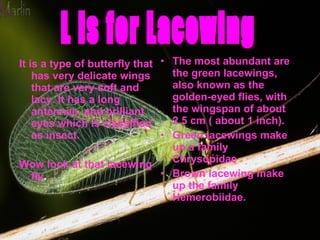
It is a type of butterfly that has very delicate wings that are very soft and lacy. It has a long antennae, and brilliant eyes which is classified as insect. Wow look at that lacewing fly . The most abundant are the green lacewings, also known as the golden-eyed flies, with the wingspan of about 2.5 cm ( about 1 inch). Green lacewings make up a family Chrysopidae Brown lacewing make up the family Hemerobiidae. L is for Lacewing
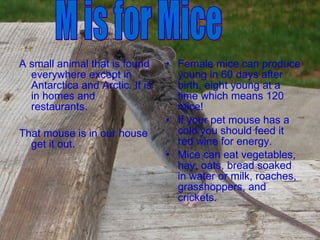
A small animal that is found everywhere except in Antarctica and Arctic. It is in homes and restaurants. That mouse is in our house get it out. Female mice can produce young in 60 days after birth, eight young at a time which means 120 mice! If your pet mouse has a cold you should feed it red wine for energy. Mice can eat vegetables, hay, oats, bread soaked in water or milk, roaches, grasshoppers, and crickets. M is for Mice
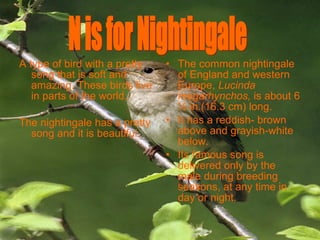
A type of bird with a pretty song that is soft and amazing. These birds live in parts of the world. The nightingale has a pretty song and it is beautiful. The common nightingale of England and western Europe,  Lucinda megarhynchos,  is   about 6 ½ in.(16.3 cm) long. It has a reddish- brown above and grayish-white below. Its famous song is delivered only by the male during breeding seasons, at any time in day or night. N is for Nightingale
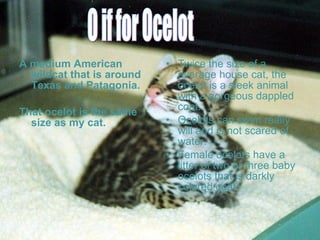
A medium American wildcat that is around Texas and Patagonia. That ocelot is the same size as my cat. Twice the size of a average house cat, the ocelot is a sleek animal with a gorgeous dappled coat. Ocelots can swim really will and is not scared of water. Female ocelots have a litter of two or three baby ocelots that is darkly colored coat. O if for Ocelot
This bamboo eating animal is so slow and sleeps a lot. (That is why they are FAT) They also sleep so much they don’t have enough time to keep their bodies in shape. That panda is so big that it can squish anything. Pandas live in the mountains slopes and exist on a very large appetite. An adult panda can grow into 3 ½ to five feet and weigh up to 350lb. A baby panda can weigh five ounces and at the end of the year 70 or 80 pounds. *they stay with their mother in 1 ½ years. P is for Panda
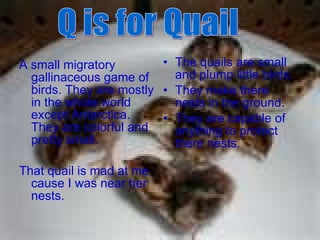
A small migratory gallinaceous game of birds. They are mostly in the whole world except Antarctica. They are colorful and pretty small. That quail is mad at me cause I was near her nests. The quails are small and plump little birds.  They make there nests in the ground. They are capable of anything to protect there nests. Q is for Quail
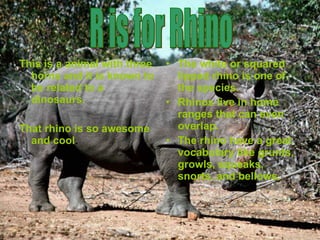
This is a animal with three horns and it is known to be related to a dinosaurs.  That rhino is so awesome and cool . The white or squared lipped rhino is one of the species. Rhinos live in home ranges that can even overlap. The rhino have a great vocabulary like grunts, growls, squeaks, snorts, and bellows. R is for Rhino
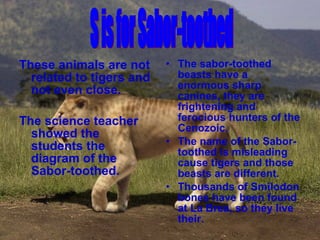
These animals are not related to tigers and not even close. The science teacher showed the students the diagram of the Sabor-toothed. The sabor-toothed beasts have a enormous sharp canines, they are frightening and ferocious hunters of the Cenozoic. The name of the Sabor-toothed is misleading cause tigers and those beasts are different. Thousands of Smilodon bones have been found at La Brea, so they live their. S is for Sabor-toothed
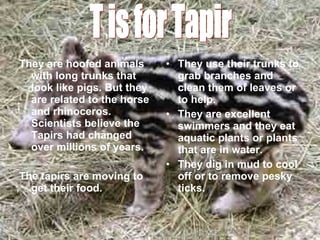
They are hoofed animals with long trunks that look like pigs. But they are related to the horse and rhinoceros. Scientists believe the Tapirs had changed over millions of years.  The tapirs are moving to get their food. They use their trunks to grab branches and clean them of leaves or to help. They are excellent swimmers and they eat aquatic plants or plants that are in water. They dig in mud to cool off or to remove pesky ticks. T is for Tapir
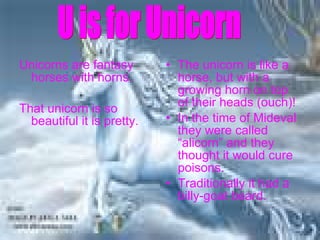
Unicorns are fantasy horses with horns. That unicorn is so beautiful it is pretty. The unicorn is like a horse, but with a growing horn on top of their heads (ouch)! In the time of Mideval they were called “alicorn” and they thought it would cure poisons. Traditionally it had a billy-goat beard. U is for Unicorn
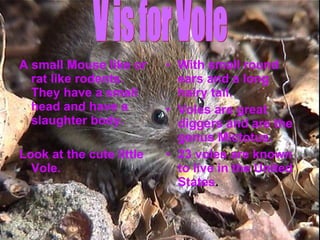
A small Mouse like or rat like rodents. They have a small head and have a slaughter body.  Look at the cute little Vole. With small round ears and a long hairy tail.  Voles are great diggers and are the genus Mictotus. 23 voles are known to live in the United States . V is for Vole
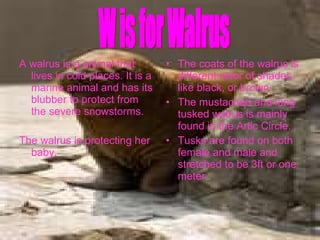
A walrus is a animal that lives in cold places. It is a marine animal and has its blubber to protect from the severe snowstorms.  The walrus is protecting her baby. The coats of the walrus is different color of shades like black, or brown. The mustached and long tusked walrus is mainly found in the Artic Circle. Tusks are found on both female and male and stretched to be 3ft or one meter. W is for Walrus
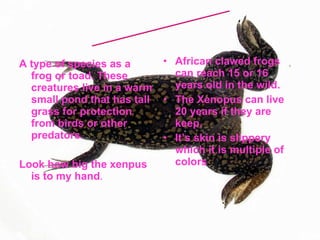
A type of species as a frog or toad. These creatures live in a warm small pond that has tall grass for protection from birds or other predators. Look how big the xenpus is to my hand . African clawed frogs can reach 15 or 16 years old in the wild. The Xenopus can live 20 years if they are keep. It’s skin is slippery which it is multiple of colors . X is for Xenopus
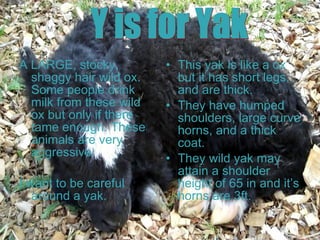
A LARGE, stocky, shaggy hair wild ox. Some people drink milk from these wild ox but only if there tame enough. These animals are very aggressive. I want to be careful around a yak. This yak is like a ox but it has short legs, and are thick. They have humped shoulders, large curve horns, and a thick coat. They wild yak may attain a shoulder height of 65 in and it’s horns are 3ft. Y is for Yak
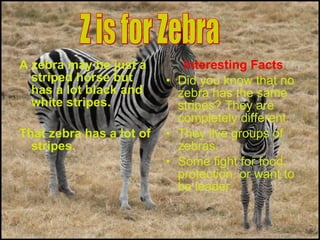
A zebra may be just a striped horse but has a lot black and white stripes.  That zebra has a lot of stripes. Interesting Facts Did you know that no zebra has the same stripes? They are completely different.  They live groups of zebras. Some fight for food, protection, or want to be leader. Z is for Zebra
Hi I am the auther of this book and I am 11 years old. I wrote this to help young people to understand animals from the world. I hope this book have been helpful to those that need it. My Background

Animal Abc book

  • 1.
    ABC Book By:Lizeet Mendoza
  • 2.
    This is aanimal that is very small. Look at the ant move. Ants are able to communicate, among other things, like directions (to where food is) and alarm. World wide, ants are one of the most important predators on small invertebrates including other insects. Most ants eat dead insects they may happen to find like nectar, or honey dew. A is for Ant
  • 3.
    A nocturnal animalthat eats fruit and veggies and (not people). They have arms that are connected to their wings. The bat wanted to get in the bat house. Interesting Facts These animals are nocturnal and sleep during the day and active during the night They can sleep vertical which just means up side down They can even have rabies so watch out and be careful B is for Bat
  • 4.
    Cats are smalldomesticated flesh-eating animals that people keep for pets. These animals are nocturnal. My cat is very cute from up close. Interesting Facts Cats are some pets that are afraid of dogs. Some people may be even allergic cause all that fur. They can even climb the tallest tree in minutes. C is for Cat
  • 5.
    A variable sizedflesh-eating animal that are also kept as a pet. My dog is very helpful and playful. Interesting Facts These animals are used an a lot of uses. These animal are the 1# pet of North Carolina and other Parts Dogs can help in police dogs, weather dogs, or firedogs. D is for Dog
  • 6.
    A large animalwith a long nose used for taking baths, eating, and grabbing. They live in Africa. Those elephants are huge. Elephants reach puberty at age fourteen or fifteen of age An elephant’s trunk is 100,000 muscle units. Elephants can live into seventy years or more. E is for Elephant
  • 7.
    This aquatic animalis a animal that is everywhere and can be eaten. Many animals eat fish. The fish is swimming in his fish bowl. Fish is a aquatic animal that has backbones, fins, and gills. Fish was the first animals systematically hunted by primitive humans. Much of variation occurs, from flattened and round, as in flounders . F is for fish
  • 8.
    A long neckedanimal that stands 4 feet tall or even more. They can reach the tallest trees in the jungles of Africa Look how tall the giraffe can reach. Most giraffes are found in southern Ethopia and northern Kenya. The reddish spot on their hides look it been caught in a large net. Giraffes are classified by their splotches in their hides. G is for giraffes
  • 9.
    A horse isa hoofed animal and can run very fast. I like to have a horse of my own to ride it. H is for Horse A horse is a day animal that lives in any part of the world. A hose can run as fast as a car and even faster. You should never go near a wild horse cause it can kick you or step on you
  • 10.
    A animal withhoofed feet and is a wild goat. These animals are plant eaters but wild so be careful around them. Look there is a ibex in the zoo. Alpine ibex are mountain animals usually living at elevations up to 3,200 meters. Males stay up on the rock cliffs during the day, whereas females stay below in rolling slopes and brushy areas At night they will move down into the forest for the night to feed. I is for Ibex
  • 11.
    A nocturnal rodentlike animal that jumps a lot and lives in the desert. They are nocturnal cause of the heat in the desert. The Jerboa can jump faster tan I can. Jerboa, name for the small, jumping rodents of the family Dipodidae, found in arid parts of Asia, N Africa, and SE Europe. Jerboas have extremely long hind feet and short forelegs; they always walk upright or hop like kangaroos. A jerboa can hop faster than a person can run, and a single leap may carry it more than 6ft (1.8m).
  • 12.
    An Australian sheepdog of a breed with the Dingo and British sheep dog that is very helpful. My Kelpie is very helpful to chase sheep. A Kelpie is a type of dog that is mixed. They are mixed with a Australian sheep dog and the British sheep dog. It is also mixed with the Dingo . K is for Kelpie
  • 13.
    It is atype of butterfly that has very delicate wings that are very soft and lacy. It has a long antennae, and brilliant eyes which is classified as insect. Wow look at that lacewing fly . The most abundant are the green lacewings, also known as the golden-eyed flies, with the wingspan of about 2.5 cm ( about 1 inch). Green lacewings make up a family Chrysopidae Brown lacewing make up the family Hemerobiidae. L is for Lacewing
  • 14.
    A small animalthat is found everywhere except in Antarctica and Arctic. It is in homes and restaurants. That mouse is in our house get it out. Female mice can produce young in 60 days after birth, eight young at a time which means 120 mice! If your pet mouse has a cold you should feed it red wine for energy. Mice can eat vegetables, hay, oats, bread soaked in water or milk, roaches, grasshoppers, and crickets. M is for Mice
  • 15.
    A type ofbird with a pretty song that is soft and amazing. These birds live in parts of the world. The nightingale has a pretty song and it is beautiful. The common nightingale of England and western Europe, Lucinda megarhynchos, is about 6 ½ in.(16.3 cm) long. It has a reddish- brown above and grayish-white below. Its famous song is delivered only by the male during breeding seasons, at any time in day or night. N is for Nightingale
  • 16.
    A medium Americanwildcat that is around Texas and Patagonia. That ocelot is the same size as my cat. Twice the size of a average house cat, the ocelot is a sleek animal with a gorgeous dappled coat. Ocelots can swim really will and is not scared of water. Female ocelots have a litter of two or three baby ocelots that is darkly colored coat. O if for Ocelot
  • 17.
    This bamboo eatinganimal is so slow and sleeps a lot. (That is why they are FAT) They also sleep so much they don’t have enough time to keep their bodies in shape. That panda is so big that it can squish anything. Pandas live in the mountains slopes and exist on a very large appetite. An adult panda can grow into 3 ½ to five feet and weigh up to 350lb. A baby panda can weigh five ounces and at the end of the year 70 or 80 pounds. *they stay with their mother in 1 ½ years. P is for Panda
  • 18.
    A small migratorygallinaceous game of birds. They are mostly in the whole world except Antarctica. They are colorful and pretty small. That quail is mad at me cause I was near her nests. The quails are small and plump little birds. They make there nests in the ground. They are capable of anything to protect there nests. Q is for Quail
  • 19.
    This is aanimal with three horns and it is known to be related to a dinosaurs. That rhino is so awesome and cool . The white or squared lipped rhino is one of the species. Rhinos live in home ranges that can even overlap. The rhino have a great vocabulary like grunts, growls, squeaks, snorts, and bellows. R is for Rhino
  • 20.
    These animals arenot related to tigers and not even close. The science teacher showed the students the diagram of the Sabor-toothed. The sabor-toothed beasts have a enormous sharp canines, they are frightening and ferocious hunters of the Cenozoic. The name of the Sabor-toothed is misleading cause tigers and those beasts are different. Thousands of Smilodon bones have been found at La Brea, so they live their. S is for Sabor-toothed
  • 21.
    They are hoofedanimals with long trunks that look like pigs. But they are related to the horse and rhinoceros. Scientists believe the Tapirs had changed over millions of years. The tapirs are moving to get their food. They use their trunks to grab branches and clean them of leaves or to help. They are excellent swimmers and they eat aquatic plants or plants that are in water. They dig in mud to cool off or to remove pesky ticks. T is for Tapir
  • 22.
    Unicorns are fantasyhorses with horns. That unicorn is so beautiful it is pretty. The unicorn is like a horse, but with a growing horn on top of their heads (ouch)! In the time of Mideval they were called “alicorn” and they thought it would cure poisons. Traditionally it had a billy-goat beard. U is for Unicorn
  • 23.
    A small Mouselike or rat like rodents. They have a small head and have a slaughter body. Look at the cute little Vole. With small round ears and a long hairy tail. Voles are great diggers and are the genus Mictotus. 23 voles are known to live in the United States . V is for Vole
  • 24.
    A walrus isa animal that lives in cold places. It is a marine animal and has its blubber to protect from the severe snowstorms. The walrus is protecting her baby. The coats of the walrus is different color of shades like black, or brown. The mustached and long tusked walrus is mainly found in the Artic Circle. Tusks are found on both female and male and stretched to be 3ft or one meter. W is for Walrus
  • 25.
    A type ofspecies as a frog or toad. These creatures live in a warm small pond that has tall grass for protection from birds or other predators. Look how big the xenpus is to my hand . African clawed frogs can reach 15 or 16 years old in the wild. The Xenopus can live 20 years if they are keep. It’s skin is slippery which it is multiple of colors . X is for Xenopus
  • 26.
    A LARGE, stocky,shaggy hair wild ox. Some people drink milk from these wild ox but only if there tame enough. These animals are very aggressive. I want to be careful around a yak. This yak is like a ox but it has short legs, and are thick. They have humped shoulders, large curve horns, and a thick coat. They wild yak may attain a shoulder height of 65 in and it’s horns are 3ft. Y is for Yak
  • 27.
    A zebra maybe just a striped horse but has a lot black and white stripes. That zebra has a lot of stripes. Interesting Facts Did you know that no zebra has the same stripes? They are completely different. They live groups of zebras. Some fight for food, protection, or want to be leader. Z is for Zebra
  • 28.
    Hi I amthe auther of this book and I am 11 years old. I wrote this to help young people to understand animals from the world. I hope this book have been helpful to those that need it. My Background