Wolves
Grey or timber wolves
Red wolves
Grey or timber wolf the story
The gray or timber wolf's story is one of the most compelling
tales of American wildlife. Once, the wolf was widespread
across most of North America, but it was hunted ruthlessly
and extirpated over most of its range. Today, the wolf is
making a successful comeback in some of its former habitat
due to strong conservation efforts. The gray wolf plays a vital
role in the health and proper functioning of ecosystems.
Grey or timber wolf
• Wolves vary in size depending on where they live.
• Wolves in the north are usually larger than those in the south.
• Wolves are carnivores--they prefer to eat large hoofed
mammals such as deer, elk, bison and moose.
• Adults can eat 20 pounds of meat in a single meal.
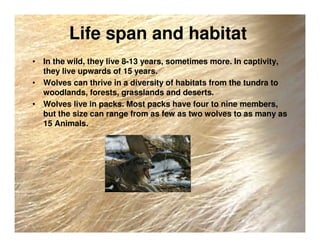
Life span and habitat
• In the wild, they live 8-13 years, sometimes more. In captivity,
they live upwards of 15 years.
• Wolves can thrive in a diversity of habitats from the tundra to
woodlands, forests, grasslands and deserts.
• Wolves live in packs. Most packs have four to nine members,
but the size can range from as few as two wolves to as many as
15 Animals.
Communication
• Communication reinforces
the social hierarchy of the
pack
• Ways of communication
include.
– Body language.
– Scent marking.
– Barking, growling and
howling
• Wolves bark as a warning.
• Howling is for .
– Long distance.
– Communication.
– Pulling a pack back
together.
– Keeping away strangers.
• Submissive behaviour.
– Crouching.
– Whimpering.
– Tucking in its tail.
– Licking the other wolves
mouth.
– Rolling over.
• When challenging another
wolf.
– Growling.
– Laying back ears on its
head.
• When playful.
– Dancing.
– Bowing.
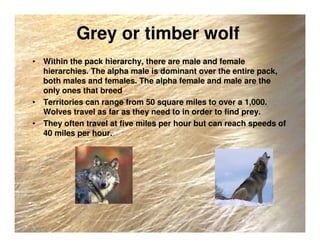
Grey or timber wolf
• Within the pack hierarchy, there are male and female
hierarchies. The alpha male is dominant over the entire pack,
both males and females. The alpha female and male are the
only ones that breed
• Territories can range from 50 square miles to over a 1,000.
Wolves travel as far as they need to in order to find prey.
• They often travel at five miles per hour but can reach speeds of
40 miles per hour.
Grey or timber wolf
• Wolves typically mate for life
• they breed from late January through March.
• Wolves are pregnant for about 63 days and usually birth four to
six pups.
• HABIT:
Most active at night, but may be seen during the day. Hunt in
packs.
• DIET:
Small animals and birds. When in packs, will hunt sheep and
other large animals.
• FAMILY:
Other common name: "Gray Wolf". Family: "Canidae". Species
classification: "Canus lupis". Related to the jackal, coyote, and
domestic dog.
Red Wolf
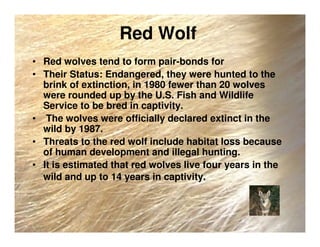
• Red wolves tend to form pair-bonds for
• Their Status: Endangered, they were hunted to the
brink of extinction, in 1980 fewer than 20 wolves
were rounded up by the U.S. Fish and Wildlife
Service to be bred in captivity.
• The wolves were officially declared extinct in the
wild by 1987.
• Threats to the red wolf include habitat loss because
of human development and illegal hunting.
• It is estimated that red wolves live four years in the
wild and up to 14 years in captivity.
Red Wolf facts
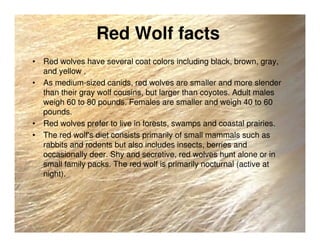
• Red wolves have several coat colors including black, brown, gray,
and yellow .
• As medium-sized canids, red wolves are smaller and more slender
than their gray wolf cousins, but larger than coyotes. Adult males
weigh 60 to 80 pounds. Females are smaller and weigh 40 to 60
pounds.
• Red wolves prefer to live in forests, swamps and coastal prairies.
• The red wolf's diet consists primarily of small mammals such as
rabbits and rodents but also includes insects, berries and
occasionally deer. Shy and secretive, red wolves hunt alone or in
small family packs. The red wolf is primarily nocturnal (active at
night).
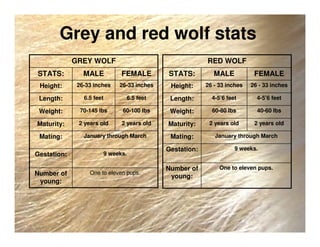
Grey and red wolf stats
One to eleven pups.Number of
young:
9 weeks.Gestation:
January through MarchMating:
2 years old2 years oldMaturity:
60-100 lbs70-145 lbsWeight:
6.5 feet6.5 feetLength:
26-33 inches26-33 inchesHeight:
FEMALEMALESTATS:
GREY WOLF
One to eleven pups.Number of
young:
9 weeks.Gestation:
January through MarchMating:
2 years old2 years oldMaturity:
40-60 lbs60-80 lbsWeight:
4-5’6 feet4-5’6 feetLength:
26 - 33 inches26 - 33 inchesHeight:
FEMALEMALESTATS:
RED WOLF
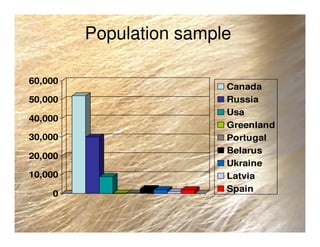
Population sample
0
10,000
20,000
30,000
40,000
50,000
60,000
Canada
Russia
Usa
Greenland
Portugal
Belarus
Ukraine
Latvia
Spain
Sources
• Information.
• http://www.naturalworlds.org/wolf/canis/Canis_lupus.htm
• http://www.npca.org/wildlife_protection/wildlife_facts/redwolf.html
• http://www.nwf.org/Wildlife/Wildlife-Library/Mammals/Gray-Wolf.aspx
• Image credits
• http://www.flickr.com/photos/7326810@N08/4093910057
• http://www.flickr.com/photos/snakphotography/5042653531
• http://www.flickr.com/photos/foovay/3031669939
• http://www.flickr.com/photos/kristiherbert/355647911
• http://www.flickr.com/photos/usfwsendsp/5039506344http://www.flickr.com/pho
tos/dobak/119671565
• http://www.flickr.com/photos/bigdog3c/2269954759/in/photostream
• http://www.flickr.com/photos/mdpettitt/4934214267/in/photostream
• http://www.flickr.com/photos/jmagnusphoto/2560203660

Wolves

  • 1.
    Wolves Grey or timberwolves Red wolves
  • 2.
    Grey or timberwolf the story The gray or timber wolf's story is one of the most compelling tales of American wildlife. Once, the wolf was widespread across most of North America, but it was hunted ruthlessly and extirpated over most of its range. Today, the wolf is making a successful comeback in some of its former habitat due to strong conservation efforts. The gray wolf plays a vital role in the health and proper functioning of ecosystems.
  • 3.
    Grey or timberwolf • Wolves vary in size depending on where they live. • Wolves in the north are usually larger than those in the south. • Wolves are carnivores--they prefer to eat large hoofed mammals such as deer, elk, bison and moose. • Adults can eat 20 pounds of meat in a single meal.
  • 4.
    Life span andhabitat • In the wild, they live 8-13 years, sometimes more. In captivity, they live upwards of 15 years. • Wolves can thrive in a diversity of habitats from the tundra to woodlands, forests, grasslands and deserts. • Wolves live in packs. Most packs have four to nine members, but the size can range from as few as two wolves to as many as 15 Animals.
  • 5.
    Communication • Communication reinforces thesocial hierarchy of the pack • Ways of communication include. – Body language. – Scent marking. – Barking, growling and howling • Wolves bark as a warning. • Howling is for . – Long distance. – Communication. – Pulling a pack back together. – Keeping away strangers. • Submissive behaviour. – Crouching. – Whimpering. – Tucking in its tail. – Licking the other wolves mouth. – Rolling over. • When challenging another wolf. – Growling. – Laying back ears on its head. • When playful. – Dancing. – Bowing.
  • 6.
    Grey or timberwolf • Within the pack hierarchy, there are male and female hierarchies. The alpha male is dominant over the entire pack, both males and females. The alpha female and male are the only ones that breed • Territories can range from 50 square miles to over a 1,000. Wolves travel as far as they need to in order to find prey. • They often travel at five miles per hour but can reach speeds of 40 miles per hour.
  • 7.
    Grey or timberwolf • Wolves typically mate for life • they breed from late January through March. • Wolves are pregnant for about 63 days and usually birth four to six pups. • HABIT: Most active at night, but may be seen during the day. Hunt in packs. • DIET: Small animals and birds. When in packs, will hunt sheep and other large animals. • FAMILY: Other common name: "Gray Wolf". Family: "Canidae". Species classification: "Canus lupis". Related to the jackal, coyote, and domestic dog.
  • 8.
    Red Wolf • Redwolves tend to form pair-bonds for • Their Status: Endangered, they were hunted to the brink of extinction, in 1980 fewer than 20 wolves were rounded up by the U.S. Fish and Wildlife Service to be bred in captivity. • The wolves were officially declared extinct in the wild by 1987. • Threats to the red wolf include habitat loss because of human development and illegal hunting. • It is estimated that red wolves live four years in the wild and up to 14 years in captivity.
  • 9.
    Red Wolf facts •Red wolves have several coat colors including black, brown, gray, and yellow . • As medium-sized canids, red wolves are smaller and more slender than their gray wolf cousins, but larger than coyotes. Adult males weigh 60 to 80 pounds. Females are smaller and weigh 40 to 60 pounds. • Red wolves prefer to live in forests, swamps and coastal prairies. • The red wolf's diet consists primarily of small mammals such as rabbits and rodents but also includes insects, berries and occasionally deer. Shy and secretive, red wolves hunt alone or in small family packs. The red wolf is primarily nocturnal (active at night).
  • 10.
    Grey and redwolf stats One to eleven pups.Number of young: 9 weeks.Gestation: January through MarchMating: 2 years old2 years oldMaturity: 60-100 lbs70-145 lbsWeight: 6.5 feet6.5 feetLength: 26-33 inches26-33 inchesHeight: FEMALEMALESTATS: GREY WOLF One to eleven pups.Number of young: 9 weeks.Gestation: January through MarchMating: 2 years old2 years oldMaturity: 40-60 lbs60-80 lbsWeight: 4-5’6 feet4-5’6 feetLength: 26 - 33 inches26 - 33 inchesHeight: FEMALEMALESTATS: RED WOLF
  • 11.
  • 12.
    Sources • Information. • http://www.naturalworlds.org/wolf/canis/Canis_lupus.htm •http://www.npca.org/wildlife_protection/wildlife_facts/redwolf.html • http://www.nwf.org/Wildlife/Wildlife-Library/Mammals/Gray-Wolf.aspx • Image credits • http://www.flickr.com/photos/7326810@N08/4093910057 • http://www.flickr.com/photos/7326810@N08/4093910057 • http://www.flickr.com/photos/snakphotography/5042653531 • http://www.flickr.com/photos/foovay/3031669939 • http://www.flickr.com/photos/kristiherbert/355647911 • http://www.flickr.com/photos/usfwsendsp/5039506344http://www.flickr.com/pho tos/dobak/119671565 • http://www.flickr.com/photos/bigdog3c/2269954759/in/photostream • http://www.flickr.com/photos/mdpettitt/4934214267/in/photostream • http://www.flickr.com/photos/jmagnusphoto/2560203660