Toward a Distributed Data Flow 
Platform for the Web of Things 
(Distributed Node-RED) 
Michael Blackstock, Rodger Lea 
Human Communication Technologies Lab 
Electrical and Computer Engineering Department 
University of British Columbia
Motivation 
• Common IoT scenarios require real time interaction between 
things, but application development can be difficult: 
• integration, variety of protocols and APIs and 
programming environments. 
• New web-based tools and platforms have emerged for 
rapid development e.g. WoTKit and Node-RED 
• Current platforms host applications on a single device/ 
server. 
• Exploration of distributed data flow for the Web of Things 
2
Data Flow Architectures 
• Initially to support massive parallelism, then 
software engineering 
• natural visual representation: nodes and arcs. 
• move more easily between design and 
implementation 
• can reduce development time 
• some evidence that they are easier for non-programmers 
3
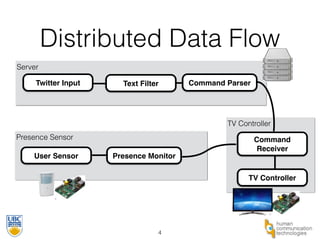
Server 
Distributed Data Flow 
Twitter Input Command Parser 
Presence Sensor 
TV Controller 
Text Filter 
User Sensor Presence Monitor 
4 
Command 
Receiver 
TV Controller
WoTKit Processor 
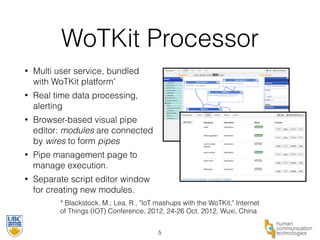
• Multi user service, bundled 
with WoTKit platform* 
• Real time data processing, 
alerting 
• Browser-based visual pipe 
editor: modules are connected 
by wires to form pipes 
• Pipe management page to 
manage execution. 
• Separate script editor window 
for creating new modules. 
* Blackstock, M.; Lea, R., "IoT mashups with the WoTKit," Internet 
of Things (IOT) Conference, 2012, 24-26 Oct. 2012, Wuxi, China 
5
WoTKit Processor 
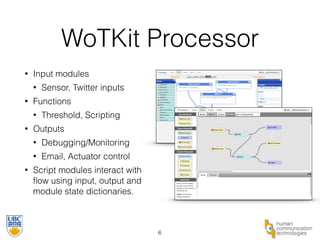
• Input modules 
• Sensor, Twitter inputs 
• Functions 
• Threshold, Scripting 
• Outputs 
• Debugging/Monitoring 
• Email, Actuator control 
• Script modules interact with 
flow using input, output and 
module state dictionaries. 
6
Processor Architecture 
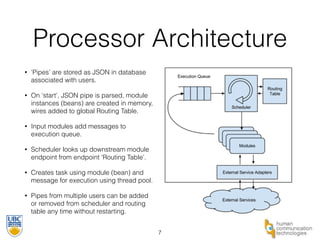
• ‘Pipes’ are stored as JSON in database 
associated with users. 
• On ‘start’, JSON pipe is parsed, module 
instances (beans) are created in memory, 
wires added to global Routing Table. 
• Input modules add messages to 
execution queue. 
• Scheduler looks up downstream module 
endpoint from endpoint ‘Routing Table’. 
• Creates task using module (bean) and 
message for execution using thread pool. 
• Pipes from multiple users can be added 
or removed from scheduler and routing 
table any time without restarting. 
7
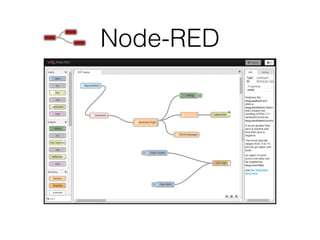
Node-RED
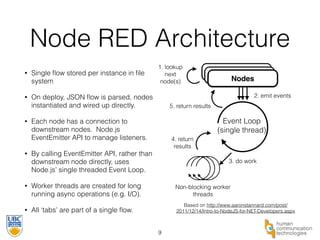
Node RED Architecture 
Nodes 
• Single flow stored per instance in file 
system 
• On deploy, JSON flow is parsed, nodes 
instantiated and wired up directly. 
• Each node has a connection to 
downstream nodes. Node.js 
EventEmitter API to manage listeners. 
• By calling EventEmitter API, rather than 
downstream node directly, uses 
Node.js’ single threaded Event Loop. 
• Worker threads are created for long 
running async operations (e.g. I/O). 
• All ‘tabs’ are part of a single flow. 
1. lookup 
next 
node(s) 
9 
Nodes 
Nodes 
2. emit events 
Event Loop 
(single thread) 
5. return results 
4. return 
results 
3. do work 
Non-blocking worker 
threads 
Based on http://www.aaronstannard.com/post/ 
2011/12/14/Intro-to-NodeJS-for-NET-Developers.aspx
Analysis 
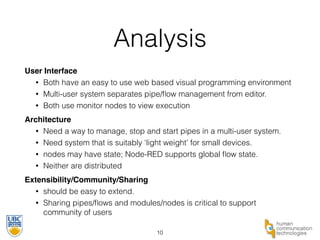
User Interface! 
• Both have an easy to use web based visual programming environment 
• Multi-user system separates pipe/flow management from editor. 
• Both use monitor nodes to view execution 
Architecture! 
• Need a way to manage, stop and start pipes in a multi-user system. 
• Need system that is suitably ‘light weight’ for small devices. 
• nodes may have state; Node-RED supports global flow state. 
• Neither are distributed 
Extensibility/Community/Sharing! 
• should be easy to extend. 
• Sharing pipes/flows and modules/nodes is critical to support 
community of users 
10
Distributed Data Flow Model 
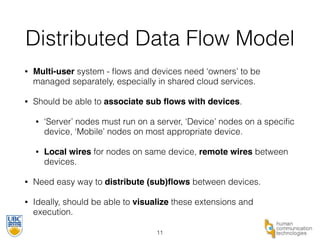
• Multi-user system - flows and devices need ‘owners’ to be 
managed separately, especially in shared cloud services. 
• Should be able to associate sub flows with devices. 
• ‘Server’ nodes must run on a server, ‘Device’ nodes on a specific 
device, ‘Mobile’ nodes on most appropriate device. 
• Local wires for nodes on same device, remote wires between 
devices. 
• Need easy way to distribute (sub)flows between devices. 
• Ideally, should be able to visualize these extensions and 
execution. 
11
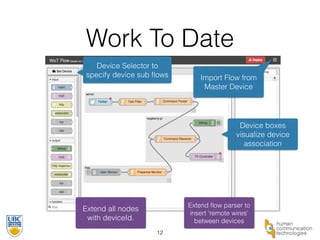
Work To Date 
12 
Device boxes 
visualize device 
association 
Device Selector to 
specify device sub flows Import Flow from 
Master Device 
Extend all nodes 
with deviceId. 
Extend flow parser to 
insert ‘remote wires’ 
between devices
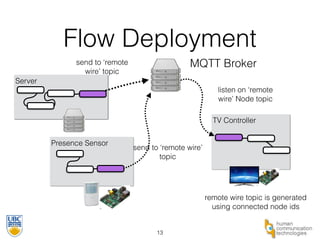
Flow Deployment 
13 
MQTT Broker 
Server 
send to ‘remote 
wire’ topic 
Presence Sensor 
send to ‘remote wire’ 
topic 
listen on ‘remote 
wire’ Node topic 
TV Controller 
remote wire topic is generated 
using connected node ids
Conclusions 
• Processor, Node-RED and others demonstrate that 
visual data flows are a useful programming model 
for developing IoT applications. 
• Web based distributed data flow promising for 
coordinating multiple ‘things’. 
• Raises many questions around programming 
model, implementation, security and heuristics. 
• Looking for collaborators! 
14
Thanks 
• Code: https://github.com/mblackstock/node-red 
(default experimental branch) 
• Node-RED: IBM and authors/contributors 
! ! ! http://nodered.org/! 
• WoTKit Processor: Sense Tecnic Systems 
! ! ! http://sensetecnic.com 
15

Distributed Data Flow for the Web of Things: Distributed Node-RED

  • 1.
    Toward a DistributedData Flow Platform for the Web of Things (Distributed Node-RED) Michael Blackstock, Rodger Lea Human Communication Technologies Lab Electrical and Computer Engineering Department University of British Columbia
  • 2.
    Motivation • CommonIoT scenarios require real time interaction between things, but application development can be difficult: • integration, variety of protocols and APIs and programming environments. • New web-based tools and platforms have emerged for rapid development e.g. WoTKit and Node-RED • Current platforms host applications on a single device/ server. • Exploration of distributed data flow for the Web of Things 2
  • 3.
    Data Flow Architectures • Initially to support massive parallelism, then software engineering • natural visual representation: nodes and arcs. • move more easily between design and implementation • can reduce development time • some evidence that they are easier for non-programmers 3
  • 4.
    Server Distributed DataFlow Twitter Input Command Parser Presence Sensor TV Controller Text Filter User Sensor Presence Monitor 4 Command Receiver TV Controller
  • 5.
    WoTKit Processor •Multi user service, bundled with WoTKit platform* • Real time data processing, alerting • Browser-based visual pipe editor: modules are connected by wires to form pipes • Pipe management page to manage execution. • Separate script editor window for creating new modules. * Blackstock, M.; Lea, R., "IoT mashups with the WoTKit," Internet of Things (IOT) Conference, 2012, 24-26 Oct. 2012, Wuxi, China 5
  • 6.
    WoTKit Processor •Input modules • Sensor, Twitter inputs • Functions • Threshold, Scripting • Outputs • Debugging/Monitoring • Email, Actuator control • Script modules interact with flow using input, output and module state dictionaries. 6
  • 7.
    Processor Architecture •‘Pipes’ are stored as JSON in database associated with users. • On ‘start’, JSON pipe is parsed, module instances (beans) are created in memory, wires added to global Routing Table. • Input modules add messages to execution queue. • Scheduler looks up downstream module endpoint from endpoint ‘Routing Table’. • Creates task using module (bean) and message for execution using thread pool. • Pipes from multiple users can be added or removed from scheduler and routing table any time without restarting. 7
  • 8.
  • 9.
    Node RED Architecture Nodes • Single flow stored per instance in file system • On deploy, JSON flow is parsed, nodes instantiated and wired up directly. • Each node has a connection to downstream nodes. Node.js EventEmitter API to manage listeners. • By calling EventEmitter API, rather than downstream node directly, uses Node.js’ single threaded Event Loop. • Worker threads are created for long running async operations (e.g. I/O). • All ‘tabs’ are part of a single flow. 1. lookup next node(s) 9 Nodes Nodes 2. emit events Event Loop (single thread) 5. return results 4. return results 3. do work Non-blocking worker threads Based on http://www.aaronstannard.com/post/ 2011/12/14/Intro-to-NodeJS-for-NET-Developers.aspx
  • 10.
    Analysis User Interface! • Both have an easy to use web based visual programming environment • Multi-user system separates pipe/flow management from editor. • Both use monitor nodes to view execution Architecture! • Need a way to manage, stop and start pipes in a multi-user system. • Need system that is suitably ‘light weight’ for small devices. • nodes may have state; Node-RED supports global flow state. • Neither are distributed Extensibility/Community/Sharing! • should be easy to extend. • Sharing pipes/flows and modules/nodes is critical to support community of users 10
  • 11.
    Distributed Data FlowModel • Multi-user system - flows and devices need ‘owners’ to be managed separately, especially in shared cloud services. • Should be able to associate sub flows with devices. • ‘Server’ nodes must run on a server, ‘Device’ nodes on a specific device, ‘Mobile’ nodes on most appropriate device. • Local wires for nodes on same device, remote wires between devices. • Need easy way to distribute (sub)flows between devices. • Ideally, should be able to visualize these extensions and execution. 11
  • 12.
    Work To Date 12 Device boxes visualize device association Device Selector to specify device sub flows Import Flow from Master Device Extend all nodes with deviceId. Extend flow parser to insert ‘remote wires’ between devices
  • 13.
    Flow Deployment 13 MQTT Broker Server send to ‘remote wire’ topic Presence Sensor send to ‘remote wire’ topic listen on ‘remote wire’ Node topic TV Controller remote wire topic is generated using connected node ids
  • 14.
    Conclusions • Processor,Node-RED and others demonstrate that visual data flows are a useful programming model for developing IoT applications. • Web based distributed data flow promising for coordinating multiple ‘things’. • Raises many questions around programming model, implementation, security and heuristics. • Looking for collaborators! 14
  • 15.
    Thanks • Code:https://github.com/mblackstock/node-red (default experimental branch) • Node-RED: IBM and authors/contributors ! ! ! http://nodered.org/! • WoTKit Processor: Sense Tecnic Systems ! ! ! http://sensetecnic.com 15