Presented By:
Smita Suresh Bachhav(ME13402)
ME-I, Department of Information Tech.
Guided By:
Prof.Sumedha Sirsikar (Software Architecture)
Department of Information Tech.
 Ad-hoc sensor network
 Advantages
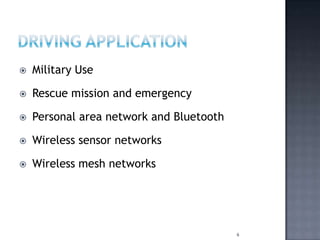
 Driving Application
 Conclusion
 Refernces
2
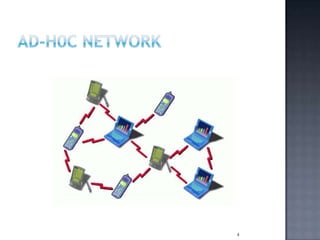
 A decentralized type of wireless network.
It does not depend on a preexisting
infrastructure.
Each node participates in routing by
forwarding data for other nodes
The determination of which nodes forward
data is made dynamically based on the
network connectivity.
Ad hoc networks can use flooding for
forwarding the data. (distributing algorithm)
3
4
 No infrastructure and lower cost- Scalable
accommodates the addition of more nodes
 Mobility (MANET only)- Self-configuring, nodes
are also routers
 Decentralized and robust – Independence from
central network administration
 Easy to build and spontaneous infrastructure-
Flexible similar to being able to access the
Internet from many different locations
5
 Military Use
 Rescue mission and emergency
 Personal area network and Bluetooth
 Wireless sensor networks
 Wireless mesh networks
6
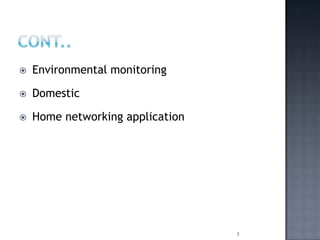
 Environmental monitoring
 Domestic
 Home networking application
7
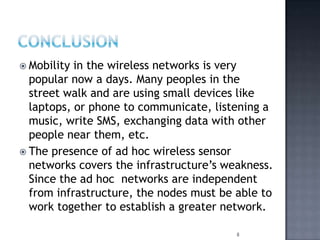
 Mobility in the wireless networks is very
popular now a days. Many peoples in the
street walk and are using small devices like
laptops, or phone to communicate, listening a
music, write SMS, exchanging data with other
people near them, etc.
 The presence of ad hoc wireless sensor
networks covers the infrastructure’s weakness.
Since the ad hoc networks are independent
from infrastructure, the nodes must be able to
work together to establish a greater network.
8
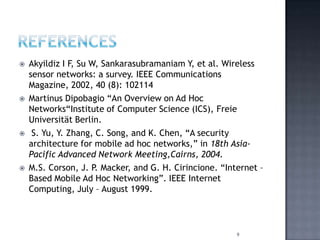
 Akyildiz I F, Su W, Sankarasubramaniam Y, et al. Wireless
sensor networks: a survey. IEEE Communications
Magazine, 2002, 40 (8): 102114
 Martinus Dipobagio “An Overview on Ad Hoc
Networks“Institute of Computer Science (ICS), Freie
Universität Berlin.
 S. Yu, Y. Zhang, C. Song, and K. Chen, “A security
architecture for mobile ad hoc networks,” in 18th Asia-
Pacific Advanced Network Meeting,Cairns, 2004.
 M.S. Corson, J. P. Macker, and G. H. Cirincione. “Internet –
Based Mobile Ad Hoc Networking”. IEEE Internet
Computing, July – August 1999.
9
Thank You !!!!
10
Any Question ????
11

Advantages of ad hoc sensor network, driving application

  • 1.
    Presented By: Smita SureshBachhav(ME13402) ME-I, Department of Information Tech. Guided By: Prof.Sumedha Sirsikar (Software Architecture) Department of Information Tech.
  • 2.
     Ad-hoc sensornetwork  Advantages  Driving Application  Conclusion  Refernces 2
  • 3.
     A decentralizedtype of wireless network. It does not depend on a preexisting infrastructure. Each node participates in routing by forwarding data for other nodes The determination of which nodes forward data is made dynamically based on the network connectivity. Ad hoc networks can use flooding for forwarding the data. (distributing algorithm) 3
  • 4.
  • 5.
     No infrastructureand lower cost- Scalable accommodates the addition of more nodes  Mobility (MANET only)- Self-configuring, nodes are also routers  Decentralized and robust – Independence from central network administration  Easy to build and spontaneous infrastructure- Flexible similar to being able to access the Internet from many different locations 5
  • 6.
     Military Use Rescue mission and emergency  Personal area network and Bluetooth  Wireless sensor networks  Wireless mesh networks 6
  • 7.
     Environmental monitoring Domestic  Home networking application 7
  • 8.
     Mobility inthe wireless networks is very popular now a days. Many peoples in the street walk and are using small devices like laptops, or phone to communicate, listening a music, write SMS, exchanging data with other people near them, etc.  The presence of ad hoc wireless sensor networks covers the infrastructure’s weakness. Since the ad hoc networks are independent from infrastructure, the nodes must be able to work together to establish a greater network. 8
  • 9.
     Akyildiz IF, Su W, Sankarasubramaniam Y, et al. Wireless sensor networks: a survey. IEEE Communications Magazine, 2002, 40 (8): 102114  Martinus Dipobagio “An Overview on Ad Hoc Networks“Institute of Computer Science (ICS), Freie Universität Berlin.  S. Yu, Y. Zhang, C. Song, and K. Chen, “A security architecture for mobile ad hoc networks,” in 18th Asia- Pacific Advanced Network Meeting,Cairns, 2004.  M.S. Corson, J. P. Macker, and G. H. Cirincione. “Internet – Based Mobile Ad Hoc Networking”. IEEE Internet Computing, July – August 1999. 9
  • 10.
  • 11.