Name _____________________________________________________ Group ___________

Date ______________________________________________________ List # ____________

                                  REVIEWING CONCEPTS

1.-A ____________ taste is a characteristic of all acids in aqueous solution.

2.-Acids react with some metals to produce _________________ gas.

3.-Acids react with carbonates to produce _____________________ gas.

4.-Acids release ___________ ions when dissolved in water.

5.-Acids turn litmus paper ____________.

6.-Acid have a pH __________ than 7.

7.-Bases tend to taste _______________ and feel __________________.

8.-Like acids, aqueous basic solutions conduct ___________________, and are identified
as good electrolytes.

9.-Bases react with __________________ to produce soap.

10.-Bases turn litmus paper _____________.

11.-Bases have a pH __________ than 7.

12.- According to Bronsted-Lowry acids are __________________ donors.

13.- A Base is a substance that releases _____________ ions in solution.

14.- According to Bronsted-Lowry a base is a ______________ acceptor.

15.- Using Arrhenius theory, indicate whether each of the following is an acid, base, salt
or other:
a) KI ___________ b) HNO3 _________ c) NaOH ________ d) CH3OH _________

e)KOH ____________ f) NaCl __________ g) HF ___________ h) Ca(OH)2 _________

16.- Using Bronsted-Lowry theory, identify the acid, base, conjugate acid and
conjugate base in each of the following chemical reactions:

a)HCN + H2O <-> H3O + + CN –


b) C5H5N + H2O <-> C5H5NH + + OH –


17.- What is the difference between a strong acid and a weak acid?(2 differences)
18.- Give formulas and name of 4 strong acids and 3 weak acids.


19.- Give formulas and names of 4 strong bases and one common weak base.


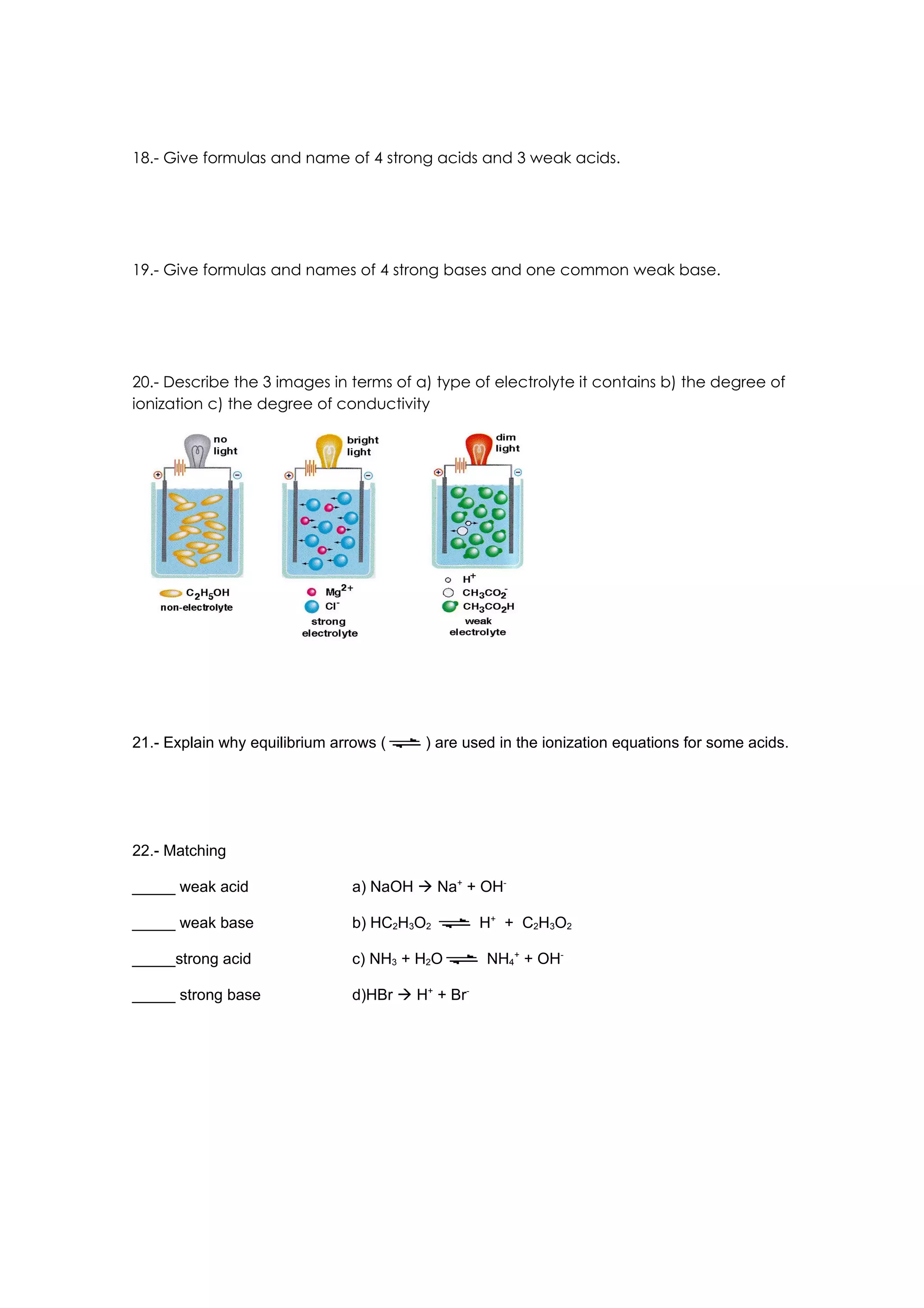
20.- Describe the 3 images in terms of a) type of electrolyte it contains b) the degree of
ionization c) the degree of conductivity


21.- Explain why equilibrium arrows (     ) are used in the ionization equations for some acids.


22.- Matching

_____ weak acid                 a) NaOH  Na+ + OH-

_____ weak base                 b) HC2H3O2         H+ + C2H3O2

_____strong acid                c) NH3 + H2O       NH4+ + OH-

_____ strong base               d)HBr  H+ + Br-

Wks reviewing concepts

  • 1.
    Name _____________________________________________________ Group___________ Date ______________________________________________________ List # ____________ REVIEWING CONCEPTS 1.-A ____________ taste is a characteristic of all acids in aqueous solution. 2.-Acids react with some metals to produce _________________ gas. 3.-Acids react with carbonates to produce _____________________ gas. 4.-Acids release ___________ ions when dissolved in water. 5.-Acids turn litmus paper ____________. 6.-Acid have a pH __________ than 7. 7.-Bases tend to taste _______________ and feel __________________. 8.-Like acids, aqueous basic solutions conduct ___________________, and are identified as good electrolytes. 9.-Bases react with __________________ to produce soap. 10.-Bases turn litmus paper _____________. 11.-Bases have a pH __________ than 7. 12.- According to Bronsted-Lowry acids are __________________ donors. 13.- A Base is a substance that releases _____________ ions in solution. 14.- According to Bronsted-Lowry a base is a ______________ acceptor. 15.- Using Arrhenius theory, indicate whether each of the following is an acid, base, salt or other: a) KI ___________ b) HNO3 _________ c) NaOH ________ d) CH3OH _________ e)KOH ____________ f) NaCl __________ g) HF ___________ h) Ca(OH)2 _________ 16.- Using Bronsted-Lowry theory, identify the acid, base, conjugate acid and conjugate base in each of the following chemical reactions: a)HCN + H2O <-> H3O + + CN – b) C5H5N + H2O <-> C5H5NH + + OH – 17.- What is the difference between a strong acid and a weak acid?(2 differences)
  • 2.
    18.- Give formulasand name of 4 strong acids and 3 weak acids. 19.- Give formulas and names of 4 strong bases and one common weak base. 20.- Describe the 3 images in terms of a) type of electrolyte it contains b) the degree of ionization c) the degree of conductivity 21.- Explain why equilibrium arrows ( ) are used in the ionization equations for some acids. 22.- Matching _____ weak acid a) NaOH  Na+ + OH- _____ weak base b) HC2H3O2 H+ + C2H3O2 _____strong acid c) NH3 + H2O NH4+ + OH- _____ strong base d)HBr  H+ + Br-