   1. GED Practice (Social Studies)
   2. US History- Finding Facts
   3. Understanding Time Order: Columbus
   4. Homework
   In this unit, you will learn about:
     The early exploration of America
     How the US became a nation
     The Civil War
     The Great Depression
     The Cold War
     How the Cold War Ended
 Vocabulary
 Fifteenth century- the years from 1401-1500
 Trade- to exchange goods for other goods
 Merchant- person who buys and sells things
 Route- a way to get somewhere
 Settle- to make a place a home
 Conquistador- Spanish word for conqueror
 Claim- to take ownership
 Northwest Passage- a sea route through North
  America to Asia
 Colony- a group of people who settle in one
  country but are governed by another
   5. European countries wanted to find a sea route to
    India and China because
   A trip by ship would be easier and faster
   6. Which Native American group built a vast system of
    roads?
   The Incas
   7. What did Columbus name the islands that he sailed
    to in 1492?
   The Indies
   When you study history, you need to
    understand Time Order (Chronological Order)

   Clues for Time Order:
     Before, after, later, next, then, first, second, soon,
      later, finally
    Exercise 1- Read the paragraph and underline
    key time order words
   When you read a passage, ask yourself the
    following questions:

   1. What are the important events?

   2. Are there clues in the text that indicate the
    order events took place?
   Which passage is written using time order?

   Passage 2 
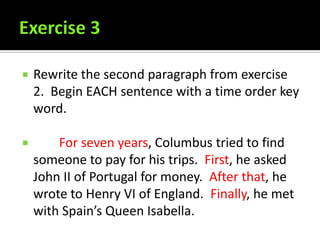
   Rewrite the second paragraph from exercise
    2. Begin EACH sentence with a time order key
    word.

       For seven years, Columbus tried to find
    someone to pay for his trips. First, he asked
    John II of Portugal for money. After that, he
    wrote to Henry VI of England. Finally, he met
    with Spain’s Queen Isabella.
   Read “From Colonies to States” and answer
    the questions on page 19.

Wk5tuesday la

  • 1.
    1. GED Practice (Social Studies)  2. US History- Finding Facts  3. Understanding Time Order: Columbus  4. Homework
  • 2.
    In this unit, you will learn about:  The early exploration of America  How the US became a nation  The Civil War  The Great Depression  The Cold War  How the Cold War Ended
  • 3.
     Vocabulary  Fifteenthcentury- the years from 1401-1500  Trade- to exchange goods for other goods  Merchant- person who buys and sells things  Route- a way to get somewhere  Settle- to make a place a home  Conquistador- Spanish word for conqueror  Claim- to take ownership  Northwest Passage- a sea route through North America to Asia  Colony- a group of people who settle in one country but are governed by another
  • 4.
    5. European countries wanted to find a sea route to India and China because  A trip by ship would be easier and faster  6. Which Native American group built a vast system of roads?  The Incas  7. What did Columbus name the islands that he sailed to in 1492?  The Indies
  • 5.
    When you study history, you need to understand Time Order (Chronological Order)  Clues for Time Order:  Before, after, later, next, then, first, second, soon, later, finally  Exercise 1- Read the paragraph and underline key time order words
  • 6.
    When you read a passage, ask yourself the following questions:  1. What are the important events?  2. Are there clues in the text that indicate the order events took place?
  • 7.
    Which passage is written using time order?  Passage 2 
  • 8.
    Rewrite the second paragraph from exercise 2. Begin EACH sentence with a time order key word.  For seven years, Columbus tried to find someone to pay for his trips. First, he asked John II of Portugal for money. After that, he wrote to Henry VI of England. Finally, he met with Spain’s Queen Isabella.
  • 9.
    Read “From Colonies to States” and answer the questions on page 19.