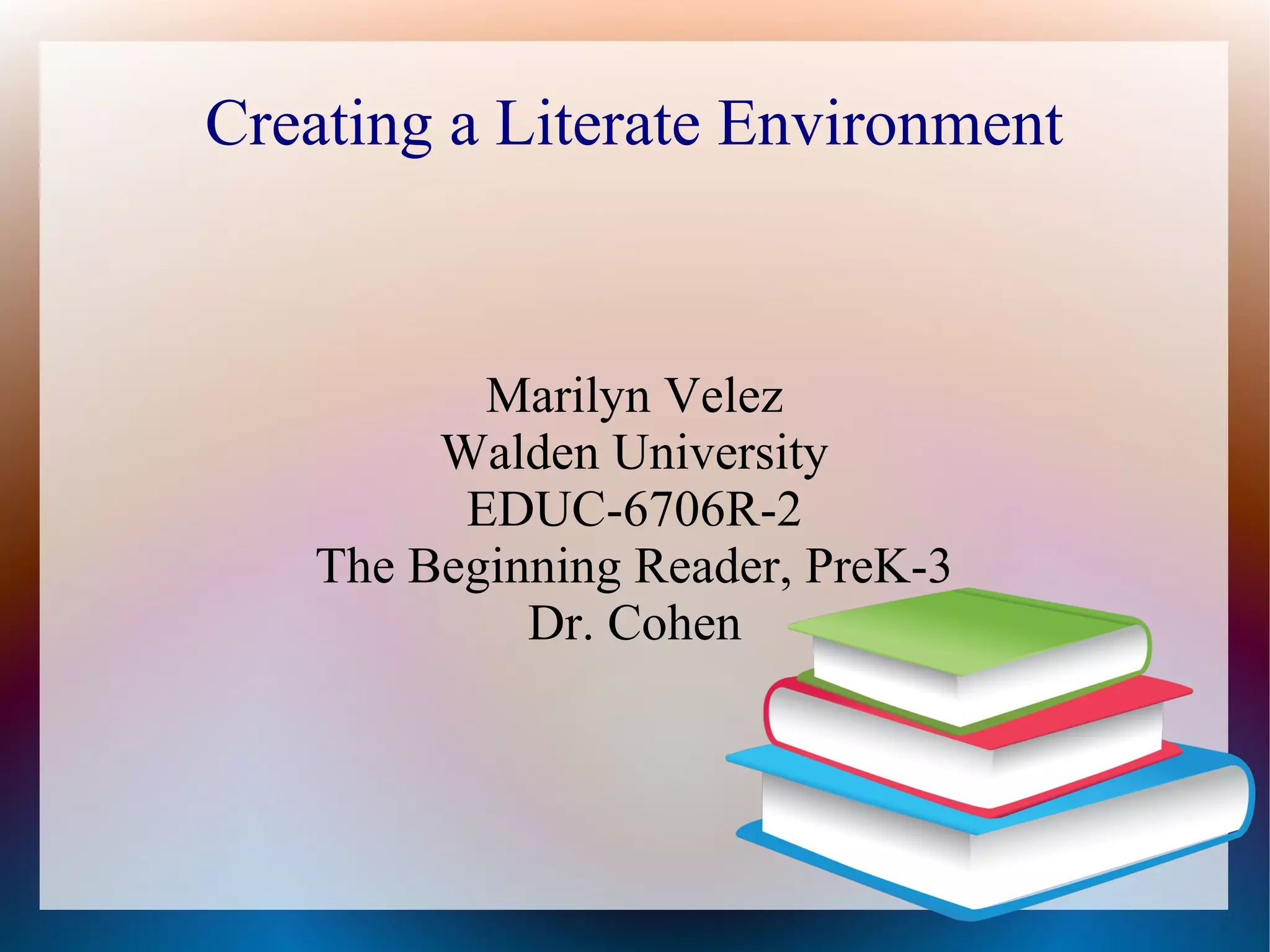
Creating a Literate Environment
Marilyn Velez
Walden University
EDUC-6706R-2
The Beginning Reader, PreK-3
Dr. Cohen
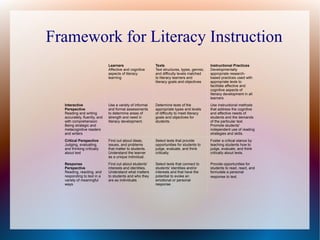
Framework for Literacy Instruction
Learners
Affective and cognitive
aspects of literacy
learning
Texts
Text structures, types, genres,
and difficulty levels matched
to literacy learners and
literacy goals and objectives
Instructional Practices
Developmentally
appropriate research-
based practices used with
appropriate texts to
facilitate affective and
cognitive aspects of
literacy development in all
learners
Interactive
Perspective
Reading and writing
accurately, fluently, and
with comprehension
Being strategic and
metacognitive readers
and writers
Use a variety of informal
and formal assessments
to determine areas of
strength and need in
literacy development.
Determine texts of the
appropriate types and levels
of difficulty to meet literacy
goals and objectives for
students.
Use instructional methods
that address the cognitive
and affective needs of
students and the demands
of the particular text.
Promote students'
independent use of reading
strategies and skills.
Critical Perspective
Judging, evaluating,
and thinking critically
about text
Find out about ideas,
issues, and problems
that matter to students.
Understand the learner
as a unique individual.
Select texts that provide
opportunities for students to
judge, evaluate, and think
critically.
Foster a critical stance by
teaching students how to
judge, evaluate, and think
critically about texts.
Response
Perspective
Reading, reacting, and
responding to text in a
variety of meaningful
ways
Find out about students'
interests and identities.
Understand what matters
to students and who they
are as individuals.
Select texts that connect to
students' identities and/or
interests and that have the
potential to evoke an
emotional or personal
response.
Provide opportunities for
students to read, react, and
formulate a personal
response to text.
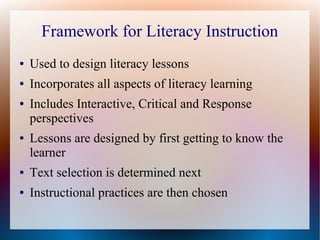
Framework for Literacy Instruction
● Used to design literacy lessons
● Incorporates all aspects of literacy learning
● Includes Interactive, Critical and Response
perspectives
● Lessons are designed by first getting to know the
learner
● Text selection is determined next
● Instructional practices are then chosen
Getting to Know Literacy Learners
● Use cognitive and noncognitive assessments
● Determine issues, problems and ideas that matter to
the student
● Determine student interests
“Motivation is an integral component of reading
instruction. In addition, a number of studies suggest
a connection between motivation and achievement.”
(Gambrell, Palmer, Codling, & Mazzoni, 1996, p.
518-533).
Getting to Know Literacy Learners
● For a cognitive assessment, I used a running record
(Tompkins, 2010, p. 463).
● With this assessment tool, I was able to determine
the students' instructional level for texts
● I also was able to determine the students' fluency,
accuracy, and comprehension at that instructional
level
● This information helped me to determine the
appropriate text for the student
Getting to Know Literacy Learners
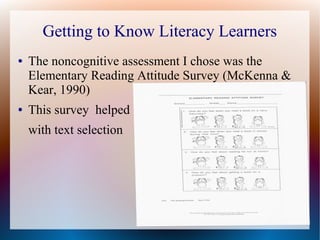
● The noncognitive assessment I chose was the
Elementary Reading Attitude Survey (McKenna &
Kear, 1990)
● This survey helped
with text selection
Selecting Texts
● Selecting the appropriate texts is an important
componant of a literacy lesson
● The texts are selected based on the results of the
cognitive and noncognitive assessments
● Factors such as narrative versus informational text,
and semiotic versus linguistic text need to be
considered (Laureate Education, n.d).
● This ensures that the text is a high-interest,
instructional-level text.
Selecting Texts
● Using these considerations helped me to choose
appropriate texts for my literacy lesson
● I chose instructional-level texts for a unit on
Dinosaurs.
● I chose a mix of informational and narrative texts
“We are surrounded by text whose primary purpose
is to convey information about the natural or social
world. Success in schooling...depends on our ability
to comprehend this material.” (Duke, 2004, p. 1).
Interactive Perspective
● This perspective concentrates on teaching students
how to read
● Students are assessed using cognitive and
noncognitive assessments
● Appropriate texts are selected
● Instructional practices are determined based on
student need
Interactive Perspective
● The lesson concentrated on improving reading
comprehension and word recognition
● An instructional practice I chose for improving
reading comprehension was a K-W-L chart
● The K-W-L chart helped the students organize and
understand their knowledge
● Through the chart they were able to visualize how
much knowledge they gained from this lesson
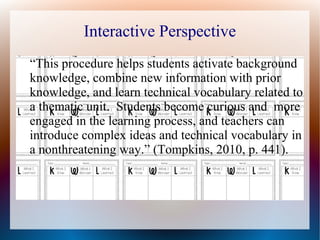
Interactive Perspective
“This procedure helps students activate background
knowledge, combine new information with prior
knowledge, and learn technical vocabulary related to
a thematic unit. Students become curious and more
engaged in the learning process, and teachers can
introduce complex ideas and technical vocabulary in
a nonthreatening way.” (Tompkins, 2010, p. 441).
Interactive Perspective
● An instructional practice I used for word recognition
was Making Words.
● With this lesson, we practiced CVC word
combinations
● This practice helped the students become fluent in
reading CVC words
“As students make words, they're practicing what
they know about sound-symbol correspondences...”
(Tompkins, 2010, p. 447).
Critical and Response Perspective
● The critical perspective helps students analyze and
judge text
“Critical literacy focuses on issues of power and
promotes reflection, transformation, and action.”
(Molden, 2007, p. 50).
● The response perspective allows the students to
connect with the text on a personal level
“For students to become engaged life-long readers
they must discover the transformative power of
text.” (Laureate Education, n.d.).
Critical and Response Perspectives
● For the critical perspective, I chose to have my
students analyze the text-to-illustration
interconnection as it relates to character
development and discuss the concept of family
traditions
● For the response perspective, they wrote about a
personal connection they felt with one of the
characters, using the text and illustrations to explain
that connection
Critical and Response Perspectives
● Adding lessons with these perspectives included has
helped to make the unit on Dinosaurs a more
meaningful journey for my students
● I feel that the skills, strategies, and other knowledge
they learned with this unit will help them become
life-long literacy learners
Feedback from Colleagues and Family
Members of Students
● What insights did you gain about literacy and
literacy instruction from viewing this presentation?
● How might the information presented change your
literacy practices and/or your literacy interactions
with students?
● In what ways can I support you in the literacy
development of your students or children? How
might you support me in my work with students or
your children?
● What questions do you have?
References
Duke, N. (2004). The case for informational text. Educational Leadership, 61(6), 40–44.
Gambrell, L. B., Palmer, B. M., Codling, R. M., & Mazzoni, S. A. (1996). Assessing motivation to read. The Reading Teacher, 49(7), 518--533.
Laureate Education (Producer). (n.d.). Analyzing and selecting text [Video file]. Retrieved from https://class.waldenu.edu
Laureate Education (Producer). (n.d.). Response perspective. [Video file]. Retrieved from https://class.waldenu.edu
McKenna, M. C., & Kear, D. J. (1990). Measuring attitude toward reading: A new tool for teachers. The Reading Teacher, 43(9), 626--639.
Molden, K. (2007). Critical literacy, the right answer for the reading classroom: Strategies to move beyond comprehension for reading improvement. Reading
Improvement, 44(1), 50–56.
Tompkins, G. E. (2010). Literacy for the 21st century: A balanced approach (5th ed.). Boston: Allyn & Bacon.

Creating a Literate Environment

  • 1.
    Creating a LiterateEnvironment Marilyn Velez Walden University EDUC-6706R-2 The Beginning Reader, PreK-3 Dr. Cohen
  • 2.
    Framework for LiteracyInstruction Learners Affective and cognitive aspects of literacy learning Texts Text structures, types, genres, and difficulty levels matched to literacy learners and literacy goals and objectives Instructional Practices Developmentally appropriate research- based practices used with appropriate texts to facilitate affective and cognitive aspects of literacy development in all learners Interactive Perspective Reading and writing accurately, fluently, and with comprehension Being strategic and metacognitive readers and writers Use a variety of informal and formal assessments to determine areas of strength and need in literacy development. Determine texts of the appropriate types and levels of difficulty to meet literacy goals and objectives for students. Use instructional methods that address the cognitive and affective needs of students and the demands of the particular text. Promote students' independent use of reading strategies and skills. Critical Perspective Judging, evaluating, and thinking critically about text Find out about ideas, issues, and problems that matter to students. Understand the learner as a unique individual. Select texts that provide opportunities for students to judge, evaluate, and think critically. Foster a critical stance by teaching students how to judge, evaluate, and think critically about texts. Response Perspective Reading, reacting, and responding to text in a variety of meaningful ways Find out about students' interests and identities. Understand what matters to students and who they are as individuals. Select texts that connect to students' identities and/or interests and that have the potential to evoke an emotional or personal response. Provide opportunities for students to read, react, and formulate a personal response to text.
  • 3.
    Framework for LiteracyInstruction ● Used to design literacy lessons ● Incorporates all aspects of literacy learning ● Includes Interactive, Critical and Response perspectives ● Lessons are designed by first getting to know the learner ● Text selection is determined next ● Instructional practices are then chosen
  • 4.
    Getting to KnowLiteracy Learners ● Use cognitive and noncognitive assessments ● Determine issues, problems and ideas that matter to the student ● Determine student interests “Motivation is an integral component of reading instruction. In addition, a number of studies suggest a connection between motivation and achievement.” (Gambrell, Palmer, Codling, & Mazzoni, 1996, p. 518-533).
  • 5.
    Getting to KnowLiteracy Learners ● For a cognitive assessment, I used a running record (Tompkins, 2010, p. 463). ● With this assessment tool, I was able to determine the students' instructional level for texts ● I also was able to determine the students' fluency, accuracy, and comprehension at that instructional level ● This information helped me to determine the appropriate text for the student
  • 6.
    Getting to KnowLiteracy Learners ● The noncognitive assessment I chose was the Elementary Reading Attitude Survey (McKenna & Kear, 1990) ● This survey helped with text selection
  • 7.
    Selecting Texts ● Selectingthe appropriate texts is an important componant of a literacy lesson ● The texts are selected based on the results of the cognitive and noncognitive assessments ● Factors such as narrative versus informational text, and semiotic versus linguistic text need to be considered (Laureate Education, n.d). ● This ensures that the text is a high-interest, instructional-level text.
  • 8.
    Selecting Texts ● Usingthese considerations helped me to choose appropriate texts for my literacy lesson ● I chose instructional-level texts for a unit on Dinosaurs. ● I chose a mix of informational and narrative texts “We are surrounded by text whose primary purpose is to convey information about the natural or social world. Success in schooling...depends on our ability to comprehend this material.” (Duke, 2004, p. 1).
  • 9.
    Interactive Perspective ● Thisperspective concentrates on teaching students how to read ● Students are assessed using cognitive and noncognitive assessments ● Appropriate texts are selected ● Instructional practices are determined based on student need
  • 10.
    Interactive Perspective ● Thelesson concentrated on improving reading comprehension and word recognition ● An instructional practice I chose for improving reading comprehension was a K-W-L chart ● The K-W-L chart helped the students organize and understand their knowledge ● Through the chart they were able to visualize how much knowledge they gained from this lesson
  • 11.
    Interactive Perspective “This procedurehelps students activate background knowledge, combine new information with prior knowledge, and learn technical vocabulary related to a thematic unit. Students become curious and more engaged in the learning process, and teachers can introduce complex ideas and technical vocabulary in a nonthreatening way.” (Tompkins, 2010, p. 441).
  • 12.
    Interactive Perspective ● Aninstructional practice I used for word recognition was Making Words. ● With this lesson, we practiced CVC word combinations ● This practice helped the students become fluent in reading CVC words “As students make words, they're practicing what they know about sound-symbol correspondences...” (Tompkins, 2010, p. 447).
  • 13.
    Critical and ResponsePerspective ● The critical perspective helps students analyze and judge text “Critical literacy focuses on issues of power and promotes reflection, transformation, and action.” (Molden, 2007, p. 50). ● The response perspective allows the students to connect with the text on a personal level “For students to become engaged life-long readers they must discover the transformative power of text.” (Laureate Education, n.d.).
  • 14.
    Critical and ResponsePerspectives ● For the critical perspective, I chose to have my students analyze the text-to-illustration interconnection as it relates to character development and discuss the concept of family traditions ● For the response perspective, they wrote about a personal connection they felt with one of the characters, using the text and illustrations to explain that connection
  • 15.
    Critical and ResponsePerspectives ● Adding lessons with these perspectives included has helped to make the unit on Dinosaurs a more meaningful journey for my students ● I feel that the skills, strategies, and other knowledge they learned with this unit will help them become life-long literacy learners
  • 16.
    Feedback from Colleaguesand Family Members of Students ● What insights did you gain about literacy and literacy instruction from viewing this presentation? ● How might the information presented change your literacy practices and/or your literacy interactions with students? ● In what ways can I support you in the literacy development of your students or children? How might you support me in my work with students or your children? ● What questions do you have?
  • 17.
    References Duke, N. (2004).The case for informational text. Educational Leadership, 61(6), 40–44. Gambrell, L. B., Palmer, B. M., Codling, R. M., & Mazzoni, S. A. (1996). Assessing motivation to read. The Reading Teacher, 49(7), 518--533. Laureate Education (Producer). (n.d.). Analyzing and selecting text [Video file]. Retrieved from https://class.waldenu.edu Laureate Education (Producer). (n.d.). Response perspective. [Video file]. Retrieved from https://class.waldenu.edu McKenna, M. C., & Kear, D. J. (1990). Measuring attitude toward reading: A new tool for teachers. The Reading Teacher, 43(9), 626--639. Molden, K. (2007). Critical literacy, the right answer for the reading classroom: Strategies to move beyond comprehension for reading improvement. Reading Improvement, 44(1), 50–56. Tompkins, G. E. (2010). Literacy for the 21st century: A balanced approach (5th ed.). Boston: Allyn & Bacon.