Chapter 2
WIRING MATERIALS AND
ACCESSORIES
• Before designing and implementing electrical
installation on buildings, we must first
understand the basic principles regarding the
materials, devices, fittings and equipment that
form a complete wiring system
• Topics of this chapter:
1. Wires and insulation materials
2. Conduits, conduit accessories & trunking
3. Lighting accessories and fittings: switches, lamp
holders, plugs and socket outlets
4. Switches and Switching circuits
5. Fuses and circuit breakers
6. Distribution board
2
Wire and Cable
• The term wire and cable are used more or less
synonymously in house wiring.
• Wire = single wire, may be bare or covered with
insulation
• Cable = several wires stranded together
• The necessary requirements of a cable
– it should conduct electricity efficiently, cheaply, and safely.
– should neither be so small so as to have a large internal
voltage drop
– nor be too large so as to cost too much.
– Its insulation should be such as to prevent leakage of
current and to minimize risk of fire and shock.
3
4
Wires cables
solid stranded
• A cable consists of three parts:
a. the conductor or core
– the metal wire or strand of wires carrying current.
b. the insulation or dielectric
– a covering of insulation material to avoid leakage current from the conductor.
c. the protective covering
– for protection of insulation from mechanical damage.
5
Conductor Materials used in Cables
• A conductor is either solid or stranded
• Copper and aluminum are the materials used as
conductors in power and lighting cables.
• Aluminum: is frequently used in place of copper
for bare electric cables used for long distance
power distribution.
• The size of conductors shall be, such that the
voltage drop between the supply terminal and
fixed current-using equipment shall not exceed
4% of the nominal voltage of the supply line,
when the conductors are carrying the full, load
current.
6
Insulating Materials
• The insulating material used in electric cable
must possess the following properties.
– High resistivity
– High flexibility
– Non-in flammability
– High resistivity to moisture, acid or alkalis qualities.
• So the type of insulating materials used depends
up on the service for which the cable is required.
7
2. PVC:
• polyvinyl chloride is a man made thermo-
plastic material
• It is tough, incombustible and chemically
unreactive.
• It is now the most usual low voltage cable
insulation.
• It does not deteriorate with age and does not
need to be renewed.
• Its chief drawback is that it softens at a
temperature above 80⁰c.
8
Color of cables
• Live wire – red, yellow or blue
• Neutral – black
• Earth wire – yellow green
9
General specification of cables:
• The complete specification of a cable will give
the following information:
I. The size of the cable
II. The type of conductor used in cables (copper or
aluminum)
III. Number of cores that the cable consists of
(single core, twin core, etc)
IV. Voltage grade
V. Type of insulation
10
Conduits and Trunking
• The most common method of installing cables is to
draw them into a conduit
• Electric Conduits are the pipelines (metal or plastic)
that used to protect and ensure wiring of electrical
wire or cable in building electrical installation.
• Some types of conduit used in electrical installation
work are as follows:
• PVC
• Steel
• Flexible
• Stainless Steel
11
• Advantages of PVC Conduit
– Lightweight and easy to handle
– Easy to cut and debut
– Simple to form and bend
– Does not require painting
– Minimal condensation due to low thermal
conductivity in wall of conduit.
– Speed of installation
– Excellent electrical and fire resistant properties
12
• Disadvantages of PVC Conduit
– Care must be taken when gluing joints to avoid
forming a barrier across the inside of the conduit.
– If insufficient adhesive is used the joints may not
be waterproof.
– PVC expands about 5 times as much as steel and
this expansion must be allowed for.
– PVC does not offer the same level of mechanical
protection as steel.
– A separate Circuit Protective Conductor must be
run inside the conduit.
13
Steel Conduit: This conduit is suitable for use in
external or damp installations.
• Some Advantages of Steel Conduit
– Provides cables good mechanical protection
– Permits easy rewiring
– Minimizes fire risks.
– Can be utilized as the Circuit Protective Conductor.
• Some Disadvantages of Steel Conduit
– Under certain conditions moisture is liable to form on
the inside wall of the conduit.
– Expensive compared with some other wiring systems.
– Liable to corrosion where subject to acids, alkalis and
corrosive fumes.
14
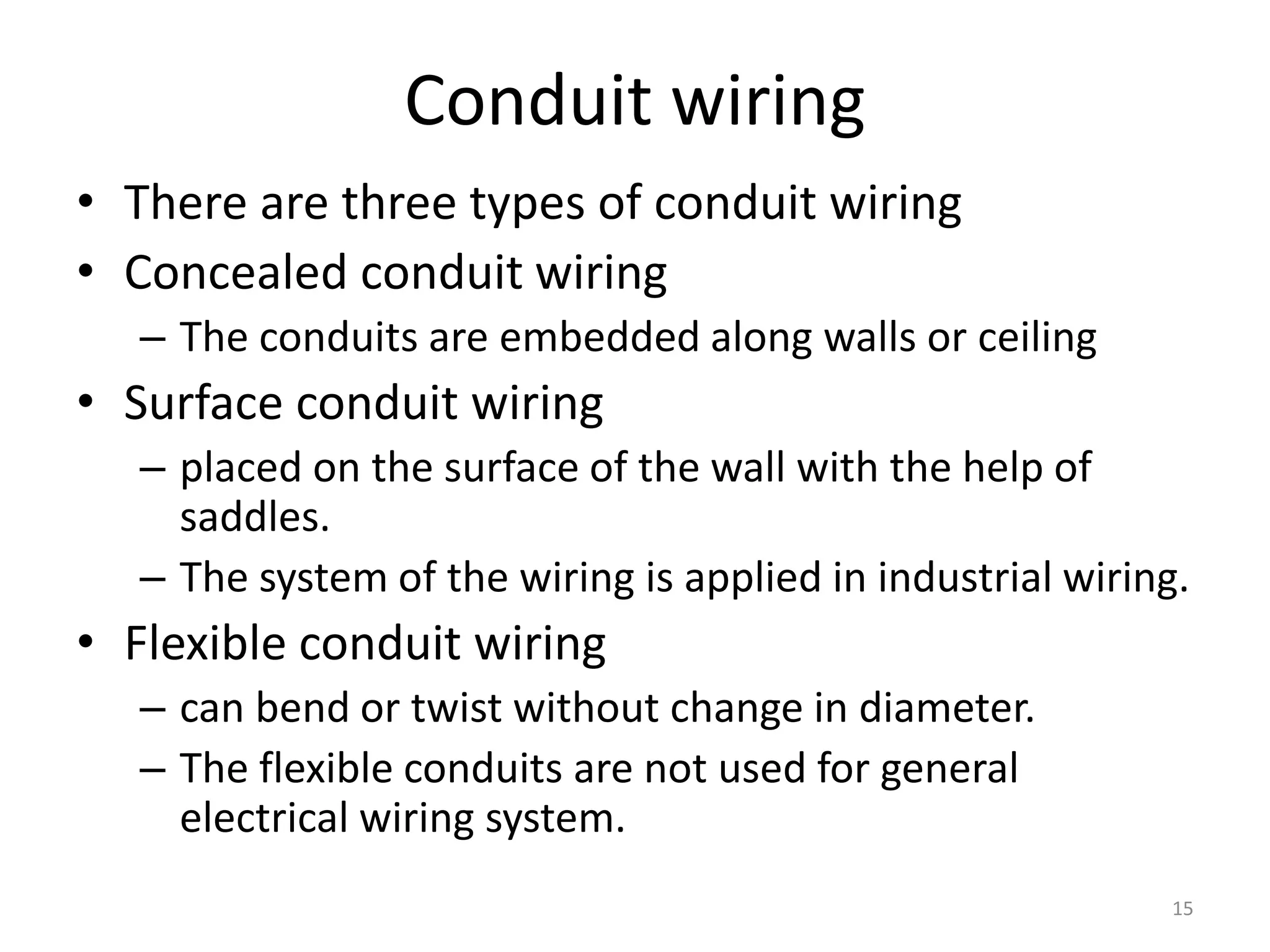
Conduit wiring
• There are three types of conduit wiring
• Concealed conduit wiring
– The conduits are embedded along walls or ceiling
• Surface conduit wiring
– placed on the surface of the wall with the help of
saddles.
– The system of the wiring is applied in industrial wiring.
• Flexible conduit wiring
– can bend or twist without change in diameter.
– The flexible conduits are not used for general
electrical wiring system.
15
• 5. conduit boxes
• The main purpose of conduit box is to conceal the
electrical junctions from sight and for
maintenance.
• The general appearance of these boxes is either a
circular, square or rectangular design.
• These are of different designs which serve the
following purposes
a) outlet boxes – for providing connections to light, fan
and other points
b) inspection boxes – for pulling of cables
c) junction boxes – for housing junction of cables
16
17
Conduit bushings and terminators
Conduit boxes: outlet boxes, junction boxes and inspection boxes
Electrical Trunking
• Trunking is an enclosure provided for the
protection of cables which is normally square
or rectangular in cross-section, having one
removable side.
• Trunking may be thought of as simply a larger
and more accessible conduit system.
18
LIGHTING ACCESSORIES AND FITTINGS
• Toggle
• Rotary
• Pushbutton
• Rocker
• Pull-chain
• Slide
• Magnetic
• Mercury
• Timer
• Voice activated
• Touch sensitive
• Clapper and many
others
19
Switches: used to control lighting circuits.
There are many types of electrical switches
20
Toggle switch
Push to make
switch
Slide switch
Rocker switch Multi way rotary switch Dimmer switch
Common switch configurations
• Single pole single throw (SPST)
• Double pole, single throw (DPST)
• Single pole, double throw (SPDT)
• Double pole, double throw (DPDT)
• The number of "poles" is the number of separate
circuits which are controlled by a switch.
• The number of "throws" is the number of separate
positions that the switch can adopt.
21
22
The two terminals are either connected
together or disconnected from each other.
A simple changeover switch: C (COM,
Common) is connected to L1 or to L2.
Equivalent to two SPST switches controlled by
a single mechanism
Equivalent to two SPDT switches
controlled by a single mechanism.
Switch control configurations
• One way switch = single pole switch
• Three way switch -> sometimes called two
way switch – allows for a device or lamp to be
controlled independently from two locations
regardless of the position of the other switch
• Four way switch -> to control a lamp from
more than two locations four-way switch (also
known as intermediate switch) is used
together with three-way switches.
23
24
junction box can be located either inside or adjacent to a fluorescent fitting. It also lends itself to
long cable runs since there is then no 1.5 mm2
cable size limit on the lighting circuit. It is not
favoured today for domestic installations since the junction boxes are liable to be under the floor
boards and with fitted carpets, etc. These become inaccessible.
25
technique known as 'two-way switching'. Alternative approaches can be adopted. Where
method of cabling involves PVC or other single core cabling enclosed in conduit [or trun
If we require to switch from 3 (or more) positions, then we need to introduce an intermed
switch.
This technique has the disadvantage that the switch feed and the switched line [often abb
technique known as 'two-way switching'. Alternative approaches can be adopted. Where the
method of cabling involves PVC or other single core cabling enclosed in conduit [or trunking]:-
If we require to switch from 3 (or more) positions, then we need to introduce an intermediate
switch.
Lamp Holders
• Are designed for quick removal and
replacement of the lamp and yet they must
hold the lamp in firm metallic contact to
prevent overheating.
• There are three main sizes of lamp holders:
– Bayonet-cap (BC) up to 200w lamps
– the medium Edison screw (ES) up to 300w lamps
– the Goliath screw (GES) above 300w lamps
26
27
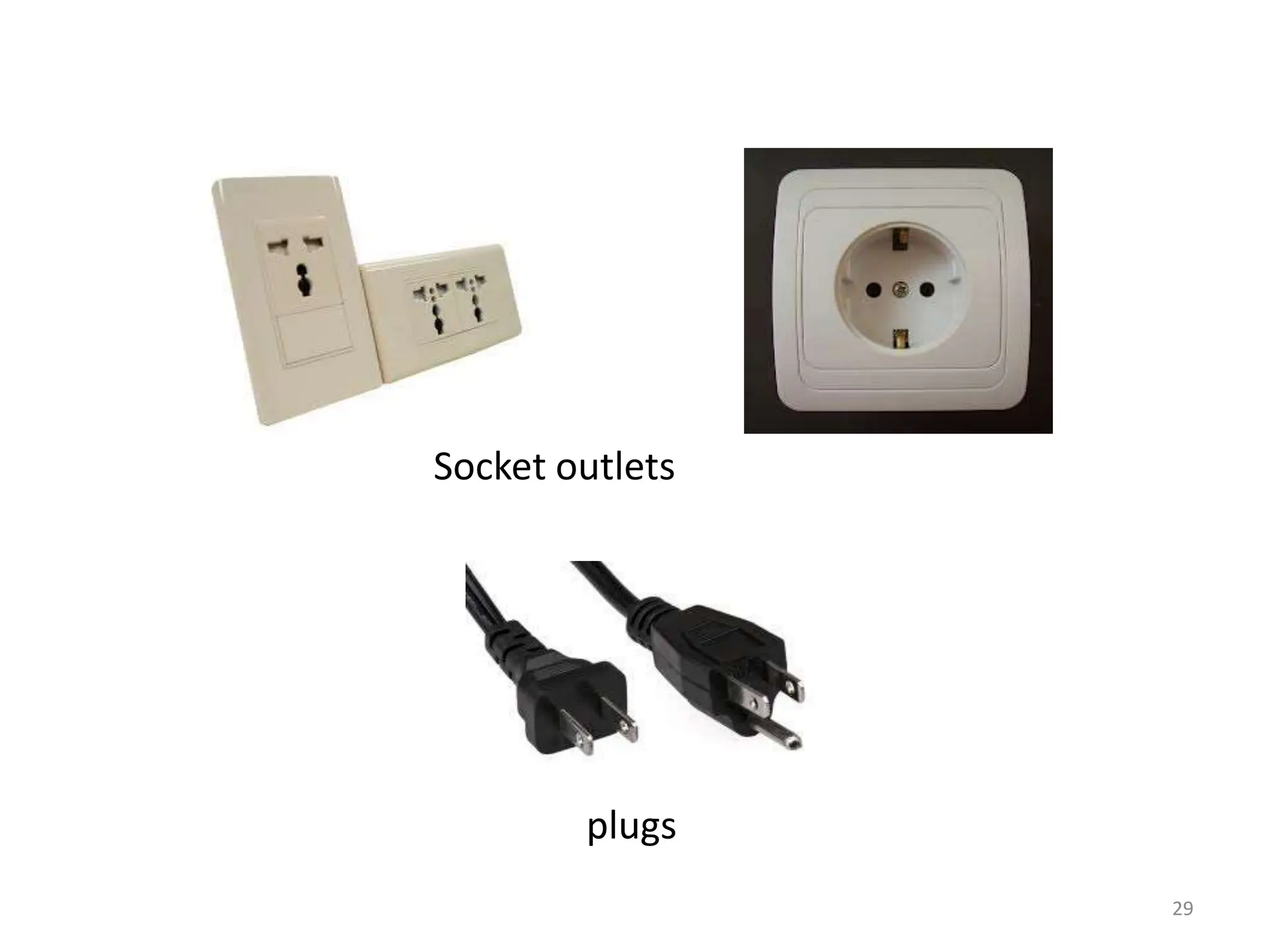
Plugs and socket outlets
• These are used to enable portable apparatus
to be connected to the fixed wiring and
comprises of two or three contact tubes and
terminals.
• The plug is the movable part connected to the
apparatus by flexible wire, and consists of two
or three contact pins to fit in to the contact
tubes.
28
29
plugs
Socket outlets
Circuit Breaker and fuse
• A circuit breaker is an automatically operated electrical
switch designed to protect an electrical circuit from
damage caused by over load or short circuit.
• Circuit breakers consists of carefully calibrated bimetallic
strip (operates by heat)
• Some types of CBs have magnetic arrangement that opens
instantly in case of short circuit.
• Fuse is a type of sacrificial over current protection device.
Its essential component is a metal wire or strip (Cu or tin-
lead alloy) that melts when too much current flows, which
interrupts the circuit in which it is connected.
• Standard ratings: both fuse and circuit breakers are
available in standard ratings of 6, 10, 16, 20, 25, 35, 50, 63,
80, 100, 125, 160, 224, 250, 300, and large sizes.
30
Circuit breaker Fuse
31
Distribution Board
• A distribution board is an assemblage of parts,
including one or more fuses or circuit breakers,
arranged for the distribution of electrical energy
to final circuits or to other sub-distribution
boards.
• It consists of a case inside which is a frame
holding a number of fuse (CB) carriers behind the
frame or something along side or above it, is a
bus-bar to which the incoming sub-main is
connected.
32
• The electrical distribution board is
represented by drawing as follows
33
34
fig 4 Typical distribution board
35
Wiring methods of Lighting
Installation
Lamps connected in series, parallel
and series-parallel have different light
intensity. One of these arrangements
is used in residential and industrial
lighting systems which you are going
to determine experimentally. Each of
them is discussed below.
36
Neutral line (N)
Phase line (P)
Lamp
1
Lamp
2
Lamp
3
Switch
1
Switch
2
Switch
3
Figure: Parallel connection of lamps
37
Lights (Load) connected in Series
This system is usually used for decorative lighting where many
lights are connected in series and connected by one switch. In
this circuit, the various load points might drop different voltage
across themselves. Depending on the rating of lighting loads
the lights might not produce enough brightness. This is due to
the bulbs are designed to produce sufficient brightness at their
rated voltage. Neutral Line (N)
Phase Line (N)
Switch
Lamp 1 Lamp 2
Figure 1: Series connected lamps
38
Figure 3: Series-parallel connection of lamps
L1
L2
N
P
L3
Switch
Series-parallel Connections
Series-parallel circuits are used either to provide dim
lights or full bright.
39
Fig. 5 Incomplete wiring diagram
N
P
L1
L2
JB
SPST
•Draw the three diagrams for two lamps connected in series and controlled
by a switch on your lab report sheet.
40
N
P
L1
L2
JB
SPST
Fig. 6 Incomplete wiring diagram
Draw wiring diagram for two lamps connected in parallel and controlled by a switch

electrical materialsand accessories ch2.pptx

  • 1.
  • 2.
    • Before designingand implementing electrical installation on buildings, we must first understand the basic principles regarding the materials, devices, fittings and equipment that form a complete wiring system • Topics of this chapter: 1. Wires and insulation materials 2. Conduits, conduit accessories & trunking 3. Lighting accessories and fittings: switches, lamp holders, plugs and socket outlets 4. Switches and Switching circuits 5. Fuses and circuit breakers 6. Distribution board 2
  • 3.
    Wire and Cable •The term wire and cable are used more or less synonymously in house wiring. • Wire = single wire, may be bare or covered with insulation • Cable = several wires stranded together • The necessary requirements of a cable – it should conduct electricity efficiently, cheaply, and safely. – should neither be so small so as to have a large internal voltage drop – nor be too large so as to cost too much. – Its insulation should be such as to prevent leakage of current and to minimize risk of fire and shock. 3
  • 4.
  • 5.
    • A cableconsists of three parts: a. the conductor or core – the metal wire or strand of wires carrying current. b. the insulation or dielectric – a covering of insulation material to avoid leakage current from the conductor. c. the protective covering – for protection of insulation from mechanical damage. 5
  • 6.
    Conductor Materials usedin Cables • A conductor is either solid or stranded • Copper and aluminum are the materials used as conductors in power and lighting cables. • Aluminum: is frequently used in place of copper for bare electric cables used for long distance power distribution. • The size of conductors shall be, such that the voltage drop between the supply terminal and fixed current-using equipment shall not exceed 4% of the nominal voltage of the supply line, when the conductors are carrying the full, load current. 6
  • 7.
    Insulating Materials • Theinsulating material used in electric cable must possess the following properties. – High resistivity – High flexibility – Non-in flammability – High resistivity to moisture, acid or alkalis qualities. • So the type of insulating materials used depends up on the service for which the cable is required. 7
  • 8.
    2. PVC: • polyvinylchloride is a man made thermo- plastic material • It is tough, incombustible and chemically unreactive. • It is now the most usual low voltage cable insulation. • It does not deteriorate with age and does not need to be renewed. • Its chief drawback is that it softens at a temperature above 80⁰c. 8
  • 9.
    Color of cables •Live wire – red, yellow or blue • Neutral – black • Earth wire – yellow green 9
  • 10.
    General specification ofcables: • The complete specification of a cable will give the following information: I. The size of the cable II. The type of conductor used in cables (copper or aluminum) III. Number of cores that the cable consists of (single core, twin core, etc) IV. Voltage grade V. Type of insulation 10
  • 11.
    Conduits and Trunking •The most common method of installing cables is to draw them into a conduit • Electric Conduits are the pipelines (metal or plastic) that used to protect and ensure wiring of electrical wire or cable in building electrical installation. • Some types of conduit used in electrical installation work are as follows: • PVC • Steel • Flexible • Stainless Steel 11
  • 12.
    • Advantages ofPVC Conduit – Lightweight and easy to handle – Easy to cut and debut – Simple to form and bend – Does not require painting – Minimal condensation due to low thermal conductivity in wall of conduit. – Speed of installation – Excellent electrical and fire resistant properties 12
  • 13.
    • Disadvantages ofPVC Conduit – Care must be taken when gluing joints to avoid forming a barrier across the inside of the conduit. – If insufficient adhesive is used the joints may not be waterproof. – PVC expands about 5 times as much as steel and this expansion must be allowed for. – PVC does not offer the same level of mechanical protection as steel. – A separate Circuit Protective Conductor must be run inside the conduit. 13
  • 14.
    Steel Conduit: Thisconduit is suitable for use in external or damp installations. • Some Advantages of Steel Conduit – Provides cables good mechanical protection – Permits easy rewiring – Minimizes fire risks. – Can be utilized as the Circuit Protective Conductor. • Some Disadvantages of Steel Conduit – Under certain conditions moisture is liable to form on the inside wall of the conduit. – Expensive compared with some other wiring systems. – Liable to corrosion where subject to acids, alkalis and corrosive fumes. 14
  • 15.
    Conduit wiring • Thereare three types of conduit wiring • Concealed conduit wiring – The conduits are embedded along walls or ceiling • Surface conduit wiring – placed on the surface of the wall with the help of saddles. – The system of the wiring is applied in industrial wiring. • Flexible conduit wiring – can bend or twist without change in diameter. – The flexible conduits are not used for general electrical wiring system. 15
  • 16.
    • 5. conduitboxes • The main purpose of conduit box is to conceal the electrical junctions from sight and for maintenance. • The general appearance of these boxes is either a circular, square or rectangular design. • These are of different designs which serve the following purposes a) outlet boxes – for providing connections to light, fan and other points b) inspection boxes – for pulling of cables c) junction boxes – for housing junction of cables 16
  • 17.
    17 Conduit bushings andterminators Conduit boxes: outlet boxes, junction boxes and inspection boxes
  • 18.
    Electrical Trunking • Trunkingis an enclosure provided for the protection of cables which is normally square or rectangular in cross-section, having one removable side. • Trunking may be thought of as simply a larger and more accessible conduit system. 18
  • 19.
    LIGHTING ACCESSORIES ANDFITTINGS • Toggle • Rotary • Pushbutton • Rocker • Pull-chain • Slide • Magnetic • Mercury • Timer • Voice activated • Touch sensitive • Clapper and many others 19 Switches: used to control lighting circuits. There are many types of electrical switches
  • 20.
    20 Toggle switch Push tomake switch Slide switch Rocker switch Multi way rotary switch Dimmer switch
  • 21.
    Common switch configurations •Single pole single throw (SPST) • Double pole, single throw (DPST) • Single pole, double throw (SPDT) • Double pole, double throw (DPDT) • The number of "poles" is the number of separate circuits which are controlled by a switch. • The number of "throws" is the number of separate positions that the switch can adopt. 21
  • 22.
    22 The two terminalsare either connected together or disconnected from each other. A simple changeover switch: C (COM, Common) is connected to L1 or to L2. Equivalent to two SPST switches controlled by a single mechanism Equivalent to two SPDT switches controlled by a single mechanism.
  • 23.
    Switch control configurations •One way switch = single pole switch • Three way switch -> sometimes called two way switch – allows for a device or lamp to be controlled independently from two locations regardless of the position of the other switch • Four way switch -> to control a lamp from more than two locations four-way switch (also known as intermediate switch) is used together with three-way switches. 23
  • 24.
    24 junction box canbe located either inside or adjacent to a fluorescent fitting. It also lends itself to long cable runs since there is then no 1.5 mm2 cable size limit on the lighting circuit. It is not favoured today for domestic installations since the junction boxes are liable to be under the floor boards and with fitted carpets, etc. These become inaccessible.
  • 25.
    25 technique known as'two-way switching'. Alternative approaches can be adopted. Where method of cabling involves PVC or other single core cabling enclosed in conduit [or trun If we require to switch from 3 (or more) positions, then we need to introduce an intermed switch. This technique has the disadvantage that the switch feed and the switched line [often abb technique known as 'two-way switching'. Alternative approaches can be adopted. Where the method of cabling involves PVC or other single core cabling enclosed in conduit [or trunking]:- If we require to switch from 3 (or more) positions, then we need to introduce an intermediate switch.
  • 26.
    Lamp Holders • Aredesigned for quick removal and replacement of the lamp and yet they must hold the lamp in firm metallic contact to prevent overheating. • There are three main sizes of lamp holders: – Bayonet-cap (BC) up to 200w lamps – the medium Edison screw (ES) up to 300w lamps – the Goliath screw (GES) above 300w lamps 26
  • 27.
  • 28.
    Plugs and socketoutlets • These are used to enable portable apparatus to be connected to the fixed wiring and comprises of two or three contact tubes and terminals. • The plug is the movable part connected to the apparatus by flexible wire, and consists of two or three contact pins to fit in to the contact tubes. 28
  • 29.
  • 30.
    Circuit Breaker andfuse • A circuit breaker is an automatically operated electrical switch designed to protect an electrical circuit from damage caused by over load or short circuit. • Circuit breakers consists of carefully calibrated bimetallic strip (operates by heat) • Some types of CBs have magnetic arrangement that opens instantly in case of short circuit. • Fuse is a type of sacrificial over current protection device. Its essential component is a metal wire or strip (Cu or tin- lead alloy) that melts when too much current flows, which interrupts the circuit in which it is connected. • Standard ratings: both fuse and circuit breakers are available in standard ratings of 6, 10, 16, 20, 25, 35, 50, 63, 80, 100, 125, 160, 224, 250, 300, and large sizes. 30
  • 31.
  • 32.
    Distribution Board • Adistribution board is an assemblage of parts, including one or more fuses or circuit breakers, arranged for the distribution of electrical energy to final circuits or to other sub-distribution boards. • It consists of a case inside which is a frame holding a number of fuse (CB) carriers behind the frame or something along side or above it, is a bus-bar to which the incoming sub-main is connected. 32
  • 33.
    • The electricaldistribution board is represented by drawing as follows 33
  • 34.
    34 fig 4 Typicaldistribution board
  • 35.
    35 Wiring methods ofLighting Installation Lamps connected in series, parallel and series-parallel have different light intensity. One of these arrangements is used in residential and industrial lighting systems which you are going to determine experimentally. Each of them is discussed below.
  • 36.
    36 Neutral line (N) Phaseline (P) Lamp 1 Lamp 2 Lamp 3 Switch 1 Switch 2 Switch 3 Figure: Parallel connection of lamps
  • 37.
    37 Lights (Load) connectedin Series This system is usually used for decorative lighting where many lights are connected in series and connected by one switch. In this circuit, the various load points might drop different voltage across themselves. Depending on the rating of lighting loads the lights might not produce enough brightness. This is due to the bulbs are designed to produce sufficient brightness at their rated voltage. Neutral Line (N) Phase Line (N) Switch Lamp 1 Lamp 2 Figure 1: Series connected lamps
  • 38.
    38 Figure 3: Series-parallelconnection of lamps L1 L2 N P L3 Switch Series-parallel Connections Series-parallel circuits are used either to provide dim lights or full bright.
  • 39.
    39 Fig. 5 Incompletewiring diagram N P L1 L2 JB SPST •Draw the three diagrams for two lamps connected in series and controlled by a switch on your lab report sheet.
  • 40.
    40 N P L1 L2 JB SPST Fig. 6 Incompletewiring diagram Draw wiring diagram for two lamps connected in parallel and controlled by a switch