International Research Journal of Engineering and Technology (IRJET) e-ISSN: 2395 -0056
Volume: 03 Issue: 02 | Feb-2016 www.irjet.net p-ISSN: 2395-0072
© 2016, IRJET | Impact Factor value: 4.45 | ISO 9001:2008 Certified Journal | Page 547
Wireless Sensor Network Based Precision Green House Management
System
G.Gnanavel1, G.Ezhilarasan2, N.Pavithra3
Assistant professor12, PG scholar3
Department of EEE
V.R.S. College of engineering, Villupuram
gnanavel1982@gmail.com1, gkar12345@yahoo.com2, pavithra24swamy@gmail.com3
Abstract – Precision Green house management based
agriculture is a combination of integrated information and
production-based farming system that is designed to increase
long term site-specific farm production efficiency and
profitability while minimizing unintended effects on green
house environment. It requires intensivesensingoftheclimate
conditions at ground levelandrapidcommunication ofdatato
the central repository. Wireless sensornetwork isanemerging
field that can be used to monitor and control the agriculture
parameters in order to make intelligent automated
agriculture system inside the green house. The system
basically comprises of CPU for monitoring the data in
LABVIEW platform and Zigbee module along with PIC
microcontroller to establish wireless communication between
two distant locations. The main purpose of the work
undertaken in this paper is to sense, monitor and control the
temperature, humidity and irrigation in the greenhouse from
remote location using the Zigbee technology atlowcost. Inthe
present work the data from sensing node afteramplificationis
fed to ADC and then to the microcontroller. This is then
connected to the Zigbee module which transmits the data to
the Zigbee module at the other end. It reads the data and
displays on to the host computer through Labview and the
control sequence is generated to control the green house
parameters from the control room wirelessly.
Key Words: Green House, Precision Farming, Wireless
Monitoring and Control, Zigbee
1. INTRODUCTION
The agricultural growth in future wouldincreaseimmensely
if improvements are made in the productivity of diversified
farming systems with specific focus on regional
specialization and sustainable management of natural
resources. In order to diversify agriculture, agro processing
and other value added activities play a pivotal role.
Climatological condition monitoring is one of the most
important aspects inagricultural productionthathasa direct
impact on the productivity and maintenance of crop. A huge
loss occurs every year damage of crops by various diseases
caused by improper climatic conditions. Deployment of
intelligent sensor nodes, on the field, promises a wide range
of new applications like plant growth monitoring and also
monitoring of various environmental conditions that
influences agricultural productions tremendouslyandmany
have used the wireless sensor nodes for the same purpose.
The sensing technique allows acquisition of soil and crop
information, communication and identification of
environmental changes which can have devastating effects
on the farm yield. With the help of that information at
regular time intervals, the irrigation and climatic conditions
inside the greenhouse can be controlled using automated
actuation devices to increase the overall productivity.
Greenhouse is the advanced facility available in which
we can control the climate to increase plant growth and
avoid the effect of season changes on the plants. Greenhouse
is playing a significant role in the production of out-of-
season fruits, flowers and vegetables as well as high value
and sensitive plants like capsicum. The purpose of
greenhouse environmental control is to get the best climatic
conditions (controlled temperature,humidity,lightandlevel
of carbon dioxide) for crop growth, increased crop yields,
improved quality of crops, and regulated growth cycle of
crops.
Aim of this project is to design, developandimplementa
sensor-based wireless communication system to monitor
and control the agricultural parameterssuchastemperature
and humidity in real time for better management and
maintenance of agricultural production and to prevent the
severe attack of diseases on the crops caused by the
climatic conditions.Inamonitoringsystemisproposed
which integratesthesystemonchip(SoC)platformand
ZigBee wireless network for precision agriculture.The
designed system basically constitute sensors for field
signal acquisition, MCU (Microcontroller with
integrated LCD controller) as a front end processing
device and Zigbee module to transmit the signal in
wireless manner. The monitoring and control system
International Research Journal of Engineering and Technology (IRJET) e-ISSN: 2395 -0056
Volume: 03 Issue: 02 | Feb-2016 www.irjet.net p-ISSN: 2395-0072
© 2016, IRJET | Impact Factor value: 4.45 | ISO 9001:2008 Certified Journal | Page 548
based on radio frequency (RF) transceiver for greenhouseis
presented which consists of a few sensor nodes placed in
greenhouse and a master node connected to host computer.
The sensor nodes collects the signals from the greenhouse,
transmits it through wireless RF transceiver and finally
sends the data to the host computerforreal timemonitoring.
In this paper an electronic system based on a
microcontroller that integrates ZIGBEE wireless functions
with PC is designed and developed. The system allows the
acquisition of different climatic parameters (temperature,
humidity and soil moisture) in the agricultural greenhouse.
In addition a graphical user interface using Labview
software has been developed for the acquisition, monitoring
through PC and storage of all data. At the same time this
interface encompasses at the same time reliability,flexibility
of use, interactivity and processing capability of the whole
data in real-time. The first part of this paper is devoted to
greenhouse structure set up, secondpartdealswithwireless
communication architecture, third part discusses on the
experimentation and results and finally conclusions are
drawn.
2. WIRELESS SYSTEM ARCHITECTURE AND ITS
COMPONENTS
Fig – 1: Block diagram of wireless sensing system
This work is basically divided into the following
modules: first is the HSM 20G humidity sensor module with
the signal conditioning circuit, second is the PIC18F452
microcontroller, and third is the ZigBee transceiver present
at both transmitting and receiving end. At the receiving end
the ZigBee module is connected to the host computer for the
purpose of continuous monitoring and database
maintenance. The HSM 20 G is a precision integrated-circuit
humidity and temperature sensor, whose output voltage is
linearly proportional to temp in Celsius (Centigrade). The
HSM 20G thus has an advantage over the linear temperature
sensors calibrated in Kelvin, as the user is not required to
subtract large constant voltage from its output to obtain
convenient Centigrade scaling. Itrequiresaninputvoltage of
5V. The HSM 20G is rated to operate over a 0°C to 50 °C
temperature range.
Fig – 2: HSM 20G
In this work PIC 18F452 microcontroller [9] is used to
transfer the data to Zigbee module serially. Its pin
configuration is shown in Fig. 3.
Fig – 3: Pin details of PIC 18F452
PIC 18F452 has Harvard architecture with a RISC
processor inside. It is having a 40 pin DIP structure, 33 pins
are set aside for five ports PORTA, PORTB, PORTC, PORTD
and PORTE. Its standardfeaturesareonchipprogram(code)
ROM, data RAM and data EEPROM, timers, ADC, USART etc.
PIC18F452 has 10-bits in-built ADC, which converts the
analog input data fed to it through PORTA pins. ADCs are
mainly used for data acquisition. A strong feature of PIC I/O
ports is that its individual bits can be accessed without
altering the rest of the bits in that port. This can be used if
we need to access few pins of the port instead of the entire 8
bits. PIC 18F452 reads the analog signalsanddeploysiton in
built ADC which digitizes it to a 10 bit resolution data. A
proper firmware is developed for dedicated applications,
which computes signal into relative humidity in percentage
and displays the same on the screen at the receiver end.
TxD and RxD serial pins are used to interface the
ZigBee module.
International Research Journal of Engineering and Technology (IRJET) e-ISSN: 2395 -0056
Volume: 03 Issue: 02 | Feb-2016 www.irjet.net p-ISSN: 2395-0072
© 2016, IRJET | Impact Factor value: 4.45 | ISO 9001:2008 Certified Journal | Page 549
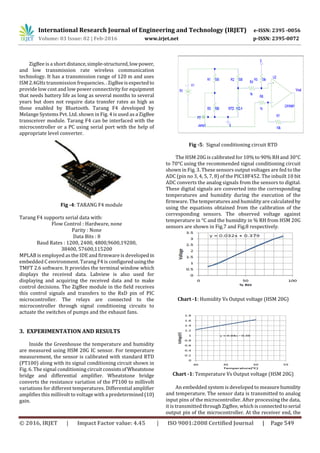
ZigBee is a short distance,simple-structured,lowpower,
and low transmission rate wireless communication
technology. It has a transmission range of 120 m and uses
ISM 2.4GHz transmission frequencies. . ZigBeeisexpectedto
provide low cost and low power connectivity for equipment
that needs battery life as long as several months to several
years but does not require data transfer rates as high as
those enabled by Bluetooth. Tarang F4 developed by
Melange Systems Pvt. Ltd. shown in Fig. 4 is used as a ZigBee
transceiver module. Tarang F4 can be interfaced with the
microcontroller or a PC using serial port with the help of
appropriate level converter.
Fig -4: TARANG F4 module
Tarang F4 supports serial data with:
Flow Control : Hardware, none
Parity : None
Data Bits : 8
Baud Rates : 1200, 2400, 4800,9600,19200,
38400, 57600,115200
MPLAB is employed as the IDE and firmware is developedin
embedded C environment. Tarang F4 is configuredusingthe
TMFT 2.6 software. It provides the terminal window which
displays the received data. Labview is also used for
displaying and acquiring the received data and to make
control decisions. The ZigBee module in the field receives
this control signals and transfers to the RxD pin of PIC
microcontroller. The relays are connected to the
microcontroller through signal conditioning circuits to
actuate the switches of pumps and the exhaust fans.
3. EXPERIMENTATION AND RESULTS
Inside the Greenhouse the temperature and humidity
are measured using HSM 20G IC sensor. For temperature
measurement, the sensor is calibrated with standard RTD
(PT100) along with its signal conditioning circuit shown in
Fig. 6. The signal conditioning circuit consistsofWheatstone
bridge and differential amplifier. Wheatstone bridge
converts the resistance variation of the PT100 to millivolt
variations for different temperatures. Differential amplifier
amplifies this millivolt to voltage with a predetermined(10)
gain.
Fig -5: Signal conditioning circuit RTD
The HSM 20G is calibrated for 10% to 90% RH and 30°C
to 70°C using the recommended signal conditioning circuit
shown in Fig. 3. These sensors output voltages are fed to the
ADC (pin no 3, 4, 5, 7, 8) of the PIC18F452. The inbuilt 10 bit
ADC converts the analog signals from the sensors to digital.
These digital signals are converted into the corresponding
temperatures and humidity during the execution of the
firmware. The temperatures and humidity are calculated by
using the equations obtained from the calibration of the
corresponding sensors. The observed voltage against
temperature in °C and the humidity in % RH from HSM 20G
sensors are shown in Fig.7 and Fig.8 respectively.
Chart -1: Humidity Vs Output voltage (HSM 20G)
Chart -1: Temperature Vs Output voltage (HSM 20G)
An embedded system is developed to measurehumidity
and temperature. The sensor data is transmitted to analog
input pins of the microcontroller. After processing the data,
it is transmitted through ZigBee, which isconnectedtoserial
output pin of the microcontroller. At the receiver end, the
International Research Journal of Engineering and Technology (IRJET) e-ISSN: 2395 -0056
Volume: 03 Issue: 02 | Feb-2016 www.irjet.net p-ISSN: 2395-0072
© 2016, IRJET | Impact Factor value: 4.45 | ISO 9001:2008 Certified Journal | Page 550
zigbee module in the control room is connected to the host
computer through RS-232. The LABVIEW software is used
to present the data at the user end. This data is then stored
as a text file for database maintenance. The LABVIEW
program is in such a way that it can be worked in two
different modes, read mode and write mode. In read mode it
will read the received data and shows it in the front panel
and in the write mode the generated control signals are sent
from the LABVIEW. These control signals are transmitted to
the zigbee module in the field from the control room zigbee
module. The ‘data out’ pin of the field zigbee module is
connected to the RX pin (pin no 26) of the PIC
microcontroller. These control signals changes the status of
the relays in the field. The host computer displays the
current value of the temperature, humidity and also the
status of the relays in the greenhouse. Relays are controlled
by the control signals from the host computer based on the
set points specified by the user. The relays are connected to
the microcontroller to carry out the required control
function. The firmware consists of the serial reception
instruction which helps to control the status of the relays.
The two relays are connected to the ‘interrupt’ pins (pin no
33, 34) of the microcontroller. The firmware controls the
status of the relays according to the control signals send by
the user from the control room. The implemented hardware
set up is shown in Fig. 10. The front panel and the block
diagram developedinLABVIEWfor real timemonitoring and
control is shown in Fig. 10 and Fig. 11 respectively. This real
time monitoring provides reliable, timely information of
crop and soil status which is important in taking decisions
for crop production improvement.
(a)
(b)
Fig -6: (a) Transceiver module with microcontroller board
(b) Monitoring of data in computer screen
Fig -7: LABVIEW front panel
Fig -8: LABVIEW block diagram
4. CONCLUSION
In green house technology, the automation of
agricultural parameters becomes a necessary part. Hence
wireless communication with simple hardware and user
friendly software like Labview is shown to be an efficient
solution for automated green house.Inthispapera precision
Green house management approach to monitor and control
the climate and irrigation system is demonstrated. It is
proved to be a boon for Hi Tech agricultural field. Although
the experimental resultshaveshownfortwoparameters, the
system is completely scalable. The proposed approach has a
great potential for remote cropmonitoringandcontrol using
WSN technology for large scale green house. The system
presented here is user friendly, low cost and can be easily
implemented.
REFERENCES
[1] Deng Xiao lei, Zheng Lihua, Li Minzan,“Developmentofa
Field Wireless Sensors Network Based on ZigBee
Technology,” World Automation Congress (WAC), 2010,pp
463 - 467.
[2] Yunseop (James) Kim, Robert G. Evans, and William M.
Iversen, “Remote SensingandControl ofanIrrigationSystem
Using a Distributed Wireless Sensor Network, ”IEEE
International Research Journal of Engineering and Technology (IRJET) e-ISSN: 2395 -0056
Volume: 03 Issue: 02 | Feb-2016 www.irjet.net p-ISSN: 2395-0072
© 2016, IRJET | Impact Factor value: 4.45 | ISO 9001:2008 Certified Journal | Page 551
Transactions on Instrumentation and Measurement, vol.57,
No. 7, July 2008.
[3] Xuemei Li, Yuyan Deng, Lixing Ding, “Study on Precision
Agriculture Monitoring Framework Based on WSN,” 2nd
International Conference on Anti-counterfeiting, Security
and Identification, 2008. ASID 2008. pp 182 – 185.
[4] Chandani Anand, Shashikant Sadistap, SatishBindal and
K. S. N. Rao, “Multi -Sensor Embedded System for Agro-
Industrial Applications,” 2009 Third International
Conference on Sensor Technologies and Applications.
[5] Ning Wang , Naiqian Zhang , Maohua Wang "Wireless
sensors in agriculture and food industry—Recent
development and future perspective,"Computers and
Electronics in Agriculture 50 (2006) 1–
[6] Muhammad Ali Mazidi,Rolin D.Mckinlay, Danny Causey,
“PIC Microcontroller And Embedded Systems Using
Assembly and C for PIC18,” Edition 2008,Pearson Education
[7] Dogan Ibrahim, “Advanced PIC MicrocontrollerProjects
in C-From USB to Zigbee with the PIC18F series,”Edition
2008, Elsevier Ltd.
[8] Martin P.Bates,“Programming8-BitPICMicrocontrollers
in C with interactive hardware simulation,” Edition 2008,
Elsevier Ltd. Datasheet
BIOGRAPHIES
G.GNANAVEL,
V.R.S College of Engineering and
Technology,
ASSISTANT PROFESSOR
E.EZHILARASAN,
V.R.S College of Engineering and
Technology,
ASSISTANT PROFESSOR
N.PAVITHRA,
V.R.S College of Engineering and
Technology,
PG SCHOLAR

Wireless Sensor Network Based Precision Green House Management System

  • 1.
    International Research Journalof Engineering and Technology (IRJET) e-ISSN: 2395 -0056 Volume: 03 Issue: 02 | Feb-2016 www.irjet.net p-ISSN: 2395-0072 © 2016, IRJET | Impact Factor value: 4.45 | ISO 9001:2008 Certified Journal | Page 547 Wireless Sensor Network Based Precision Green House Management System G.Gnanavel1, G.Ezhilarasan2, N.Pavithra3 Assistant professor12, PG scholar3 Department of EEE V.R.S. College of engineering, Villupuram gnanavel1982@gmail.com1, gkar12345@yahoo.com2, pavithra24swamy@gmail.com3 Abstract – Precision Green house management based agriculture is a combination of integrated information and production-based farming system that is designed to increase long term site-specific farm production efficiency and profitability while minimizing unintended effects on green house environment. It requires intensivesensingoftheclimate conditions at ground levelandrapidcommunication ofdatato the central repository. Wireless sensornetwork isanemerging field that can be used to monitor and control the agriculture parameters in order to make intelligent automated agriculture system inside the green house. The system basically comprises of CPU for monitoring the data in LABVIEW platform and Zigbee module along with PIC microcontroller to establish wireless communication between two distant locations. The main purpose of the work undertaken in this paper is to sense, monitor and control the temperature, humidity and irrigation in the greenhouse from remote location using the Zigbee technology atlowcost. Inthe present work the data from sensing node afteramplificationis fed to ADC and then to the microcontroller. This is then connected to the Zigbee module which transmits the data to the Zigbee module at the other end. It reads the data and displays on to the host computer through Labview and the control sequence is generated to control the green house parameters from the control room wirelessly. Key Words: Green House, Precision Farming, Wireless Monitoring and Control, Zigbee 1. INTRODUCTION The agricultural growth in future wouldincreaseimmensely if improvements are made in the productivity of diversified farming systems with specific focus on regional specialization and sustainable management of natural resources. In order to diversify agriculture, agro processing and other value added activities play a pivotal role. Climatological condition monitoring is one of the most important aspects inagricultural productionthathasa direct impact on the productivity and maintenance of crop. A huge loss occurs every year damage of crops by various diseases caused by improper climatic conditions. Deployment of intelligent sensor nodes, on the field, promises a wide range of new applications like plant growth monitoring and also monitoring of various environmental conditions that influences agricultural productions tremendouslyandmany have used the wireless sensor nodes for the same purpose. The sensing technique allows acquisition of soil and crop information, communication and identification of environmental changes which can have devastating effects on the farm yield. With the help of that information at regular time intervals, the irrigation and climatic conditions inside the greenhouse can be controlled using automated actuation devices to increase the overall productivity. Greenhouse is the advanced facility available in which we can control the climate to increase plant growth and avoid the effect of season changes on the plants. Greenhouse is playing a significant role in the production of out-of- season fruits, flowers and vegetables as well as high value and sensitive plants like capsicum. The purpose of greenhouse environmental control is to get the best climatic conditions (controlled temperature,humidity,lightandlevel of carbon dioxide) for crop growth, increased crop yields, improved quality of crops, and regulated growth cycle of crops. Aim of this project is to design, developandimplementa sensor-based wireless communication system to monitor and control the agricultural parameterssuchastemperature and humidity in real time for better management and maintenance of agricultural production and to prevent the severe attack of diseases on the crops caused by the climatic conditions.Inamonitoringsystemisproposed which integratesthesystemonchip(SoC)platformand ZigBee wireless network for precision agriculture.The designed system basically constitute sensors for field signal acquisition, MCU (Microcontroller with integrated LCD controller) as a front end processing device and Zigbee module to transmit the signal in wireless manner. The monitoring and control system
  • 2.
    International Research Journalof Engineering and Technology (IRJET) e-ISSN: 2395 -0056 Volume: 03 Issue: 02 | Feb-2016 www.irjet.net p-ISSN: 2395-0072 © 2016, IRJET | Impact Factor value: 4.45 | ISO 9001:2008 Certified Journal | Page 548 based on radio frequency (RF) transceiver for greenhouseis presented which consists of a few sensor nodes placed in greenhouse and a master node connected to host computer. The sensor nodes collects the signals from the greenhouse, transmits it through wireless RF transceiver and finally sends the data to the host computerforreal timemonitoring. In this paper an electronic system based on a microcontroller that integrates ZIGBEE wireless functions with PC is designed and developed. The system allows the acquisition of different climatic parameters (temperature, humidity and soil moisture) in the agricultural greenhouse. In addition a graphical user interface using Labview software has been developed for the acquisition, monitoring through PC and storage of all data. At the same time this interface encompasses at the same time reliability,flexibility of use, interactivity and processing capability of the whole data in real-time. The first part of this paper is devoted to greenhouse structure set up, secondpartdealswithwireless communication architecture, third part discusses on the experimentation and results and finally conclusions are drawn. 2. WIRELESS SYSTEM ARCHITECTURE AND ITS COMPONENTS Fig – 1: Block diagram of wireless sensing system This work is basically divided into the following modules: first is the HSM 20G humidity sensor module with the signal conditioning circuit, second is the PIC18F452 microcontroller, and third is the ZigBee transceiver present at both transmitting and receiving end. At the receiving end the ZigBee module is connected to the host computer for the purpose of continuous monitoring and database maintenance. The HSM 20 G is a precision integrated-circuit humidity and temperature sensor, whose output voltage is linearly proportional to temp in Celsius (Centigrade). The HSM 20G thus has an advantage over the linear temperature sensors calibrated in Kelvin, as the user is not required to subtract large constant voltage from its output to obtain convenient Centigrade scaling. Itrequiresaninputvoltage of 5V. The HSM 20G is rated to operate over a 0°C to 50 °C temperature range. Fig – 2: HSM 20G In this work PIC 18F452 microcontroller [9] is used to transfer the data to Zigbee module serially. Its pin configuration is shown in Fig. 3. Fig – 3: Pin details of PIC 18F452 PIC 18F452 has Harvard architecture with a RISC processor inside. It is having a 40 pin DIP structure, 33 pins are set aside for five ports PORTA, PORTB, PORTC, PORTD and PORTE. Its standardfeaturesareonchipprogram(code) ROM, data RAM and data EEPROM, timers, ADC, USART etc. PIC18F452 has 10-bits in-built ADC, which converts the analog input data fed to it through PORTA pins. ADCs are mainly used for data acquisition. A strong feature of PIC I/O ports is that its individual bits can be accessed without altering the rest of the bits in that port. This can be used if we need to access few pins of the port instead of the entire 8 bits. PIC 18F452 reads the analog signalsanddeploysiton in built ADC which digitizes it to a 10 bit resolution data. A proper firmware is developed for dedicated applications, which computes signal into relative humidity in percentage and displays the same on the screen at the receiver end. TxD and RxD serial pins are used to interface the ZigBee module.
  • 3.
    International Research Journalof Engineering and Technology (IRJET) e-ISSN: 2395 -0056 Volume: 03 Issue: 02 | Feb-2016 www.irjet.net p-ISSN: 2395-0072 © 2016, IRJET | Impact Factor value: 4.45 | ISO 9001:2008 Certified Journal | Page 549 ZigBee is a short distance,simple-structured,lowpower, and low transmission rate wireless communication technology. It has a transmission range of 120 m and uses ISM 2.4GHz transmission frequencies. . ZigBeeisexpectedto provide low cost and low power connectivity for equipment that needs battery life as long as several months to several years but does not require data transfer rates as high as those enabled by Bluetooth. Tarang F4 developed by Melange Systems Pvt. Ltd. shown in Fig. 4 is used as a ZigBee transceiver module. Tarang F4 can be interfaced with the microcontroller or a PC using serial port with the help of appropriate level converter. Fig -4: TARANG F4 module Tarang F4 supports serial data with: Flow Control : Hardware, none Parity : None Data Bits : 8 Baud Rates : 1200, 2400, 4800,9600,19200, 38400, 57600,115200 MPLAB is employed as the IDE and firmware is developedin embedded C environment. Tarang F4 is configuredusingthe TMFT 2.6 software. It provides the terminal window which displays the received data. Labview is also used for displaying and acquiring the received data and to make control decisions. The ZigBee module in the field receives this control signals and transfers to the RxD pin of PIC microcontroller. The relays are connected to the microcontroller through signal conditioning circuits to actuate the switches of pumps and the exhaust fans. 3. EXPERIMENTATION AND RESULTS Inside the Greenhouse the temperature and humidity are measured using HSM 20G IC sensor. For temperature measurement, the sensor is calibrated with standard RTD (PT100) along with its signal conditioning circuit shown in Fig. 6. The signal conditioning circuit consistsofWheatstone bridge and differential amplifier. Wheatstone bridge converts the resistance variation of the PT100 to millivolt variations for different temperatures. Differential amplifier amplifies this millivolt to voltage with a predetermined(10) gain. Fig -5: Signal conditioning circuit RTD The HSM 20G is calibrated for 10% to 90% RH and 30°C to 70°C using the recommended signal conditioning circuit shown in Fig. 3. These sensors output voltages are fed to the ADC (pin no 3, 4, 5, 7, 8) of the PIC18F452. The inbuilt 10 bit ADC converts the analog signals from the sensors to digital. These digital signals are converted into the corresponding temperatures and humidity during the execution of the firmware. The temperatures and humidity are calculated by using the equations obtained from the calibration of the corresponding sensors. The observed voltage against temperature in °C and the humidity in % RH from HSM 20G sensors are shown in Fig.7 and Fig.8 respectively. Chart -1: Humidity Vs Output voltage (HSM 20G) Chart -1: Temperature Vs Output voltage (HSM 20G) An embedded system is developed to measurehumidity and temperature. The sensor data is transmitted to analog input pins of the microcontroller. After processing the data, it is transmitted through ZigBee, which isconnectedtoserial output pin of the microcontroller. At the receiver end, the
  • 4.
    International Research Journalof Engineering and Technology (IRJET) e-ISSN: 2395 -0056 Volume: 03 Issue: 02 | Feb-2016 www.irjet.net p-ISSN: 2395-0072 © 2016, IRJET | Impact Factor value: 4.45 | ISO 9001:2008 Certified Journal | Page 550 zigbee module in the control room is connected to the host computer through RS-232. The LABVIEW software is used to present the data at the user end. This data is then stored as a text file for database maintenance. The LABVIEW program is in such a way that it can be worked in two different modes, read mode and write mode. In read mode it will read the received data and shows it in the front panel and in the write mode the generated control signals are sent from the LABVIEW. These control signals are transmitted to the zigbee module in the field from the control room zigbee module. The ‘data out’ pin of the field zigbee module is connected to the RX pin (pin no 26) of the PIC microcontroller. These control signals changes the status of the relays in the field. The host computer displays the current value of the temperature, humidity and also the status of the relays in the greenhouse. Relays are controlled by the control signals from the host computer based on the set points specified by the user. The relays are connected to the microcontroller to carry out the required control function. The firmware consists of the serial reception instruction which helps to control the status of the relays. The two relays are connected to the ‘interrupt’ pins (pin no 33, 34) of the microcontroller. The firmware controls the status of the relays according to the control signals send by the user from the control room. The implemented hardware set up is shown in Fig. 10. The front panel and the block diagram developedinLABVIEWfor real timemonitoring and control is shown in Fig. 10 and Fig. 11 respectively. This real time monitoring provides reliable, timely information of crop and soil status which is important in taking decisions for crop production improvement. (a) (b) Fig -6: (a) Transceiver module with microcontroller board (b) Monitoring of data in computer screen Fig -7: LABVIEW front panel Fig -8: LABVIEW block diagram 4. CONCLUSION In green house technology, the automation of agricultural parameters becomes a necessary part. Hence wireless communication with simple hardware and user friendly software like Labview is shown to be an efficient solution for automated green house.Inthispapera precision Green house management approach to monitor and control the climate and irrigation system is demonstrated. It is proved to be a boon for Hi Tech agricultural field. Although the experimental resultshaveshownfortwoparameters, the system is completely scalable. The proposed approach has a great potential for remote cropmonitoringandcontrol using WSN technology for large scale green house. The system presented here is user friendly, low cost and can be easily implemented. REFERENCES [1] Deng Xiao lei, Zheng Lihua, Li Minzan,“Developmentofa Field Wireless Sensors Network Based on ZigBee Technology,” World Automation Congress (WAC), 2010,pp 463 - 467. [2] Yunseop (James) Kim, Robert G. Evans, and William M. Iversen, “Remote SensingandControl ofanIrrigationSystem Using a Distributed Wireless Sensor Network, ”IEEE
  • 5.
    International Research Journalof Engineering and Technology (IRJET) e-ISSN: 2395 -0056 Volume: 03 Issue: 02 | Feb-2016 www.irjet.net p-ISSN: 2395-0072 © 2016, IRJET | Impact Factor value: 4.45 | ISO 9001:2008 Certified Journal | Page 551 Transactions on Instrumentation and Measurement, vol.57, No. 7, July 2008. [3] Xuemei Li, Yuyan Deng, Lixing Ding, “Study on Precision Agriculture Monitoring Framework Based on WSN,” 2nd International Conference on Anti-counterfeiting, Security and Identification, 2008. ASID 2008. pp 182 – 185. [4] Chandani Anand, Shashikant Sadistap, SatishBindal and K. S. N. Rao, “Multi -Sensor Embedded System for Agro- Industrial Applications,” 2009 Third International Conference on Sensor Technologies and Applications. [5] Ning Wang , Naiqian Zhang , Maohua Wang "Wireless sensors in agriculture and food industry—Recent development and future perspective,"Computers and Electronics in Agriculture 50 (2006) 1– [6] Muhammad Ali Mazidi,Rolin D.Mckinlay, Danny Causey, “PIC Microcontroller And Embedded Systems Using Assembly and C for PIC18,” Edition 2008,Pearson Education [7] Dogan Ibrahim, “Advanced PIC MicrocontrollerProjects in C-From USB to Zigbee with the PIC18F series,”Edition 2008, Elsevier Ltd. [8] Martin P.Bates,“Programming8-BitPICMicrocontrollers in C with interactive hardware simulation,” Edition 2008, Elsevier Ltd. Datasheet BIOGRAPHIES G.GNANAVEL, V.R.S College of Engineering and Technology, ASSISTANT PROFESSOR E.EZHILARASAN, V.R.S College of Engineering and Technology, ASSISTANT PROFESSOR N.PAVITHRA, V.R.S College of Engineering and Technology, PG SCHOLAR