Introduction
Emerging technologies are making our life simpler
these days. With the introduction of mobile phones,
life has changed rapidly. This is a dream of radio
engineering. Now just think of a battery charger that
charges your mobile automatically. When you sit for
tea and place your mobile on the table, it simply
charges your mobile. This article explains a simple
wireless battery charger circuit that charges
your mobile when placed near the transmitter. This
circuit may be used as wireless power transfer circuit,
wireless mobile charger circuit, wireless battery
charger circuit, etc.
Principle
• This circuit mainly works on the principle of mutual inductance.
Power is transferred from transmitter to the receiver wirelessly
based on the principle of “inductive coupling”.
• Inductance is the property of the conductor, in which the current
flowing in a conductor induces a voltage or electromotive force in it
or in another nearby conductor.
• There are two types inductance. 1) Self inductance, 2)Mutual
Inductance.
• “Mutual inductance” is the phenomena in which, when a current
carrying conductor is placed near another conductor voltage is
induced in that conductor. This is because, as the current is flowing
in the conductor, a magnetic flux is induced in it. This induced
magnetic flux links with another conductor and this flux induces
voltage in the second conductor. Thus two conductors are said to be
inductively coupled.
Wireless Power
Transfer Circuit Diagram
Wireless Power
Transfer Circuit Diagram
Wireless Mobile Charger Circuit
Design
• In our Wireless battery charger, we use two circuits
• The first circuit is transmitter circuit used to produce
voltage wirelessly
• The transmitter circuit consists of DC source, oscillator
circuit and a transmitter coil. oscillator circuit consists
of two n channel MOSFETS IRF 540 , 4148 diodes.
• When the DC power is given to the oscillator, current
starts flowing through the two coils L1, L2 and drain
terminal of the transistor.
• At the same time some voltage is appeared at the gate
terminals of the transistors.
• One of the transistors is in on state while the
other is in off state. Thus voltage at drain of
transistor which is in off state raises and it fall
through the tank circuit made of 6.8nf
capacitors and transmitter coil of 0.674.
• Thus operating frequency is determined by
using formula F=1/[2π√(LC)].
Wireless Mobile Charger Circuit
Design
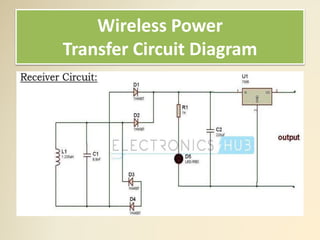
• In the second circuit that is receiver circuit
consists of receiver coil, rectifier circuit and
regulator.
• When the receiver coil is placed at a distance
near the inductor Ac power is induced in the coil.
• This is rectified by the rectifier circuit and is
regulated to DC 5v using 7805 regulator.
• The rectifier circuit consists of 1n4007 diode and
capacitor of 6.8nf. The output of regulator is
connected to the battery.
Wireless Mobile Charger Circuit
Design
How to operate this Wireless Power
Transfer Circuit?
• Initially, connect the circuit as shown in the
circuit diagram.
• Switch on the supply.
• Connect the battery charger at the output of
the circuit.
• Place the receiver coil near the transmitter
coil .
• You can observe the charging of battery.
Wireless Battery Charger Circuit
Advantages
• Usage of separate charger is eliminated.
• Phone can be charged anywhere and anytime.
• It does not require wire for charging.
• Easier than plug into power cable.
Wireless Power
Transfer Circuit Applications
• Wireless chargers can be used to charge
mobiles, camera batteries, Bluetooth headsets
etc.
• This can also be used in applications like car
battery charger with little modification. Go
to Simple Car Battery Charger Circuit post for
more information.
• This can also be used in medical devices.
Limitations of the Circuit
• Power is somewhat wasted due to mutual
induction.
• It will work for very short distances only. If you
want to use it for long distances, then the
number of inductor turns should be high.
The End

Wireless mobile battery charger

  • 2.
    Introduction Emerging technologies aremaking our life simpler these days. With the introduction of mobile phones, life has changed rapidly. This is a dream of radio engineering. Now just think of a battery charger that charges your mobile automatically. When you sit for tea and place your mobile on the table, it simply charges your mobile. This article explains a simple wireless battery charger circuit that charges your mobile when placed near the transmitter. This circuit may be used as wireless power transfer circuit, wireless mobile charger circuit, wireless battery charger circuit, etc.
  • 4.
    Principle • This circuitmainly works on the principle of mutual inductance. Power is transferred from transmitter to the receiver wirelessly based on the principle of “inductive coupling”. • Inductance is the property of the conductor, in which the current flowing in a conductor induces a voltage or electromotive force in it or in another nearby conductor. • There are two types inductance. 1) Self inductance, 2)Mutual Inductance. • “Mutual inductance” is the phenomena in which, when a current carrying conductor is placed near another conductor voltage is induced in that conductor. This is because, as the current is flowing in the conductor, a magnetic flux is induced in it. This induced magnetic flux links with another conductor and this flux induces voltage in the second conductor. Thus two conductors are said to be inductively coupled.
  • 5.
  • 6.
  • 7.
    Wireless Mobile ChargerCircuit Design • In our Wireless battery charger, we use two circuits • The first circuit is transmitter circuit used to produce voltage wirelessly • The transmitter circuit consists of DC source, oscillator circuit and a transmitter coil. oscillator circuit consists of two n channel MOSFETS IRF 540 , 4148 diodes. • When the DC power is given to the oscillator, current starts flowing through the two coils L1, L2 and drain terminal of the transistor. • At the same time some voltage is appeared at the gate terminals of the transistors.
  • 8.
    • One ofthe transistors is in on state while the other is in off state. Thus voltage at drain of transistor which is in off state raises and it fall through the tank circuit made of 6.8nf capacitors and transmitter coil of 0.674. • Thus operating frequency is determined by using formula F=1/[2π√(LC)]. Wireless Mobile Charger Circuit Design
  • 9.
    • In thesecond circuit that is receiver circuit consists of receiver coil, rectifier circuit and regulator. • When the receiver coil is placed at a distance near the inductor Ac power is induced in the coil. • This is rectified by the rectifier circuit and is regulated to DC 5v using 7805 regulator. • The rectifier circuit consists of 1n4007 diode and capacitor of 6.8nf. The output of regulator is connected to the battery. Wireless Mobile Charger Circuit Design
  • 10.
    How to operatethis Wireless Power Transfer Circuit? • Initially, connect the circuit as shown in the circuit diagram. • Switch on the supply. • Connect the battery charger at the output of the circuit. • Place the receiver coil near the transmitter coil . • You can observe the charging of battery.
  • 11.
    Wireless Battery ChargerCircuit Advantages • Usage of separate charger is eliminated. • Phone can be charged anywhere and anytime. • It does not require wire for charging. • Easier than plug into power cable.
  • 12.
    Wireless Power Transfer CircuitApplications • Wireless chargers can be used to charge mobiles, camera batteries, Bluetooth headsets etc. • This can also be used in applications like car battery charger with little modification. Go to Simple Car Battery Charger Circuit post for more information. • This can also be used in medical devices.
  • 13.
    Limitations of theCircuit • Power is somewhat wasted due to mutual induction. • It will work for very short distances only. If you want to use it for long distances, then the number of inductor turns should be high.
  • 15.