Wireless Power
Transfer Overview
Gary Chi, Chief Marketing Officer, jjPlus
2018/02/17
Types of Wireless Power/Energy Transfer
* Figure from Texas Instruments
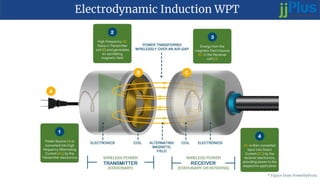
Electrodynamic Induction WPT
* Figure from PowerbyProxi
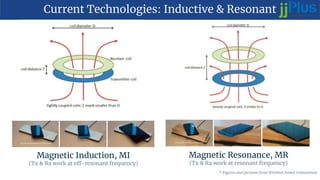
Current Technologies: Inductive & Resonant
Magnetic Induction, MI
(Tx & Rx work at off-resonant frequency)
Magnetic Resonance, MR
(Tx & Rx work at resonant frequency)
* Figures and pictures from Wireless Power Consortium
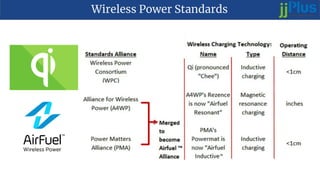
Wireless Power Standards
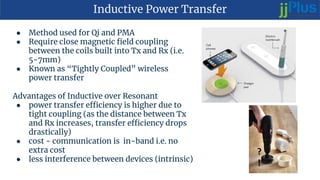
Inductive Power Transfer
● Method used for Qi and PMA
● Require close magnetic field coupling
between the coils built into Tx and Rx (i.e.
5-7mm)
● Known as “Tightly Coupled” wireless
power transfer
Advantages of Inductive over Resonant
● power transfer efficiency is higher due to
tight coupling (as the distance between Tx
and Rx increases, transfer efficiency drops
drastically)
● cost - communication is in-band i.e. no
extra cost
● less interference between devices (intrinsic)
Qi Specification
Prior to V1.2
● Typical wireless power
transfer is 5W (baseline power
profile)
● Closely coupled system at 5 -
7mm
● Work at off-resonant
frequency, MI mode only
● 100~205KHz range of
operation
● In-band, backscatter Rx to Tx
one-way communication
● Foreign Object Detection (FOD)
is used to detect metallic
objects’ presence
V1.2
● Released in 2014
● Increased power to 15W
(extended power profile)
● Adds 2-way communication
● Resonant Task Force added
the resonant extension draft,
but unreleased until now
Challenges
● Backscatter Tx-Rx
communication might be the
main road block for Resonant Qi
(4 years of fighting the laws of
physics already!)
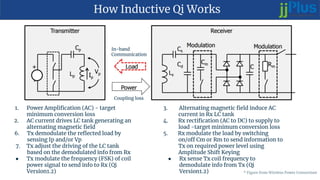
How Inductive Qi Works
1. Power Amplification (AC) - target
minimum conversion loss
2. AC current drives LC tank generating an
alternating magnetic field
6. Tx demodulate the reflected load by
sensing Ip and/or Vp
7. Tx adjust the driving of the LC tank
based on the demodulated info from Rx
● Tx modulate the frequency (FSK) of coil
power signal to send info to Rx (Qi
Version1.2)
3. Alternating magnetic field induce AC
current in Rx LC tank
4. Rx rectification (AC to DC) to supply to
load -target minimum conversion loss
5. Rx modulate the load by switching
on/off Cm or Rm to send information to
Tx on required power level using
Amplitude Shift Keying
● Rx sense Tx coil frequency to
demodulate info from Tx (Qi
Version1.2)
Coupling loss
In-band
Communication
* Figure from Wireless Power Consortium
Resonant Power Transfer
● Method used for A4WP’s Rezence, now
AirFuel Resonant
● Magnetic field coupling require a pair of tuned
and highly resonant coils+Impedance
Matching Networks built into Tx and Rx
● High efficiency wireless power transfer at a
distance (overcome the problem of inductive
method where the transfer efficiency drops
drastically when the distance between Tx and
Rx increases)
● Known as “Loosely Coupled” wireless power
transfer
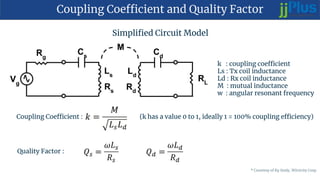
Coupling Coefficient and Quality Factor
Simplified Circuit Model
k : coupling coefficient
Ls : Tx coil inductance
Ld : Rx coil inductance
M : mutual inductance
w : angular resonant frequency
Coupling Coefficient : (k has a value 0 to 1, ideally 1 = 100% coupling efficiency)
Quality Factor :
* Courtesy of Ky Sealy, Witricity Corp.
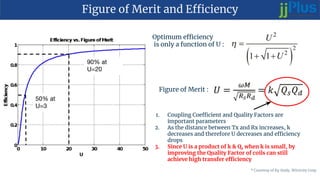
Figure of Merit and Efficiency
Figure of Merit :
* Courtesy of Ky Sealy, Witricity Corp.
Optimum efficiency
is only a function of U :
1. Coupling Coefficient and Quality Factors are
important parameters
2. As the distance between Tx and Rx increases, k
decreases and therefore U decreases and efficiency
drops
3. Since U is a product of k & Q, when k is small, by
improving the Quality Factor of coils can still
achieve high transfer efficiency
Advantages of Resonant over Inductive
● Power transfer through thick surfaces and materials
● Spatial/Positional flexibility - does not require precise alignment between Tx
and Rx
● Single Tx coil can transfer power to multiple Rx coils
● Power transfer to multiple devices with different power requirements
● Negligible heating effect with metal objects * Pictures from Witricity Corp.
What is Resonance?
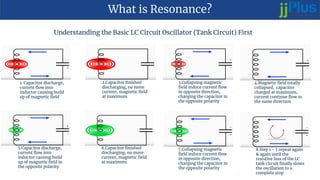
1. Capacitor discharge,
current flow into
inductor causing build
up of magnetic field
2.Capacitor finished
discharging, no more
current, magnetic field
at maximum
3.Collapsing magnetic
field induce current flow
in opposite direction,
charging the capacitor in
the opposite polarity
4.Magnetic field totally
collapsed, capacitor
charged at maximum,
current continue flow in
the same direction
5.Capacitor discharge,
current flow into
inductor causing build
up of magnetic field in
the opposite polarity
6.Capacitor finished
discharging, no more
current, magnetic field
at maximum
7.Collapsing magnetic
field induce current flow
in opposite direction,
charging the capacitor in
the opposite polarity
8.Step 1 - 7 repeat again
& again until the
resistive loss of the LC
tank circuit finally slows
the oscillation to a
complete stop
Understanding the Basic LC Circuit Oscillator (Tank Circuit) First
What is Resonance?
Tank circuit basic knowledge
● Energy transfer between Capacitor (electrical
energy) and Inductor (magnetic energy) like water
sloshing back and forth in a tank
● The rate of the energy transfer, the oscillation, is
the natural resonant frequency of the tank circuit
● An idealized tank circuit assumes no loss of energy,
therefore, the energy transfer can continue on its
own forever, theoretically
● Practical tank circuit design target minimum
damping meaning that the resistive loss of
components and connecting wires is made as low as
possible
Imaging the child is pushed at the natural resonant frequency of the swing!
AirFuel Resonant Specification
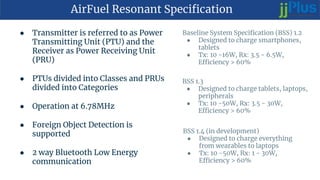
● Transmitter is referred to as Power
Transmitting Unit (PTU) and the
Receiver as Power Receiving Unit
(PRU)
● PTUs divided into Classes and PRUs
divided into Categories
● Operation at 6.78MHz
● Foreign Object Detection is
supported
● 2 way Bluetooth Low Energy
communication
Baseline System Specification (BSS) 1.2
● Designed to charge smartphones,
tablets
● Tx: 10 -16W, Rx: 3.5 - 6.5W,
Efficiency > 60%
BSS 1.3
● Designed to charge tablets, laptops,
peripherals
● Tx: 10 -50W, Rx: 3.5 - 30W,
Efficiency > 60%
BSS 1.4 (in development)
● Designed to charge everything
from wearables to laptops
● Tx: 10 -50W, Rx: 1 - 30W,
Efficiency > 60%
PTUs and PRUs
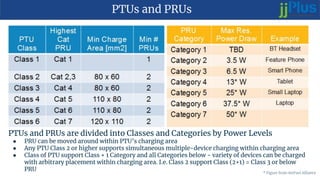
PTUs and PRUs are divided into Classes and Categories by Power Levels
● PRU can be moved around within PTU’s charging area
● Any PTU Class 2 or higher supports simultaneous multiple-device charging within charging area
● Class of PTU support Class + 1 Category and all Categories below - variety of devices can be charged
with arbitrary placement within charging area. I.e. Class 2 support Class (2+1) = Class 3 or below
PRU
* Figure from AirFuel Alliance
Why 6.78 MHz
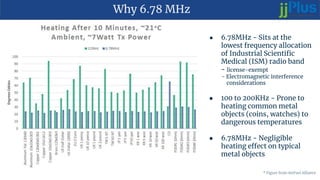
● 6.78MHz - Sits at the
lowest frequency allocation
of Industrial Scientific
Medical (ISM) radio band
- license-exempt
- Electromagnetic interference
considerations
● 100 to 200KHz - Prone to
heating common metal
objects (coins, watches) to
dangerous temperatures
● 6.78MHz - Negligible
heating effect on typical
metal objects
* Figure from AirFuel Alliance
How AirFuel Resonant Works
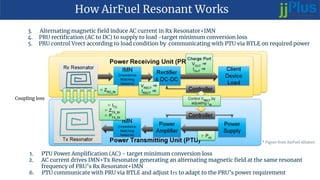
1. PTU Power Amplification (AC) - target minimum conversion loss
2. AC current drives IMN+Tx Resonator generating an alternating magnetic field at the same resonant
frequency of PRU’s Rx Resonator+IMN
6. PTU communicate with PRU via BTLE and adjust ITX to adapt to the PRU’s power requirement
3. Alternating magnetic field induce AC current in Rx Resonator+IMN
4. PRU rectification (AC to DC) to supply to load -target minimum conversion loss
5. PRU control Vrect according to load condition by communicating with PTU via BTLE on required power
Coupling loss
* Figure from AirFuel Alliance
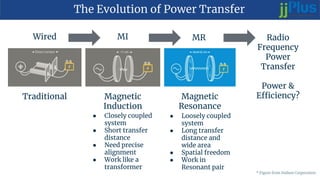
The Evolution of Power Transfer
Traditional Magnetic
Induction
Magnetic
Resonance
● Closely coupled
system
● Short transfer
distance
● Need precise
alignment
● Work like a
transformer
● Loosely coupled
system
● Long transfer
distance and
wide area
● Spatial freedom
● Work in
Resonant pair
MI MRWired Radio
Frequency
Power
Transfer
Power &
Efficiency?
* Figure from Daihen Corporation
Where jjPlus Stands in Magnetic Resonance
● Official member of the AirFuel Alliance
● Official licensee of Witricity Corp. with ongoing
design collaboration
● Preferred solution provider of Efficient Power
Conversion Corp. with ongoing design collaboration
● Powered the world's 1st
commercially available
laptop, Dell Latitude 7285 with wireless charging
● First in the world to obtain AirFuel Resonant
Certification
● Backed and protected by 450+ patents & increasing
(Witricity 400+, jjPlus 40+, EPC 10+)
● Customer projects in Robotics, Infrastructure Public
Charging, Medical and Gaming markets
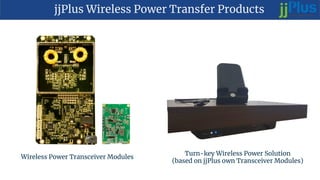
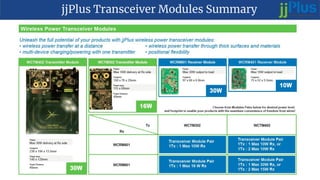
jjPlus Wireless Power Transfer Products
Wireless Power Transceiver Modules
Turn-key Wireless Power Solution
(based on jjPlus own Transceiver Modules)
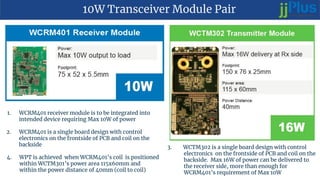
10W Transceiver Module Pair
1. WCRM401 receiver module is to be integrated into
intended device requiring Max 10W of power
2. WCRM401 is a single board design with control
electronics on the frontside of PCB and coil on the
backside
4. WPT is achieved when WCRM401’s coil is positioned
within WCTM301’s power area 115x60mm and
within the power distance of 40mm (coil to coil)
3. WCTM302 is a single board design with control
electronics on the frontside of PCB and coil on the
backside. Max 16W of power can be delivered to
the receiver side, more than enough for
WCRM401’s requirement of Max 10W
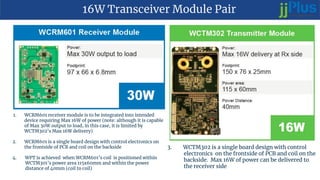
16W Transceiver Module Pair
1. WCRM601 receiver module is to be integrated into intended
device requiring Max 16W of power (note: although it is capable
of Max 30W output to load, in this case, it is limited by
WCTM302’s Max 16W delivery)
2. WCRM601 is a single board design with control electronics on
the frontside of PCB and coil on the backside
4. WPT is achieved when WCRM601’s coil is positioned within
WCTM301’s power area 115x60mm and within the power
distance of 40mm (coil to coil)
3. WCTM302 is a single board design with control
electronics on the frontside of PCB and coil on the
backside. Max 16W of power can be delivered to
the receiver side
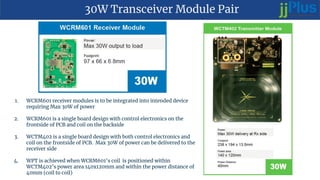
30W Transceiver Module Pair
1. WCRM601 receiver modules is to be integrated into intended device
requiring Max 30W of power
2. WCRM601 is a single board design with control electronics on the
frontside of PCB and coil on the backside
3. WCTM402 is a single board design with both control electronics and
coil on the frontside of PCB. Max 30W of power can be delivered to the
receiver side
4. WPT is achieved when WCRM601’s coil is positioned within
WCTM402’s power area 140x120mm and within the power distance of
40mm (coil to coil)
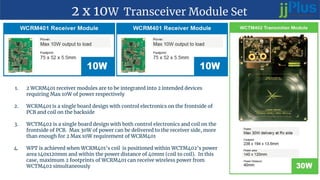
2 x 10W Transceiver Module Set
1. 2 WCRM401 receiver modules are to be integrated into 2 intended devices
requiring Max 10W of power respectively
2. WCRM401 is a single board design with control electronics on the frontside of
PCB and coil on the backside
3. WCTM402 is a single board design with both control electronics and coil on the
frontside of PCB. Max 30W of power can be delivered to the receiver side, more
than enough for 2 Max 10W requirement of WCRM401
4. WPT is achieved when WCRM401’s coil is positioned within WCTM402’s power
area 140x120mm and within the power distance of 40mm (coil to coil). In this
case, maximum 2 footprints of WCRM401 can receive wireless power from
WCTM402 simultaneously
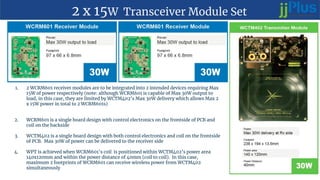
2 x 15W Transceiver Module Set
1. 2 WCRM601 receiver modules are to be integrated into 2 intended devices requiring Max
15W of power respectively (note: although WCRM601 is capable of Max 30W output to
load, in this case, they are limited by WCTM402’s Max 30W delivery which allows Max 2
x 15W power in total to 2 WCRM601s)
2. WCRM601 is a single board design with control electronics on the frontside of PCB and
coil on the backside
3. WCTM402 is a single board design with both control electronics and coil on the frontside
of PCB. Max 30W of power can be delivered to the receiver side
4. WPT is achieved when WCRM601’s coil is positioned within WCTM402’s power area
140x120mm and within the power distance of 40mm (coil to coil). In this case,
maximum 2 footprints of WCRM601 can receive wireless power from WCTM402
simultaneously
jjPlus Transceiver Modules Summary
jjPlus Turn-key Wireless Power Solutions
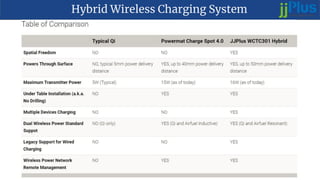
Hybrid Wireless Charging System
Shown left: WCTC301 - 16W wireless power transmitter charging
base and WCRB401 - Qi charging stand with wired devices
support. How it works: 1. WCTC301 delivers 16W of resonant
power through 46mm table 2. enough power to charge up to two
phones simultaneously 3. A “power bridge” WCRB401 which is a
Qi charging stand receives power, at the base of the stand, from
WCTC301 and powers the Qi transmitter 4. When WCRB401 is
placed within WCTC301’s effective charging area, full spatial
freedom is supported 5. Legacy support from type-A output of
WCRB401 with optional 3-in-1 cable
Advantages:
● Full spatial freedom
● Under table transmitter installation/no drilling
● Resonant power through thick surfaces of different types
● Multiple devices charging, one single transmitter
● Full compatibility with Inductive Qi and AirFuel Resonant
● Legacy support to still billions of phones requiring wired charging
NO COMPROMISES ON
DELIVERING
COMPELLING USER
EXPERIENCES
Hybrid Wireless Charging System
jjPlus Wireless Charging System in public places
jjPlus wireless charging systems have been installed in public places such as coffee shops, convenience stores,
bars, fitness centers and so on. For example, FamilyMart, one of the largest convenience store chains in Asia, has
jjPlus’ systems installed in its 1,000+ stores in China’s Hangzhou and Chengdu cities. Each store can provide,
typically, 8 simultaneous wireless charging sessions via WCRB401 or WCRDG04 from the transmitter choice of
either WCTC301 or WCTC202.
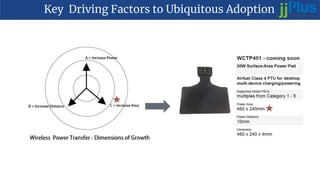
Key Driving Factors to Ubiquitous Adoption
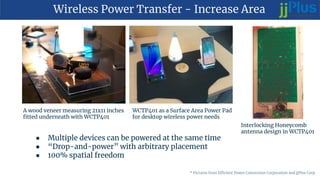
Wireless Power Transfer - Increase Area
A wood veneer measuring 21x11 inches
fitted underneath with WCTP401
WCTP401 as a Surface Area Power Pad
for desktop wireless power needs
Interlocking Honeycomb
antenna design in WCTP401
● Multiple devices can be powered at the same time
● “Drop-and-power” with arbitrary placement
● 100% spatial freedom
* Pictures from Efficient Power Conversion Corporation and jjPlus Corp.
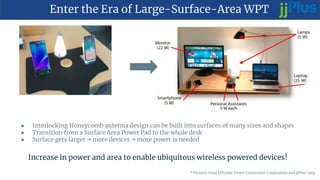
Enter the Era of Large-Surface-Area WPT
● Interlocking Honeycomb antenna design can be built into surfaces of many sizes and shapes
● Transition from a Surface Area Power Pad to the whole desk
● Surface gets larger → more devices → more power is needed
Increase in power and area to enable ubiquitous wireless powered devices!
* Pictures from Efficient Power Conversion Corporation and jjPlus Corp.
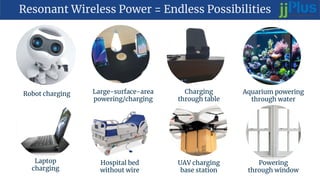
Resonant Wireless Power = Endless Possibilities
Robot charging Large-surface-area
powering/charging
Charging
through table
Aquarium powering
through water
Powering
through window
UAV charging
base station
Hospital bed
without wire
Laptop
charging
CONTACT INFO:
WEB: www.jjplus.com
TEL:+886-2-2248-5700
FAX : +886-2-2248-5977
13F.-3, No.120, Qiaohe Rd., Zhonghe Dist., New Taipei City 235, Taiwan
235新北市中和區橋和路 120號13樓之3
E-mail:info@jjplus.com
LinkedIn: www.linkedin.com/company/13649008/
Facebook: www.facebook.com/jjpluswireless/
Contact us on-line: www.jjplus.com/#contact
or email direct:
Lucy Wang – Sales Manager JJPlus Corporation at
lucy_wang@jjplus.com
About JJPlus Corp.
Established in 2004, JJPlus is a forerunner design manufacturer from Taiwan in wireless communication
and wireless power technologies. With deep domain knowledge and engineering expertise, JJPlus has
always been developing and designing collaboratively with fundamental technology partners to offer OEMs
and ODMs the latest and the best by integrating JJPlus wireless solutions, gracefully, into their solutions.
jjPlus wireless power transfer overivew

  • 1.
    Wireless Power Transfer Overview GaryChi, Chief Marketing Officer, jjPlus 2018/02/17
  • 2.
    Types of WirelessPower/Energy Transfer * Figure from Texas Instruments
  • 3.
    Electrodynamic Induction WPT *Figure from PowerbyProxi
  • 4.
    Current Technologies: Inductive& Resonant Magnetic Induction, MI (Tx & Rx work at off-resonant frequency) Magnetic Resonance, MR (Tx & Rx work at resonant frequency) * Figures and pictures from Wireless Power Consortium
  • 5.
  • 6.
    Inductive Power Transfer ●Method used for Qi and PMA ● Require close magnetic field coupling between the coils built into Tx and Rx (i.e. 5-7mm) ● Known as “Tightly Coupled” wireless power transfer Advantages of Inductive over Resonant ● power transfer efficiency is higher due to tight coupling (as the distance between Tx and Rx increases, transfer efficiency drops drastically) ● cost - communication is in-band i.e. no extra cost ● less interference between devices (intrinsic)
  • 7.
    Qi Specification Prior toV1.2 ● Typical wireless power transfer is 5W (baseline power profile) ● Closely coupled system at 5 - 7mm ● Work at off-resonant frequency, MI mode only ● 100~205KHz range of operation ● In-band, backscatter Rx to Tx one-way communication ● Foreign Object Detection (FOD) is used to detect metallic objects’ presence V1.2 ● Released in 2014 ● Increased power to 15W (extended power profile) ● Adds 2-way communication ● Resonant Task Force added the resonant extension draft, but unreleased until now Challenges ● Backscatter Tx-Rx communication might be the main road block for Resonant Qi (4 years of fighting the laws of physics already!)
  • 8.
    How Inductive QiWorks 1. Power Amplification (AC) - target minimum conversion loss 2. AC current drives LC tank generating an alternating magnetic field 6. Tx demodulate the reflected load by sensing Ip and/or Vp 7. Tx adjust the driving of the LC tank based on the demodulated info from Rx ● Tx modulate the frequency (FSK) of coil power signal to send info to Rx (Qi Version1.2) 3. Alternating magnetic field induce AC current in Rx LC tank 4. Rx rectification (AC to DC) to supply to load -target minimum conversion loss 5. Rx modulate the load by switching on/off Cm or Rm to send information to Tx on required power level using Amplitude Shift Keying ● Rx sense Tx coil frequency to demodulate info from Tx (Qi Version1.2) Coupling loss In-band Communication * Figure from Wireless Power Consortium
  • 9.
    Resonant Power Transfer ●Method used for A4WP’s Rezence, now AirFuel Resonant ● Magnetic field coupling require a pair of tuned and highly resonant coils+Impedance Matching Networks built into Tx and Rx ● High efficiency wireless power transfer at a distance (overcome the problem of inductive method where the transfer efficiency drops drastically when the distance between Tx and Rx increases) ● Known as “Loosely Coupled” wireless power transfer
  • 10.
    Coupling Coefficient andQuality Factor Simplified Circuit Model k : coupling coefficient Ls : Tx coil inductance Ld : Rx coil inductance M : mutual inductance w : angular resonant frequency Coupling Coefficient : (k has a value 0 to 1, ideally 1 = 100% coupling efficiency) Quality Factor : * Courtesy of Ky Sealy, Witricity Corp.
  • 11.
    Figure of Meritand Efficiency Figure of Merit : * Courtesy of Ky Sealy, Witricity Corp. Optimum efficiency is only a function of U : 1. Coupling Coefficient and Quality Factors are important parameters 2. As the distance between Tx and Rx increases, k decreases and therefore U decreases and efficiency drops 3. Since U is a product of k & Q, when k is small, by improving the Quality Factor of coils can still achieve high transfer efficiency
  • 12.
    Advantages of Resonantover Inductive ● Power transfer through thick surfaces and materials ● Spatial/Positional flexibility - does not require precise alignment between Tx and Rx ● Single Tx coil can transfer power to multiple Rx coils ● Power transfer to multiple devices with different power requirements ● Negligible heating effect with metal objects * Pictures from Witricity Corp.
  • 13.
    What is Resonance? 1.Capacitor discharge, current flow into inductor causing build up of magnetic field 2.Capacitor finished discharging, no more current, magnetic field at maximum 3.Collapsing magnetic field induce current flow in opposite direction, charging the capacitor in the opposite polarity 4.Magnetic field totally collapsed, capacitor charged at maximum, current continue flow in the same direction 5.Capacitor discharge, current flow into inductor causing build up of magnetic field in the opposite polarity 6.Capacitor finished discharging, no more current, magnetic field at maximum 7.Collapsing magnetic field induce current flow in opposite direction, charging the capacitor in the opposite polarity 8.Step 1 - 7 repeat again & again until the resistive loss of the LC tank circuit finally slows the oscillation to a complete stop Understanding the Basic LC Circuit Oscillator (Tank Circuit) First
  • 14.
    What is Resonance? Tankcircuit basic knowledge ● Energy transfer between Capacitor (electrical energy) and Inductor (magnetic energy) like water sloshing back and forth in a tank ● The rate of the energy transfer, the oscillation, is the natural resonant frequency of the tank circuit ● An idealized tank circuit assumes no loss of energy, therefore, the energy transfer can continue on its own forever, theoretically ● Practical tank circuit design target minimum damping meaning that the resistive loss of components and connecting wires is made as low as possible Imaging the child is pushed at the natural resonant frequency of the swing!
  • 15.
    AirFuel Resonant Specification ●Transmitter is referred to as Power Transmitting Unit (PTU) and the Receiver as Power Receiving Unit (PRU) ● PTUs divided into Classes and PRUs divided into Categories ● Operation at 6.78MHz ● Foreign Object Detection is supported ● 2 way Bluetooth Low Energy communication Baseline System Specification (BSS) 1.2 ● Designed to charge smartphones, tablets ● Tx: 10 -16W, Rx: 3.5 - 6.5W, Efficiency > 60% BSS 1.3 ● Designed to charge tablets, laptops, peripherals ● Tx: 10 -50W, Rx: 3.5 - 30W, Efficiency > 60% BSS 1.4 (in development) ● Designed to charge everything from wearables to laptops ● Tx: 10 -50W, Rx: 1 - 30W, Efficiency > 60%
  • 16.
    PTUs and PRUs PTUsand PRUs are divided into Classes and Categories by Power Levels ● PRU can be moved around within PTU’s charging area ● Any PTU Class 2 or higher supports simultaneous multiple-device charging within charging area ● Class of PTU support Class + 1 Category and all Categories below - variety of devices can be charged with arbitrary placement within charging area. I.e. Class 2 support Class (2+1) = Class 3 or below PRU * Figure from AirFuel Alliance
  • 17.
    Why 6.78 MHz ●6.78MHz - Sits at the lowest frequency allocation of Industrial Scientific Medical (ISM) radio band - license-exempt - Electromagnetic interference considerations ● 100 to 200KHz - Prone to heating common metal objects (coins, watches) to dangerous temperatures ● 6.78MHz - Negligible heating effect on typical metal objects * Figure from AirFuel Alliance
  • 18.
    How AirFuel ResonantWorks 1. PTU Power Amplification (AC) - target minimum conversion loss 2. AC current drives IMN+Tx Resonator generating an alternating magnetic field at the same resonant frequency of PRU’s Rx Resonator+IMN 6. PTU communicate with PRU via BTLE and adjust ITX to adapt to the PRU’s power requirement 3. Alternating magnetic field induce AC current in Rx Resonator+IMN 4. PRU rectification (AC to DC) to supply to load -target minimum conversion loss 5. PRU control Vrect according to load condition by communicating with PTU via BTLE on required power Coupling loss * Figure from AirFuel Alliance
  • 19.
    The Evolution ofPower Transfer Traditional Magnetic Induction Magnetic Resonance ● Closely coupled system ● Short transfer distance ● Need precise alignment ● Work like a transformer ● Loosely coupled system ● Long transfer distance and wide area ● Spatial freedom ● Work in Resonant pair MI MRWired Radio Frequency Power Transfer Power & Efficiency? * Figure from Daihen Corporation
  • 20.
    Where jjPlus Standsin Magnetic Resonance ● Official member of the AirFuel Alliance ● Official licensee of Witricity Corp. with ongoing design collaboration ● Preferred solution provider of Efficient Power Conversion Corp. with ongoing design collaboration ● Powered the world's 1st commercially available laptop, Dell Latitude 7285 with wireless charging ● First in the world to obtain AirFuel Resonant Certification ● Backed and protected by 450+ patents & increasing (Witricity 400+, jjPlus 40+, EPC 10+) ● Customer projects in Robotics, Infrastructure Public Charging, Medical and Gaming markets
  • 21.
    jjPlus Wireless PowerTransfer Products Wireless Power Transceiver Modules Turn-key Wireless Power Solution (based on jjPlus own Transceiver Modules)
  • 22.
    10W Transceiver ModulePair 1. WCRM401 receiver module is to be integrated into intended device requiring Max 10W of power 2. WCRM401 is a single board design with control electronics on the frontside of PCB and coil on the backside 4. WPT is achieved when WCRM401’s coil is positioned within WCTM301’s power area 115x60mm and within the power distance of 40mm (coil to coil) 3. WCTM302 is a single board design with control electronics on the frontside of PCB and coil on the backside. Max 16W of power can be delivered to the receiver side, more than enough for WCRM401’s requirement of Max 10W
  • 23.
    16W Transceiver ModulePair 1. WCRM601 receiver module is to be integrated into intended device requiring Max 16W of power (note: although it is capable of Max 30W output to load, in this case, it is limited by WCTM302’s Max 16W delivery) 2. WCRM601 is a single board design with control electronics on the frontside of PCB and coil on the backside 4. WPT is achieved when WCRM601’s coil is positioned within WCTM301’s power area 115x60mm and within the power distance of 40mm (coil to coil) 3. WCTM302 is a single board design with control electronics on the frontside of PCB and coil on the backside. Max 16W of power can be delivered to the receiver side
  • 24.
    30W Transceiver ModulePair 1. WCRM601 receiver modules is to be integrated into intended device requiring Max 30W of power 2. WCRM601 is a single board design with control electronics on the frontside of PCB and coil on the backside 3. WCTM402 is a single board design with both control electronics and coil on the frontside of PCB. Max 30W of power can be delivered to the receiver side 4. WPT is achieved when WCRM601’s coil is positioned within WCTM402’s power area 140x120mm and within the power distance of 40mm (coil to coil)
  • 25.
    2 x 10WTransceiver Module Set 1. 2 WCRM401 receiver modules are to be integrated into 2 intended devices requiring Max 10W of power respectively 2. WCRM401 is a single board design with control electronics on the frontside of PCB and coil on the backside 3. WCTM402 is a single board design with both control electronics and coil on the frontside of PCB. Max 30W of power can be delivered to the receiver side, more than enough for 2 Max 10W requirement of WCRM401 4. WPT is achieved when WCRM401’s coil is positioned within WCTM402’s power area 140x120mm and within the power distance of 40mm (coil to coil). In this case, maximum 2 footprints of WCRM401 can receive wireless power from WCTM402 simultaneously
  • 26.
    2 x 15WTransceiver Module Set 1. 2 WCRM601 receiver modules are to be integrated into 2 intended devices requiring Max 15W of power respectively (note: although WCRM601 is capable of Max 30W output to load, in this case, they are limited by WCTM402’s Max 30W delivery which allows Max 2 x 15W power in total to 2 WCRM601s) 2. WCRM601 is a single board design with control electronics on the frontside of PCB and coil on the backside 3. WCTM402 is a single board design with both control electronics and coil on the frontside of PCB. Max 30W of power can be delivered to the receiver side 4. WPT is achieved when WCRM601’s coil is positioned within WCTM402’s power area 140x120mm and within the power distance of 40mm (coil to coil). In this case, maximum 2 footprints of WCRM601 can receive wireless power from WCTM402 simultaneously
  • 27.
  • 28.
    jjPlus Turn-key WirelessPower Solutions
  • 29.
    Hybrid Wireless ChargingSystem Shown left: WCTC301 - 16W wireless power transmitter charging base and WCRB401 - Qi charging stand with wired devices support. How it works: 1. WCTC301 delivers 16W of resonant power through 46mm table 2. enough power to charge up to two phones simultaneously 3. A “power bridge” WCRB401 which is a Qi charging stand receives power, at the base of the stand, from WCTC301 and powers the Qi transmitter 4. When WCRB401 is placed within WCTC301’s effective charging area, full spatial freedom is supported 5. Legacy support from type-A output of WCRB401 with optional 3-in-1 cable Advantages: ● Full spatial freedom ● Under table transmitter installation/no drilling ● Resonant power through thick surfaces of different types ● Multiple devices charging, one single transmitter ● Full compatibility with Inductive Qi and AirFuel Resonant ● Legacy support to still billions of phones requiring wired charging NO COMPROMISES ON DELIVERING COMPELLING USER EXPERIENCES
  • 30.
  • 31.
    jjPlus Wireless ChargingSystem in public places jjPlus wireless charging systems have been installed in public places such as coffee shops, convenience stores, bars, fitness centers and so on. For example, FamilyMart, one of the largest convenience store chains in Asia, has jjPlus’ systems installed in its 1,000+ stores in China’s Hangzhou and Chengdu cities. Each store can provide, typically, 8 simultaneous wireless charging sessions via WCRB401 or WCRDG04 from the transmitter choice of either WCTC301 or WCTC202.
  • 32.
    Key Driving Factorsto Ubiquitous Adoption
  • 33.
    Wireless Power Transfer- Increase Area A wood veneer measuring 21x11 inches fitted underneath with WCTP401 WCTP401 as a Surface Area Power Pad for desktop wireless power needs Interlocking Honeycomb antenna design in WCTP401 ● Multiple devices can be powered at the same time ● “Drop-and-power” with arbitrary placement ● 100% spatial freedom * Pictures from Efficient Power Conversion Corporation and jjPlus Corp.
  • 34.
    Enter the Eraof Large-Surface-Area WPT ● Interlocking Honeycomb antenna design can be built into surfaces of many sizes and shapes ● Transition from a Surface Area Power Pad to the whole desk ● Surface gets larger → more devices → more power is needed Increase in power and area to enable ubiquitous wireless powered devices! * Pictures from Efficient Power Conversion Corporation and jjPlus Corp.
  • 35.
    Resonant Wireless Power= Endless Possibilities Robot charging Large-surface-area powering/charging Charging through table Aquarium powering through water Powering through window UAV charging base station Hospital bed without wire Laptop charging
  • 36.
    CONTACT INFO: WEB: www.jjplus.com TEL:+886-2-2248-5700 FAX: +886-2-2248-5977 13F.-3, No.120, Qiaohe Rd., Zhonghe Dist., New Taipei City 235, Taiwan 235新北市中和區橋和路 120號13樓之3 E-mail:info@jjplus.com LinkedIn: www.linkedin.com/company/13649008/ Facebook: www.facebook.com/jjpluswireless/ Contact us on-line: www.jjplus.com/#contact or email direct: Lucy Wang – Sales Manager JJPlus Corporation at lucy_wang@jjplus.com About JJPlus Corp. Established in 2004, JJPlus is a forerunner design manufacturer from Taiwan in wireless communication and wireless power technologies. With deep domain knowledge and engineering expertise, JJPlus has always been developing and designing collaboratively with fundamental technology partners to offer OEMs and ODMs the latest and the best by integrating JJPlus wireless solutions, gracefully, into their solutions.