ELECTROMAGNETICS FIELD
APPLICATION
WIRELESS
COMMUNICATION
MADE BY;
BHARAT SUTHAR (16EL023)
Why wireless communication?
 Freedom from wires.
 No bunch of wires running from here and there.
 “Auto Magical” instantaneous communication without
 physical connection setup e.g.- Bluetooth, Wi-Fi.
 Global coverage
 Communication can reach where wiring is infeasible
 or costly
 E.g.- rural areas, buildings, battlefield, outerspace.
 Stay connected, flexiblity to connect multiple devices.
WIRELESS COMMUNICATION
 Transmitting/receiving voice and data using electromagnetic
waves in open space.
 The information from sender to receiver is carried over a
well defined channel.
 Each channel has a fixed frequency bandwidth & capacity(bit
rate).
 Different channels can be used to transmit information in
parallel and independently.
TYPICAL FREQUENCIES
 FM RADIO 88 MHZ
 TV BROADCAST 200 MHZ
 GSM PHONES 900 MHZ
 GPS 1.2 GHZ
 PCS PHONES 1.8 GHZ
 BLUETOOTH 2.4 GHZ
 Wi-Fi 2.4 GHZ
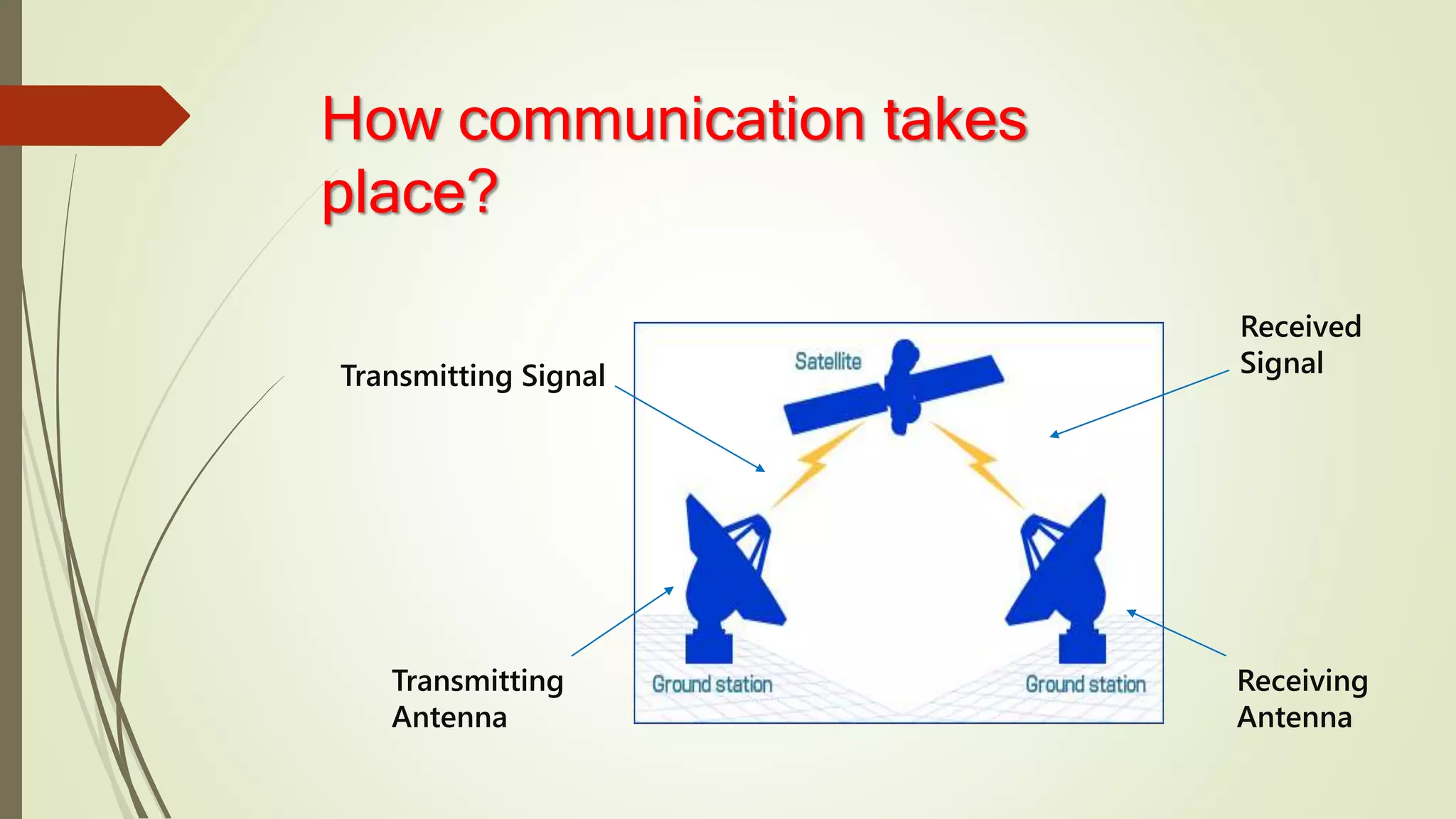
How communication takes
place?
Transmitting Signal
Received
Signal
Transmitting
Antenna
Receiving
Antenna
TYPES OF WIRELESS
COMMUNICATION
 RADIO TRANSMISSION:- easily generated, Omnidirectional,
travel long distance , easily penetrates buildings.
PROBLEMS:- frequency dependent , relatively low
bandwidth for data communication , tightly licensed by
government.
 MICROWAVE TRANSMISSION:- widely used for long
distance communication , relatively inexpensive.
PROBLEMS:- don’t pass through buildings , weather and
frequency dependent.
 INFRARED AND MILIMETER WAVES:-Widely used for short
range communication, unable to pass through solid objects ,
used for indoor wireless LANs , not for outdoors.
 LIGHT WAVE TRANSMISSION:- unguided optical signal such
as laser , unidirectional, easy to install , no license required.
PROBLEMS:- unable to penetrate rain or thick fog , laser
beam can be easily diverted by air.
Advantages:
 Working professionals can work and access Internet
anywhere and anytime without carrying cables or wires
wherever they go. This also helps to complete the work
anywhere on time and improves the productivity.
 A wireless communication network is a solution in areas
where cables are impossible to install (e.g. hazardous areas,
long distances etc.)
 Wireless networks are cheaper to install and maintain
disadvantages
 Has security vulnerabilities
 High costs for setting the infrastructure
 Unlike wired communication, wireless communication is
influenced by physical obstructions, climatic conditions,
interference from other wireless devices
CURRENT WIRELESS SYSTEMS
 CELLULAR SYSTEM
 WIRELESS LANS
 SATELLITE SYSTEM
 PANS(BLUETOOTH)
 PAGING SYSTEM
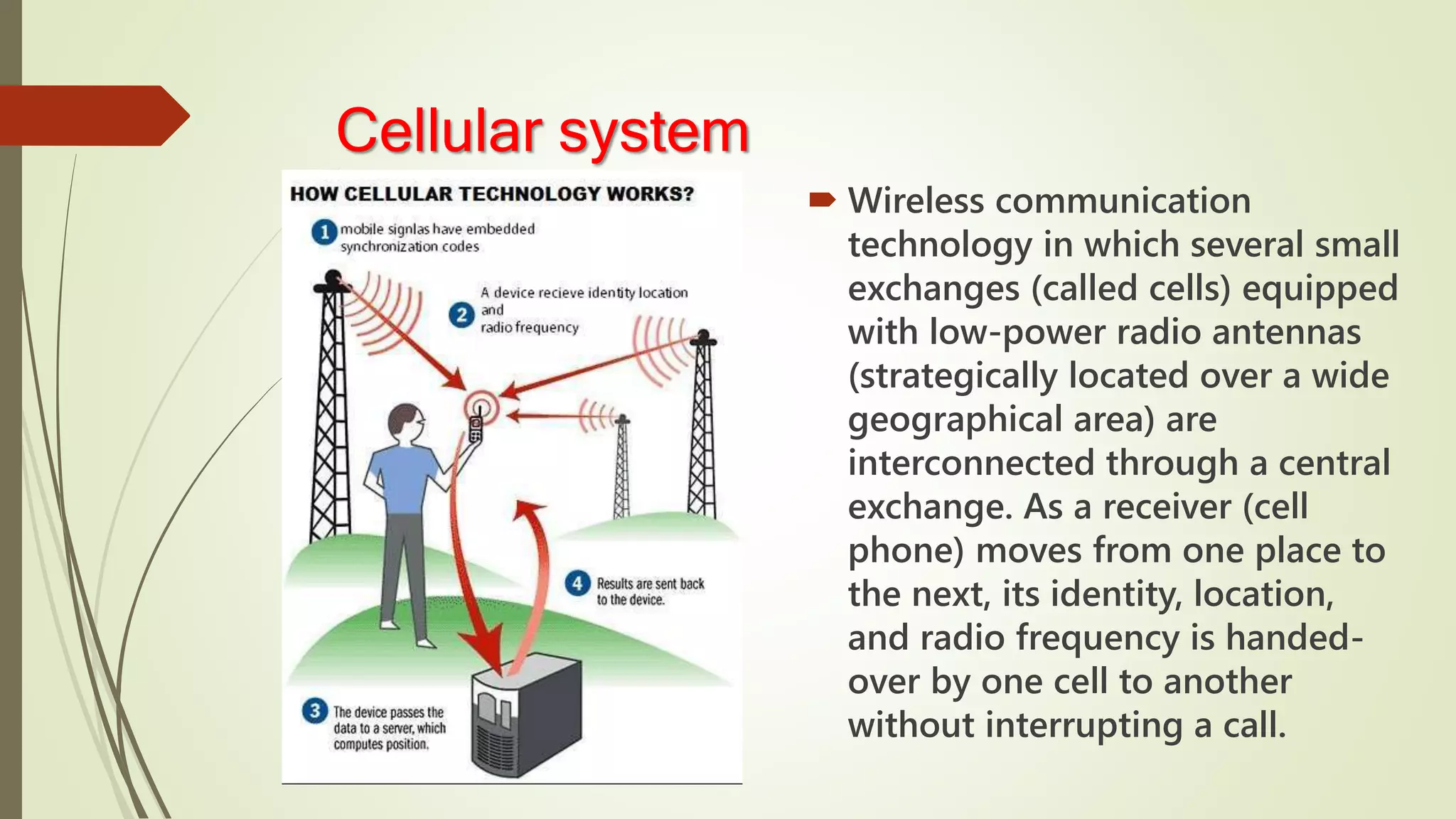
Cellular system
 Wireless communication
technology in which several small
exchanges (called cells) equipped
with low-power radio antennas
(strategically located over a wide
geographical area) are
interconnected through a central
exchange. As a receiver (cell
phone) moves from one place to
the next, its identity, location,
and radio frequency is handed-
over by one cell to another
without interrupting a call.
 Communication between the base station and mobiles is
defined by the standard common air interface (CAI)
 Forward voice channel (FVC): voice transmission from base
station to mobile
 Reverse voice channel (RVC): voice transmission from
mobile to base station
 Forward control channels (FCC): initiating mobile call from
base station to mobile
 Reverse control channel (RCC): initiating mobile call from
mobile to base station
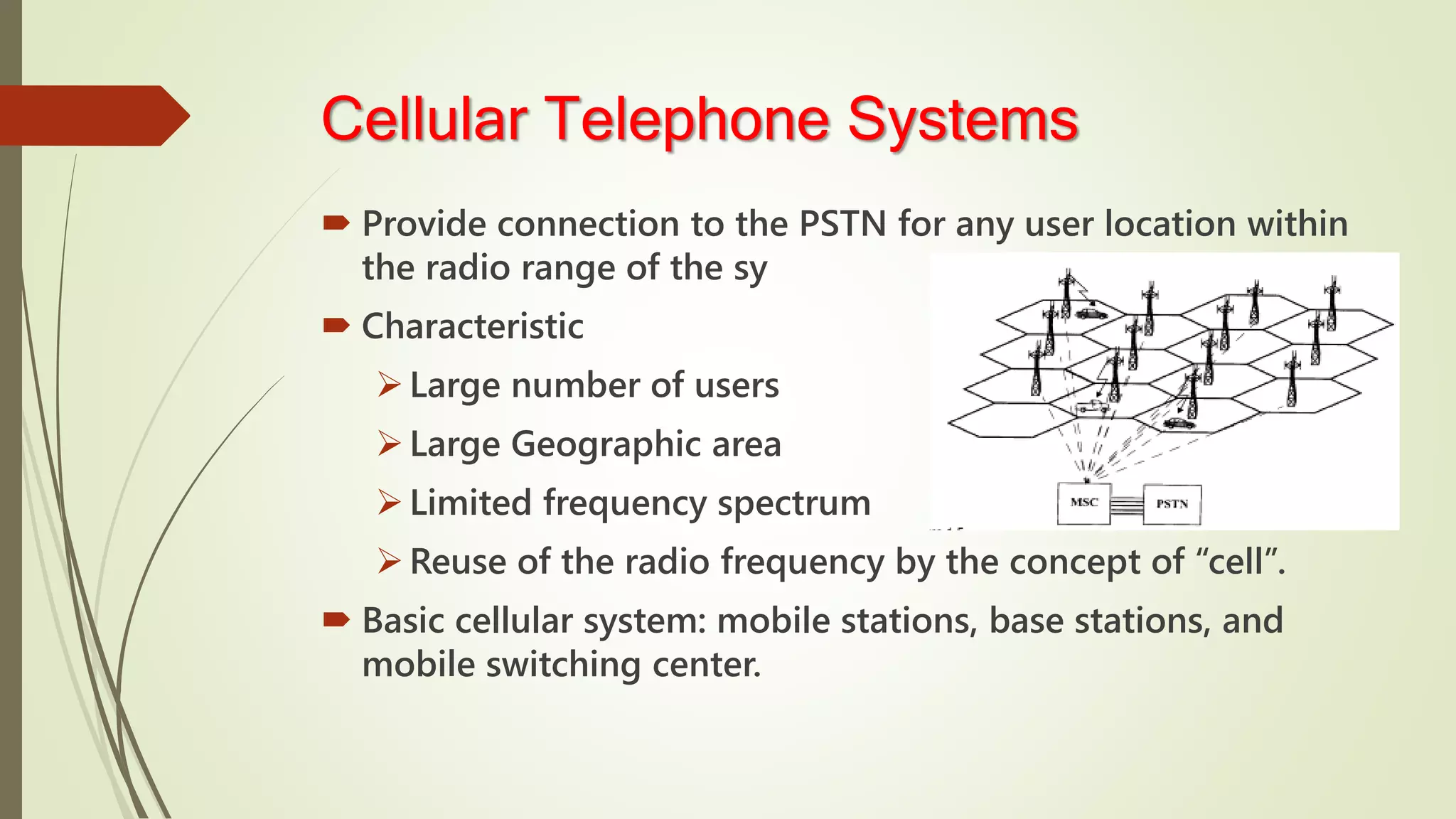
Cellular Telephone Systems
 Provide connection to the PSTN for any user location within
the radio range of the sy
 Characteristic
Large number of users
Large Geographic area
Limited frequency spectrum
Reuse of the radio frequency by the concept of “cell’’.
 Basic cellular system: mobile stations, base stations, and
mobile switching center.
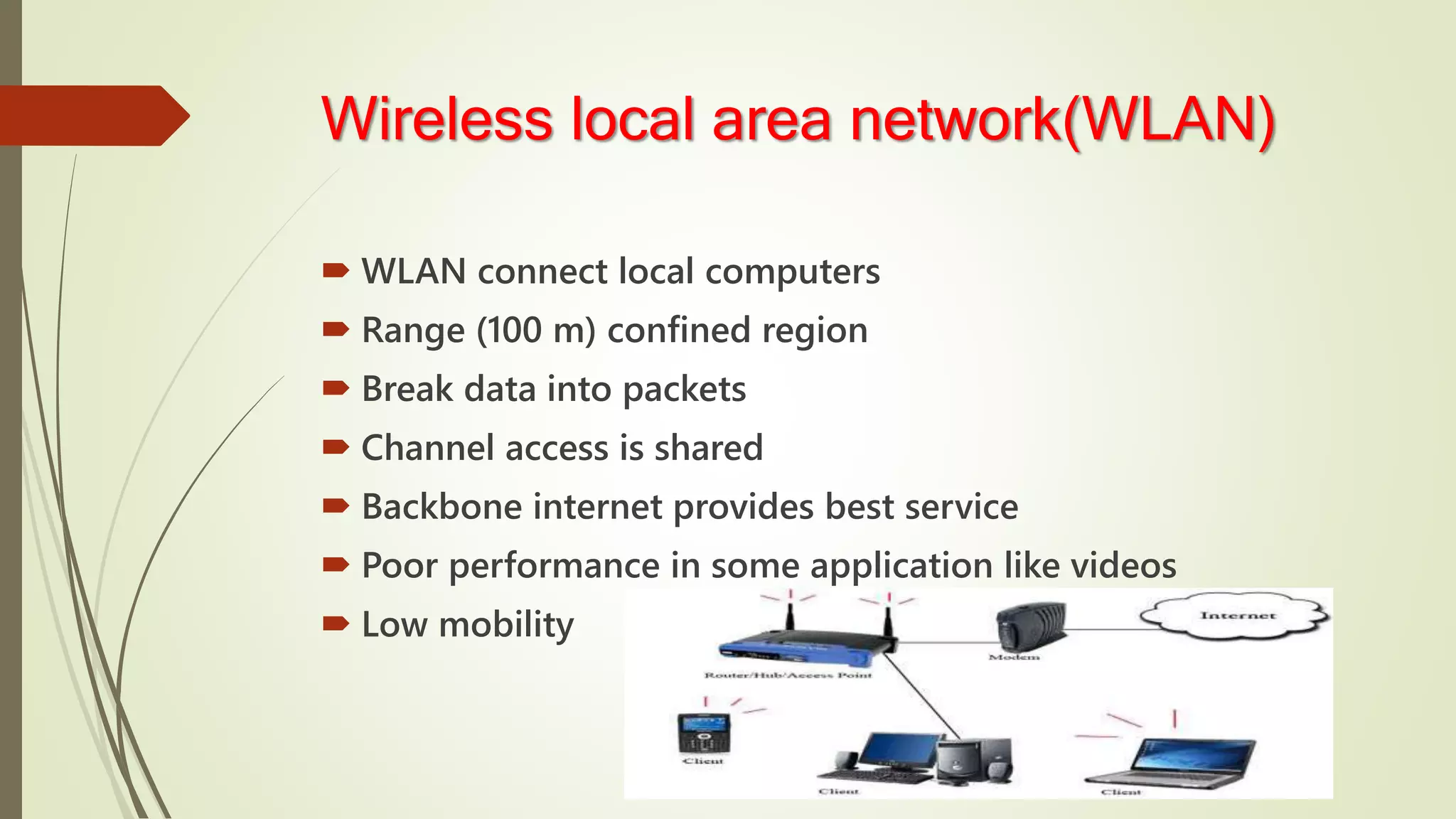
Wireless local area network(WLAN)
 WLAN connect local computers
 Range (100 m) confined region
 Break data into packets
 Channel access is shared
 Backbone internet provides best service
 Poor performance in some application like videos
 Low mobility
Satellite system
 Global coverage
 Optimized for good transmission
 Expensive base stations.
 Voice and data transmission
 Telecommunication application
 GPS , global telephone connection
 TV broadcasting , military , weather broadcasting
Paging system
 Broad coverage for short messages
 Message broadcast from all base stations
 Simple terminals
 Optimized for one way transmission
 Answer back hard
 Overtaken by cellular
 Conventional paging system send brief messages to a
subscriber
 Modern paging system: news headline, stock quotations,
faxes, etc.
 Simultaneously broadcast paging message from each base
station.
 Large transmission power to cover wide area.
REFFERENCE:
1. https://www.elprocus.com/types-of-wireless-communication-
applications/
2. https://en.wikipedia.org/wiki/Wireless
3. https://www.coursera.org/learn/wireless-communications/lecture/3V3ag/2-
THANKYOU

Wireless communication

  • 1.
  • 2.
    Why wireless communication? Freedom from wires.  No bunch of wires running from here and there.  “Auto Magical” instantaneous communication without  physical connection setup e.g.- Bluetooth, Wi-Fi.  Global coverage  Communication can reach where wiring is infeasible  or costly  E.g.- rural areas, buildings, battlefield, outerspace.  Stay connected, flexiblity to connect multiple devices.
  • 3.
    WIRELESS COMMUNICATION  Transmitting/receivingvoice and data using electromagnetic waves in open space.  The information from sender to receiver is carried over a well defined channel.  Each channel has a fixed frequency bandwidth & capacity(bit rate).  Different channels can be used to transmit information in parallel and independently.
  • 4.
    TYPICAL FREQUENCIES  FMRADIO 88 MHZ  TV BROADCAST 200 MHZ  GSM PHONES 900 MHZ  GPS 1.2 GHZ  PCS PHONES 1.8 GHZ  BLUETOOTH 2.4 GHZ  Wi-Fi 2.4 GHZ
  • 5.
    How communication takes place? TransmittingSignal Received Signal Transmitting Antenna Receiving Antenna
  • 6.
    TYPES OF WIRELESS COMMUNICATION RADIO TRANSMISSION:- easily generated, Omnidirectional, travel long distance , easily penetrates buildings. PROBLEMS:- frequency dependent , relatively low bandwidth for data communication , tightly licensed by government.  MICROWAVE TRANSMISSION:- widely used for long distance communication , relatively inexpensive. PROBLEMS:- don’t pass through buildings , weather and frequency dependent.
  • 7.
     INFRARED ANDMILIMETER WAVES:-Widely used for short range communication, unable to pass through solid objects , used for indoor wireless LANs , not for outdoors.  LIGHT WAVE TRANSMISSION:- unguided optical signal such as laser , unidirectional, easy to install , no license required. PROBLEMS:- unable to penetrate rain or thick fog , laser beam can be easily diverted by air.
  • 8.
    Advantages:  Working professionalscan work and access Internet anywhere and anytime without carrying cables or wires wherever they go. This also helps to complete the work anywhere on time and improves the productivity.  A wireless communication network is a solution in areas where cables are impossible to install (e.g. hazardous areas, long distances etc.)  Wireless networks are cheaper to install and maintain
  • 9.
    disadvantages  Has securityvulnerabilities  High costs for setting the infrastructure  Unlike wired communication, wireless communication is influenced by physical obstructions, climatic conditions, interference from other wireless devices
  • 10.
    CURRENT WIRELESS SYSTEMS CELLULAR SYSTEM  WIRELESS LANS  SATELLITE SYSTEM  PANS(BLUETOOTH)  PAGING SYSTEM
  • 11.
    Cellular system  Wirelesscommunication technology in which several small exchanges (called cells) equipped with low-power radio antennas (strategically located over a wide geographical area) are interconnected through a central exchange. As a receiver (cell phone) moves from one place to the next, its identity, location, and radio frequency is handed- over by one cell to another without interrupting a call.
  • 12.
     Communication betweenthe base station and mobiles is defined by the standard common air interface (CAI)  Forward voice channel (FVC): voice transmission from base station to mobile  Reverse voice channel (RVC): voice transmission from mobile to base station  Forward control channels (FCC): initiating mobile call from base station to mobile  Reverse control channel (RCC): initiating mobile call from mobile to base station
  • 13.
    Cellular Telephone Systems Provide connection to the PSTN for any user location within the radio range of the sy  Characteristic Large number of users Large Geographic area Limited frequency spectrum Reuse of the radio frequency by the concept of “cell’’.  Basic cellular system: mobile stations, base stations, and mobile switching center.
  • 14.
    Wireless local areanetwork(WLAN)  WLAN connect local computers  Range (100 m) confined region  Break data into packets  Channel access is shared  Backbone internet provides best service  Poor performance in some application like videos  Low mobility
  • 15.
    Satellite system  Globalcoverage  Optimized for good transmission  Expensive base stations.  Voice and data transmission  Telecommunication application  GPS , global telephone connection  TV broadcasting , military , weather broadcasting
  • 16.
    Paging system  Broadcoverage for short messages  Message broadcast from all base stations  Simple terminals  Optimized for one way transmission  Answer back hard  Overtaken by cellular
  • 17.
     Conventional pagingsystem send brief messages to a subscriber  Modern paging system: news headline, stock quotations, faxes, etc.  Simultaneously broadcast paging message from each base station.  Large transmission power to cover wide area.
  • 18.