Dhaka International University
Presentation topic: Wireless communication
Submitted by
Name : Md.Rokonuzzaman
Roll : 27
Reg No: 103454
Batch No: E-36th
Submitted to
Md. Abdul Baset
Chairman of EETE,
Dhaka International University
Submission Date: 27-March-2020
Page no: 01
Page no: 01
To
My Presentation
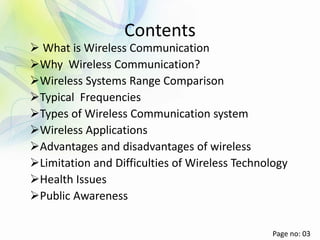
Contents
 What is Wireless Communication
Why Wireless Communication?
Wireless Systems Range Comparison
Typical Frequencies
Types of Wireless Communication system
Wireless Applications
Advantages and disadvantages of wireless
Limitation and Difficulties of Wireless Technology
Health Issues
Public Awareness
Page no: 03
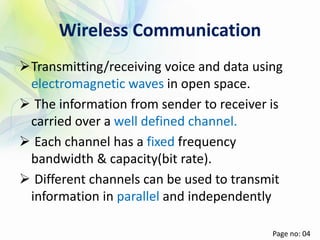
Wireless Communication
Transmitting/receiving voice and data using
electromagnetic waves in open space.
 The information from sender to receiver is
carried over a well defined channel.
 Each channel has a fixed frequency
bandwidth & capacity(bit rate).
 Different channels can be used to transmit
information in parallel and independently
Page no: 04
Why Wireless Communication?
 Freedom from wires.
 No bunch of wires running from here and there.
 “Auto Magical” instantaneous communication without
physical connection setup e.g.- Bluetooth, Wi-Fi.
 Global coverage
 Communication can reach where wiring is infeasible or
costly
 E.g.- rural areas, buildings, battlefield, outer space.
 Stay connected, flexibility to connect multiple devices.
Page no: 05
Wireless Systems Range Comparison
Page no: 06
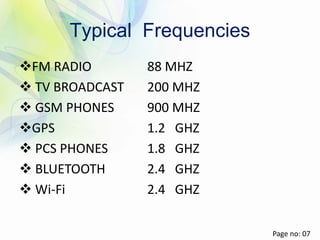
Typical Frequencies
FM RADIO 88 MHZ
 TV BROADCAST 200 MHZ
 GSM PHONES 900 MHZ
GPS 1.2 GHZ
 PCS PHONES 1.8 GHZ
 BLUETOOTH 2.4 GHZ
 Wi-Fi 2.4 GHZ
Page no: 07
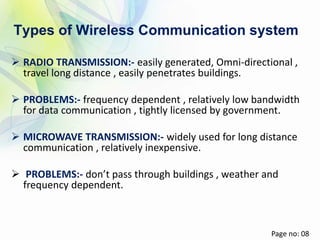
Types of Wireless Communication system
 RADIO TRANSMISSION:- easily generated, Omni-directional ,
travel long distance , easily penetrates buildings.
 PROBLEMS:- frequency dependent , relatively low bandwidth
for data communication , tightly licensed by government.
 MICROWAVE TRANSMISSION:- widely used for long distance
communication , relatively inexpensive.
 PROBLEMS:- don’t pass through buildings , weather and
frequency dependent.
Page no: 08
• INFRARED AND MILIMETER WAVES:
Widely used for short range communication ,
unable to pass through solid objects , used for
indoor wireless LANs , not for outdoors.
• LIGHT WAVE TRANSMISSION:- unguided optical
signal such as laser , unidirectional , easy to install
, no license required.
• PROBLEMS:- unable to penetrate rain or thick fog
, laser beam can be easily diverted by air.
Page no: 09
Wireless Applications
 CELLULAR SYSTEM
WIRELESS LANs
 SATELLITE SYSTEM
 PAGING SYSTEM
 PANs(BLUETOOTH)
Page no: 10
Advantages and disadvantages of wireless
Advantages:
 Working professionals can work and access Internet anywhere and
anytime without carrying cables or wires wherever they go. This also
helps to complete the work anywhere on time and improves the
productivity.
 A wireless communication network is a solution in areas where
cables are impossible to install (e.g. hazardous areas, long distances
etc.)
 Wireless networks are cheaper to install and maintain
Disadvantages:
 Has security vulnerabilities
 High costs for setting the infrastructure
 Unlike wired communication, wireless communication is influenced
by physical obstructions, climatic conditions, interference from
other wireless devices
Page no: 11
Limitation and Difficulties of Wireless Technology
Wireless is convenient and less expensive
Limitations and political and technical
difficulties inhibit wireless technologies
Lack of an industry-wide standard
Device limitations
– E.g., small LCD on a mobile telephone can only
displaying a few lines of text
– E.g., browsers of most mobile wireless devices use
wireless markup language (WML) instead of HTML
Page no: 12
Health Issues
• DNA damage
• Male infertility
• Brain tumor
• Brain cancer
• Heart risks
• Oxidative Stress
• Micro RNA expression
• Blood Pressure Disruption
Page no: 13
Public Awareness
 According to our survey the wireless communication devices are
produced radiations which is harmful to human health so there are
some recommendations that one should use one’s cell phone when
it is necessary.
 Don’t put the cell phone in a pant and shirt pocket.
 Don’t use the cell phone for long-term which is harmful to health
because doctors suggesting the use of cell phone for 1 hour in a day
which cause of brain tumor within 10 years.
 Avoid the long time conversation, use wireless head phone when
you have to talk for long call.
 Avoid using the wireless gadget like cell phone, laptop, tablet pc,
wireless keyboard and mouse so on.
Page no: 14
 Don’t place the laptop on a lap when it is connected to Wi-Fi because it is
harmful for sperms and also effect on the fetus, specially pregnant women
avoid to use tablet, PC, laptop and cell phone.
 Don’t use wireless devices in schools and colleges because it is harmful for
the children and it is suggested that use the land line phone and DSL.
 Each and every one should know about the effects of these wireless
radiations on human body, in this regard public awareness programs may be
designed and executed as soon as possible by the concerned authorities.
 Government should take an action on cell phone towers existing in or near
populated areas because cell phone towers emit the harmful radio waves
which are a cause of human health problems.
 The installation of towers in the populated area may be banned and if they
are already installed, should be removed immediately to save the people
from their dangerous effects of radiations.
Page no: 15
Page no: 01

Wireless communication

  • 1.
    Dhaka International University Presentationtopic: Wireless communication Submitted by Name : Md.Rokonuzzaman Roll : 27 Reg No: 103454 Batch No: E-36th Submitted to Md. Abdul Baset Chairman of EETE, Dhaka International University Submission Date: 27-March-2020 Page no: 01
  • 2.
    Page no: 01 To MyPresentation
  • 3.
    Contents  What isWireless Communication Why Wireless Communication? Wireless Systems Range Comparison Typical Frequencies Types of Wireless Communication system Wireless Applications Advantages and disadvantages of wireless Limitation and Difficulties of Wireless Technology Health Issues Public Awareness Page no: 03
  • 4.
    Wireless Communication Transmitting/receiving voiceand data using electromagnetic waves in open space.  The information from sender to receiver is carried over a well defined channel.  Each channel has a fixed frequency bandwidth & capacity(bit rate).  Different channels can be used to transmit information in parallel and independently Page no: 04
  • 5.
    Why Wireless Communication? Freedom from wires.  No bunch of wires running from here and there.  “Auto Magical” instantaneous communication without physical connection setup e.g.- Bluetooth, Wi-Fi.  Global coverage  Communication can reach where wiring is infeasible or costly  E.g.- rural areas, buildings, battlefield, outer space.  Stay connected, flexibility to connect multiple devices. Page no: 05
  • 6.
    Wireless Systems RangeComparison Page no: 06
  • 7.
    Typical Frequencies FM RADIO88 MHZ  TV BROADCAST 200 MHZ  GSM PHONES 900 MHZ GPS 1.2 GHZ  PCS PHONES 1.8 GHZ  BLUETOOTH 2.4 GHZ  Wi-Fi 2.4 GHZ Page no: 07
  • 8.
    Types of WirelessCommunication system  RADIO TRANSMISSION:- easily generated, Omni-directional , travel long distance , easily penetrates buildings.  PROBLEMS:- frequency dependent , relatively low bandwidth for data communication , tightly licensed by government.  MICROWAVE TRANSMISSION:- widely used for long distance communication , relatively inexpensive.  PROBLEMS:- don’t pass through buildings , weather and frequency dependent. Page no: 08
  • 9.
    • INFRARED ANDMILIMETER WAVES: Widely used for short range communication , unable to pass through solid objects , used for indoor wireless LANs , not for outdoors. • LIGHT WAVE TRANSMISSION:- unguided optical signal such as laser , unidirectional , easy to install , no license required. • PROBLEMS:- unable to penetrate rain or thick fog , laser beam can be easily diverted by air. Page no: 09
  • 10.
    Wireless Applications  CELLULARSYSTEM WIRELESS LANs  SATELLITE SYSTEM  PAGING SYSTEM  PANs(BLUETOOTH) Page no: 10
  • 11.
    Advantages and disadvantagesof wireless Advantages:  Working professionals can work and access Internet anywhere and anytime without carrying cables or wires wherever they go. This also helps to complete the work anywhere on time and improves the productivity.  A wireless communication network is a solution in areas where cables are impossible to install (e.g. hazardous areas, long distances etc.)  Wireless networks are cheaper to install and maintain Disadvantages:  Has security vulnerabilities  High costs for setting the infrastructure  Unlike wired communication, wireless communication is influenced by physical obstructions, climatic conditions, interference from other wireless devices Page no: 11
  • 12.
    Limitation and Difficultiesof Wireless Technology Wireless is convenient and less expensive Limitations and political and technical difficulties inhibit wireless technologies Lack of an industry-wide standard Device limitations – E.g., small LCD on a mobile telephone can only displaying a few lines of text – E.g., browsers of most mobile wireless devices use wireless markup language (WML) instead of HTML Page no: 12
  • 13.
    Health Issues • DNAdamage • Male infertility • Brain tumor • Brain cancer • Heart risks • Oxidative Stress • Micro RNA expression • Blood Pressure Disruption Page no: 13
  • 14.
    Public Awareness  Accordingto our survey the wireless communication devices are produced radiations which is harmful to human health so there are some recommendations that one should use one’s cell phone when it is necessary.  Don’t put the cell phone in a pant and shirt pocket.  Don’t use the cell phone for long-term which is harmful to health because doctors suggesting the use of cell phone for 1 hour in a day which cause of brain tumor within 10 years.  Avoid the long time conversation, use wireless head phone when you have to talk for long call.  Avoid using the wireless gadget like cell phone, laptop, tablet pc, wireless keyboard and mouse so on. Page no: 14
  • 15.
     Don’t placethe laptop on a lap when it is connected to Wi-Fi because it is harmful for sperms and also effect on the fetus, specially pregnant women avoid to use tablet, PC, laptop and cell phone.  Don’t use wireless devices in schools and colleges because it is harmful for the children and it is suggested that use the land line phone and DSL.  Each and every one should know about the effects of these wireless radiations on human body, in this regard public awareness programs may be designed and executed as soon as possible by the concerned authorities.  Government should take an action on cell phone towers existing in or near populated areas because cell phone towers emit the harmful radio waves which are a cause of human health problems.  The installation of towers in the populated area may be banned and if they are already installed, should be removed immediately to save the people from their dangerous effects of radiations. Page no: 15
  • 16.