
Windows Operating System Windows 2.0
History of Microsoft Windows In  1983   Microsoft announced the development of Windows, a graphical user interface (GUI) for its own operating system (MS-DOS), which had shipped for IBM PC and compatible computers since 1981.  Since then, Microsoft has shipped many versions of Windows, and the product line has changed from a GUI product to a modern operating system.
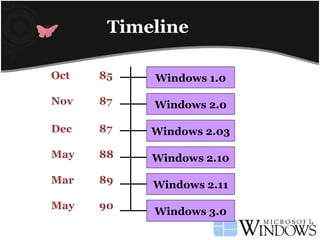
Oct  85 Nov  87  Dec 87    May 88  Mar  89  May  90 Timeline Windows 1.0 Windows 2.0 Windows 2.03 Windows 2.10 Windows 2.11 Windows 3.0
Windows 2.0
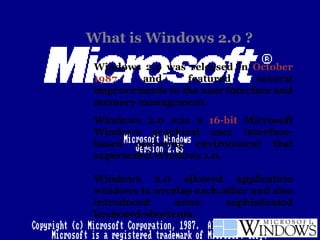
What is Windows 2.0 ? Windows 2.0 was released in  October 1987  and featured several improvements to the user interface and memory management. Windows 2.0 was a  16-bit  Microsoft Windows graphical user interface-based operating environment that superseded Windows 1.0. Windows 2.0 allowed application windows to overlap each other and also introduced more sophisticated keyboard-shortcuts.
Comparison with 1.0 Windows 2.0 allowed application windows to  overlap each other , unlike its predecessor Windows 1.0, which could only display  tiled windows Windows 2.0 also introduced  more sophisticated keyboard-shortcuts  and the  terminology of "Minimize" and "Maximize" , as opposed to  "Iconize" and "Zoom"  in Windows 1.0.
Different   versions
took advantage of the improved processing speed of the Intel 286 processor, expanded memory, and inter-application communication capabilities made possible through Dynamic Data Exchange (DDE).  Windows   2.0 took advantage of the protected mode and extended memory capabilities of the Intel 386 processor. Subsequent Windows releases continued to improve the speed, reliability, and usability of the PC as well as interface design and capabilities. Windows   2.03
released on 27 May 1988. These versions can take advantage of the specific features of the Intel 80286 and Intel 80386 processors. Windows   2.10 released on March 1989 with Windows/286 and Windows/386 editions, and some minor changes in memory management, AppleTalk support and faster printing and updated printer drivers. Windows   2.11
Windows 2.11 two different editions: Windows/386 still ran in real mode, but could make use of the high memory area. employed the 386 virtual 8086 mode to multitask several DOS programs, and the paged memory model to emulate expanded memory using available extended memory. Windows/286
Windows 2.03 Requirements -  MS-DOS version 3.0 - Two double-sided disk  drives or a  hard disk -  512K of memory or greater -  Graphics-adapter card Changes - Overlapping windows instead of tiled windows - LIM Version 4.0 expanded memory support - Dynamic Data Exchange (DDE) support - SMARTDrive disk-cache program included - Revised .FON format for screen fonts
Windows 2.03 Changes - NEWFON.EXE included to convert 1.x  font format to 2.x font format - Revised Paint file format - CVTPAINT.EXE included to convert 2.x Paint file format to 1.x format - About command moved to File menu  from System menu - Printer Timeouts option added to Control Panel - Mouse Acceleration option added to Control Panel - Warning Beep toggle added to Control Panel - Notepad About command reports - Remaining Free Space - 3812 Pageprinter no longer supported
Windows 2.10 Requirements - 512K Memory - MS-DOS version 3.0 or later - One floppy-disk drive AND one hard  disk (note that a hard disk is  now required) - Graphics adapter card  (the box notes:  IBM EGA, IBM VGA, IBM 8514,  IBM CGA, Hercules Graphics  Card, or compatibles) - Use of the Microsoft Mouse is  optional - Packaged with 5.25-inch 1.2 megabyte  disks OR 3.5-inch 720K disks,  plus an order form for free 360K  5.25-inch disks
Windows 2.10 Changes - New HIMEM.SYS driver allowing the  use of the first 64K of extended  memory to store part of  Windows, giving approximately  50K additional conventional  memory inside Windows - Support for approximately 65 more  printers than version 2.03,  bringing the total supported  printers to approximately 127 - Support for additional computers - Support for additional display devices
Windows 2.11 Requirements Same as Version 2.1 Changes -Accounts for memory freed by XMS  when computing the maximum  swap size allowed -Increased minimum bankable memory  required for large frame EMS -Setup program no longer terminates  when incompatible driver is  encountered -Setup corrected to permit set up on  512K machine with MS-DOS  version 3.3
Windows 2.11 Changes -Updated COMM.DRV to solve  handshaking problems at 9600  bits per second (BPS)  -Updated HPPCL.DRV driver that  supports LaserJet series IID,  Olivetti LP 5000, Toshiba -PageLaser 12, and Intel Visual Edge -Updated PSCRIPT.DRV driver that  supports Olivetti LP 5000 in  PostScript mode -Printing speed increased -Windows/386 WINOLDAP.MOD  modified to support high- resolution displays
Windows 2.11 Additions -AppleTalk library (must accompany  the new PostScript driver)  -Toshiba 24-pin printer driver - 8514/a driver for Windows/386 - /E switch to adjust large frame EMS threshold
Application support The first Windows versions of Microsoft Word and Microsoft Excel run on Windows 2.0. Third-party developer support for Windows increased substantially with this version  However, most developers still maintained DOS versions of their applications, as Windows users were still a distinct minority of their market.
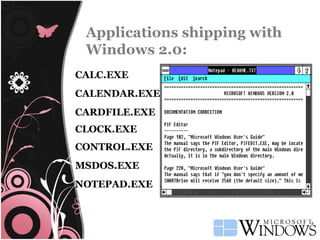
Applications shipping with Windows 2.0: CALC.EXE CALENDAR.EXE CARDFILE.EXE CLOCK.EXE CONTROL.EXE MSDOS.EXE NOTEPAD.EXE
WRITE.EXE TERMINAL.EXE PAINT.EXE REVERSI.EXE PRACTICE.WRI CLIPBRD.EXE MSDOSD.EXE
Legal conflict  with Apple
On 17 March 1988,  Apple filed suit against Microsoft  and Hewlett-Packard, accusing them of violating copyrights Apple held on the Macintosh System Software Apple claimed the  "look and feel"  of the Macintosh operating system, taken as a whole, was protected by copyright and that Windows 2.0 violated this copyright by looking extremely similar to it.
Windows 2.11 was superseded by  Windows 3.0  in May 1990.

Windows 2.0

  • 1.
  • 2.
    History of MicrosoftWindows In 1983 Microsoft announced the development of Windows, a graphical user interface (GUI) for its own operating system (MS-DOS), which had shipped for IBM PC and compatible computers since 1981. Since then, Microsoft has shipped many versions of Windows, and the product line has changed from a GUI product to a modern operating system.
  • 3.
    Oct 85Nov 87 Dec 87 May 88 Mar 89 May 90 Timeline Windows 1.0 Windows 2.0 Windows 2.03 Windows 2.10 Windows 2.11 Windows 3.0
  • 4.
  • 5.
    What is Windows2.0 ? Windows 2.0 was released in October 1987 and featured several improvements to the user interface and memory management. Windows 2.0 was a 16-bit Microsoft Windows graphical user interface-based operating environment that superseded Windows 1.0. Windows 2.0 allowed application windows to overlap each other and also introduced more sophisticated keyboard-shortcuts.
  • 6.
    Comparison with 1.0Windows 2.0 allowed application windows to overlap each other , unlike its predecessor Windows 1.0, which could only display tiled windows Windows 2.0 also introduced more sophisticated keyboard-shortcuts and the terminology of "Minimize" and "Maximize" , as opposed to "Iconize" and "Zoom" in Windows 1.0.
  • 7.
    Different versions
  • 8.
    took advantage ofthe improved processing speed of the Intel 286 processor, expanded memory, and inter-application communication capabilities made possible through Dynamic Data Exchange (DDE). Windows 2.0 took advantage of the protected mode and extended memory capabilities of the Intel 386 processor. Subsequent Windows releases continued to improve the speed, reliability, and usability of the PC as well as interface design and capabilities. Windows 2.03
  • 9.
    released on 27May 1988. These versions can take advantage of the specific features of the Intel 80286 and Intel 80386 processors. Windows 2.10 released on March 1989 with Windows/286 and Windows/386 editions, and some minor changes in memory management, AppleTalk support and faster printing and updated printer drivers. Windows 2.11
  • 10.
    Windows 2.11 twodifferent editions: Windows/386 still ran in real mode, but could make use of the high memory area. employed the 386 virtual 8086 mode to multitask several DOS programs, and the paged memory model to emulate expanded memory using available extended memory. Windows/286
  • 11.
    Windows 2.03 Requirements- MS-DOS version 3.0 - Two double-sided disk drives or a hard disk - 512K of memory or greater - Graphics-adapter card Changes - Overlapping windows instead of tiled windows - LIM Version 4.0 expanded memory support - Dynamic Data Exchange (DDE) support - SMARTDrive disk-cache program included - Revised .FON format for screen fonts
  • 12.
    Windows 2.03 Changes- NEWFON.EXE included to convert 1.x font format to 2.x font format - Revised Paint file format - CVTPAINT.EXE included to convert 2.x Paint file format to 1.x format - About command moved to File menu from System menu - Printer Timeouts option added to Control Panel - Mouse Acceleration option added to Control Panel - Warning Beep toggle added to Control Panel - Notepad About command reports - Remaining Free Space - 3812 Pageprinter no longer supported
  • 13.
    Windows 2.10 Requirements- 512K Memory - MS-DOS version 3.0 or later - One floppy-disk drive AND one hard disk (note that a hard disk is now required) - Graphics adapter card (the box notes: IBM EGA, IBM VGA, IBM 8514, IBM CGA, Hercules Graphics Card, or compatibles) - Use of the Microsoft Mouse is optional - Packaged with 5.25-inch 1.2 megabyte disks OR 3.5-inch 720K disks, plus an order form for free 360K 5.25-inch disks
  • 14.
    Windows 2.10 Changes- New HIMEM.SYS driver allowing the use of the first 64K of extended memory to store part of Windows, giving approximately 50K additional conventional memory inside Windows - Support for approximately 65 more printers than version 2.03, bringing the total supported printers to approximately 127 - Support for additional computers - Support for additional display devices
  • 15.
    Windows 2.11 RequirementsSame as Version 2.1 Changes -Accounts for memory freed by XMS when computing the maximum swap size allowed -Increased minimum bankable memory required for large frame EMS -Setup program no longer terminates when incompatible driver is encountered -Setup corrected to permit set up on 512K machine with MS-DOS version 3.3
  • 16.
    Windows 2.11 Changes-Updated COMM.DRV to solve handshaking problems at 9600 bits per second (BPS) -Updated HPPCL.DRV driver that supports LaserJet series IID, Olivetti LP 5000, Toshiba -PageLaser 12, and Intel Visual Edge -Updated PSCRIPT.DRV driver that supports Olivetti LP 5000 in PostScript mode -Printing speed increased -Windows/386 WINOLDAP.MOD modified to support high- resolution displays
  • 17.
    Windows 2.11 Additions-AppleTalk library (must accompany the new PostScript driver) -Toshiba 24-pin printer driver - 8514/a driver for Windows/386 - /E switch to adjust large frame EMS threshold
  • 18.
    Application support Thefirst Windows versions of Microsoft Word and Microsoft Excel run on Windows 2.0. Third-party developer support for Windows increased substantially with this version However, most developers still maintained DOS versions of their applications, as Windows users were still a distinct minority of their market.
  • 19.
    Applications shipping withWindows 2.0: CALC.EXE CALENDAR.EXE CARDFILE.EXE CLOCK.EXE CONTROL.EXE MSDOS.EXE NOTEPAD.EXE
  • 20.
    WRITE.EXE TERMINAL.EXE PAINT.EXEREVERSI.EXE PRACTICE.WRI CLIPBRD.EXE MSDOSD.EXE
  • 21.
    Legal conflict with Apple
  • 22.
    On 17 March1988, Apple filed suit against Microsoft and Hewlett-Packard, accusing them of violating copyrights Apple held on the Macintosh System Software Apple claimed the "look and feel" of the Macintosh operating system, taken as a whole, was protected by copyright and that Windows 2.0 violated this copyright by looking extremely similar to it.
  • 23.
    Windows 2.11 wassuperseded by Windows 3.0 in May 1990.