A
SEMINAR PRESENTATION
AT
“WIND ENERGY”
SUBMITTED IN THE PARTIAL FULFILLMENT OF THE REQUIREMENT FOR THE AWARD OF DEGREE OF
BACHELOR OF TECHNOLOGY
IN
ELECTRICAL ENGINEERING
SUBMITTED TO:
MR. SUBHASH CHANDER
SWAMI
(H.O.D. ELECTRICAL
ENGINEERING DEPT.)
SUBMITTED BY:
CHENARAM BHAMBHOO
(ELECTRICAL
ENGINEERING DEPT.)
1
CONTENTS
 Why wind energy ?
 Energy production & the Environment
 Wind energy benefits
 Wind power equation
 Energy from the wind
 Wind turbines
 Technology overview
 Typical turbine size
 Wind & natural gas comparison
 Wind power isn’t perfect
Why Wind Energy?
Wind, for now, is the renewable energy resource/technology
of choice
“Free” resource
A “clean” resource due to:
 Replacement of a “dirty” energy source (coal) and,
 No emissions associated with its use
Can be utilized on underutilized land or on lands currently in
commodity crop production (“harvest” on the surface and
“harvest” above the surface)
Energy Production and the Environment
Energy use in power plants accounts for:
 67% of air emissions of SO2, the primary cause of acid rain.
SO2 causes acidification of lakes and damages forests and
other habitats.
 25% of NOx, which causes smog and respiratory ailments.
 33% of Hg (mercury), a persistent, bio-accumulative toxin
which increases in concentration as it moves up the food
chain, e.g. from fish to birds, causing serious deformities and
nerve disorders.
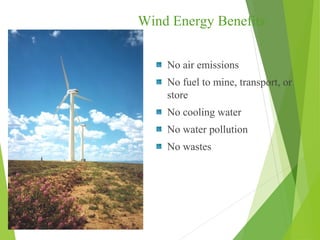
Wind Energy Benefits
No air emissions
No fuel to mine, transport, or
store
No cooling water
No water pollution
No wastes
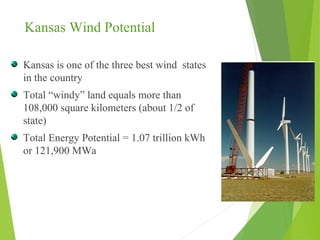
Kansas Wind Potential
Kansas is one of the three best wind states
in the country
Total “windy” land equals more than
108,000 square kilometers (about 1/2 of
state)
Total Energy Potential = 1.07 trillion kWh
or 121,900 MWa
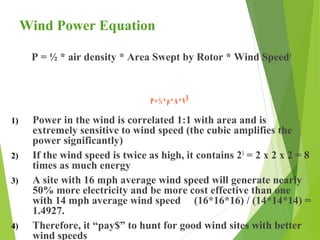
Wind Power Equation
P = ½ * air density * Area Swept by Rotor * Wind Speed3
P=½*ρ*A*V3
1) Power in the wind is correlated 1:1 with area and is
extremely sensitive to wind speed (the cubic amplifies the
power significantly)
2) If the wind speed is twice as high, it contains 23
= 2 x 2 x 2 = 8
times as much energy
3) A site with 16 mph average wind speed will generate nearly
50% more electricity and be more cost effective than one
with 14 mph average wind speed (16*16*16) / (14*14*14) =
1.4927.
4) Therefore, it “pay$” to hunt for good wind sites with better
wind speeds
Energy from the Wind
 Turbine output drives wind economics and output is a
strong function of wind speed
 Wind speed increases with height above the ground
 Power = 1/2 × (air density) × (area) × (wind speed)³
 Energy in the wind increases as height increases
(theoretically)
V2/V1 = (H2/H1)1/7
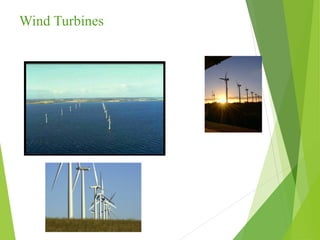
Wind Turbines
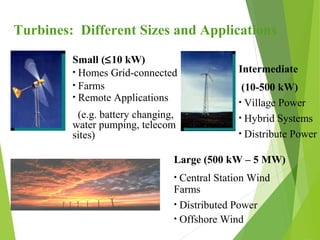
Turbines: Different Sizes and Applications
Small (≤10 kW)
• Homes Grid-connected
• Farms
• Remote Applications
(e.g. battery changing,
water pumping, telecom
sites)
Intermediate
(10-500 kW)
• Village Power
• Hybrid Systems
• Distribute Power
Large (500 kW – 5 MW)
• Central Station Wind
Farms
• Distributed Power
• Offshore Wind
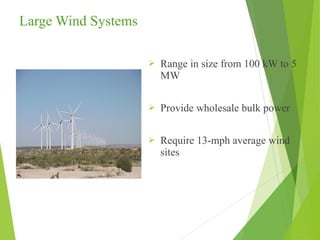
Large Wind Systems
 Range in size from 100 kW to 5
MW
 Provide wholesale bulk power
 Require 13-mph average wind
sites
Technology Overview
Large Wind Projects
Over 98-99% availability
Can deliver power for less than 5 cents/kWh (with Production
Tax Credit) in many locations
~6,000 MW to be installed nationwide at end of 2003
In 2004, will generate about 3x Vermont’s total use
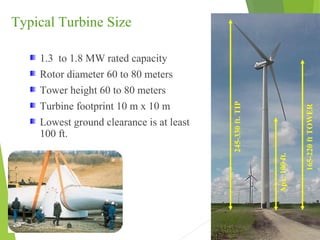
Typical Turbine Size
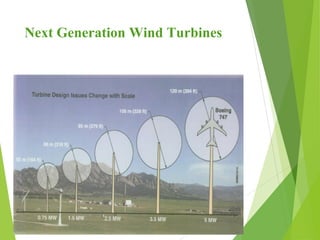
1.3 to 1.8 MW rated capacity
Rotor diameter 60 to 80 meters
Tower height 60 to 80 meters
Turbine footprint 10 m x 10 m
Lowest ground clearance is at least
100 ft.
165-220ftTOWER
245-330ft.TIP
Apx.100ft.
Next Generation Wind Turbines
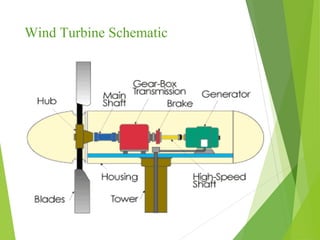
Wind Turbine Schematic
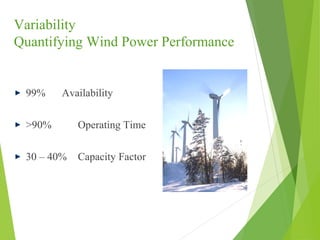
Variability
Quantifying Wind Power Performance
99% Availability
>90% Operating Time
30 – 40% Capacity Factor
Expected Output/Capacity Factor
 The capacity factor is simply the wind turbine's
actual energy output for the year divided by the
energy output if the machine operated at its
rated power output for the entire year
 A reasonable capacity factor would be 0.25 to
0.30. A very good capacity factor would be
0.40
 Capacity factor is very sensitive to the average
wind speed
“Value” of Wind Energy
 The value of a wind turbine or wind farm
depends upon many factors
 location
 terrain
 wind speed = f(location, terrain)
 cost of competing energy source
 rate structure of competing energy source
Wind Insures Against
Fuel Price Risk
 Platts “conservatively
estimates that generating
electricity from renewable
sources can ultimately save
consumers more than
$5/MWh (1/2¢ per kW-h)
by eliminating fuel price
risk”.
 Value of domestic fuel
source (wind) would have a
direct benefit on the
Kansas/community
 Wind energy “Fuel” is
inflation-proof; therefore
impervious to fuel price
hikes
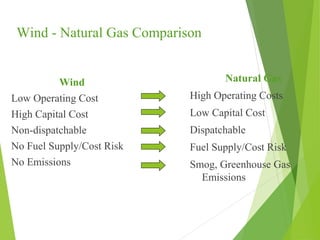
Wind - Natural Gas Comparison
Wind
Low Operating Cost
High Capital Cost
Non-dispatchable
No Fuel Supply/Cost Risk
No Emissions
Natural Gas
High Operating Costs
Low Capital Cost
Dispatchable
Fuel Supply/Cost Risk
Smog, Greenhouse Gas
Emissions
Wind Power Isn’t Perfect
 Wind Power output varies over time; it isn’t dispatchable
 Wind Power is location-dependent (rural vs. urban where it is
needed most)
 Wind Power is transmission-dependent for tie-in to the grid
 Wind Power has environmental impacts (pro / con)
 Wind Power can only meet part of the electrical load
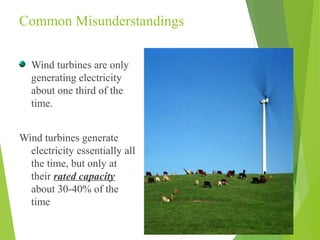
Common Misunderstandings
Wind turbines are only
generating electricity
about one third of the
time.
Wind turbines generate
electricity essentially all
the time, but only at
their rated capacity
about 30-40% of the
time
THANK YOU

wind energy

  • 1.
    A SEMINAR PRESENTATION AT “WIND ENERGY” SUBMITTEDIN THE PARTIAL FULFILLMENT OF THE REQUIREMENT FOR THE AWARD OF DEGREE OF BACHELOR OF TECHNOLOGY IN ELECTRICAL ENGINEERING SUBMITTED TO: MR. SUBHASH CHANDER SWAMI (H.O.D. ELECTRICAL ENGINEERING DEPT.) SUBMITTED BY: CHENARAM BHAMBHOO (ELECTRICAL ENGINEERING DEPT.) 1
  • 2.
    CONTENTS  Why windenergy ?  Energy production & the Environment  Wind energy benefits  Wind power equation  Energy from the wind  Wind turbines  Technology overview  Typical turbine size  Wind & natural gas comparison  Wind power isn’t perfect
  • 3.
    Why Wind Energy? Wind,for now, is the renewable energy resource/technology of choice “Free” resource A “clean” resource due to:  Replacement of a “dirty” energy source (coal) and,  No emissions associated with its use Can be utilized on underutilized land or on lands currently in commodity crop production (“harvest” on the surface and “harvest” above the surface)
  • 4.
    Energy Production andthe Environment Energy use in power plants accounts for:  67% of air emissions of SO2, the primary cause of acid rain. SO2 causes acidification of lakes and damages forests and other habitats.  25% of NOx, which causes smog and respiratory ailments.  33% of Hg (mercury), a persistent, bio-accumulative toxin which increases in concentration as it moves up the food chain, e.g. from fish to birds, causing serious deformities and nerve disorders.
  • 5.
    Wind Energy Benefits Noair emissions No fuel to mine, transport, or store No cooling water No water pollution No wastes
  • 6.
    Kansas Wind Potential Kansasis one of the three best wind states in the country Total “windy” land equals more than 108,000 square kilometers (about 1/2 of state) Total Energy Potential = 1.07 trillion kWh or 121,900 MWa
  • 7.
    Wind Power Equation P= ½ * air density * Area Swept by Rotor * Wind Speed3 P=½*ρ*A*V3 1) Power in the wind is correlated 1:1 with area and is extremely sensitive to wind speed (the cubic amplifies the power significantly) 2) If the wind speed is twice as high, it contains 23 = 2 x 2 x 2 = 8 times as much energy 3) A site with 16 mph average wind speed will generate nearly 50% more electricity and be more cost effective than one with 14 mph average wind speed (16*16*16) / (14*14*14) = 1.4927. 4) Therefore, it “pay$” to hunt for good wind sites with better wind speeds
  • 8.
    Energy from theWind  Turbine output drives wind economics and output is a strong function of wind speed  Wind speed increases with height above the ground  Power = 1/2 × (air density) × (area) × (wind speed)³  Energy in the wind increases as height increases (theoretically) V2/V1 = (H2/H1)1/7
  • 9.
  • 10.
    Turbines: Different Sizesand Applications Small (≤10 kW) • Homes Grid-connected • Farms • Remote Applications (e.g. battery changing, water pumping, telecom sites) Intermediate (10-500 kW) • Village Power • Hybrid Systems • Distribute Power Large (500 kW – 5 MW) • Central Station Wind Farms • Distributed Power • Offshore Wind
  • 11.
    Large Wind Systems Range in size from 100 kW to 5 MW  Provide wholesale bulk power  Require 13-mph average wind sites
  • 12.
    Technology Overview Large WindProjects Over 98-99% availability Can deliver power for less than 5 cents/kWh (with Production Tax Credit) in many locations ~6,000 MW to be installed nationwide at end of 2003 In 2004, will generate about 3x Vermont’s total use
  • 13.
    Typical Turbine Size 1.3to 1.8 MW rated capacity Rotor diameter 60 to 80 meters Tower height 60 to 80 meters Turbine footprint 10 m x 10 m Lowest ground clearance is at least 100 ft. 165-220ftTOWER 245-330ft.TIP Apx.100ft.
  • 14.
  • 15.
  • 16.
    Variability Quantifying Wind PowerPerformance 99% Availability >90% Operating Time 30 – 40% Capacity Factor
  • 17.
    Expected Output/Capacity Factor The capacity factor is simply the wind turbine's actual energy output for the year divided by the energy output if the machine operated at its rated power output for the entire year  A reasonable capacity factor would be 0.25 to 0.30. A very good capacity factor would be 0.40  Capacity factor is very sensitive to the average wind speed
  • 18.
    “Value” of WindEnergy  The value of a wind turbine or wind farm depends upon many factors  location  terrain  wind speed = f(location, terrain)  cost of competing energy source  rate structure of competing energy source
  • 19.
    Wind Insures Against FuelPrice Risk  Platts “conservatively estimates that generating electricity from renewable sources can ultimately save consumers more than $5/MWh (1/2¢ per kW-h) by eliminating fuel price risk”.  Value of domestic fuel source (wind) would have a direct benefit on the Kansas/community  Wind energy “Fuel” is inflation-proof; therefore impervious to fuel price hikes
  • 20.
    Wind - NaturalGas Comparison Wind Low Operating Cost High Capital Cost Non-dispatchable No Fuel Supply/Cost Risk No Emissions Natural Gas High Operating Costs Low Capital Cost Dispatchable Fuel Supply/Cost Risk Smog, Greenhouse Gas Emissions
  • 21.
    Wind Power Isn’tPerfect  Wind Power output varies over time; it isn’t dispatchable  Wind Power is location-dependent (rural vs. urban where it is needed most)  Wind Power is transmission-dependent for tie-in to the grid  Wind Power has environmental impacts (pro / con)  Wind Power can only meet part of the electrical load
  • 22.
    Common Misunderstandings Wind turbinesare only generating electricity about one third of the time. Wind turbines generate electricity essentially all the time, but only at their rated capacity about 30-40% of the time
  • 23.