Are Microservices Going To Die?
—
Emily Jiang
5th December 2022
Java Champion
Cloud Native Architect, IBM
@emilyfhjiang
Mastodon: @emilyjiang@mastodon.social
2
The History of Microservices
Enterprise Java Beans
3
4
5
SOAP
6
Representational State Transfer
REST
7
8
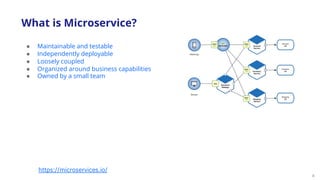
● Maintainable and testable
● Independently deployable
● Loosely coupled
● Organized around business capabilities
● Owned by a small team
What is Microservice?
https://microservices.io/
9
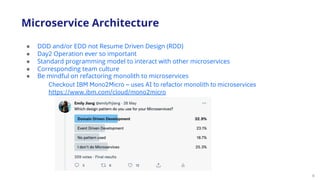
● DDD and/or EDD not Resume Driven Design (RDD)
● Day2 Operation ever so important
● Standard programming model to interact with other microservices
● Corresponding team culture
● Be mindful on refactoring monolith to microservices
Microservice Architecture
Checkout IBM Mono2Micro – uses AI to refactor monolith to microservices
https://www.ibm.com/cloud/mono2micro
10
● DDD is hard
● Team culture is difficult to change
● Convert Monolith to microservices is hard if done manually
● No resources to convert Monolith to microservices
Microservices difficulties
11
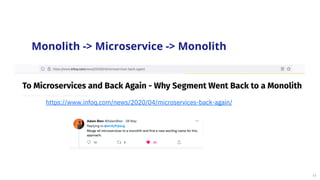
Monolith -> Microservice -> Monolith
https://www.infoq.com/news/2020/04/microservices-back-again/
12
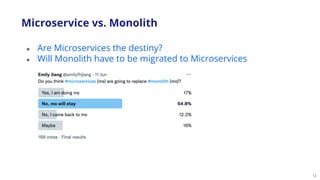
● Are Microservices the destiny?
● Will Monolith have to be migrated to Microservices
Microservice vs. Monolith
13
Microservices won’t take over Monolith
14
Monolith and Microservice will coexist
15
The boundary between Microservices
and Monolith blends and evolves to
Cloud Native applications
16
What you need is Cloud Native
Applications!
17
What are Cloud Native
Applications?
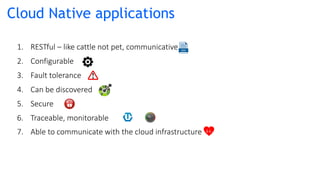
Cloud Native applications
1. RESTful – like cattle not pet, communicative
2. Configurable
3. Fault tolerance
4. Can be discovered
5. Secure
6. Traceable, monitorable
7. Able to communicate with the cloud infrastructure
19
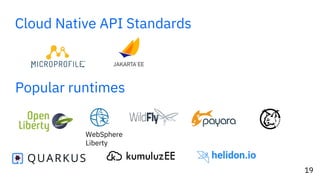
Cloud Native API Standards
Popular runtimes
WebSphere
Liberty
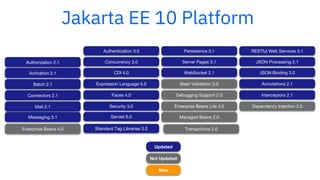
Jakarta EE 10 Platform
Updated
Not Updated
New
Authorization 2.1
Activation 2.1
Batch 2.1
Connectors 2.1
Mail 2.1
Messaging 3.1
Enterprise Beans 4.0
RESTful Web Services 3.1
JSON Processing 2.1
JSON Binding 3.0
Annotations 2.1
Interceptors 2.1
Dependency Injection 2.0
Servlet 6.0
Server Pages 3.1
Expression Language 5.0
Debugging Support 2.0
Standard Tag Libraries 3.0
Faces 4.0
WebSocket 2.1
Enterprise Beans Lite 4.0
Persistence 3.1
Transactions 2.0
Managed Beans 2.0
CDI 4.0
Authentication 3.0
Concurrency 3.0
Security 3.0
Bean Validation 3.0
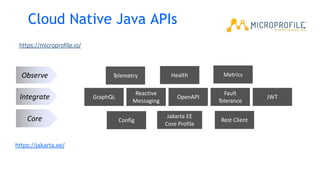
Health Metrics
Fault
Tolerance
OpenAPI
Config
JWT
Rest Client
Jakarta EE
Core Profile
Core
Reactive
Messaging
Integrate
Observe
GraphQL
Telemetry
https://microprofile.io/
Cloud Native Java APIs
https://jakarta.ee/
22
Containerization
23
24
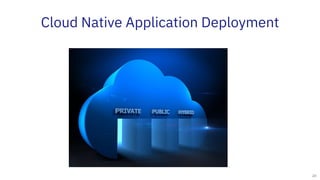
Cloud Native Application Deployment
25
Microservice seen as best practices for
developing Cloud Native Applications!
26
Here comes Serverless!!!
27
● It often has servers – too minor to be noticed
● Pay as you Go pattern: applicable to public cloud
● Occasionally running; fast operations
● scaling to zero
What is Serverless?
Cloud Native Runtimes
28
The JVM was designed with portability and flexibility
in mind. This meant that bytecodes were loaded
lazily and optimized while the application was
running. The result was slower startup times but
high peak throughput. The cloud demands a shift in
the performance characteristics of JVMs.
Solutions:
- Dynamic AOT compilation and class metadata
persistence
- Static compilation – native image
Native Image JDK
Positives
1. Extremely fast startup time (less than 50 ms)
2. Small memory footprint (less than 30mb) on
startup
3. Small on-disk footprint (no bytecodes, no
interpreter, no JIT etc.)
4. Very small container image size
5. Native OS executable image
Negatives
1. Only runs a subset of existing Java workloads
and tooling
• Developer experience mismatch
2. Not designed for intensive / long running
applications
3. Peak throughput is much lower than that of JVM
mode
4. GC technology is not as good as in JVM mode
5. Requires work to keep up with new Java
versions
6. Different technology = different bugs and
behavior
Positives
1. Full Java capabilities available
• Dynamic class loading,
Reflection,
Serialization
• Monitoring agents, JNI
• ….
2. Runs full suite of applications and
tooling
3. Dynamically adapts to program
behavior
•AOT, Interpreter, JIT
compiler
Negatives
1. Runtime memory use typically
higher
2. Slower startup
3. Larger on-disk footprint
29
Is Cloud Native Application obsolete
when Serverless dominates?
30
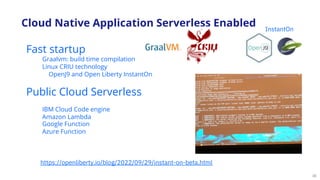
Fast startup
Graalvm: build time compilation
Linux CRIU technology
OpenJ9 and Open Liberty InstantOn
Public Cloud Serverless
IBM Cloud Code engine
Amazon Lambda
Google Function
Azure Function
Cloud Native Application Serverless Enabled
https://openliberty.io/blog/2022/09/29/instant-on-beta.html
InstantOn
31
Microservice won’t die but its
name will be less impactable!
32
● https://microprofile.io
● https://jakarta.ee/
● https://openliberty.io/guides
● https://microservices.io/
● https://criu.org/Main_Page
● https://www.graalvm.org/
● https://www.ibm.com/cloud/mono2micro
● https://ibm.biz/MicroProfileBook
Useful resources
33
MicroProfile Book featured Open Liberty
https://ibm.biz/MicroProfileBook
@emilyfhjiang
Twitter/LinkedIn: @emilyfhjiang
Mastodon: @emilyjiang@mastodon.social

WillMicroserviceDie.pdf

  • 1.
    Are Microservices GoingTo Die? — Emily Jiang 5th December 2022 Java Champion Cloud Native Architect, IBM @emilyfhjiang Mastodon: @emilyjiang@mastodon.social
  • 2.
    2 The History ofMicroservices
  • 3.
  • 4.
  • 5.
  • 6.
  • 7.
  • 8.
    8 ● Maintainable andtestable ● Independently deployable ● Loosely coupled ● Organized around business capabilities ● Owned by a small team What is Microservice? https://microservices.io/
  • 9.
    9 ● DDD and/orEDD not Resume Driven Design (RDD) ● Day2 Operation ever so important ● Standard programming model to interact with other microservices ● Corresponding team culture ● Be mindful on refactoring monolith to microservices Microservice Architecture Checkout IBM Mono2Micro – uses AI to refactor monolith to microservices https://www.ibm.com/cloud/mono2micro
  • 10.
    10 ● DDD ishard ● Team culture is difficult to change ● Convert Monolith to microservices is hard if done manually ● No resources to convert Monolith to microservices Microservices difficulties
  • 11.
    11 Monolith -> Microservice-> Monolith https://www.infoq.com/news/2020/04/microservices-back-again/
  • 12.
    12 ● Are Microservicesthe destiny? ● Will Monolith have to be migrated to Microservices Microservice vs. Monolith
  • 13.
  • 14.
  • 15.
    15 The boundary betweenMicroservices and Monolith blends and evolves to Cloud Native applications
  • 16.
    16 What you needis Cloud Native Applications!
  • 17.
    17 What are CloudNative Applications?
  • 18.
    Cloud Native applications 1.RESTful – like cattle not pet, communicative 2. Configurable 3. Fault tolerance 4. Can be discovered 5. Secure 6. Traceable, monitorable 7. Able to communicate with the cloud infrastructure
  • 19.
    19 Cloud Native APIStandards Popular runtimes WebSphere Liberty
  • 20.
    Jakarta EE 10Platform Updated Not Updated New Authorization 2.1 Activation 2.1 Batch 2.1 Connectors 2.1 Mail 2.1 Messaging 3.1 Enterprise Beans 4.0 RESTful Web Services 3.1 JSON Processing 2.1 JSON Binding 3.0 Annotations 2.1 Interceptors 2.1 Dependency Injection 2.0 Servlet 6.0 Server Pages 3.1 Expression Language 5.0 Debugging Support 2.0 Standard Tag Libraries 3.0 Faces 4.0 WebSocket 2.1 Enterprise Beans Lite 4.0 Persistence 3.1 Transactions 2.0 Managed Beans 2.0 CDI 4.0 Authentication 3.0 Concurrency 3.0 Security 3.0 Bean Validation 3.0
  • 21.
    Health Metrics Fault Tolerance OpenAPI Config JWT Rest Client JakartaEE Core Profile Core Reactive Messaging Integrate Observe GraphQL Telemetry https://microprofile.io/ Cloud Native Java APIs https://jakarta.ee/
  • 22.
  • 23.
  • 24.
  • 25.
    25 Microservice seen asbest practices for developing Cloud Native Applications!
  • 26.
  • 27.
    27 ● It oftenhas servers – too minor to be noticed ● Pay as you Go pattern: applicable to public cloud ● Occasionally running; fast operations ● scaling to zero What is Serverless?
  • 28.
    Cloud Native Runtimes 28 TheJVM was designed with portability and flexibility in mind. This meant that bytecodes were loaded lazily and optimized while the application was running. The result was slower startup times but high peak throughput. The cloud demands a shift in the performance characteristics of JVMs. Solutions: - Dynamic AOT compilation and class metadata persistence - Static compilation – native image Native Image JDK Positives 1. Extremely fast startup time (less than 50 ms) 2. Small memory footprint (less than 30mb) on startup 3. Small on-disk footprint (no bytecodes, no interpreter, no JIT etc.) 4. Very small container image size 5. Native OS executable image Negatives 1. Only runs a subset of existing Java workloads and tooling • Developer experience mismatch 2. Not designed for intensive / long running applications 3. Peak throughput is much lower than that of JVM mode 4. GC technology is not as good as in JVM mode 5. Requires work to keep up with new Java versions 6. Different technology = different bugs and behavior Positives 1. Full Java capabilities available • Dynamic class loading, Reflection, Serialization • Monitoring agents, JNI • …. 2. Runs full suite of applications and tooling 3. Dynamically adapts to program behavior •AOT, Interpreter, JIT compiler Negatives 1. Runtime memory use typically higher 2. Slower startup 3. Larger on-disk footprint
  • 29.
    29 Is Cloud NativeApplication obsolete when Serverless dominates?
  • 30.
    30 Fast startup Graalvm: buildtime compilation Linux CRIU technology OpenJ9 and Open Liberty InstantOn Public Cloud Serverless IBM Cloud Code engine Amazon Lambda Google Function Azure Function Cloud Native Application Serverless Enabled https://openliberty.io/blog/2022/09/29/instant-on-beta.html InstantOn
  • 31.
    31 Microservice won’t diebut its name will be less impactable!
  • 32.
    32 ● https://microprofile.io ● https://jakarta.ee/ ●https://openliberty.io/guides ● https://microservices.io/ ● https://criu.org/Main_Page ● https://www.graalvm.org/ ● https://www.ibm.com/cloud/mono2micro ● https://ibm.biz/MicroProfileBook Useful resources
  • 33.
    33 MicroProfile Book featuredOpen Liberty https://ibm.biz/MicroProfileBook @emilyfhjiang
  • 34.