Introduction to Micronaut
About Me
• Graeme Rocher
• Creator of Grails and Micronaut
• Principal Engineer at Object Computing
• Oracle Groundbreaker Award Winner
• Based in Pais Vasco
Agenda
• Challenges Facing Java and Software in General
• Microservces and Serverless vs. Traditional Models

• Micronaut Demos!
• Q & A!
Serverless
Challenges
• Challenges to using Java in
Serverless / Microservices scenarios
• Existing Tools and Frameworks Not
Optimized for Cold Starts / Low
Memory
• Go, Node etc. better in this regards
• Tim Bray (Amazon/AWS) and others
not recommending Java
https://youtu.be/IPOvrK3S3gQ?t=1109
Adapting to Serverless
• Optimize for cold starts
• Forget about connection pools
• Don't bother with local caches
• Choose technology based on your cold start requirements
Adapting to
Microservices
• Cold starts less important, but still
important
• The Container is the deployment
unit
• Containers and Java require special
memory management
• Optimization for memory usage
required
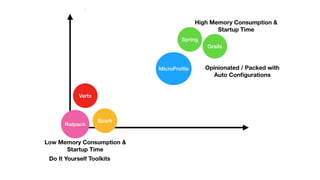
Traditional Frameworks
Spring is an amazing technical achievement and does so many
things, but does them at runtime.
• Reads the byte code of every bean it finds
• Synthesizes new annotations for each annotation on each
bean method, constructor, field etc. to support Annotation
metadata
• Builds Reflective Metadata for each bean for every method,
constructor, field etc.
What to do, What to
do?
1. Tough technology decisions ahead
2. Choose appropriately tool for the
job
3. Traditional frameworks often not the
best choice
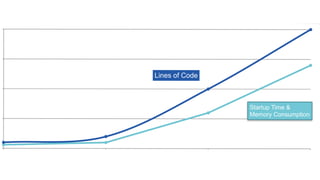
The Micro Reality
• Frameworks based on reflection
and annotations become fat
• But we love the programming
model and productivity so
we live with it
• So ... why should we be
more efficient?
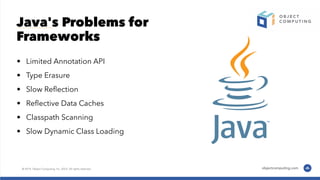
Java's Problems for
Frameworks
• Limited Annotation API
• Type Erasure
• Slow Reflection
• Reflective Data Caches
• Classpath Scanning
• Slow Dynamic Class Loading
Imagine if
Kubernetes or Docker
had been written in
Spring or Jakarta EE
instead of Go?
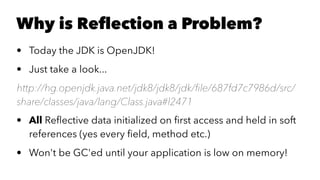
Why is Reflection a Problem?
• Today the JDK is OpenJDK!
• Just take a look...
http://hg.openjdk.java.net/jdk8/jdk8/jdk/file/687fd7c7986d/src/
share/classes/java/lang/Class.java#l2471
• All Reflective data initialized on first access and held in soft
references (yes every field, method etc.)
• Won't be GC'ed until your application is low on memory!
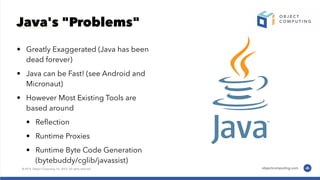
Java's "Problems"
• Greatly Exaggerated (Java has been
dead forever)
• Java can be Fast! (see Android and
Micronaut)
• However Most Existing Tools are
based around
• Reflection
• Runtime Proxies
• Runtime Byte Code Generation
(bytebuddy/cglib/javassist)
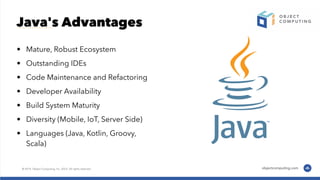
Java's Advantages
• Mature, Robust Ecosystem
• Outstanding IDEs
• Code Maintenance and Refactoring
• Developer Availability
• Build System Maturity
• Diversity (Mobile, IoT, Server Side)
• Languages (Java, Kotlin, Groovy,
Scala)
By the time Go has all
the features of Java,
Java's startup
performance will
match Go
Already Solved
Problem
• The Android Community already
solved the problem
• Ahead of Time Compilation used
extensively
• Google Dagger 2.x
• Compile Time Dependency
Injector
• Reflection Free
• Limited in Scope to just DI
Ahead of Time
Compilation
• So what is Ahead of Time (AOT)
compilation?
• Pre-computation of application code
using closed world static analysis
• Fancy way of saying do more at
compilation time
and less at runtime
Micronaut is...
• A Microservices and Serverless
Focused framework (hence the
branding)
• Also a Complete Application
Framework for any type of
Application
• Dependency Injection, Aspect
Oriented Programming (AOP),
Configuration Management,
Bean Introspection and more..
Micronaut AOT
Computation
• All Dependency & Configuration
Injection
• Annotation Metadata (Meta
annotations)
• AOP Proxies
• Essentially all framework
infrastructure
• ie. What Spring/CDI do at runtime
With Micronaut You
Can Build
• Microservices
• Serverless Applications
• Message-Driven Applications with
Kafka/Rabbit
• CLI Applications
• Even Android Applications
• Anything with
static void main(String..args)
So What is
Micronaut? Really?
• An Application Framework for the
Future
• Reflection Free, Runtime Proxy Free,
No Dynamic Classloading
• Ahead of Time (AOT) Compilation
AOT APIs
• ... oh and let's you build
Microservices
Micronaut's Impact
• We announced Micronaut on March
2018
• Open Sourced 28th of May 2018 (a
year ago!)
• Sparked industry wide
improvements from Red Hat (with
Quarkus) and Pivotal (Spring Boot
2.2)
• Micronaut is changing the face of
server side Java
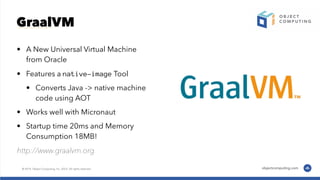
GraalVM
• A New Universal Virtual Machine
from Oracle
• Features a native-image Tool
• Converts Java -> native machine
code using AOT
• Works well with Micronaut
• Startup time 20ms and Memory
Consumption 18MB!
http://www.graalvm.org
DEMOMicronaut
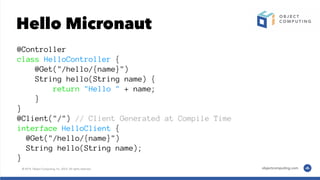
Hello Micronaut
@Controller
class HelloController {
@Get("/hello/{name}")
String hello(String name) {
return "Hello " + name;
}
}
@Client("/") // Client Generated at Compile Time
interface HelloClient {
@Get("/hello/{name}")
String hello(String name);
}
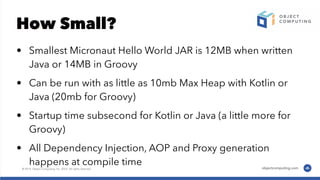
How Small?
• Smallest Micronaut Hello World JAR is 12MB when written
Java or 14MB in Groovy
• Can be run with as little as 10mb Max Heap with Kotlin or
Java (20mb for Groovy)
• Startup time subsecond for Kotlin or Java (a little more for
Groovy)
• All Dependency Injection, AOP and Proxy generation
happens at compile time
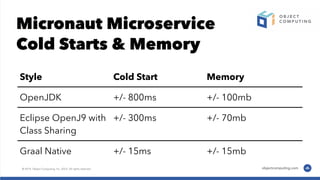
Micronaut Microservice
Cold Starts & Memory
Style Cold Start Memory
OpenJDK +/- 800ms +/- 100mb
Eclipse OpenJ9 with
Class Sharing
+/- 300ms +/- 70mb
Graal Native +/- 15ms +/- 15mb
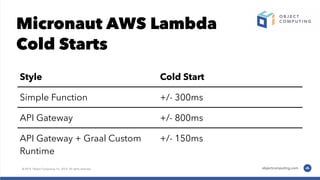
Micronaut AWS Lambda
Cold Starts
Style Cold Start
Simple Function +/- 300ms
API Gateway +/- 800ms
API Gateway + Graal Custom
Runtime
+/- 150ms
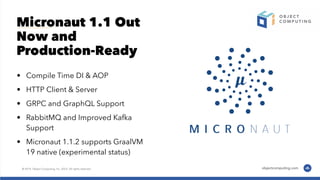
Micronaut 1.1 Out
Now and
Production-Ready
• Compile Time DI & AOP
• HTTP Client & Server
• GRPC and GraphQL Support
• RabbitMQ and Improved Kafka
Support
• Micronaut 1.1.2 supports GraalVM
19 native (experimental status)
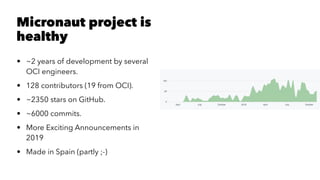
Micronaut project is
healthy
• ~2 years of development by several
OCI engineers.
• 128 contributors (19 from OCI).
• ~2350 stars on GitHub.
• ~6000 commits.
• More Exciting Announcements in
2019
• Made in Spain (partly ;-)
Micronaut Resources
• Gitter Community: https://gitter.im/micronautfw
• User Guide: http://micronaut.io/documentation.html
• Micronaut Guides: http://guides.micronaut.io
• FAQ: http://micronaut.io/faq.html
• Github: https://github.com/micronaut-projects/micronaut-
core
• Examples: https://github.com/micronaut-projects/
micronaut-examples
Summary
• Micronaut and GraalVM are leading the AOT revolution
• Server Side Java is Adapting to the Serverless world
• Building more efficient applications possible with right
framework choices
• AOT Sacrifices Compilation Speed to Gain so Much More
• Going native an option for the future with GraalVM
Q & AMicronaut
Introduction to Micronaut - JBCNConf 2019

Introduction to Micronaut - JBCNConf 2019

  • 1.
  • 2.
    About Me • GraemeRocher • Creator of Grails and Micronaut • Principal Engineer at Object Computing • Oracle Groundbreaker Award Winner • Based in Pais Vasco
  • 3.
    Agenda • Challenges FacingJava and Software in General • Microservces and Serverless vs. Traditional Models • Micronaut Demos! • Q & A!
  • 4.
    Serverless Challenges • Challenges tousing Java in Serverless / Microservices scenarios • Existing Tools and Frameworks Not Optimized for Cold Starts / Low Memory • Go, Node etc. better in this regards • Tim Bray (Amazon/AWS) and others not recommending Java https://youtu.be/IPOvrK3S3gQ?t=1109
  • 5.
    Adapting to Serverless •Optimize for cold starts • Forget about connection pools • Don't bother with local caches • Choose technology based on your cold start requirements
  • 6.
    Adapting to Microservices • Coldstarts less important, but still important • The Container is the deployment unit • Containers and Java require special memory management • Optimization for memory usage required
  • 7.
    Traditional Frameworks Spring isan amazing technical achievement and does so many things, but does them at runtime. • Reads the byte code of every bean it finds • Synthesizes new annotations for each annotation on each bean method, constructor, field etc. to support Annotation metadata • Builds Reflective Metadata for each bean for every method, constructor, field etc.
  • 8.
    What to do,What to do? 1. Tough technology decisions ahead 2. Choose appropriately tool for the job 3. Traditional frameworks often not the best choice
  • 9.
    The Micro Reality •Frameworks based on reflection and annotations become fat • But we love the programming model and productivity so we live with it • So ... why should we be more efficient?
  • 12.
    Java's Problems for Frameworks •Limited Annotation API • Type Erasure • Slow Reflection • Reflective Data Caches • Classpath Scanning • Slow Dynamic Class Loading
  • 13.
    Imagine if Kubernetes orDocker had been written in Spring or Jakarta EE instead of Go?
  • 15.
    Why is Reflectiona Problem? • Today the JDK is OpenJDK! • Just take a look... http://hg.openjdk.java.net/jdk8/jdk8/jdk/file/687fd7c7986d/src/ share/classes/java/lang/Class.java#l2471 • All Reflective data initialized on first access and held in soft references (yes every field, method etc.) • Won't be GC'ed until your application is low on memory!
  • 16.
    Java's "Problems" • GreatlyExaggerated (Java has been dead forever) • Java can be Fast! (see Android and Micronaut) • However Most Existing Tools are based around • Reflection • Runtime Proxies • Runtime Byte Code Generation (bytebuddy/cglib/javassist)
  • 17.
    Java's Advantages • Mature,Robust Ecosystem • Outstanding IDEs • Code Maintenance and Refactoring • Developer Availability • Build System Maturity • Diversity (Mobile, IoT, Server Side) • Languages (Java, Kotlin, Groovy, Scala)
  • 18.
    By the timeGo has all the features of Java, Java's startup performance will match Go
  • 19.
    Already Solved Problem • TheAndroid Community already solved the problem • Ahead of Time Compilation used extensively • Google Dagger 2.x • Compile Time Dependency Injector • Reflection Free • Limited in Scope to just DI
  • 20.
    Ahead of Time Compilation •So what is Ahead of Time (AOT) compilation? • Pre-computation of application code using closed world static analysis • Fancy way of saying do more at compilation time and less at runtime
  • 22.
    Micronaut is... • AMicroservices and Serverless Focused framework (hence the branding) • Also a Complete Application Framework for any type of Application • Dependency Injection, Aspect Oriented Programming (AOP), Configuration Management, Bean Introspection and more..
  • 23.
    Micronaut AOT Computation • AllDependency & Configuration Injection • Annotation Metadata (Meta annotations) • AOP Proxies • Essentially all framework infrastructure • ie. What Spring/CDI do at runtime
  • 24.
    With Micronaut You CanBuild • Microservices • Serverless Applications • Message-Driven Applications with Kafka/Rabbit • CLI Applications • Even Android Applications • Anything with static void main(String..args)
  • 25.
    So What is Micronaut?Really? • An Application Framework for the Future • Reflection Free, Runtime Proxy Free, No Dynamic Classloading • Ahead of Time (AOT) Compilation AOT APIs • ... oh and let's you build Microservices
  • 26.
    Micronaut's Impact • Weannounced Micronaut on March 2018 • Open Sourced 28th of May 2018 (a year ago!) • Sparked industry wide improvements from Red Hat (with Quarkus) and Pivotal (Spring Boot 2.2) • Micronaut is changing the face of server side Java
  • 27.
    GraalVM • A NewUniversal Virtual Machine from Oracle • Features a native-image Tool • Converts Java -> native machine code using AOT • Works well with Micronaut • Startup time 20ms and Memory Consumption 18MB! http://www.graalvm.org
  • 28.
  • 29.
    Hello Micronaut @Controller class HelloController{ @Get("/hello/{name}") String hello(String name) { return "Hello " + name; } } @Client("/") // Client Generated at Compile Time interface HelloClient { @Get("/hello/{name}") String hello(String name); }
  • 30.
    How Small? • SmallestMicronaut Hello World JAR is 12MB when written Java or 14MB in Groovy • Can be run with as little as 10mb Max Heap with Kotlin or Java (20mb for Groovy) • Startup time subsecond for Kotlin or Java (a little more for Groovy) • All Dependency Injection, AOP and Proxy generation happens at compile time
  • 31.
    Micronaut Microservice Cold Starts& Memory Style Cold Start Memory OpenJDK +/- 800ms +/- 100mb Eclipse OpenJ9 with Class Sharing +/- 300ms +/- 70mb Graal Native +/- 15ms +/- 15mb
  • 32.
    Micronaut AWS Lambda ColdStarts Style Cold Start Simple Function +/- 300ms API Gateway +/- 800ms API Gateway + Graal Custom Runtime +/- 150ms
  • 33.
    Micronaut 1.1 Out Nowand Production-Ready • Compile Time DI & AOP • HTTP Client & Server • GRPC and GraphQL Support • RabbitMQ and Improved Kafka Support • Micronaut 1.1.2 supports GraalVM 19 native (experimental status)
  • 34.
    Micronaut project is healthy •~2 years of development by several OCI engineers. • 128 contributors (19 from OCI). • ~2350 stars on GitHub. • ~6000 commits. • More Exciting Announcements in 2019 • Made in Spain (partly ;-)
  • 35.
    Micronaut Resources • GitterCommunity: https://gitter.im/micronautfw • User Guide: http://micronaut.io/documentation.html • Micronaut Guides: http://guides.micronaut.io • FAQ: http://micronaut.io/faq.html • Github: https://github.com/micronaut-projects/micronaut- core • Examples: https://github.com/micronaut-projects/ micronaut-examples
  • 36.
    Summary • Micronaut andGraalVM are leading the AOT revolution • Server Side Java is Adapting to the Serverless world • Building more efficient applications possible with right framework choices • AOT Sacrifices Compilation Speed to Gain so Much More • Going native an option for the future with GraalVM
  • 37.