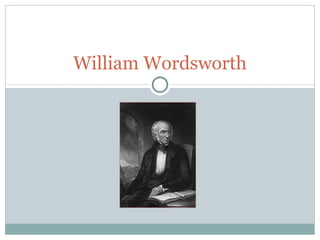
William Wordsworth
William Wordsworth was born on April 7th, 1770 in Cockermouth, Cumberland. He is considered one of the founders of the Romantic Movement of the English literature  . Wordsworth was known as a "Lakeland Poet“, because of the area where he lived, which is renowned for its beautiful, wild landscapes.   Biography
Biography Wordsworth travelled to the Revolutionary France in 1790, and spent a year there .  The war between France and England prevented him from returning to France until 1802.  In the same year, he married Mary Hutchinson.  They had five children. In Dorsetshire (1802),Wordsworth met Samuel Coleridge. The two formed a mutually beneficial and inspirational relationship, eventually beginning the English Romantic Movement. William Wordsworth died on April 23rd, 1850 of pneumonia   , in Rydal Mount.
Major Works Lyrical Ballads (1798) Lyrical Ballads (1800) Poems, in two volumes (1807) The Excursion (1814) Ecclesiastical Sketches (1822) The Prelude (1850, posthumous)
The Poem: The Tables Turned Up! up! my Friend, and quit your books; Or surely you'll grow double: Up! up! my Friend, and clear your looks; Why all this toil and trouble? The sun, above the mountain's head, A freshening lustre mellow Through all the long green fields has spread, His first sweet evening yellow. Books! 'tis a dull and endless strife: Come, hear the woodland linnet, How sweet his music! on my life, There's more of wisdom in it.
And hark! how blithe the throstle sings! He, too, is no mean preacher: Come forth into the light of things, Let Nature be your Teacher. She has a world of ready wealth, Our minds and hearts to bless Spontaneous wisdom breathed by health, Truth breathed by cheerfulness. One impulse from a vernal wood May teach you more of man, Of moral evil and of good, Than all the sages can.
Sweet is the lore which Nature brings; Our meddling intellect Mis-shapes the beauteous forms of things: We murder to dissect. Enough of Science and of Art; Close up those barren leaves; Come forth, and bring with you a heart That watches and receives.
Comprehension Analysis In “The Tables Turned”,  Wordsworth tells his friend to put his books away and go outside to be part of nature. The common theme: Nature as a Teacher . The poem shows that the education we can receive from experiencing nature is superior than learn from books.
Figures of Speech Personification: Line 1 and 2, stanza 3 How blithe the throstle sings! He, too, is no mean preacher: Line 4, stanza 3 Let  Nature be your teacher. Stanza 4 One impulse from a vernal wood May teach you more of man…
Figures of Speech
Figures of Speech

The Tables Turned Presentation

  • 1.
  • 2.
    William Wordsworth wasborn on April 7th, 1770 in Cockermouth, Cumberland. He is considered one of the founders of the Romantic Movement of the English literature . Wordsworth was known as a "Lakeland Poet“, because of the area where he lived, which is renowned for its beautiful, wild landscapes. Biography
  • 3.
    Biography Wordsworth travelledto the Revolutionary France in 1790, and spent a year there . The war between France and England prevented him from returning to France until 1802. In the same year, he married Mary Hutchinson. They had five children. In Dorsetshire (1802),Wordsworth met Samuel Coleridge. The two formed a mutually beneficial and inspirational relationship, eventually beginning the English Romantic Movement. William Wordsworth died on April 23rd, 1850 of pneumonia , in Rydal Mount.
  • 4.
    Major Works LyricalBallads (1798) Lyrical Ballads (1800) Poems, in two volumes (1807) The Excursion (1814) Ecclesiastical Sketches (1822) The Prelude (1850, posthumous)
  • 5.
    The Poem: TheTables Turned Up! up! my Friend, and quit your books; Or surely you'll grow double: Up! up! my Friend, and clear your looks; Why all this toil and trouble? The sun, above the mountain's head, A freshening lustre mellow Through all the long green fields has spread, His first sweet evening yellow. Books! 'tis a dull and endless strife: Come, hear the woodland linnet, How sweet his music! on my life, There's more of wisdom in it.
  • 6.
    And hark! howblithe the throstle sings! He, too, is no mean preacher: Come forth into the light of things, Let Nature be your Teacher. She has a world of ready wealth, Our minds and hearts to bless Spontaneous wisdom breathed by health, Truth breathed by cheerfulness. One impulse from a vernal wood May teach you more of man, Of moral evil and of good, Than all the sages can.
  • 7.
    Sweet is thelore which Nature brings; Our meddling intellect Mis-shapes the beauteous forms of things: We murder to dissect. Enough of Science and of Art; Close up those barren leaves; Come forth, and bring with you a heart That watches and receives.
  • 8.
    Comprehension Analysis In“The Tables Turned”, Wordsworth tells his friend to put his books away and go outside to be part of nature. The common theme: Nature as a Teacher . The poem shows that the education we can receive from experiencing nature is superior than learn from books.
  • 9.
    Figures of SpeechPersonification: Line 1 and 2, stanza 3 How blithe the throstle sings! He, too, is no mean preacher: Line 4, stanza 3 Let Nature be your teacher. Stanza 4 One impulse from a vernal wood May teach you more of man…
  • 10.
  • 11.