Wikitology Wikipedia as an Ontology Zareen Syed, Tim Finin and Anupam Joshi zarsyed1@umbc.edu, finin@cs.umbc.edu, joshi@cs.umbc.edu University of Maryland Baltimore County
Outline Introduction and motivation Wikipedia Methodology and Experiments Evaluation Future Work Directions Conclusion    intro     wikipedia    experiments    evaluation    next    conclusion  
Introduction Identifying the topics and concepts associated with a document or collection of documents is a common task for many applications and can help in: Annotation  and categorization of documents in a corpus.  Modelling  user interests Business intelligence Selecting  Advertisements    intro     wikipedia    experiments    evaluation    next    conclusion  
Motivation Problem:  describe what an analyst has been working on to support collaboration Idea:   track documents she reads  map  these to terms in an ontology aggregate  to produce a short list of topics    intro     wikipedia    experiments    evaluation    next    conclusion  
Approach Use Wikipedia articles and categories as  ontology terms   Categories as  Generalized  Concepts Articles as  Specialized  Concepts How to  map  the documents she reads to the ontology terms? Use document to Wiki-article similarity for the  mapping How to  aggregate  to get a shorter list? Use spreading activation algorithm for  aggregation    intro     wikipedia    experiments    evaluation    next    conclusion  
What’s a document about? Two common approaches: Statistical Approach Select words and phrases using  TF-IDF  that characterize the document (2)  Controlled Vocabulary or Ontology Map document to a list of terms from a controlled vocabulary or ontology First approach is  flexible  and does not require creating and maintaining an ontology Second approach can tie documents to a rich  knowledge base    intro     wikipedia    experiments    evaluation    next    conclusion  
Wikitology ! Using Wikipedia as an ontology offers the best of both approaches  Each article is a  concept  in the ontology Terms  linked  via Wikipedia’s category system and inter-article links It’s a  consensus  ontology created, kept  current  and maintained by a diverse community  Overall  content quality  is high  Terms have unique IDs (URLs) and are “ self describing ” for people Underlying graphs provide  structure : categories, article links    intro      wikipedia     experiments    evaluation    next    conclusion  
Wikipedia Graph Structures Wikipedia Category graph is a thesaurus    intro      wikipedia     experiments    evaluation    next    conclusion   Wikipedia Page links graph is similar to WWW Network
Methods Goal : given one or more documents, compute a ranked list of the top N Wikipedia  articles  and/or  categories  that describe it. Basic metric : document similarity between Wikipedia article and document(s) Variations :  role of categories eliminating uninteresting articles use of spreading activation using similarity scores for weighing links number of  spreading activation pulses individual or set of query documents, etc, etc.
Spreading Activation In  associative retrieval  the idea is that it is possible to retrieve relevant documents if they are associated with other documents that have been considered relevant by the user. The documents can be represented as nodes and their associations as links in a network.    intro    wikipedia     experiments     evaluation    next    conclusion  
Spreading Activation Start with an initial set of activated nodes
Spreading Activation At each pulse/iteration, spread activation to adjacent nodes
Spreading Activation Constraints Distance Fan out Path constraints Activation threshold Some nodes will have higher activation than others
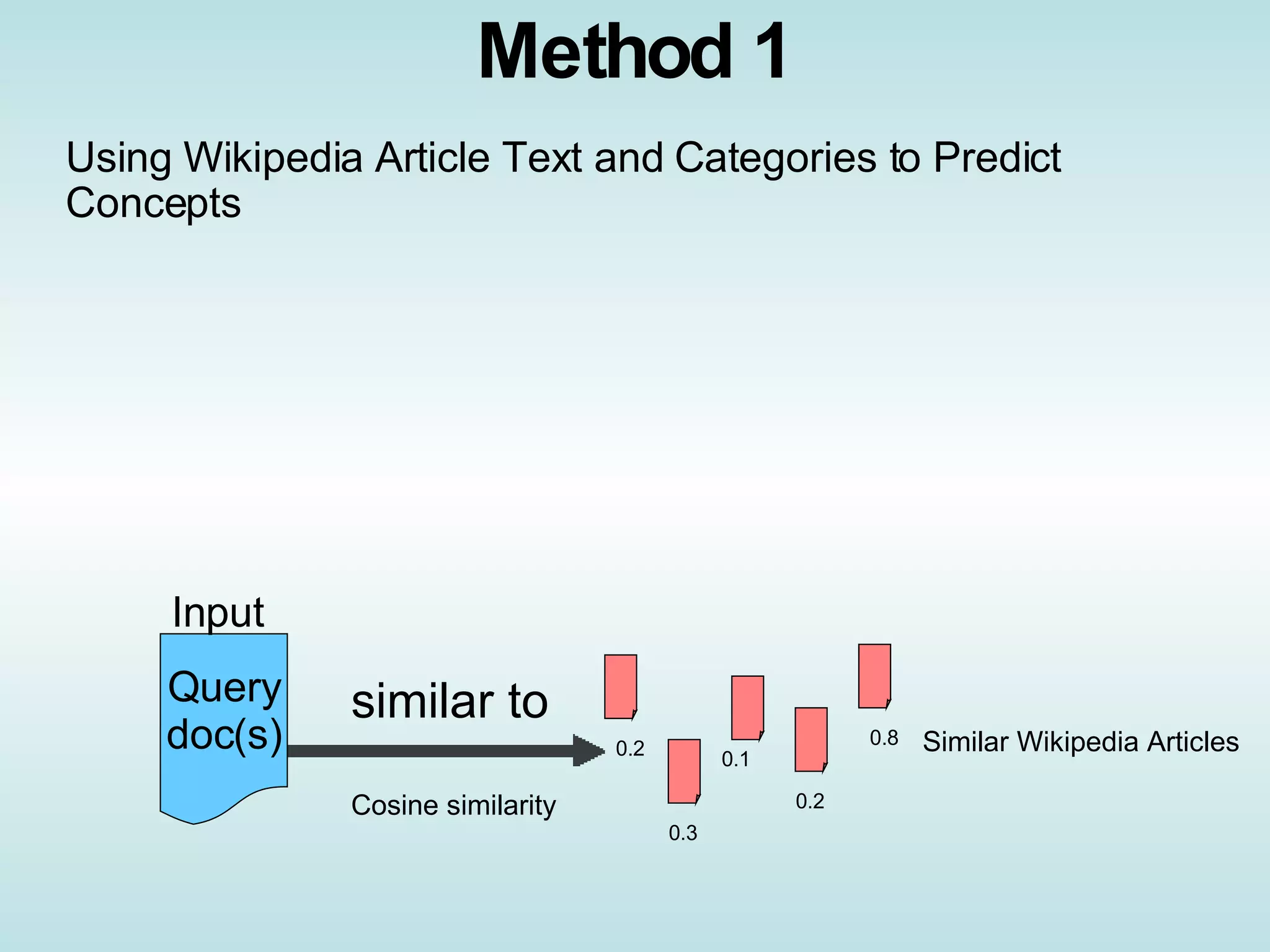
Method 1 Query doc(s) similar to Cosine similarity Similar Wikipedia Articles Using Wikipedia Article Text and Categories to Predict Concepts 0.2 0.1 0.3 0.8 0.2 Input
Method 1 Query doc(s) similar to Cosine similarity Wikipedia Category Graph Similar Wikipedia Articles Using Wikipedia Article Text and Categories to Predict Concepts 0.2 0.1 0.3 0.8 0.2 Input
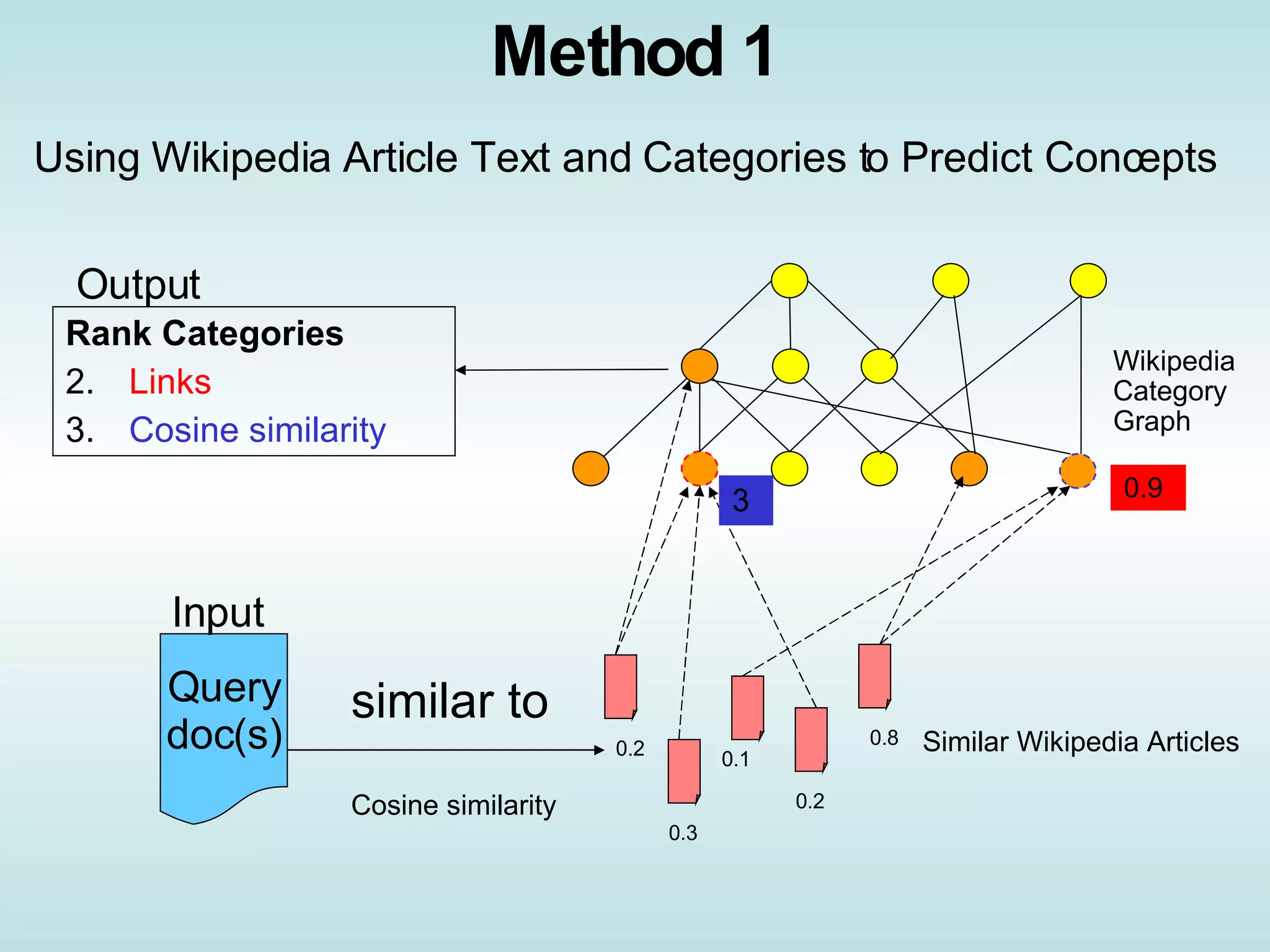
Method 1 Query doc(s) similar to Rank Categories   Links Cosine similarity Cosine similarity Wikipedia Category Graph Similar Wikipedia Articles Using Wikipedia Article Text and Categories to Predict Concepts 0.2 0.1 0.3 0.8 0.2 0.9 3 Input Output
Method 2 Query doc(s) Similar to Cosine similarity Wikipedia Category Graph Using Spreading Activation on Category Links Graph to get Aggregated Concepts 0.2 0.1 0.3 0.8 0.2 Input Ranked Concepts based  on Final Activation Score Output Spreading Activation Input Function Output Function
Can we predict concepts that are  NOT  present in the category hierarchy? Use the  article concepts ! But  How ?
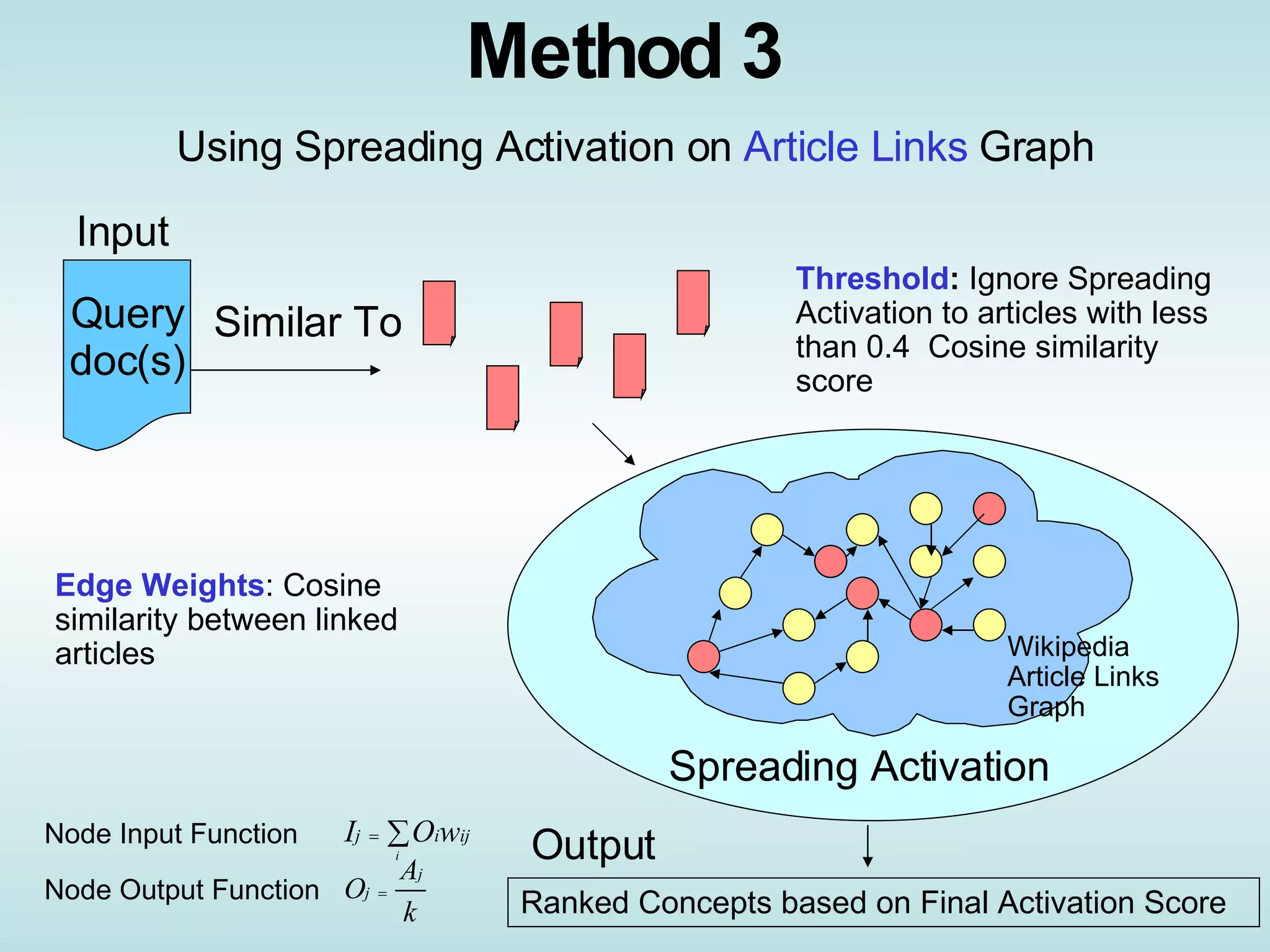
Method 3  Query doc(s) Similar To Ranked Concepts based on Final Activation Score Spreading Activation Threshold :  Ignore Spreading Activation to articles with less than 0.4  Cosine similarity score Edge Weights : Cosine  similarity between linked articles Wikipedia Article Links Graph Using Spreading Activation on  Article Links  Graph Node Input Function Node Output Function Output Input
Prediction for Single Test Document Preliminary Experiments    intro    wikipedia    experiments     evaluation     next    conclusion   An initial  informal evaluation  compared results against our own judgments Downloaded articles from  internet  and predicted concepts Using  Single  Document and  Group  of Related Documents More pulses -> More Generalized Concepts Test Document Title Method 1 Ranking Categories Directly  Method 2 Spreading Activation Pulses=2 Method 2 Spreading Activation Pulses=3 Weather Prediction of thunder storms (CNN) “ Weather_Hazards” “ Winds” “ Severe_weather_and_convection”  “ Weather_Hazards” “ Current_events” “ Types_of_cyclone” “ Meterology” “ Nature” “ Weather”
Test Document Titles in the Set: (Wikipedia Articles) Crop_rotation  Permaculture  Beneficial_insects Neem  Lady_Bird Principles_of_Organic_Agriculture Rhizobia Biointensive Inter­cropping Green_manure  Preliminary Experiments Prediction for Set of Test Documents    intro    wikipedia    experiments     evaluation     next    conclusion   Concept not in the Category Hierarchy Method 1 Ranking Categories Directly Method 2 (2 pulses) Spreading Activation on Category links Graph Method 3 (2 pulses) Spreading Activation on Article Links Graph Agriculture Sustainable_technologies Crops Agronomy Permaculture Skills Applied_sciences Land_management Food_industry Agriculture Organic_farming Sustainable_agriculture Organic_gardening Agriculture Companion_planting
Average Similarity Query doc(s) similar to Cosine similarity 0.9 0.5 0.7 0.8 0.2 0.5 + 0.9 + 0.7 + 0.2 + 0.8 5    intro    wikipedia    experiments     evaluation     next    conclusion   Evaluation Select wikipedia articles randomly and predict their  categories  and  links Sort the results based on  Average Similarity
Evaluation If our system predicts a category  three levels higher  in hierarchy than the original category we consider our prediction to be correct Antibiotics Medical Treatments Medicines Oxytetracyclin Tetracyclin 1st Observation Articles are linked often with super and sub categories both
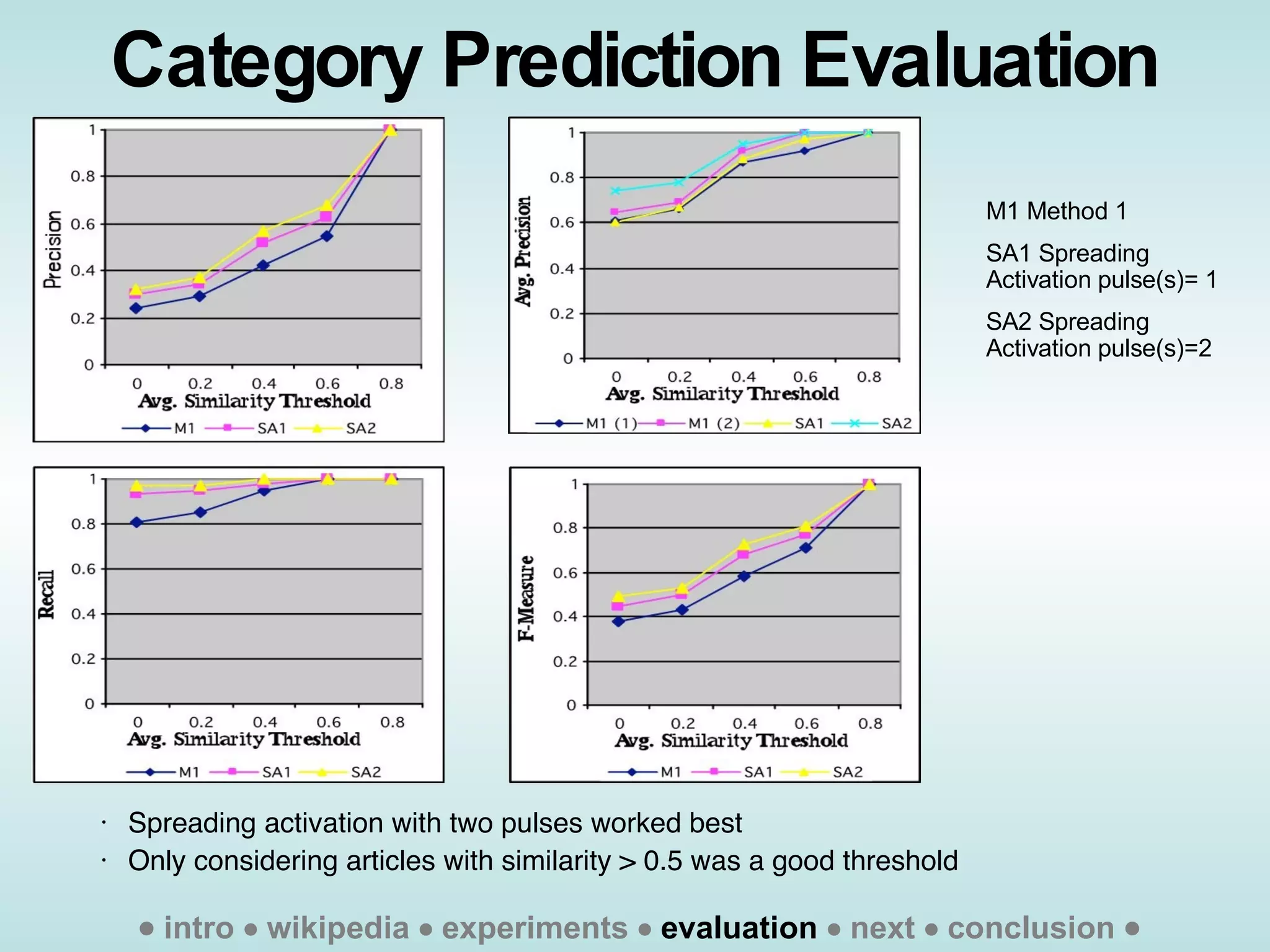
Category Prediction Evaluation    intro    wikipedia    experiments     evaluation     next    conclusion   Spreading activation with two pulses worked best Only considering articles with similarity > 0.5 was a good threshold M1 Method 1 SA1 Spreading Activation pulse(s)= 1 SA2 Spreading Activation pulse(s)=2
Article Links Prediction Evaluation Spreading activation with one pulse worked best Only considering articles with similarity > 0.5 was a good threshold Similar Documents, N = 5 Spreading Activation pulses=1    intro    wikipedia    experiments     evaluation     next    conclusion  
Prediction Accuracy  Issues: To what  extent  the concept is represented in Wikipedia For eg. we have a category related to the fruit apple but not for mango Presence of links  between  semantically  related concepts Presence of links  between  irrelevant articles  (term definitions, country names) Possible Solutions: Use  Average Similarity Score  to measure the extent of concept representation with in Wikipedia Use existing  semantic relatedness measures  to handle presence or absence of semantically related links    intro    wikipedia    experiments     evaluation     next    conclusion  
Potential Applications Recommending  categories and links for new Wikipedia articles Introducing  new  Wikipedia categories Automating  the process of building a Wiki from a corpus
Future Work Classifying links in Wikipedia using Machine learning techniques To Predict semantic type of article To control flow of spreading activation Exploit parallel execution on cluster Refining Wikipedia ontology Bridging the gap between Wikipedia and formal ontologies    intro    wikipedia    experiments    evaluation     next     conclusion  
Document Expansion  with Wikipedia Derived Ontology Terms   * Expansion of each  TREC document  using Wikitology terms We are still working on refining the methodology *  In Collaboration with Paul McNamee, John Hopkins University Applied Physics Laboratory Doc: FT921-4598  (3/9/92) ... Alan Turing, described as a brilliant mathematician and a key figure in the breaking of the Nazis' Enigma codes. Prof IJ Good says it is as well that British security was unaware of Turing's homosexuality, otherwise he might have been fired 'and we might have lost the war'. In 1950 Turing wrote the seminal paper 'Computing Machinery And Intelligence', but in 1954 killed himself ... Turing_machine, Turing_test, Church_Turing_thesis, Halting_problem, Computable_number, Bombe, Alan_Turing, Recusion_theory, Formal_methods,  Computational_models, Theory_of_computation, Theoretical_computer_science, Artificial_Intelligence
Conclusion We tested the idea of using  Wikitology  for describing documents and proposed different methods using the Wikipedia article text, category links and article links Suggested improvements Using  average similarity  to judge the accuracy of prediction Easily  extendable  to other wikis and collaborative KBs, e.g., Intellipedia, Freebase    intro    wikipedia    experiments    evaluation    next     conclusion   
References Crestani, F. 1997. Application of Spreading Activation Techniques in Information Retrieval. Artificial Intelligence Review, 1997, vol 11; No. 6, 453-482.  Gabrilovich, E., and Markovitch, S. 2006. Overcoming the brittleness bottleneck using Wikipedia: Enhancing text categorization with encyclopedic knowledge. Proceedings of the Twenty-First National Conference on Artificial Intelligence. AAAI’06. Boston, MA. Schonhofen, P. 2006. Identifying Document Topics Using the Wikipedia Category Network. Proc. 2006 IEEE/WIC/ACM International Conference on Web Intelligence. 456-462, 2006. IEEE Computer Society, Washington, DC, USA. Strube,M., and Ponzetto, S.P. 2006. Exploiting semantic role labeling, WordNet and Wikipedia for coreference resolution. Proceedings of the main conference on Human Language Technology Conference of the North American Chapter of the Association of Computational Linguistics (2006). Asso-ciation for Computational Linguistics Morristown, NJ, USA.
References Gabrilovich, E., and Markovitch, S. 2007.  Computing Semantic Relatedness using Wikipedia-based Explicit Semantic Analysis , Proc. of the 20th International Joint Con-ference on Artificial Intelligence (IJCAI’07), 6-12. Krizhanovsky, A. 2006. Synonym search in Wikipedia: Synarcher.  URL:http://arxiv.org/abs/cs/0606097v1 Mihalcea, R. 2007. Using Wikipedia for Automatic Word Sense Disambiguation. Proc NAACL HLT. 196-203. Strube,M., and Ponzetto, S.P. 2006. WikiRelate! Computing semantic relatedness using Wikipedia. American Association for Artificial Intelligence, 2006, Boston, MA. Voss, J. 2006. Collaborative thesaurus tagging the Wikipedia way. Collaborative Web Tagging Workshop. Arxiv Computer Science e prints .  URL  http://arxiv.org/abs/cs/0604036 Milne, D. 2007. Computing Semantic Relatedness using Wikipedia Link Structure. Proceedings of the New Zealand Computer Science Research Student conference (NZCSRSC’07), Hamilton, New Zealand.
Thank you Questions and Suggestions?

Wikipedia as an Ontology for Describing Documents

  • 1.
    Wikitology Wikipedia asan Ontology Zareen Syed, Tim Finin and Anupam Joshi zarsyed1@umbc.edu, finin@cs.umbc.edu, joshi@cs.umbc.edu University of Maryland Baltimore County
  • 2.
    Outline Introduction andmotivation Wikipedia Methodology and Experiments Evaluation Future Work Directions Conclusion  intro  wikipedia  experiments  evaluation  next  conclusion 
  • 3.
    Introduction Identifying thetopics and concepts associated with a document or collection of documents is a common task for many applications and can help in: Annotation and categorization of documents in a corpus. Modelling user interests Business intelligence Selecting Advertisements  intro  wikipedia  experiments  evaluation  next  conclusion 
  • 4.
    Motivation Problem: describe what an analyst has been working on to support collaboration Idea: track documents she reads map these to terms in an ontology aggregate to produce a short list of topics  intro  wikipedia  experiments  evaluation  next  conclusion 
  • 5.
    Approach Use Wikipediaarticles and categories as ontology terms Categories as Generalized Concepts Articles as Specialized Concepts How to map the documents she reads to the ontology terms? Use document to Wiki-article similarity for the mapping How to aggregate to get a shorter list? Use spreading activation algorithm for aggregation  intro  wikipedia  experiments  evaluation  next  conclusion 
  • 6.
    What’s a documentabout? Two common approaches: Statistical Approach Select words and phrases using TF-IDF that characterize the document (2) Controlled Vocabulary or Ontology Map document to a list of terms from a controlled vocabulary or ontology First approach is flexible and does not require creating and maintaining an ontology Second approach can tie documents to a rich knowledge base  intro  wikipedia  experiments  evaluation  next  conclusion 
  • 7.
    Wikitology ! UsingWikipedia as an ontology offers the best of both approaches Each article is a concept in the ontology Terms linked via Wikipedia’s category system and inter-article links It’s a consensus ontology created, kept current and maintained by a diverse community Overall content quality is high Terms have unique IDs (URLs) and are “ self describing ” for people Underlying graphs provide structure : categories, article links  intro  wikipedia  experiments  evaluation  next  conclusion 
  • 8.
    Wikipedia Graph StructuresWikipedia Category graph is a thesaurus  intro  wikipedia  experiments  evaluation  next  conclusion  Wikipedia Page links graph is similar to WWW Network
  • 9.
    Methods Goal :given one or more documents, compute a ranked list of the top N Wikipedia articles and/or categories that describe it. Basic metric : document similarity between Wikipedia article and document(s) Variations : role of categories eliminating uninteresting articles use of spreading activation using similarity scores for weighing links number of spreading activation pulses individual or set of query documents, etc, etc.
  • 10.
    Spreading Activation In associative retrieval the idea is that it is possible to retrieve relevant documents if they are associated with other documents that have been considered relevant by the user. The documents can be represented as nodes and their associations as links in a network.  intro  wikipedia  experiments  evaluation  next  conclusion 
  • 11.
    Spreading Activation Startwith an initial set of activated nodes
  • 12.
    Spreading Activation Ateach pulse/iteration, spread activation to adjacent nodes
  • 13.
    Spreading Activation ConstraintsDistance Fan out Path constraints Activation threshold Some nodes will have higher activation than others
  • 14.
    Method 1 Querydoc(s) similar to Cosine similarity Similar Wikipedia Articles Using Wikipedia Article Text and Categories to Predict Concepts 0.2 0.1 0.3 0.8 0.2 Input
  • 15.
    Method 1 Querydoc(s) similar to Cosine similarity Wikipedia Category Graph Similar Wikipedia Articles Using Wikipedia Article Text and Categories to Predict Concepts 0.2 0.1 0.3 0.8 0.2 Input
  • 16.
    Method 1 Querydoc(s) similar to Rank Categories Links Cosine similarity Cosine similarity Wikipedia Category Graph Similar Wikipedia Articles Using Wikipedia Article Text and Categories to Predict Concepts 0.2 0.1 0.3 0.8 0.2 0.9 3 Input Output
  • 17.
    Method 2 Querydoc(s) Similar to Cosine similarity Wikipedia Category Graph Using Spreading Activation on Category Links Graph to get Aggregated Concepts 0.2 0.1 0.3 0.8 0.2 Input Ranked Concepts based on Final Activation Score Output Spreading Activation Input Function Output Function
  • 18.
    Can we predictconcepts that are NOT present in the category hierarchy? Use the article concepts ! But How ?
  • 19.
    Method 3 Query doc(s) Similar To Ranked Concepts based on Final Activation Score Spreading Activation Threshold : Ignore Spreading Activation to articles with less than 0.4 Cosine similarity score Edge Weights : Cosine similarity between linked articles Wikipedia Article Links Graph Using Spreading Activation on Article Links Graph Node Input Function Node Output Function Output Input
  • 20.
    Prediction for SingleTest Document Preliminary Experiments  intro  wikipedia  experiments  evaluation  next  conclusion  An initial informal evaluation compared results against our own judgments Downloaded articles from internet and predicted concepts Using Single Document and Group of Related Documents More pulses -> More Generalized Concepts Test Document Title Method 1 Ranking Categories Directly Method 2 Spreading Activation Pulses=2 Method 2 Spreading Activation Pulses=3 Weather Prediction of thunder storms (CNN) “ Weather_Hazards” “ Winds” “ Severe_weather_and_convection” “ Weather_Hazards” “ Current_events” “ Types_of_cyclone” “ Meterology” “ Nature” “ Weather”
  • 21.
    Test Document Titlesin the Set: (Wikipedia Articles) Crop_rotation Permaculture Beneficial_insects Neem Lady_Bird Principles_of_Organic_Agriculture Rhizobia Biointensive Inter­cropping Green_manure Preliminary Experiments Prediction for Set of Test Documents  intro  wikipedia  experiments  evaluation  next  conclusion  Concept not in the Category Hierarchy Method 1 Ranking Categories Directly Method 2 (2 pulses) Spreading Activation on Category links Graph Method 3 (2 pulses) Spreading Activation on Article Links Graph Agriculture Sustainable_technologies Crops Agronomy Permaculture Skills Applied_sciences Land_management Food_industry Agriculture Organic_farming Sustainable_agriculture Organic_gardening Agriculture Companion_planting
  • 22.
    Average Similarity Querydoc(s) similar to Cosine similarity 0.9 0.5 0.7 0.8 0.2 0.5 + 0.9 + 0.7 + 0.2 + 0.8 5  intro  wikipedia  experiments  evaluation  next  conclusion  Evaluation Select wikipedia articles randomly and predict their categories and links Sort the results based on Average Similarity
  • 23.
    Evaluation If oursystem predicts a category three levels higher in hierarchy than the original category we consider our prediction to be correct Antibiotics Medical Treatments Medicines Oxytetracyclin Tetracyclin 1st Observation Articles are linked often with super and sub categories both
  • 24.
    Category Prediction Evaluation intro  wikipedia  experiments  evaluation  next  conclusion  Spreading activation with two pulses worked best Only considering articles with similarity > 0.5 was a good threshold M1 Method 1 SA1 Spreading Activation pulse(s)= 1 SA2 Spreading Activation pulse(s)=2
  • 25.
    Article Links PredictionEvaluation Spreading activation with one pulse worked best Only considering articles with similarity > 0.5 was a good threshold Similar Documents, N = 5 Spreading Activation pulses=1  intro  wikipedia  experiments  evaluation  next  conclusion 
  • 26.
    Prediction Accuracy Issues: To what extent the concept is represented in Wikipedia For eg. we have a category related to the fruit apple but not for mango Presence of links between semantically related concepts Presence of links between irrelevant articles (term definitions, country names) Possible Solutions: Use Average Similarity Score to measure the extent of concept representation with in Wikipedia Use existing semantic relatedness measures to handle presence or absence of semantically related links  intro  wikipedia  experiments  evaluation  next  conclusion 
  • 27.
    Potential Applications Recommending categories and links for new Wikipedia articles Introducing new Wikipedia categories Automating the process of building a Wiki from a corpus
  • 28.
    Future Work Classifyinglinks in Wikipedia using Machine learning techniques To Predict semantic type of article To control flow of spreading activation Exploit parallel execution on cluster Refining Wikipedia ontology Bridging the gap between Wikipedia and formal ontologies  intro  wikipedia  experiments  evaluation  next  conclusion 
  • 29.
    Document Expansion with Wikipedia Derived Ontology Terms * Expansion of each TREC document using Wikitology terms We are still working on refining the methodology * In Collaboration with Paul McNamee, John Hopkins University Applied Physics Laboratory Doc: FT921-4598 (3/9/92) ... Alan Turing, described as a brilliant mathematician and a key figure in the breaking of the Nazis' Enigma codes. Prof IJ Good says it is as well that British security was unaware of Turing's homosexuality, otherwise he might have been fired 'and we might have lost the war'. In 1950 Turing wrote the seminal paper 'Computing Machinery And Intelligence', but in 1954 killed himself ... Turing_machine, Turing_test, Church_Turing_thesis, Halting_problem, Computable_number, Bombe, Alan_Turing, Recusion_theory, Formal_methods, Computational_models, Theory_of_computation, Theoretical_computer_science, Artificial_Intelligence
  • 30.
    Conclusion We testedthe idea of using Wikitology for describing documents and proposed different methods using the Wikipedia article text, category links and article links Suggested improvements Using average similarity to judge the accuracy of prediction Easily extendable to other wikis and collaborative KBs, e.g., Intellipedia, Freebase  intro  wikipedia  experiments  evaluation  next  conclusion 
  • 31.
    References Crestani, F.1997. Application of Spreading Activation Techniques in Information Retrieval. Artificial Intelligence Review, 1997, vol 11; No. 6, 453-482. Gabrilovich, E., and Markovitch, S. 2006. Overcoming the brittleness bottleneck using Wikipedia: Enhancing text categorization with encyclopedic knowledge. Proceedings of the Twenty-First National Conference on Artificial Intelligence. AAAI’06. Boston, MA. Schonhofen, P. 2006. Identifying Document Topics Using the Wikipedia Category Network. Proc. 2006 IEEE/WIC/ACM International Conference on Web Intelligence. 456-462, 2006. IEEE Computer Society, Washington, DC, USA. Strube,M., and Ponzetto, S.P. 2006. Exploiting semantic role labeling, WordNet and Wikipedia for coreference resolution. Proceedings of the main conference on Human Language Technology Conference of the North American Chapter of the Association of Computational Linguistics (2006). Asso-ciation for Computational Linguistics Morristown, NJ, USA.
  • 32.
    References Gabrilovich, E.,and Markovitch, S. 2007. Computing Semantic Relatedness using Wikipedia-based Explicit Semantic Analysis , Proc. of the 20th International Joint Con-ference on Artificial Intelligence (IJCAI’07), 6-12. Krizhanovsky, A. 2006. Synonym search in Wikipedia: Synarcher. URL:http://arxiv.org/abs/cs/0606097v1 Mihalcea, R. 2007. Using Wikipedia for Automatic Word Sense Disambiguation. Proc NAACL HLT. 196-203. Strube,M., and Ponzetto, S.P. 2006. WikiRelate! Computing semantic relatedness using Wikipedia. American Association for Artificial Intelligence, 2006, Boston, MA. Voss, J. 2006. Collaborative thesaurus tagging the Wikipedia way. Collaborative Web Tagging Workshop. Arxiv Computer Science e prints . URL http://arxiv.org/abs/cs/0604036 Milne, D. 2007. Computing Semantic Relatedness using Wikipedia Link Structure. Proceedings of the New Zealand Computer Science Research Student conference (NZCSRSC’07), Hamilton, New Zealand.
  • 33.
    Thank you Questionsand Suggestions?