Wide Sargasso Sea
-Jean Rhys
PREPARED BY:- SNEHA AGRAVAT
SEM : 3
DATE:- 5/9/2021
DEPARTMENT OF ENGLISH (MKBU)
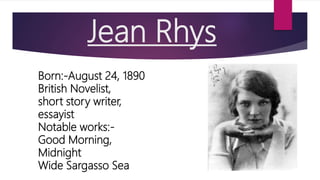
Jean Rhys
Born:-August 24, 1890
British Novelist,
short story writer,
essayist
Notable works:-
Good Morning,
Midnight
Wide Sargasso Sea
 Her early stories and novels reflect her lifestyle.
 Married three times
 She never adjusted to the Move from the west India to
Pakistan.
 She had always a felling of displacement that we find in her
characters.
 In her novels she offers physchoanalytic readings. Though it’s
exploration Of Of the unconscious.
 Died:-May 14, 1979
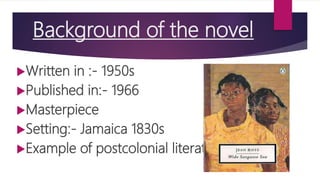
Background of the novel
Written in :- 1950s
Published in:- 1966
Masterpiece
Setting:- Jamaica 1830s
Example of postcolonial literature
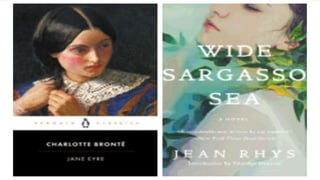
 Imagines the early life of Bertha Mason from Charlotte Brontë’s Jane Eyre.
 Time when Women are beginning to demand a ‘voice’.
 Position of women, black people and other groups were discussed.
 Ideas of freedom- post-war europia.
 Issues surrounding colonialism/slavery.
 Response to Jane Eyre – a “ prequel”
Characters
 Antoinette (protogonist)
 Mr. Mason (first husband of Annette)
 Annette ( mother of Antoinette)
 Aunt Cora ( A rich widow)
 Pierre (Antoinette’s younger brother)
 Amelie (A maid at Granbois)
 Tia(Antoinette’s only childhood friend)
 Richard Mason (son of Mr. Mason and stepbrother of Antoinette)
 Christophine(Antoinette’s nurse)
The plot
 The plot Antoinette was a creole, daughter of ex-slave owners. She lived on a
plantation called Coulibri Estate with her mother and her sickly brother.
 The family’s finances went in ruins after the passage of the Emancipation Act of
1833.
 Throughout Antoinette’s childhood there is hostility between white aristocracy
and the impoverished black servants.
 When Antoinette was 17, her stepfather arranged her marriage with Mr
Rochester.
 He begins to have misgivings about the marriage: he knows little of his new wife
and he agreed to the marriage because he was desperate for money, In add,
Rochester receives a menacing letter that warns of the madness that’s deep-
rooted in Antoinette’s family.
 After reading this, the relationship between them deteriorates. Antoinette
tries to regain her husband’s love but she fails.
 That makes Antoniette mad and violent.
 They moved to England where he locked her in a garret room in his house,
under the watch of a servant. Antoinette has no sense of time or place.
 She become mad because she was left alone and abandoned. She has a
recurring dream about going out from her prison to explore the house and it
ablaze.
 The novel ends with Antoinette walking down from her prison to act on her
dream.
Narrative technique
 Divided into three parts, each of which is written as if
in a different voice.
 Antoinette, Rochester and Grace Poole.
 Sometimes the different characters discuss a different
event in different ways – this makes the reader
question the reliability of the accounts.
 Stream of consciousness technique(represent
Rochester’s interior life in all its complexity and
ambivalence )
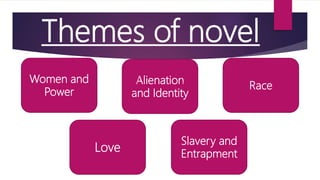
Alienation
and Identity
Race
Slavery and
Entrapment
Women and
Power
Love
Themes of novel
 Race:- Race is absolutely integral to the way that the
characters understand themselves and their place in society.
Some writers and scholars claim that Rhys’s Wide Sargasso
portrays black characters as flat stereotypes – child-like,
primitive, animalistic.
 Alination and Identity:-The consequences of alienation
become both increasingly isolating as well as increasingly
as the novel progresses. The tensions at the start of the
are between groups, “us” vs. “them.”
 Slavery and Entrapment:-Freedom can mean abandonment or
isolation, the fear of which leads many to enter complacently and
sometimes even willingly into their own imprisonment.
 Women and Power:-The female characters in Wide Sargasso Sea
must confront societal forces that prevent them from acting
fimprisonmentor and sustaining themselves, regardless of race or
class.
 Love:-For Rochester, neither Antoinette nor Amélie are worthy of
romantic love because of their racial status; instead, they are
objects to be owned and enjoyed sexually.
wide_sargasso_sea_by_jean_rhys

wide_sargasso_sea_by_jean_rhys

  • 1.
    Wide Sargasso Sea -JeanRhys PREPARED BY:- SNEHA AGRAVAT SEM : 3 DATE:- 5/9/2021 DEPARTMENT OF ENGLISH (MKBU)
  • 2.
    Jean Rhys Born:-August 24,1890 British Novelist, short story writer, essayist Notable works:- Good Morning, Midnight Wide Sargasso Sea
  • 3.
     Her earlystories and novels reflect her lifestyle.  Married three times  She never adjusted to the Move from the west India to Pakistan.  She had always a felling of displacement that we find in her characters.  In her novels she offers physchoanalytic readings. Though it’s exploration Of Of the unconscious.  Died:-May 14, 1979
  • 5.
    Background of thenovel Written in :- 1950s Published in:- 1966 Masterpiece Setting:- Jamaica 1830s Example of postcolonial literature
  • 6.
     Imagines theearly life of Bertha Mason from Charlotte Brontë’s Jane Eyre.  Time when Women are beginning to demand a ‘voice’.  Position of women, black people and other groups were discussed.  Ideas of freedom- post-war europia.  Issues surrounding colonialism/slavery.  Response to Jane Eyre – a “ prequel”
  • 7.
    Characters  Antoinette (protogonist) Mr. Mason (first husband of Annette)  Annette ( mother of Antoinette)  Aunt Cora ( A rich widow)  Pierre (Antoinette’s younger brother)  Amelie (A maid at Granbois)  Tia(Antoinette’s only childhood friend)  Richard Mason (son of Mr. Mason and stepbrother of Antoinette)  Christophine(Antoinette’s nurse)
  • 8.
    The plot  Theplot Antoinette was a creole, daughter of ex-slave owners. She lived on a plantation called Coulibri Estate with her mother and her sickly brother.  The family’s finances went in ruins after the passage of the Emancipation Act of 1833.  Throughout Antoinette’s childhood there is hostility between white aristocracy and the impoverished black servants.  When Antoinette was 17, her stepfather arranged her marriage with Mr Rochester.  He begins to have misgivings about the marriage: he knows little of his new wife and he agreed to the marriage because he was desperate for money, In add, Rochester receives a menacing letter that warns of the madness that’s deep- rooted in Antoinette’s family.
  • 9.
     After readingthis, the relationship between them deteriorates. Antoinette tries to regain her husband’s love but she fails.  That makes Antoniette mad and violent.  They moved to England where he locked her in a garret room in his house, under the watch of a servant. Antoinette has no sense of time or place.  She become mad because she was left alone and abandoned. She has a recurring dream about going out from her prison to explore the house and it ablaze.  The novel ends with Antoinette walking down from her prison to act on her dream.
  • 10.
    Narrative technique  Dividedinto three parts, each of which is written as if in a different voice.  Antoinette, Rochester and Grace Poole.  Sometimes the different characters discuss a different event in different ways – this makes the reader question the reliability of the accounts.  Stream of consciousness technique(represent Rochester’s interior life in all its complexity and ambivalence )
  • 11.
  • 12.
     Race:- Raceis absolutely integral to the way that the characters understand themselves and their place in society. Some writers and scholars claim that Rhys’s Wide Sargasso portrays black characters as flat stereotypes – child-like, primitive, animalistic.  Alination and Identity:-The consequences of alienation become both increasingly isolating as well as increasingly as the novel progresses. The tensions at the start of the are between groups, “us” vs. “them.”
  • 13.
     Slavery andEntrapment:-Freedom can mean abandonment or isolation, the fear of which leads many to enter complacently and sometimes even willingly into their own imprisonment.  Women and Power:-The female characters in Wide Sargasso Sea must confront societal forces that prevent them from acting fimprisonmentor and sustaining themselves, regardless of race or class.  Love:-For Rochester, neither Antoinette nor Amélie are worthy of romantic love because of their racial status; instead, they are objects to be owned and enjoyed sexually.