Persistent Storage for Linux Containers
Grant Della Vecchia
Senior Storage Solutions Architect, Red Hat
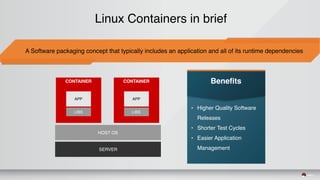
Linux Containers in brief
A Software packaging concept that typically includes an application and all of its runtime dependencies
• Higher Quality Software
Releases
• Shorter Test Cycles
• Easier Application
Management
HOST OS
SERVER
CONTAINER
LIBS
APP
CONTAINER
LIBS
APP
Benefits
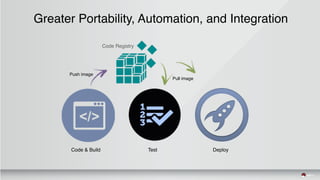
Greater Portability, Automation, and Integration
Code Registry
Push image
Code & Build Test Deploy
Pull image
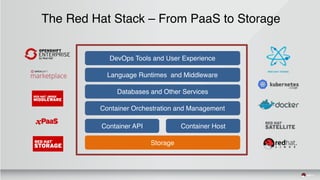
The Red Hat Stack – From PaaS to Storage
DevOps Tools and User Experience
Language Runtimes and Middleware
Databases and Other Services
Container Orchestration and Management
Container API
Storage
Container Host
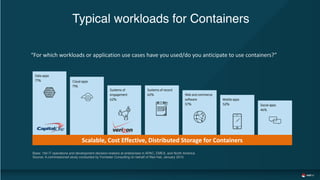
Typical workloads for Containers
Base: 194 IT operations and development decision-makers at enterprises in APAC, EMEA, and North America

Source: A commissioned study conducted by Forrester Consulting on behalf of Red Hat, January 2015
“For	which	workloads	or	application	use	cases	have	you	used/do	you	anticipate	to	use	containers?”
Scalable,	Cost	Effective,	Distributed	Storage	for	Containers
Why Containers require persistent Storage?
• Web & presentation layers should be stateless ... but ...
• That’s probably < 5% of all application instances in a DC
• Most other infrastructure applications / services require persistence
for storing application and configuration data
• Building a different infrastructure for stateful vs. stateless apps ?
• Modern IT requires Standardization (e.g. Cloud Computing)
• Software-defined DC is a hybrid cloud enabler
The requirements for Container Storage?
• Scalable – Scale out capacity & performance
• Resilient – Likely there will be important data
• Flexible – Allow different application access profiles
• Software-defined – To allow flexible deployment models
• Open – For customer choice and lowest TCO
RED HAT
STORAGE➔
Persistent Storage requires Redundancy
• Red Hat Storage includes important data redundancy features
• 2-way and 3-way replication
• Erasure Coding
• Geo-Replication
• Snapshots
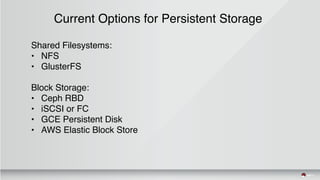
Current Options for Persistent Storage
Shared Filesystems:
• NFS
• GlusterFS
Block Storage:
• Ceph RBD
• iSCSI or FC
• GCE Persistent Disk
• AWS Elastic Block Store
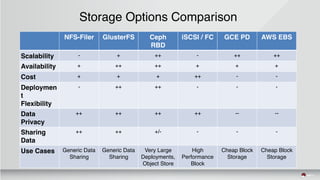
Storage Options Comparison
NFS-Filer GlusterFS Ceph
RBD
iSCSI / FC GCE PD AWS EBS
Scalability - + ++ - ++ ++
Availability + ++ ++ + + +
Cost + + + ++ - -
Deploymen
t
Flexibility
- ++ ++ - - -
Data
Privacy
++ ++ ++ ++ -- --
Sharing
Data
++ ++ +/- - - -
Use Cases Generic Data
Sharing
Generic Data
Sharing
Very Large
Deployments,
Object Store
High
Performance
Block
Cheap Block
Storage
Cheap Block
Storage
Configuration Examples
Node 1
NGINX
Container
Node 2
NGINX
Container
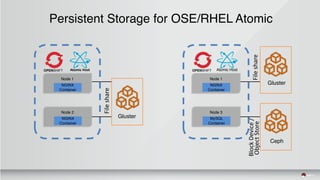
Persistent Storage for OSE/RHEL Atomic
Node 1
NGINX
Container
Node 3
MySQL
Container
File	share
File	share
	Block	Device	/		
Object	Store
Atomic	Host Atomic HostOPENSHIFTOPENSHIFT
Gluster
Ceph
Gluster
Host OS
Container Container
Host OS
Container Container
/share
(Gluster/NFS)
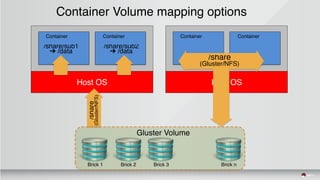
Container Volume mapping options
Gluster Volume
Brick 1 Brick 2 Brick 3 Brick n
/share
(Gluster/NFS)
/share/sub1
➔ /data
/share/sub2
➔ /data
Host OS
Container Container
Host OS
Container Container
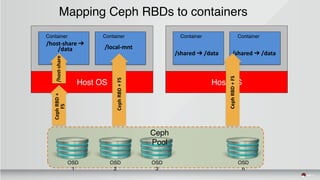
Mapping Ceph RBDs to containers
/shared	➔	/data
Ceph
Pool
OSD
1
OSD
2
OSD
3
OSD
n
Ceph	RBD	+	
FS
Ceph	RBD	+	FS
/host-share	➔	
/data /local-mnt
/shared	➔	/data
/host-share
Ceph	RBD	+	FS
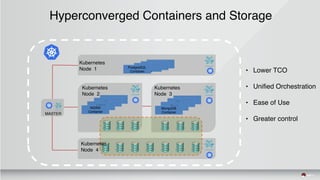
Hyperconverged Containers and Storage
• Lower TCO
• Unified Orchestration
• Ease of Use
• Greater control
Container
JBoss
NGINX
NGINX
Container
MASTER
Kubernetes
Node 2
Container
Elastic
Spark
MongoDB
Container
Kubernetes
Node 3
Redis
PostgreSQL
Container
Kubernetes
Node 1
Kubernetes
Node 4
App Container App Container App Container App Container
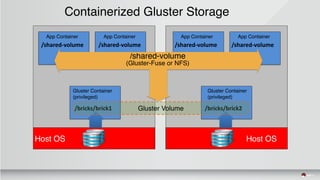
Containerized Gluster Storage
/shared-volume /shared-volume
Gluster Container
(privileged)
/bricks/brick2
Gluster Container
(privileged)
/bricks/brick1
/shared-volume
(Gluster-Fuse or NFS)
Host OS Host OS
Gluster Volume
/shared-volume /shared-volume
Container Container Container Container
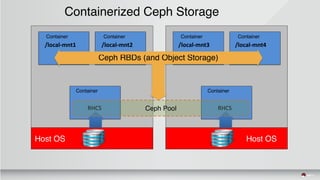
Containerized Ceph Storage
/local-mnt1
Container
RHCS
Container
RHCS
Ceph RBDs (and Object Storage)
Host OS Host OS
Ceph Pool
/local-mnt2 /local-mnt3 /local-mnt4
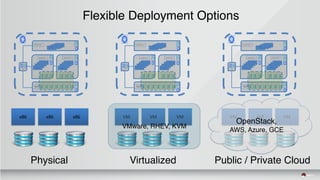
Flexible Deployment Options
x86 x86 x86
Physical
VM VM VM
Virtualized
VM VM VM
Public / Private Cloud
OpenStack,
AWS, Azure, GCE
VMware, RHEV, KVM
Container
JBoss
NGINX
NGINX Container
MASTER
Kubernetes Node 2
Container
Elastic
Spark
MongoDB Container
Kubernetes Node 3
Redis
PostgreSQL Container
Kubernetes Node 1
Kubernetes
Node 4
Container
JBoss
NGINX
NGINX Container
MASTER
Kubernetes Node 2
Container
Elastic
Spark
MongoDB Container
Kubernetes Node 3
Redis
PostgreSQL Container
Kubernetes Node 1
Kubernetes
Node 4
Container
JBoss
NGINX
NGINX Container
MASTER
Kubernetes Node 2
Container
Elastic
Spark
MongoDB Container
Kubernetes Node 3
Redis
PostgreSQL Container
Kubernetes Node 1
Kubernetes
Node 4
Customer		
Case	Studies
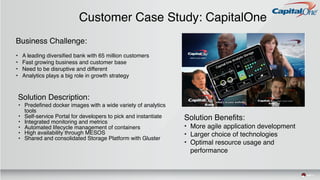
Customer Case Study: CapitalOne
Business Challenge:
• A leading diversified bank with 65 million customers
• Fast growing business and customer base
• Need to be disruptive and different
• Analytics plays a big role in growth strategy
Solution Description:
• Predefined docker images with a wide variety of analytics
tools
• Self-service Portal for developers to pick and instantiate
• Integrated monitoring and metrics
• Automated lifecycle management of containers
• High availability through MESOS
• Shared and consolidated Storage Platform with Gluster
Solution Benefits:
• More agile application development
• Larger choice of technologies
• Optimal resource usage and
performance
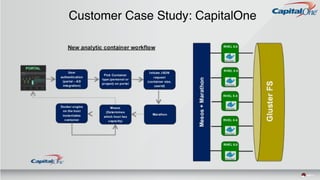
Customer Case Study: CapitalOne
Customer Case Study: Verizon
D
o
c
k
e
r	
c
o
n
t
a
i
n
e
r
s	
r
u
n
n
i
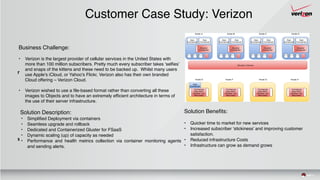
Business Challenge:
• Verizon is the largest provider of cellular services in the United States with
more than 100 million subscribers. Pretty much every subscriber takes ‘selfies’
and snaps of the kittens and these need to be backed up. Whilst many users
use Apple’s iCloud, or Yahoo’s Flickr, Verizon also has their own branded
Cloud offering – Verizon Cloud.
• Verizon wished to use a file-based format rather than converting all these
images to Objects and to have an extremely efficient architecture in terms of
the use of their server infrastructure.
Solution Description:
• Simplified Deployment via containers
• Seamless upgrade and rollback
• Dedicated and Containerized Gluster for FSaaS
• Dynamic scaling (up) of capacity as needed
• Performance and health metrics collection via container monitoring agents
and sending alerts.
Solution Benefits:
• Quicker time to market for new services
• Increased subscriber ‘stickiness’ and improving customer
satisfaction.
• Reduced infrastructure Costs
• Infrastructure can grow as demand grows
ETH/IB
app app app
app app app
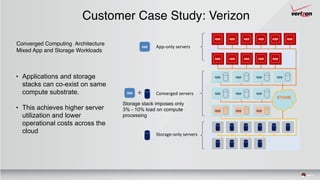
Converged Computing Architecture

Mixed App and Storage Workloads
App-only	servers
Converged	servers
app
app +
Storage-only	servers
app app app app
app app app app
app app app app
app app
app
Storage stack imposes only
3% - 10% load on compute
processing
• Applications and storage
stacks can co-exist on same
compute substrate.
• This achieves higher server
utilization and lower
operational costs across the
cloud
Customer Case Study: Verizon
Summary
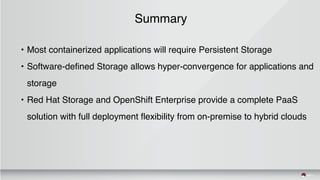
• Most containerized applications will require Persistent Storage
• Software-defined Storage allows hyper-convergence for applications and
storage
• Red Hat Storage and OpenShift Enterprise provide a complete PaaS
solution with full deployment flexibility from on-premise to hybrid clouds
Thank You

Red Hat Storage Day Atlanta - Persistent Storage for Linux Containers

  • 1.
    Persistent Storage forLinux Containers Grant Della Vecchia Senior Storage Solutions Architect, Red Hat
  • 2.
    Linux Containers inbrief A Software packaging concept that typically includes an application and all of its runtime dependencies • Higher Quality Software Releases • Shorter Test Cycles • Easier Application Management HOST OS SERVER CONTAINER LIBS APP CONTAINER LIBS APP Benefits
  • 3.
    Greater Portability, Automation,and Integration Code Registry Push image Code & Build Test Deploy Pull image
  • 4.
    The Red HatStack – From PaaS to Storage DevOps Tools and User Experience Language Runtimes and Middleware Databases and Other Services Container Orchestration and Management Container API Storage Container Host
  • 5.
    Typical workloads forContainers Base: 194 IT operations and development decision-makers at enterprises in APAC, EMEA, and North America
 Source: A commissioned study conducted by Forrester Consulting on behalf of Red Hat, January 2015 “For which workloads or application use cases have you used/do you anticipate to use containers?” Scalable, Cost Effective, Distributed Storage for Containers
  • 6.
    Why Containers requirepersistent Storage? • Web & presentation layers should be stateless ... but ... • That’s probably < 5% of all application instances in a DC • Most other infrastructure applications / services require persistence for storing application and configuration data • Building a different infrastructure for stateful vs. stateless apps ? • Modern IT requires Standardization (e.g. Cloud Computing) • Software-defined DC is a hybrid cloud enabler
  • 7.
    The requirements forContainer Storage? • Scalable – Scale out capacity & performance • Resilient – Likely there will be important data • Flexible – Allow different application access profiles • Software-defined – To allow flexible deployment models • Open – For customer choice and lowest TCO RED HAT STORAGE➔
  • 8.
    Persistent Storage requiresRedundancy • Red Hat Storage includes important data redundancy features • 2-way and 3-way replication • Erasure Coding • Geo-Replication • Snapshots
  • 9.
    Current Options forPersistent Storage Shared Filesystems: • NFS • GlusterFS Block Storage: • Ceph RBD • iSCSI or FC • GCE Persistent Disk • AWS Elastic Block Store
  • 10.
    Storage Options Comparison NFS-FilerGlusterFS Ceph RBD iSCSI / FC GCE PD AWS EBS Scalability - + ++ - ++ ++ Availability + ++ ++ + + + Cost + + + ++ - - Deploymen t Flexibility - ++ ++ - - - Data Privacy ++ ++ ++ ++ -- -- Sharing Data ++ ++ +/- - - - Use Cases Generic Data Sharing Generic Data Sharing Very Large Deployments, Object Store High Performance Block Cheap Block Storage Cheap Block Storage
  • 11.
  • 12.
    Node 1 NGINX Container Node 2 NGINX Container PersistentStorage for OSE/RHEL Atomic Node 1 NGINX Container Node 3 MySQL Container File share File share Block Device / Object Store Atomic Host Atomic HostOPENSHIFTOPENSHIFT Gluster Ceph Gluster
  • 13.
    Host OS Container Container HostOS Container Container /share (Gluster/NFS) Container Volume mapping options Gluster Volume Brick 1 Brick 2 Brick 3 Brick n /share (Gluster/NFS) /share/sub1 ➔ /data /share/sub2 ➔ /data
  • 14.
    Host OS Container Container HostOS Container Container Mapping Ceph RBDs to containers /shared ➔ /data Ceph Pool OSD 1 OSD 2 OSD 3 OSD n Ceph RBD + FS Ceph RBD + FS /host-share ➔ /data /local-mnt /shared ➔ /data /host-share Ceph RBD + FS
  • 15.
    Hyperconverged Containers andStorage • Lower TCO • Unified Orchestration • Ease of Use • Greater control Container JBoss NGINX NGINX Container MASTER Kubernetes Node 2 Container Elastic Spark MongoDB Container Kubernetes Node 3 Redis PostgreSQL Container Kubernetes Node 1 Kubernetes Node 4
  • 16.
    App Container AppContainer App Container App Container Containerized Gluster Storage /shared-volume /shared-volume Gluster Container (privileged) /bricks/brick2 Gluster Container (privileged) /bricks/brick1 /shared-volume (Gluster-Fuse or NFS) Host OS Host OS Gluster Volume /shared-volume /shared-volume
  • 17.
    Container Container ContainerContainer Containerized Ceph Storage /local-mnt1 Container RHCS Container RHCS Ceph RBDs (and Object Storage) Host OS Host OS Ceph Pool /local-mnt2 /local-mnt3 /local-mnt4
  • 18.
    Flexible Deployment Options x86x86 x86 Physical VM VM VM Virtualized VM VM VM Public / Private Cloud OpenStack, AWS, Azure, GCE VMware, RHEV, KVM Container JBoss NGINX NGINX Container MASTER Kubernetes Node 2 Container Elastic Spark MongoDB Container Kubernetes Node 3 Redis PostgreSQL Container Kubernetes Node 1 Kubernetes Node 4 Container JBoss NGINX NGINX Container MASTER Kubernetes Node 2 Container Elastic Spark MongoDB Container Kubernetes Node 3 Redis PostgreSQL Container Kubernetes Node 1 Kubernetes Node 4 Container JBoss NGINX NGINX Container MASTER Kubernetes Node 2 Container Elastic Spark MongoDB Container Kubernetes Node 3 Redis PostgreSQL Container Kubernetes Node 1 Kubernetes Node 4
  • 19.
  • 20.
    Customer Case Study:CapitalOne Business Challenge: • A leading diversified bank with 65 million customers • Fast growing business and customer base • Need to be disruptive and different • Analytics plays a big role in growth strategy Solution Description: • Predefined docker images with a wide variety of analytics tools • Self-service Portal for developers to pick and instantiate • Integrated monitoring and metrics • Automated lifecycle management of containers • High availability through MESOS • Shared and consolidated Storage Platform with Gluster Solution Benefits: • More agile application development • Larger choice of technologies • Optimal resource usage and performance
  • 21.
  • 22.
    Customer Case Study:Verizon D o c k e r c o n t a i n e r s r u n n i Business Challenge: • Verizon is the largest provider of cellular services in the United States with more than 100 million subscribers. Pretty much every subscriber takes ‘selfies’ and snaps of the kittens and these need to be backed up. Whilst many users use Apple’s iCloud, or Yahoo’s Flickr, Verizon also has their own branded Cloud offering – Verizon Cloud. • Verizon wished to use a file-based format rather than converting all these images to Objects and to have an extremely efficient architecture in terms of the use of their server infrastructure. Solution Description: • Simplified Deployment via containers • Seamless upgrade and rollback • Dedicated and Containerized Gluster for FSaaS • Dynamic scaling (up) of capacity as needed • Performance and health metrics collection via container monitoring agents and sending alerts. Solution Benefits: • Quicker time to market for new services • Increased subscriber ‘stickiness’ and improving customer satisfaction. • Reduced infrastructure Costs • Infrastructure can grow as demand grows
  • 23.
    ETH/IB app app app appapp app Converged Computing Architecture
 Mixed App and Storage Workloads App-only servers Converged servers app app + Storage-only servers app app app app app app app app app app app app app app app Storage stack imposes only 3% - 10% load on compute processing • Applications and storage stacks can co-exist on same compute substrate. • This achieves higher server utilization and lower operational costs across the cloud Customer Case Study: Verizon
  • 24.
    Summary • Most containerizedapplications will require Persistent Storage • Software-defined Storage allows hyper-convergence for applications and storage • Red Hat Storage and OpenShift Enterprise provide a complete PaaS solution with full deployment flexibility from on-premise to hybrid clouds
  • 25.