®

Why Product Management Matters
Presented by:

Steven Haines
President, Sequent Learning Networks
Founder, The Product Management Executive Board
Author, The Product Manager’s Desk Reference
Author, Managing Product Management
Author: The Product Manager’s Survival Guide
© Copyright Sequent Learning Networks
Sequent Learning Networks
Our mission:
To elevate the skills and capabilities of product managers
and marketers
To help executives improve the effectiveness of their PM
organizations

Our clients:
More than 10,000 alumni
100’s of organizational diagnostic projects
1000’s of product manager assessments
International clientele, multiple industries

Our People:
Steven Haines, founder and author
A team of former corporate leaders with the depth and
breadth of experience to guide organizations on their
Product Management journey

Contact:
+1.212.647.9100
sequentlearning.com

2

© Copyright Sequent Learning Networks

®
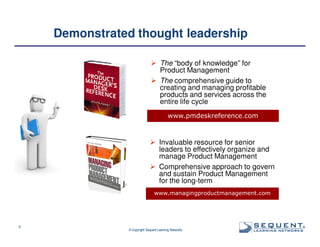
Demonstrated thought leadership
The “body of knowledge” for
Product Management
The comprehensive guide to
creating and managing profitable
products and services across the
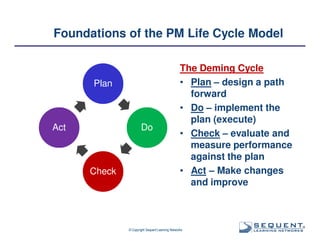
entire life cycle
www.pmdeskreference.com

Invaluable resource for senior
leaders to effectively organize and
manage Product Management
Comprehensive approach to govern
and sustain Product Management
for the long-term
www.managingproductmanagement.com

3

© Copyright Sequent Learning Networks

®
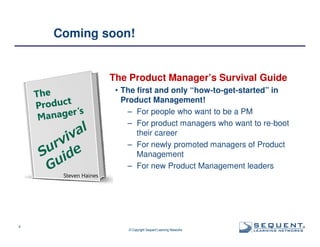
Coming soon!

The Product Manager’s Survival Guide
• The first and only “how-to-get-started” in
Product Management!
– For people who want to be a PM
– For product managers who want to re-boot
their career
– For newly promoted managers of Product
Management
– For new Product Management leaders
Steven Haines

4

© Copyright Sequent Learning Networks

®
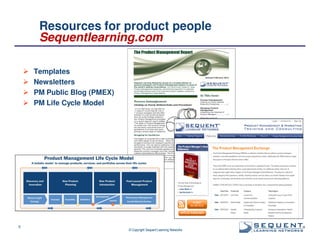
Resources for product people
Sequentlearning.com
Templates
Newsletters
PM Public Blog (PMEX)
PM Life Cycle Model

5

© Copyright Sequent Learning Networks

®
Main points for this program
• Share the Current State of Product Management
• Define the Role of Product Management in the Firm
• Portray the Main Players: The Product Managers and
the Cross-Functional Product Team
• Describe How Product Managers and Their Teams Do
What They Need to Do
• How to Leverage the Most Effective Reference Model
for Product Management
• Define What’s Needed from Executives
• Explain Why Product Management Matters

6

© Copyright Sequent Learning Networks

®
1
Product Management refers to
the business management
products

7

© Copyright Sequent Learning Networks

®
With such an easy
to understand
definition, what’s
the problem?

8

© Copyright Sequent Learning Networks

®
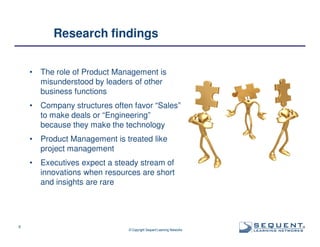
Research findings
•

•

Company structures often favor “Sales”
to make deals or “Engineering”
because they make the technology

•

Product Management is treated like
project management

•

9

The role of Product Management is
misunderstood by leaders of other
business functions

Executives expect a steady stream of
innovations when resources are short
and insights are rare

© Copyright Sequent Learning Networks

®
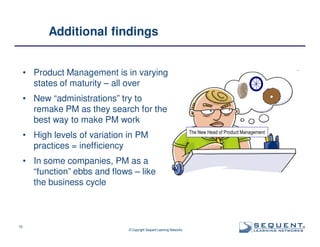
Additional findings

• Product Management is in varying
states of maturity – all over
• New “administrations” try to
remake PM as they search for the
best way to make PM work
• High levels of variation in PM
practices = inefficiency

The New Head of Product Management

• In some companies, PM as a
“function” ebbs and flows – like
the business cycle

10

© Copyright Sequent Learning Networks

®
2
It’s time to stop reinventing
the wheel!
Here’s how. . .
11

© Copyright Sequent Learning Networks

®
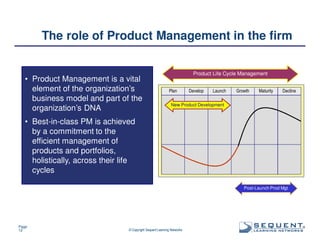
The role of Product Management in the firm

• Product Management is a vital
element of the organization’s
business model and part of the
organization’s DNA

Product Life Cycle Management
Plan

Develop

Launch

Growth

Maturity

Decline

New Product Development

• Best-in-class PM is achieved
by a commitment to the
efficient management of
products and portfolios,
holistically, across their life
cycles
Post-Launch Prod Mgt

Page
12

© Copyright Sequent Learning Networks

®
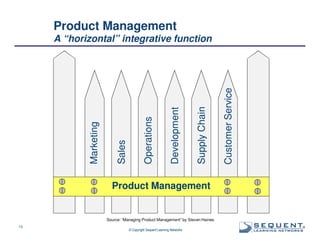
Product Management

Customer Service

Supply Chain

Development

Operations

Sales

Marketing

A “horizontal” integrative function

Product Management

Source: “Managing Product Management” by Steven Haines
13

© Copyright Sequent Learning Networks

®
3
The main players?

Page
14

© Copyright Sequent Learning Networks

®
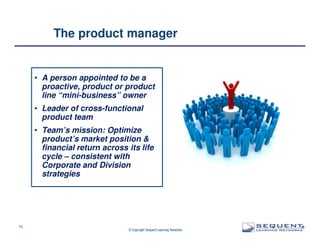
The product manager

• A person appointed to be a
proactive, product or product
line “mini-business” owner
• Leader of cross-functional
product team
• Team’s mission: Optimize
product’s market position &
financial return across its life
cycle – consistent with
Corporate and Division
strategies

15

© Copyright Sequent Learning Networks

®
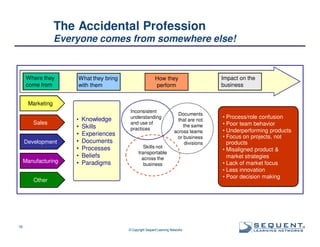
The Accidental Profession
Everyone comes from somewhere else!

Where they
come from

What they bring
with them

How they
perform

Impact on the
business

Marketing
Sales
Development
Manufacturing

• Knowledge

•
•
•
•
•
•

Skills
Experiences
Documents
Processes
Beliefs
Paradigms

Inconsistent
understanding
and use of
practices

Skills not
transportable
across the
business

Documents
that are not
the same
across teams
or business
divisions

Other

16

© Copyright Sequent Learning Networks

• Process/role confusion
• Poor team behavior
• Underperforming products
• Focus on projects, not
products
• Misaligned product &
market strategies
• Lack of market focus
• Less innovation
• Poor decision making

®
4
If PMs are supposed to play such a
leadership role, and they’re all
different, why is that so, and what
can we do about it?

17

© Copyright Sequent Learning Networks

®
5
We have to understand how product
managers learn their jobs.

18

© Copyright Sequent Learning Networks

®
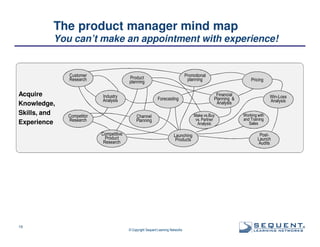
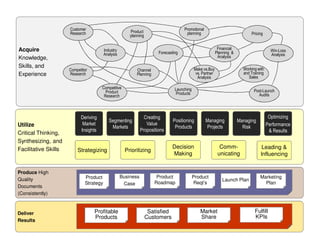
The product manager mind map
You can’t make an appointment with experience!

Customer
Research

Acquire
Knowledge,
Skills, and
Experience

Industry
Analysis
Competitor
Research

Forecasting

Pricing
Financial
Planning &
Analysis

Make vs.Buy
vs. Partner
Analysis

Channel
Planning
Competitive
Product
Research

19

Promotional
planning

Product
planning

Launching
Products

© Copyright Sequent Learning Networks

Win-Loss
Analysis
Working with
and Training
Sales

PostLaunch
Audits

®
6
We need to examine how product
managers assimilate to produce
positive business outcomes.

20

© Copyright Sequent Learning Networks

®
Customer
Research

Acquire
Knowledge,
Skills, and
Experience

Promotional
planning

Product
planning
Industry
Analysis

Produce High
Quality
Documents
(Consistently)

Deliver
Results

Product
Strategy

Profitable
Products

Working with
and Training
Sales

Launching
Products

Segmenting
Markets

Strategizing

Win-Loss
Analysis

Make vs.Buy
vs. Partner
Analysis

Channel
Planning
Competitive
Product
Research

Utilize
Critical Thinking,
Synthesizing, and
Facilitative Skills

Financial
Planning &
Analysis

Forecasting

Competitor
Research

Deriving
Market
Insights

Pricing

Creating
Value
Propositions

Positioning
Products

Managing
Projects

Decision
Making

Prioritizing

Business
Case

Post-Launch
Audits

Product
Roadmap

Satisfied
Customers
© Copyright Sequent Learning Networks

Managing
Risk

Communicating

Product
Reqt’s

Market
Share

Launch Plan

Optimizing
Performance
& Results

Leading &
Influencing

Marketing
Plan

Fulfill
KPIs
What it takes
•
•
•
•
•
•
•
•
•
•

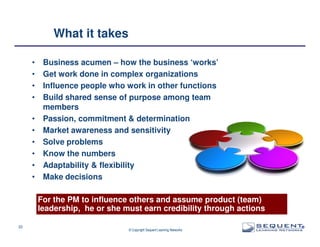
Business acumen – how the business ‘works’
Get work done in complex organizations
Influence people who work in other functions
Build shared sense of purpose among team
members
Passion, commitment & determination
Market awareness and sensitivity
Solve problems
Know the numbers
Adaptability & flexibility
Make decisions
For the PM to influence others and assume product (team)
leadership, he or she must earn credibility through actions

22

© Copyright Sequent Learning Networks

®
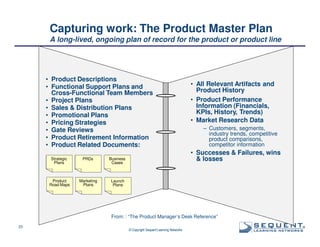
Capturing work: The Product Master Plan
A long-lived, ongoing plan of record for the product or product line

• Product Descriptions
• Functional Support Plans and
Cross-Functional Team Members
• Project Plans
• Sales & Distribution Plans
• Promotional Plans
• Pricing Strategies
• Gate Reviews
• Product Retirement Information
• Product Related Documents:
Strategic
Plans

PRDs

Marketing
Plans

– Customers, segments,
industry trends, competitive
product comparisons,
competitor information

• Successes & Failures, wins
& losses

Business
Cases

Product
Road Maps

• All Relevant Artifacts and
Product History
• Product Performance
Information (Financials,
KPIs, History, Trends)
• Market Research Data

Launch
Plans

From: : “The Product Manager’s Desk Reference”
23

© Copyright Sequent Learning Networks

®
7
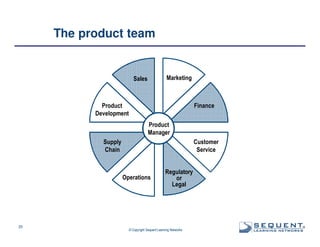
Product managers need to integrate,
leverage, and synchronize… they
cannot do it on their own.

24

© Copyright Sequent Learning Networks

®
The product team

Marketing

Sales

Product
Development

Finance
Product
Manager

Supply
Chain

Customer
Service

Operations

25

Regulatory
or
Legal

© Copyright Sequent Learning Networks

®
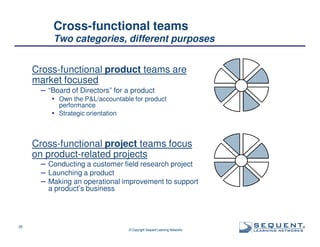
Cross-functional teams
Two categories, different purposes
Cross-functional product teams are
market focused
– “Board of Directors” for a product
• Own the P&L/accountable for product
performance
• Strategic orientation

Cross-functional project teams focus
on product-related projects
– Conducting a customer field research project
– Launching a product
– Making an operational improvement to support
a product’s business

26

© Copyright Sequent Learning Networks

®
27

© Copyright Sequent Learning Networks

®
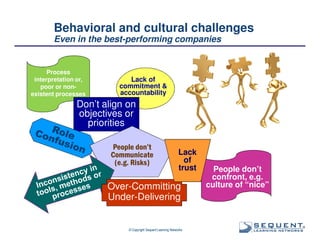
Behavioral and cultural challenges
Even in the best-performing companies

Process
interpretation or,
poor or nonexistent processes

Lack of
commitment &
accountability

Don’t align on
objectives or
priorities
People don’t
Communicate
(e.g. Risks)

Lack
of
trust

Over-Committing
Under-Delivering

© Copyright Sequent Learning Networks

People don’t
confront, e.g.
culture of “nice”

®
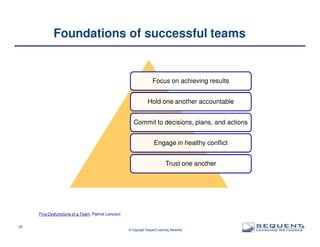
Foundations of successful teams

Focus on achieving results
Hold one another accountable
Commit to decisions, plans, and actions
Engage in healthy conflict
Trust one another

Five Dysfunctions of a Team, Patrick Lencioni
29

© Copyright Sequent Learning Networks

®
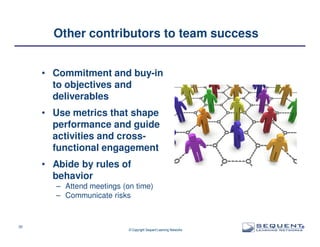
Other contributors to team success
• Commitment and buy-in
to objectives and
deliverables
• Use metrics that shape
performance and guide
activities and crossfunctional engagement
• Abide by rules of
behavior
– Attend meetings (on time)
– Communicate risks

30

© Copyright Sequent Learning Networks

®
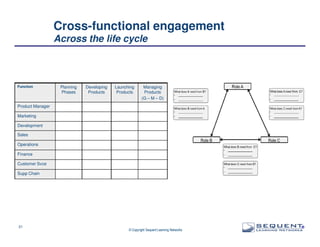
Cross-functional engagement
Across the life cycle

Function

Planning
Phases

Developing
Products

Launching
Products

Managing
Products
(G – M – D)

Product Manager
Marketing
Development
Sales
Operations
Finance
Customer Svce
Supp Chain

31

© Copyright Sequent Learning Networks

®
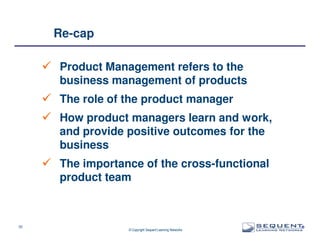
Re-cap
Product Management refers to the
business management of products
The role of the product manager
How product managers learn and work,
and provide positive outcomes for the
business
The importance of the cross-functional
product team

32

© Copyright Sequent Learning Networks

®
8
Product managers depend on
proven business practices and a
usable, relevant reference model.

33

© Copyright Sequent Learning Networks

®
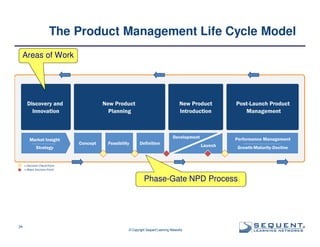
The Product Management Life Cycle Model
Areas of Work

Phase-Gate NPD Process

34

© Copyright Sequent Learning Networks

®
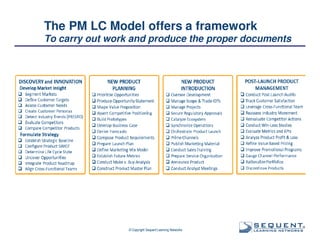
The PM LC Model offers a framework
To carry out work and produce the proper documents

© Copyright Sequent Learning Networks

®
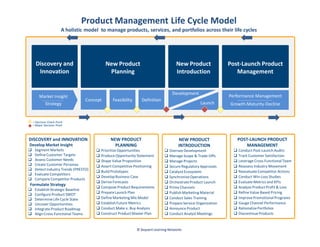
Product Management Life Cycle Model
A holistic model to manage products, services, and portfolios across their life cycles

Discovery and
Innovation

Market Insight
Strategy

New Product
Planning

New Product
Introduction

Development
Concept

Feasibility

Definition

Post-Launch Product
Management

Performance Management
Growth-Maturity-Decline

= Decision Check Point
= Major Decision Point

DISCOVERY and INNOVATION
Develop Market Insight
Segment Markets
Define Customer Targets
Assess Customer Needs
Create Customer Personas
Detect Industry Trends (PRESTO)
Evaluate Competitors
Compare Competitor Products

Formulate Strategy
Establish Strategic Baseline
Configure Product SWOT
Determine Life Cycle State
Uncover Opportunities
Integrate Product Roadmap
Align Cross-Functional Teams

NEW PRODUCT
PLANNING
Prioritize Opportunities
Produce Opportunity Statement
Shape Value Proposition
Assert Competitive Positioning
Build Prototypes
Develop Business Case
Derive Forecasts
Compose Product Requirements
Prepare Launch Plan
Define Marketing Mix Model
Establish Future Metrics
Conduct Make v. Buy Analysis
Construct Product Master Plan

NEW PRODUCT
INTRODUCTION
Oversee Development
Manage Scope & Trade-Offs
Manage Projects
Secure Regulatory Approvals
Catalyze Ecosystem
Synchronize Operations
Orchestrate Product Launch
Prime Channels
Publish Marketing Material
Conduct Sales Training
Prepare Service Organization
Announce Product
Conduct Analyst Meetings

© Sequent Learning Networks

POST-LAUNCH PRODUCT
MANAGEMENT
Conduct Post-Launch Audits
Track Customer Satisfaction
Leverage Cross-Functional Team
Reassess Industry Movement
Reevaluate Competitor Actions
Conduct Win-Loss Studies
Evaluate Metrics and KPIs
Analyze Product Profit & Loss
Refine Value Based Pricing
Improve Promotional Programs
Gauge Channel Performance
Rationalize Portfolios
Discontinue Products
Get the model!

sequentlearning.com/pm-model.php

37

© Copyright Sequent Learning Networks

®
Foundations of the PM Life Cycle Model

Plan

Act

Do

Check

The Deming Cycle
• Plan – design a path
forward
• Do – implement the
plan (execute)
• Check – evaluate and
measure performance
against the plan
• Act – Make changes
and improve

© Copyright Sequent Learning Networks

®
Important points from Deming
•
•

Encourage collaborative
communication so that employees
work in the organization’s interest

•

Break down internal barriers –
department’s in an organization are
“internal Clients” to each other and
must work together

•

39

Commitment to continuous
improvement to reduce variation

Everyone is responsible for continual
improvement in quality and
productivity – particularly top
management

© Copyright Sequent Learning Networks

®
9
How the model is used.

40

© Copyright Sequent Learning Networks

®
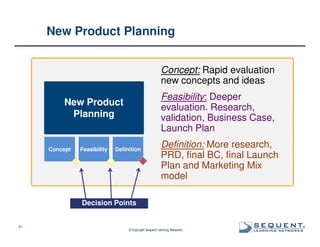
New Product Planning
Concept: Rapid evaluation
new concepts and ideas
Feasibility: Deeper
evaluation. Research,
validation, Business Case,
Launch Plan

New Product
Planning

Concept

Feasibility

Definition

Definition: More research,
PRD, final BC, final Launch
Plan and Marketing Mix
model

Decision Points

41

© Copyright Sequent Learning Networks

®
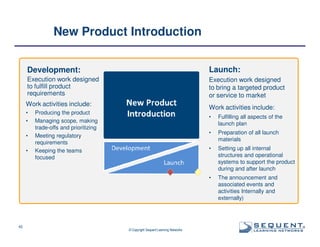
New Product Introduction
Development:

Launch:

Execution work designed
to fulfill product
requirements

Execution work designed
to bring a targeted product
or service to market

Work activities include:
•
•

Work activities include:

Producing the product
Managing scope, making
trade-offs and prioritizing
Meeting regulatory
requirements
Keeping the teams
focused

•

42

•

Preparation of all launch
materials

•

© Copyright Sequent Learning Networks

Fulfilling all aspects of the
launch plan

Setting up all internal
structures and operational
systems to support the product
during and after launch

•

•

•

The announcement and
associated events and
activities Internally and
externally)

®
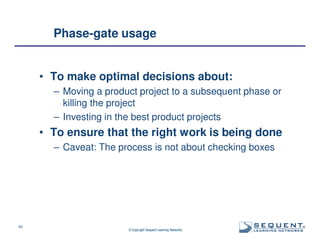
Phase-gate usage

• To make optimal decisions about:
– Moving a product project to a subsequent phase or
killing the project
– Investing in the best product projects

• To ensure that the right work is being done
– Caveat: The process is not about checking boxes

43

© Copyright Sequent Learning Networks

®
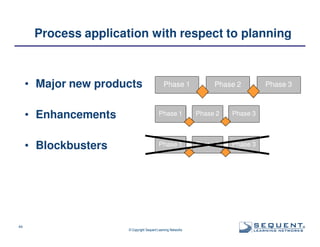
Process application with respect to planning

• Major new products

Phase 1

Phase 2

• Enhancements

Phase 2

Phase 3

• Blockbusters

44

Phase 1

Phase 1

Phase 2

Phase 3

Phase 3

© Copyright Sequent Learning Networks

®
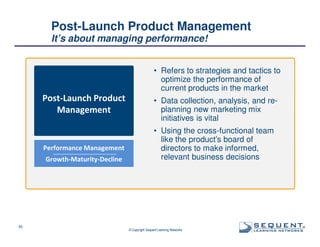
Post-Launch Product Management
It’s about managing performance!
• Refers to strategies and tactics to
optimize the performance of
current products in the market

Post-Launch Product
Management

Performance Management
Growth-Maturity-Decline

45

• Data collection, analysis, and replanning new marketing mix
initiatives is vital
• Using the cross-functional team
like the product’s board of
directors to make informed,
relevant business decisions

© Copyright Sequent Learning Networks

®
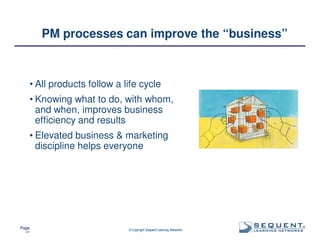
PM processes can improve the “business”

• All products follow a life cycle
• Knowing what to do, with whom,
and when, improves business
efficiency and results
• Elevated business & marketing
discipline helps everyone

Page
46

© Copyright Sequent Learning Networks

®
10
PMs need committed, aligned
executives to properly govern
(guide) Product Management as a
business function.

47

© Copyright Sequent Learning Networks

®
Imperatives for organizational success
1. Executives must be aligned around the function and
purpose of Product Management

2. A Chief Product Officer should be appointed and
should have a seat at the table

3. A product portfolio council should serve as the single
source of reconciliation of all product, platform, and
portfolio investments

4. A Product Management governance board should be
established to guide key processes and programs to
enable the success of Product Management – and
product managers

5. The PM governance board should enable “continuous
improvement” of Product Management
48

© Copyright Sequent Learning Networks

®
Why Product Management Matters
•

It’s a function that, when properly
chartered, will add value to a firm
because if focuses on the product’s
business from a holistic
perspective
– No other function in a business can
properly and effectively fill this role

•

Product Management can transform
an organization into a highly
performing, market focused
enterprise
– Its efforts create a unified view of
markets to conquer
– It minimizes functional agendas that
may not act in the best interest of the
collective organization

49

© Copyright Sequent Learning Networks

®
Thank you!
Steven Haines
Sequent Learning Networks
www.sequentlearning.com

The Product Management Executive Board
www.productmanagementexecboard.com

+1 212.647.9100

50

© Copyright Sequent Learning Networks

®

Why Product Management Matters

  • 1.
    ® Why Product ManagementMatters Presented by: Steven Haines President, Sequent Learning Networks Founder, The Product Management Executive Board Author, The Product Manager’s Desk Reference Author, Managing Product Management Author: The Product Manager’s Survival Guide © Copyright Sequent Learning Networks
  • 2.
    Sequent Learning Networks Ourmission: To elevate the skills and capabilities of product managers and marketers To help executives improve the effectiveness of their PM organizations Our clients: More than 10,000 alumni 100’s of organizational diagnostic projects 1000’s of product manager assessments International clientele, multiple industries Our People: Steven Haines, founder and author A team of former corporate leaders with the depth and breadth of experience to guide organizations on their Product Management journey Contact: +1.212.647.9100 sequentlearning.com 2 © Copyright Sequent Learning Networks ®
  • 3.
    Demonstrated thought leadership The“body of knowledge” for Product Management The comprehensive guide to creating and managing profitable products and services across the entire life cycle www.pmdeskreference.com Invaluable resource for senior leaders to effectively organize and manage Product Management Comprehensive approach to govern and sustain Product Management for the long-term www.managingproductmanagement.com 3 © Copyright Sequent Learning Networks ®
  • 4.
    Coming soon! The ProductManager’s Survival Guide • The first and only “how-to-get-started” in Product Management! – For people who want to be a PM – For product managers who want to re-boot their career – For newly promoted managers of Product Management – For new Product Management leaders Steven Haines 4 © Copyright Sequent Learning Networks ®
  • 5.
    Resources for productpeople Sequentlearning.com Templates Newsletters PM Public Blog (PMEX) PM Life Cycle Model 5 © Copyright Sequent Learning Networks ®
  • 6.
    Main points forthis program • Share the Current State of Product Management • Define the Role of Product Management in the Firm • Portray the Main Players: The Product Managers and the Cross-Functional Product Team • Describe How Product Managers and Their Teams Do What They Need to Do • How to Leverage the Most Effective Reference Model for Product Management • Define What’s Needed from Executives • Explain Why Product Management Matters 6 © Copyright Sequent Learning Networks ®
  • 7.
    1 Product Management refersto the business management products 7 © Copyright Sequent Learning Networks ®
  • 8.
    With such aneasy to understand definition, what’s the problem? 8 © Copyright Sequent Learning Networks ®
  • 9.
    Research findings • • Company structuresoften favor “Sales” to make deals or “Engineering” because they make the technology • Product Management is treated like project management • 9 The role of Product Management is misunderstood by leaders of other business functions Executives expect a steady stream of innovations when resources are short and insights are rare © Copyright Sequent Learning Networks ®
  • 10.
    Additional findings • ProductManagement is in varying states of maturity – all over • New “administrations” try to remake PM as they search for the best way to make PM work • High levels of variation in PM practices = inefficiency The New Head of Product Management • In some companies, PM as a “function” ebbs and flows – like the business cycle 10 © Copyright Sequent Learning Networks ®
  • 11.
    2 It’s time tostop reinventing the wheel! Here’s how. . . 11 © Copyright Sequent Learning Networks ®
  • 12.
    The role ofProduct Management in the firm • Product Management is a vital element of the organization’s business model and part of the organization’s DNA Product Life Cycle Management Plan Develop Launch Growth Maturity Decline New Product Development • Best-in-class PM is achieved by a commitment to the efficient management of products and portfolios, holistically, across their life cycles Post-Launch Prod Mgt Page 12 © Copyright Sequent Learning Networks ®
  • 13.
    Product Management Customer Service SupplyChain Development Operations Sales Marketing A “horizontal” integrative function Product Management Source: “Managing Product Management” by Steven Haines 13 © Copyright Sequent Learning Networks ®
  • 14.
    3 The main players? Page 14 ©Copyright Sequent Learning Networks ®
  • 15.
    The product manager •A person appointed to be a proactive, product or product line “mini-business” owner • Leader of cross-functional product team • Team’s mission: Optimize product’s market position & financial return across its life cycle – consistent with Corporate and Division strategies 15 © Copyright Sequent Learning Networks ®
  • 16.
    The Accidental Profession Everyonecomes from somewhere else! Where they come from What they bring with them How they perform Impact on the business Marketing Sales Development Manufacturing • Knowledge • • • • • • Skills Experiences Documents Processes Beliefs Paradigms Inconsistent understanding and use of practices Skills not transportable across the business Documents that are not the same across teams or business divisions Other 16 © Copyright Sequent Learning Networks • Process/role confusion • Poor team behavior • Underperforming products • Focus on projects, not products • Misaligned product & market strategies • Lack of market focus • Less innovation • Poor decision making ®
  • 17.
    4 If PMs aresupposed to play such a leadership role, and they’re all different, why is that so, and what can we do about it? 17 © Copyright Sequent Learning Networks ®
  • 18.
    5 We have tounderstand how product managers learn their jobs. 18 © Copyright Sequent Learning Networks ®
  • 19.
    The product managermind map You can’t make an appointment with experience! Customer Research Acquire Knowledge, Skills, and Experience Industry Analysis Competitor Research Forecasting Pricing Financial Planning & Analysis Make vs.Buy vs. Partner Analysis Channel Planning Competitive Product Research 19 Promotional planning Product planning Launching Products © Copyright Sequent Learning Networks Win-Loss Analysis Working with and Training Sales PostLaunch Audits ®
  • 20.
    6 We need toexamine how product managers assimilate to produce positive business outcomes. 20 © Copyright Sequent Learning Networks ®
  • 21.
    Customer Research Acquire Knowledge, Skills, and Experience Promotional planning Product planning Industry Analysis Produce High Quality Documents (Consistently) Deliver Results Product Strategy Profitable Products Workingwith and Training Sales Launching Products Segmenting Markets Strategizing Win-Loss Analysis Make vs.Buy vs. Partner Analysis Channel Planning Competitive Product Research Utilize Critical Thinking, Synthesizing, and Facilitative Skills Financial Planning & Analysis Forecasting Competitor Research Deriving Market Insights Pricing Creating Value Propositions Positioning Products Managing Projects Decision Making Prioritizing Business Case Post-Launch Audits Product Roadmap Satisfied Customers © Copyright Sequent Learning Networks Managing Risk Communicating Product Reqt’s Market Share Launch Plan Optimizing Performance & Results Leading & Influencing Marketing Plan Fulfill KPIs
  • 22.
    What it takes • • • • • • • • • • Businessacumen – how the business ‘works’ Get work done in complex organizations Influence people who work in other functions Build shared sense of purpose among team members Passion, commitment & determination Market awareness and sensitivity Solve problems Know the numbers Adaptability & flexibility Make decisions For the PM to influence others and assume product (team) leadership, he or she must earn credibility through actions 22 © Copyright Sequent Learning Networks ®
  • 23.
    Capturing work: TheProduct Master Plan A long-lived, ongoing plan of record for the product or product line • Product Descriptions • Functional Support Plans and Cross-Functional Team Members • Project Plans • Sales & Distribution Plans • Promotional Plans • Pricing Strategies • Gate Reviews • Product Retirement Information • Product Related Documents: Strategic Plans PRDs Marketing Plans – Customers, segments, industry trends, competitive product comparisons, competitor information • Successes & Failures, wins & losses Business Cases Product Road Maps • All Relevant Artifacts and Product History • Product Performance Information (Financials, KPIs, History, Trends) • Market Research Data Launch Plans From: : “The Product Manager’s Desk Reference” 23 © Copyright Sequent Learning Networks ®
  • 24.
    7 Product managers needto integrate, leverage, and synchronize… they cannot do it on their own. 24 © Copyright Sequent Learning Networks ®
  • 25.
  • 26.
    Cross-functional teams Two categories,different purposes Cross-functional product teams are market focused – “Board of Directors” for a product • Own the P&L/accountable for product performance • Strategic orientation Cross-functional project teams focus on product-related projects – Conducting a customer field research project – Launching a product – Making an operational improvement to support a product’s business 26 © Copyright Sequent Learning Networks ®
  • 27.
    27 © Copyright SequentLearning Networks ®
  • 28.
    Behavioral and culturalchallenges Even in the best-performing companies Process interpretation or, poor or nonexistent processes Lack of commitment & accountability Don’t align on objectives or priorities People don’t Communicate (e.g. Risks) Lack of trust Over-Committing Under-Delivering © Copyright Sequent Learning Networks People don’t confront, e.g. culture of “nice” ®
  • 29.
    Foundations of successfulteams Focus on achieving results Hold one another accountable Commit to decisions, plans, and actions Engage in healthy conflict Trust one another Five Dysfunctions of a Team, Patrick Lencioni 29 © Copyright Sequent Learning Networks ®
  • 30.
    Other contributors toteam success • Commitment and buy-in to objectives and deliverables • Use metrics that shape performance and guide activities and crossfunctional engagement • Abide by rules of behavior – Attend meetings (on time) – Communicate risks 30 © Copyright Sequent Learning Networks ®
  • 31.
    Cross-functional engagement Across thelife cycle Function Planning Phases Developing Products Launching Products Managing Products (G – M – D) Product Manager Marketing Development Sales Operations Finance Customer Svce Supp Chain 31 © Copyright Sequent Learning Networks ®
  • 32.
    Re-cap Product Management refersto the business management of products The role of the product manager How product managers learn and work, and provide positive outcomes for the business The importance of the cross-functional product team 32 © Copyright Sequent Learning Networks ®
  • 33.
    8 Product managers dependon proven business practices and a usable, relevant reference model. 33 © Copyright Sequent Learning Networks ®
  • 34.
    The Product ManagementLife Cycle Model Areas of Work Phase-Gate NPD Process 34 © Copyright Sequent Learning Networks ®
  • 35.
    The PM LCModel offers a framework To carry out work and produce the proper documents © Copyright Sequent Learning Networks ®
  • 36.
    Product Management LifeCycle Model A holistic model to manage products, services, and portfolios across their life cycles Discovery and Innovation Market Insight Strategy New Product Planning New Product Introduction Development Concept Feasibility Definition Post-Launch Product Management Performance Management Growth-Maturity-Decline = Decision Check Point = Major Decision Point DISCOVERY and INNOVATION Develop Market Insight Segment Markets Define Customer Targets Assess Customer Needs Create Customer Personas Detect Industry Trends (PRESTO) Evaluate Competitors Compare Competitor Products Formulate Strategy Establish Strategic Baseline Configure Product SWOT Determine Life Cycle State Uncover Opportunities Integrate Product Roadmap Align Cross-Functional Teams NEW PRODUCT PLANNING Prioritize Opportunities Produce Opportunity Statement Shape Value Proposition Assert Competitive Positioning Build Prototypes Develop Business Case Derive Forecasts Compose Product Requirements Prepare Launch Plan Define Marketing Mix Model Establish Future Metrics Conduct Make v. Buy Analysis Construct Product Master Plan NEW PRODUCT INTRODUCTION Oversee Development Manage Scope & Trade-Offs Manage Projects Secure Regulatory Approvals Catalyze Ecosystem Synchronize Operations Orchestrate Product Launch Prime Channels Publish Marketing Material Conduct Sales Training Prepare Service Organization Announce Product Conduct Analyst Meetings © Sequent Learning Networks POST-LAUNCH PRODUCT MANAGEMENT Conduct Post-Launch Audits Track Customer Satisfaction Leverage Cross-Functional Team Reassess Industry Movement Reevaluate Competitor Actions Conduct Win-Loss Studies Evaluate Metrics and KPIs Analyze Product Profit & Loss Refine Value Based Pricing Improve Promotional Programs Gauge Channel Performance Rationalize Portfolios Discontinue Products
  • 37.
    Get the model! sequentlearning.com/pm-model.php 37 ©Copyright Sequent Learning Networks ®
  • 38.
    Foundations of thePM Life Cycle Model Plan Act Do Check The Deming Cycle • Plan – design a path forward • Do – implement the plan (execute) • Check – evaluate and measure performance against the plan • Act – Make changes and improve © Copyright Sequent Learning Networks ®
  • 39.
    Important points fromDeming • • Encourage collaborative communication so that employees work in the organization’s interest • Break down internal barriers – department’s in an organization are “internal Clients” to each other and must work together • 39 Commitment to continuous improvement to reduce variation Everyone is responsible for continual improvement in quality and productivity – particularly top management © Copyright Sequent Learning Networks ®
  • 40.
    9 How the modelis used. 40 © Copyright Sequent Learning Networks ®
  • 41.
    New Product Planning Concept:Rapid evaluation new concepts and ideas Feasibility: Deeper evaluation. Research, validation, Business Case, Launch Plan New Product Planning Concept Feasibility Definition Definition: More research, PRD, final BC, final Launch Plan and Marketing Mix model Decision Points 41 © Copyright Sequent Learning Networks ®
  • 42.
    New Product Introduction Development: Launch: Executionwork designed to fulfill product requirements Execution work designed to bring a targeted product or service to market Work activities include: • • Work activities include: Producing the product Managing scope, making trade-offs and prioritizing Meeting regulatory requirements Keeping the teams focused • 42 • Preparation of all launch materials • © Copyright Sequent Learning Networks Fulfilling all aspects of the launch plan Setting up all internal structures and operational systems to support the product during and after launch • • • The announcement and associated events and activities Internally and externally) ®
  • 43.
    Phase-gate usage • Tomake optimal decisions about: – Moving a product project to a subsequent phase or killing the project – Investing in the best product projects • To ensure that the right work is being done – Caveat: The process is not about checking boxes 43 © Copyright Sequent Learning Networks ®
  • 44.
    Process application withrespect to planning • Major new products Phase 1 Phase 2 • Enhancements Phase 2 Phase 3 • Blockbusters 44 Phase 1 Phase 1 Phase 2 Phase 3 Phase 3 © Copyright Sequent Learning Networks ®
  • 45.
    Post-Launch Product Management It’sabout managing performance! • Refers to strategies and tactics to optimize the performance of current products in the market Post-Launch Product Management Performance Management Growth-Maturity-Decline 45 • Data collection, analysis, and replanning new marketing mix initiatives is vital • Using the cross-functional team like the product’s board of directors to make informed, relevant business decisions © Copyright Sequent Learning Networks ®
  • 46.
    PM processes canimprove the “business” • All products follow a life cycle • Knowing what to do, with whom, and when, improves business efficiency and results • Elevated business & marketing discipline helps everyone Page 46 © Copyright Sequent Learning Networks ®
  • 47.
    10 PMs need committed,aligned executives to properly govern (guide) Product Management as a business function. 47 © Copyright Sequent Learning Networks ®
  • 48.
    Imperatives for organizationalsuccess 1. Executives must be aligned around the function and purpose of Product Management 2. A Chief Product Officer should be appointed and should have a seat at the table 3. A product portfolio council should serve as the single source of reconciliation of all product, platform, and portfolio investments 4. A Product Management governance board should be established to guide key processes and programs to enable the success of Product Management – and product managers 5. The PM governance board should enable “continuous improvement” of Product Management 48 © Copyright Sequent Learning Networks ®
  • 49.
    Why Product ManagementMatters • It’s a function that, when properly chartered, will add value to a firm because if focuses on the product’s business from a holistic perspective – No other function in a business can properly and effectively fill this role • Product Management can transform an organization into a highly performing, market focused enterprise – Its efforts create a unified view of markets to conquer – It minimizes functional agendas that may not act in the best interest of the collective organization 49 © Copyright Sequent Learning Networks ®
  • 50.
    Thank you! Steven Haines SequentLearning Networks www.sequentlearning.com The Product Management Executive Board www.productmanagementexecboard.com +1 212.647.9100 50 © Copyright Sequent Learning Networks ®