toy as verb
Why children play
topics
•   Why play             • What is toy
•   What is play         • Why do they make
•   What they play       • How do they make
•   How do they play
•   What do they play


        +Value   + Beauty +knowledge
word of Caution

Play and Toy are categories of adult mind.
We have divided everything in to various
      categories- work, play, learn.
          Art, science, language
                 etc etc etc
warning

   Reasoning short circuits comprehension.
So hold your firmly held opinion at bay and be
     open to reading with out judgments.

Allow understanding to take place rather than
                 forcing it.
What is a toy?
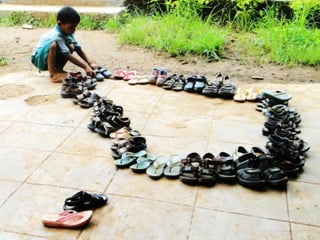
Exploring beauty?
                           Arrangement
                                  Order
                                 Colour

     Do not conclude, let insights happen
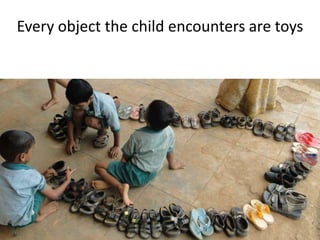
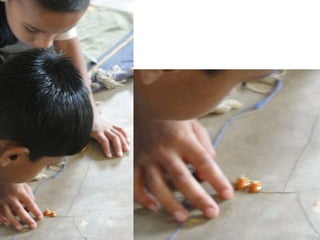
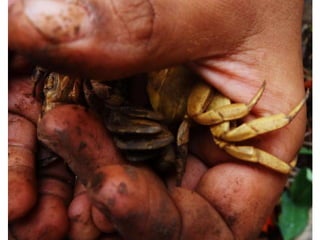
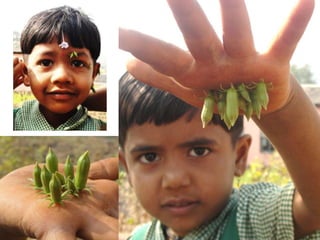
Every object the child encounters are toys
Nature as 'toy'
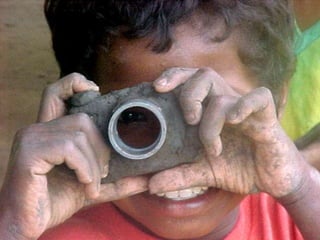
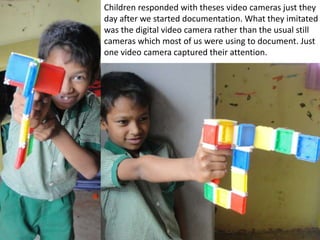
Children responded with theses video cameras just they
day after we started documentation. What they imitated
was the digital video camera rather than the usual still
cameras which most of us were using to document. Just
one video camera captured their attention.
It looks like
Children explore the way
       things look
         (form)
Body as 'toy'
There is no word for 'toy' in
       indigenous communities.
   Children in the process of making
sense of the world explores what ever
 it comes across. In this sense even
     the body is turned in to a toy.
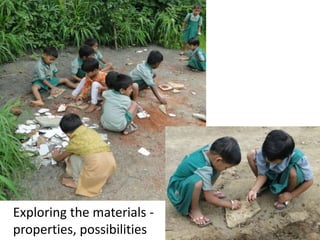
Exploring the materials -
properties, possibilities
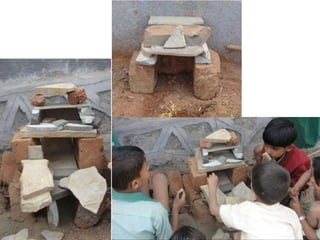
Children explore the external form,
 the internal structure (quality or
 what is possible) and the process
Child observes what the world is
  about, the way it looks, the way it
        sounds, feels, tastes….
The way things are connected, related.
 Child wants to understand how the
           world functions
        what possibilities exists

  the real world in which the adults
               inhabits
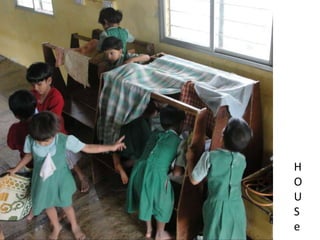
H
O
U
S
e
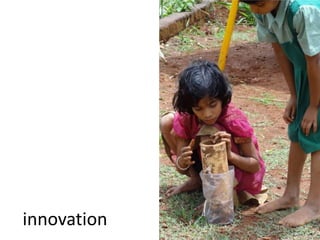
innovation
Children as sociologists- to learn to live in society
Children as lawers. Exploring the inherent value system
in the child
Children as artist. How children are exploring order
Children as scientist. How children explore the world.
Children as designers
Children as architects
Children and theatre - how children enact what they
experience
What children draw naturally. Connection between
their context, experience and drawing.
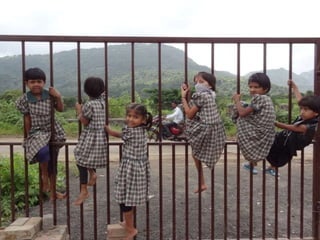
Play is a biologically rooted process to help
children to make sense of the place they live in
and to develop qualities to live. children
develop their physical, intellectual, emotional,
social, and moral capacities through play. They
practice physical and manual skills, intellectual
skills, and social skills.
Fear, resilience, endurance

In such play, children dose themselves with just the
level of fear that they can tolerate, a level just below
the threshold of what might cause them to freeze
up. In this way, they learn how to manage fear, how to
prevent it from incapacitating them. They learn that
fear is normal and healthy, something they can control
and overcome through their own efforts.
What is not play?
When a child feels coerced, the play spirit
vanishes and all of the advantages of that spirit
go with it.
Math games in school and adult-led sports are
not play for those who feel that they have to
participate and are not ready to accept, as their
own, the rules that the adults have established.
(peter Gray)
sensitivity


It is through social play that children learn, on
their own, with no lectures, how to meet their
own needs while, at the same time, satisfying
the needs of others. This is perhaps the most
important lesson that people in any society can
learn.
adults who have a great deal of freedom as to
how and when to do their work often
experience that work as play, even (in fact,
especially) when the work is difficult. In
contrast, people who must do just what others
tell them to do at work rarely experience their
work as play.
What is play?
types of play
There are two types
1.Internally motivated play
2. Externally motivated play
Internally motivated play is for the development
and growth of the physical body, the cognitive
apparatus and …….(the internal development)
Externally motivated play is to make sense of
the world but this also helps in internal
development
Internally motivated play
Some play emanate from bodies need to
develop and this do not need play mate.
Children would spontaneously swirl around,
children would close their eyes and walk etc
These are not externally motivated plays.
This happens more in younger age. In this sense
most actions of the new born till they are
around 3 is largly internally motivated.
Play can only happen when there is total freedom.
Autonomy of each participant is respected.
play always involves rules of some sort, but all players
must freely accept the rules, and if rules are changed
then all players must agree to the changes. That is
why play is the most democratic of all activities. In
social play (play involving more than one player), one
player may emerge for a period as the leader, but only
at the will of all the others. Every rule a leader
proposes must be approved, at least tacitly, by all of
the other players.
The freedom to quit provides the foundation for all of
the democratic processes that occur in social play.
What children play
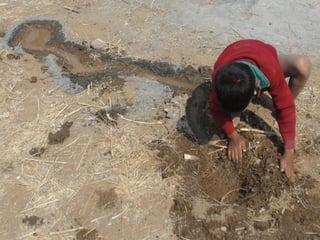
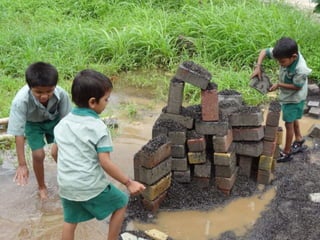
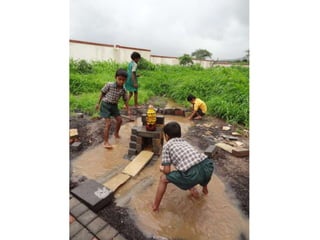
What ever phenomenon the child encounters is
made in to a play.
Every phenomenon has components, process
and relationship.
All this becomes aspects for children to explore
and play
What ever the child experiences are recreated, re
enacted and this becomes their play
Stages of play
Children play
   to enable phisical growth
     to awaken intellegence
        to awaken senses
 to learn to manipulate things
 to develop qualities for living-
observation, patience, attention,
       curiosity, creativity,
No gender division
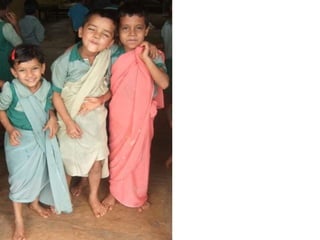
We are born with the qualities of male and female principle
and children till about 7 years have very integrated body.
In cultures where there is patriarchy as the gender division is
cultivated the bodies begin to look distinct.
But people in oral, sense literate cultures tend to have similar
bodies as they retain both the qualities.
The internal quality gets exhibited in external form.
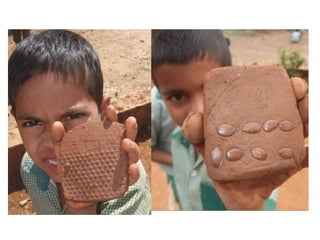
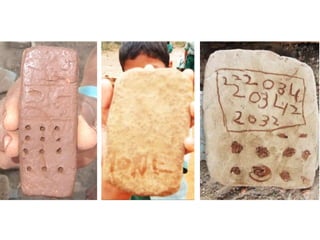
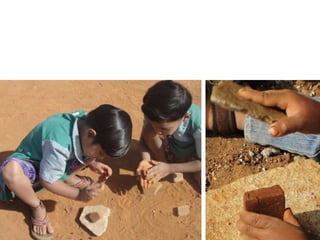
Children imitates, invents, pretends, repeats
          what ever they see around.
  Constantly revisiting the happenings around
them. Each time innovating and discovering new
                      things
Cooking/ kitchen
The world outside is an integrated, holistic
system and not fragmented and linear.
The childs attempt is to know the whole and its
inter relationship and the patterns with in.
The child lives a here and now situation
establishing a sot of completeness at every
moment.
Their way of knowing is by being. They live the
laws of science and imbibe it just the way they
learn to speak gramatically correct language.
Toy is an idea totally misunderstood
        by the modern adult.
 Children, in the process of making
 sense of the terrain in which they
  find themselves, observe, touch,
   smell, twist, break, taste, make.
Their actions are spontaneous but at
     the same time planing and
       abstracting is inherent.
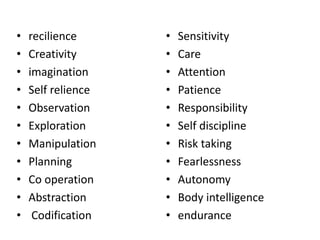
•   recilience      •   Sensitivity
•   Creativity      •   Care
•   imagination     •   Attention
•   Self relience   •   Patience
•   Observation     •   Responsibility
•   Exploration     •   Self discipline
•   Manipulation    •   Risk taking
•   Planning        •   Fearlessness
•   Co operation    •   Autonomy
•   Abstraction     •   Body intelligence
•    Codification   •   endurance
work as play
Why Children play


May be
To awaken their abilities to make sense of the world
To awaken the qualities to be in the world
To awaken the sensibilities to live in harmony
Children are usually very busy doing something or the
other
They don’t like to sit still
If they are alone either they are exploring whatever
they can put their hand on
Any objects becomes the toy to play with

What ever the child experiences is recreated, re
enacted and this becomes their play
Some times the object of their experience is recreated
Some times the objects are recreated as propes to
their play
After a bus ride or several bus rides
Bus or vehicle as an object is explored, this exploration
itself is play
Some times they are exploring only the formal aspect
Some times they are exploring the process or mechanisms
Some times the experience of riding in the bus is reenaced
This could be both dynamic as well as static
They could just use a chair, bench or any such object and
enact the sound of the bus or
Children just use their own body as bus/ car/ bike etc and
run around, go from city to city, stop for passengers to get
in and get out.
The bus is often very specific. They will tell you which bus
they are riding.
Observe a child sitting on a soft sofa.
Sitting?
No they don’t sit, they keep jumping on it as if
the to experience the softness and the spring
like quality.
But if the surface is hard they don’t jump.
Children are constantly responding aptly to
what ever situations they find themselves in.
A round pillar would make them run around but
a square may not
The way the world is
The form, the process and the connection or the
relation
Children are exploring what the world is about/
how does it look, how does it feel, how does it
function
Cultural diversity will be a thing of the past
soon.
Modernity with its mass schooling, adult
controlled play and mass manufactured toys
would homogenize and control people .
Why children play for upload

Why children play for upload

  • 1.
  • 3.
  • 4.
    topics • Why play • What is toy • What is play • Why do they make • What they play • How do they make • How do they play • What do they play +Value + Beauty +knowledge
  • 5.
    word of Caution Playand Toy are categories of adult mind. We have divided everything in to various categories- work, play, learn. Art, science, language etc etc etc
  • 6.
    warning Reasoning short circuits comprehension. So hold your firmly held opinion at bay and be open to reading with out judgments. Allow understanding to take place rather than forcing it.
  • 7.
  • 9.
    Exploring beauty? Arrangement Order Colour Do not conclude, let insights happen
  • 10.
    Every object thechild encounters are toys
  • 11.
  • 14.
    Children responded withtheses video cameras just they day after we started documentation. What they imitated was the digital video camera rather than the usual still cameras which most of us were using to document. Just one video camera captured their attention.
  • 15.
    It looks like Childrenexplore the way things look (form)
  • 16.
  • 17.
    There is noword for 'toy' in indigenous communities. Children in the process of making sense of the world explores what ever it comes across. In this sense even the body is turned in to a toy.
  • 18.
    Exploring the materials- properties, possibilities
  • 20.
    Children explore theexternal form, the internal structure (quality or what is possible) and the process
  • 21.
    Child observes whatthe world is about, the way it looks, the way it sounds, feels, tastes…. The way things are connected, related. Child wants to understand how the world functions what possibilities exists the real world in which the adults inhabits
  • 23.
  • 28.
  • 29.
    Children as sociologists-to learn to live in society Children as lawers. Exploring the inherent value system in the child Children as artist. How children are exploring order Children as scientist. How children explore the world. Children as designers Children as architects Children and theatre - how children enact what they experience What children draw naturally. Connection between their context, experience and drawing.
  • 30.
    Play is abiologically rooted process to help children to make sense of the place they live in and to develop qualities to live. children develop their physical, intellectual, emotional, social, and moral capacities through play. They practice physical and manual skills, intellectual skills, and social skills.
  • 31.
    Fear, resilience, endurance Insuch play, children dose themselves with just the level of fear that they can tolerate, a level just below the threshold of what might cause them to freeze up. In this way, they learn how to manage fear, how to prevent it from incapacitating them. They learn that fear is normal and healthy, something they can control and overcome through their own efforts.
  • 32.
    What is notplay? When a child feels coerced, the play spirit vanishes and all of the advantages of that spirit go with it. Math games in school and adult-led sports are not play for those who feel that they have to participate and are not ready to accept, as their own, the rules that the adults have established. (peter Gray)
  • 33.
    sensitivity It is throughsocial play that children learn, on their own, with no lectures, how to meet their own needs while, at the same time, satisfying the needs of others. This is perhaps the most important lesson that people in any society can learn.
  • 34.
    adults who havea great deal of freedom as to how and when to do their work often experience that work as play, even (in fact, especially) when the work is difficult. In contrast, people who must do just what others tell them to do at work rarely experience their work as play.
  • 35.
  • 36.
    types of play Thereare two types 1.Internally motivated play 2. Externally motivated play Internally motivated play is for the development and growth of the physical body, the cognitive apparatus and …….(the internal development) Externally motivated play is to make sense of the world but this also helps in internal development
  • 37.
    Internally motivated play Someplay emanate from bodies need to develop and this do not need play mate. Children would spontaneously swirl around, children would close their eyes and walk etc These are not externally motivated plays. This happens more in younger age. In this sense most actions of the new born till they are around 3 is largly internally motivated.
  • 38.
    Play can onlyhappen when there is total freedom. Autonomy of each participant is respected. play always involves rules of some sort, but all players must freely accept the rules, and if rules are changed then all players must agree to the changes. That is why play is the most democratic of all activities. In social play (play involving more than one player), one player may emerge for a period as the leader, but only at the will of all the others. Every rule a leader proposes must be approved, at least tacitly, by all of the other players. The freedom to quit provides the foundation for all of the democratic processes that occur in social play.
  • 39.
  • 40.
    What ever phenomenonthe child encounters is made in to a play. Every phenomenon has components, process and relationship. All this becomes aspects for children to explore and play
  • 41.
    What ever thechild experiences are recreated, re enacted and this becomes their play
  • 42.
  • 43.
    Children play to enable phisical growth to awaken intellegence to awaken senses to learn to manipulate things to develop qualities for living- observation, patience, attention, curiosity, creativity,
  • 44.
    No gender division Weare born with the qualities of male and female principle and children till about 7 years have very integrated body. In cultures where there is patriarchy as the gender division is cultivated the bodies begin to look distinct. But people in oral, sense literate cultures tend to have similar bodies as they retain both the qualities. The internal quality gets exhibited in external form.
  • 46.
    Children imitates, invents,pretends, repeats what ever they see around. Constantly revisiting the happenings around them. Each time innovating and discovering new things
  • 47.
  • 50.
    The world outsideis an integrated, holistic system and not fragmented and linear. The childs attempt is to know the whole and its inter relationship and the patterns with in. The child lives a here and now situation establishing a sot of completeness at every moment. Their way of knowing is by being. They live the laws of science and imbibe it just the way they learn to speak gramatically correct language.
  • 51.
    Toy is anidea totally misunderstood by the modern adult. Children, in the process of making sense of the terrain in which they find themselves, observe, touch, smell, twist, break, taste, make. Their actions are spontaneous but at the same time planing and abstracting is inherent.
  • 52.
    recilience • Sensitivity • Creativity • Care • imagination • Attention • Self relience • Patience • Observation • Responsibility • Exploration • Self discipline • Manipulation • Risk taking • Planning • Fearlessness • Co operation • Autonomy • Abstraction • Body intelligence • Codification • endurance
  • 53.
  • 54.
    Why Children play Maybe To awaken their abilities to make sense of the world To awaken the qualities to be in the world To awaken the sensibilities to live in harmony
  • 55.
    Children are usuallyvery busy doing something or the other They don’t like to sit still If they are alone either they are exploring whatever they can put their hand on Any objects becomes the toy to play with What ever the child experiences is recreated, re enacted and this becomes their play Some times the object of their experience is recreated Some times the objects are recreated as propes to their play
  • 56.
    After a busride or several bus rides Bus or vehicle as an object is explored, this exploration itself is play Some times they are exploring only the formal aspect Some times they are exploring the process or mechanisms Some times the experience of riding in the bus is reenaced This could be both dynamic as well as static They could just use a chair, bench or any such object and enact the sound of the bus or Children just use their own body as bus/ car/ bike etc and run around, go from city to city, stop for passengers to get in and get out. The bus is often very specific. They will tell you which bus they are riding.
  • 57.
    Observe a childsitting on a soft sofa. Sitting? No they don’t sit, they keep jumping on it as if the to experience the softness and the spring like quality. But if the surface is hard they don’t jump. Children are constantly responding aptly to what ever situations they find themselves in. A round pillar would make them run around but a square may not
  • 58.
    The way theworld is The form, the process and the connection or the relation Children are exploring what the world is about/ how does it look, how does it feel, how does it function
  • 59.
    Cultural diversity willbe a thing of the past soon. Modernity with its mass schooling, adult controlled play and mass manufactured toys would homogenize and control people .