Why are Proficiency Testing Programs useful?
Background Some perspectives from Australia
• Soil analyses are used in many agricultural systems to guide
fertiliser inputs
• Broad acre grains (wheat, barley, sorghum, maize)
• Sugarcane
• Dairy
Background Some perspectives from Australia
• Fertiliser inputs must be
o profitable for the farmer
o environmentally responsible
For example, to protect the water quality of the
Great Barrier Reef in tropical north Queensland,
government legislation requires fertiliser
application rates to be based on
- yield targets for nitrogen
- soil analyses for phosphorus and potassium
Background Some perspectives from Australia
• In the early 1990’s, a newspaper reported that when a
soil sample was sent to several labs for analysis,
different results were reported for the same soil test.
• This prompted ASPAC (Australasian Soil and Plant Analysis
Council) to set up an Inter-Laboratory Proficiency Program
(ILPP) for soil and plant analysis to benchmark and improve
cross-lab performance.
• The ILPP includes a certification scheme to allow labs to
demonstrate that they are providing results consistent with
other labs providing that analysis
What is a Proficiency Testing Program?
• Labs may have accreditation for following prescribed
QA/QC processes and procedures, but this does not
demonstrate that they would obtain a similar result as other
abs for a soil test
QA/QC accredited labs
(e.g., ISO/IEC 17025)
For example: Soil test A results
Proficiency certified labs
What is a Proficiency Testing Program?
The basic requirements for a Proficiency Testing Program are:
• Homogenised bulk soil samples are periodically distributed
to participating labs and analysed for a specified soil method
according to its Standard Operating Procedure.
• Lab results (anonymous) are reported to a central
technical panel responsible for undertaking statistical analyses
to calculate the median value and confidence intervals for the
soil test.
• Lab results are classified as ‘acceptable’, ‘straggler’ or
‘outlier’, and demerit points applied for any stragglers/outliers.
• The lab is certified if it produces soil test results that are
consistently within the confidence intervals for the soil test
median value.
What are the benefits of a Proficiency Testing
Program?
• Assists in maintaining/increasing your current level of
soil testing capacity.
• Increases your confidence to carry out standard soil test
methods.
• Provides a cost-effective quality assurance program to
participants.
• Indicates your current level of proficiency to existing and
prospective clients.
• Allows for continuous improvement in lab performance
by benchmarking and interaction with other labs
carrying out the same analyses.
Some observations from the ASPAC ILPP
• Approximately 60 labs participate: ≈40 Australia,
≈7 New Zealand, ≈10 south-east Asia and south Pacific
Most commonly reported soil methods are:
soil pH (1:5 water); soil EC (1:5 water); Walkley-Black
organic C; Colwell-P; Olsen-P; NH4OAc-extractable K;
DTPA-extractable Cu, Zn, Fe and Mn
• Each certification round comprises 3 dispatches of
4 soil samples each over a 12 month period
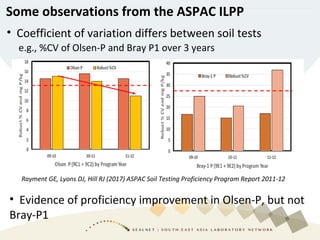
Rayment GE, Lyons DJ, Hill RJ (2017) ASPAC Soil Testing Proficiency Program Report 2011-12
Some observations from the ASPAC ILPP
• Coefficient of variation differs between soil tests
e.g., %CV of Olsen-P and Bray P1 over 3 years
• Evidence of proficiency improvement in Olsen-P, but not
Bray-P1
The way forward for SEALNET
• The ‘ASEAN Guidelines on Soil
and Nutrient Management’ identify the
importance of a regional lab proficiency
testing program
Now is the time to implement a lab proficiency
testing program!
Thank you for your attention…

Why are proficiency testing programs useful?

  • 1.
    Why are ProficiencyTesting Programs useful?
  • 2.
    Background Some perspectivesfrom Australia • Soil analyses are used in many agricultural systems to guide fertiliser inputs • Broad acre grains (wheat, barley, sorghum, maize) • Sugarcane • Dairy
  • 3.
    Background Some perspectivesfrom Australia • Fertiliser inputs must be o profitable for the farmer o environmentally responsible For example, to protect the water quality of the Great Barrier Reef in tropical north Queensland, government legislation requires fertiliser application rates to be based on - yield targets for nitrogen - soil analyses for phosphorus and potassium
  • 4.
    Background Some perspectivesfrom Australia • In the early 1990’s, a newspaper reported that when a soil sample was sent to several labs for analysis, different results were reported for the same soil test. • This prompted ASPAC (Australasian Soil and Plant Analysis Council) to set up an Inter-Laboratory Proficiency Program (ILPP) for soil and plant analysis to benchmark and improve cross-lab performance. • The ILPP includes a certification scheme to allow labs to demonstrate that they are providing results consistent with other labs providing that analysis
  • 5.
    What is aProficiency Testing Program? • Labs may have accreditation for following prescribed QA/QC processes and procedures, but this does not demonstrate that they would obtain a similar result as other abs for a soil test QA/QC accredited labs (e.g., ISO/IEC 17025) For example: Soil test A results Proficiency certified labs
  • 6.
    What is aProficiency Testing Program? The basic requirements for a Proficiency Testing Program are: • Homogenised bulk soil samples are periodically distributed to participating labs and analysed for a specified soil method according to its Standard Operating Procedure. • Lab results (anonymous) are reported to a central technical panel responsible for undertaking statistical analyses to calculate the median value and confidence intervals for the soil test. • Lab results are classified as ‘acceptable’, ‘straggler’ or ‘outlier’, and demerit points applied for any stragglers/outliers. • The lab is certified if it produces soil test results that are consistently within the confidence intervals for the soil test median value.
  • 7.
    What are thebenefits of a Proficiency Testing Program? • Assists in maintaining/increasing your current level of soil testing capacity. • Increases your confidence to carry out standard soil test methods. • Provides a cost-effective quality assurance program to participants. • Indicates your current level of proficiency to existing and prospective clients. • Allows for continuous improvement in lab performance by benchmarking and interaction with other labs carrying out the same analyses.
  • 8.
    Some observations fromthe ASPAC ILPP • Approximately 60 labs participate: ≈40 Australia, ≈7 New Zealand, ≈10 south-east Asia and south Pacific Most commonly reported soil methods are: soil pH (1:5 water); soil EC (1:5 water); Walkley-Black organic C; Colwell-P; Olsen-P; NH4OAc-extractable K; DTPA-extractable Cu, Zn, Fe and Mn • Each certification round comprises 3 dispatches of 4 soil samples each over a 12 month period
  • 9.
    Rayment GE, LyonsDJ, Hill RJ (2017) ASPAC Soil Testing Proficiency Program Report 2011-12 Some observations from the ASPAC ILPP • Coefficient of variation differs between soil tests e.g., %CV of Olsen-P and Bray P1 over 3 years • Evidence of proficiency improvement in Olsen-P, but not Bray-P1
  • 10.
    The way forwardfor SEALNET • The ‘ASEAN Guidelines on Soil and Nutrient Management’ identify the importance of a regional lab proficiency testing program Now is the time to implement a lab proficiency testing program!
  • 11.
    Thank you foryour attention…