Media Economics
Rupert Murdoch
• Australian
• 1953 RM inherited 2 newspapers.
• 1970s RM bought San Antonio Express-News & The New York
Post.Founded the Star (gossip tabloid).
• 1981 purchases the London Times.
• 1980s Buys 20th Century Fox film studios & multiple U.S.
television stations.
• Launches Fox network.
• Buys TV Guide to promote his network.
• Fox: The Simpsons, X-Files American Idol, House.
• 1990s Fox News, FX, Fox Business Channel.
• 2005 News Corp purchases Shine Group (distributor $580
million).
• 2008 MySpaceTV partnered with British ShineReveille
International (DVD distributor) for content. (Elisabeth Murdoch is
CEO of Shine Group).
• 2006 Dow Jones & Wall Street Journal purchased by News
Corp for $5.6 billion.
• 2011 hacking scandal, closes News of The World (UK paper).
• 2012 ethics scandal.
http://www.newscorp.com/
http://www.pbs.org/wgbh/pages/frontline/murdochs-scandal/
Structure of the Media
Industry
Three common economic structures of
the media industry:
• Monopoly
• Oligopoly
• Limited competition
Monopoly
• Single firm dominates production &
distribution or a particular industry.
• AT&T has a government approved monopoly for over 100 years, until
the 1980s.
• 2002 Microsoft accused of monopolistic practices for controlling more
than 80% of operating systems. Computers coming pre-loaded with
Microsoft OS & products.
• LOCAL or worldwide monopolies can occur.
Oligopoly
• Few firms dominate an industry.
• Book publishing & feature film industry
are oligopolies.
• 5 or 6 major companies that control the
production & distribution of the
majority of content.
• MUSIC: Warner Music, Sony, Universal, EMI
How does the media make
money?
• Direct payments (consumer buys
media product).
• Indirect payments (media product is
free to consumer, paid for by
advertising).
Economies of Scale Principle
• Increasing production should lead to
reduction of cost of product.
How Media Companies are
assessed
• Profit
• Production costs
• Price setting
• Market strategies
• Introduction of new technologies
• New products & services
• Traditional media
• New media
• Free market laissez faire
• Regulated market
Regulation & Deregulation
• Monopolists of the 1800s:
John D. Rockefeller (oil), Cornelius Vanderbilt (shipping &
railroads), & Andrew Carnegie (steel).
1890 US congress passed the Sherman Antitrust Act. Outlawing
monopolies that made it impossible for new businesses to enter
the market.
1914 Clayton Antitrust Act: prohibited manufacturers from selling
only to dealers & contractors who agreed to reject competitor’s
products.
Regulation & Deregulation
• 1950 Celler-Kefauver Act, limited
corporate mergers that affected
competition.
• FTC enforces regulation today.
• http://www.ftc.gov/
Deregulation
• Until 2008 financial crises, government
regulation was seen to encumber
business & the economy.
• Business owners celebrate “FREE”
market practices (anything goes
economics).
Deregulation
• President Jimmy Carter (1977-81)
initiated deregulation.
• Ronald Reagan (1981-89) deregulated
quite severely.
• Consequences of deregulaiton: 2009
Enron, 2005 fraud WorldCom &
Adelphia, 2008 financial crisis.
• BUT BIG PROFITS WERE MADE
Deregulation
• 1996 Telecommunications Act (Pres. Clinton) lifted most
restrictions on how many radio & TV stations one corporation
could own.
• CONSOLIDATION of radio & TV ownership.
• 7 powerful regional telephone companies allowed into TV &
radio.
• Cable operators gained the right to freely raise their rates &
compete in local telephone market.
• Result: price of expanded basic cable service jumped 122%
from 1995 to 2008 (three times the rate of inflation).
• Cost of monthly telephone landline increased by 20%.
Introduction of mobile phone offset landlines.
Comcast & AT&T try to corner all communications through
“bundling”. Internet, phone, mobile, satellite.
Deregulation Today
• 1995 FCC allowed Murdoch (Australian)
many US media outlets.
• WWI government feared foreign
ownership of media outlets to be
dangerous to national security. Only
20% of market could be owned by
foreign investment. Murdoch changed
citizenship in 2004 to avoid problems.
Deregulation Today
2007 FCC rules relaxed allowing cross-
ownership of newspaper & TV.
• Previously a company could not own a
newspaper & a broadcast outlet in the
same market.
Media Powerhouses
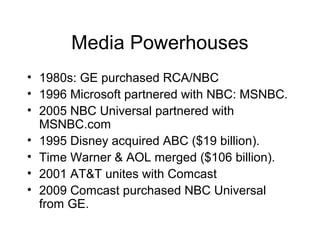
• 1980s: GE purchased RCA/NBC
• 1996 Microsoft partnered with NBC: MSNBC.
• 2005 NBC Universal partnered with
MSNBC.com
• 1995 Disney acquired ABC ($19 billion).
• Time Warner & AOL merged ($106 billion).
• 2001 AT&T unites with Comcast
• 2009 Comcast purchased NBC Universal
from GE.
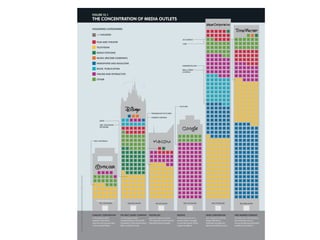
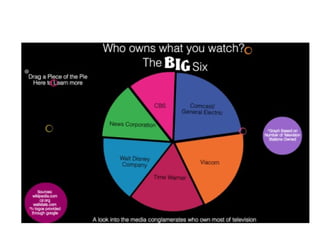
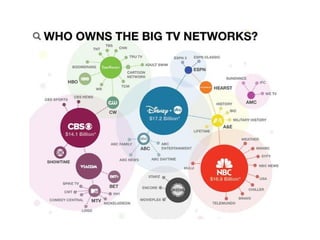
Media Powerhouses
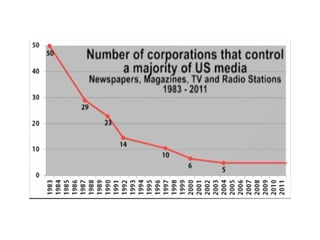
• http://www.freepress.net/ownership/chart
• http://www.businessinsider.com/these-6-corporations-control-90-of-the-media-in-america-
2012-6
• Shadows of Liberty:
• http://www.youtube.com/user/linktv
http://shadows.kcetlink.org/
Democracy Now on Shadows of Liberty
http://www.democracynow.org/2013/4/5/shadows_of_liberty_new_film_explores
http://shadowsofliberty.org/
Trends in Media Business
Practices
• “Flexibility” new, fleeting rather than
traditional.
• Individual consumer preferences
• Cheap labor
• Quick, high-volume sales
• Niche markets
Trends in Media Business
Practices
• 80-90% of new ventures fail.
• Dozens of films made 1 or 2 hits.
• Merchandising
• DVD
• Oversea sales
• Downloading digital product
Trends in Media Business
Practices
• “Globalized” workforce.
• Outsourcing
• US Labor Unions:
• 1955- 35% of workforce
• 1983- 20%
• 2008- 12% (Canada 30%)
Trends in Media Business
Practices
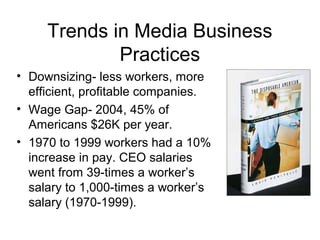
• Downsizing- less workers, more
efficient, profitable companies.
• Wage Gap- 2004, 45% of
Americans $26K per year.
• 1970 to 1999 workers had a 10%
increase in pay. CEO salaries
went from 39-times a worker’s
salary to 1,000-times a worker’s
salary (1970-1999).
Hegemony
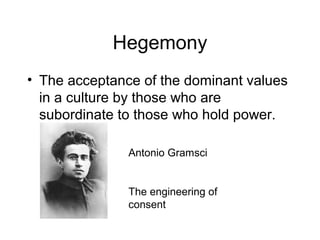
• The acceptance of the dominant values
in a culture by those who are
subordinate to those who hold power.
Antonio Gramsci
The engineering of
consent
Hegemony
• “If companies or politicians convinced
consumers and citizens that the
interests of the powerful were common
sense and therefore normal or natural,
they also created an atmosphere and
context in which there was less chance
of challenge of criticism.” Media & Culture, 2011.
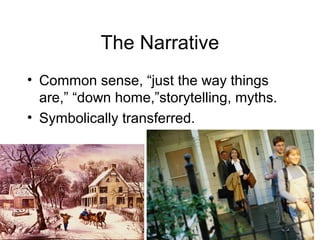
The Narrative
• Common sense, “just the way things
are,” “down home,”storytelling, myths.
• Symbolically transferred.
Hegemony
Television, film, music, magazines,
newspapers, & books reinforce
narratives.
Globalization
• 1947 GATT General Agreement on
Tariffs & Trade
• 1995 WTO World Trade Organization
NAFTA (1994) North American Free
Trade Agreement
• Low-wage jobs in countries with little or
no worker’s regulations.
Specialization
• Specialized, niche market media.
• BET
• Seventeen
• AARP
• A&E
• Cartoon Network
Synergy
• Promotion & sale of different versions of
a media product across the various
subsidiaries of a conglomerate.
• Time Warner HBO “making of” a
Warner Brothers movie, reviewed in
Time magazine.
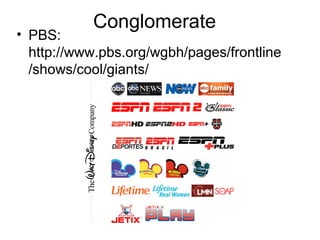
Conglomerate
• PBS:
http://www.pbs.org/wgbh/pages/frontline
/shows/cool/giants/
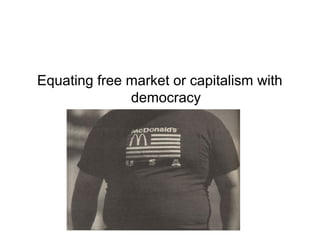
Equating free market or capitalism with
democracy
Consumer choice
&
Consumer control
Media literacy
Consumer literacy
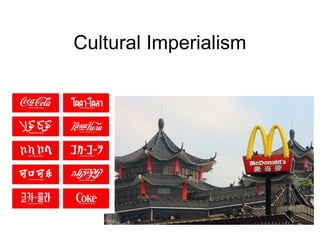
Cultural Imperialism
Media Consolidation &
Democracy
• NOW with Bill Moyers
• http://billmoyers.com/topics/media/
• www.Onthemedia.org

Media economics

  • 1.
  • 2.
    Rupert Murdoch • Australian •1953 RM inherited 2 newspapers. • 1970s RM bought San Antonio Express-News & The New York Post.Founded the Star (gossip tabloid). • 1981 purchases the London Times. • 1980s Buys 20th Century Fox film studios & multiple U.S. television stations. • Launches Fox network. • Buys TV Guide to promote his network. • Fox: The Simpsons, X-Files American Idol, House. • 1990s Fox News, FX, Fox Business Channel. • 2005 News Corp purchases Shine Group (distributor $580 million). • 2008 MySpaceTV partnered with British ShineReveille International (DVD distributor) for content. (Elisabeth Murdoch is CEO of Shine Group). • 2006 Dow Jones & Wall Street Journal purchased by News Corp for $5.6 billion. • 2011 hacking scandal, closes News of The World (UK paper). • 2012 ethics scandal. http://www.newscorp.com/ http://www.pbs.org/wgbh/pages/frontline/murdochs-scandal/
  • 3.
    Structure of theMedia Industry Three common economic structures of the media industry: • Monopoly • Oligopoly • Limited competition
  • 4.
    Monopoly • Single firmdominates production & distribution or a particular industry. • AT&T has a government approved monopoly for over 100 years, until the 1980s. • 2002 Microsoft accused of monopolistic practices for controlling more than 80% of operating systems. Computers coming pre-loaded with Microsoft OS & products. • LOCAL or worldwide monopolies can occur.
  • 5.
    Oligopoly • Few firmsdominate an industry. • Book publishing & feature film industry are oligopolies. • 5 or 6 major companies that control the production & distribution of the majority of content. • MUSIC: Warner Music, Sony, Universal, EMI
  • 6.
    How does themedia make money? • Direct payments (consumer buys media product). • Indirect payments (media product is free to consumer, paid for by advertising).
  • 7.
    Economies of ScalePrinciple • Increasing production should lead to reduction of cost of product.
  • 8.
    How Media Companiesare assessed • Profit • Production costs • Price setting • Market strategies • Introduction of new technologies • New products & services
  • 9.
  • 10.
    • Free marketlaissez faire • Regulated market
  • 11.
    Regulation & Deregulation •Monopolists of the 1800s: John D. Rockefeller (oil), Cornelius Vanderbilt (shipping & railroads), & Andrew Carnegie (steel). 1890 US congress passed the Sherman Antitrust Act. Outlawing monopolies that made it impossible for new businesses to enter the market. 1914 Clayton Antitrust Act: prohibited manufacturers from selling only to dealers & contractors who agreed to reject competitor’s products.
  • 12.
    Regulation & Deregulation •1950 Celler-Kefauver Act, limited corporate mergers that affected competition. • FTC enforces regulation today. • http://www.ftc.gov/
  • 13.
    Deregulation • Until 2008financial crises, government regulation was seen to encumber business & the economy. • Business owners celebrate “FREE” market practices (anything goes economics).
  • 14.
    Deregulation • President JimmyCarter (1977-81) initiated deregulation. • Ronald Reagan (1981-89) deregulated quite severely. • Consequences of deregulaiton: 2009 Enron, 2005 fraud WorldCom & Adelphia, 2008 financial crisis. • BUT BIG PROFITS WERE MADE
  • 15.
    Deregulation • 1996 TelecommunicationsAct (Pres. Clinton) lifted most restrictions on how many radio & TV stations one corporation could own. • CONSOLIDATION of radio & TV ownership. • 7 powerful regional telephone companies allowed into TV & radio. • Cable operators gained the right to freely raise their rates & compete in local telephone market. • Result: price of expanded basic cable service jumped 122% from 1995 to 2008 (three times the rate of inflation). • Cost of monthly telephone landline increased by 20%. Introduction of mobile phone offset landlines. Comcast & AT&T try to corner all communications through “bundling”. Internet, phone, mobile, satellite.
  • 16.
    Deregulation Today • 1995FCC allowed Murdoch (Australian) many US media outlets. • WWI government feared foreign ownership of media outlets to be dangerous to national security. Only 20% of market could be owned by foreign investment. Murdoch changed citizenship in 2004 to avoid problems.
  • 17.
    Deregulation Today 2007 FCCrules relaxed allowing cross- ownership of newspaper & TV. • Previously a company could not own a newspaper & a broadcast outlet in the same market.
  • 18.
    Media Powerhouses • 1980s:GE purchased RCA/NBC • 1996 Microsoft partnered with NBC: MSNBC. • 2005 NBC Universal partnered with MSNBC.com • 1995 Disney acquired ABC ($19 billion). • Time Warner & AOL merged ($106 billion). • 2001 AT&T unites with Comcast • 2009 Comcast purchased NBC Universal from GE.
  • 19.
    Media Powerhouses • http://www.freepress.net/ownership/chart •http://www.businessinsider.com/these-6-corporations-control-90-of-the-media-in-america- 2012-6 • Shadows of Liberty: • http://www.youtube.com/user/linktv http://shadows.kcetlink.org/ Democracy Now on Shadows of Liberty http://www.democracynow.org/2013/4/5/shadows_of_liberty_new_film_explores http://shadowsofliberty.org/
  • 24.
    Trends in MediaBusiness Practices • “Flexibility” new, fleeting rather than traditional. • Individual consumer preferences • Cheap labor • Quick, high-volume sales • Niche markets
  • 25.
    Trends in MediaBusiness Practices • 80-90% of new ventures fail. • Dozens of films made 1 or 2 hits. • Merchandising • DVD • Oversea sales • Downloading digital product
  • 26.
    Trends in MediaBusiness Practices • “Globalized” workforce. • Outsourcing • US Labor Unions: • 1955- 35% of workforce • 1983- 20% • 2008- 12% (Canada 30%)
  • 27.
    Trends in MediaBusiness Practices • Downsizing- less workers, more efficient, profitable companies. • Wage Gap- 2004, 45% of Americans $26K per year. • 1970 to 1999 workers had a 10% increase in pay. CEO salaries went from 39-times a worker’s salary to 1,000-times a worker’s salary (1970-1999).
  • 28.
    Hegemony • The acceptanceof the dominant values in a culture by those who are subordinate to those who hold power. Antonio Gramsci The engineering of consent
  • 29.
    Hegemony • “If companiesor politicians convinced consumers and citizens that the interests of the powerful were common sense and therefore normal or natural, they also created an atmosphere and context in which there was less chance of challenge of criticism.” Media & Culture, 2011.
  • 30.
    The Narrative • Commonsense, “just the way things are,” “down home,”storytelling, myths. • Symbolically transferred.
  • 31.
    Hegemony Television, film, music,magazines, newspapers, & books reinforce narratives.
  • 32.
    Globalization • 1947 GATTGeneral Agreement on Tariffs & Trade • 1995 WTO World Trade Organization NAFTA (1994) North American Free Trade Agreement • Low-wage jobs in countries with little or no worker’s regulations.
  • 33.
    Specialization • Specialized, nichemarket media. • BET • Seventeen • AARP • A&E • Cartoon Network
  • 34.
    Synergy • Promotion &sale of different versions of a media product across the various subsidiaries of a conglomerate. • Time Warner HBO “making of” a Warner Brothers movie, reviewed in Time magazine.
  • 35.
  • 36.
    Equating free marketor capitalism with democracy
  • 37.
    Consumer choice & Consumer control Medialiteracy Consumer literacy
  • 38.
  • 39.
    Media Consolidation & Democracy •NOW with Bill Moyers • http://billmoyers.com/topics/media/ • www.Onthemedia.org