WHO
PATIENT
SAFETY
PROGRAM
Discipline: Patient Safety
Teacher: Elena Ma’am
Prepared By:
Baliyan Asheesh
Pandey Ankit
Verma Shubham
Group No. 265
Contents
 Introduction
 Patient Safety
 The Burden Of Harm
 WHO Response
 WHO Initiatives
 Conclusion
 References
What Is Patient
Safety?
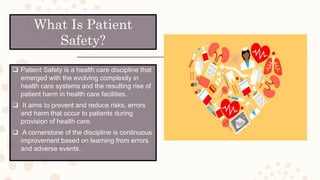
 Patient Safety is a health care discipline that
emerged with the evolving complexity in
health care systems and the resulting rise of
patient harm in health care facilities.
 It aims to prevent and reduce risks, errors
and harm that occur to patients during
provision of health care.
 A cornerstone of the discipline is continuous
improvement based on learning from errors
and adverse events.
Patient Safety
 Patient safety is fundamental to delivering quality essential health
services.
 In addition, to realize the benefits of quality health care, health services
must be timely, equitable, integrated and efficient.
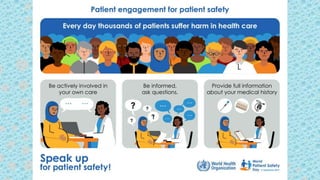
 To ensure successful implementation of patient safety strategies; clear
policies, leadership capacity, data to drive safety improvements, skilled
health care professionals and effective involvement of patients in their
care, are all needed.
The Burden Of Harm
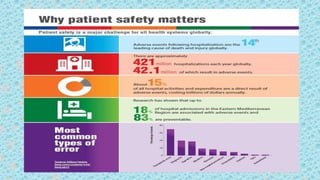
Every year, millions of patients suffer injuries or
die because of unsafe and poor-quality health
care.
Burden Of Harm
 Many medical practices and risks associated with health care are
emerging as major challenges for patient safety and contribute
significantly to the burden of harm due to unsafe care.
 The next few slides contain some of the patient safety situations causing
most concern.
Medication errors HCAI
 are a leading cause of injury and
avoidable harm in health care
systems:
Globally, the cost associated with
medication errors has been
estimated at US$ 42 billion annually
 occur in 7 and 10 out of every 100
hospitalized patients in high-
income countries and low- and
middle-income countries
respectively
Unsafe injections
practices
Diagnostic errors
 can transmit infections, including
HIV and hepatitis B and C, and
pose direct danger to patients and
health care workers;
 they account for a burden of harm
estimated at 9.2 million years of
life lost to disability and death
worldwide
 occur in about 5% of adults in
outpatient care settings, more
than half of which have the
potential to cause severe harm.
 Most people will suffer a
diagnostic error in their lifetime
Unsafe surgical care
procedures
Unsafe transfusion
practices
 cause complications in up to 25%
of patients.
 Almost 7 million surgical patients
suffer significant complications
annually, 1 million of whom die
during or immediately following
surgery
 expose patients to the risk of
adverse transfusion reactions and
the transmission of infections.
 Data on adverse transfusion
reactions from a group of 21
countries show an average
incidence of 8.7 serious reactions
per 100 000 distributed blood
components
Radiation errors Sepsis
 involve overexposure to radiation
and cases of wrong-patient and
wrong-site identification
 A review of 30 years of published
data on safety in radiotherapy
estimates that the overall
incidence of errors is around 15
per 10 000 treatment courses
 is frequently not diagnosed early
enough to save a patient’s life.
 Because these infections are
often resistant to antibiotics, they
can rapidly lead to deteriorating
clinical conditions, affecting an
estimated 31 million people
worldwide and causing over 5
million deaths per year
Recognizing that Patient Safety is a global health
priority, the World Health Assembly (WHA)
adopted a resolution on Patient Safety which
endorsed the establishment of World Patient
Safety Day to be observed annually by Member
States on 17 September.
WHO RESPONSE
WHO Response
1. Patient Safety as a global health priority
The purpose of World Patient Safety Day is to promote patient
safety by increasing public awareness and engagement,
enhancing global understanding and working towards global
solidarity and action.
WHO Response
1. World Patient Safety Day – Key Strategies
• providing global leadership and fostering collaboration between Member
States and relevant stakeholders
• setting global priorities for action
• developing guidelines and tools
WHO Response
1. World Patient Safety Day – Key Strategies
• providing technical support and building capacity of Member States
• engaging patients and families for safer health care
• monitoring improvements in patient safety
• conducting research in the area
• By focusing on these key areas to facilitate sustainable improvements in
patient safety, WHO aims to enhance patient experience, reduce risks
and harm, achieve better health outcomes and lower costs.
WHO Initiatives
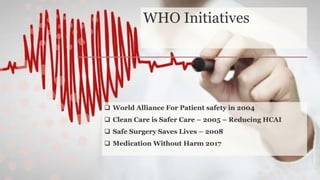
 World Alliance For Patient safety in 2004
 Clean Care is Safer Care – 2005 – Reducing HCAI
 Safe Surgery Saves Lives – 2008
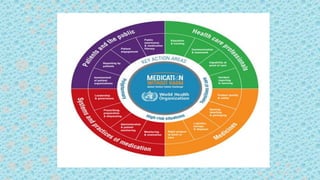
 Medication Without Harm 2017
Conclusion
• The occurrence of adverse events due to unsafe care is likely one of the 10
leading causes of death and disability in the world.
• In high-income countries, it is estimated that one in every 10 patients is harmed
while receiving hospital care. The harm can be caused by a range of adverse
events, with nearly 50% of them being preventable.
• Each year, 134 million adverse events occur in hospitals in low- and middle-
income countries (LMICs), due to unsafe care, resulting in 2.6 million deaths.
• Globally, as many as 4 in 10 patients are harmed in primary and outpatient
health care. Up to 80% of harm is preventable. The most detrimental errors are
related to diagnosis, prescription and the use of medicines
• An example of prevention is engaging patients, if done well, it can reduce the
burden of harm by up to 15%
References
 https://www.who.int/patientsafety/en/brochure_final.pdf
 https://www.euro.who.int/en/health-topics/Health-systems/patient-safety
 https://www.who.int/teams/integrated-health-services/patient-
safety/policy/global-patient-safety-action-plan
 https://www.who.int/teams/integrated-health-services/patient-safety
Thank You
Baliyan Asheesh Verma Shubham
Pandey Ankit

Who patient safety program

  • 1.
    WHO PATIENT SAFETY PROGRAM Discipline: Patient Safety Teacher:Elena Ma’am Prepared By: Baliyan Asheesh Pandey Ankit Verma Shubham Group No. 265
  • 2.
    Contents  Introduction  PatientSafety  The Burden Of Harm  WHO Response  WHO Initiatives  Conclusion  References
  • 3.
    What Is Patient Safety? Patient Safety is a health care discipline that emerged with the evolving complexity in health care systems and the resulting rise of patient harm in health care facilities.  It aims to prevent and reduce risks, errors and harm that occur to patients during provision of health care.  A cornerstone of the discipline is continuous improvement based on learning from errors and adverse events.
  • 4.
    Patient Safety  Patientsafety is fundamental to delivering quality essential health services.  In addition, to realize the benefits of quality health care, health services must be timely, equitable, integrated and efficient.  To ensure successful implementation of patient safety strategies; clear policies, leadership capacity, data to drive safety improvements, skilled health care professionals and effective involvement of patients in their care, are all needed.
  • 6.
    The Burden OfHarm Every year, millions of patients suffer injuries or die because of unsafe and poor-quality health care.
  • 7.
    Burden Of Harm Many medical practices and risks associated with health care are emerging as major challenges for patient safety and contribute significantly to the burden of harm due to unsafe care.  The next few slides contain some of the patient safety situations causing most concern.
  • 8.
    Medication errors HCAI are a leading cause of injury and avoidable harm in health care systems: Globally, the cost associated with medication errors has been estimated at US$ 42 billion annually  occur in 7 and 10 out of every 100 hospitalized patients in high- income countries and low- and middle-income countries respectively
  • 9.
    Unsafe injections practices Diagnostic errors can transmit infections, including HIV and hepatitis B and C, and pose direct danger to patients and health care workers;  they account for a burden of harm estimated at 9.2 million years of life lost to disability and death worldwide  occur in about 5% of adults in outpatient care settings, more than half of which have the potential to cause severe harm.  Most people will suffer a diagnostic error in their lifetime
  • 10.
    Unsafe surgical care procedures Unsafetransfusion practices  cause complications in up to 25% of patients.  Almost 7 million surgical patients suffer significant complications annually, 1 million of whom die during or immediately following surgery  expose patients to the risk of adverse transfusion reactions and the transmission of infections.  Data on adverse transfusion reactions from a group of 21 countries show an average incidence of 8.7 serious reactions per 100 000 distributed blood components
  • 11.
    Radiation errors Sepsis involve overexposure to radiation and cases of wrong-patient and wrong-site identification  A review of 30 years of published data on safety in radiotherapy estimates that the overall incidence of errors is around 15 per 10 000 treatment courses  is frequently not diagnosed early enough to save a patient’s life.  Because these infections are often resistant to antibiotics, they can rapidly lead to deteriorating clinical conditions, affecting an estimated 31 million people worldwide and causing over 5 million deaths per year
  • 13.
    Recognizing that PatientSafety is a global health priority, the World Health Assembly (WHA) adopted a resolution on Patient Safety which endorsed the establishment of World Patient Safety Day to be observed annually by Member States on 17 September. WHO RESPONSE
  • 14.
    WHO Response 1. PatientSafety as a global health priority The purpose of World Patient Safety Day is to promote patient safety by increasing public awareness and engagement, enhancing global understanding and working towards global solidarity and action.
  • 15.
    WHO Response 1. WorldPatient Safety Day – Key Strategies • providing global leadership and fostering collaboration between Member States and relevant stakeholders • setting global priorities for action • developing guidelines and tools
  • 16.
    WHO Response 1. WorldPatient Safety Day – Key Strategies • providing technical support and building capacity of Member States • engaging patients and families for safer health care • monitoring improvements in patient safety • conducting research in the area • By focusing on these key areas to facilitate sustainable improvements in patient safety, WHO aims to enhance patient experience, reduce risks and harm, achieve better health outcomes and lower costs.
  • 17.
    WHO Initiatives  WorldAlliance For Patient safety in 2004  Clean Care is Safer Care – 2005 – Reducing HCAI  Safe Surgery Saves Lives – 2008  Medication Without Harm 2017
  • 19.
    Conclusion • The occurrenceof adverse events due to unsafe care is likely one of the 10 leading causes of death and disability in the world. • In high-income countries, it is estimated that one in every 10 patients is harmed while receiving hospital care. The harm can be caused by a range of adverse events, with nearly 50% of them being preventable. • Each year, 134 million adverse events occur in hospitals in low- and middle- income countries (LMICs), due to unsafe care, resulting in 2.6 million deaths. • Globally, as many as 4 in 10 patients are harmed in primary and outpatient health care. Up to 80% of harm is preventable. The most detrimental errors are related to diagnosis, prescription and the use of medicines • An example of prevention is engaging patients, if done well, it can reduce the burden of harm by up to 15%
  • 20.
    References  https://www.who.int/patientsafety/en/brochure_final.pdf  https://www.euro.who.int/en/health-topics/Health-systems/patient-safety https://www.who.int/teams/integrated-health-services/patient- safety/policy/global-patient-safety-action-plan  https://www.who.int/teams/integrated-health-services/patient-safety
  • 21.
    Thank You Baliyan AsheeshVerma Shubham Pandey Ankit