1
Associating Waiting & Consultation time with Patient Satisfaction
HHCM MNWC (C) 2021 All Rights Reserved
Project
Report
BY: NAHEEDA KHAN
HOSPITAL AND HEALTHCARE MANAGEMENT
Associating Waiting & Consultation time with Patient SatisfactionHHCM
MNWC (C) 2021 All Rights Reserved
Executive Summary
Medical examination and treatment and community health improvements are a concern for the whole
society. Waiting time for a medical examination is an equally important fact, contributing to the level
of the consultation process.
Reducing waiting time and thereby meeting patient satisfaction is a developing trend in hospitals and
clinics today.
Long hospital wait times can be exacerbated by various factors such as patient flow, a bottleneck, and
overcrowding. In India overcrowding is a common problem in most of the healthcare sectors.
Overcrowding is not just caused by a large number of patients but also by a high number of patients with
serious illnesses and low numbers of nurses.
In order to provide better care for patients in addition to improving professionalquality, infrastructure
and service attitudes, the project is focused on waiting and consultation time for medical examination as a
contributing factor to patient satisfaction levels.
Association of Waiting and
Consultation Time with
Patient Satisfaction
Associating Waiting & Consultation time with Patient SatisfactionHHCM
MNWC (C) 2021 All Rights Reserved
Background
Many studies have shown an inverse relationship
between waiting time and patient satisfaction.
This has become a major concern for hospital
administrators and policymakers because it is a
measure of organizational efficiency.
Waiting times as well as
Consultation times a r e the main
factors that affect patient and consumer
satisfaction.
Patients are aware that they should wait to see a
doctor. However, there is no known acceptable
waiting or consultation time.
Patient waiting time for healthcare services is
identified by W.H.O as one of the key
measurements of a responsive health system.
Patient waiting time is amount of time for
patients seeking care at healthcare units before
being attended for consultation and treatment.
The United States (US) Instituteof Medicine’s
report “Crossing
the Quality Chasm” outlines a framework
of six guiding principles to staying ahead
in a more competitive healthcare delivery
system.
One of these principles is the ability to
provide timely care and to reduce harmful
delays.
Evidence shows that patients are less
likely to be dissatisfied if their waiting
time is within 30- 45 mins.
It is also stated that the dispensing of
medication from the time the pharmacy
receivedthe patient's prescription should
not exceed 30 minutes.
Association of Waiting and
Consulting Time with
Patient Satisfaction
Associating Waiting & Consultation time with Patient SatisfactionHHCM
MNWC (C) 2021 All Rights Reserved
Problem Statement
Dysfunctional healthcare systems can only add to the tension between patients and doctors. Simple
things like long waiting times in the hospitals, clinics, consecutive unjustified cancellations, or delays to
previous appointments or investigations; essentially, anything that may have gone wrong in the patient
pathway can potentially lead to a challenging interaction between patients anddoctors.
Lack of resources in terms of staffing levels or of maintaining patient privacy and dignity during
consultation is another contributing factor, for example, during a consultation there may be staff or
nurses moving in and out of the room that distract attention and may affect dignity and privacy.
The outpatient services often are the first point of contact with a hospital. It is an extremely busy area
as all the patients have to pass through this area. It is important that it should be well managed, as the
first impressions get shaped during this process.
Some of the major challenges in outpatient management are waiting time, communication employee
behavior for promoting service excellence, ambience for creating healing environment, and health
education. Each of this is looked at to get different perspectives on how to address it in a patient
friendly way.
Associating Waiting & Consultation time with Patient SatisfactionHHCM
MNWC (C) 2021 All Rights Reserved
Define
Lengthy waiting time has long been considered
frustrating to patients and thus appears to be a
consistent significant potential cause of patient
dissatisfaction. As health solutions become more
personalized and consumer driven, the need to
provide overall patient satisfaction is becoming
more important.
The outstanding waiting time problem
in the Indian Health Systems lies in
the following aspects:
1. Long waiting time at the
registration and admission
windows.
Many Indian hospitals and clinicsare not
used to schedule the appointment; patients
get registered upon arrival to hospitals at
the service window, thus the unplanned
patient flow clogged in the hospitals.
2. Long waiting time between the appointment
time and the time patients are attended by
doctors. Outpatient users of ambulatory
services are least satisfied with long waiting
times for consultations. Reason behind thisis
that the increasing of patient demand is faster
than that of the health care resources.
Although the number of hospitals in India
doubled during the past years, the annual
number of outpatient visitsincreased during
the same time period due to the pandemic
and other health crisis. The increasingpatient
turnover may have implications for overall
quality care, such as insufficiencies patient
safety and increased tension between doctors
and patients.
3. The tendency for patients to arrive earlier
than their given appointment, hence arriving
at the same time in large numbers. A study of
scheduled model found that patients who were
given an appointment time and arrived at the
appropriate time had shorter waiting time
than those who walked in without an
appointment.
4. Late arrival and early leave of physicians.
Associating Waiting & Consultation time with Patient SatisfactionHHCM
MNWC (C) 2021 All Rights Reserved
5. More patients and follow up patients.
6. Lack of registration staffs and on-duty
doctors in some specific departments.
A high percentage of patients still wait
unnecessarily for a long time to be registered
and to see the doctor.
Registration should be a quick and simple
process
The long waiting time is due to long queues
caused by the registration counter beingmanned
by less staff that is also in charge of giving
appointments to patients.
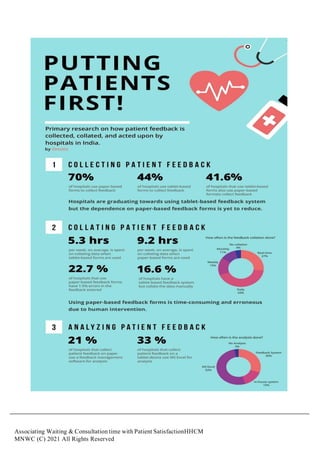
7. Despite living in a digital era, over 70%
of Indian hospitals still use paper based
forms to collect feedback from patients,
whereas merely 40% use digital media.
While 96% of hospitals are taking action
on feedback, most of them take almost
month to address patients’ concerns.
It takes ~2x more time to collate feedback
collected on paper than that collected ona
tablet device. This is the reason that 70% of
the hospitals that use paper forms to collect
feedback have a turnaround time of over 10
hours.
Associating Waiting & Consultation time with Patient SatisfactionHHCM
MNWC (C) 2021 All Rights Reserved
Associating Waiting & Consultation time with Patient SatisfactionHHCM
MNWC (C) 2021 All Rights Reserved
Aim and Objectives
 To identify the factors those are responsible for high waiting time in hospitals
 To recommend appropriate suggestions to optimize the waiting time in hospitals
Research Methodology
 This descriptive study was carried out at Maratha Mandir’s Babasaheb Gawde Charitable
Hospital, Ville Parle (E), Mumbai, Maharashtra, India. A structured questionnaire was used
to elicit information from 5 OPD supervisors and the Assistant. Medical Director of the
hospital.
 The research design will be used in this study on both ‘descriptive’ and‘exploratory’
 I have used primary data for this project.
Data Collection:
 Websites
 Articles
 E-books
 Questionnaire
 Google form and spreadsheet for accurate data analysis of the questionnaire survey
Associating Waiting & Consultation time with Patient SatisfactionHHCM
MNWC (C) 2021 All Rights Reserved
Introduction
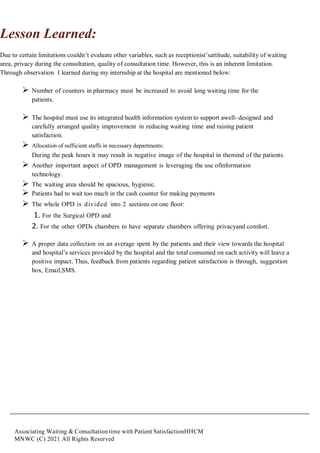
On 1st of November 2009, BGH started with 35 bedded Multispecialty Hospital. It was inaugurated by Dr. Mrs.
Snehalata Deshmukh the Former Vice Chancellor of Mumbai University.The Hospital is very well-equipped with
the latest & modern technology required, having ICU, NICU, Deluxe rooms, General ward & Maternity wards.
The timings of Babasaheb Gawde Hospital are: Mon-Sun: 00:00-23:59. (24x7)
General Surgeon (2)
Laparoscopic Surgeon (2)
Gynecologist/Obstetrician (1)
Orthopedist (1)
Services
 ICU
 NICU
 Dialysis
 Pharmacy
 Sonography, Mammography
 24 hrs Digital X-Ray & Portable X-Ray, ECG
 2D Echo Cardiography, 24 hrs Pathology including Blood Gas Analysis
 Holter monitoring, 24 hrs Ambulatory BP monitoring, Stress test
 EEG, PFT, Audiometry
Associating Waiting & Consultation time with Patient SatisfactionHHCM
MNWC (C) 2021 All Rights Reserved
Lesson Learned:
Due to certain limitations couldn’t evaluate other variables, such as receptionist’sattitude, suitability of waiting
area, privacy during the consultation, quality of consultation time. However, this is an inherent limitation.
Through observation I learned during my internship at the hospital are mentioned below:
 Number of counters in pharmacy must be increased to avoid long waiting time for the
patients.
 The hospital must use its integrated health information system to support awell- designed and
carefully arranged quality improvement in reducing waiting time and raising patient
satisfaction.
 Allocation of sufficient staffs in necessary departments:
During the peak hours it may result in negative image of the hospital in themind of the patients.
 Another important aspect of OPD management is leveraging the use ofinformation
technology.
 The waiting area should be spacious, hygienic.
 Patients had to wait too much in the cash counter for making payments
 The whole OPD is divided into 2 sections on one floor:
1. For the Surgical OPD and
2. For the other OPDs chambers to have separate chambers offering privacyand comfort.
 A proper data collection on an average spent by the patients and their view towards the hospital
and hospital’s services provided by the hospital and the total consumed on each activity will leave a
positive impact. Thus, feedback from patients regarding patient satisfaction is through, suggestion
box, Email,SMS.
Associating Waiting & Consultation time with Patient SatisfactionHHCM
MNWC (C) 2021 All Rights Reserved
Conclusion
Patients attending each hospital are responsible for spreading the good image of the hospital and therefore
satisfaction of patients attending the hospital is equally important for hospital management. Various studies
about outpatient service have elicited problems like overcrowding, delay in consultation, no proper behavior of
thestaff etc.
Conduction of questionnaire regarding patient satisfaction was at Maratha Mandir’s Babasaheb Gawde Charitable
Hospital, Ville Parle (E)
The questionnaires were answered by the 5 OPD staffs and Administrators of the hospital. Although this was
an exploratory project, the findings raised many questions about the processes in hospitals and their impact
on patient satisfaction with the clinical experiences and services.
A much larger study could be conducted not only to study one hospital or one clinic in a more
comprehensive manner but also extend this study to other similar hospitals especially in the small towns and
overcrowded hospitals in the Indian medical system.
Additionally, the overall purpose of this project was to study on the ways to improve the quality services
in healthcare systems through an assessment. From additional studies, additional data could be obtained to
provide a foundation for future changes to processes that influence outcome.
Associating Waiting & Consultation time with Patient SatisfactionHHCM
MNWC (C) 2021 All Rights Reserved
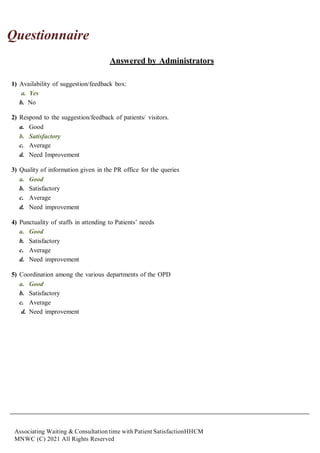
Questionnaire
Answered by Administrators
1) Availability of suggestion/feedback box:
a. Yes
b. No
2) Respond to the suggestion/feedback of patients/ visitors.
a. Good
b. Satisfactory
c. Average
d. Need Improvement
3) Quality of information given in the PR office for the queries
a. Good
b. Satisfactory
c. Average
d. Need improvement
4) Punctuality of staffs in attending to Patients’ needs
a. Good
b. Satisfactory
c. Average
d. Need improvement
5) Coordination among the various departments of the OPD
a. Good
b. Satisfactory
c. Average
d. Need improvement
Associating Waiting & Consultation time with Patient SatisfactionHHCM
MNWC (C) 2021 All Rights Reserved
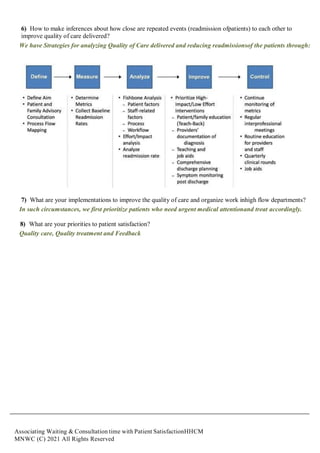
6) How to make inferences about how close are repeated events (readmission ofpatients) to each other to
improve quality of care delivered?
We have Strategies for analyzing Quality of Care delivered and reducing readmissionsof the patients through:
7) What are your implementations to improve the quality of care and organize work inhigh flow departments?
In such circumstances, we first prioritize patients who need urgent medical attentionand treat accordingly.
8) What are your priorities to patient satisfaction?
Quality care, Quality treatment and Feedback
Associating Waiting & Consultation time with Patient SatisfactionHHCM
MNWC (C) 2021 All Rights Reserved
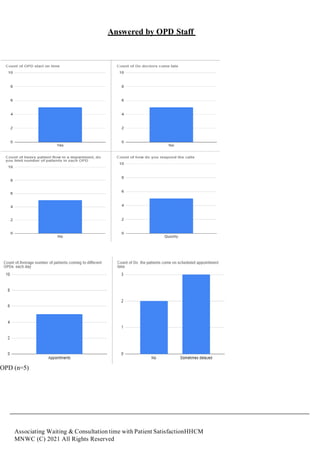
Answered by OPD Staff
OPD (n=5)
Associating Waiting & Consultation time with Patient SatisfactionHHCM
MNWC (C) 2021 All Rights Reserved
References
 Mandel, Prior (et. Al) (2004), Quality assessment program in primary care clinics: A tool for Quality
Improvement, International Journal for Quality in healthcare, pp 175-1803.
 https://pubmed.ncbi.nlm.nih.gov/30268841/
 https://omoto.io/academy/patient-feedback-management-system/
 https://academic.oup.com/ajhp/article-
abstract/68/15/1381/5129290?redirectedFrom=fulltext
 https://bmchealthservres.biomedcentral.com/articles/10.1186/s12913-019-4288-6
Data Analysis of Survey Questionnaire of 5OPD staffs
 https://docs.google.com/spreadsheets/d/1Q5WPvfioE1ytT25JoKjngSVsoqQdk4dYgt_Nq5K_jN8/edit?usp=s
haring

Project Report on Patient Satisfaction

  • 1.
    1 Associating Waiting &Consultation time with Patient Satisfaction HHCM MNWC (C) 2021 All Rights Reserved Project Report BY: NAHEEDA KHAN HOSPITAL AND HEALTHCARE MANAGEMENT
  • 2.
    Associating Waiting &Consultation time with Patient SatisfactionHHCM MNWC (C) 2021 All Rights Reserved Executive Summary Medical examination and treatment and community health improvements are a concern for the whole society. Waiting time for a medical examination is an equally important fact, contributing to the level of the consultation process. Reducing waiting time and thereby meeting patient satisfaction is a developing trend in hospitals and clinics today. Long hospital wait times can be exacerbated by various factors such as patient flow, a bottleneck, and overcrowding. In India overcrowding is a common problem in most of the healthcare sectors. Overcrowding is not just caused by a large number of patients but also by a high number of patients with serious illnesses and low numbers of nurses. In order to provide better care for patients in addition to improving professionalquality, infrastructure and service attitudes, the project is focused on waiting and consultation time for medical examination as a contributing factor to patient satisfaction levels. Association of Waiting and Consultation Time with Patient Satisfaction
  • 3.
    Associating Waiting &Consultation time with Patient SatisfactionHHCM MNWC (C) 2021 All Rights Reserved Background Many studies have shown an inverse relationship between waiting time and patient satisfaction. This has become a major concern for hospital administrators and policymakers because it is a measure of organizational efficiency. Waiting times as well as Consultation times a r e the main factors that affect patient and consumer satisfaction. Patients are aware that they should wait to see a doctor. However, there is no known acceptable waiting or consultation time. Patient waiting time for healthcare services is identified by W.H.O as one of the key measurements of a responsive health system. Patient waiting time is amount of time for patients seeking care at healthcare units before being attended for consultation and treatment. The United States (US) Instituteof Medicine’s report “Crossing the Quality Chasm” outlines a framework of six guiding principles to staying ahead in a more competitive healthcare delivery system. One of these principles is the ability to provide timely care and to reduce harmful delays. Evidence shows that patients are less likely to be dissatisfied if their waiting time is within 30- 45 mins. It is also stated that the dispensing of medication from the time the pharmacy receivedthe patient's prescription should not exceed 30 minutes. Association of Waiting and Consulting Time with Patient Satisfaction
  • 4.
    Associating Waiting &Consultation time with Patient SatisfactionHHCM MNWC (C) 2021 All Rights Reserved Problem Statement Dysfunctional healthcare systems can only add to the tension between patients and doctors. Simple things like long waiting times in the hospitals, clinics, consecutive unjustified cancellations, or delays to previous appointments or investigations; essentially, anything that may have gone wrong in the patient pathway can potentially lead to a challenging interaction between patients anddoctors. Lack of resources in terms of staffing levels or of maintaining patient privacy and dignity during consultation is another contributing factor, for example, during a consultation there may be staff or nurses moving in and out of the room that distract attention and may affect dignity and privacy. The outpatient services often are the first point of contact with a hospital. It is an extremely busy area as all the patients have to pass through this area. It is important that it should be well managed, as the first impressions get shaped during this process. Some of the major challenges in outpatient management are waiting time, communication employee behavior for promoting service excellence, ambience for creating healing environment, and health education. Each of this is looked at to get different perspectives on how to address it in a patient friendly way.
  • 5.
    Associating Waiting &Consultation time with Patient SatisfactionHHCM MNWC (C) 2021 All Rights Reserved Define Lengthy waiting time has long been considered frustrating to patients and thus appears to be a consistent significant potential cause of patient dissatisfaction. As health solutions become more personalized and consumer driven, the need to provide overall patient satisfaction is becoming more important. The outstanding waiting time problem in the Indian Health Systems lies in the following aspects: 1. Long waiting time at the registration and admission windows. Many Indian hospitals and clinicsare not used to schedule the appointment; patients get registered upon arrival to hospitals at the service window, thus the unplanned patient flow clogged in the hospitals. 2. Long waiting time between the appointment time and the time patients are attended by doctors. Outpatient users of ambulatory services are least satisfied with long waiting times for consultations. Reason behind thisis that the increasing of patient demand is faster than that of the health care resources. Although the number of hospitals in India doubled during the past years, the annual number of outpatient visitsincreased during the same time period due to the pandemic and other health crisis. The increasingpatient turnover may have implications for overall quality care, such as insufficiencies patient safety and increased tension between doctors and patients. 3. The tendency for patients to arrive earlier than their given appointment, hence arriving at the same time in large numbers. A study of scheduled model found that patients who were given an appointment time and arrived at the appropriate time had shorter waiting time than those who walked in without an appointment. 4. Late arrival and early leave of physicians.
  • 6.
    Associating Waiting &Consultation time with Patient SatisfactionHHCM MNWC (C) 2021 All Rights Reserved 5. More patients and follow up patients. 6. Lack of registration staffs and on-duty doctors in some specific departments. A high percentage of patients still wait unnecessarily for a long time to be registered and to see the doctor. Registration should be a quick and simple process The long waiting time is due to long queues caused by the registration counter beingmanned by less staff that is also in charge of giving appointments to patients. 7. Despite living in a digital era, over 70% of Indian hospitals still use paper based forms to collect feedback from patients, whereas merely 40% use digital media. While 96% of hospitals are taking action on feedback, most of them take almost month to address patients’ concerns. It takes ~2x more time to collate feedback collected on paper than that collected ona tablet device. This is the reason that 70% of the hospitals that use paper forms to collect feedback have a turnaround time of over 10 hours.
  • 7.
    Associating Waiting &Consultation time with Patient SatisfactionHHCM MNWC (C) 2021 All Rights Reserved
  • 8.
    Associating Waiting &Consultation time with Patient SatisfactionHHCM MNWC (C) 2021 All Rights Reserved Aim and Objectives  To identify the factors those are responsible for high waiting time in hospitals  To recommend appropriate suggestions to optimize the waiting time in hospitals Research Methodology  This descriptive study was carried out at Maratha Mandir’s Babasaheb Gawde Charitable Hospital, Ville Parle (E), Mumbai, Maharashtra, India. A structured questionnaire was used to elicit information from 5 OPD supervisors and the Assistant. Medical Director of the hospital.  The research design will be used in this study on both ‘descriptive’ and‘exploratory’  I have used primary data for this project. Data Collection:  Websites  Articles  E-books  Questionnaire  Google form and spreadsheet for accurate data analysis of the questionnaire survey
  • 9.
    Associating Waiting &Consultation time with Patient SatisfactionHHCM MNWC (C) 2021 All Rights Reserved Introduction On 1st of November 2009, BGH started with 35 bedded Multispecialty Hospital. It was inaugurated by Dr. Mrs. Snehalata Deshmukh the Former Vice Chancellor of Mumbai University.The Hospital is very well-equipped with the latest & modern technology required, having ICU, NICU, Deluxe rooms, General ward & Maternity wards. The timings of Babasaheb Gawde Hospital are: Mon-Sun: 00:00-23:59. (24x7) General Surgeon (2) Laparoscopic Surgeon (2) Gynecologist/Obstetrician (1) Orthopedist (1) Services  ICU  NICU  Dialysis  Pharmacy  Sonography, Mammography  24 hrs Digital X-Ray & Portable X-Ray, ECG  2D Echo Cardiography, 24 hrs Pathology including Blood Gas Analysis  Holter monitoring, 24 hrs Ambulatory BP monitoring, Stress test  EEG, PFT, Audiometry
  • 10.
    Associating Waiting &Consultation time with Patient SatisfactionHHCM MNWC (C) 2021 All Rights Reserved Lesson Learned: Due to certain limitations couldn’t evaluate other variables, such as receptionist’sattitude, suitability of waiting area, privacy during the consultation, quality of consultation time. However, this is an inherent limitation. Through observation I learned during my internship at the hospital are mentioned below:  Number of counters in pharmacy must be increased to avoid long waiting time for the patients.  The hospital must use its integrated health information system to support awell- designed and carefully arranged quality improvement in reducing waiting time and raising patient satisfaction.  Allocation of sufficient staffs in necessary departments: During the peak hours it may result in negative image of the hospital in themind of the patients.  Another important aspect of OPD management is leveraging the use ofinformation technology.  The waiting area should be spacious, hygienic.  Patients had to wait too much in the cash counter for making payments  The whole OPD is divided into 2 sections on one floor: 1. For the Surgical OPD and 2. For the other OPDs chambers to have separate chambers offering privacyand comfort.  A proper data collection on an average spent by the patients and their view towards the hospital and hospital’s services provided by the hospital and the total consumed on each activity will leave a positive impact. Thus, feedback from patients regarding patient satisfaction is through, suggestion box, Email,SMS.
  • 11.
    Associating Waiting &Consultation time with Patient SatisfactionHHCM MNWC (C) 2021 All Rights Reserved Conclusion Patients attending each hospital are responsible for spreading the good image of the hospital and therefore satisfaction of patients attending the hospital is equally important for hospital management. Various studies about outpatient service have elicited problems like overcrowding, delay in consultation, no proper behavior of thestaff etc. Conduction of questionnaire regarding patient satisfaction was at Maratha Mandir’s Babasaheb Gawde Charitable Hospital, Ville Parle (E) The questionnaires were answered by the 5 OPD staffs and Administrators of the hospital. Although this was an exploratory project, the findings raised many questions about the processes in hospitals and their impact on patient satisfaction with the clinical experiences and services. A much larger study could be conducted not only to study one hospital or one clinic in a more comprehensive manner but also extend this study to other similar hospitals especially in the small towns and overcrowded hospitals in the Indian medical system. Additionally, the overall purpose of this project was to study on the ways to improve the quality services in healthcare systems through an assessment. From additional studies, additional data could be obtained to provide a foundation for future changes to processes that influence outcome.
  • 12.
    Associating Waiting &Consultation time with Patient SatisfactionHHCM MNWC (C) 2021 All Rights Reserved Questionnaire Answered by Administrators 1) Availability of suggestion/feedback box: a. Yes b. No 2) Respond to the suggestion/feedback of patients/ visitors. a. Good b. Satisfactory c. Average d. Need Improvement 3) Quality of information given in the PR office for the queries a. Good b. Satisfactory c. Average d. Need improvement 4) Punctuality of staffs in attending to Patients’ needs a. Good b. Satisfactory c. Average d. Need improvement 5) Coordination among the various departments of the OPD a. Good b. Satisfactory c. Average d. Need improvement
  • 13.
    Associating Waiting &Consultation time with Patient SatisfactionHHCM MNWC (C) 2021 All Rights Reserved 6) How to make inferences about how close are repeated events (readmission ofpatients) to each other to improve quality of care delivered? We have Strategies for analyzing Quality of Care delivered and reducing readmissionsof the patients through: 7) What are your implementations to improve the quality of care and organize work inhigh flow departments? In such circumstances, we first prioritize patients who need urgent medical attentionand treat accordingly. 8) What are your priorities to patient satisfaction? Quality care, Quality treatment and Feedback
  • 14.
    Associating Waiting &Consultation time with Patient SatisfactionHHCM MNWC (C) 2021 All Rights Reserved Answered by OPD Staff OPD (n=5)
  • 15.
    Associating Waiting &Consultation time with Patient SatisfactionHHCM MNWC (C) 2021 All Rights Reserved References  Mandel, Prior (et. Al) (2004), Quality assessment program in primary care clinics: A tool for Quality Improvement, International Journal for Quality in healthcare, pp 175-1803.  https://pubmed.ncbi.nlm.nih.gov/30268841/  https://omoto.io/academy/patient-feedback-management-system/  https://academic.oup.com/ajhp/article- abstract/68/15/1381/5129290?redirectedFrom=fulltext  https://bmchealthservres.biomedcentral.com/articles/10.1186/s12913-019-4288-6 Data Analysis of Survey Questionnaire of 5OPD staffs  https://docs.google.com/spreadsheets/d/1Q5WPvfioE1ytT25JoKjngSVsoqQdk4dYgt_Nq5K_jN8/edit?usp=s haring