WHITE NOISE:
 ANALYSIS

         Harry Heath
CAMERA ANGLES

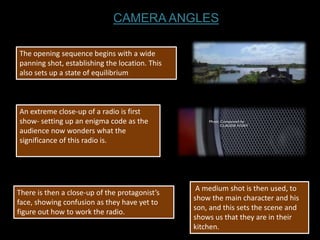
The opening sequence begins with a wide
panning shot, establishing the location. This
also sets up a state of equilibrium


An extreme close-up of a radio is first
show- setting up an enigma code as the
audience now wonders what the
significance of this radio is.


                                                 A medium shot is then used, to
There is then a close-up of the protagonist’s
                                                show the main character and his
face, showing confusion as they have yet to
                                                son, and this sets the scene and
figure out how to work the radio.
                                                shows us that they are in their
                                                kitchen.
CAMERA ANGLES

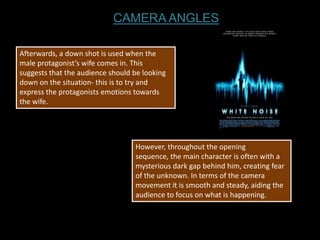
Afterwards, a down shot is used when the
male protagonist’s wife comes in. This
suggests that the audience should be looking
down on the situation- this is to try and
express the protagonists emotions towards
the wife.


                                  However, throughout the opening
                                  sequence, the main character is often with a
                                  mysterious dark gap behind him, creating fear
                                  of the unknown. In terms of the camera
                                  movement it is smooth and steady, aiding the
                                  audience to focus on what is happening.
SOUNDTRACK
•   Non-Diagetic
    In the opening sequence there are non diagetic static sounds, these are loud and
    immediate- these intend to make the audience jump, a generic convention of
    thrillers. There are also ghoulish whispers and ghostly noises- this helps to create
    an unsettling atmosphere- another typical convention of a thriller.
•   Diagetic
    When the male protagonist begins fiddling around with the radio there are static
    noises- this time realistically inputted ones. This helps to foreshadow that there is
    some significance with the radio later on. As the audience have already been put
    on edge from the sounds prior, when the sound of the tap plays out the audience
    jump.
EDITING

•   During the opening credits, the editing is fast and has a lot of quick cuts- this
    leads the audience to believe that the rest of the film will retain this pace.
•   However straight after this, the pace unexpectedly slows down. This aids in
    tricking the audience as from then on the audience can not expect how the rest
    of the film will be paced.
MISE-EN-SCENE
• Initially the opening sequence starts of in a peaceful suburban area- this
  is implemented into tricking the audience into a false sense of security.
• The colour scheme of the film is very dark, this is a conventional aspect of
  a thriller film. Additionally, with its occasional flashes of light it gives the
  impression that there is some sort of supernatural aspect to the film.
• In terms of the costumes; all of the characters are wearing work clothes
  and casual day clothes- this makes the film easier to relate to as the
  characters are meant to reflect their audience. This also adds a false
  sense of normality
• The radio prop used in the opening scene helps to set up an enigma code
  which is what the relevance of the radio is.

WHITE NOISE: ANALYSIS

  • 1.
  • 2.
    CAMERA ANGLES The openingsequence begins with a wide panning shot, establishing the location. This also sets up a state of equilibrium An extreme close-up of a radio is first show- setting up an enigma code as the audience now wonders what the significance of this radio is. A medium shot is then used, to There is then a close-up of the protagonist’s show the main character and his face, showing confusion as they have yet to son, and this sets the scene and figure out how to work the radio. shows us that they are in their kitchen.
  • 3.
    CAMERA ANGLES Afterwards, adown shot is used when the male protagonist’s wife comes in. This suggests that the audience should be looking down on the situation- this is to try and express the protagonists emotions towards the wife. However, throughout the opening sequence, the main character is often with a mysterious dark gap behind him, creating fear of the unknown. In terms of the camera movement it is smooth and steady, aiding the audience to focus on what is happening.
  • 4.
    SOUNDTRACK • Non-Diagetic In the opening sequence there are non diagetic static sounds, these are loud and immediate- these intend to make the audience jump, a generic convention of thrillers. There are also ghoulish whispers and ghostly noises- this helps to create an unsettling atmosphere- another typical convention of a thriller. • Diagetic When the male protagonist begins fiddling around with the radio there are static noises- this time realistically inputted ones. This helps to foreshadow that there is some significance with the radio later on. As the audience have already been put on edge from the sounds prior, when the sound of the tap plays out the audience jump.
  • 5.
    EDITING • During the opening credits, the editing is fast and has a lot of quick cuts- this leads the audience to believe that the rest of the film will retain this pace. • However straight after this, the pace unexpectedly slows down. This aids in tricking the audience as from then on the audience can not expect how the rest of the film will be paced.
  • 6.
    MISE-EN-SCENE • Initially theopening sequence starts of in a peaceful suburban area- this is implemented into tricking the audience into a false sense of security. • The colour scheme of the film is very dark, this is a conventional aspect of a thriller film. Additionally, with its occasional flashes of light it gives the impression that there is some sort of supernatural aspect to the film. • In terms of the costumes; all of the characters are wearing work clothes and casual day clothes- this makes the film easier to relate to as the characters are meant to reflect their audience. This also adds a false sense of normality • The radio prop used in the opening scene helps to set up an enigma code which is what the relevance of the radio is.